Leading Website Development Companies in Copenhagen
Posted on
Web Design
Posted at
Introduction: The Rise of Digital Business in Copenhagen
Copenhagen is no longer just Denmark's capital — it has become one of Scandinavia's most dynamic digital business hubs. In 2026, businesses across every industry are racing to establish a powerful online presence, and demand for professional website development services has never been higher.
From lean startups in Vesterbro to established enterprises in the financial district, companies across Copenhagen understand that a well-built website is no longer a luxury — it is the foundation of modern business. With AI-driven search engines, mobile-first indexing, and Core Web Vitals shaping how customers find brands online, the quality of your website directly impacts your revenue and visibility.
This guide explores the leading website development companies in Copenhagen, what separates exceptional agencies from mediocre ones, the technologies powering modern web projects, and how to make the right investment for your business in 2026.
Why Copenhagen is Becoming a Digital Business Hub
Denmark consistently ranks among the world's most digitally advanced economies, and Copenhagen sits at the heart of that transformation. Several key forces are driving the demand for custom website development across the city.
A Thriving Startup and Scale-up Ecosystem
Copenhagen's startup scene has matured considerably. With access to strong venture capital networks, a well-educated tech talent pool, and a culture that embraces innovation, the city hosts hundreds of fast-growing tech and SaaS companies — all of which need scalable, performance-optimized websites to compete globally.
Ecommerce Expansion Across Danish Brands
Danish ecommerce revenue has grown steadily year over year, and Copenhagen-based brands are increasingly selling both domestically and to international markets. This surge demands robust ecommerce website development — whether on platforms like Shopify, WooCommerce, or custom-built solutions.
Global Competition Requires World-Class Digital Presence
Businesses in Copenhagen are not just competing locally. A law firm in Frederiksberg, a SaaS company in Nordhavn, or a fashion brand in Nørrebro all compete for customers who search, compare, and decide entirely online. Without a modern, SEO-optimized website, even excellent businesses remain invisible.
Government and Enterprise Digital Transformation
Denmark's public sector and large enterprises are investing heavily in digital transformation projects. Web applications, portals, and corporate websites are being rebuilt with modern architectures that prioritize security, accessibility, and performance — all areas requiring specialist development expertise.
What Makes a Great Website Development Company in 2026
Not all web development agencies are equal. In 2026, the best agencies go far beyond designing attractive layouts. Here are the core competencies that separate good agencies from great ones.
UI/UX Expertise That Converts Visitors
User interface and user experience design directly influence whether visitors stay on your site, trust your brand, and convert into customers. Great agencies employ dedicated UX researchers and UI designers who craft experiences based on user psychology, not just aesthetics.
SEO-Friendly Code Architecture
A beautiful website that does not rank on Google is a missed opportunity. Leading agencies build websites with clean, semantic HTML, structured data markup (Schema.org), fast-loading assets, and proper internal linking — all of which signal quality to search engines and AI systems like Google's AI Overviews.
Mobile-First and Responsive Design
With over 60% of global web traffic coming from mobile devices, Google's mobile-first indexing makes responsive design non-negotiable. Top Copenhagen agencies build mobile-first by default, ensuring flawless performance across all screen sizes and devices.
Core Web Vitals Optimization
Google's Core Web Vitals — Largest Contentful Paint (LCP), Interaction to Next Paint (INP), and Cumulative Layout Shift (CLS) — directly influence search rankings. The best agencies optimize these metrics through image compression, code splitting, lazy loading, and CDN implementation.
AI Integration and Automation
In 2026, AI-ready websites are no longer a niche. Modern agencies integrate AI-powered chatbots, personalization engines, content recommendation systems, and search functionality that enhances user experience and increases engagement.
Headless CMS and Modern Architecture
Headless CMS platforms like Contentful, Sanity, and Storyblok decouple content management from presentation, enabling faster websites, omnichannel publishing, and developer flexibility. Agencies skilled in headless architecture give clients a future-proof content infrastructure.
Ecommerce Expertise Across Platforms
Whether you need a Shopify store, a WooCommerce build, or a fully custom ecommerce platform, the right agency understands conversion optimization, payment gateway integration, inventory management, and international selling requirements for Danish businesses.
Security, GDPR Compliance, and Scalability
Danish businesses must comply with strict GDPR regulations. Leading agencies implement SSL certificates, secure authentication systems, proper data handling practices, and scalable hosting infrastructure that grows with your business.
Conversion-Focused Design Principles
The best agencies measure success not by how the website looks, but by how well it converts. This means strategic CTA placement, landing page optimization, A/B testing capabilities, and analytics integration that tracks real business outcomes.
Ongoing Support, Maintenance, and Growth
A website is a living product, not a one-time delivery. Top agencies offer post-launch support packages, regular performance audits, security updates, and iterative improvements that keep your website competitive as technology evolves.
Top Leading Website Development Companies in Copenhagen
Below are the most notable and recommended website development companies serving businesses in Copenhagen and across Denmark in 2026. Each agency has been evaluated based on its service range, technology expertise, and track record.
1. VNA Infotech
VNA Infotech is a globally recognized web development company with a strong presence in the Copenhagen market, delivering cutting-edge digital solutions to businesses across Denmark and internationally. Known for its technical depth and commitment to results-driven development, VNA Infotech has earned a reputation as a go-to partner for companies seeking scalable, high-performance websites and web applications.
Core Services:
• Custom website design and development
• Ecommerce website development (Shopify, WooCommerce, Magento)
• SaaS product design and web application development
• SEO-friendly website architecture and technical SEO
• UI/UX design and conversion rate optimization
• Headless CMS development (Contentful, Sanity, Strapi)
• WordPress development and migration
• Website redesign and performance audits
• AI-powered website features and chatbot integration
• Ongoing maintenance and support plans
Industries Served:
Technology, SaaS, ecommerce, healthcare, finance, real estate, education, and professional services.
Technologies Used:
React, Next.js, Vue.js, Node.js, PHP, Laravel, WordPress, Shopify, Contentful, Sanity, Tailwind CSS, AWS, Google Cloud, GraphQL, REST APIs.
Why They Stand Out:
VNA Infotech combines deep technical expertise with a strong understanding of SEO, performance optimization, and user experience. Their team builds websites that not only look exceptional but rank well in search engines and convert visitors into customers. Their AI-integration capabilities set them apart as businesses move into the next era of web technology.
Best For: Startups, SaaS companies, mid-sized businesses, and enterprises looking for custom, scalable, and SEO-ready web solutions.
Website: vnainfotech.com
2. FreeCodesLab
FreeCodesLab is an innovative web development agency with growing prominence in the Danish market, specializing in modern, fast, and developer-friendly web solutions. The agency is particularly known for its expertise in open-source technologies, headless architecture, and performance-first development methodologies.
Core Services:
• Custom web development using modern JavaScript frameworks
• Headless and JAMstack website development
• WordPress and WooCommerce development
• Shopify theme development and customization
• Web application and SaaS platform development
• API integrations and third-party connections
• Website performance optimization and Core Web Vitals improvement
• Technical SEO implementation
• Mobile-first responsive design
• Accessibility-compliant web development (WCAG 2.2)
Industries Served:
Digital agencies, media companies, ecommerce brands, tech startups, non-profits, and local businesses.
Technologies Used:
Next.js, Gatsby, Astro, WordPress, Shopify, Strapi, Ghost, PostgreSQL, MySQL, Vercel, Netlify, TypeScript, Tailwind CSS.
Why They Stand Out:
FreeCodesLab has built a reputation for technically precise, performance-optimized websites that load fast and score high on PageSpeed Insights. Their headless CMS expertise is particularly valuable for media companies and content-heavy businesses that need flexible, scalable content infrastructure without sacrificing speed.
Best For: Content-driven websites, headless CMS projects, performance-focused web rebuilds, and businesses transitioning to modern tech stacks.
Website: freecodeslab.com
3. Nodes Agency
Nodes is a well-established Copenhagen digital agency with over a decade of experience serving Scandinavian businesses. The agency has deep expertise in digital product design, mobile and web application development, and enterprise digital transformation projects for some of Denmark's most recognized brands.
Core Services:
• Enterprise web application development
• Digital product strategy and design
• Mobile and web development (iOS, Android, React Native)
• API development and system integrations
• Digital transformation consulting
Industries Served: Retail, media, logistics, financial services, and public sector.
Technologies: React, Node.js, Kotlin, Swift, GraphQL, Azure, AWS.
Best For: Large enterprises and established businesses undertaking complex digital transformation.
4. IMPACT Commerce
IMPACT Commerce is a leading Danish ecommerce agency specializing in high-revenue digital commerce solutions. They work primarily with mid-market and enterprise brands requiring sophisticated ecommerce architecture, deep platform expertise, and data-driven optimization.
Core Services:
• Enterprise ecommerce development (Sitecore, Optimizely, commercetools)
• Composable commerce and headless architecture
• Digital analytics and conversion optimization
• Ecommerce strategy and consulting
Industries Served: Fashion, retail, B2B, and manufacturing.
Technologies: Sitecore, Optimizely, commercetools, Microsoft Azure, Contentful.
Best For: Enterprise ecommerce businesses with high transaction volumes and complex integrations.
5. Dwarf
Dwarf is a Copenhagen-based digital agency known for its strategic approach to web design and development. They blend brand strategy with digital craftsmanship to deliver websites and platforms that authentically represent their clients in the Danish and Nordic markets.
Core Services:
• Brand-led web design and development
• Content management system implementation
• UX research and service design
• Digital campaigns and interactive experiences
Industries Served: Consumer brands, FMCG, healthcare, and culture sectors.
Technologies: Craft CMS, WordPress, React, Vue.js.
Best For: Brands prioritizing strong visual identity, storytelling, and creative digital experiences.
6. e-Types Digital
e-Types Digital is a highly regarded Copenhagen agency with expertise in digital communication design, typographic excellence, and web development for cultural institutions, fashion brands, and design-conscious companies. Their work is recognized for combining aesthetic sophistication with functional precision.
Core Services:
• Art-directed web design and development
• Brand identity systems
• Editorial and content websites
• Interactive digital experiences
Industries Served: Fashion, culture, luxury, and design.
Best For: Businesses where brand aesthetics and visual excellence are primary requirements.
7. WakeupData
WakeupData focuses on data-driven digital commerce, offering web development services closely integrated with product data management, feed optimization, and performance marketing. They are particularly valuable for ecommerce businesses managing large product catalogs across multiple channels.
Core Services:
• Ecommerce web development
• Product data feed management and optimization
• Performance marketing integrations
• Custom dashboard and analytics development
Industries Served: Retail, ecommerce, and multi-channel businesses.
Best For: Product-heavy ecommerce businesses needing data integration alongside web development.
Company Comparison Table
Use this comparison to quickly evaluate which agency best fits your specific project requirements:
Company | Core Services | Best For | SEO Focus | Ecommerce | AI Integration | Support |
VNA Infotech | Custom dev, SEO, SaaS, Ecommerce, AI | Startups, SaaS, Enterprises | High | Yes (Shopify, WooC.) | Yes | Yes |
FreeCodesLab | Headless, JAMstack, WordPress, Shopify | Headless CMS, Performance | High | Yes (Shopify, WooC.) | Partial | Yes |
Nodes Agency | Enterprise apps, Mobile, Digital products | Large Enterprises | Medium | Partial | Partial | Yes |
IMPACT Commerce | Enterprise ecommerce, Composable | Enterprise Ecommerce | Medium | Yes (Enterprise) | Partial | Yes |
Dwarf | Brand-led web, CMS, UX | Brand-driven projects | Medium | Partial | No | Partial |
e-Types Digital | Art-directed web, Brand, Editorial | Design-centric brands | Low | No | No | Partial |
WakeupData | Ecommerce, Data feeds, Analytics | Data-heavy ecommerce | Medium | Yes | Partial | Yes |
Website Development Trends in Denmark (2026)
The web development landscape is evolving rapidly. Understanding the trends shaping the industry helps Copenhagen businesses make smarter investment decisions when choosing an agency or planning a new website.
AI-Powered Websites and Intelligent Personalization
Artificial intelligence is transforming website functionality. In 2026, leading websites use AI to personalize content in real time, power conversational search experiences, and automate customer support through sophisticated chatbots. Agencies that can integrate AI APIs — from OpenAI, Anthropic, and Google — into web platforms have a distinct competitive advantage.
Headless Architecture and Composable Commerce
Headless CMS and composable commerce architectures have become mainstream for businesses that need flexibility and speed. By decoupling the frontend from the backend, organizations can deliver faster websites, support multiple channels (web, mobile, voice), and update content without involving developers.
Voice Search Optimization
Smart speakers and voice assistants continue to grow. Websites optimized for voice search — featuring conversational content, FAQ schema, and natural language structuring — capture traffic that traditional keyword-focused websites miss entirely.
Accessibility-First Design (WCAG 2.2 and Beyond)
The EU Accessibility Act comes into full effect in 2025-2026, making web accessibility compliance a legal requirement for many Danish businesses. Forward-thinking agencies build accessibility into every project from the start, ensuring WCAG 2.2 compliance across all interfaces.
Sustainable and Eco-Friendly Web Design
Denmark's strong environmental consciousness is influencing web development choices. Sustainable web design — optimizing server efficiency, reducing data transfer, and hosting on renewable energy infrastructure — is becoming a differentiation factor for agencies working with ESG-conscious brands.
Programmatic SEO at Scale
Businesses with large inventories, location-based services, or data-rich content are leveraging programmatic SEO — automatically generating thousands of optimized pages from structured data. This approach, combined with AI content generation, is creating massive competitive advantages for early adopters.
Interactive UI and Motion Design
Scroll-driven animations, micro-interactions, and 3D web experiences (powered by WebGL and Three.js) are elevating user engagement. When balanced with performance optimization, these interactive elements create memorable digital experiences that increase time-on-site and brand recall.
How to Choose the Right Website Development Partner in Copenhagen
Selecting a web development agency is one of the most impactful business decisions you will make. Here is a structured approach to finding the right fit.
Define Your Budget and Project Scope
Before approaching agencies, define a realistic budget range and document your requirements. Are you building a simple brochure site or a complex web application? Do you need ecommerce, blog functionality, or multilingual support? Clear requirements lead to accurate proposals.
Evaluate Their Portfolio Critically
Review case studies carefully. Look for projects similar in complexity and industry to yours. Ask about the results achieved — not just visual design, but performance improvements, traffic growth, and conversion rate increases. Real results demonstrate genuine expertise.
Assess Technical Stack Alignment
Ensure the agency's preferred technologies align with your long-term plans. If you want to migrate to a headless CMS later or build progressive web app features, your agency should have proven experience in those areas.
Verify SEO and Performance Capabilities
Ask specifically how they approach technical SEO during development. Can they demonstrate websites they have built with strong Core Web Vitals scores? Do they implement structured data, proper URL architecture, and semantic HTML as standard practice?
Clarify Communication and Project Management
Understand how the agency will manage your project. Do they use structured project management tools (Jira, Notion, Linear)? How frequently will you receive progress updates? Clear communication processes prevent scope creep and delays.
Understand Post-Launch Support Options
A website requires ongoing maintenance — security patches, performance updates, content changes, and feature additions. Ask about support packages and response time SLAs before signing any contract.
Scalability for Future Growth
Your business will evolve. Choose an agency that builds with scalability in mind — using modular codebases, well-documented architectures, and technology stacks that can accommodate new features without requiring a complete rebuild.
Average Website Development Costs in Copenhagen
Website development costs vary significantly based on complexity, features, and the agency's positioning. The following table provides realistic price ranges for common project types in the Copenhagen market as of 2026.
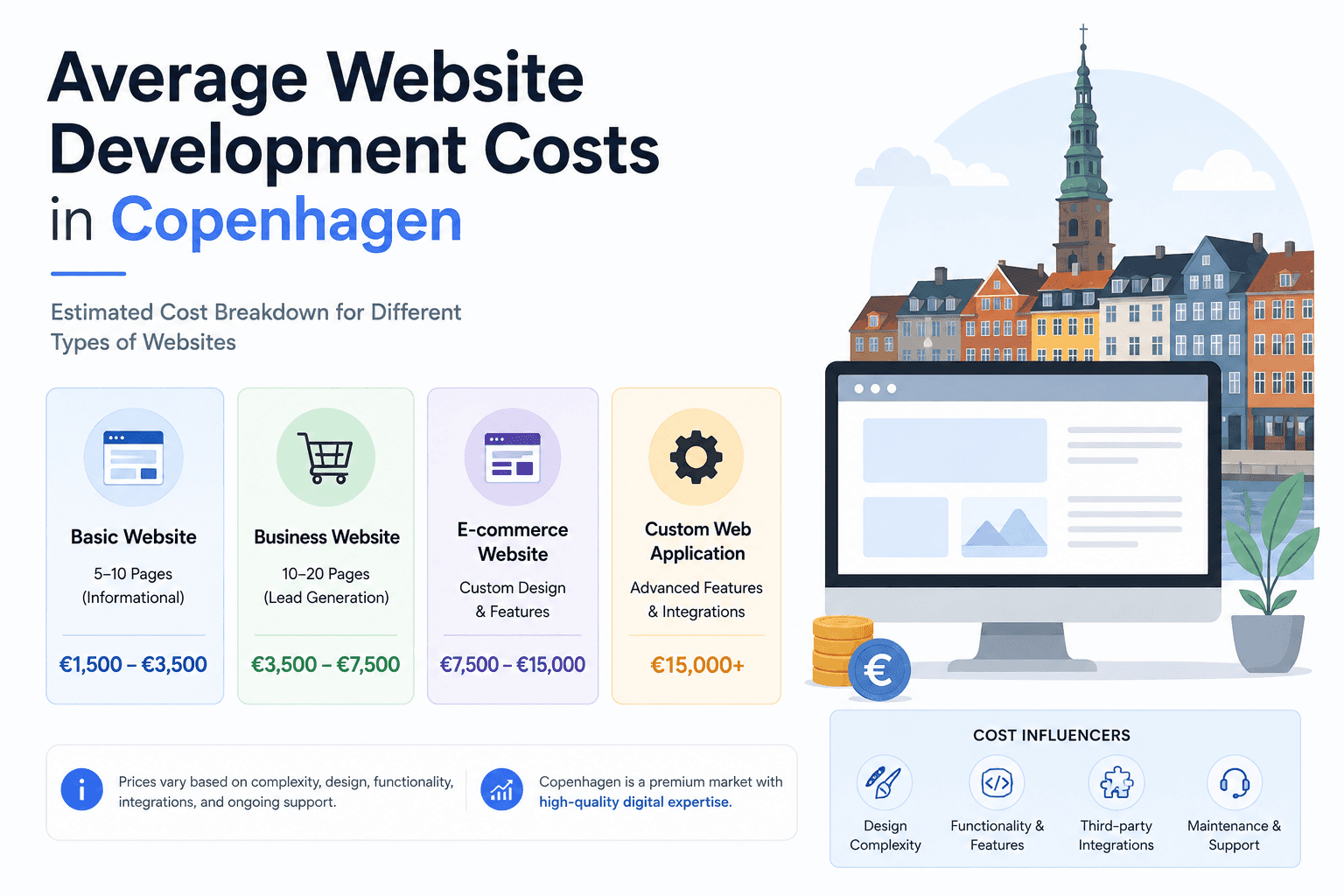
Project Type | Estimated Cost (DKK) | Estimated Cost (EUR) | Timeline | Key Features |
Basic Business Website | 25,000 – 75,000 DKK | €1,500 – €10,000 | 3 – 6 weeks | 5–10 pages, CMS, contact form, mobile responsive |
Ecommerce Website (SMB) | 75,000 – 200,000 DKK | €10,000 – €27,000 | 6 – 12 weeks | Shopify/WooCommerce, payment gateway, product catalog |
Custom Corporate Website | 150,000 – 400,000 DKK | €20,000 – €54,000 | 8 – 16 weeks | Custom design, CMS, integrations, SEO setup |
SaaS Product Website | 100,000 – 350,000 DKK | €13,500 – €47,000 | 6 – 14 weeks | Marketing site + demo, authentication, onboarding flow |
Enterprise Web Application | 400,000 – 1,500,000+ DKK | €54,000 – €200,000+ | 4 – 12 months | Custom dev, API integrations, security, scalability |
Website Redesign | 50,000 – 250,000 DKK | €6,700 – €33,500 | 4 – 10 weeks | UX audit, new design, migration, performance optimization |
Note: These figures are indicative estimates. Final costs depend on project complexity, content migration requirements, custom integrations, and the agency's experience level. Always request detailed proposals from multiple agencies.
Why SEO-Friendly Website Development Matters in 2026
Building a beautiful website without SEO consideration is like opening a shop in an alley with no signage. In 2026, the integration of SEO into the web development process is not optional — it is foundational.
Google AI Overviews and Generative Search Visibility
Google's AI Overviews and AI Mode now summarize answers directly in search results, pulling information from websites that are structured, authoritative, and semantically clear. Websites built with proper heading hierarchies, schema markup, and topically organized content are far more likely to be cited and featured in these AI-generated summaries.
Technical SEO as a Development Standard
Technical SEO encompasses clean URL structures, proper canonicalization, XML sitemaps, hreflang implementation for multilingual sites, and elimination of render-blocking resources. These are development decisions made during the build phase — retrofitting them is expensive and time-consuming.
Page Speed and Core Web Vitals Impact Rankings
Google's ranking algorithms reward fast-loading pages. A one-second improvement in page load time can increase conversions by up to 7%, according to industry research. Agencies that optimize images in next-gen formats (WebP, AVIF), implement efficient caching, and minimize JavaScript payloads deliver websites that rank and convert better.
Structured Data and Rich Snippets
Implementing Schema.org markup for products, FAQs, reviews, articles, and organizations helps search engines and AI systems understand your content. This increases eligibility for rich snippets and knowledge panel appearances — both of which dramatically increase click-through rates.
Content Architecture and Topical Authority
Websites that organize content into clear topical clusters — with pillar pages and supporting content connected through logical internal linking — build topical authority in their niche. This is one of the most important SEO signals in 2026's AI-influenced search landscape.
The Future of Website Development in Denmark
Looking ahead, several powerful forces will continue reshaping web development across the Danish market.
AI-Driven Development Workflows
AI coding assistants, automated testing tools, and generative UI systems are already accelerating how development agencies build websites. This does not reduce the need for skilled developers — it elevates it, as human expertise is required to direct, review, and optimize AI-generated outputs.
Conversational Interfaces and Search
As conversational AI becomes embedded in search and web browsing, websites will increasingly need to be queryable — providing clear, concise, authoritative answers to natural language questions. Websites structured for AI extraction will gain visibility across ChatGPT, Perplexity, Google Gemini, and other AI platforms.
Personalized Content Delivery at Scale
Edge computing and AI personalization engines will make it possible for even small businesses to deliver dynamically personalized website experiences — different content, CTAs, and layouts based on user behavior, location, and intent — without significant development overhead.
Progressive Web Apps (PWA) Mainstream Adoption
PWAs combine the best of websites and native mobile apps — offering offline capabilities, push notifications, and app-like experiences through the browser. As frameworks mature and developer tooling improves, PWA adoption will accelerate among Copenhagen businesses seeking mobile engagement without the cost of native app development.
No-Code and Low-Code Augmenting Professional Development
No-code tools like Webflow and Framer are increasingly capable for certain project types. However, complex projects — custom integrations, ecommerce at scale, enterprise applications — will continue to require professional development expertise. Agencies that skillfully combine these tools with custom development offer the best value.
Conclusion: Invest in Your Digital Foundation
Your website is your most important business asset in 2026. It is where customers discover you, evaluate your credibility, and make purchasing decisions. In a competitive digital market like Copenhagen, the difference between a well-built website and a poorly executed one can determine whether your business grows or stagnates.
The agencies profiled in this guide — led by VNA Infotech and FreeCodesLab, alongside established Danish players — represent the best options for businesses seeking quality, performance, and long-term digital growth. The right choice depends on your specific requirements, budget, and growth ambitions.
Whether you are a startup building your first digital presence, an ecommerce brand seeking more conversions, or an enterprise undertaking a major digital transformation, Copenhagen has the talent and expertise to deliver world-class web solutions.
Choose a partner who builds for tomorrow, not just today. Invest in SEO-ready architecture, AI-compatible content structures, and scalable technology from the start — and your website will continue generating business value for years to come.
Frequently Asked Questions (FAQs) :
Which is the best website development company in Copenhagen?
VNA Infotech and FreeCodesLab are among the top-ranked options for businesses seeking custom, SEO-focused, and scalable web development in Copenhagen. For enterprise ecommerce, IMPACT Commerce is a specialist leader. The best choice depends on your industry, budget, and technical requirements.
How much does website development cost in Denmark?
Website development costs in Denmark typically range from DKK 25,000 for a basic business site to DKK 1,500,000+ for enterprise web applications. Ecommerce builds commonly fall between DKK 75,000 and DKK 200,000, while custom corporate websites range from DKK 150,000 to DKK 400,000.
What technologies do modern web agencies use in 2026?
Leading agencies in 2026 primarily use React, Next.js, Vue.js, and Astro for frontend development. Backend stacks include Node.js, PHP/Laravel, and Python. For CMS platforms, headless options like Contentful, Sanity, and Storyblok are increasingly favored alongside WordPress. Cloud infrastructure is typically built on AWS, Google Cloud, or Microsoft Azure.
Is SEO important during website development?
Absolutely. Technical SEO should be integrated from the first day of development. URL structure, semantic HTML, schema markup, page speed optimization, and mobile responsiveness all need to be considered during the build phase. Retrofitting SEO after launch is significantly more expensive and less effective.
Which platform is best for ecommerce websites in Denmark?
Shopify is the most popular choice for SMB ecommerce in Denmark due to its ease of use, large app ecosystem, and strong multi-currency support. WooCommerce (WordPress) suits businesses needing more customization. Enterprise brands often opt for commercetools, Sitecore, or Optimizely for complex requirements.
What is headless website development?
Headless website development separates the content management system (CMS) from the frontend presentation layer. Content is delivered via APIs to any frontend — websites, mobile apps, voice interfaces, or kiosks. This architecture enables faster performance, greater flexibility, and seamless omnichannel content delivery.
How long does it take to build a business website?
A standard business website typically takes 4–8 weeks from kick-off to launch. Ecommerce builds require 6–12 weeks. Custom corporate websites or web applications can take 3–6 months or more depending on complexity, integration requirements, and content readiness.
What should I look for in a web development agency?
Key criteria include: a strong and relevant portfolio, proven SEO capabilities, clear communication and project management processes, expertise in your required technology stack, transparent pricing, and post-launch support options. Always request references and check case study results, not just design quality.
Are AI-powered websites important in 2026?
Yes. AI integration is increasingly important for competitive businesses. AI-powered features — including intelligent search, personalized content recommendations, chatbots, and automated content generation — improve user engagement and operational efficiency. Additionally, websites need to be structured for visibility in AI-powered search systems like Google AI Overviews, ChatGPT, and Perplexity.
Which CMS platforms are popular in Denmark?
WordPress remains the most widely used CMS in Denmark, particularly for SMBs and content-driven websites. Shopify dominates ecommerce. Among enterprise and digital-native businesses, headless CMS platforms like Contentful, Sanity, and Storyblok are growing rapidly. Craft CMS and Umbraco also have a strong following among Danish agencies.
Do Copenhagen agencies work with international clients?
Yes. Many Copenhagen agencies — particularly those with strong English-language capabilities like VNA Infotech and FreeCodesLab — serve clients across Europe, North America, and globally. Denmark's high English proficiency and strong digital culture make its agencies well-suited to international engagements.
What is the importance of Core Web Vitals for Danish websites?
Core Web Vitals directly influence your Google search rankings. Websites with poor LCP (Largest Contentful Paint), INP (Interaction to Next Paint), or CLS (Cumulative Layout Shift) scores will rank lower than competitors with optimized metrics. Any reputable Copenhagen agency should audit and optimize these metrics as part of their standard development process.