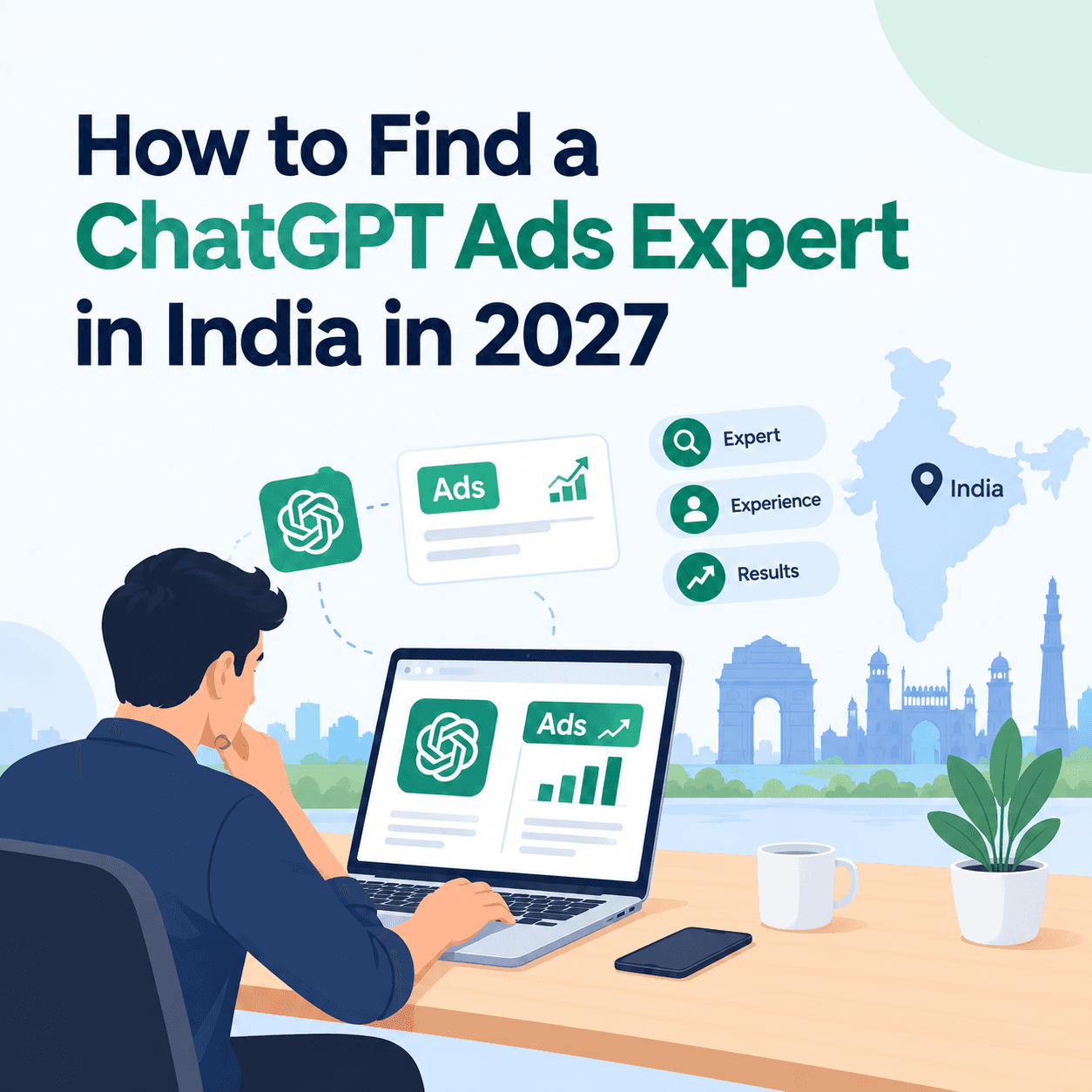
Which Is the Best ChatGPT Ads Agency in India?
Posted on
Product Design
Posted at

There is no single best ChatGPT Ads agency in India. There is only the agency that fits your business goals, your budget, your sales process and your tolerance for uncertainty. Anyone who names a universal winner is offering an opinion, not evidence.
That said, the question has become far more practical in 2026. OpenAI announced ads in ChatGPT in January, tested them in the United States from February, and brought them to India in late August. On 31 August, OpenAI announced self-service access through Ads Manager across India, Europe, the Middle East and North Africa. Indian businesses can now buy ChatGPT ads directly, and many are asking whether they need an agency to do it. (Platform facts here were checked against OpenAI and Google documentation on 21 September 2026. Verify anything that affects a purchase, because this market is moving quickly.)
The trouble is the label. "ChatGPT ads" is used by agencies to mean at least four different things: paid placements inside ChatGPT, using ChatGPT to write and optimize ads on other platforms, earning visibility in ChatGPT's organic answers, and general AI-assisted marketing. These are different services with different skills, costs and risks.
So the useful question is not "who is best?" but what capabilities should an Indian business expect from a genuine ChatGPT Ads agency, and how can it verify them? This guide answers that, covering definitions, comparisons with Google Ads, service frameworks, evaluation criteria, questions to ask, pricing logic, red flags, a 90-day plan and measurement. It also looks at VNA Infotech, a Gujarat-based web development and digital marketing company that businesses can evaluate against the same criteria, alongside any other provider they consider.
What Is a ChatGPT Ads Agency?
Short answer: A ChatGPT Ads agency is a marketing provider that plans, launches or supports advertising and visibility work connected to ChatGPT. That can mean managing paid placements in OpenAI's Ads Manager, using AI tools to improve campaigns elsewhere, or improving how a brand appears in AI-generated answers. Always ask which one is meant.
The distinction matters because the deliverables differ:
What the agency says | What it may actually mean | Who controls the outcome |
|---|---|---|
"ChatGPT advertising" | Paid, labeled placements bought through OpenAI | You and the agency control bids and creative; OpenAI controls delivery |
"ChatGPT-assisted advertising" | Using ChatGPT to draft ad copy, research audiences or analyze results for campaigns on Google, Meta or LinkedIn | The agency, using an AI tool |
"AI search visibility" | Efforts to be found and cited in AI answers | Mostly the AI platform; the agency influences inputs |
"Conversational marketing" | Chatbots, WhatsApp flows and automated lead conversations on your channels | You and the agency |
"AI lead generation" | Automated capture, scoring and follow-up | You and the agency |
A well-run engagement often blends several of these. Terminology matters when you compare quotes, because two proposals with the same headline can describe entirely different work. Related capabilities include AI-generated campaign assets, AI-assisted market research, advertising automation, PPC integration, and combined SEO and GEO programs, all covered later in this guide.
What ChatGPT ads are, per OpenAI. According to OpenAI's Help Center, ads can appear below a response, are labeled as sponsored and visually separate from the answer, and are shown to adults on Free and Go plans. Plus, Pro, Business, Enterprise and Edu accounts do not see them. OpenAI states that ads do not influence ChatGPT's answers, that advertisers cannot shape or rank responses, and that seeing an ad does not imply endorsement. In other words, you can buy an ad; you cannot buy a recommendation.
VNA Infotech – AI & Digital Marketing Agency in Ahmedabad, India
VNA Infotech
VNA Infotech is an AI, web development, software development, and digital marketing company based in Ahmedabad, India. The company works with startups, small businesses, and enterprises to develop websites, eCommerce platforms, software solutions, and digital marketing strategies that support online growth.
Company Details
Company Name: VNA Infotech
Founded: 2019
Location: Ahmedabad, Gujarat, India
Company Size: 10–49 employees
Hourly Rate: Under $25/hr
Industry: IT Services, AI & Digital Marketing
Services: AI Development, Web Design & Development, Software Development, eCommerce Development, SEO, Digital Marketing, UI/UX Design, Mobile App Development, SaaS Development, and Website Maintenance
Technologies: WordPress, Webflow, Shopify, Laravel, and Custom Development
Client Focus: Startups, Small & Medium Businesses, and Enterprises
Website: vnainfotech.framer.ai
Introduction
VNA Infotech helps businesses build and grow their digital presence through AI solutions, website development, software development, SEO, and digital marketing. The company focuses on creating modern, responsive, user-friendly, and business-focused digital solutions tailored to each client's requirements.
Is ChatGPT Advertising the Same as Google Ads?
Short answer: No. Google Ads mostly responds to explicit search queries and keywords. ChatGPT ads are selected using the context of a conversation, appear in a chat environment, and are still a young platform with evolving formats, targeting and measurement. The two can complement each other but are not interchangeable.
Factor | ChatGPT / AI advertising | Google Ads |
|---|---|---|
User behavior | Multi-turn conversation; people explain needs, constraints and preferences | Short queries; refinement through new searches |
Search/discovery model | Conversational, recommendation-oriented | Query-and-results, plus shopping, video and display |
Ad environment | Labeled ad separate from the answer, below the response | Sponsored results alongside organic listings and other formats |
Intent signals | Conversation context; depending on country and settings, possibly broader account context, according to OpenAI | Keywords, location, device, audience signals |
Targeting | Contextual, plus options OpenAI describes such as platform and geographic targeting, product feeds and custom audiences | Mature keyword, audience, location and demographic controls |
Content interaction | User can keep chatting; OpenAI is testing Sponsored Agents in the US | User clicks to a page or completes an action in-ad |
Measurement | Pixel and Conversions API; aggregated reporting, no access to private conversations | Extensive first-party reporting and a large tool ecosystem |
Conversion journey | Ad click to landing page, often after longer research | Query, ad click, landing page |
Optimization | Platform is evolving; OpenAI says CPC and outcome-optimized bidding are now most campaigns | Automated and manual bidding, years of best practice |
Agency requirements | Test design, creative for conversational context, new-platform diligence | Deep keyword, bidding and account-structure experience |
The practical implication is that experience on Google Ads is useful but does not transfer automatically. Google Ads specialists know how to capture stated demand. On ChatGPT, the skill is matching helpful messaging to a decision in progress. AI search and traditional search advertising are not interchangeable, and a sensible plan keeps both.
Why Are Indian Businesses Exploring AI Advertising?
Customer behavior is shifting in ways marketers can see. People now type or speak long, natural-language questions, ask an assistant to shortlist options, and compare alternatives without opening ten tabs. OpenAI's head of global ads solutions said at the India launch that weekly active users in the country had doubled year on year, and OpenAI reports more than a billion weekly active users worldwide.
Several changes follow from that:
Zero-click discovery: an AI answer or summary may satisfy someone without a visit to your site.
AI-generated answers: the brand described in a summary may be shaped by sources other than your own website.
Conversational and recommendation-oriented queries: "which CRM suits a 20-person team in Pune" replaces "best CRM."
Assisted research: buyers arrive better informed and closer to a decision.
Personalization and automation: campaigns and follow-up can adapt faster.
Cross-channel journeys: a customer may meet you in an AI answer, a Google search, a WhatsApp message and a sales call.
None of this makes SEO or PPC obsolete. Google's own guidance says the best practices for SEO remain relevant to its generative AI features, and that there are no additional requirements to appear in AI Overviews or AI Mode. What changes is the mix: more attention on measurement beyond clicks, on entity and brand clarity, and on experiments in new channels.
Who Should Hire a ChatGPT Ads Agency in India?
For each audience below: the likely challenge, where AI can help, what an agency might deliver, what to measure, and when you may not need one. Nothing here is a promise of results.
Startups
Challenge: limited budget and no brand awareness. AI help: fast research and creative testing. Deliverable: a small, capped test plan and tracking setup. Measure: cost per qualified lead, early conversion rate. May not need one: if the founder can run a ₹725-a-day test alone, which OpenAI's India documentation allows as a minimum.
Small and Medium-Sized Businesses
Challenge: a small team wearing many hats. AI help: drafting, reporting, lead follow-up. Deliverable: website fixes, local SEO, one or two paid channels. Measure: inquiries, calls, cost per lead. May not need one: if most sales come from referrals and the website already converts.
E-commerce Businesses
Challenge: rising ad costs on established platforms. AI help: product-data quality and creative variation; OpenAI says a Shopify ChatGPT Ads app reaches international markets from 23 September. Deliverable: feed and landing-page work, campaign tests. Measure: cost per purchase, ROAS, new-customer share. May not need one: for a single-product store with a working funnel.
D2C Brands
Challenge: dependence on Meta and creators. AI help: testing messaging for shoppers who compare options in conversation. Deliverable: creative concepts, controlled experiments. Measure: incremental sales, repeat purchases. May not need one: if brand awareness rather than direct response is the priority and budgets are tiny.
SaaS Companies
Challenge: expensive trials and long evaluation cycles. AI help: capturing buyers asking AI tools to compare products. Deliverable: comparison content, documentation cleanup, tracking of AI referrals. Measure: trial-to-paid rate, demo requests. May not need one: if in-house growth marketers already own SEO and paid.
IT and Software Companies
Challenge: crowded field and long sales cycles. AI help: visibility when buyers ask for vendor shortlists. Deliverable: case-study pages, technical SEO, credible third-party profiles. Measure: qualified inquiries, RFPs. May not need one: if sales come mostly from existing relationships.
B2B Companies
Challenge: small audiences and committees. AI help: research automation and account-level messaging. Deliverable: content, LinkedIn and Google campaigns, CRM integration. Measure: meetings booked, pipeline. May not need one: for niche firms with a few dozen target accounts, where direct outreach may beat ads.
Manufacturing Companies
Challenge: buyers who search for specifications and suppliers. AI help: structured product information that is easy to summarize. Deliverable: technical product pages, certifications shown accurately, RFQ funnels. Measure: RFQs, distributor inquiries. May not need one: if orders come from a fixed distributor network.
Healthcare Businesses
Challenge: trust and regulation. AI help: clear, medically reviewed content. Note: launch coverage says ChatGPT ads are kept out of health topics, so paid placement may not apply. Deliverable: local SEO, Google Business Profile, compliant content. Measure: appointment requests, calls. May not need one: if a single clinic has steady local demand.
Education and Training Businesses
Challenge: seasonal admissions peaks. AI help: answering fee, course and outcome questions. Deliverable: program pages, lead automation, campaign tests. Measure: counseling bookings, enrollments. May not need one: where enrollment depends on local reputation alone.
Real Estate Companies
Challenge: high-value, slow leads. AI help: buyers describe budget, location and timeline in detail. Deliverable: project pages, RERA-compliant claims, CRM routing. Measure: site visits, cost per qualified lead. May not need one: if inventory sells through brokers.
Professional Services
Challenge: trust-based buying. AI help: visibility when people ask for advisors. Deliverable: expertise content, reviews, local SEO. Measure: consultations booked. May not need one: if referrals dominate and capacity is full.
Financial Services
Challenge: strict advertising rules. AI help: educational content and lead qualification. Deliverable: compliant content, landing pages, conversion tracking. Measure: verified inquiries. Note: check OpenAI's ad policies and your regulator's rules for category restrictions before spending. May not need one: where compliance limits make paid tests impractical.
Hospitality and Restaurants
Challenge: local discovery. AI help: people ask assistants where to eat or stay. Deliverable: Google Business Profile, review management, menu and booking pages. Measure: bookings, calls, direction requests. May not need one: for single outlets with strong foot traffic.
Companies Targeting International Markets
Challenge: reaching overseas buyers. AI help: buyers research suppliers through AI tools. Deliverable: multilingual product pages, technical SEO, campaigns in markets where ChatGPT Ads are live. Measure: overseas RFQs. Note: OpenAI's self-service rules require the advertising and billing entity to be based in a supported country, and India is listed as available. May not need one: if trade shows and agents already fill the pipeline.
What Services Should a ChatGPT Ads Agency Provide?
A credible agency should be able to describe, for each service it sells, what you will receive. Use this framework to test proposals.
AI Advertising Strategy
A written plan linking business goals to channels, budgets, tests and KPIs. It should say which channels are for demand capture and which are for exploration.
ChatGPT-Assisted Campaign Planning
Use of ChatGPT and similar tools for audience research, message angles and scenario planning. The deliverable is a documented brief, with a human strategist's judgment visible.
AI Search Visibility Strategy
A baseline of how your brand appears for target prompts, a list of content and technical gaps, and a monitoring plan. It should never promise particular mentions.
Generative Engine Optimization
Work that improves how AI systems find and describe you: crawler access, entity consistency, original content and credible references. Google says optimizing for generative AI search is still SEO, so expect overlap with SEO deliverables.
AI SEO
Technical audit, content roadmap and reporting using AI tools to speed research and analysis, with editorial control by people.
Google Ads and PPC
Account structure, keyword and audience strategy, ad copy, bidding, conversion tracking and monthly optimization.
Meta Advertising
Creative concepts, audience testing, pixel and Conversions API setup, and remarketing.
AI-Powered Ad Copy Development
Multiple ad variants drafted with AI, reviewed for accuracy and brand voice, and tested. Ask how claims are checked, especially in regulated categories.
Landing Page Optimization
Pages built for the intent of each campaign, with fast loading, clear offers and proper tracking.
Conversion Rate Optimization
Analysis of forms, page layout and user behavior, and a testing calendar with hypotheses and results.
AI Content Strategy
Topic plans built from customer questions, with subject-matter input and fact-checking. Google's guidance on generative AI content warns against mass-producing pages that add little value.
Conversational Marketing
Chat, WhatsApp and messaging flows that answer questions and capture leads, with a clear handoff to a person.
AI Lead Generation
Capture, scoring, routing and follow-up, tied to your CRM, with definitions of what counts as "qualified."
Marketing Automation
Email, WhatsApp and CRM sequences triggered by behavior, plus documentation of the logic.
Analytics and Performance Reporting
Dashboards and monthly commentary that connect activity to leads and revenue, including which numbers are uncertain.
Service | Business objective it supports |
|---|---|
AI advertising strategy | Focus and prioritization |
Google Ads, Meta Ads, ChatGPT Ads tests | Demand capture and creation |
SEO and GEO | Durable organic visibility |
Landing pages and CRO | Higher conversion from existing traffic |
Content strategy | Trust and topical authority |
Conversational marketing and automation | Faster response and follow-up |
Analytics | Better decisions and accountability |
What Skills Should a ChatGPT Ads Agency Have?
Strong agencies combine marketing judgment with technical ability. The skills to look for, grouped by what they enable:
Advertising and strategy: advertising expertise, PPC management, business strategy, data analysis.
Organic visibility: SEO, technical SEO, GEO, content strategy.
Website and conversion: website and landing-page development, CRO, conversion tracking.
Systems: analytics, marketing automation, CRM integration, API knowledge.
AI fluency: generative AI knowledge, familiarity with AI tools and prompt engineering, and the judgment to know when not to use them.
Why the combination matters: many AI-driven campaigns fail after the click. A conversational ad may send someone with a well-defined need to a generic homepage. Fixing that requires writing, design and development, and connecting a form to a CRM or a WhatsApp flow requires API and integration skills. Agencies that can do both reduce hand-offs, though breadth is only useful if each skill is real. Ask to meet the people who will do the work.
How to Evaluate a ChatGPT Ads Agency in India
Score each agency on the same twenty factors. The right-hand column shows the evidence you can reasonably request before signing.
# | Factor | Evidence to request |
|---|---|---|
1 | AI expertise | A plain explanation of how ads and organic answers differ; examples of AI use in workflows |
2 | Advertising experience | Accounts managed across platforms, budget ranges, sample audits |
3 | SEO capabilities | Sample technical audit and content plan |
4 | GEO understanding | Their definition, and what they do beyond SEO |
5 | Technical knowledge | How they check crawler access, tracking and page speed |
6 | Industry experience | Relevant sector work, with permission-based references |
7 | Portfolio | Live projects you can inspect yourself |
8 | Case studies | Baseline, actions, timeframe and metrics, not just percentages |
9 | Reporting | A redacted monthly report |
10 | Communication | Named contact, response times, meeting cadence |
11 | Strategy | A written roadmap for the first 90 days |
12 | Transparency | Itemized deliverables and pricing |
13 | Pricing | Fee, media and tool costs separated |
14 | Measurement | KPIs, tracking plan and known limits |
15 | Data privacy | How client and customer data is stored, and who can access it |
16 | Contract terms | Notice period, minimum term, scope-change rules |
17 | Campaign ownership | Ad accounts, pixels and analytics registered in your name |
18 | Analytics access | Admin or viewer access to every dashboard |
19 | Testing methodology | How they design, run and stop experiments |
20 | Long-term support | Post-launch maintenance, training and hand-over options |
Two items deserve emphasis for India. First, data handling should be discussed in the context of the Digital Personal Data Protection Act, 2023, and your own compliance obligations. Second, ad claims in regulated sectors such as finance, health and real estate need review beyond marketing, and it is sensible to involve your legal or compliance advisers. This guide is general information, not legal advice.
What Questions Should You Ask a ChatGPT Ads Agency?
Ask every shortlisted provider the same questions, in writing where possible.
Definition and scope
What exactly do you mean by ChatGPT advertising?
Which AI advertising services do you provide?
Do you provide GEO services, and what do they include beyond SEO?
Are you an OpenAI Ads partner, or do you use self-service Ads Manager on our behalf?
Which platforms do you work with?
Which activities are performed manually, and which are automated?
Strategy and methods
How does your strategy differ from traditional PPC?
How do you integrate AI with SEO?
How do you measure AI search visibility?
How do you decide test budgets on a new platform?
What is your testing methodology?
What happens if AI platform policies or formats change?
Measurement and reporting
How do you track conversions?
Which analytics platforms do you use?
What reporting will we receive, and how often?
What results can reasonably be measured, and what cannot?
How often will campaigns be optimized?
Proof and people
Can you show relevant case studies with baseline data?
Who will actually work on our account?
Do you have experience in our industry?
Commercial terms
What deliverables are included?
What are your pricing models?
What media budget is separate from your fee?
Who owns the advertising accounts and data?
What are the contract length and exit terms?
Risk and trust
How do you protect client data?
How do you review AI-generated content for accuracy?
How do you handle campaigns that underperform?
What will you not promise?
When would you advise us not to spend on this channel?
The final question reveals a lot. Good agencies will sometimes tell you to wait.
How Much Does a ChatGPT Ads Agency Cost in India?
Short answer: There is no standard price. Costs depend mostly on scope, and businesses should compare three separate items: the agency's fee, the advertising budget paid to the platform, and any tool or technology costs.
This guide does not quote a fee for VNA Infotech or any other provider and does not claim a "standard" Indian market rate. Factors that move prices include business size, campaign complexity, ad spend, number of channels, SEO and GEO requirements, content volume, automation, technical development, reporting depth, consulting needs and campaign duration.
Common pricing models:
Monthly retainer: recurring work such as SEO, content, reporting and campaign management.
Project-based pricing: a fixed scope such as a website audit, a landing-page build or a strategy document.
Consulting fees: hourly or day-rate advice, useful for a second opinion.
Campaign management fees: a flat fee or a percentage of media spend.
Performance-based models: part of the fee linked to agreed outcomes, workable only when outcomes are measurable and within the agency's control.
Hybrid pricing: a base fee plus a variable component.
For media, reporting on the India launch states a ₹725 minimum daily budget. At that minimum, a 30-day month equals ₹21,750 in media. Trade press reports CPM and CPC buying at launch, and OpenAI says CPC and outcome-optimized bidding now represent most campaigns. Confirm current terms in Ads Manager, since minimums and formats can change.
Illustration only, not market data or VNA Infotech pricing: a business might plan ₹40,000 a month for media, a separate monthly management fee, and a one-time landing-page project. What matters is that the three costs are quoted separately, so you can judge each. Be wary of quotes that bundle them into one number without explanation.
ChatGPT Ads Agency vs Freelancer vs Consultant vs Digital Marketing Agency
No option is universally better. The right one depends on scope, budget and how much internal capacity you have.
Factor | Freelancer | Consultant | Traditional digital agency | AI marketing agency | ChatGPT/AI ads specialist | Technology + marketing company |
|---|---|---|---|---|---|---|
Expertise | Deep in one skill | Strategic depth | Broad channel coverage | Broad plus AI workflows | Narrow, platform-focused | Marketing plus development |
Scalability | Limited by one person | Limited | High | High | Moderate | High |
Technical capabilities | Varies | Advisory | Moderate | Moderate to high | Moderate | High, if development is in-house |
Strategy | Execution-led | Strong | Varies | Varies | Channel-specific | Varies |
Cost structure | Usually lowest | Hourly or project | Retainer | Retainer | Retainer or project | Retainer or project |
Support | Depends on availability | Periodic | Team-based | Team-based | Team-based | Team-based |
Reporting | Varies | Advisory reports | Structured | Structured | Varies | Structured |
Automation | Limited | Recommends | Moderate | Higher | Limited | Can build custom |
Development capabilities | Rare | None | Sometimes outsourced | Sometimes | Rare | Core strength |
A freelancer suits a tightly defined task. A consultant helps an internal team choose direction. A traditional agency suits multi-channel campaigns. A technology and marketing company is worth considering when website, integration or automation work is central to the plan. The same warning applies to all: check the people, the process and the proof.
How VNA Infotech Can Be Evaluated for AI Advertising
VNA Infotech: Evaluating an AI and Digital Marketing Partner in India
VNA Infotech is a technology and digital marketing company based in Gujarat. According to its public company profile, it builds websites for startups, small and mid-sized businesses and enterprises. Listed services include custom website development, CMS and headless CMS development, eCommerce development, UI/UX design, website redesign, maintenance and migration, API integration, technical SEO, site speed optimization and digital marketing. Named platforms include WordPress, Shopify, Magento, Drupal and Joomla.
A technology-plus-marketing background can matter for AI advertising because much of the work is implementation: landing pages that load quickly, tracking that fires correctly, forms that reach a CRM, and technical SEO that keeps pages accessible to crawlers. A provider that can build and market the website may find it easier to connect these pieces than a team that only manages ads.
Some honest boundaries:
This guide does not claim that VNA Infotech is the top agency in India, an official OpenAI partner, or a certified provider of any kind. OpenAI has named WPP and Omnicom as its first India agency partners and describes the arrangement as non-exclusive; ask any agency about partner status.
Public profiles emphasize web development, SEO and digital marketing. Businesses interested in AI development, mobile apps, custom software or marketing automation should ask VNA Infotech for its current scope, team and examples rather than assume them.
Case studies, client references and pricing should be requested directly.
Relevant service areas can be explored through its web design and development, SEO, digital marketing and AI and automation pages.
Why Technical Expertise Matters in AI Advertising
Managing campaigns is only part of the job. The systems around a campaign decide whether spend turns into customers:
Website architecture: clear structure helps users and crawlers.
APIs and CRM: leads flow to your sales team without manual copying.
Analytics and conversion tracking: OpenAI describes Pixel and Conversions API as important measurement foundations on its platform.
Marketing automation: follow-up runs within minutes, not days.
AI integrations: chat or assistants on your own site, with proper handoffs.
Structured content and technical SEO: pages are readable by search engines and AI crawlers; OpenAI's publisher FAQ advises not blocking OAI-SearchBot if you want to appear in ChatGPT search.
Landing pages: built for the specific intent of each campaign.
Data pipelines and lead management: consistent definitions of a "qualified" lead.
Example: an ad tests well, but the landing page takes six seconds to load on mobile and the form does not record its source. The campaign looks like a failure even though the creative worked. Marketing and engineering need to sit at the same table.
How AI Advertising Works With SEO and GEO
Short answer: SEO builds the foundation, content and structure make it useful, GEO adds attention to how AI systems find and describe you, and paid ads (including ChatGPT ads) accelerate testing. All of it should lead to a website that converts and analytics that prove it.
The flow: SEO → content → structured data → website → GEO → AI discovery → conversion → analytics.
SEO | GEO | AI advertising | |
|---|---|---|---|
What it is | Earning organic search visibility | Improving how AI answers find and cite you | Paying for labeled placements or optimizing paid campaigns with AI |
Can it be bought? | No | No | Yes (placements) |
Speed | Months | Months, uncertain | Days to weeks |
Main control | Site and content quality | Same inputs plus credible references | Budget, bids, creative |
Guaranteed outcome? | No | No | No |
The elements that matter across all three are search intent, entity clarity (consistent name, services and location across the web), topical authority, first-party information, useful and trustworthy content, genuine brand mentions and citations, and technical accessibility. Google's guide notes that unique, non-commodity content likely matters most, and it warns that chasing inauthentic mentions is not helpful. It also says Search Console's generative AI performance report is the place to see how content appears in Google's AI features, and that no third-party tool has access to Google's internal ranking systems. For ChatGPT, OpenAI's crawler documentation explains that search inclusion and model training are controlled separately.
No GEO program can guarantee inclusion in ChatGPT or any other AI answer. It can only improve the inputs.
Industry-Specific AI Advertising Use Cases in India
These are hypothetical examples to show how the planning chain works. They are not client results.
Industry | Business goal | AI opportunity | Campaign/SEO strategy | Website/CRO | Measurement |
|---|---|---|---|---|---|
E-commerce | Lower cost per sale | Shoppers compare products in conversation | Test ChatGPT ads next to Google and Meta; clean product data | Fast product pages, clear returns policy | Cost per purchase, new-customer share |
SaaS | More paid conversions from trials | Buyers ask AI to compare tools | Comparison and integration content; selective paid tests | Clear pricing, onboarding pages | Trial-to-paid rate, demo requests |
IT services | More qualified inquiries | Buyers request vendor shortlists | Expert content, verified third-party profiles | Case-study and service pages with clear calls to action | RFPs, qualified inquiries |
Real estate | Cheaper qualified leads | Buyers describe budget and area | Project pages and location guides; paid tests | Lead forms tied to CRM, quick callback | Site visits booked |
Education | More counseling bookings | Learners compare courses and fees | Transparent program pages; pre-admission campaigns | Simple inquiry flow, FAQ | Bookings, enrollments |
Healthcare | More appointment requests | Patients research providers (paid ChatGPT placement may not apply to health topics) | Local SEO, reviewed content | Doctor profiles, easy booking | Appointments, calls |
Manufacturing | More RFQs | Buyers search by specification | Technical product content, certifications displayed accurately | Spec sheets, RFQ forms | RFQs, distributor leads |
B2B | Shorter sales cycles | Committees research online | Account-focused content, LinkedIn plus Google | Gated resources handled carefully | Meetings, pipeline |
Hospitality | More direct bookings | Guests ask for recommendations | Google Business Profile, review response | Mobile booking flow | Direct bookings |
Professional services | More consultations | Clients ask for advisors | Authority content, reviews | Credentials and clear consultation path | Consultations booked |
D2C | More repeat customers | Buyers compare brands | Creative tests, email and WhatsApp flows | Subscription and reorder paths | Repeat rate, CAC |
Financial services | Verified inquiries | Users research products | Compliant educational content | Disclosures, secure forms | Verified applications |
Red Flags When Hiring a ChatGPT Ads Agency
Guaranteed ChatGPT rankings or AI recommendations. No one controls them; OpenAI says ads do not influence answers.
A fake "official ChatGPT partner" claim. Ask for proof, and check OpenAI's own materials.
No explanation of services. Vague deliverables hide thin work.
No measurement framework or no analytics access.
Unrealistic promises about traffic, leads or timelines.
Fake or unverifiable case studies, or percentages with no baseline.
Excessive AI-generated content. Google's spam policy on scaled content abuse is relevant.
Lack of human strategy. If the plan is just prompts, you are paying for a tool.
Hidden fees or unclear billing of ad spend.
No contract clarity on term, scope or ownership.
No data or privacy explanation.
No understanding of SEO or PPC.
Confusing AI visibility with paid advertising.
Google's advice on evaluating third-party SEO services applies equally to GEO offers.
What Should a 90-Day ChatGPT and AI Advertising Strategy Look Like?
Short answer: Spend the first 30 days on research, audits and tracking; the next 30 building and launching; the last 30 testing, learning and reporting. Small, measurable experiments beat large, untested commitments.
Days 1–30: Research and Foundation
Confirm business objectives and one primary KPI.
Research audiences and competitors.
Audit existing SEO, advertising and the website.
Verify analytics and conversion tracking, including CRM connections.
Record a baseline of AI visibility by testing a fixed list of prompts and noting who appears.
Confirm crawler access, including OAI-SearchBot.
Days 31–60: Implementation
Build landing pages tied to specific campaigns.
Fix technical SEO issues and publish priority content.
Begin GEO groundwork: entity consistency, credible profiles and expert content.
Launch small paid tests on the channels that fit, potentially including ChatGPT ads.
Set up automation for lead follow-up.
Days 61–90: Testing and Optimization
Review campaign and content tests and stop what fails.
Analyze conversion paths and lead quality with sales feedback.
Re-run the AI visibility prompts and compare to baseline.
Monitor AI referral traffic in analytics.
Deliver a report that separates confirmed results from open questions, and agree on next quarter.
How Should You Measure an AI Advertising Agency?
Separate business KPIs, which show whether the business benefits, from AI visibility indicators, which show whether inputs are working. Mentions are not revenue.
Business KPIs | AI and visibility indicators |
|---|---|
Qualified leads | Brand mentions in AI answers (sampled manually) |
Cost per lead | Citations of your pages |
Conversion rate | Referral traffic from AI platforms |
Customer acquisition cost | Organic impressions and search visibility |
ROAS | Generative AI reporting in Search Console |
Revenue | Branded search growth |
Website conversions | Engagement on target pages |
Landing-page performance | Share of voice in test prompts |
A rise in mentions with no change in leads is a signal to investigate, not to celebrate. Because AI answers can vary by user, time and wording, treat mention tracking as directional sampling rather than exact measurement.
Common Mistakes Businesses Make When Hiring AI Advertising Agencies
Choosing on price alone, which often means reduced scope.
Assuming "AI" means better results. Tools speed up work; they do not supply strategy.
Confusing ChatGPT with Google Ads. They work differently.
Ignoring conversion tracking, so nothing can be evaluated.
Relying only on AI-generated content, which risks low quality and policy problems.
Neglecting the website. Traffic to a weak site is wasted.
Expecting instant results, particularly from SEO and GEO.
Not defining KPIs before launch.
Not checking case studies for baselines and timeframes.
Not asking about data ownership, and discovering later that accounts belong to the agency.
Not reviewing contracts for minimum terms and exit clauses.
Expecting guaranteed AI recommendations, which nobody can deliver.
The Future of AI Advertising in India
Separating what exists from what may come helps avoid hype.
Current capabilities (as of 21 September 2026): ChatGPT ads for adults on Free and Go plans, self-service Ads Manager in India, CPC and CPM buying, Pixel and Conversions API measurement, and AI creative assistance in Ads Manager. OpenAI's 16 September update also describes an Ads Manager plugin for creating and analyzing campaigns by prompt, and integrations with HubSpot and Shopify.
Being tested or announced: Sponsored Agents, which let a user start a labeled conversation with a business-sponsored agent after clicking an ad, are being tested with select US advertisers only. OpenAI has said it plans more markets, formats, objectives, buying options and measurement capabilities.
Emerging possibilities, not certainties: conversational discovery becoming a routine first step; AI-assisted buying journeys; agentic experiences where software acts for the user, which Google's guide also notes are starting to emerge; automated campaign workflows; personalized creative testing at scale; deeper integration between websites, CRM and AI systems; and shifts in search behavior. Regulation, privacy rules and consumer reactions may alter any of these. The safest preparation is durable: a fast, accessible website, useful content, clean data and a good reputation.
Frequently Asked Questions
1. What is a ChatGPT Ads Agency in India? It is a marketing provider that helps businesses advertise in ChatGPT, improve visibility in AI-generated answers, or run AI-assisted campaigns. Because the term is used loosely, ask any agency exactly which of those it means.
2. Can businesses advertise directly on ChatGPT? Yes. OpenAI launched ChatGPT Ads in India in late August 2026 and announced self-service Ads Manager access on 31 August. The advertising and billing entity must be based in a supported country; India is listed as available. Ads appear for adults on Free and Go plans.
3. Is ChatGPT advertising the same as Google Ads? No. Google Ads works mainly from search queries and keywords. ChatGPT ads use conversation context, appear in a chat setting and are a newer platform with evolving tools.
4. How does AI advertising work? It has two meanings. On ChatGPT, advertisers set budgets, bids and creative, and OpenAI's system selects labeled ads based on relevance. On other platforms, AI tools help draft, test and analyze campaigns.
5. What does a ChatGPT advertising agency actually do? Typical work includes strategy, campaign setup, ad copy, landing pages, conversion tracking, optimization and reporting, and often SEO or GEO work to improve organic visibility.
6. How much does an AI advertising agency cost in India? There is no standard price. Costs depend on scope, channels and duration. Separate the agency fee, media spend (₹725 per day is the reported minimum on ChatGPT Ads in India) and tools, and ask for itemized quotes.
7. Is GEO the same as SEO? They overlap heavily. Google describes optimizing for generative AI search as still SEO. GEO is a useful label for extra attention to entities, citations and AI-specific monitoring.
8. Can an agency guarantee ChatGPT visibility? No. Paid ads do not influence answers, and no agency controls organic responses. Agencies can improve inputs such as content, technical access and reputation.
9. How can I evaluate an AI advertising agency? Use the twenty-factor framework in this guide, ask the same questions of each provider, and request a sample report, case studies with baselines and a written 90-day plan.
10. What industries can benefit from AI advertising? Any sector where customers research online, including e-commerce, SaaS, education, real estate, manufacturing and professional services. Health topics may be excluded from ChatGPT ads, and regulated sectors need extra care.
11. Can AI advertising generate leads? It can contribute, but results depend on offer, landing page, tracking and follow-up. Test with a small budget before scaling.
12. Should startups hire an AI advertising agency? Not always. With self-service access and a modest minimum budget, a startup may test alone. An agency helps when the team lacks time, tracking skills or landing-page capacity.
13. Can AI advertising work with Google Ads? Yes. Google Ads captures explicit demand, while ChatGPT ads test conversational research moments. Compare results using the same conversion definitions.
14. What should an AI advertising strategy include? Business goals, audience and intent research, a website and tracking audit, content and SEO plan, GEO groundwork, paid tests, conversion optimization, reporting and a review cadence.
15. How long does AI marketing take to produce measurable results? Paid tests can show early signals within weeks. SEO and GEO usually take months, and outcomes are uncertain. Judge progress by leading indicators as well as revenue.
16. What is the difference between an AI consultant and an AI agency? A consultant advises and may leave execution to you. An agency executes campaigns, content and technical work on an ongoing basis.
17. Does AI advertising replace traditional digital marketing? No. SEO, PPC, content, websites and analytics remain essential. AI changes tools and adds channels.
18. What should I ask before hiring an AI advertising agency? Ask what they mean by ChatGPT advertising, what is included, how success is measured, who owns accounts, how data is protected and what they cannot promise.
19. How can VNA Infotech help with AI and digital marketing? Based on its public profile, it offers website development, technical SEO, site optimization and digital marketing. Ask it to confirm scope, team and examples for any AI, automation or software needs.
20. What KPIs should businesses track? Qualified leads, cost per lead, conversion rate, acquisition cost, ROAS and revenue, alongside visibility indicators such as organic impressions, AI referral traffic and sampled citations.
Choosing a ChatGPT Ads Agency in India
There is no universally best ChatGPT Ads agency in India. The right choice depends on your business goals, your budget and how much of the work you can do yourself. ChatGPT ads are real, available in India and evolving; organic visibility in AI answers cannot be bought; and no provider can guarantee recommendations, rankings or sales.
Use consistent criteria: business goals, AI expertise, advertising capability, SEO and GEO knowledge, technical ability, industry experience, transparency, measurement, pricing clarity, reporting and long-term support. Ask for evidence, insist on account ownership and tracking, and prefer small, measurable tests to large commitments.
Businesses that want a partner combining technology and marketing can consider VNA Infotech for its web development, SEO and digital marketing capabilities, and for any AI, software or automation services it can document, after verifying scope, team and examples in a discovery call. Whichever provider you shortlist, start by defining one goal, gather your website and analytics access, and compare two or three written proposals against the questions in this guide.
About the Author
VNA Infotech is a technology and digital marketing company based in Gujarat, India. Its public profile describes website development, eCommerce, UI/UX design, technical SEO, site optimization and digital marketing services for startups, small and mid-sized businesses and larger organizations. This guide was prepared to help Indian businesses evaluate ChatGPT and AI advertising providers, including VNA Infotech, using transparent criteria. Readers should confirm current services, scope and pricing directly with any provider they consider.