How to Find a ChatGPT Ads Expert in Ahmedabad
Posted on
Product Design
Posted at

The most reliable way to find a ChatGPT Ads Expert in Ahmedabad is to look for someone who can show hands-on work inside OpenAI's Ads Manager, and who can also explain, without being asked, what ChatGPT advertising cannot do. That second half of the test matters. ChatGPT Ads is now a real, purchasable channel in India: OpenAI's announcement dated 31 August 2026 says self-service access was launching across India, Europe, the Middle East and North Africa. Ads appear below ChatGPT's responses, they are labelled, and OpenAI states that advertising does not influence the answers ChatGPT gives.
So when a business owner searches for a "ChatGPT Ads Expert," there are really two jobs hiding inside the phrase. One is paid media: planning, launching and measuring campaigns in a new auction-based platform. The other is earned visibility: making sure your business is discoverable and citable when ChatGPT, Google's AI features or other assistants answer a question. The first can be bought. The second cannot, and anyone who promises otherwise is selling something that does not exist.
There is a further wrinkle. OpenAI's ad pilot began in the United States in February 2026, and the India rollout is only weeks old, so nobody has years of experience with this channel. What you are really looking for is a marketer with strong fundamentals in paid search, SEO, content, analytics and landing-page conversion, plus the discipline to test a new platform honestly. That is also why a company like VNA Infotech, an Ahmedabad-based technology and digital services company that covers web development, SEO and digital marketing, is worth evaluating alongside freelancers and specialist agencies. This guide walks through what a ChatGPT Ads Expert does, how the channel differs from Google Ads, the skills to test, a ten-step evaluation process, cost structures, red flags, thirty questions to ask, and a 90-day plan.
What Is a ChatGPT Ads Expert?
A ChatGPT Ads Expert is a marketing professional who plans, launches, optimizes and measures advertising campaigns on OpenAI's ChatGPT Ads platform, and who understands how that work connects to the rest of a business's marketing. In practice the label gets used for three different things, and it helps to separate them before you speak to anyone.
The first is ChatGPT paid advertising, which means working in Ads Manager: choosing campaign objectives, writing ad copy, setting context hints and bids, installing the measurement pixel or Conversions API, and reading the results. This is the literal meaning of "ChatGPT Ads."
The second is AI search visibility, sometimes called Generative Engine Optimization (GEO) or AI SEO. This is the work of making your website and brand easy for AI systems to find, understand and cite in their organic answers. It overlaps heavily with traditional SEO, and no payment to OpenAI or anyone else buys a place in an answer.
The third is AI-assisted marketing, where a marketer uses ChatGPT and other AI tools to speed up research, drafting, reporting or workflow automation across all channels. That is a useful skill, but it is not the same as running ads on ChatGPT.
Many providers blur these three on purpose because "ChatGPT Ads" is a high-demand search phrase. A credible expert will tell you which of the three they actually deliver, and will be equally clear about which they do not. Ask for that definition in writing before any proposal is discussed.
The role is also shifting under everyone's feet. In a 16 September 2026 announcement, OpenAI described an Ads Manager plugin that lets advertisers create, update and analyze campaigns using plain-language prompts inside ChatGPT, along with AI-suggested ad copy and imagery. As the mechanical tasks get easier, the value of an expert moves toward strategy, tracking quality, creative judgment and honest interpretation of results.
VNA Infotech – AI & Digital Marketing Agency in Ahmedabad, India
VNA Infotech
VNA Infotech is a technology and digital marketing company based in Ahmedabad, India. Founded in 2019, the company provides AI, web development, software development, eCommerce, SEO, and digital marketing services for startups, small and medium-sized businesses, and enterprises.
Company Details
Company Name: VNA Infotech
Founded: 2019
Location: Ahmedabad, Gujarat, India
Company Size: 10–49 employees
Hourly Rate: Under $25/hr
Industry: IT Services & Digital Marketing
Main Services: AI Development, Web Design, Web Development, Software Development, eCommerce Development, SEO, Digital Marketing, UI/UX Design, Mobile App Development, SaaS Development, and Website Maintenance
Technologies: WordPress, Webflow, Shopify, Laravel, and Custom Technologies
Clients: Startups, SMEs, and Enterprises
Website: vnainfotech.framer.ai
Introduction
VNA Infotech helps businesses develop and improve their digital presence with AI, web, software, eCommerce, SEO, and digital marketing solutions. The company focuses on creating modern websites and digital products that are responsive, user-friendly, and aligned with business goals. Its services are designed to help businesses establish a stronger online presence and support their digital growth.
Would you like the next version to be shorter and more suitable for a Clutch company profile?
Is ChatGPT Advertising the Same as Google Ads?
No. Both are paid, auction-driven channels that put a sponsored message in front of someone with an active need, but the environment, the targeting logic and the measurement maturity are quite different. Google Ads is a two-decade-old system with many formats and detailed controls. ChatGPT Ads is a young platform with a narrower set of formats and objectives, and OpenAI has said more will follow.
The table below compares them on the factors that most affect how a campaign is planned.
Factor | Google Ads | ChatGPT Ads and AI-oriented marketing |
|---|---|---|
Search behavior | People type short queries and scan results, though Google's AI Overviews and AI Mode now encourage longer, more conversational questions. | People describe goals, constraints and budgets across several turns, then ask follow-up questions. |
Advertising model | Mature auction across Search, Shopping, video, display and automated campaign types. | Ads shown below ChatGPT responses, selected through a relevance-weighted second-price auction. Billing supports impressions and valid clicks. |
Keywords | Keyword match types are a core control. | No exact-match keywords. Advertisers add "context hints" at ad-group level, which guide matching but do not guarantee delivery in any specific conversation. |
User intent | Declared in the query itself. | Inferred from the conversation and, where the user has personalization enabled, from broader signals in their ChatGPT experience. |
AI-generated answers | AI Overviews and AI Mode are organic features with their own eligibility rules. | ChatGPT's answers are independent of ads, according to OpenAI. Ads are separate and clearly labelled. |
Paid placement | Advertisers pay for placement in ad slots. | Advertisers pay for the sponsored unit only. There is no way to pay for a mention inside the answer. |
SEO relationship | SEO and Google Ads are separate systems, though they share landing pages and data. | Paid ads and organic citation in ChatGPT are separate. Organic visibility depends on crawlability, content quality and reputation, not ad spend. |
Measurement | Google Ads reporting, Google Analytics, Search Console and a large ecosystem of tools. | Ads Manager reporting (impressions, clicks, spend, CTR, average CPC, average CPM, conversions), pixel, Conversions API and UTM parameters. Advertisers get aggregated data, not individual conversations. |
Content requirements | Ad text plus keyword-relevant landing pages. | Headline, description, image and landing page that fit the context of a conversation, plus a landing page that continues the exploration the user started. |
Conversion journey | Click, landing page, form or purchase. | Click, landing page, form or purchase. OpenAI is also testing Sponsored Agents, which let a user chat with a business-sponsored agent after clicking an ad, currently with select advertisers in the United States. |
The practical consequence is that a strong Google Ads manager is a good starting point for ChatGPT Ads, but not automatically an expert. Keyword-driven habits do not transfer directly when the platform explicitly does not do exact-match keywords. Equally, treating ChatGPT Ads as a replacement for Google Ads would be a mistake: they reach people at different moments and behave differently. Most businesses will get more from testing ChatGPT Ads as an addition, with a capped budget, than from shifting money wholesale.
It is also worth knowing who sees these ads. According to OpenAI's Help Center, ads are not shown to users on Plus, Pro or any Business plan, or to accounts identified as belonging to people under 18. In India, press coverage of the launch describes ads appearing for logged-in adults on the Free tier and the ₹399-per-month Go tier. That defines your addressable audience, and it is one reason an expert should ask who your buyers are before proposing spend.
Why Businesses Are Looking for AI Advertising Experts
Customers are increasingly doing their research inside conversations rather than across a string of separate searches. A person deciding on accounting software, a wedding venue or a CNC machine might describe the situation to an assistant, ask for a shortlist, push back on the shortlist, compare two options and only then visit a website. The old path of discovery, research, comparison, recommendation and purchase is being compressed into a single exchange, and that changes where a business needs to be visible.
OpenAI itself frames it this way. Its announcement describes people arriving at ChatGPT with clear goals, explaining what they need and what constraints they face, and moving from framing a decision to weighing alternatives inside one experience. Whether or not that framing suits every industry, it explains why marketing managers in Ahmedabad are asking about it.
Three practical pressures follow. The first is brand discovery: if an assistant recommends three vendors and you are not among them, you may never learn you were considered. The second is content authority: AI systems that answer commercial questions tend to draw on sources that explain things clearly and are trusted elsewhere on the web, which rewards genuine expertise and penalizes thin pages. The third is online reputation: reviews, directory listings and third-party mentions shape what any system, human or automated, believes about your business.
None of this means every business needs a ChatGPT Ads Expert. It means someone in the organization, or someone you hire, should be watching how customers use AI to research purchases and deciding deliberately how to respond.
What Skills Should a ChatGPT Ads Expert Have?
Because the channel is new, the best predictor of competence is the strength of adjacent skills. A candidate who is excellent at seven of the areas below and honest about the eighth is a better bet than one who claims to be a "ChatGPT specialist" with shallow fundamentals.
Generative AI Knowledge
The expert should understand what large language models are good at and where they fail. That includes knowing that models can produce confident but wrong statements, that outputs vary between runs, and that prompts are not a reliable control mechanism. They should be able to explain how AI-assisted workflows are built with human review points, and how they decide when AI should not be used at all. Ask them to describe a time an AI-generated draft was wrong and how they caught it.
SEO Knowledge
Google's own guidance is direct here. Its documentation on AI features and your website states that there are no additional requirements to appear in AI Overviews or AI Mode and no special optimizations needed beyond fundamental SEO. Its newer guide to optimizing for generative AI features says that from Google Search's perspective, optimizing for generative AI search is still SEO. An expert should therefore be fluent in technical SEO, on-page optimization, keyword research and search intent, internal linking, content architecture, entity clarity, structured data and local SEO. Local SEO deserves special attention for Ahmedabad businesses that depend on customers within a defined area, including Google Business Profile management and consistent business information across directories.
Paid Advertising Knowledge
Someone running ChatGPT Ads should already know how to run paid media well elsewhere. That means Google Ads, Meta Ads and, for B2B, LinkedIn Ads, along with sound campaign structure, audience targeting, creative testing, conversion tracking and budget pacing. The reason is simple: the disciplines of writing a clear offer, matching it to a landing page, setting sensible budgets and reading results honestly are universal. The platform-specific knowledge, such as OpenAI's campaign, ad-group and ad hierarchy or its objectives of Views, Clicks and Conversions, can be learned in days by a competent media buyer.
Content Strategy
Creating original, expert-led content is the single most durable way to improve visibility in both classic and AI-driven search. Google's guidance emphasizes unique, non-commodity content, meaning material that offers real experience or a distinctive viewpoint rather than a rewrite of what everyone else has published. An expert should be able to describe how they build topical authority, involve subject-matter specialists, run editorial review, and refresh pages as facts change. Be wary of any plan that relies on producing large volumes of AI-drafted articles with no human expertise added.
Analytics
Measurement is where many campaigns succeed or quietly fail. The expert should be comfortable with conversion tracking, attribution limits, cost per lead, customer acquisition cost, return on ad spend, lead quality and conversion rate. For ChatGPT Ads specifically, they should understand OpenAI's pixel and Conversions API options, know that OpenAI's documentation describes the Conversions API as a more reliable tracking source than the pixel alone, and know that conversion-optimized campaigns currently support one standard conversion event, with custom events not supported. Those are the kind of practical details that separate someone who has built a campaign from someone who has read a headline.
Website and CRO Knowledge
Every ad, organic listing and AI citation ends at your website. The expert should therefore care about landing-page clarity, mobile experience, page speed, form design, calls to action and the path from first click to enquiry. A brilliant campaign sending traffic to a slow page with a confusing form will underperform a mediocre campaign sending traffic to a fast, clear one. This is one reason businesses often benefit from providers who can fix the website as well as buy the traffic.
Marketing Automation
AI and automation can improve how leads are qualified, how quickly enquiries receive a first response, how follow-ups are scheduled, and how reports are compiled. OpenAI is already moving in this direction, with new integrations that connect ChatGPT Ads to HubSpot for lead follow-up and to Shopify for product campaigns. An expert should be able to describe how they would connect ad clicks to your CRM, WhatsApp or email workflows, what should be automated, and what should stay with a human.
How to Evaluate a ChatGPT Ads Expert in Ahmedabad
Evaluating a ChatGPT Ads Expert in Ahmedabad works best as a sequence. Each step below produces something you can compare across candidates, so by the end you are judging documents and answers rather than impressions.
Step 1 — Define Your Marketing Goal
Decide what success looks like before you speak to anyone. Are you trying to generate qualified leads, drive online sales, raise awareness, increase website traffic, win local visibility, grow an e-commerce store, improve your standing in AI search, build content authority, or automate parts of your marketing? A provider cannot tell you whether ChatGPT Ads is right for you if you cannot say what you are trying to achieve. Write one primary goal and no more than two secondary goals, with a number and timeframe attached to the primary one, such as "60 qualified enquiries a month within a quarter."
Step 2 — Define Your Target Audience
Audience definition shapes everything: whether ChatGPT Ads is even relevant, which conversations your ads might sit near, what your landing page must say, and how you evaluate results. Describe your buyers by role, location, language, budget and the questions they ask before purchasing. A B2B software firm selling to CFOs, a Navrangpura clinic serving local families and a Naroda manufacturer exporting components have almost nothing in common as audiences. Also note that ChatGPT Ads currently reach logged-in adults on the Free and Go tiers, so consider whether your buyers plausibly use those tiers.
Step 3 — Ask About Their AI Experience
Ask which AI platforms they work with, which parts of their workflow use AI, and where they refuse to use it. Ask for a specific example of an AI-assisted process they built and what went wrong the first time. Because ChatGPT Ads only reached India at the end of August 2026, ask whether they have run campaigns in another market or on the Ads Manager beta, and be realistic about the answer. Honest candidates will say "we are early on this platform, and here is how we apply what we know from Google and Meta." That answer is worth more than a claim of years of specialist experience.
Step 4 — Review Their SEO and Advertising Knowledge
Give them a short scenario from your own business and ask how they would approach it across organic and paid. A strong response will separate what is search intent from what is a keyword, will mention landing pages and tracking early, and will distinguish ads from organic visibility without prompting. If a candidate treats "ChatGPT Ads" and "getting ChatGPT to recommend us" as the same thing, that is a substantive knowledge gap.
Step 5 — Examine Their Strategy
Ask for a written outline of how they would approach your first ninety days. It need not be polished, but it should include a hypothesis, a proposed test budget, the audiences and contexts to be tested, the tracking setup, the landing-page changes needed and the decision points at which spend would be increased, changed or stopped. Be cautious of generic decks that could apply to any business.
Step 6 — Understand Their Reporting
Find out what they will report, how often, in what format and from which data source. Good reporting connects ad activity to business outcomes: enquiries, qualified leads, sales and cost per result, not just impressions and clicks. Ask whether you will have direct access to your Ads Manager account and analytics, or whether the provider controls them. You should own your ad account and your data.
Step 7 — Review Their Pricing
Pricing should be broken into the provider's fee, the media budget paid to the platform, and any tool or software costs. If a proposal blends these into one number, ask for a breakdown. Ask what happens if you need to pause, and whether there is a minimum contract term. The cost section later in this guide explains typical structures.
Step 8 — Confirm Deliverables
Ask for a list of what you will receive in month one and by day ninety, expressed as tangible items: an audit document, a tracking setup, a set of ad variants, a content plan, a dashboard. Deliverables are things you can check; outcomes are things that depend partly on the platform, the market and your own offer. A good provider commits firmly to the former and speaks carefully about the latter.
Step 9 — Check Communication
Note how quickly and clearly they respond during the sales process, because it usually predicts the working relationship. Find out who will manage your account day to day, whether you will speak to the person doing the work, how disagreements about strategy are resolved, and how often you will meet. Clear written summaries after calls are a good sign.
Step 10 — Set Realistic Expectations
Agree in writing what success looks like at thirty, sixty and ninety days, and what the plan is if the first test does not perform. A new channel demands a testing budget and a tolerance for learning. Any provider that promises a specific number of leads, or a guaranteed return on ad spend, on a platform this young is guessing.
ChatGPT Ads Expert vs AI Advertising Agency
The right type of provider depends on how much you need done and how much you can manage yourself. There is no universally better category. A skilled freelancer can outperform a mediocre agency, and a focused specialist can beat a large firm on a narrow task. The table gives a general sense of how each model tends to work.
Factor | Freelancer | Consultant | Agency | Technology + marketing company |
|---|---|---|---|---|
Strategy | Depends on the individual. Often strong in one area. | Usually the strongest focus. Advises and reviews. | Team-based strategy, sometimes templated. | Strategy tied to technical possibilities, such as tracking and automation. |
Execution | Personal and hands-on, limited by one person's time. | Often advisory only, with your team executing. | Dedicated team runs campaigns. | Team can execute across marketing and technical work. |
SEO | Available if that is their specialism. | Often deep expertise in a niche. | Usually in-house or partnered. | Typically part of a broader digital offer. |
PPC | Often strong on one platform. | Audits and guides. | Generally covers several platforms. | Varies. Ask which platforms and how much experience. |
AI | Depends on interest and self-training. | Can be strong in advisory. | Increasingly offered, quality varies. | May include AI development and integration as well as marketing use. |
Website | Limited unless they also design. | Recommends changes. | Often through partners. | Frequently in-house. |
Automation | Simple workflows. | Recommends tools. | Varies. | Often able to build custom workflows and integrations. |
Scalability | Limited by capacity. | Limited by time. | Scales with team size. | Scales across services, but check depth in each. |
One more point applies to all four: OpenAI has stated that WPP and Omnicom are its first agency partners in India and that the arrangements are non-exclusive. Being an official partner is not required to run campaigns, since Ads Manager is self-serve, but if a provider claims official status, you can ask for evidence and verify it with OpenAI.
Why Ahmedabad Businesses May Need an Integrated AI Marketing Approach
Ahmedabad's business base is unusually varied. A single neighbourhood can contain a pharmaceutical exporter, a textile trader, a software development studio, a coaching institute and a multispecialty clinic. Each has a different buyer, a different sales cycle and a different relationship with AI tools. A manufacturer selling to procurement teams in Europe cares about being discoverable by technical buyers and about credibility signals such as certifications and case documentation. A restaurant cares about maps, reviews and reservations. An education institute cares about enquiry volume in a short admissions window and about language.
Because those needs differ, isolated tactics usually disappoint. A ChatGPT ad that leads to a poorly written landing page wastes its click. A strong organic content programme with no conversion tracking cannot prove its worth. An automated WhatsApp follow-up is useless if the traffic driving it is unqualified. The more defensible approach is an integrated one, where SEO, paid campaigns, content, AI visibility work, website quality, conversion optimization, automation and analytics are planned together and each is judged by its contribution to the same business goal.
Language is a local factor worth raising. Many Ahmedabad buyers search and converse in Gujarati, Hindi or English depending on context. OpenAI has announced an opt-in AI text customization feature that adapts ad headlines and descriptions to the conversation and translates ad copy into a user's preferred language, so ask any provider how they would handle multilingual creative and how they would review the output for accuracy, since automated translation of commercial claims needs human checking.
Sector restrictions also matter. OpenAI's stated ad principles say ads are not eligible near sensitive or regulated topics such as health, mental health and politics, and coverage of the India launch says the same. Healthcare and wellness businesses should read OpenAI's ad policies before planning any spend, and should have a provider who checks eligibility first rather than after budget is committed.
How VNA Infotech Can Be Evaluated as an AI Marketing Partner
VNA Infotech is an Ahmedabad-based technology and digital services company. Its published service descriptions centre on web design and website development, including custom builds on platforms such as WordPress, Shopify and Magento, e-commerce development, UI/UX design, website maintenance and migration, technical SEO, website speed optimization and digital marketing. The company's own materials also refer to software development, mobile applications, AI-related development, automation and lead-generation-oriented digital solutions. Businesses should confirm the current scope, the team that would do the work and relevant examples directly with VNA Infotech, as they would with any provider.
Why is that mix relevant to someone shortlisting a ChatGPT Ads Expert in Ahmedabad? Because ad performance depends on much more than the ad. A business that discovers its website loads slowly, its forms do not record source data, or its CRM cannot receive leads automatically will need those problems fixed before paid traffic can pay back. A provider that can handle the web development, SEO, tracking and automation alongside campaign management reduces the number of hand-offs between separate vendors. That is a genuine advantage for some buyers and an unnecessary bundle for others, particularly those who already have a capable website team and only need specialist media buying.
To be clear about what this section does not claim: it does not say VNA Infotech is the best or only choice, does not claim any official relationship with OpenAI, and does not offer client results, awards or rankings. The sensible approach is to evaluate VNA Infotech with the same ten steps and thirty questions in this guide, and to compare it with at least two other providers.
What VNA Infotech Can Bring to an AI Advertising Strategy
The following are areas of work a business could discuss with VNA Infotech, based on its published service categories. Whether each is appropriate depends on your goals, and scope and deliverables should be agreed in writing.
SEO and Search Visibility
Foundational SEO remains the base for organic visibility. That includes crawlability, site architecture, page speed, mobile usability, on-page optimization, internal linking, structured data and local SEO. VNA Infotech lists SEO services among its offerings, and technical SEO is one of the areas its profiles highlight.
AI Search Optimization
Work here focuses on making your business clear and citable: consistent naming of the company, its services and locations across the site and directories; clear answers to buyer questions; original content with named expertise; and references to credible sources. It also includes technical basics such as making sure important pages are crawlable. OpenAI's publisher guidance says any public website can appear in ChatGPT search, and advises not blocking its search crawler, OAI-SearchBot, in robots.txt. Its crawler documentation explains that site owners can allow the search crawler while disallowing GPTBot, which OpenAI describes as related to model training. None of this guarantees inclusion in any answer.
Paid Advertising
Paid campaigns can complement organic work by giving you controllable reach while organic authority builds. A provider offering digital marketing should be able to plan tests across Google Ads, Meta and, where appropriate, ChatGPT Ads, and to report each channel against the same business goals.
Website Development
Your website is where visitors from every channel arrive. Web design and web development improvements, such as faster pages, clearer service pages, better forms and clean tracking, often produce more return than tweaking ad copy.
AI Development
Where it fits, AI development could include chatbots for enquiry handling, internal tools that draft or classify content, or product features for software businesses. It should be scoped to a clear problem, with human oversight and attention to data protection.
Automation
Automation can route leads to the right salesperson, send first-response messages, update a CRM and assemble weekly reports. The point is to save time and shorten response delays, not to remove human judgment from sales conversations.
Lead Generation
Lead generation work connects the visitor's first click to a captured, qualified enquiry. That requires ad-to-landing-page consistency, forms that ask for the right information, tracking that records the source and a follow-up process the sales team actually uses. Businesses building apps or platforms may also want to discuss mobile app development and software development where those are part of the customer journey.
What Does a ChatGPT Ads Expert Actually Deliver?
The list below shows potential deliverables. Not every engagement includes all of them, and none of them is a guaranteed outcome. Deliverables are work products; results such as leads and sales depend on the platform, competition, your offer and your sales process.
A marketing audit reviews your current channels, tracking and website. An AI opportunity analysis identifies where conversational discovery could affect your category. Competitor analysis looks at who else is visible for the questions your buyers ask. Audience research and search intent analysis define who you are trying to reach and what they want to know. An SEO audit finds technical and content gaps. A content strategy plans pages and resources that demonstrate real expertise. GEO recommendations cover crawl access, entity clarity, structured data and citable content. A campaign strategy sets objectives, budgets, context hints, bidding approach and test design. Campaign setup builds the account, campaigns, ad groups and ads. Creative strategy covers messages, images and variations to test. Landing-page recommendations describe what to change so that clicks convert. Conversion tracking and analytics setup installs the pixel or Conversions API, configures events and adds UTM parameters. Reporting delivers a regular view of results against agreed KPIs. And an optimization roadmap sets out what to test next.
If a provider guarantees leads, rankings or return on ad spend rather than specifying deliverables like these, treat the proposal with caution.
How Much Does a ChatGPT Ads Expert Cost in Ahmedabad?
There is no standard price, and it would be misleading to quote one. Costs fall into three separate buckets, and a good proposal keeps them apart: the expert or agency fee, the advertising budget paid to the platform, and technology or tool costs.
On the fee side, providers commonly charge in one of four ways: an hourly rate for consulting, a fixed project fee for an audit or setup, a monthly retainer for ongoing management, or a percentage of media spend for advertising management. Each suits different situations. Project fees suit clear one-off tasks; retainers suit continuous optimization; percentage-of-spend models can align with growth but may reward higher spending regardless of results, so ask how the fee changes as budget rises.
The media budget is paid to OpenAI, not the provider. The platform has a low entry point in India: press coverage of the launch reports daily budgets starting at ₹725. As simple arithmetic, that minimum daily budget over a 30-day month is ₹21,750 in media spend, before any provider fees. That figure is an entry threshold, not a recommended test budget, and it does not tell you what a click will cost. OpenAI's Help Center recommends starting maximum cost-per-click bids of $3 to $5 USD for click-based campaigns and says Ads Manager may provide bid-strength guidance. Treat those as reference points, and ask your provider to explain what Ads Manager suggests for your category in India, since costs in a young auction can change quickly.
Technology costs might include analytics and tracking tools, landing-page builders, CRM or automation software, reporting dashboards, AI tools and, if your site needs it, development work. Content production and SEO scope also move the price significantly.
Two businesses can receive very different proposals for good reasons: different goals, different starting points, different sectors, different levels of website readiness. They can also receive different proposals for bad ones, such as one provider leaving out tracking or reporting to look cheaper. Compare deliverables line by line, not headline price.
Any price ranges you see quoted online should be treated as illustrative market examples, not as VNA Infotech's pricing. VNA Infotech's actual pricing depends on scope and should be requested directly.
How to Tell if a ChatGPT Ads Expert Is Actually Qualified
Qualification is easier to verify than most buyers assume, because you can ask for evidence and test reasoning in a short conversation. Look at ten areas.
Test technical knowledge by asking them to explain how ChatGPT Ads are selected, priced and measured, and check the answer against OpenAI's Help Center overview. Test advertising experience by asking for anonymized account screenshots or campaign structures from other platforms, with client permission. Test SEO knowledge by asking what they would check first on your site. Test AI knowledge by asking where AI-generated content goes wrong. Test analytical ability by giving them a sample dataset of leads and spend and asking what they conclude and what they would want to know next. Assess communication by whether they explain things plainly. Assess strategic thinking by whether their plan starts from your goal or from their service list. Assess reporting by asking to see a sample report. Assess transparency by whether they volunteer limitations and account for costs clearly. And assess understanding of your business objectives by whether they ask about margins, sales cycle and lead quality, not just budget.
Reasonable evidence to request includes a sample audit or report with client details removed, references you can call, a written scope, a description of who will work on your account and, if they claim partner status with a platform, verification you can check with the platform.
Red Flags When Hiring a ChatGPT Ads Expert
Some warning signs are obvious; others are subtle enough to slip through a persuasive sales call. Watch for the following.
Guaranteed ChatGPT recommendations. No provider can guarantee that ChatGPT will name your business in an answer. OpenAI says ads do not influence the answers.
Guaranteed AI search rankings. Rankings and citations in AI systems are not fixed positions that anyone can promise.
Guaranteed number-one visibility. Even in classic search, this is a warning sign.
Claims of a secret AI algorithm. OpenAI does not publish a hidden formula that agencies have discovered. Google's documentation, for instance, says no special optimizations are needed for AI features beyond good SEO.
Unrealistic lead guarantees. A promise of a set number of leads on a channel that reached India weeks ago is speculation.
No documented strategy. If they cannot put the plan in writing, they may not have one.
No reporting. You should know what you are getting for your spend.
No clear deliverables. Vague scopes make it impossible to hold anyone accountable.
No conversion tracking. Without it, no one can say whether the campaign works.
Excessive AI-generated content. Publishing large volumes of unreviewed AI text can dilute your site's quality, and Google's guidance says content should be created for people, with thought given to how automation is disclosed and used.
Keyword stuffing. Repeating phrases unnaturally is a sign of outdated tactics and hurts readability.
Fake case studies. Ask whether results are real, from which client and over what period.
Fake testimonials. Look for named, verifiable reviewers and reviews on independent platforms.
Extremely low pricing with unrealistic promises. If the fee is low and the promises are large, something is missing.
No explanation of limitations. A confident expert can tell you what will not work, what depends on OpenAI and what remains uncertain.
Control of your accounts. If the provider insists on owning your ad account or analytics, you may struggle to leave.
Questions to Ask Before Hiring a ChatGPT Ads Expert in Ahmedabad
Use these questions in your discovery calls. Note the answers in a shared sheet so you can compare providers on equal terms.
What exactly do you mean by ChatGPT advertising, and which services do you deliver?
Which AI platforms do you work with?
How do you approach AI search visibility?
How does your strategy differ from traditional SEO?
Do you manage paid advertising?
Do you work with Google Ads?
Do you work with Meta Ads?
How do you conduct audience research?
How do you identify search intent?
How do you use AI in campaign planning?
How do you maintain human editorial oversight?
How do you measure performance?
Which KPIs will you report?
What will you deliver during the first month?
What will you deliver during the first 90 days?
How much is your professional fee, and how is it structured?
How much advertising budget should be allocated separately?
What AI tools do you use, and what happens to our data in them?
Can you work with our existing website?
Can you improve our landing pages?
Can you handle SEO?
Can you handle automation?
How frequently will we receive reports?
Who will manage our account?
How do you handle underperforming campaigns?
What information do you need from our business?
What results can realistically be measured?
Which outcomes depend on third-party platforms?
How do you protect business and customer data?
Can you explain your strategy in writing?
Question 28 is a useful filter. A credible provider will note that delivery, pricing, ad eligibility and feature availability sit with OpenAI, that organic citations sit with each AI system's own ranking and retrieval methods, and that conversions depend on your own offer and sales follow-up.
Practical AI Advertising Use Cases for Ahmedabad Businesses
The examples below are hypothetical illustrations for planning purposes. They are not case studies, and they do not represent results achieved by VNA Infotech or any other provider. Each follows the sequence: problem, AI opportunity, strategy, execution, KPI.
E-Commerce Brand
Problem: A D2C home-textile brand relies on Instagram ads and marketplace listings, and its acquisition costs are rising. AI opportunity: Shoppers ask assistants to compare fabrics, care instructions and budgets before buying. Strategy: Test ChatGPT Ads with a small capped budget alongside existing channels, using product-focused messaging. Execution: Create category-specific landing pages, add ad-specific UTM tags, set up the Conversions API and, if on Shopify, evaluate OpenAI's ChatGPT Ads app. KPI: Cost per purchase, share of new customers, return on ad spend compared with Meta and Google.
IT Company
Problem: A mid-sized software services firm gets enquiries mostly through referrals and wants to reach founders and CTOs researching vendors. AI opportunity: Buyers ask for shortlists and comparison criteria. Strategy: Combine authoritative content with a narrow paid test. Execution: Publish expert-written pages on specific problems the firm solves, make sure crawlers can access them, and test a limited campaign pointing to a consultation page. KPI: Qualified enquiries, sales-accepted leads, branded search growth.
Manufacturing Company
Problem: An engineering components manufacturer needs to reach procurement managers and overseas buyers who research technical requirements before contacting suppliers. AI opportunity: Buyers use conversational tools to understand specifications and compare suppliers. Strategy: Focus first on organic clarity and credibility, not ads. Execution: Build detailed product and capability pages, structured data, certification documentation and a fast enquiry form. KPI: Quality of RFQs, geographic mix of enquiries, time to first response.
Education Institute
Problem: A private institute has a short admissions window and strong seasonal competition. AI opportunity: Students and parents ask detailed comparison questions about courses, fees and outcomes. Strategy: Pair search and social campaigns with clear, honest information pages, and test ChatGPT Ads for course queries. Execution: Build course-specific landing pages in relevant languages, track enquiries and use automated first-response messages that a counsellor follows up. KPI: Cost per admission enquiry, enquiry-to-admission rate.
Healthcare Business
Problem: A multispecialty clinic wants more appointment bookings. AI opportunity: Patients research providers online, but ChatGPT Ads has restrictions near sensitive health topics. Strategy: Check OpenAI's ad policies first. Prioritize local SEO, Google Business Profile, patient education content reviewed by clinicians and compliance with advertising rules for medical services in India. Execution: Use paid ChatGPT Ads only where eligible and compliant. KPI: Appointment requests, call volume, review quality. Be especially careful with health claims.
Real Estate Company
Problem: A residential developer relies on portals and pays heavily per lead, with mixed lead quality. AI opportunity: Buyers ask conversational questions about neighbourhoods, budgets and configurations. Strategy: Test ChatGPT Ads on a specific project with geographic targeting, using clear pricing and location content. Execution: Build a project page with honest specifications, connect enquiries to a CRM and qualify leads automatically by budget and timeline. KPI: Cost per site visit, site-visit-to-booking rate.
Local Service Business
Problem: An Ahmedabad home-services firm depends on Google Maps and word of mouth. AI opportunity: People ask assistants for reliable local providers. Strategy: Strengthen local SEO and reviews first, since these shape visibility across all systems, and consider small paid tests once tracking works. Execution: Keep business details consistent across directories, gather genuine reviews, add service-area pages and use call and form tracking. KPI: Calls, booked jobs, cost per booking.
SaaS Company
Problem: A B2B SaaS startup needs demos from operations leaders but has limited brand awareness. AI opportunity: Prospects use conversations to define criteria and compare tools. Strategy: Test ChatGPT Ads on high-intent topics with conversion-optimized bidding once tracking is reliable. Execution: Install the Conversions API for demo requests, create comparison-style landing pages, and integrate with HubSpot or another CRM. KPI: Demo requests, demo-to-opportunity rate, customer acquisition cost.
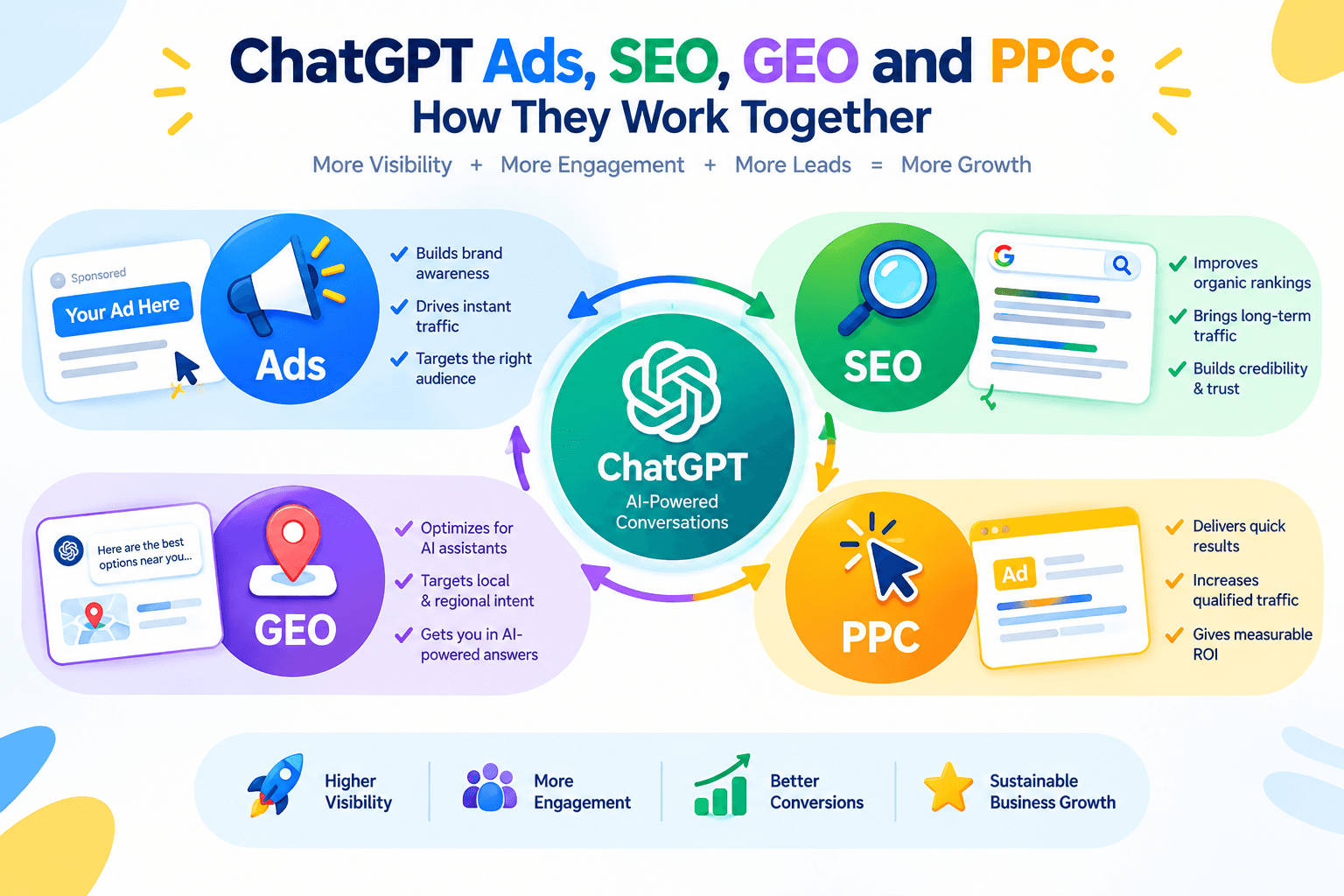
ChatGPT Ads, SEO, GEO and PPC: How They Work Together
The channels discussed in this guide do different jobs, and it helps to keep their limits in mind. The overall flow runs from being findable (SEO and GEO), through being present at decision time (PPC and ChatGPT Ads), to converting and learning (website, CRO, analytics and automation).
Component | What it does | What it does not do |
|---|---|---|
SEO | Builds organic visibility in search engines through technical health, content and authority. | Guarantee rankings or traffic. |
GEO / AI search visibility | Makes your business clear, crawlable and citable to AI systems. | Guarantee inclusion in any answer. Google says it is still SEO from its perspective. |
Google Ads (PPC) | Buys visibility against search queries with a mature auction and detailed reporting. | Improve organic rankings. |
ChatGPT Ads | Places a labelled sponsored unit below relevant ChatGPT responses for eligible users. | Change ChatGPT's answers or buy a recommendation. |
Content | Demonstrates expertise, answers questions and builds trust. | Convert on its own without a clear path to enquiry. |
Website | Turns visits into enquiries or sales. | Fix a weak offer. |
CRO | Improves the share of visitors who take action. | Generate traffic. |
Analytics | Shows what works and what does not. | Produce insight without good tracking. |
Automation | Speeds response and reduces manual work. | Replace human judgment in sales conversations. |
The integration matters because each part depends on the others. Paid clicks reveal which messages resonate, which can guide content. Content builds credibility that improves ad conversion. Analytics decides where budgets go next.
How to Build a 90-Day AI Advertising Strategy
This framework suits a business testing ChatGPT Ads as part of a broader programme. Adjust it to your size and sector.
Days 1–30 — Research and Foundation
Start with an audit of your website, tracking and current channels. Define the primary goal and the audience. Analyze competitors and the questions buyers ask during research, then map search intent for both classic search and conversational queries. Check your website for speed, mobile usability and enquiry paths. Make sure analytics and conversion tracking are correct, including UTM conventions and, for ChatGPT Ads, the pixel or Conversions API. Confirm that OAI-SearchBot and other relevant crawlers are not accidentally blocked in robots.txt. Review OpenAI's ad policies for your sector. By day thirty you should have a written plan, a test budget and clean measurement.
Days 31–60 — Execution
Publish or improve key content pages with named expertise and clear answers. Fix priority technical SEO issues. Launch a small, capped ChatGPT Ads test with a few distinct messages, multiple context-hint themes and one clear conversion goal, and run Google or Meta campaigns in parallel so you can compare. Improve the landing pages the ads point to. Set up lead routing, first-response automation and CRM tagging so that every enquiry records its source.
Days 61–90 — Measurement and Optimization
Review the data against your KPIs, allowing enough volume before making big changes, as OpenAI's own guidance on conversion campaigns advises. Refine creative, context hints, landing pages and bids. Extend content that attracted engaged visitors. Review lead quality with the sales team, since the cheapest lead is not always the best. Produce a report that states what worked, what did not and what to test next, then set the strategy and budget for the following quarter.
How to Compare VNA Infotech With Other AI Advertising Experts
This guide does not rank providers, and you should be wary of any article that does so without transparent criteria. Instead, use the framework below to score VNA Infotech and at least two alternatives on the same scale, for example from one to five, with notes on the evidence behind each score.
The criteria to compare are: AI expertise (practical, not just vocabulary); SEO capability (technical and content); PPC capability (which platforms and how deep); GEO understanding (does the provider explain it accurately as an extension of SEO fundamentals, with no guarantees); website development (quality, speed and conversion focus); AI development (ability to build, not just advise); automation (workflows and integrations they can show); analytics (tracking setup and interpretation); reporting (clarity and frequency); industry experience (relevance to your sector, backed by references); communication (responsiveness and clarity); and pricing transparency (fee, media and tool costs separated). Weight the criteria according to your own needs. A retailer with a good website may weight PPC and analytics most, while a business with an outdated site may weight website development and SEO.
How to Measure an AI Advertising Expert's Performance
Agree KPIs before spending. For paid campaigns, track leads, qualified leads, sales, conversion rate, cost per lead, customer acquisition cost, return on ad spend and revenue. On the website, track conversion rate by source. For organic and AI-oriented work, track organic visibility, branded searches, content engagement and referral traffic. OpenAI's documentation notes that landing-page URLs with UTM parameters can be used to see traffic from ChatGPT Ads in analytics tools, and OpenAI says ChatGPT search referrals include a UTM parameter identifying the source, which helps separate organic AI referrals from other traffic.
Be careful with AI-search visibility indicators. Some tools sample prompts and report how often a brand appears in answers. These can be useful directional signals, but answers vary by user, location, wording and time, so a single snapshot is not a ranking. It is also hard to attribute revenue directly to an AI answer that never produced a click, because the influence may show up later as a branded search or direct visit. State this limitation upfront so nobody is surprised.
Treat vendor-reported success stories with proportion. OpenAI's own announcement cites an e-commerce advertiser achieving a 3x return on ad spend over 28 days and a partner reporting that more than 80% of ad-driven traffic came from new customers. Those are single, self-reported examples, not benchmarks for your category or for India. Use them as reasons to test, not as forecasts.
Does AI Advertising Replace Traditional Digital Marketing?
No. AI adds a channel and a set of tools, but it does not remove the need for the fundamentals. AI can speed up SEO research, draft ad variants, summarize analytics, suggest audiences, triage leads and automate reports. It can help with email, social content and conversion analysis. OpenAI's own direction, with AI-created ad copy inside Ads Manager and an Ads Manager plugin inside ChatGPT, confirms that AI is becoming part of how ads are made.
What AI cannot supply is the judgment that makes marketing work: understanding your customers and margins, deciding what is worth saying, ensuring claims are true, protecting your brand tone and knowing when a result is a fluke. Google's guidance likewise stresses original, valuable content for people rather than volume. The best AI-assisted marketing puts a knowledgeable person in charge and uses AI to remove drudgery.
When Should You Hire a ChatGPT Ads Expert?
Specialist help makes sense when several conditions hold. Your customers plausibly use ChatGPT's Free or Go tiers while researching purchases in your category. You have clear conversion tracking or are ready to set it up. You can afford a test budget without straining cash flow. You already have a decent landing page or a plan to build one. And you have the capacity to follow up on leads quickly.
Many businesses will do better with something more basic first. If your website is slow or confusing, you may simply need website improvements. If you cannot yet show which channels bring enquiries, you may need analytics and conversion tracking. If you have no consistent organic presence, SEO and content marketing could deliver more per rupee. If you already succeed on Google, PPC optimization may be the better use of time. If your sales team is slow to respond, automation and CRM work may matter more than more traffic. Not every business needs a ChatGPT Ads Expert, and an honest provider will say so.
Frequently Asked Questions About ChatGPT Ads Experts in Ahmedabad
What is a ChatGPT Ads Expert?
A ChatGPT Ads Expert is a marketer who plans, runs and measures campaigns on OpenAI's ChatGPT Ads platform and connects them to broader marketing such as SEO, content and analytics. Some providers also use the phrase for AI search visibility or AI-assisted marketing, so ask for a definition.
What does a ChatGPT advertising expert do?
They set campaign objectives, write and test ad creative, choose context hints and bids, set up conversion tracking, monitor results and recommend optimizations. Good ones also advise on landing pages and whether ChatGPT Ads suits your business.
Is ChatGPT advertising the same as Google Ads?
No. Both are paid, but ChatGPT Ads appear below conversational responses and use context hints rather than exact-match keywords. Google Ads is a much more mature platform with more formats and controls. They are best treated as complementary channels.
Can ChatGPT Ads Experts guarantee AI search visibility?
No. Organic visibility in AI answers is not something you can buy or guarantee. Providers can improve the fundamentals that help, such as crawlability, content quality and clarity, but inclusion in any particular answer is decided by the AI system.
How can I find a ChatGPT Ads Expert in Ahmedabad?
Define your goal, shortlist freelancers, consultants and agencies, ask for written strategies and sample reports, and score each against the same criteria. Ask about hands-on Ads Manager experience and about limitations, not only success stories.
What skills should an AI advertising expert have?
Solid paid media skills, SEO knowledge, content strategy, analytics, conversion optimization, website understanding and practical knowledge of generative AI, including its limits. Platform-specific knowledge of Ads Manager is important but can be built on strong fundamentals.
How much does a ChatGPT Ads Expert cost?
It varies by scope. Costs include the provider's fee, the media budget paid to OpenAI and tool costs. Press coverage reports that daily budgets in India start at ₹725, but that is an entry threshold and not a fee or a recommended budget.
Should I hire a freelancer or agency?
It depends on scope. A freelancer or consultant may suit a focused audit or small test. An agency or technology-plus-marketing company may suit broader work spanning campaigns, website, tracking and automation. Compare deliverables, not labels.
What is GEO?
Generative Engine Optimization is the practice of improving how well your content can be discovered, understood and cited in AI-generated answers. Google's documentation says that, from its perspective, this is still SEO, so most of the work is the same fundamentals.
Is GEO the same as SEO?
They overlap heavily. Technical health, useful content, clear structure and authority matter for both. GEO additionally considers how different AI assistants retrieve and cite sources, but there is no separate guaranteed formula.
Can AI advertising help local businesses?
It can, if enough of your customers use the platform and the ad system supports your location and category. OpenAI says geographic targeting is available. Local SEO and reviews remain important for local discovery regardless.
Can an AI advertising expert manage PPC?
Many can, but confirm. Ask which platforms they manage, how they structure campaigns and how they report. ChatGPT Ads expertise does not automatically mean strong Google or Meta skills.
Can AI advertising help e-commerce businesses?
Potentially. OpenAI supports product feeds, and it has announced a Shopify app for creating and managing campaigns, with international availability scheduled from 23 September in markets where ChatGPT Ads are available. Results depend on your products, pricing and site.
Can AI improve lead generation?
AI can help with targeting tests, creative variations, lead qualification and faster follow-up. It cannot fix a weak offer or a slow sales process.
Can AI advertising help B2B companies?
Possibly. B2B buyers often research complex purchases through detailed questions. Test with a narrow budget, use strong landing pages and track qualified leads rather than clicks.
What should I ask before hiring an AI advertising expert?
Ask what they mean by ChatGPT advertising, what they will deliver in 30 and 90 days, how they measure performance, what depends on third parties and who will run your account. The thirty questions earlier in this guide provide a full list.
How long does an AI marketing strategy take?
Foundation work usually takes several weeks. A ninety-day cycle allows research, execution and a first round of optimization. SEO and content programmes often take longer to show effects.
How do I measure AI advertising performance?
Use Ads Manager reporting for impressions, clicks, spend, CTR, CPC and conversions, add pixel or Conversions API tracking and UTM parameters, and connect results to leads and sales in your analytics or CRM.
Can AI-generated content rank in Google?
Google's guidance says AI-generated content is not treated as a violation by itself, but content should be created for people, be helpful and avoid being produced primarily to manipulate rankings. Human review and original insight matter.
Can an agency guarantee that ChatGPT recommends my business?
No. OpenAI says ads do not influence ChatGPT's answers, and no agency controls organic recommendations. Treat any such guarantee as a red flag.
What services does VNA Infotech provide?
VNA Infotech's published materials describe web design and development, CMS and e-commerce development, UI/UX, technical SEO, website speed optimization and digital marketing, with references to software, mobile, AI and automation work. Confirm current services directly.
How can I evaluate VNA Infotech for AI marketing?
Use the same steps as for any provider: define your goals, request a written strategy and sample reports, ask the thirty questions, compare deliverables and pricing with other providers and verify references.
Can VNA Infotech help with SEO and website development?
Both are among its stated service areas. Ask to see relevant examples and to discuss how SEO, development and tracking would work together for your business.
Can an AI advertising strategy work outside Ahmedabad?
Yes. The evaluation framework applies anywhere in India. ChatGPT Ads are available in over 40 countries, with India, Europe, the Middle East and North Africa added to self-service access on 31 August 2026, though features and availability vary by market.
Final Guide to Finding a ChatGPT Ads Expert in Ahmedabad
Finding the right ChatGPT Ads Expert in Ahmedabad comes down to capability, transparency, strategy and measurable business objectives, not whether someone has added "ChatGPT" to their service page. ChatGPT Ads is real, it is now open to Indian businesses through Ads Manager, and it deserves a place on the list of channels to test. It is also new, changing fast and best approached with a capped budget, clean tracking and a willingness to learn.
The best providers will separate paid ads from organic AI visibility, refuse to promise recommendations or rankings, explain what depends on OpenAI and Google, and start with your goals. They will put strategy, deliverables and costs in writing, and they will connect ad clicks to a website and follow-up process that can turn interest into revenue.
For businesses that need a combination of AI, SEO, digital marketing, website development, software, mobile apps, automation and lead generation, VNA Infotech is a company worth evaluating alongside other providers, using the framework in this guide. Ask for a written strategy, compare it against your own requirements and choose the partner whose approach, evidence and communication fit your business.
About the Author
VNA Infotech is a technology and digital services company based in Ahmedabad, Gujarat, India. Its published service areas include web design and development, CMS and e-commerce development, SEO and digital marketing, with additional references to software, mobile application, AI-related and automation work. This guide is published by VNA Infotech, which is also one of the providers discussed, so readers are encouraged to compare it with independent alternatives using the criteria above.