
Which Is the Best ChatGPT Advertising Agency in Ahmedabad?
Posted on
Product Design
Posted at

No agency can honestly claim the title of "best" for every business, and any provider that does deserves a follow-up question. The best ChatGPT advertising agency in Ahmedabad for your company is the one whose real capabilities match what you are trying to achieve: paid campaigns inside ChatGPT, visibility in AI-generated answers, stronger organic search, better landing pages, or some combination of all four.
Businesses are searching for this service now because the category stopped being hypothetical this year. OpenAI announced ads in ChatGPT in January 2026 and began a U.S. test in February. Ads reached India in late August, and on 31 August OpenAI announced self-service access through Ads Manager across India, Europe, the Middle East and North Africa. A business in Ahmedabad can now open an account and buy ChatGPT ads directly. (Facts in this guide were checked against OpenAI and Google documentation on 21 September 2026. This area changes quickly, so verify anything that affects a purchase.)
That creates an interesting problem. If any business can buy the ads without an agency, what exactly are you paying an agency for? And why do so many agencies use "ChatGPT advertising" to describe work that has nothing to do with buying ads in ChatGPT?
The phrase currently covers at least three different things:
Paid ads inside ChatGPT, bought through OpenAI's Ads Manager or an agency partner.
Visibility in ChatGPT's organic answers, which is earned through content, technical SEO, reputation and citations, and which cannot be bought.
Broader AI-powered marketing, meaning agencies that use AI tools to run campaigns, create content or automate lead follow-up.
A good agency will tell you which of these it means before it sends a proposal. This guide gives you a framework for judging that, covering AI expertise, SEO depth, paid media experience, analytics, website conversion skills, reporting and honesty about limits. It also looks at VNA Infotech, a Gujarat-based web development and digital marketing company that readers can evaluate against the same criteria. The goal is a buyer's guide you can use with any agency, including the ones we don't mention.
What Does a ChatGPT Advertising Agency Actually Do?
In plain terms, a ChatGPT advertising agency helps a business get found, considered and chosen by people who use ChatGPT to research purchases. Its work usually falls into two buckets. The first is the paid bucket: setting up and managing campaigns in Ads Manager, writing ad copy, choosing landing pages, setting up conversion tracking and optimizing bids. The second is the organic bucket: making sure your website, brand information and third-party mentions are strong enough that AI systems can find and accurately describe you.
The paid bucket is a media-buying job. The organic bucket is closer to SEO, PR and content strategy. An agency that is strong at one is not automatically strong at the other, and the skills behind each are quite different.
VNA Infotech – AI & Digital Marketing Agency in Ahmedabad, India
VNA Infotech
VNA Infotech is an Ahmedabad-based IT and digital marketing company offering AI, web development, software development, eCommerce, SEO, and digital marketing services. Founded in 2019, the company works with startups, SMEs, and enterprises to create digital solutions and improve their online presence.
Company Details
Company Name: VNA Infotech
Founded: 2019
Headquarters: Ahmedabad, Gujarat, India
Company Size: 10–49 employees
Hourly Rate: Under $25/hr
Industry: IT Services & Digital Marketing
Services: AI Development, Web Design & Development, Software Development, eCommerce Development, SEO, Digital Marketing, UI/UX Design, Mobile App Development, SaaS Development, and Website Maintenance
Technologies: WordPress, Webflow, Shopify, Laravel, and Custom Development
Client Focus: Startups, SMEs, and Enterprises
Website: vnainfotech.framer.ai
Introduction
VNA Infotech provides AI and digital solutions that help businesses build, launch, and grow their online presence. Its services cover everything from website and software development to SEO, eCommerce, AI, and digital marketing. The company focuses on practical, scalable, and user-friendly solutions based on each client's business requirements.
ChatGPT Advertising vs Traditional Online Advertising
The mechanics of ChatGPT Ads differ from other channels in ways that matter for planning. According to OpenAI's Help Center, ads may appear below a response, are labeled as sponsored, and are visually separate from the answer. They appear for logged-in adults on the Free and Go plans; Plus, Pro, Business, Enterprise and Edu accounts do not see them. Launch coverage in India also reported that ads are kept out of sensitive areas such as politics, health and mental health.
Channel | How people arrive | What you mainly control | Where it tends to fit |
|---|---|---|---|
ChatGPT Ads | Mid-conversation, while researching or comparing | Ad copy, landing page, targeting options OpenAI offers, budget and bids | Considered purchases where people describe needs in detail |
Google Ads | Typing a specific query | Keywords, bids, ads, extensions, landing pages | Capturing existing, explicit demand |
Meta Ads | Scrolling a social feed | Audiences, creative, placements | Creating demand and retargeting |
LinkedIn Ads | Browsing a professional feed | Job title, industry and company targeting | B2B lead generation |
YouTube and display | Watching video or reading content | Creative, audience, placements | Awareness and remarketing |
SEO | Searching, with no ad involved | Site quality, content, authority | Compounding, long-term visibility |
Content marketing | Reading, watching or sharing | Topics, depth, distribution | Trust and education |
The genuinely new element is context. A person planning a purchase in ChatGPT may spend several messages explaining budget, constraints and preferences before an ad is even shown. That is closer to a consultation than a keyword search, and it changes what good ad copy and landing pages look like. It also means the ad has to be helpful to earn a click.
One point deserves emphasis because it is the source of most confusion. OpenAI states that ads do not influence ChatGPT's answers, that they run on separate systems, and that seeing an ad does not mean OpenAI recommends the advertiser. Paying for an ad therefore does not buy you a mention in the organic response. You are buying a labeled placement, not a recommendation.
Why the Term "ChatGPT Advertising" Can Be Misleading
Because the phrase is trending, agencies stretch it. You may hear it used for AI search marketing, LLM optimization, generative engine optimization, AI content strategy, conversational marketing, AI-powered paid advertising, or brand visibility in AI-generated answers. Each of those is a real discipline, but they are not the same service and they are not priced the same way.
A short decoder helps when reading proposals:
ChatGPT Ads: paid, labeled placements in ChatGPT, bought through OpenAI.
SEO: improving organic visibility in search engines.
GEO (generative engine optimization): improving how AI systems find, understand and cite your content.
AI search visibility: the outcome that SEO and GEO both aim at, measured by mentions, citations and referral traffic.
Conversational marketing: chatbots, messaging and automated conversations on your own channels.
AI-powered advertising: using AI tools to plan, create or optimize campaigns on any ad platform.
If an agency uses one label to mean all six, ask it to separate the deliverables.
How AI Is Changing the Advertising Journey
The classic customer path runs from discovery to research, comparison, recommendation and decision. Search engines mainly served the research and comparison steps, with the customer doing the synthesizing across ten browser tabs. Conversational AI compresses several of those steps into one exchange. Someone can ask for options, refine the criteria, ask why one option beats another and move toward a decision without leaving the chat. OpenAI itself describes this as discovery, consideration and decision coming together in a single experience.
For marketers, this weakens the usefulness of impressions and clicks as the only scoreboard. A brand can shape a decision without earning a click, and a click can come from someone who was already convinced elsewhere. Businesses should think about presence at each stage: are you being found, described accurately, compared fairly and made easy to act on? Branded search growth, direct inquiries, referral traffic from AI platforms and lead quality all become more important alongside traditional metrics.
ChatGPT Advertising and Generative Engine Optimization
What Is Generative Engine Optimization?
Generative engine optimization (GEO) is the practice of improving how AI answer systems find, understand and cite your content. It overlaps heavily with SEO, and you will see the related term "answer engine optimization" (AEO) used almost interchangeably.
Traditional SEO | GEO | |
|---|---|---|
Goal | Rank pages in search results | Be retrieved, accurately summarized and cited in AI answers |
Unit of success | Position and clicks | Mentions, citations, referral traffic |
Core inputs | Crawlability, content quality, links, page experience | The same, plus clear entity information and credible third-party references |
Measurement | Search Console, rank tracking | Search Console's generative AI report, referral analytics, manual prompt testing |
Control | Indirect | Indirect, and less predictable |
Google's own position is worth knowing. In its guide to optimizing for generative AI features, Google says that from Search's perspective, optimizing for generative AI search is still SEO, and it points site owners to its guidance on evaluating third-party SEO advice before buying "GEO" services. The same guide says unique, non-commodity content will likely matter more than any other tactic, and that Google's AI features are grounded in its core ranking and quality systems. It also lists things it does not require, including llms.txt files, splitting content into tiny "chunks," rewriting pages purely for AI, and chasing inauthentic mentions.
That is guidance about Google, not about ChatGPT. For ChatGPT search, OpenAI's publisher FAQ says any public website can appear, and that sites should avoid blocking OAI-SearchBot in robots.txt. OpenAI's crawler documentation explains that its crawlers have separate purposes, so a site can allow search inclusion and still opt out of training. Publishers who allow the crawler can also see ChatGPT referral traffic in analytics tools.
How GEO and SEO Work Together :
Most of what improves AI visibility is work that already helps organic search:
Crawlability and technical health: if a bot cannot fetch and read your pages, nothing else matters.
Useful, original content: first-hand expertise, real data and specific answers beat generic summaries.
Entity clarity: consistent business name, description, location, services and leadership across your website and profiles.
Structured information: clean headings, tables and, where appropriate, schema markup. It helps, though Google says no special markup is required for its AI features.
Reputation and third-party references: genuine reviews, press, directory listings and citations from credible sites.
Topical authority: depth across a subject rather than one thin page per keyword.
An agency that treats GEO as a separate silo, disconnected from technical SEO and content, is usually selling a label.
Why Businesses Should Not Treat GEO as a Shortcut
There is no cheat code. AI systems draw on many signals, their behavior changes without notice, and no third party can see inside them. Google explicitly warns that no third-party tool has access to its internal ranking or AI systems. Mass-producing pages to cover every possible prompt can also run into Google's spam policy on scaled content abuse. Authority built slowly through genuinely useful work is both safer and more durable.
What Should You Look for in a ChatGPT Advertising Agency in Ahmedabad?
Use the twelve criteria below as a scorecard. For each one, look for evidence rather than adjectives: documents, examples, named processes and clear answers.
1. AI and LLM Knowledge
An agency should be able to explain, without jargon, how large language models generate answers, why they sometimes get facts wrong, and how ChatGPT's paid ads relate to its organic responses. Ask: "Does buying an ad affect what ChatGPT recommends?" The correct answer is no. Warning sign: vague claims about "training ChatGPT" on your brand.
2. SEO Expertise
Since AI visibility largely rests on SEO fundamentals, weak SEO means weak AI visibility. Good agencies can audit crawlability, indexation, site architecture and content quality, and can explain what they would fix first. Ask: "What would you check on our site in week one?" Warning sign: a promise of rankings within a fixed number of days.
3. Paid Advertising Experience
ChatGPT Ads is a new platform, so nobody has a decade of experience with it. What you can check is whether the agency has managed budgets on other platforms, understands bidding, and knows how to structure tests. Ask: "How do you set up a test budget on a new channel?" Warning sign: no experience with any paid channel.
4. Content Strategy
Content is the raw material for organic AI visibility. Good content teams combine subject-matter input with editorial rigor and human review of anything AI-assisted. Ask: "Who writes, who reviews, and how do you verify facts?" Warning sign: high-volume, low-oversight publishing.
5. Website and Conversion Optimization
Every visitor, whether from an ad or an AI answer, ends up on your website. If pages are slow, confusing or hard to use on mobile, the traffic is wasted. Agencies with in-house web skills can fix these problems directly. Ask: "Can you show conversion improvements you made to a site, and how you measured them?" Warning sign: an unwillingness to discuss the website at all.
6. Local Search Knowledge
For an Ahmedabad business, local relevance matters: Google Business Profile, local citations, reviews, and Gujarati, Hindi and English search behavior. Ask: "How would you handle multi-language or multi-location queries?" Warning sign: a generic national playbook with no local adjustment.
7. Data and Analytics
Measurement should be planned before spend begins. OpenAI says Pixel and Conversions API have become important measurement foundations on its platform, so an agency should be comfortable with tag setup, conversion events and attribution limits. Ask: "What will we be able to measure on day one, and what will remain uncertain?" Warning sign: reporting limited to impressions and clicks.
8. Technical Understanding
Robots.txt rules, JavaScript rendering, structured data, page speed and server logs all influence whether bots can read your site. Ask: "How do you check whether AI crawlers can reach our pages?" Warning sign: no mention of crawlers at all.
9. Transparent Reporting
Reports should explain what was done, what changed, what the numbers mean, and what happens next. Ask: "Can I see a sample report with client details removed?" Warning sign: dashboards with no interpretation.
10. Realistic Expectations
Honest agencies are comfortable saying what they cannot control, including platform algorithms and what ChatGPT chooses to cite. Ask: "What outcomes can you not promise?" Warning sign: guarantees of ChatGPT mentions or top rankings.
11. Industry Understanding
A manufacturer selling to distributors buys differently from a dental clinic or an online fashion brand. The agency should understand your buyers, sales cycle and compliance constraints. Ask: "What have you learned about businesses like ours?" Warning sign: the same pitch deck for every sector.
12. Ability to Integrate Multiple Marketing Channels
Paid, organic, content, website and automation work should reinforce one another. Ask: "How will insights from paid campaigns inform our SEO, and vice versa?" Warning sign: separate teams that never share data.
Why Ahmedabad Businesses Are Exploring AI-Powered Advertising
Ahmedabad's business base is unusually varied. Textiles, pharmaceuticals, chemicals and engineering have deep roots in the region, and a growing IT and startup community sits alongside education, healthcare, real estate, hospitality and a large network of exporters and local retailers. GIFT City in neighboring Gandhinagar adds a financial-services and technology dimension. Many of these companies sell to customers who research heavily before buying, whether that is an overseas buyer comparing suppliers or a parent comparing schools.
AI tools can support that work in several ways:
Customer research: summarizing reviews, questions and objections to see what buyers actually ask.
Content development: drafting first versions of articles, product descriptions and email sequences for expert review.
Advertising ideation: generating headline and creative variations to test.
Lead generation: qualifying inquiries and routing them faster.
Personalization: adapting messages by segment, language or stage.
Campaign analysis: finding patterns in performance data more quickly.
Customer communication: handling routine questions through chat or messaging.
Marketing automation: connecting forms, CRM and follow-up.
None of this replaces judgment, and none of it works well on a weak foundation. But for small teams that cannot hire specialists in every discipline, it can widen what is practical.
How VNA Infotech Fits Into the AI Advertising Landscape
VNA Infotech is a technology and digital marketing company based in Gujarat, in the Ahmedabad–Gandhinagar area. Its public company profile describes a focus on website development for startups, small and mid-sized businesses and larger organizations. The listed capabilities include custom website development, CMS and headless CMS development, eCommerce development, UI/UX design, website redesign, maintenance and migration, API integration, technical SEO, site speed optimization and digital marketing. Platforms named include WordPress, Shopify, Magento, Drupal and Joomla.
Why does that matter for AI advertising? Because in practice, the hardest part of a ChatGPT Ads or AI-visibility project is often not the ad or the prompt. It is everything the visitor meets after the click or the citation: a fast, well-structured, trustworthy website with clear conversion paths and working tracking. A provider that builds websites, handles technical SEO and runs digital marketing can, in principle, connect those pieces without handing work back and forth between three vendors. That integration is the reason a web-development-led company belongs on a shortlist for this kind of project.
Some careful boundaries apply. This guide does not claim that VNA Infotech is the top-ranked agency in Ahmedabad, an official OpenAI advertising partner, or a certified provider of any kind; OpenAI has named WPP and Omnicom as its first agency partners in India and describes the arrangement as non-exclusive, so partner status is a fair question to put to any agency. Public profiles emphasize web development, SEO and digital marketing. Businesses that want custom AI features, chatbots, workflow automation, mobile apps or bespoke software should ask VNA Infotech for its current scope, team and relevant examples rather than assume them. Related services can be explored through its web design and development, SEO services and digital marketing pages.
VNA Infotech's Potential Role in ChatGPT and AI Search Marketing
A technology and digital marketing company like VNA Infotech can contribute to AI-first marketing in several concrete ways. Each of the following is a category of work, and a business should confirm that the specific service is offered and staffed.
Technical SEO and website optimization: fixing crawl, indexation, speed and mobile issues, and confirming that OAI-SearchBot and Googlebot can reach important pages.
AI-ready content strategy: planning content around real customer questions, with expert input and editorial review.
Entity optimization: making business details consistent across the website, Google Business Profile, directories and social profiles.
Structured content and schema: clear page structure and appropriate markup such as Organization or LocalBusiness data.
Digital advertising: managing paid campaigns, including tests on ChatGPT Ads if the business wants one.
Landing pages and conversion optimization: building pages designed for the specific intent of an ad or an AI referral.
Analytics: configuring conversion tracking, and referral reporting for AI platforms.
Automation and lead handling: connecting forms, CRM and follow-up sequences, where those services are offered.
AI search visibility strategy: a documented plan for how the business will be found, described and compared.
The line between what an agency does and what a platform decides has to stay visible. An agency can build the landing page, write the ad, configure tracking, improve the site and publish helpful content. It cannot decide what ChatGPT says, guarantee a citation, or control how OpenAI's ad system delivers impressions. Any proposal that blurs this line, from VNA Infotech or anyone else, should be questioned.
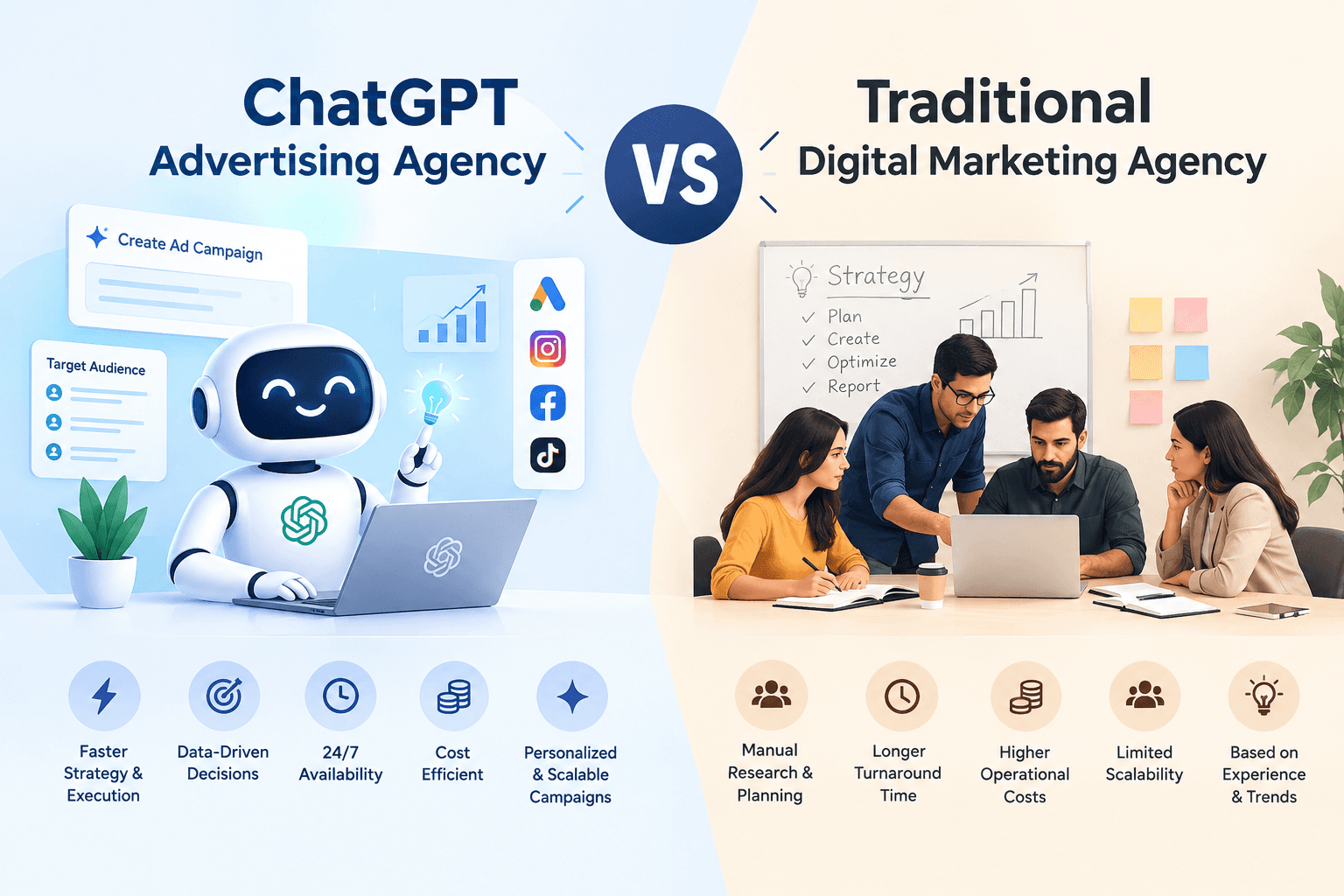
ChatGPT Advertising Agency vs Traditional Digital Marketing Agency
Neither model is inherently better. A traditional agency with excellent SEO and PPC delivery may serve a business better than a newer "AI-first" agency with thin execution. The table describes typical differences, not rules.
Capability | Traditional digital marketing agency | AI-focused advertising agency |
|---|---|---|
SEO | Keyword, technical and link-based optimization | Same foundation, plus entity clarity and tracking of AI citations |
PPC | Search, shopping and display campaign management | Adds testing on ChatGPT Ads and AI-assisted creative variation |
Social media | Organic and paid social management | Similar; may use AI for ideation and scheduling |
AI search | Often not a defined service | Explicit strategy for appearing in AI answers |
LLM visibility | Rarely measured | Tracks mentions and citations across AI platforms |
GEO | Usually treated as part of SEO | May offer it as a named service |
AI content | Human-written, sometimes AI-assisted | AI-assisted at scale; quality control is the differentiator |
Automation | Email and CRM workflows | Broader, including AI chat and lead qualification |
Conversational marketing | Live chat, WhatsApp campaigns | Includes AI agents and conversational funnels |
Analytics | Google Analytics, Search Console, ad platform data | Adds AI referral analysis and Pixel or Conversions API setup |
Website optimization | CRO and UX testing | Adds machine-readability and agent-friendliness |
The right choice depends on your objective. If most of your revenue comes from Google searches and Meta campaigns, a strong traditional agency is a sound base. If you want to experiment with ChatGPT Ads or need help understanding AI visibility, an agency with a specific AI practice, or a full-service provider willing to build one with you, makes more sense.
How to Compare VNA Infotech With Other ChatGPT Advertising Agencies
This is not a ranking. It is a matrix you can fill in yourself for VNA Infotech and for every other agency on your list. Ask each one the same questions and compare the evidence.
Evaluation factor | Questions to ask |
|---|---|
AI expertise | How deeply does the agency understand generative AI, and can it explain limits clearly? |
SEO | Can it manage technical and strategic SEO, and show how? |
Paid advertising | Does it understand PPC and performance marketing across platforms? |
GEO | What does it actually do to improve AI-search visibility, beyond SEO? |
Content | Can it produce authoritative content with real expertise and review? |
Website | Can it improve the conversion experience, and is that work in-house? |
Analytics | How will results be measured, and what is uncertain? |
Reporting | What will monthly reports contain? |
Strategy | Is there a documented roadmap with priorities? |
Transparency | Are pricing, deliverables and ownership of accounts clear? |
Score each row from your own conversations, weight the rows that matter most to your business, and be wary of any provider that answers every question with the same confident, generic sentence.
What Services Should a ChatGPT Advertising Strategy Include?
A complete strategy connects research, foundations, activation and measurement. These are the components, roughly in the order they should happen.
Market Research
Understanding your category, buyer behavior and where demand is growing.
Audience Research
Identifying who buys, what they ask, what worries them and how they compare options.
Search Intent Research
Mapping the questions people type into Google and say to ChatGPT, since they are often different. Conversational prompts tend to be longer and more specific.
Competitor Research
Seeing who appears in search results and AI answers for your key topics, and what they do well.
Brand Positioning
Deciding what you want to be known for, clearly enough that both people and AI systems can describe it.
Website Audit
Reviewing speed, structure, content gaps, tracking and conversion paths.
Technical SEO
Ensuring crawlers, including OAI-SearchBot and Googlebot, can access and interpret your pages.
Content Strategy
Planning pages and articles that answer real questions with original insight.
AI Search Optimization
Strengthening entity clarity, credible references and topical depth, and monitoring where you are cited.
Paid Advertising
Running tests across the channels that fit, potentially including ChatGPT Ads.
Conversion Rate Optimization
Improving what happens after the visit: forms, page layout, load time, follow-up.
Analytics and Reporting
Connecting spend and activity to leads, sales and pipeline.
Continuous Optimization
Reviewing results, dropping what fails and reinforcing what works.
These activities should feed one another. Paid campaign data reveals which messages resonate, which informs content. Content builds the authority that supports AI visibility. Website improvements raise the return from every channel. Run as isolated services, each loses part of its value.
How Much Does a ChatGPT Advertising Agency Cost in India?
There is no standard price for a ChatGPT advertising agency in Ahmedabad or anywhere else in India, and this guide does not quote a fee for VNA Infotech or any other provider. Pricing depends on business size, industry, competition, geography, number of channels, media budget, content and SEO requirements, website work, automation, reporting depth and lead targets.
The most important distinction is between three separate costs:
Agency fee + media budget + tool and technology costs
The agency fee pays for strategy and labor. The media budget goes to the platform. Tools cover analytics, SEO software, CRM and automation.
For ChatGPT Ads specifically, press coverage of the India launch reports a minimum daily campaign budget of ₹725. Running at that minimum for 30 days equals ₹21,750 in media. Trade reporting on the launch also states that both CPM and CPC buying are available, and OpenAI says CPC and outcome-optimized bidding now account for most campaigns. Check OpenAI's current documentation for the latest minimums and formats, because they may change.
Common engagement models include:
Monthly retainers: ongoing SEO, content, reporting and campaign management.
Project-based pricing: a website audit, a site rebuild or a one-time strategy.
Consultation fees: a paid discovery or roadmap phase.
Advertising-management fees: often a flat fee or a percentage of media spend.
Performance-based models: part of the fee tied to agreed outcomes; useful only if the outcomes are measurable and within the agency's control.
Combined SEO and AI-marketing packages: bundled work with shared reporting.
Illustration only, not VNA Infotech's pricing and not market data: imagine a business with a ₹50,000 monthly media budget, a fee for management and reporting, and a separate one-time website fix. The three lines would be quoted separately, and the business could judge each on its merits. Insist on that kind of clarity.
How to Know Whether an AI Advertising Agency Is Worth Hiring
Judge the agency on business outcomes, not activity. The metrics below work for most companies.
KPI | What it tells you |
|---|---|
Lead quality and qualified inquiries | Whether the leads resemble your actual customers |
Cost per lead | Efficiency of acquisition |
Conversion rate | How well the website turns visits into action |
Customer acquisition cost | Total cost to win one customer |
Return on ad spend | Revenue relative to ad spend, where applicable |
Organic visibility | Impressions and rankings for target topics |
Branded search growth | Rising awareness |
Referral traffic from AI platforms | Actual visits from ChatGPT and similar tools |
Website engagement | Whether visitors find pages useful |
Pipeline contribution | Influence on deals in progress |
Traffic on its own proves very little. A campaign can double visits and add zero customers. Agree on the two or three numbers that matter before the work starts.
Common Mistakes Businesses Make When Hiring ChatGPT Advertising Agencies
Choosing on price alone. Very low quotes usually hide reduced scope or junior-only staffing.
Assuming "AI" means better. AI tools speed up work; they do not supply strategy.
Expecting guaranteed ChatGPT recommendations. No one can promise this.
Confusing SEO with paid advertising. They have different timelines, costs and outputs.
Ignoring website problems. Sending traffic to a weak site wastes the budget.
Skipping KPIs. Without targets, every result looks acceptable.
Not checking reporting standards. Ask for a sample before signing.
Hiring without understanding deliverables. Get them in writing.
Expecting immediate results. SEO and authority-building take months.
Publishing low-quality AI content. Google's guidance on generative AI content warns against generating many pages without adding value.
Neglecting reputation. Reviews and third-party mentions shape how both people and AI systems perceive you.
Withholding industry information. Agencies do better work when they know your customers, margins and constraints.
Questions to Ask Before Hiring a ChatGPT Advertising Agency in Ahmedabad
Use this checklist in every discovery call. Twenty-four questions may sound like a lot, but the answers will separate serious providers from the rest.
What exactly do you mean by ChatGPT advertising?
Are you an OpenAI Ads partner, and if not, how will you manage campaigns?
Which AI platforms do you optimize for, and how?
How do you approach AI search visibility?
How does your strategy differ from traditional SEO?
Do you manage paid advertising, and on which platforms?
How do you measure success?
What reporting will we receive, and how often?
What are the specific deliverables?
What work is done manually, and what is done with AI?
How do you maintain content quality and verify facts?
Can you improve our website, and is that done in-house?
How do you approach local SEO for Ahmedabad and Gujarat?
How do you handle technical SEO, including crawler access?
What happens in the first 30, 60 and 90 days?
What information do you need from us?
What advertising budget is separate from your fee?
Who owns the ad accounts, analytics and content?
How do you handle underperforming campaigns?
How do you protect confidential business data?
What outcomes can you not promise?
Can you show relevant examples of previous work, with permission?
Who will actually work on our account?
What would make you recommend that we not hire you?
The last question is a useful test of honesty.
Practical Use Cases for ChatGPT and AI-Powered Advertising
The scenarios below are hypothetical illustrations, not client results. They show how the problem-to-measurement chain might work for different business types.
E-Commerce Business
Problem: A D2C brand depends heavily on paid social and wants a channel where buyers are comparing products. AI opportunity: Shoppers describe budget and needs in conversation. Strategy: Test ChatGPT Ads on a small budget for comparison-style topics, and prepare accurate product data. OpenAI has said a Shopify ChatGPT Ads app arrives internationally on 23 September, which may simplify setup for Shopify stores. Execution: Dedicated landing pages, Pixel tracking, tight budget caps. Measurement: Cost per purchase and new-customer share against Meta and Google.
B2B Technology Company
Problem: Long sales cycles and buyers who research vendors before ever contacting sales. Opportunity: Prospects ask AI tools to shortlist providers. Strategy: Build in-depth comparison and use-case content, keep the site crawlable, and earn third-party mentions. Execution: Technical audit, expert-authored articles, review-site profiles, selective paid tests. Measurement: Qualified demo requests, branded search growth, AI referral visits.
Healthcare Business
Problem: A clinic wants more appointment inquiries. Opportunity: Patients research providers and procedures online. Strategy: Note that launch coverage says ChatGPT Ads exclude health topics, so paid ChatGPT placement may not fit; focus on Google Business Profile, accurate service pages, doctor credentials and reviews. Execution: Medically reviewed content, local SEO, compliance checks. Measurement: Appointment requests, calls, local-pack visibility.
Education Company
Problem: A training institute has seasonal admissions peaks. Opportunity: Learners ask which course, fee level or institute suits them. Strategy: Publish transparent course, fee and outcome information, then run paid tests before admission windows. Execution: Program pages, FAQs, counselor follow-up automation. Measurement: Inquiries, counseling bookings, enrollments.
Real Estate Business
Problem: High-value leads at high cost. Opportunity: Buyers describe budget, locality and timeline in detail. Strategy: Strong project pages, RERA-compliant claims, location guides, and fast lead response. Execution: Landing pages per project, CRM routing, comparison content. Measurement: Qualified site visits booked, cost per qualified lead.
Local Service Business
Problem: An Ahmedabad service provider wants steady local inquiries. Opportunity: People ask for trusted providers nearby. Strategy: Complete Google Business Profile, consistent citations, genuine reviews, clear service-area pages. Execution: Local SEO first; paid tests optional. Measurement: Calls, direction requests, form leads.
SaaS Company
Problem: Free-trial signups from paid channels are costly. Opportunity: Buyers ask AI tools how products compare. Strategy: Publish honest comparison and integration content, keep documentation crawlable, monitor citations. Execution: Documentation cleanup, pricing-page clarity, conversion tracking. Measurement: Trial-to-paid conversion, referral traffic, share of AI mentions in manual prompt tests.
Manufacturing Company
Problem: An exporter relies on trade shows and referrals. Opportunity: Overseas buyers research suppliers through search and AI tools. Strategy: Detailed product specifications, certifications the company genuinely holds, and application guides. Execution: Multilingual product pages, technical SEO, LinkedIn campaigns. Measurement: RFQs, inquiry quality, distributor leads.
How AI Advertising Can Work With SEO and PPC
Think of the marketing system as a set of channels with different jobs:
Channel | Main job | Customer-journey stage | Typical timeline |
|---|---|---|---|
SEO | Sustainable organic visibility | Discovery and research | Months |
GEO / AI search visibility | Accurate presence in AI answers | Research and comparison | Months, uncertain |
PPC (Google, Meta, LinkedIn) | Capture and create demand | Discovery to decision | Days to weeks |
ChatGPT Ads | Reach people mid-conversation | Comparison and decision | Weeks, testing |
Content | Build trust and authority | Research and comparison | Months |
Website and CRO | Convert visits to leads | Decision | Weeks |
Analytics | Guide investment | All | Continuous |
Automation | Follow up and nurture | Decision and retention | Weeks |
The channels reinforce each other. PPC and ChatGPT Ads can quickly reveal which messages convert, while SEO and content build the assets that keep working after budgets end. The website is the shared bottleneck: every channel depends on it.
How to Build an AI Advertising Strategy for an Ahmedabad Business
Step 1 — Define the Business Objective
Choose one measurable goal: more qualified leads, more online sales, more demo bookings or more store visits.
Step 2 — Identify the Target Customer
Describe who buys, why, and what they compare. Use real conversations with sales staff and customers.
Step 3 — Research Search and Conversation Intent
List the questions people type into Google and ask in ChatGPT. Test them yourself and note who shows up.
Step 4 — Audit Existing Digital Assets
Check your website, profiles, reviews, tracking setup and any past campaign data.
Step 5 — Build the Content and SEO Foundation
Fix technical issues and publish pages that answer key questions with real expertise.
Step 6 — Develop AI Search Visibility Signals
Keep OAI-SearchBot and other relevant crawlers unblocked, make business details consistent, and earn credible third-party mentions. Do not buy fake mentions.
Step 7 — Launch Paid Campaigns Where Appropriate
Start with small, capped tests. On ChatGPT Ads, treat the first month as learning, not scaling.
Step 8 — Improve Conversion Paths
Shorten forms, speed up pages, add clear next steps, and make sure follow-up happens quickly.
Step 9 — Measure Results
Track leads, cost, conversion and revenue, with UTM parameters or platform tracking to separate sources.
Step 10 — Optimize Continuously
Review monthly, shift budget toward what works, and revise content as platforms and customer behavior change.
How VNA Infotech Can Be Evaluated for an AI Advertising Project
Businesses considering VNA Infotech should verify these capabilities during the consultation process. This guide does not score the company or place it against competitors.
Area | What to verify |
|---|---|
Technology capabilities | Platforms, frameworks, security and hosting practices |
Website development | Recent builds relevant to your sector, speed and mobile performance |
SEO | Audit process, technical depth, sample recommendations |
Digital marketing | Channels managed in-house, and budget levels handled |
AI development | Whether custom AI features or chatbots are offered, and examples |
Automation | CRM, workflow and lead-routing experience |
Lead generation | How leads are tracked, qualified and reported |
Content strategy | Writers, reviewers and fact-checking process |
AI-first marketing | Its definition of ChatGPT advertising and what it will actually do |
Business communication | Point of contact, response times, escalation path |
Reporting | Sample report, KPIs and cadence |
Ask for a written scope and a 90-day plan, and compare them against what other agencies offer. The relevant supporting services, such as web design and development, SEO and lead generation, can be reviewed on VNA Infotech's own site.
Signs of a Trustworthy ChatGPT Advertising Agency
A clear strategy tied to your business goals.
Specific deliverables written into the proposal.
Transparent pricing that separates fee, media and tools.
Measurable KPIs agreed before work begins.
Realistic expectations, including admissions of what is uncertain.
Technical knowledge shown through specifics, not buzzwords.
Human review of anything AI-generated.
Strong documentation and clear account ownership.
Reports that explain, not just display.
Appropriate, disclosed use of AI.
Understanding of both SEO and paid advertising.
Willingness to explain limitations and to say "this is not the right fit."
Red Flags to Watch for When Hiring an AI Advertising Agency
Guaranteed ChatGPT recommendations. No one controls them.
Guaranteed AI search rankings. Same problem.
"Secret" AI algorithms. Legitimate agencies explain their methods.
Unrealistic traffic promises.
No clear deliverables or reporting.
Extremely low pricing with an unrealistic scope.
Automatically generated content with no editorial review.
Fake testimonials or unverifiable case studies.
Unsupported claims of awards, partnerships or platform endorsements.
Lack of technical knowledge when you ask about crawlers, tracking or attribution.
No measurement framework.
Google's guidance on third-party SEO advice is worth reading before signing any AI-visibility contract.
The Future of ChatGPT Advertising in India
Some trends are visible, though the outcomes are not guaranteed. OpenAI's most recent announcement, dated 16 September 2026, describes testing "Sponsored Agents" with select U.S. advertisers: after clicking an ad, a user can begin a labeled conversation with a business-sponsored agent. It also describes AI tools for generating campaigns and ad copy and integrations with HubSpot and Shopify. OpenAI has said future phases will bring more formats, objectives, buying options and measurement tools.
For India, possibilities include more regional-language experiences, deeper links between ads and CRMs, more agents acting on behalf of shoppers, and further blending of search, recommendations and advertising. Nothing here is certain. Regulation, privacy rules, user reactions and competition from other AI platforms may change the picture. The safest approach is to build durable assets, meaning a fast website, useful content, clean tracking and a strong reputation, and to test new formats carefully.
Is a ChatGPT Advertising Agency Right for Your Business?
An AI-focused strategy makes most sense when:
A large share of your customers discover and compare you online.
Your customer journey is complex and involves detailed research.
You want stronger brand visibility beyond a single channel.
You need content at a scale your team cannot manage alone.
You want SEO, paid advertising and automation to work together.
You are willing to run controlled experiments on AI search visibility.
It may be a poor fit, or at least a low priority, if most of your business comes from walk-ins, referrals or repeat customers; if your website is not yet functional; if your tracking is not set up; or if your budget is too small to test anything properly. In those cases, fixing the website, collecting reviews and getting basic local SEO right will usually pay off first. Because self-service access to ChatGPT Ads is now available in India, a capable in-house marketer can also run a small test without an agency; what an agency adds is strategy, creative, measurement discipline and integration with everything else.
Frequently Asked Questions About ChatGPT Advertising Agencies in Ahmedabad
1. What is a ChatGPT advertising agency? It is an agency that helps businesses advertise in ChatGPT, improve their visibility in AI-generated answers, or both. Confirm which one is meant before you engage.
2. Is ChatGPT advertising the same as Google Ads? No. Google Ads responds to search queries and keywords. ChatGPT Ads appear based on conversation context and are separate from the model's answers.
3. Does ChatGPT offer traditional advertising placements? Yes, in a limited form. OpenAI now sells labeled ads that appear below responses for logged-in adults on Free and Go plans, and self-service access is available in India. They do not appear in every response.
4. How can businesses improve visibility in AI-generated answers? Publish original, accurate content, keep your site crawlable (including OAI-SearchBot), maintain consistent business information, earn genuine third-party mentions and monitor referral traffic.
5. What is Generative Engine Optimization? GEO is the work of improving how AI systems find, understand and cite your content. Google describes optimizing for its AI features as part of SEO.
6. Is GEO different from SEO? They overlap heavily. GEO adds attention to entity clarity, citations and AI-specific measurement, but the foundations are the same.
7. How much does a ChatGPT advertising agency cost in Ahmedabad? Prices vary by scope, and you should ask for a written quote. Separate the agency fee, the media budget (the reported minimum on ChatGPT Ads in India is ₹725 per day) and tool costs.
8. Can an agency guarantee ChatGPT recommendations? No. OpenAI states that ads do not influence answers, and no agency controls organic responses.
9. How long does AI search optimization take? Technical fixes can show effects within weeks, while authority and citation growth generally take months. Timelines are uncertain.
10. Can ChatGPT advertising help local businesses? Possibly, if customers use ChatGPT to research local services and if the topic is eligible for ads. Local SEO and Google Business Profile usually remain the priority.
11. Can an AI advertising agency manage Google Ads? Many can, but confirm it. Ask about experience, account ownership and reporting.
12. Can AI advertising help e-commerce companies? It can, especially where shoppers compare products in conversation. Product data quality, landing pages and tracking determine results.
13. How do I compare AI marketing agencies? Use the evaluation matrix in this guide, ask every agency the same questions, and request sample reports and a written 90-day plan.
14. What should I ask VNA Infotech before hiring it? Ask what it means by ChatGPT advertising, which services are handled in-house, whether it holds OpenAI partner status, what its reporting looks like, and for relevant examples.
15. Is VNA Infotech suitable for businesses outside Ahmedabad? Its public profile describes clients across markets, not only in Gujarat, so it may be. Verify time-zone coverage, communication and relevant experience during a discovery call.
16. How should AI advertising performance be measured? By leads, cost per lead, conversion rate, acquisition cost, return on ad spend and pipeline contribution, not by clicks alone.
17. Does AI-generated content help SEO? Only when it is accurate, useful and edited by people. Google warns against mass-producing pages that add no value.
18. Can AI replace traditional digital marketing? No. AI changes how work is done and where customers look, but SEO, paid media, content, websites and analytics still matter.
19. What is the difference between AI advertising and AI SEO? AI advertising means paid placements, such as ChatGPT Ads. AI SEO means earning organic visibility, including in AI answers.
20. How should a business prepare for AI-first search? Fix technical SEO, allow relevant crawlers, publish expert content, keep business details consistent, collect reviews and set up analytics that can identify AI referral traffic.
Choosing a ChatGPT Advertising Agency in Ahmedabad
ChatGPT advertising is real and still evolving. Businesses should begin by understanding exactly what an agency means by the phrase, since it may refer to paid placements, organic AI visibility or general AI-assisted marketing. AI visibility should never be confused with guaranteed placement, because ads do not influence answers and no provider controls them.
The strongest results come when SEO, content, paid media, the website, analytics and automation work as one system. Judge any ChatGPT advertising agency in Ahmedabad on its capabilities, transparency, strategy, measurement and relevant experience, and ask hard questions about what it cannot promise.
VNA Infotech is a reasonable candidate for businesses that want technology, web development, SEO and digital marketing with one provider, subject to verifying the exact services, team and scope they need. The practical next step is simple: define your goal, gather your website and analytics access, and request a discovery call with two or three providers. Compare their answers using the questions and matrix above, and choose the one that is most specific and most honest.
About the Author
VNA Infotech is a technology and digital marketing company based in Gujarat, India. It works with startups, small and mid-sized businesses and larger organizations on website development, SEO and digital marketing. This guide was prepared to help businesses evaluate AI advertising providers, including VNA Infotech itself, using transparent criteria. Readers should confirm current services, scope and pricing directly with any provider they consider.