
How Much Does Web Design Cost in Denmark? (2026 Pricing Guide)
Posted on
Web Design
Posted at
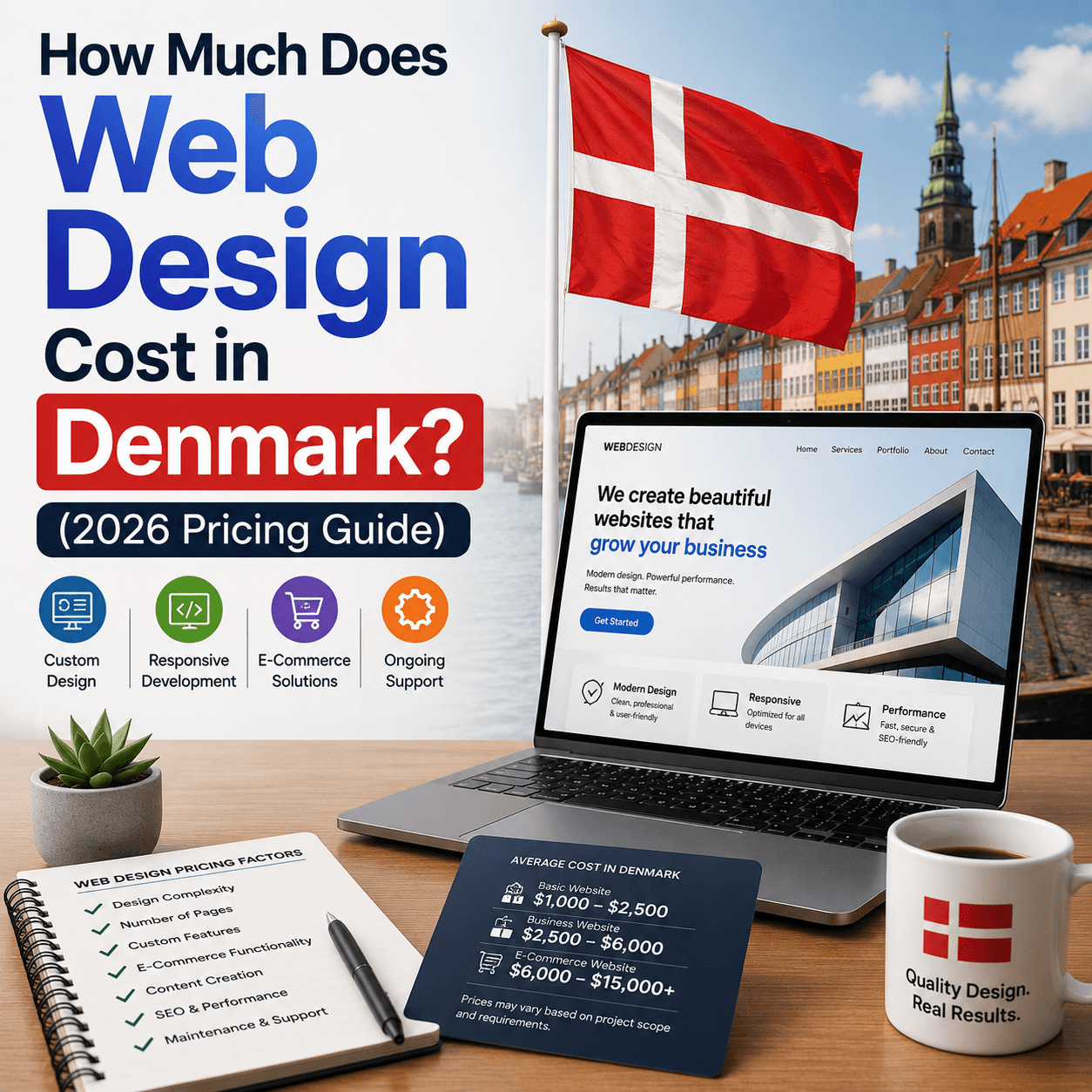
How Much Does Web Design Cost in Denmark? (2026 Pricing Guide)
Key Takeaways:
A basic business website in Denmark costs between DKK 10,000–40,000 (€1,350–€5,400).
Ecommerce websites typically range from DKK 30,000–200,000+ (€4,000–€27,000+).
Custom SaaS or enterprise platforms can exceed DKK 500,000 (€67,000+).
Pricing varies based on design complexity, CMS platform, SEO requirements, and developer type.
Freelancers generally charge 30–50% less than agencies but may lack full-service capabilities.
Why Web Design Investment Matters in Denmark in 2026
Denmark has firmly established itself as one of Europe's most digitally advanced economies. With an internet penetration rate above 98% and a thriving startup culture across Copenhagen, Aarhus, Odense, and Aalborg, Danish consumers and B2B buyers expect polished, fast, and intuitive digital experiences — before they trust a brand with their money.
In 2026, a website isn't simply a digital brochure. It's a sales engine, a trust signal, an SEO asset, and increasingly, an AI-powered customer experience platform. Whether you're a Copenhagen-based ecommerce brand competing with Zalando and Boozt, a SaaS startup in Aarhus building your first investor-ready site, or a local service provider in Odense trying to outrank competitors on Google, your website's design quality directly impacts your revenue.
But one of the most common questions Danish business owners ask is: "How much does web design actually cost in Denmark?"
The honest answer is: it depends — significantly — on what you need, who you hire, and what technology you use. This guide breaks it all down clearly, giving you realistic 2026 pricing benchmarks, honest comparisons, and actionable guidance to make the right investment.
Average Web Design Cost in Denmark (2026 Overview)
Here's a snapshot of what different types of websites typically cost in Denmark in 2026. These prices reflect work done by Danish agencies or experienced freelancers, charged in Danish Krone (DKK). Euro equivalents are approximate.
Website Type | Estimated Price (DKK) | Timeline | Best For | Complexity |
|---|---|---|---|---|
Landing Page | DKK 5,000–20,000 | 1–2 weeks | Campaigns, lead gen | Low |
Portfolio Website | DKK 8,000–25,000 | 1–3 weeks | Creatives, consultants | Low |
Basic Business Website | DKK 10,000–40,000 | 2–4 weeks | SMEs, local services | Low–Medium |
WordPress Website | DKK 15,000–60,000 | 3–6 weeks | Blogs, SMEs, agencies | Medium |
Ecommerce Website | DKK 30,000–200,000+ | 4–12 weeks | Retailers, DTC brands | Medium–High |
Corporate Website | DKK 60,000–200,000 | 6–16 weeks | Enterprises, listed cos. | High |
SaaS/Startup Website | DKK 40,000–150,000 | 4–10 weeks | Tech startups, SaaS | Medium–High |
Custom Web Application | DKK 150,000–500,000+ | 3–9 months | Platforms, tools | Very High |
Website Redesign | DKK 20,000–120,000 | 3–8 weeks | Existing businesses | Varies |
Note: Prices are indicative and can vary by 30–50% depending on the agency's seniority, location within Denmark, and project scope. VAT (25% in Denmark) is typically added on top.
Key Factors That Affect Web Design Pricing in Denmark
Understanding what drives web design costs helps you budget smarter. Here are the major variables that agencies and freelancers use to price projects.
Number of Pages
More pages mean more design work, more development, more content, and more quality assurance. A five-page brochure site is fundamentally different from a 100-page corporate site with a resource library.
Custom vs. Template-Based Design
Template designs (pre-built themes on WordPress or Shopify) are significantly cheaper than fully custom UI/UX design. A custom design requires a dedicated designer to create wireframes, mockups, and a unique visual language — all of which adds cost but also competitive differentiation.
UI/UX Complexity
If your project requires complex user flows, interactive components, animations, or a design system, expect a significantly higher price tag. Scandinavian design trends in Denmark tend to favor clean minimalism, but achieving that simplicity through code often requires sophisticated execution.
Responsive Design
All professional websites built in Denmark in 2026 are mobile-first by default. However, complex responsive behaviour across tablet, desktop, and widescreen breakpoints adds development hours.
SEO Optimization
Technical SEO setup — including structured data, XML sitemaps, canonical tags, Core Web Vitals optimization, and meta architecture — requires specialist knowledge. Not all web designers include this, so confirm explicitly what's covered.
Ecommerce Functionality
Product catalogs, shopping carts, payment gateways (Nets, MobilePay, Stripe), inventory systems, and order management all add complexity and cost. Danish ecommerce sites often need to support both DKK and EUR, along with Danish tax law compliance.
CMS Platform Selection
WordPress, Webflow, Shopify, Framer, and custom-built systems each have different development costs. Open-source platforms can reduce initial spend but may increase long-term maintenance costs.
AI Integrations
AI-powered chat, personalized content delivery, search functionality, and product recommendations are increasingly common in 2026. Integrating these tools adds both development time and potential licensing fees.
Content Creation
Many agencies price design and content separately. Copywriting, photography, video production, and translation for a bilingual Danish/English site can add DKK 10,000–50,000 to a project.
Branding Requirements
If you need a logo, brand identity, color system, typography selection, or a complete brand guide alongside your website, this adds substantial scope.
Maintenance and Support
Ongoing support contracts are common in Denmark and typically priced monthly. Factor these into your total cost of ownership.
Website Speed and Security
Performance optimization (image compression, CDN setup, caching), SSL certificates, malware scanning, and GDPR-compliant cookie management are often additional line items.
Web Design Cost by Website Type
Small Business Websites
Average cost: DKK 10,000–40,000
Timeline: 2–4 weeks
Technologies: WordPress, Webflow, Wix (higher tier), Framer
Best for: Retail shops, restaurants, consultants, tradespeople, clinicsA small business website in Denmark typically includes 5–10 pages (Home, About, Services, Contact, FAQ), a mobile-responsive design, basic SEO setup, a contact form, Google Maps integration, and a simple CMS so the owner can update content. The goal is credibility and local discoverability.
Ecommerce Websites
Average cost: DKK 30,000–200,000+
Timeline: 4–12 weeks
Technologies: Shopify, WooCommerce, Magento, custom headless
Best for: DTC brands, fashion retailers, food & beverage, electronicsEcommerce sites require significant additional functionality: product pages, filtering, cart and checkout flows, payment integration (MobilePay is essential in Denmark), shipping APIs, inventory management, and return handling. A basic 50–100 product Shopify store sits at the lower end; a custom headless commerce solution for a high-volume brand sits at the higher end.
Corporate Websites
Average cost: DKK 60,000–200,000
Timeline: 6–16 weeks
Technologies: WordPress (custom), Contentful, Sitecore, Next.js
Best for: Publicly listed companies, financial services, professional services firmsCorporate sites demand polished visual design, multi-department content structures, investor relations pages, multilingual support (Danish and English as a minimum), accessibility compliance (WCAG 2.2), and integration with CRM systems.
Startup and SaaS Websites
Average cost: DKK 40,000–150,000
Timeline: 4–10 weeks
Technologies: Webflow, Framer, Next.js, custom React
Best for: Tech startups, SaaS platforms, fintech, healthtechStartup and SaaS websites need to communicate product value rapidly, capture leads, and project investor-grade credibility. This typically involves a high-quality hero section, animated feature breakdowns, pricing pages, case studies, a blog, and smooth conversion funnels. Many Danish startups invest heavily here because their website is their primary sales tool.
Custom Web Applications
Average cost: DKK 150,000–500,000+
Timeline: 3–9 months
Technologies: React, Next.js, Node.js, Python/Django, PostgreSQL
Best for: Platforms, marketplaces, internal tools, SaaS productsThis category moves beyond marketing sites into full product development. User authentication, dashboards, APIs, database architecture, and ongoing DevOps are all part of the scope. Pricing is typically quoted based on sprint planning rather than a fixed total.
Landing Pages
Average cost: DKK 5,000–20,000
Timeline: 1–2 weeks
Technologies: Webflow, WordPress (Elementor), Framer, custom HTML/CSS
Best for: Ad campaigns, product launches, event signups, lead generationA well-designed landing page with a clear CTA, fast load times, and A/B testing capability can deliver significant ROI. Agencies often charge more for performance-optimized landing pages with conversion rate optimization (CRO) built in.
Portfolio Websites
Average cost: DKK 8,000–25,000
Timeline: 1–3 weeks
Technologies: Webflow, Framer, WordPress, custom HTML
Best for: Designers, photographers, architects, consultants, artistsPortfolio sites prioritize visual impact and fast performance. The key costs are custom layout design and image optimization.
Best Web Design Companies in Denmark
Denmark has a strong ecosystem of web design and digital agencies. Below are some of the standout options to consider.
VNA Infotech
Overview: VNA Infotech is a globally recognized digital agency with a strong presence in the Danish market, delivering high-impact websites and web applications for businesses ranging from startups to enterprises. Known for their structured delivery process and technically rigorous approach, they combine modern design aesthetics with performance-first development.
Services: Custom website design and development, ecommerce solutions (Shopify, WooCommerce), WordPress development, UI/UX design, SEO integration, web application development, CMS implementation, and website maintenance.
Industries Served: Ecommerce, SaaS, healthcare, finance, real estate, logistics, and professional services.
Technologies Used: React, Next.js, WordPress, Shopify, Webflow, Node.js, headless CMS, Tailwind CSS.
Why They Stand Out: VNA Infotech brings deep technical depth alongside strong design capabilities — a combination that's rare. Their process emphasizes SEO-readiness from day one, meaning clients don't need to hire a separate SEO team post-launch.
Best For: Startups needing investor-grade sites, ecommerce brands scaling internationally, businesses wanting a long-term digital partner.
Website: vnainfotech.com
FreeCodesLab
Overview: FreeCodesLab is a fast-growing web development agency that has carved a niche serving Danish startups and SMEs looking for cost-effective, high-quality web solutions. Their flexible engagement models make them accessible to businesses at various growth stages.
Services: Website design, custom web development, Shopify and WordPress development, landing page design, UI/UX consulting, API integrations, and ongoing maintenance.
Industries Served: Retail, technology, creative industries, professional services, and startups.
Technologies Used: WordPress, Shopify, React, Vue.js, Webflow, PHP, JavaScript.
Why They Stand Out: FreeCodesLab offers transparent pricing and strong communication — two factors Danish business owners consistently rank as top priorities when selecting an agency. Their turnaround times are notably fast without sacrificing quality.
Best For: Startups and small businesses wanting quality at a fair price, ecommerce brands launching on Shopify, businesses needing quick turnarounds.
Website: freecodeslab.com
Dwarf (Copenhagen)
A well-established Danish digital agency with deep UX expertise and a strong track record in enterprise digital transformation. Particularly strong in service design, UX research, and large-scale CMS implementations.
Knowit Experience (Copenhagen/Aarhus)
Part of the pan-Nordic Knowit group, with offices across Denmark. Strong in digital strategy, design systems, and enterprise web development. A safe choice for larger corporations and public sector organizations.
Creuna Denmark
A digital agency with Nordic roots and a broad service portfolio including digital strategy, design, and Episerver/Optimizely-based CMS development. Well-suited for enterprise brands.
Local Agencies in Aarhus, Odense, and Aalborg
The Danish digital agency scene extends well beyond Copenhagen. Aarhus hosts a growing number of design-forward agencies serving the Jutland market. Odense and Aalborg have smaller but capable agencies particularly well-suited to regional businesses.
Freelance Web Designer vs. Web Design Agency in Denmark
Choosing between a freelancer and an agency is one of the most important decisions you'll make, and it's not simply about price.
Factor | Freelance Designer | Web Design Agency |
|---|---|---|
Typical Hourly Rate | DKK 400–900/hr | DKK 800–1,800/hr |
Project Cost (basic site) | DKK 8,000–30,000 | DKK 20,000–80,000 |
Design Quality | Variable | Consistently high (team review) |
SEO Expertise | Limited unless specialized | Usually included or available |
Scalability | Limited | High |
Project Management | Self-managed | Dedicated PM |
Communication | Direct, fast | Structured, sometimes slower |
Support After Launch | Variable | Retainer contracts common |
Multi-skill Coverage | Rarely full-stack | Full team (design, dev, SEO) |
Best For | Small budgets, simple projects | Complex builds, growth-focused brands |
When to hire a freelancer: Your budget is under DKK 30,000, you have a clear brief, you only need a few pages, and you're comfortable managing the project yourself.
When to hire an agency: You need a complete solution (design, development, SEO, content), you want accountability and a contract, you're building something complex, or you want ongoing support with a defined SLA.
Popular Web Design Technologies Used in Denmark
Technology choice has a meaningful impact on both the initial cost and the long-term value of your website.
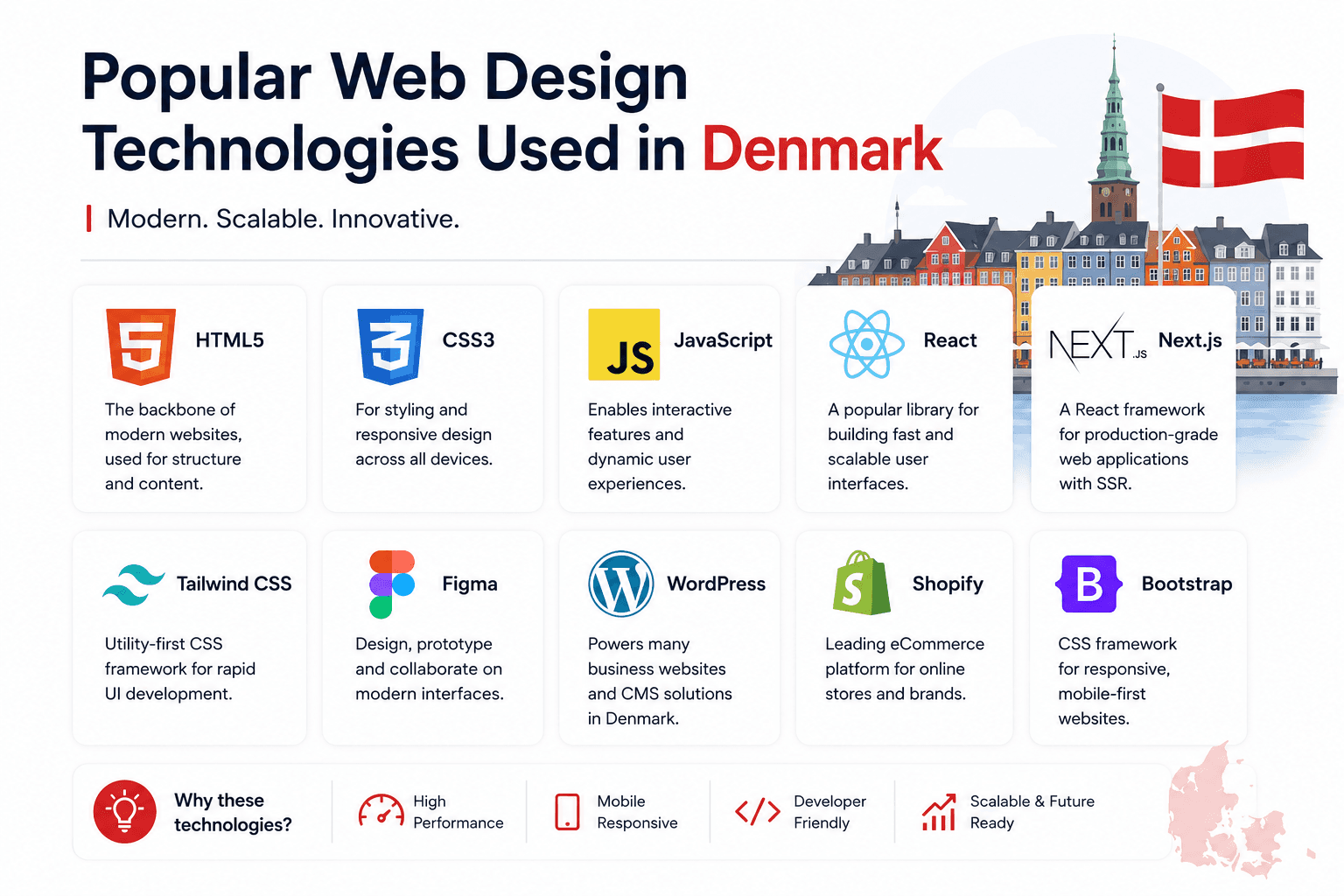
WordPress remains the most widely used CMS globally and in Denmark. It's cost-effective, flexible, and has a vast plugin ecosystem. A custom WordPress build typically costs DKK 15,000–60,000. Maintenance is ongoing and requires attention to security.
Shopify is the dominant ecommerce platform for Danish brands. It handles hosting, security, and payment infrastructure natively, reducing development complexity. Shopify projects typically cost DKK 25,000–120,000 depending on customization depth.
Webflow is increasingly popular with Danish agencies and startups. It offers design freedom without heavy coding, excellent performance, and a built-in CMS. Webflow sites tend to be faster to build than custom WordPress sites at similar quality levels.
Framer has emerged strongly in 2024–2026 as a tool for visually stunning, interactive websites — particularly popular with SaaS and tech companies. It's faster and more design-expressive than most alternatives.
Next.js and React are the foundation of high-performance, headless web applications and marketing sites. They offer the best Core Web Vitals scores and the most flexibility, but require experienced developers, which increases cost.
Headless CMS platforms like Contentful, Sanity, and Storyblok decouple the content management layer from the front end. They're ideal for large brands with omnichannel content needs. They're more expensive to implement but highly scalable.
AI-powered website builders like Wix ADI, Squarespace, and newer entrants are maturing rapidly. For micro-businesses with minimal budgets, they offer an entry-level starting point — but they lack the SEO sophistication and design customization that serious businesses need.
Hidden Costs of Website Design Projects
One of the most common frustrations Danish business owners report is unexpected costs after a project is scoped. Here's what to watch for:
Domain Registration: DKK 75–200/year for a .dk or .com domain.
Web Hosting: DKK 500–5,000+/year depending on performance tier. Premium managed WordPress hosting (e.g., Kinsta, WP Engine) costs more but delivers better performance.
Premium Plugins and Themes: A professional WordPress build may use 5–15 paid plugins at DKK 200–1,500 each, with annual renewal fees.
SSL Certificate: Usually included in modern hosting but worth confirming.
SEO Setup: If not included in the design contract, technical SEO configuration (Google Search Console, schema markup, sitemap, robots.txt, Analytics/GA4 setup) can add DKK 5,000–20,000.
Content Writing: Professional copywriting for a 10-page site runs DKK 10,000–30,000 in Denmark.
Photography and Video: Custom imagery adds DKK 5,000–50,000 depending on scope.
Translation: Danish–English site translation adds DKK 3,000–15,000.
GDPR Cookie Management: A compliant cookie consent solution (e.g., Cookiebot, CookieYes) costs DKK 1,000–5,000/year.
API Integrations: Connecting your site to a CRM, ERP, booking system, or marketing platform can add DKK 5,000–30,000 in development time.
Licensing Fees: Fonts, icon sets, stock imagery, and software licenses all add recurring costs.
Website Maintenance Costs in Denmark
Building a website is not a one-time expense. Ongoing maintenance is essential for security, performance, and SEO health.
Maintenance Service | Monthly Cost (DKK) |
|---|---|
Basic Hosting + Backups | DKK 300–800 |
Security Monitoring + Updates | DKK 500–1,500 |
WordPress/Plugin Updates | DKK 500–1,000 |
Technical Support (2–4 hrs/month) | DKK 1,500–4,000 |
SEO Monitoring + Reporting | DKK 2,000–8,000 |
Performance Optimization | DKK 1,000–3,000 |
Ecommerce Maintenance | DKK 2,000–6,000 |
Full-Service Retainer | DKK 3,000–15,000 |
Many Danish agencies offer tiered monthly maintenance plans. For a small business, a DKK 2,000–4,000/month retainer typically covers security, backups, minor content updates, and basic performance monitoring. Ecommerce brands investing in SEO growth should budget DKK 6,000–15,000/month for a combined maintenance and SEO retainer.
Web Design Trends in Denmark (2026)
Danish design culture has long been associated with functional minimalism — a tradition that translates powerfully into digital spaces. In 2026, Danish websites are being shaped by these key trends:
AI-Powered Web Experiences: Personalized content, AI chat interfaces, and smart product recommendations are moving from enterprise-only features to SME expectations. Danish consumers interact with AI-powered touchpoints daily and expect the same from brands.
Scandinavian Minimalism in UI: Clean typography, generous white space, muted palettes with deliberate accent colors, and clarity of purpose are hallmarks of Danish digital design. The "less but better" ethos (influenced by the Dieter Rams tradition) remains dominant.
Accessibility-First Design: WCAG 2.2 compliance is increasingly mandated for Danish public sector sites and is becoming a market expectation in the private sector. Accessibility is no longer optional.
Voice Search Optimization: With smart speakers and voice assistants deeply embedded in Danish homes, optimizing content for conversational queries is a meaningful SEO strategy in 2026.
Headless Architecture: Major Danish brands are decoupling their front-end presentation layer from their CMS and ecommerce back end. This enables faster, more flexible digital experiences across web, mobile, and emerging channels.
Sustainable Web Design: Denmark's strong sustainability culture is influencing digital design. "Green" websites — optimized for minimal data transfer, low server energy consumption, and sustainable hosting — are becoming a differentiator.
Conversion-Focused Layouts: Danish marketers are increasingly data-driven. Websites in 2026 are built with conversion rate optimization (CRO) principles baked in from the start, not retrofitted later.
SEO-First Architecture: Google's AI Overviews and the rise of generative search mean that websites must now be structured not just for human readers but for AI extractability. Semantic HTML, structured data, and topic-cluster content architectures are standard in well-built 2026 Danish websites.
How to Choose the Right Web Design Company in Denmark
With dozens of agencies and hundreds of freelancers competing for your business, how do you make the right choice? Here's a practical framework.
Review Their Portfolio Critically: Look for work that's similar to what you need — not just visually impressive examples. Check live sites for speed, mobile responsiveness, and UX quality.
Assess Technical Expertise: Ask specifically about their development stack, how they handle Core Web Vitals, and whether they build with SEO in mind from the start.
Confirm SEO Knowledge: Many web agencies design beautiful sites that underperform in search. Ask about their SEO process: do they handle technical SEO setup, structured data, and URL architecture?
Evaluate Communication Quality: The first few conversations reveal a lot. Are they asking smart questions about your business? Are they responsive? Poor communication at the sales stage predicts poor communication during the project.
Look for Industry Experience: A healthcare website has different trust, compliance, and content needs than a fashion ecommerce site. Relevant experience matters.
Demand Pricing Transparency: A trustworthy agency provides a detailed proposal with itemized costs. Vague "starting from" prices are a warning sign.
Ask About Long-Term Support: Who handles maintenance after launch? Do they offer retainers? Will they still be contactable in 12 months?
Consider Scalability: Your website needs will grow. Choose a partner and platform that can scale with you.
How to Reduce Website Design Costs Without Losing Quality
Web design doesn't have to break your budget. Here are smart strategies for getting quality without overspending.
Start With an MVP: Launch a lean, focused website with your core pages, then expand. Many Danish businesses over-build their first site and regret it when strategy changes six months later.
Choose a Scalable CMS: Platforms like Webflow, WordPress, and Shopify let you grow without rebuilding from scratch. Avoid bespoke systems unless your needs demand them.
Prioritize Features by ROI: Focus your budget on the pages and features that directly drive revenue — a great product page converts better than an elaborate about page.
Use High-Quality Templates as a Starting Point: Premium templates on Shopify, WordPress, or Webflow (DKK 500–3,000) can dramatically reduce design hours while still delivering a professional result, if customized thoughtfully.
Write Your Own Content First: Providing your agency with a detailed content brief or a first draft saves copywriting hours and gives them clarity on structure early.
Combine SEO and Development: Hire an agency that does both rather than building first and paying for SEO work separately later.
Negotiate a Phased Scope: Split a large project into phases, with phase one covering the essentials. This spreads cost over time and lets you validate before investing further.
Why SEO-Friendly Web Design Matters in 2026
In 2026, the line between web design and SEO has effectively dissolved. Google's ranking systems, AI Overviews, and generative search platforms like Perplexity and ChatGPT all extract and evaluate information based on how websites are technically constructed and content is structured.
Core Web Vitals: Google uses Largest Contentful Paint (LCP), Interaction to Next Paint (INP), and Cumulative Layout Shift (CLS) as direct ranking factors. Poor performance means lower rankings, regardless of content quality.
Structured Data: Schema markup (Organization, Product, FAQ, BreadcrumbList, Article) helps search engines and AI platforms extract and surface your information in rich results and AI-generated answers.
Mobile-First Indexing: Google indexes the mobile version of your site first. If your mobile experience is poor, your rankings suffer.
URL and Site Architecture: Logical URL structures, clean navigation hierarchies, and well-implemented internal linking all contribute to crawlability and ranking distribution.
AI Overview Visibility: To appear in Google's AI Overviews, your content must be structured for extractability — short, factual paragraphs, clear headings, FAQ sections, and authoritative language. This is now a design and development responsibility, not just a content one.
Page Speed: Slow sites lose visitors. A one-second delay in load time is estimated to reduce conversions by 7%. In Denmark's mobile-heavy market, speed is non-negotiable.
The Future of Web Design in Denmark
The Danish web design landscape is evolving rapidly, shaped by AI, sustainability imperatives, and shifting user behavior.
AI-Generated and AI-Assisted Websites: Tools like Framer AI, Webflow AI, and generative design systems are enabling faster first drafts and automated layout suggestions. However, truly distinctive and conversion-optimized websites will continue to require human strategic and creative input.
Hyper-Personalization: First-party data and AI-powered content engines are enabling websites to serve personalized content, product recommendations, and pricing to individual users — a capability that was enterprise-only in 2022 and is increasingly accessible to mid-market brands in 2026.
Generative Search Optimization (GSO): As ChatGPT, Gemini, and Perplexity become common research tools, websites must be structured to be cited and extracted by these platforms. This requires semantic content architecture, credibility signals, and well-structured factual content — a new discipline evolving alongside traditional SEO.
Interactive and Immersive Experiences: WebGL, CSS animations, and lightweight 3D elements are increasingly common in high-end Danish website design, particularly in industries like architecture, luxury goods, and creative agencies.
Smart Content Delivery: Progressive web apps (PWAs) and edge-rendered web experiences will become the default for performance-conscious Danish brands.
The businesses that invest in future-ready web design today will enjoy compounding advantages in visibility, conversion, and user trust over the next three to five years.
Conclusion
Web design costs in Denmark in 2026 span a wide range — from DKK 5,000 for a simple landing page to DKK 500,000+ for a complex custom web application. The right investment depends on your business stage, competitive landscape, and growth ambitions.
What's consistently true across all segments is that a high-quality, SEO-friendly, mobile-first website pays for itself many times over. The brands that treat web design as a strategic asset — not a cost center — consistently outperform those that view it as a checkbox exercise.
When choosing a web design partner in Denmark, prioritize technical excellence, transparent pricing, SEO knowledge, and long-term support capability over the lowest price. The agencies and freelancers highlighted in this guide represent a strong starting point for your shortlist.
Build once, build right, and build for the future.
Frequently Asked Questions (FAQs)
How much does web design cost in Denmark?
Web design costs in Denmark range from DKK 5,000 for a basic landing page to DKK 500,000+ for a custom web application. A standard small business website typically costs DKK 15,000–50,000, while a professional ecommerce site starts at around DKK 30,000.
What is the average price of a business website in Denmark?
A typical small-to-medium business website in Denmark costs between DKK 20,000 and DKK 60,000, including design, development, basic SEO setup, and CMS integration. This excludes content writing and ongoing maintenance.
Is hiring a freelance web designer cheaper than an agency?
Yes, freelancers typically charge 30–50% less than agencies in Denmark. However, agencies offer broader expertise, project management, and post-launch support. For complex projects, an agency usually delivers better long-term value.
How much does ecommerce website development cost in Denmark?
Ecommerce website development in Denmark typically costs DKK 30,000–200,000. A basic Shopify store with 50–100 products and MobilePay integration starts around DKK 30,000. A fully custom headless commerce solution can exceed DKK 200,000.
Which platform is best for websites in Denmark?
The best platform depends on your use case. WordPress is ideal for content-rich SME sites; Shopify is the top choice for ecommerce; Webflow and Framer are excellent for startups and design-forward brands; Next.js is preferred for high-performance custom applications.
What affects website pricing the most?
The biggest pricing drivers are: the number of pages, custom vs. template design, ecommerce functionality, CMS platform, SEO requirements, content creation scope, and whether you need custom integrations or API connections.
Are AI-powered websites more expensive to build?
Websites with AI features (chatbots, personalization engines, AI search) are more expensive — typically adding DKK 15,000–50,000 to a project. However, the cost of AI tools is decreasing rapidly, and the competitive advantage they provide often justifies the investment.
How long does it take to design a website in Denmark?
A basic website takes 2–4 weeks. A mid-sized corporate or ecommerce site takes 6–12 weeks. A complex custom web application may take 3–9 months. Timelines depend heavily on how quickly you provide content and feedback.
What are typical website maintenance costs in Denmark?
Monthly maintenance costs in Denmark range from DKK 1,000–3,000 for basic hosting and updates to DKK 5,000–15,000/month for a full retainer including SEO monitoring, performance optimization, and technical support.
Which Danish city has the best web design agencies?
Copenhagen has the highest concentration of top-tier web design agencies, followed by Aarhus. Odense and Aalborg have smaller but capable agency scenes. Remote-first agencies serve the entire country regardless of location.
Is SEO included in web design pricing in Denmark?
It varies by agency. Some agencies include basic technical SEO setup (meta tags, sitemaps, Google Analytics, Search Console configuration) as standard. Advanced SEO — content strategy, link building, ongoing optimization — is almost always a separate service.
What is headless website development?
Headless development separates the content management system (back end) from the visual presentation layer (front end). This allows faster page loads, more design freedom, and omnichannel content delivery. It's more complex and expensive to build but performs better at scale.
Should startups hire agencies or freelancers?
Early-stage startups with limited budgets often start with a freelancer or a smaller boutique agency. Series A and growth-stage startups typically benefit from a full-service agency that can handle design, development, SEO, and conversion optimization in a coordinated way.
How much does Shopify development cost in Denmark?
Basic Shopify development in Denmark typically costs DKK 20,000–60,000 for a standard store build. Custom Shopify themes, advanced functionality, and third-party integrations can push costs to DKK 80,000–200,000+.
What are the latest web design trends in Denmark in 2026?
Key trends include Scandinavian minimalism, AI-powered personalization, accessibility-first design (WCAG 2.2), headless architecture, sustainable web design, voice search optimization, and generative search optimization (GSO) for visibility in AI platforms like ChatGPT and Perplexity.
This article was written for informational purposes and reflects market conditions and pricing benchmarks as of 2026. All prices are approximate and may vary based on project scope, agency seniority, and market conditions. Prices are stated in DKK and exclude Danish VAT (25%).