How Much Does AI Software Development Cost in Spain?
Posted on
Web Design
Posted at

How Much Does AI Software Development Cost in Spain? (2026 Complete Guide)
The definitive pricing guide for startups, enterprises, and international companies investing in AI software development in Spain.
Key Takeaways
AI software development in Spain costs €15,000–€500,000+ depending on project type and complexity
Spanish AI developers charge €40–€100/hour — significantly cheaper than the US and UK, with comparable quality
Spain's tech ecosystem is now worth over €123 billion, making it the second-fastest-growing startup market in Europe
Barcelona and Madrid lead the AI development landscape, with emerging hubs in Valencia, Malaga, and Bilbao
Hidden costs — API fees, cloud infrastructure, model retraining — can add 20–40% to initial project budgets
Why AI Software Investment in Spain Is Accelerating in 2026
Artificial intelligence has moved from competitive advantage to operational necessity. Across industries — from logistics to healthcare, fintech to ecommerce — companies that haven't started their AI transformation are already playing catch-up. The question most businesses are asking isn't whether to invest in AI software. It's how much it will cost, where to build it, and which development partner to trust.
Spain has emerged as one of the most strategically attractive destinations for AI software development in Europe. The combination of a rapidly growing tech ecosystem, a strong university pipeline of AI engineers, development costs that are 40–60% lower than the US or UK, and a CET time zone that works seamlessly with clients across Europe and the Middle East makes Spain an increasingly compelling choice.
This guide gives you a comprehensive, honest breakdown of AI software development costs in Spain in 2026 — from simple chatbot projects to enterprise-grade machine learning platforms. You'll also find hourly rate benchmarks, project type cost tables, a country-by-country comparison, and practical guidance on choosing the right development partner.
Why Spain Is Becoming a Hub for AI Software Development
Spain's transformation into a serious AI development hub isn't coincidental — it's the result of converging structural advantages that have built up over the past decade.
A Rapidly Growing Tech Ecosystem
Spain's startup ecosystem has reached an enterprise value of over €123 billion, according to The Spanish Tech Ecosystem Report 2026. The country now ranks as the second-fastest-growing startup market in Europe over the past five years. Barcelona and Madrid anchor the primary clusters, but strong secondary ecosystems have taken root in Valencia, Bilbao, Malaga, and San Sebastián.
The AI vertical is one of the strongest growth drivers within this ecosystem. Active AI companies across Spain are working on everything from AI-native clinical trials platforms (Biorce, Barcelona) to agentic cybersecurity systems (Zynap, Barcelona) to AI-powered debt recovery automation (Murphy, Barcelona). This is not a nascent scene experimenting with AI — it's a mature and diverse ecosystem producing fundable, deployable AI products.
Competitive Development Costs Without Quality Compromise
This is the critical differentiator. Spanish AI developers command hourly rates of €40–€100/hour — significantly less than US or UK developers ($150–$250/hour for senior AI specialists), but without the communication, time zone, or quality consistency challenges that sometimes accompany lower-cost offshore destinations. For international companies, Spain represents a nearshore option that genuinely competes on talent quality while delivering a 40–60% cost reduction versus Western European equivalents.
Strong Academic Pipeline for AI Talent
Spanish universities — particularly UPC Barcelona, Universidad Complutense de Madrid, and the University of Valencia — have expanded AI and machine learning programs significantly over the past five years. The result is a growing generation of Spanish AI engineers with hands-on experience in Python, TensorFlow, PyTorch, LangChain, transformer architectures, and cloud AI infrastructure.
Government Digital Investment and EU Alignment
Spain has been an active beneficiary of EU digital transformation funds, including NextGenerationEU. Government initiatives have specifically targeted AI infrastructure, digital skills development, and startup ecosystem support. Spain's alignment with the EU AI Act — now in full implementation — means Spanish development agencies are already building AI systems that meet European regulatory standards, which is a meaningful advantage for businesses that need EU-compliant AI.
CET Time Zone and Language Accessibility
For UK, European, and North African clients, Spain's CET time zone provides near-perfect overlap. Most Spanish AI agencies work comfortably in English, and many have bilingual or fully English-speaking development teams. This removes the communication friction that makes some offshore development relationships expensive in practice even when cheap on paper.
Average AI Software Development Cost in Spain: Pricing Overview
The table below provides estimated cost ranges for common AI software project types, based on 2026 market pricing from Spanish development agencies and independent consultants.
AI Project Type | Complexity | Team Size | Timeline | Estimated Cost (Spain) |
|---|---|---|---|---|
Basic AI Chatbot (FAQ/support) | Low | 2–3 devs | 4–8 weeks | €15,000–€35,000 |
Advanced AI Chatbot (LLM-powered, CRM-integrated) | Medium | 3–5 devs | 8–16 weeks | €35,000–€90,000 |
Generative AI Application (text/image/code gen) | Medium–High | 4–6 devs | 12–24 weeks | €60,000–€150,000 |
Machine Learning Software (custom models) | High | 5–8 devs | 16–32 weeks | €80,000–€200,000 |
AI SaaS Platform (full product) | High | 6–10 devs | 24–52 weeks | €120,000–€400,000+ |
AI Mobile Application | Medium | 3–5 devs | 10–20 weeks | €40,000–€120,000 |
Computer Vision System | High | 4–7 devs | 16–30 weeks | €70,000–€200,000 |
Predictive Analytics Platform | Medium–High | 4–6 devs | 14–28 weeks | €60,000–€180,000 |
NLP Application (document processing, extraction) | Medium | 3–5 devs | 10–20 weeks | €50,000–€130,000 |
AI Ecommerce Solution (recommendations, search) | Medium | 3–5 devs | 8–18 weeks | €40,000–€100,000 |
Enterprise AI Automation Platform | Very High | 8–15 devs | 30–60 weeks | €200,000–€500,000+ |
AI MVP / Proof of Concept | Low–Medium | 2–4 devs | 4–10 weeks | €15,000–€50,000 |
Estimates are indicative ranges based on 2026 market data. Actual costs vary by agency size, technical complexity, integration requirements, and client specifications.
Hourly Rates for AI Developers in Spain (2026)
Developer Level | Hourly Rate (Agency) | Hourly Rate (Freelance) |
|---|---|---|
Junior AI Developer (1–3 years) | €40–€55/hr | €30–€45/hr |
Mid-Level AI Developer (3–6 years) | €55–€75/hr | €50–€70/hr |
Senior AI Engineer (6+ years) | €75–€100/hr | €70–€95/hr |
AI Architect / Principal Engineer | €100–€130/hr | €90–€120/hr |
AI Project Manager | €60–€85/hr | €50–€75/hr |
Data Scientist | €65–€90/hr | €55–€85/hr |
ML Engineer | €70–€100/hr | €60–€90/hr |
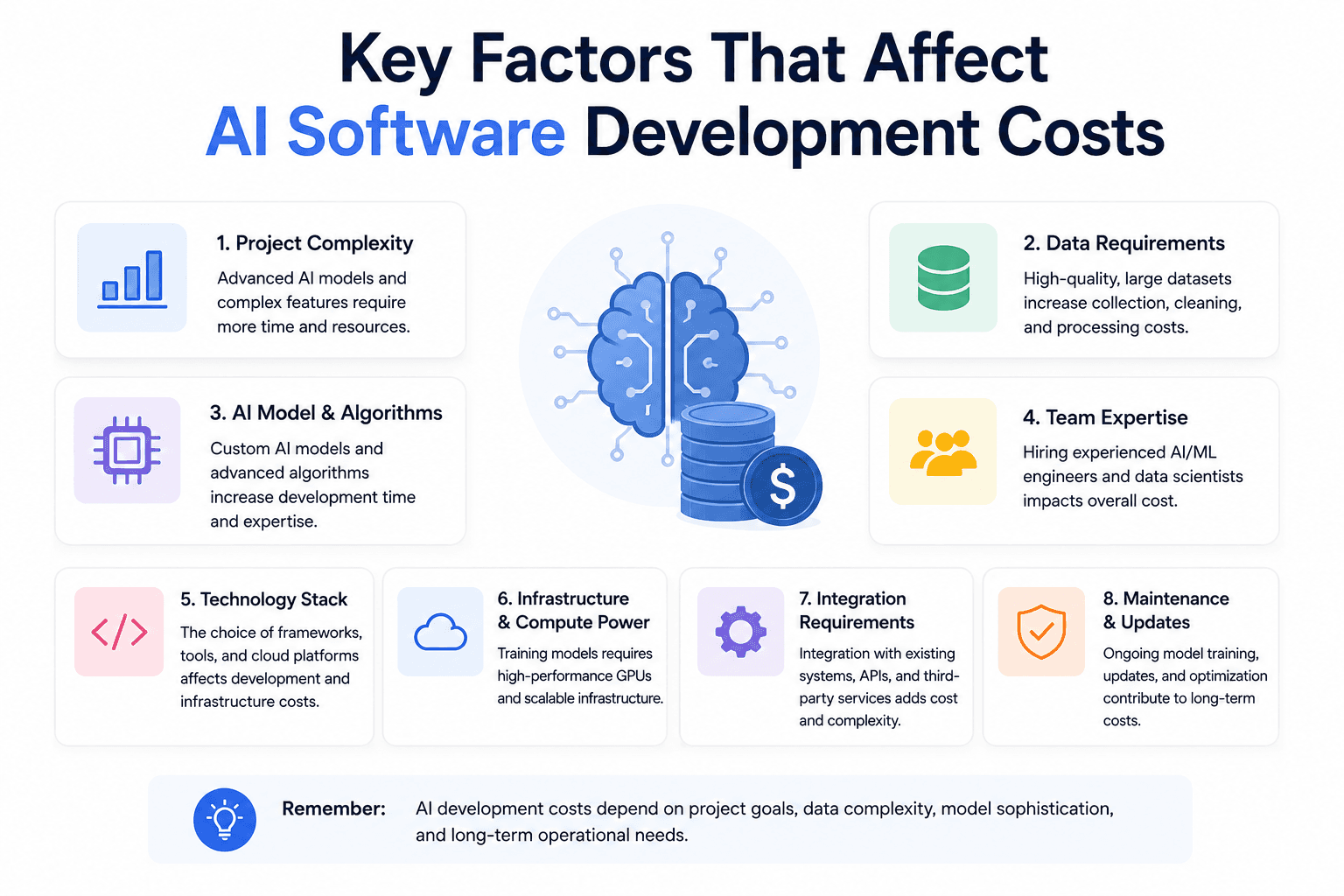
Key Factors That Affect AI Software Development Costs
Understanding why AI development costs what it does helps you budget accurately and avoid scope creep. These are the major cost variables.
1. Project Complexity and Scope
This is the single biggest cost driver. A simple chatbot built on top of OpenAI's API with a predefined FAQ knowledge base is a fundamentally different engineering challenge from a custom-trained machine learning model that analyzes medical imaging data. Complexity affects team size, development time, testing requirements, and infrastructure needs simultaneously.
2. Type of AI Technology
Different AI technologies have different cost profiles:
LLM integrations (GPT-4o, Claude, Gemini): Faster to build, lower engineering cost, but ongoing API costs
Custom machine learning models: Higher upfront engineering cost, more predictable running costs
Computer vision systems: Require significant data collection, labeling, and training infrastructure
Generative AI platforms: Complex pipeline architecture, model fine-tuning, and safety layers
AI agents and autonomous systems: Emerging complexity tier — orchestration, tool use, and reliability engineering are non-trivial
3. Data Collection and Model Training
AI systems are only as good as the data they're trained on. If your project requires collecting, cleaning, labeling, and structuring large datasets, budget for this separately. Data labeling alone can add €10,000–€50,000 to a project, depending on volume and annotation complexity. Model training on custom hardware adds cloud compute costs on top.
4. API and Third-Party Integrations
Most AI applications in 2026 use some combination of LLM APIs (OpenAI, Anthropic, Google), vector databases, search APIs, and CRM/ERP integrations. These integrations add development time and introduce ongoing API costs that vary significantly based on usage volume. A system making millions of API calls monthly can cost €3,000–€30,000/month in API fees alone — an ongoing cost that needs to be in your financial model from the start.
5. Cloud Infrastructure
AI workloads are compute-intensive. Whether you're running inference on GPU instances, training models on cloud clusters, or serving a high-traffic AI application, cloud costs are significant. AWS, Google Cloud, and Azure AI services are the standard providers for Spanish AI development teams. Budget €500–€10,000+/month for cloud infrastructure depending on scale, with a clear difference between development-phase costs and production-phase costs.
6. Development Team Experience and Seniority Mix
A team of senior AI engineers with deep specialization in your specific domain — healthcare AI, fintech ML, computer vision — will cost more per hour but typically deliver higher quality, faster, with fewer post-launch issues. A team with more junior developers at lower hourly rates might look cheaper upfront but often produces technical debt that's expensive to resolve later.
7. UI/UX Requirements
AI functionality needs to be wrapped in interfaces that users can actually use. A sophisticated ML model with a confusing interface generates no business value. Depending on the complexity of the user experience required, UI/UX design can represent 15–25% of total project cost.
8. Security, Compliance, and GDPR
EU data protection requirements, the EU AI Act, and industry-specific regulations (HIPAA equivalents for healthcare, PSD2 for fintech) add meaningful compliance engineering overhead. For regulated industries, budget 15–25% additional cost for security architecture, compliance documentation, and testing.
9. AI Model Retraining and Maintenance
AI systems require ongoing maintenance that traditional software doesn't. Models drift as data patterns change. APIs deprecate. New model versions improve performance but require integration work. Budget 15–25% of the original development cost annually for maintenance, retraining, and ongoing optimization.
Best AI Software Development Companies in Spain
1. VNA Infotech
Overview: VNA Infotech is a technology solutions provider with a growing AI development practice, serving clients across Europe and internationally. They specialize in end-to-end digital product development with increasing focus on AI-powered applications, automation systems, and custom software solutions.
Core AI services: AI SaaS development, chatbot and conversational AI, machine learning integration, API-first AI applications, web and mobile AI products.
Industries served: Technology companies, SaaS businesses, ecommerce, professional services, startups.
Technologies: Python, Node.js, React, OpenAI integrations, LangChain, AWS, headless CMS, Next.js.
Why they stand out: Broad full-stack capability combined with AI integration expertise. Strong track record in building complete digital products — not just AI features in isolation. Suited for companies that need a development partner who can own the full product, not just the AI layer.
Best for: Startups and growth-stage companies building AI-integrated SaaS products, web applications, and digital platforms.
Website: vnainfotech.com
2. FreeCodesLab
Overview: FreeCodesLab is a specialist software development agency with a strong emphasis on custom AI solutions, automation tools, and scalable digital products. Their team combines software engineering depth with practical AI implementation expertise.
Core AI services: Custom AI software development, generative AI applications, AI automation, NLP solutions, AI-powered web applications.
Industries served: Startups, ecommerce, SaaS, digital agencies, enterprise clients.
Technologies: Python, OpenAI API, LangChain, React, Node.js, cloud infrastructure (AWS/GCP).
Why they stand out: Focused AI development practice with emphasis on practical, deployable solutions. Strong combination of technical depth and project delivery efficiency, making them suitable for clients who need AI products built on time and budget.
Best for: Startups, SaaS companies, and businesses building AI-first products from scratch, particularly where speed to market is a priority.
Website: freecodeslab.com
Other Notable AI Development Companies in Spain
Sngular (Madrid): Enterprise digital transformation partner with strong AI and ML capabilities. Best for large-scale enterprise AI integration projects.
Taiger (Madrid): Specialized in enterprise AI workflow automation and semantic search. Strong track record with large corporate clients.
PREDICTIVA (Malaga): Research-led AI company focused on machine learning and predictive analytics. Strong for data science-intensive projects.
SoftKraft (Spain): AI, SaaS platforms, and cloud solutions with strong client reviews on Clutch. Praised for proactive project management and technical depth.
Murphy (Barcelona): AI agents for business process automation. Demonstrates what agentic AI architecture looks like in production at scale.
Biorce (Barcelona): AI-native clinical trials platform. Relevant for healthcare AI development requiring regulatory compliance expertise.
AI Development Cost by Project Type:
AI Chatbots: €15,000–€90,000
Basic support chatbot (pre-defined intents, FAQ-based): €15,000–€35,000. Uses existing LLM APIs with prompt engineering and a knowledge base. Integrates with website via widget. Timeline: 4–8 weeks.
Advanced conversational AI (LLM-powered, multi-turn, CRM-integrated, voice-capable): €35,000–€90,000. Involves RAG architecture, vector database, conversation memory, CRM handoff logic, and analytics. Timeline: 8–16 weeks.
Technologies typically used: OpenAI GPT-4o, Anthropic Claude, LangChain, Pinecone, Weaviate, HubSpot/Salesforce API, React frontend.
Best use cases: Customer support automation, lead qualification, internal knowledge assistants, HR onboarding tools.
AI SaaS Platforms: €120,000–€400,000+
Building an AI-native SaaS product from scratch is one of the most complex and expensive categories. It involves the full product development stack — infrastructure, AI pipeline, multi-tenant architecture, billing, authentication, user management, onboarding, and an evolving AI model layer.
Key components and their cost contributions:
AI model layer (LLM integration or custom ML): €30,000–€100,000
Backend API and data architecture: €40,000–€80,000
Frontend application (web or mobile): €30,000–€60,000
DevOps and cloud infrastructure setup: €15,000–€30,000
Security and compliance layer: €15,000–€40,000
Technologies: Next.js or React frontend, Python/FastAPI or Node.js backend, PostgreSQL + vector DB, AWS or GCP, Stripe, Auth0 or Clerk.
Timeline: 24–52 weeks for full product. An AI MVP can be scoped for €40,000–€80,000 in 12–16 weeks.
Generative AI Applications: €60,000–€150,000
Applications that generate text, images, code, video, or audio at scale. This includes document generation tools, AI writing assistants, AI design tools, synthetic data generators, and content automation platforms.
Cost drivers:
Fine-tuning foundation models: €10,000–€40,000 additional
Output safety and moderation layers: €8,000–€20,000
Multi-modal capabilities (text + image + voice): adds 40–60% to base cost
Technologies: GPT-4o, Claude 3.5 Sonnet, Gemini, Stable Diffusion, Midjourney API, LangChain, LlamaIndex, Python.
Enterprise AI Automation Tools: €200,000–€500,000+
These are full-scale AI workflow automation platforms for enterprise clients — replacing manual processes in HR, finance, operations, or customer service with AI-driven workflows. Complexity is high: multi-step process orchestration, system integrations (ERP, CRM, HRMS), audit logging, access controls, and scalability to thousands of concurrent users.
Examples in Spain's market: Taiger (Madrid) builds enterprise workflow automation using AI. Murphy (Barcelona) automates collections operations via AI agents.
Budget allocation:
Discovery and architecture: €20,000–€50,000
Core AI pipeline development: €80,000–€150,000
Enterprise integrations: €40,000–€80,000
Testing, QA, and compliance: €30,000–€60,000
Deployment and DevOps: €20,000–€40,000
Computer Vision Software: €70,000–€200,000
Vision AI — defect detection, quality control, medical imaging analysis, video surveillance analytics, facial recognition, object tracking — requires custom dataset collection, labeling, model training, and hardware-specific optimization.
Key variables: Labeled training data (can double project cost if dataset doesn't exist), GPU compute for training, edge deployment requirements, real-time vs. batch processing.
Technologies: PyTorch, TensorFlow, OpenCV, YOLO architectures, ONNX, NVIDIA CUDA, AWS Rekognition.
NLP Applications: €50,000–€130,000
Document processing, contract analysis, sentiment analysis, entity extraction, multilingual translation, and content classification are core NLP use cases with strong demand in Spain across legal, healthcare, and financial services.
Technologies: Hugging Face Transformers, spaCy, NLTK, BERT fine-tuning, OpenAI embeddings, LangChain document loaders.
Use cases in Spain: Legal document review (platforms like Bigle Legal), healthcare record extraction, multilingual customer communication processing.
AI Technologies Commonly Used by Spanish Development Teams
Understanding the technology stack helps you evaluate agency expertise and anticipate infrastructure costs.
Foundation Models and LLM APIs
OpenAI (GPT-4o): The most widely integrated LLM in commercial AI applications. Strong performance across text tasks, vision, and code.
Anthropic Claude: Preferred for document analysis, long-context tasks, and applications requiring reliable instruction-following.
Google Gemini: Strong for multimodal applications and Google Cloud ecosystem integrations.
Open-source models (Llama, Mistral): Used when data privacy requirements prevent sending data to external APIs, or when fine-tuning is needed without licensing restrictions.
AI Development Frameworks
LangChain / LlamaIndex: Standard orchestration frameworks for building RAG pipelines, AI agents, and multi-step LLM workflows.
TensorFlow / PyTorch: Core frameworks for custom model development, training, and deployment.
Hugging Face: Model hub and pipeline tools used extensively for NLP tasks and fine-tuning transformer models.
RAG (Retrieval-Augmented Generation): The dominant architecture pattern for knowledge-grounded AI applications in 2026.
Vector Databases
Vector databases are essential for similarity search, semantic retrieval, and RAG architectures:
Pinecone: Managed vector database, popular for commercial applications
Weaviate: Open-source with strong multimodal search capabilities
Chroma: Lightweight, developer-friendly, popular for MVPs and prototypes
pgvector: PostgreSQL extension for vector search — cost-effective for teams already on Postgres
Backend and Infrastructure
Python / FastAPI: The dominant backend stack for AI applications in Spain
Node.js: Used for real-time features, webhooks, and lightweight API layers
AWS / Google Cloud / Azure: All three major cloud providers are widely used; AWS and GCP dominate AI workloads
Docker / Kubernetes: Standard containerization and orchestration for production AI deployments
AI Agent Frameworks
Agentic AI — systems that autonomously plan, use tools, and complete multi-step tasks — has become a major development category in 2026:
CrewAI, AutoGen, LangGraph: Popular frameworks for building multi-agent systems
Browser Use, Playwright: For web-browsing agents
Function calling / tool use APIs: Built into GPT-4o and Claude for structured agent tool integration
Cost Comparison: Spain vs. Other Countries
One of the most frequently asked questions from international companies is how Spain compares to other common outsourcing and nearshore destinations.
Country | Junior AI Dev | Senior AI Dev | Quality Level | Time Zone (vs CET) | English Proficiency | EU Compliance |
|---|---|---|---|---|---|---|
Spain | €40–€55/hr | €75–€100/hr | High | CET (0hr) | High | Native |
USA | $80–$120/hr | $150–$250/hr | Very High | -6 to -9hrs | Native | Via compliance layer |
UK | £65–£90/hr | £120–£180/hr | Very High | -1hr | Native | Post-Brexit compliance |
Germany | €60–€80/hr | €100–€140/hr | Very High | CET (0hr) | High | Native |
Eastern Europe | €25–€40/hr | €50–€75/hr | High | +1 to +2hrs | Medium–High | Native |
India | $20–$35/hr | $45–$70/hr | Variable | +3.5 to +5.5hrs | Medium–High | Requires adaptation |
Key observations:
Spain occupies a clear sweet spot. Development costs are 40–60% lower than the US and UK, with none of the quality variability or communication challenges associated with low-cost offshore destinations. The CET time zone means Spanish agencies can hold morning calls with US East Coast clients and end-of-day syncs with Asia-Pacific teams. And unlike India or Eastern Europe, Spain provides native EU regulatory compliance — critical for healthcare, finance, and any application handling EU citizen data.
Eastern Europe (Poland, Romania, Ukraine) is a credible alternative if cost is the primary constraint, but comes with a slightly narrower AI talent pool and more variable quality across agencies.
Hidden Costs in AI Software Development
This is where many initial budgets fall apart. AI development has cost categories that don't appear in most project quotes but can add 25–50% to the total cost of ownership over the first year.
API Usage Costs
OpenAI, Anthropic, and Google charge per token (unit of text). A high-traffic AI application can easily accumulate €5,000–€50,000/month in API costs. Before signing off on an LLM-based application, model the expected API usage at realistic traffic levels.
Cloud Infrastructure
Compute, storage, networking, and AI-specific services (AWS Bedrock, Google Vertex AI, Azure OpenAI) all carry ongoing costs. Development environments are cheap; production AI workloads at scale are not. Budget €500–€15,000+/month depending on scale.
Data Labeling and Dataset Preparation
If your AI system requires custom training data, labeling that data is a significant cost category. Human annotators in Spain charge €15–€25/hour; offshore labeling services are cheaper but require quality control overhead. A medium-scale labeling project can cost €10,000–€50,000.
Model Retraining and Drift Management
AI models degrade in performance as real-world data patterns shift. Production AI systems need scheduled retraining, monitoring infrastructure (MLflow, Weights & Biases), and DevOps processes to manage model versions. Budget 10–20% of initial development cost annually.
DevOps and MLOps Infrastructure
Continuous integration, deployment pipelines, model monitoring, A/B testing infrastructure, and feature stores are collectively called MLOps. Setting this up properly costs €15,000–€40,000 upfront and €2,000–€8,000/month to operate at scale.
Security Audits and Penetration Testing
AI applications handling sensitive data require security auditing, particularly in regulated industries. Expect €5,000–€20,000 for a thorough security audit, plus ongoing penetration testing costs.
Licensing Fees
Some enterprise AI frameworks, data providers, and specialized model APIs carry licensing costs. Vector database managed services (Pinecone, Weaviate Cloud) charge based on storage and query volume. Budget for licensing as a line item, not an afterthought.
How to Reduce AI Development Costs Without Sacrificing Quality
Reducing cost and reducing quality are not the same thing. These strategies genuinely lower costs without compromising outcomes.
1. Start with an MVP
Resist the impulse to build every feature in version one. An AI MVP — a focused proof-of-concept that validates core functionality with real users — typically costs €15,000–€50,000 and generates data that makes subsequent development decisions more accurate. Startups that build MVPs first consistently spend less on their full product because they're not building features users don't need.
2. Leverage Existing LLM APIs Before Training Custom Models
Custom model training is expensive — not just upfront, but in ongoing maintenance. For most business use cases in 2026, prompt engineering, fine-tuning, or RAG architecture using existing LLM APIs (GPT-4o, Claude, Gemini) delivers excellent results at a fraction of the cost of training from scratch. Custom models are justified when data privacy prevents API use, or when performance requirements exceed what APIs can deliver.
3. Start with High-ROI Automation Use Cases
AI automation that replaces repetitive, rule-based tasks — document processing, data extraction, classification, scheduling — typically has the highest and most measurable ROI. Starting here justifies the investment early and creates internal momentum for larger AI initiatives.
4. Use Open-Source Infrastructure Where Possible
Hugging Face models, pgvector instead of Pinecone, self-hosted LLM options for non-sensitive internal use cases — open-source components can reduce infrastructure costs by 30–50% compared to fully managed paid services.
5. Be Precise About Requirements Before Development Starts
Scope creep is the most common cause of AI project overruns. The more precisely you define functional requirements, technical constraints, and success metrics before development begins, the more accurate the quote and the more controlled the actual spend.
6. Choose an Agency with Deep AI Specialization
Generalist web development agencies that offer AI development as an add-on service will spend time learning on your budget. Agencies with genuine AI portfolios — demonstrated experience with LLM architectures, ML pipelines, or computer vision systems — are faster, more accurate in estimates, and less likely to produce costly technical debt.
AI Development Trends in Spain for 2026
AI Agents Are Entering Production
Agentic AI — systems that autonomously complete multi-step tasks using tools, memory, and reasoning — has moved from research to production deployments. Spanish development teams are actively building agent systems for sales automation, customer support, document processing, and operations management. Barcelona-based Murphy's AI collections agents demonstrate what production-grade agentic AI looks like at commercial scale.
Generative AI Across Every Industry Vertical
Generative AI has moved well beyond content creation. In Spain's market, it's being applied to clinical trial planning (Biorce), legal contract analysis (Bigle Legal, LexClaro), financial forecasting (Danelfin), and cybersecurity (Zynap). The pattern is consistent: foundation model capabilities plus domain-specific data and fine-tuning.
RAG Architecture as the Standard for Knowledge-Grounded AI
Retrieval-Augmented Generation has become the de facto architecture for enterprise AI applications that need to work with proprietary data. Instead of training custom models, companies build vector databases of their internal knowledge and retrieve relevant chunks to ground LLM responses. Spanish agencies have strong proficiency in this architecture pattern.
Voice AI Integration
Voice interfaces — using LLM-powered TTS and STT systems — are appearing in customer service, accessibility tools, and field workforce applications. LexClaro's roadmap explicitly includes live voice chat for contract review. Expect voice AI to add 25–40% to application development costs when required.
AI Personalization for Ecommerce
Spanish ecommerce brands are investing in AI-powered product recommendations, dynamic pricing, and personalized search. The ROI case is clear, and the tooling has matured enough to make implementation tractable for mid-market businesses.
Healthcare AI Compliance Architecture
Spain's medical AI companies are building with EU Medical Device Regulation (MDR) and the EU AI Act's high-risk AI requirements in mind from day one. This compliance-native approach to healthcare AI architecture is a genuine differentiator for Spanish agencies serving international healthcare clients.
Multimodal AI Systems
Applications that process text, images, audio, and documents together are becoming standard in document-heavy industries (legal, finance, healthcare). Spanish development teams are building multimodal pipelines using GPT-4o's vision capabilities alongside custom image processing.
How to Choose the Right AI Development Company in Spain
Selecting the wrong AI development partner is an expensive mistake. Use this framework to evaluate options rigorously.
Evaluate Genuine AI Portfolio Depth
Ask to see live examples of deployed AI systems — not mockups, not demos. Can they show you a production RAG pipeline? A deployed LLM integration? A machine learning model in use? Agencies with real AI delivery experience will have these to show. Agencies retrofitting AI onto a web development practice often won't.
Assess Technical Stack Alignment
Your project's requirements should align with the agency's demonstrated technology stack. If you need PyTorch-based custom model training, verify they have ML engineers who have done this before. If you need HubSpot CRM integration with your AI system, check for specific experience.
Request Detailed Project Scoping
A reputable AI agency will invest meaningful time in scoping your project before quoting. They'll ask questions about data availability, integration requirements, success metrics, and user personas. An agency that quotes immediately without detailed discovery is likely to underquote and overrun.
Prioritize Data Security and GDPR Capability
AI applications often process sensitive data. Verify the agency's approach to data security architecture, GDPR compliance processes, and handling of training data. For regulated industries (healthcare, finance), this isn't optional — it's a qualification criterion.
Check Communication and Project Management Practices
AI projects are iterative. Models need evaluation, features need user testing, architectures need adjustment. Choose an agency that communicates clearly, uses structured project management tools, and provides regular transparent updates — not one that disappears for weeks and surfaces with "results."
Understand the Long-Term Support Model
Who maintains the AI system after launch? How are model updates handled? What's the SLA for issues? Production AI systems need ongoing attention. Agencies that only offer project-based engagements without post-launch support are not equipped for production AI partnerships.
Pricing Transparency
Request detailed breakdowns of how costs are structured: hours per role, milestone payments, infrastructure costs, API cost estimates. Agencies that provide opaque flat-rate quotes without explanation make scope disputes inevitable.
Future of AI Software Development in Spain
Growing Startup Ecosystem with International Ambition
Spain's AI startup ecosystem is maturing rapidly. Recent funding rounds reflect international investor confidence: Murphy raised $15 million, Biorce raised €8.5 million, Zynap raised €11.7 million, and Alinia AI raised $7.5 million — all in the past 18 months. This capital influx is creating stronger development teams and more sophisticated technical leadership across the ecosystem.
Enterprise AI Adoption Accelerating
Large Spanish corporations — Santander, Telefónica, BBVA, Inditex — have moved from AI pilots to production deployments at scale. This enterprise demand is pulling in international AI agencies and growing the local talent pool. The availability of experienced AI engineers who have worked on large-scale enterprise projects is increasing.
EU AI Act Implementation Creating Compliance Expertise
Spain's development agencies are building EU AI Act compliance expertise as a genuine differentiator. As more international companies look to build EU-compliant AI systems, Spanish agencies that understand Article 9 risk management requirements, transparency obligations, and prohibited AI practice categories will have a structural advantage.
Government Investment in AI Infrastructure
Spain's national AI strategy includes investment in computing infrastructure (the BSC-CNS Barcelona Supercomputing Center is a major national AI compute resource), educational programs, and startup support mechanisms. This infrastructure investment reduces the effective cost of AI development by providing academic and early-stage companies access to compute resources.
The Demand for AI Engineers Will Outpace Supply
The fastest-growing constraint on AI development in Spain is not capital or client demand — it's engineering talent. Demand for senior AI engineers, ML engineers, and data scientists is growing faster than universities can produce them. This will push hourly rates up 10–15% annually and make agency partnerships more valuable than direct hiring for most businesses.
Conclusion: Spain Offers Compelling Value for AI Software Investment
The numbers are clear. For international companies looking to build AI software in 2026, Spain offers a combination of cost efficiency, technical quality, regulatory alignment, and time zone convenience that few markets match.
AI software development costs in Spain range from €15,000 for a basic chatbot to €500,000+ for an enterprise automation platform. Senior AI engineers charge €75–€100/hour — significantly less than US or UK equivalents, but with comparable technical depth and without the friction of offshore development relationships. And Spain's AI startup ecosystem, now worth over €123 billion in enterprise value, is generating the kind of production-grade AI talent that makes ambitious projects achievable.
The right AI development partner will save you more money than the wrong one could ever earn you through lower hourly rates. Choose based on genuine AI portfolio evidence, transparent cost structures, domain expertise in your industry, and demonstrated capability with the technologies your project requires.
The businesses that invest in well-built AI infrastructure now will compound that advantage for years. The cost of waiting is higher than the cost of starting.
Frequently Asked Questions :
1. How much does AI software development cost in Spain?
AI software development in Spain costs €15,000–€500,000+ depending on project type and complexity. Simple AI chatbots built on existing LLM APIs cost €15,000–€35,000. Full AI SaaS platforms cost €120,000–€400,000+. Enterprise AI automation systems range from €200,000 to €500,000 or more.
2. Is Spain good for AI software outsourcing?
Yes. Spain offers one of the best combinations of cost, quality, time zone alignment, and regulatory compatibility in Europe. Development costs are 40–60% lower than the US or UK, but technical quality is high and EU data protection compliance is native. The CET time zone works well for European and North African clients.
3. What is the average hourly rate for AI developers in Spain?
Junior AI developers in Spain charge €40–€55/hour. Mid-level AI engineers charge €55–€75/hour. Senior AI engineers and architects charge €75–€130/hour. These are agency rates; freelance developers typically charge 10–15% less.
4. How long does it take to build AI software in Spain?
Development timelines vary widely. An AI chatbot takes 4–16 weeks. An AI mobile application takes 10–20 weeks. A full AI SaaS platform takes 24–52 weeks. A simple AI MVP or proof-of-concept can be completed in 4–10 weeks. Timeline depends on complexity, team size, and integration requirements.
5. What industries use AI the most in Spain?
Fintech, healthcare, logistics, ecommerce, legal services, and enterprise software are the highest-adoption AI sectors in Spain. Notable examples include Murphy (AI collections in fintech), Biorce (clinical trials in healthcare), Danelfin (AI stock analysis in finance), and Zynap (AI cybersecurity for enterprise).
6. Which AI technology stack is most popular in 2026?
Python is the dominant language for AI development. The most common stack includes: Python with FastAPI or Flask for backend, LangChain or LlamaIndex for LLM orchestration, OpenAI or Anthropic APIs for foundation model capabilities, Pinecone or pgvector for vector search, and React or Next.js for frontends. RAG architecture is the standard pattern for enterprise knowledge-grounded AI.
7. How much does AI chatbot development cost in Spain?
A basic FAQ chatbot built on existing LLM APIs costs €15,000–€35,000. An advanced conversational AI with RAG architecture, CRM integration, multi-turn dialogue, and analytics costs €35,000–€90,000. Voice-capable AI chatbots with multilingual support add 30–50% to these estimates.
8. What is generative AI development?
Generative AI development involves building applications that generate text, images, code, audio, or video using foundation models like GPT-4o, Claude, or Gemini. Projects include AI writing tools, document generation platforms, AI design tools, code generation systems, and synthetic data applications. In Spain, costs typically range from €60,000–€150,000 for a production-ready generative AI application.
9. Can startups afford custom AI software in Spain?
Yes. An AI MVP in Spain typically costs €15,000–€50,000 — affordable for funded startups and many bootstrapped companies. Starting with a focused MVP rather than a full product is the standard approach for managing costs while validating market fit.
10. Is AI software expensive to maintain?
Ongoing maintenance for AI software typically costs 15–25% of the original development cost annually. This covers model retraining, API cost management, security updates, performance monitoring, and feature additions. Cloud and API running costs are additional and vary by usage volume.
11. Which city in Spain has the best AI companies?
Barcelona is Spain's leading AI hub, home to companies like Murphy, Danelfin, Zynap, Biorce, and a large concentration of AI-focused startups and development agencies. Madrid is the second major center, with strong enterprise AI companies like Taiger and Omnia. Valencia and Malaga are growing secondary hubs.
12. What is the cost of AI SaaS development in Spain?
A full AI SaaS platform developed in Spain typically costs €120,000–€400,000, depending on scope, team size, and timeline. An AI SaaS MVP can be scoped for €40,000–€80,000 in 12–16 weeks.
13. What are AI agent systems?
AI agent systems are software architectures where AI models autonomously plan and execute multi-step tasks using tools, APIs, and memory. Rather than responding to a single prompt, agents can browse the web, write and execute code, query databases, send emails, and complete complex workflows. Building production AI agent systems in Spain costs €80,000–€250,000+ depending on complexity.
14. Which frameworks are most used for AI development in Spain?
LangChain, LlamaIndex, Hugging Face Transformers, PyTorch, and TensorFlow are the most widely used AI frameworks. For agent systems, CrewAI and LangGraph are popular. Vector databases Pinecone, Weaviate, and pgvector are standard. Python is the universal language for AI development.
15. Is AI development cheaper in Spain than in the USA?
Yes, significantly. Senior AI engineers in the US typically charge $150–$250/hour. Equivalent-quality senior AI engineers in Spain charge €75–€100/hour — representing a 40–60% cost saving. A project that costs $500,000 in the US can often be built in Spain for €250,000–€300,000 with comparable quality.
This guide was compiled from 2026 market data, developer rate surveys, industry reports, and AI ecosystem analyses. All pricing ranges are indicative estimates — actual project costs depend on specific requirements, team composition, and agency selection.