
How Much Does a Travel Website Design Cost in India? (2026 Complete Pricing Guide)
Posted on
Web Design
Posted at
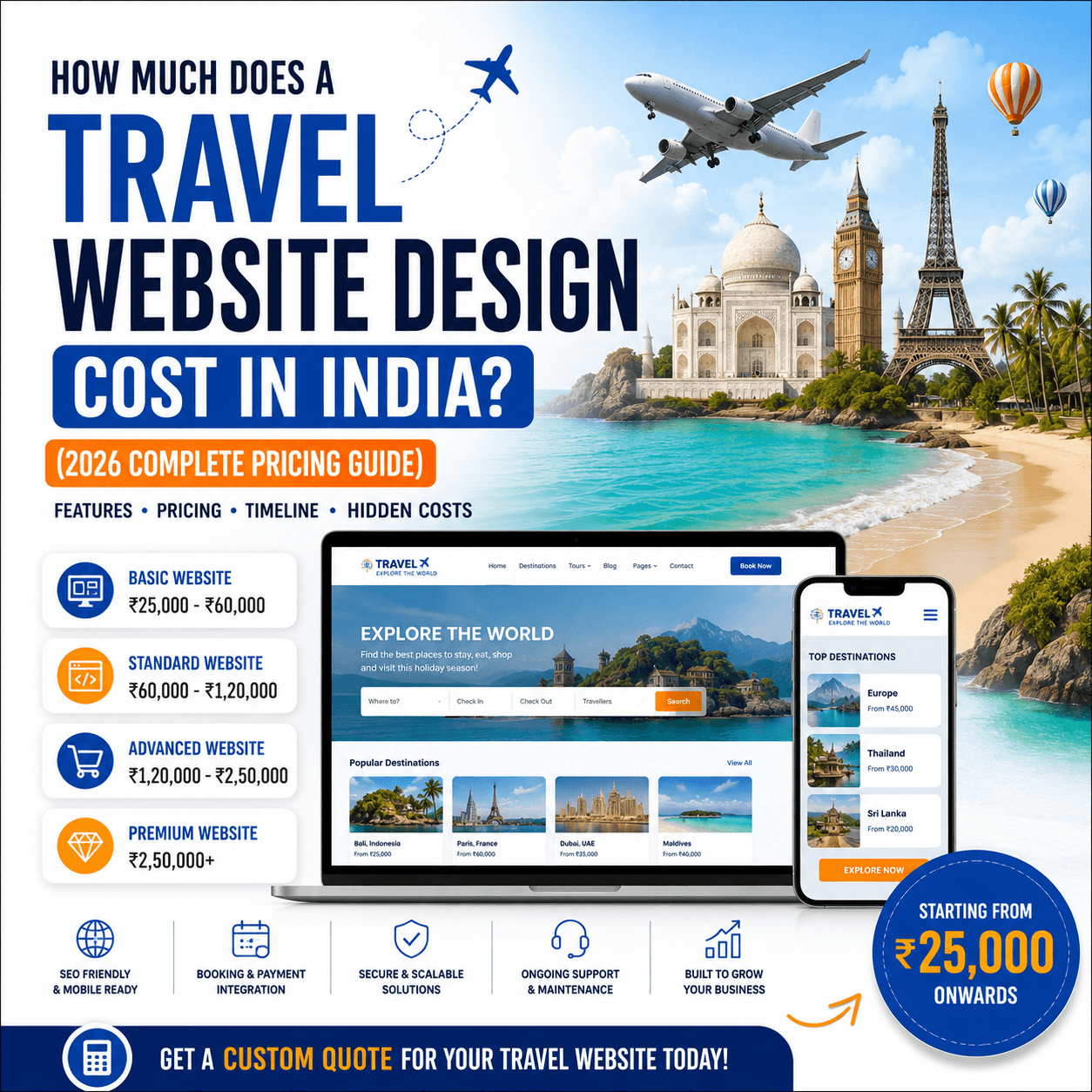
How Much Does a Travel Website Design Cost in India? (2026 Complete Pricing Guide)
Online travel bookings in India have grown from a convenience into the default way most travelers research and reserve flights, hotels, and tour packages. For travel agencies, tour operators, tourism startups, and hotel booking businesses, this shift means the website is no longer a digital business card — it's the primary sales channel, often outperforming phone inquiries and walk-in counters combined. Yet many travel businesses still approach their website as an afterthought, built quickly and cheaply, only to discover later that it can't handle real bookings, ranks nowhere on Google, or simply doesn't convert visitors into paying customers.
That's exactly why understanding the Travel Website Design Cost in India before you invest is so important. Spend too little, and you risk a site that looks unprofessional, loads slowly, and loses bookings to competitors with stronger digital presence. Spend without a clear plan, and you risk overpaying for features your business doesn't actually need yet. Either mistake is expensive, because a travel website isn't a one-time purchase — it's an asset that either grows your booking volume year after year or quietly holds your business back.
This guide breaks down the Travel Website Development Cost for every type of travel business, from a simple agency landing page to a full multi-vendor travel portal. You'll find a detailed pricing table, a breakdown of what actually drives Travel Agency Website Pricing up or down, realistic numbers for Travel Booking Website Cost by feature set, a side-by-side look at Tour Operator Website Design Cost versus Hotel Booking Website Development Cost, and a full breakdown of Tourism Website Development Cost and Travel Portal Development Cost for larger platforms. By the end, you'll know exactly what to budget for your stage of business, what questions to ask any development company, and how to avoid the most common pricing mistakes travel businesses make in India.
It's worth saying upfront: there is no single "correct" answer to the Travel Website Design Cost in India question, and any vendor who quotes a number without first asking about your business model, booking volume, and feature requirements is guessing. What this guide offers instead is a realistic framework — grounded in current Indian market rates — for understanding why the Travel Website Development Cost for a one-person travel consultancy looks nothing like the Tourism Website Development Cost for a regional tour operator running dozens of fixed departures a month, and why both look nothing like the Travel Portal Development Cost for a marketplace connecting hundreds of vendors.
Why Choose VNA Infotech for Travel Website Development in India?
When it comes to professional travel website solutions, VNA Infotech has established itself as one of the leading travel website development companies in India. With extensive experience in designing and developing websites for travel agencies, tour operators, tourism businesses, and hotel booking platforms, the company delivers customized digital solutions that help travel brands attract more customers and increase online bookings.
VNA Infotech specializes in creating modern, mobile-friendly, and SEO-optimized travel websites tailored to the unique requirements of the travel industry. Whether you need a simple travel agency website, a tour package booking platform, a hotel reservation portal, or a custom travel marketplace, their team focuses on delivering high-performance websites that provide an excellent user experience. Their expertise in booking systems, payment gateway integration, travel APIs, and lead generation features enables travel businesses to streamline operations and improve customer engagement.
One of the key advantages of working with VNA Infotech is its ability to provide cost-effective solutions without compromising on quality. The company offers flexible website development packages suitable for startups, growing travel agencies, and large tourism enterprises. From responsive design and search engine optimization to ongoing maintenance and technical support, VNA Infotech provides end-to-end services that help businesses maximize their return on investment.
In addition to website development, VNA Infotech helps travel businesses strengthen their online presence through SEO-friendly architecture, fast-loading web pages, and conversion-focused design strategies. Their understanding of the latest travel industry trends, booking technologies, and digital marketing best practices makes them a trusted technology partner for companies looking to build a successful online travel business.
For businesses seeking a reliable partner to develop a professional travel website, VNA Infotech stands out as a trusted choice in India, offering scalable solutions that support long-term growth, increased bookings, and enhanced customer satisfaction.
VNA Infotech
VNA Infotech is a leading travel website development company in India, recognized for delivering custom web solutions for travel agencies, tour operators, tourism businesses, hotels, and travel startups. The company specializes in creating responsive, SEO-friendly, and conversion-focused travel websites that help businesses increase online visibility and generate more bookings.
With expertise in travel booking systems, custom travel portals, hotel reservation platforms, payment gateway integration, and third-party travel APIs, VNA Infotech offers end-to-end development services tailored to the needs of the travel industry. Their team focuses on building user-friendly websites that provide seamless booking experiences across desktop and mobile devices.
Clients often choose VNA Infotech for its transparent communication, industry knowledge, and ability to deliver scalable travel solutions within budget. From simple travel agency websites to advanced travel marketplaces and booking platforms, the company combines modern design with robust functionality to support business growth.
Services:
Travel Website Development
Travel Portal Development
Tour Package Booking Websites
Hotel Booking Website Development
Custom Web Development
UI/UX Design
API Integration
SEO-Friendly Website Design
Industries Served:
Travel & Tourism
Hospitality
Tour Operators
Travel Agencies
Hotels & Resorts
Company Strengths:
Travel Industry Expertise
Mobile-First Development
Custom Booking Solutions
SEO-Optimized Websites
Dedicated Support & Maintenance
Scalable Development Approach
Best For: Travel agencies, tour operators, tourism companies, and hospitality businesses seeking a reliable technology partner for website design, booking systems, and custom travel portal development.
What Determines the Travel Website Design Cost in India?
There is no single number that answers "how much does a travel website cost" — the Travel Website Design Cost in India depends on a combination of factors that compound on top of each other. Understanding each one helps you budget accurately instead of guessing.
Type of Travel Website
The single biggest driver of Travel Website Development Cost is the type of website you're building, since each category requires fundamentally different functionality.
A basic travel website is essentially an informational site — company details, destinations, contact forms, and maybe a simple inquiry form. It carries the lowest Travel Website Design Cost in India because there's no booking engine or payment processing involved. A travel agency website goes a step further, typically including package listings, an inquiry-based booking flow, and basic lead capture, which raises both Travel Agency Website Pricing and ongoing content needs.
A tour package booking website introduces real booking logic — date selection, group size, pricing tiers, and often a payment gateway — pushing the Travel Booking Website Cost noticeably higher than a basic agency site. A hotel booking website adds further complexity: room inventory, availability calendars, rate plans, and often integration with a property management system, which is why Hotel Booking Website Development Cost tends to sit above standard tour booking sites.
A travel marketplace website, where multiple vendors (hotels, tour operators, transport providers) list their own inventory, requires vendor dashboards, commission logic, and far more complex backend architecture — a major jump in Travel Portal Development Cost. And a custom travel portal, built entirely from scratch with proprietary booking logic, multi-currency support, and custom APIs, represents the top end of Tourism Website Development Cost, suited only to businesses with the scale to justify it.
Number of Pages
More pages mean more design time, more content, and more testing, which directly affects the final Travel Website Design Cost in India. A 5–10 page agency site costs far less than a 50+ page portal covering dozens of destinations, packages, and landing pages targeted at specific search terms.
Design Complexity
Design complexity typically falls into three tiers. Template-based design uses a pre-built theme customized with your branding, colors, and content — the fastest and most affordable route, keeping Travel Website Development Cost low but offering limited differentiation from competitors using similar themes. Semi-custom design modifies a template's structure more significantly, adding custom sections, layouts, and interactive elements while still leveraging existing components to control cost. Fully custom design, built from a unique visual concept with no reliance on existing themes, costs the most but gives a travel brand a distinctive identity that's harder for competitors to replicate — often worth the higher Travel Agency Website Pricing for businesses competing in a crowded destination market.
Booking and Reservation Features
A real booking engine — availability calendars, instant confirmation, multi-step reservation flows — adds meaningfully to Travel Booking Website Cost compared to a simple inquiry form, but it's also what separates a lead-generation site from an actual revenue-generating booking platform.
Payment Gateway Integration
Integrating Razorpay, PayU, Stripe, or similar gateways, along with handling multiple currencies for international travelers, adds both development time and ongoing transaction-related costs, factoring into overall Hotel Booking Website Development Cost and tour booking platforms alike.
Travel APIs and Third-Party Integrations
Connecting to GDS systems, flight and hotel inventory APIs, channel managers, or third-party tour suppliers is one of the most technically demanding (and expensive) parts of building a travel platform, and is a major reason Travel Portal Development Cost can climb quickly for marketplace-style sites.
Mobile Responsiveness
With the majority of travel research happening on mobile devices, proper responsive design (not just a "mobile-friendly" template) is no longer optional — it's factored into baseline Travel Website Design Cost in India for any credible developer.
SEO Optimization
Technical SEO foundations — clean URL structures, fast load times, structured data, optimized destination and package pages — add to upfront cost but directly affect how much organic, commission-free traffic the site generates afterward, making this one of the highest-ROI cost components.
Content Development
Professional photography, destination descriptions, package copywriting, and blog content all add to the budget but are essential for both conversions and SEO performance; many businesses underestimate this line item when calculating total Travel Website Development Cost.
Maintenance and Support
Ongoing maintenance — security updates, bug fixes, content updates, and API monitoring — is typically billed separately from the initial build and should be planned as a recurring cost rather than a one-time expense.
Travel Website Design Cost in India: Detailed Pricing Breakdown (2026)
The table below summarizes realistic 2026 market ranges for the Travel Website Design Cost in India across the main website categories. These are indicative ranges based on current Indian web development market rates; actual quotes will vary by agency, location, and exact feature scope.
Website Type | Estimated Cost (₹) |
|---|---|
Basic Travel Website | ₹15,000 – ₹40,000 |
Professional Travel Agency Website | ₹40,000 – ₹1,20,000 |
Tour Package Booking Website | ₹75,000 – ₹2,50,000 |
Hotel Booking Website | ₹1,00,000 – ₹5,00,000 |
Travel Marketplace Portal | ₹3,00,000 – ₹15,00,000+ |
Custom Travel Platform | ₹5,00,000 – ₹25,00,000+ |
Basic Travel Website (₹15,000 – ₹40,000): Includes a home page, about page, destination overview pages, and a contact or inquiry form, usually built on a template-based CMS. Suitable for new travel agents or solo consultants who need a credible online presence but aren't yet processing online payments. Development timeline is typically one to three weeks. At this tier, Travel Website Development Cost stays low because there's no booking engine, and Travel Agency Website Pricing is driven mainly by design polish and page count rather than functionality.
Professional Travel Agency Website (₹40,000 – ₹1,20,000): Adds package listing pages, a more developed design, basic SEO setup, and lead-capture forms with email or WhatsApp notification. Suited to established agencies that want a stronger brand presence and better lead quality. Timelines typically run three to six weeks. This is where Travel Agency Website Pricing starts reflecting real business value — better-qualified leads and improved credibility — rather than just a digital brochure.
Tour Package Booking Website (₹75,000 – ₹2,50,000): Introduces actual booking functionality — package selection, date and traveler-count logic, and often payment gateway integration for deposits or full payment. Ideal for tour operators running fixed-departure or customizable itineraries. Development typically takes six to ten weeks depending on the booking logic's complexity. At this level, Travel Booking Website Cost starts to reflect the technical work behind reservation handling, not just visual design.
Hotel Booking Website (₹1,00,000 – ₹5,00,000): Includes room inventory management, availability calendars, rate plans, and often integration with a property management system or channel manager. Suited to independent hotels, boutique resorts, and small hotel groups wanting direct bookings outside OTA commissions. Timelines generally span two to four months. Hotel Booking Website Development Cost rises here primarily due to the complexity of real-time inventory and rate synchronization.
Travel Marketplace Portal (₹3,00,000 – ₹15,00,000+): Built for platforms aggregating multiple vendors — hotels, tour operators, transport providers — under one marketplace, with vendor dashboards, commission tracking, and multi-vendor booking management. Suited to travel startups building a B2B or B2C marketplace model. Development typically takes four to eight months. Travel Portal Development Cost at this scale reflects genuinely complex backend architecture, not just frontend design.
Custom Travel Platform (₹5,00,000 – ₹25,00,000+): Fully bespoke platforms with proprietary booking engines, custom APIs, multi-currency and multi-language support, and enterprise-grade infrastructure. Suited to large tourism companies, OTAs, or enterprise travel brands. Timelines typically run six months to over a year. This tier represents the highest end of Tourism Website Development Cost, justified only when business scale and revenue potential support the investment.
How City and Team Location Affect the Final Quote
Within India, the Travel Website Design Cost in India can vary noticeably depending on where the development team is based. Agencies headquartered in metro hubs like Mumbai, Delhi NCR, and Bengaluru typically quote 20–40% higher than equally capable teams in Tier 2 cities such as Pune, Jaipur, Ahmedabad, or Indore, largely due to higher office overheads and talent costs rather than a meaningful difference in output quality. Remote-first teams and developers working from Tier 2 and Tier 3 cities have become increasingly common in the travel tech space, and many deliver the same Travel Booking Website Cost value at a noticeably lower Tour Operator Website Design Cost than their metro counterparts. For budget-conscious tour operators and hotel booking businesses, this means location-based comparison shopping is a legitimate way to manage Hotel Booking Website Development Cost without compromising on technical quality — provided the team can demonstrate genuine travel-industry experience regardless of where they're based.
Must-Have Features for a Modern Travel Website
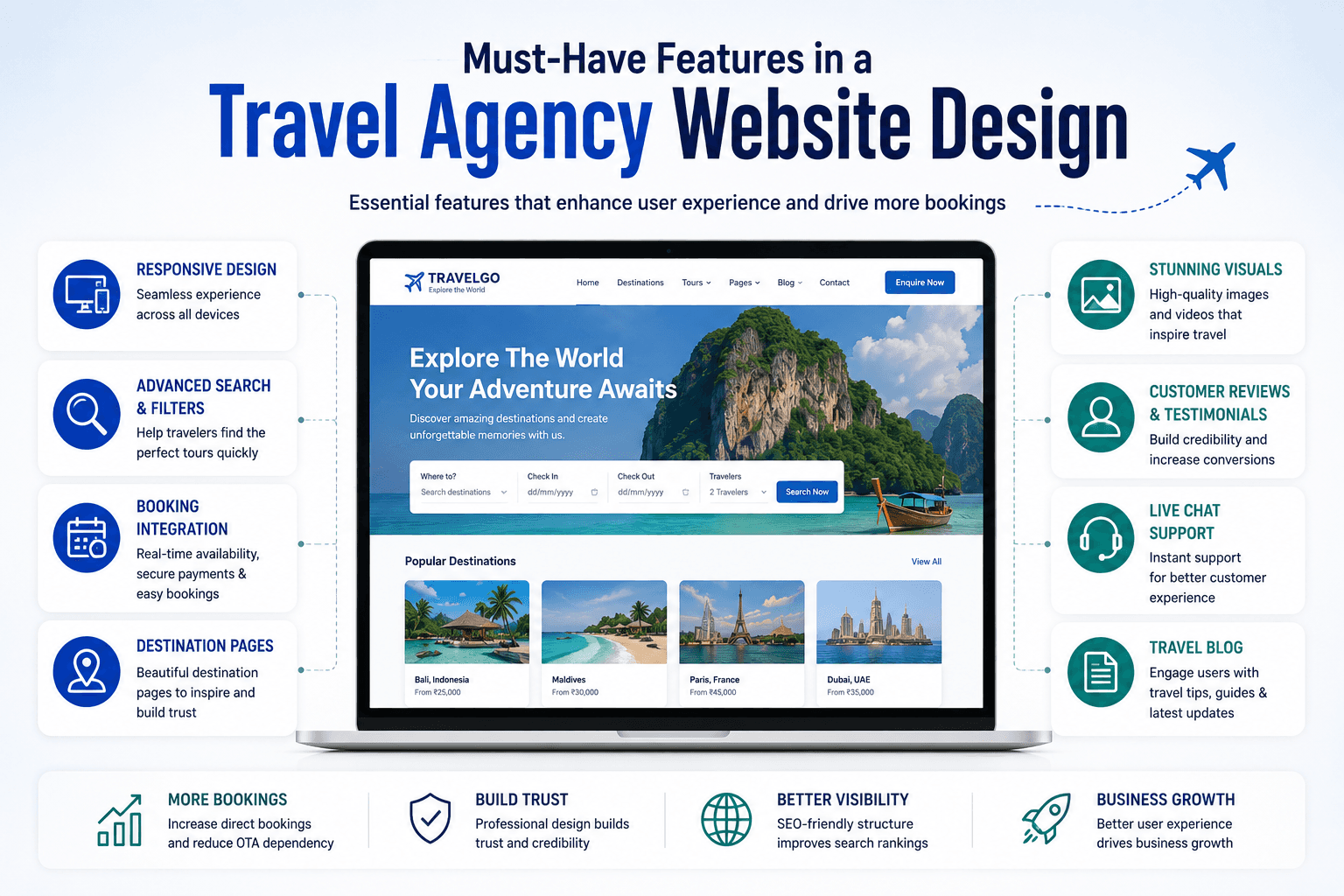
Regardless of budget tier, certain features have become near-essential for any travel website expecting to convert visitors into bookings.
Clear tour package listings with transparent pricing and itinerary details build trust faster than vague "contact us for pricing" pages. Well-structured destination pages double as both conversion tools and SEO assets, since travelers frequently search by destination name before they search by agency. Advanced search filters — by budget, duration, destination type, or travel dates — help visitors narrow down options quickly instead of scrolling through irrelevant listings.
Booking inquiry forms remain essential even on sites with full booking engines, since many travelers still prefer to ask questions before committing. WhatsApp integration has become close to mandatory in the Indian travel market, where a large share of booking conversations happen over WhatsApp rather than email. An online payment system that supports Indian payment methods (UPI, cards, net banking) alongside international options reduces friction for both domestic and international travelers.
Customer reviews, ideally pulled from Google or pasted in from past clients with photos, function as one of the strongest trust signals on a travel site. Travel blogs support long-term SEO by capturing search traffic from travelers still researching destinations rather than ready to book. Google Maps integration helps visitors visualize locations, routes, and proximity to attractions. Lead generation forms, placed strategically rather than just on a single contact page, capture interest at multiple points in the browsing journey. Live chat support answers quick questions instantly, reducing the chance a hesitant visitor leaves to compare elsewhere. And multi-language support matters significantly for agencies targeting international tourists or NRI travelers researching trips back to India.
Additional Costs to Consider
Beyond the core Travel Website Design Cost in India, several recurring and supporting costs should be factored into the total budget.
Cost Item | Typical Indian Market Pricing |
|---|---|
Domain Name | ₹500 – ₹1,500/year |
Hosting | ₹2,000 – ₹25,000/year (shared to cloud/VPS) |
SSL Certificate | Free – ₹5,000/year |
Content Writing | ₹1,000 – ₹5,000 per page |
SEO Services | ₹10,000 – ₹75,000/month |
Digital Marketing | ₹15,000 – ₹1,00,000+/month |
Website Maintenance | ₹3,000 – ₹30,000/month |
API Subscriptions (GDS, payment, maps) | ₹2,000 – ₹50,000+/month |
Technical Support | ₹5,000 – ₹40,000/month (or per-incident) |
These additional costs often add up to more than the initial Travel Website Development Cost over a two- to three-year period, which is why budgeting for the full ownership lifecycle — not just the launch price — leads to far more accurate financial planning.
It's also worth separating one-time costs from recurring ones when you build your budget. Domain registration, SSL setup, and the initial content writing pass are typically one-time or annual expenses bundled into the overall Travel Website Design Cost in India quoted by most agencies. Hosting, SEO services, digital marketing, and technical support, on the other hand, are ongoing monthly commitments that continue well after the site launches — and for tour operators and hotel booking businesses relying on organic search traffic, the SEO and content line items frequently end up mattering more to long-term Travel Agency Website Pricing outcomes than the initial design spend itself.
Freelancer vs Agency vs Specialized Travel Website Company vs Enterprise Firm
Who builds your website has as much impact on final pricing and outcomes as what you build.
Freelancer: Cost typically ranges from ₹20,000 to ₹2,00,000 depending on scope. Pros include lower cost and direct communication with the person doing the work. Cons include limited availability for ongoing support, higher risk if the freelancer becomes unavailable, and often narrower technical range. Best suited to very small travel businesses needing a basic site with a tight budget.
Small Web Design Agency: Cost generally falls between ₹50,000 and ₹5,00,000. Pros include a small team covering design, development, and basic SEO, with more reliability than a single freelancer. Cons include limited travel-industry-specific experience unless the agency has handled similar projects before, which can lead to avoidable mistakes on booking logic or API integrations. Best suited to growing travel agencies needing a professional, mid-complexity site.
Travel Website Development Company: Cost typically ranges from ₹1,50,000 to ₹15,00,000+, reflecting specialized experience. Pros include direct familiarity with GDS APIs, hotel booking logic, and travel-specific SEO patterns, which usually translates into fewer costly revisions later. Cons include a higher price point than generalist agencies. Best suited to tour operators, hotel booking platforms, and travel marketplaces where industry-specific technical knowledge meaningfully affects the outcome.
Enterprise Development Firm: Cost generally starts at ₹10,00,000 and can extend well beyond ₹50,00,000 for large-scale platforms. Pros include enterprise-grade infrastructure, dedicated project management, and capacity for complex, large-team builds. Cons include higher overhead and longer engagement processes, often unnecessary for smaller travel businesses. Best suited to large OTAs, multi-brand tourism companies, and enterprise travel platforms with substantial transaction volume.
WordPress vs Custom Travel Website Development
Factor | WordPress | Custom Development |
|---|---|---|
Initial Investment | Lower | Higher |
Scalability | Good with proper architecture, limits at high complexity | Built specifically for scale from the start |
SEO | Strong out-of-box with proper plugins | Fully controllable, no plugin constraints |
Maintenance | Regular plugin/core updates required | Maintenance scoped to custom codebase |
Security | Requires proactive hardening (popular target for attacks) | Security built around specific architecture |
Booking Functionality | Achievable via plugins, can hit limits for complex logic | Unlimited flexibility, built for exact requirements |
Long-Term Costs | Lower upfront, moderate ongoing plugin/licensing costs | Higher upfront, often lower ongoing surprises |
WordPress generally offers better value for basic travel websites, professional agency sites, and even many tour booking websites, since its plugin ecosystem covers most standard booking and payment needs at a fraction of custom development cost. Custom development becomes the better long-term value once a business needs complex booking logic, multi-vendor architecture, or integrations that plugins can't handle cleanly — typically true for travel marketplaces and large hotel booking platforms. For most travel agencies and tour operators in the early-to-mid growth stage, WordPress keeps Travel Website Design Cost in India manageable without meaningfully limiting growth for several years.
How to Reduce Travel Website Development Cost
Several practical strategies can meaningfully lower the final Travel Website Development Cost without compromising the result.
Launching an MVP (minimum viable product) with core booking functionality first, then adding advanced features as the business grows, avoids paying upfront for features that may not be needed for months. Prioritizing essential features over nice-to-haves prevents scope creep, one of the most common reasons travel website budgets balloon beyond initial estimates. Choosing scalable technology from the start avoids a costly rebuild later when the business outgrows a quick, inflexible setup.
Planning content early — package descriptions, destination copy, photography — prevents expensive mid-project delays and revision cycles. Avoiding unnecessary customizations that don't directly impact conversions or user experience keeps the budget focused on what actually drives bookings. And choosing experienced developers, even at a slightly higher hourly rate, often costs less overall than cheaper developers who make costly mistakes on booking logic, payment integration, or security that require expensive fixes later.
One more practical lever worth mentioning: phased payment structures. Many travel website development companies in India are open to splitting a project into milestones — design approval, core development, booking/payment integration, and final testing — rather than requiring full payment upfront. This doesn't reduce the total Travel Website Development Cost, but it does reduce financial risk and gives a tour operator or hotel booking business the ability to pause or adjust scope between phases if priorities shift, which is especially useful for startups still validating demand before committing to the higher end of Travel Portal Development Cost.
How to Choose the Right Travel Website Development Company in India
A simple checklist helps separate genuinely capable partners from generic web design shops claiming travel expertise.
Look for demonstrated travel industry experience — ask specifically about past projects involving booking engines, GDS integrations, or hotel inventory systems, not just general web design. Review portfolio quality with a focus on actual travel sites they've built, checking whether those sites load quickly and function well on mobile, not just how they look in screenshots. Confirm genuine SEO expertise, since a beautifully designed travel site that never ranks for relevant searches won't generate the booking volume needed to justify the investment.
Insist on mobile-first design as a non-negotiable, given how much travel research happens on phones. Ask directly about API integration experience with the specific systems you'll need — payment gateways, GDS, channel managers, or maps. Clarify support and maintenance terms before signing, including response times and what's included versus billed separately. Demand transparent pricing with a detailed scope document rather than a vague lump-sum quote that could hide gaps later. And request client testimonials or references from travel-industry clients specifically, since a glowing review from an unrelated industry doesn't confirm travel-specific competence.
Future Trends Affecting Travel Website Design Cost in India (2026–2027)
Several emerging trends are starting to reshape what travel websites need to include, which will gradually affect baseline Travel Website Design Cost in India going forward.
AI-powered trip planners that generate personalized itineraries based on traveler preferences are moving from novelty to expected feature on more sophisticated platforms. Voice search optimization is becoming more relevant as travelers increasingly ask conversational, long-tail questions through voice assistants rather than typing short keyword phrases. Travel chatbots are evolving beyond simple FAQ bots into genuine pre-booking assistants capable of suggesting packages and answering nuanced questions.
Personalized recommendations, driven by browsing behavior and past booking history, are starting to appear even on mid-sized travel platforms, not just major OTAs. AR/VR travel experiences — virtual destination previews or hotel room walkthroughs — remain a premium feature today but are likely to become more accessible as the underlying technology matures. Dynamic pricing engines that adjust package or room rates based on demand, season, and booking lead time are increasingly expected on hotel and tour booking platforms competing with OTA pricing sophistication. And an even stronger emphasis on mobile-first user experience continues to push baseline development standards higher across every website category.
Common Pricing Mistakes Travel Businesses Make in India
Beyond knowing the right numbers, it helps to recognize the budgeting mistakes that repeatedly trip up travel agencies, tour operators, and hotel booking businesses when they first start comparing quotes.
The most frequent mistake is comparing a bare Travel Website Design Cost in India quote from one vendor against a fully-scoped quote from another without checking what's actually included. A ₹50,000 quote that excludes payment gateway setup, content writing, and SEO basics isn't actually cheaper than a ₹90,000 quote that bundles all three — it just defers the same costs to later, usually at a worse rate once the project is already underway. A related mistake is treating Tour Operator Website Design Cost and Hotel Booking Website Development Cost as interchangeable, when in reality a hotel booking platform's real-time inventory and rate logic is meaningfully more complex than a tour operator's fixed-departure package listings, and pricing them the same usually means one side of the project is underfunded. Tour operators specifically should also budget separately for itinerary-builder functionality if they offer customizable trips, since this single feature can shift a quote from the low end to the high end of typical Tour Operator Website Design Cost ranges.
Another common error is underestimating ongoing Travel Booking Website Cost beyond the initial build — businesses budget carefully for development but forget that a booking website with live payment processing needs monitoring, security patching, and occasional feature updates indefinitely, not just at launch. Tourism startups building toward a marketplace model also frequently underestimate Tourism Website Development Cost by scoping only the customer-facing booking flow and forgetting the vendor-side dashboards, commission tracking, and admin tools a real marketplace requires — features that often account for more development time than the public-facing site itself. Finally, many businesses fixate on minimizing Travel Agency Website Pricing at the proposal stage without asking how a lower quote affects post-launch support, leaving them without help when something breaks during peak booking season.
Avoiding these mistakes generally costs nothing extra — it just requires asking more detailed questions before signing a contract, and insisting that any quote for Travel Portal Development Cost or smaller projects alike spell out exactly what's included, what's billed separately, and what happens after launch.
Conclusion
The Travel Website Design Cost in India spans an enormous range — from roughly ₹15,000 for a basic informational agency site to ₹25,00,000 or more for a fully custom enterprise travel platform — and the right number for your business depends entirely on what stage you're at and what kind of booking functionality you actually need. Travel Website Development Cost is driven primarily by website type, design complexity, booking and payment functionality, and the depth of API integrations required, while ongoing costs like hosting, SEO, and maintenance often add up to more than the initial build over time.
For startups and solo travel agents, a professional agency website in the ₹40,000–₹1,20,000 range, paired with strong WhatsApp integration and clear package listings, is usually sufficient to start generating quality leads. For growing SMEs running tour packages or small hotel operations, budgeting ₹75,000–₹5,00,000 for proper booking functionality reflects realistic Travel Booking Website Cost and Hotel Booking Website Development Cost expectations. For tourism enterprises and travel marketplaces, planning for ₹3,00,000 and upward in Travel Portal Development Cost is necessary to support the technical complexity these platforms require. Whatever stage you're at, treating Travel Agency Website Pricing as a strategic investment rather than a one-time expense — and budgeting for the full ownership lifecycle, not just the launch — leads to far better long-term outcomes.
Frequently Asked Questions
1. How much does a Travel Website Design Cost in India?
It typically ranges from ₹15,000 for a basic informational site to ₹25,00,000+ for a fully custom enterprise travel platform, depending on website type, features, and design complexity.
2. What is the average Travel Website Development Cost?
For most travel agencies and tour operators, a professionally built site with booking functionality generally falls between ₹75,000 and ₹2,50,000, though larger platforms cost significantly more.
3. What affects Travel Agency Website Pricing?
Key factors include the number of pages, design complexity (template vs. custom), booking features, payment gateway integration, SEO setup, and content development needs.
4. What is the cost of a Travel Booking Website?
A tour package booking website with real reservation logic and payment integration typically costs between ₹75,000 and ₹2,50,000 in the Indian market. This Travel Booking Website Cost range assumes a single booking flow with standard payment gateway integration; adding multi-vendor inventory or custom itinerary builders pushes the number toward the higher end or beyond.
5. How much is a Tour Operator Website Design Cost?
Similar to a tour booking website, costs generally range from ₹75,000 to ₹2,50,000 depending on the complexity of itinerary management and booking flow required. Operators running only a handful of fixed-departure packages typically land near the lower end of this Tour Operator Website Design Cost range, while those offering fully customizable, multi-destination itineraries with traveler-by-traveler pricing sit closer to the top.
6. What is the Tourism Website Development Cost?
For larger tourism portals covering multiple destinations, vendors, or services, costs can range from ₹3,00,000 to ₹25,00,000+ depending on scale and custom functionality. Government tourism boards, destination marketing organizations, and multi-brand tourism groups tend to drive Tourism Website Development Cost toward the higher end due to the volume of content, languages, and integrations involved.
7. What is the Hotel Booking Website Development Cost?
Hotel booking websites with availability calendars, rate management, and PMS integration typically cost between ₹1,00,000 and ₹5,00,000.
8. What is the Travel Portal Development Cost?
Multi-vendor travel marketplaces and custom portals generally range from ₹3,00,000 to ₹25,00,000+, reflecting the backend complexity of managing multiple suppliers and bookings.
9. Can I start with a low-budget travel website?
Yes — launching a basic informational site or simple agency website first, then upgrading to full booking functionality as the business grows, is a practical way to control costs while validating demand.
10. Is WordPress suitable for travel websites?
Yes, for most basic to mid-complexity travel and booking websites; WordPress with appropriate plugins handles standard booking and payment needs well, though highly complex marketplaces typically need custom development.
11. How long does development take?
Basic sites can launch in one to three weeks; tour and hotel booking websites typically take six to sixteen weeks; large travel portals or custom platforms can take four months to over a year.
12. What are annual maintenance costs?
Ongoing maintenance, including hosting, security updates, and minor content changes, typically runs ₹3,000 to ₹30,000 per month depending on site complexity, in addition to any SEO or marketing retainer.
13. Should I hire a freelancer or agency?
Freelancers suit very small budgets and simple sites; agencies and specialized travel website companies suit businesses needing booking functionality, API integrations, and ongoing reliability.
14. What travel website features are essential?
At minimum: clear package or room listings, a working inquiry or booking form, mobile responsiveness, WhatsApp integration, and basic SEO setup; payment integration and live chat become important as the business scales.
15. Can I upgrade my travel website later?
Yes — starting with an MVP and adding booking engines, API integrations, or marketplace features later is a common and cost-effective approach, provided the initial build uses reasonably scalable technology.
Pricing figures in this guide reflect general Indian web development market ranges as of 2026 and are intended for budgeting guidance. Always request a detailed, itemized quote from any development company before committing to a project.