
20+ Top eVTOL Manufacturers & Electric Aircraft Companies in 2027
Posted on
Product Design
Posted at

Aviation is going through its most significant architectural shift since the jet engine, and the shift is electric. Electric vertical takeoff and landing (eVTOL) aircraft — once dismissed as "flying car" novelties — have moved into active flight testing, multi-stage government certification, and, in a handful of cases, real ticketed operations. What started as a cluster of well-funded startups chasing a single vision (a piloted air taxi for city commuting) has broadened into a genuinely diverse industry: urban air mobility, airport-to-city connectors, regional transportation, autonomous cargo delivery, emergency medical response, defense logistics, and even consumer flying vehicles.
No single company builds this future alone. Behind every aircraft sits a supply chain of propulsion specialists, battery scientists, avionics integrators, and materials engineers whose work rarely makes headlines but directly determines whether these aircraft can fly safely, repeatedly, and affordably. This guide profiles more than 20 of the companies — both aircraft developers and the suppliers behind them — that are actually shaping where electric flight stands heading into 2027, based on verified 2026 information rather than hype, valuation, or marketing language.
Some of these companies are racing toward FAA or EASA type certification. Others have already achieved certification under China's CAAC and are flying paying customers today. A few have paused or scaled back their programs entirely, and one — Lilium — no longer exists. Distinguishing between a company's announced targets and its actual, verified progress is the central discipline of this article, and it's a distinction worth keeping in mind throughout, because in this industry the gap between the two has proven costly more than once.
What Is eVTOL Technology?
An eVTOL — electric vertical takeoff and landing aircraft — is exactly what the name describes: an aircraft that takes off and lands vertically, like a helicopter, but is powered by electric motors rather than a combustion turbine or piston engine.
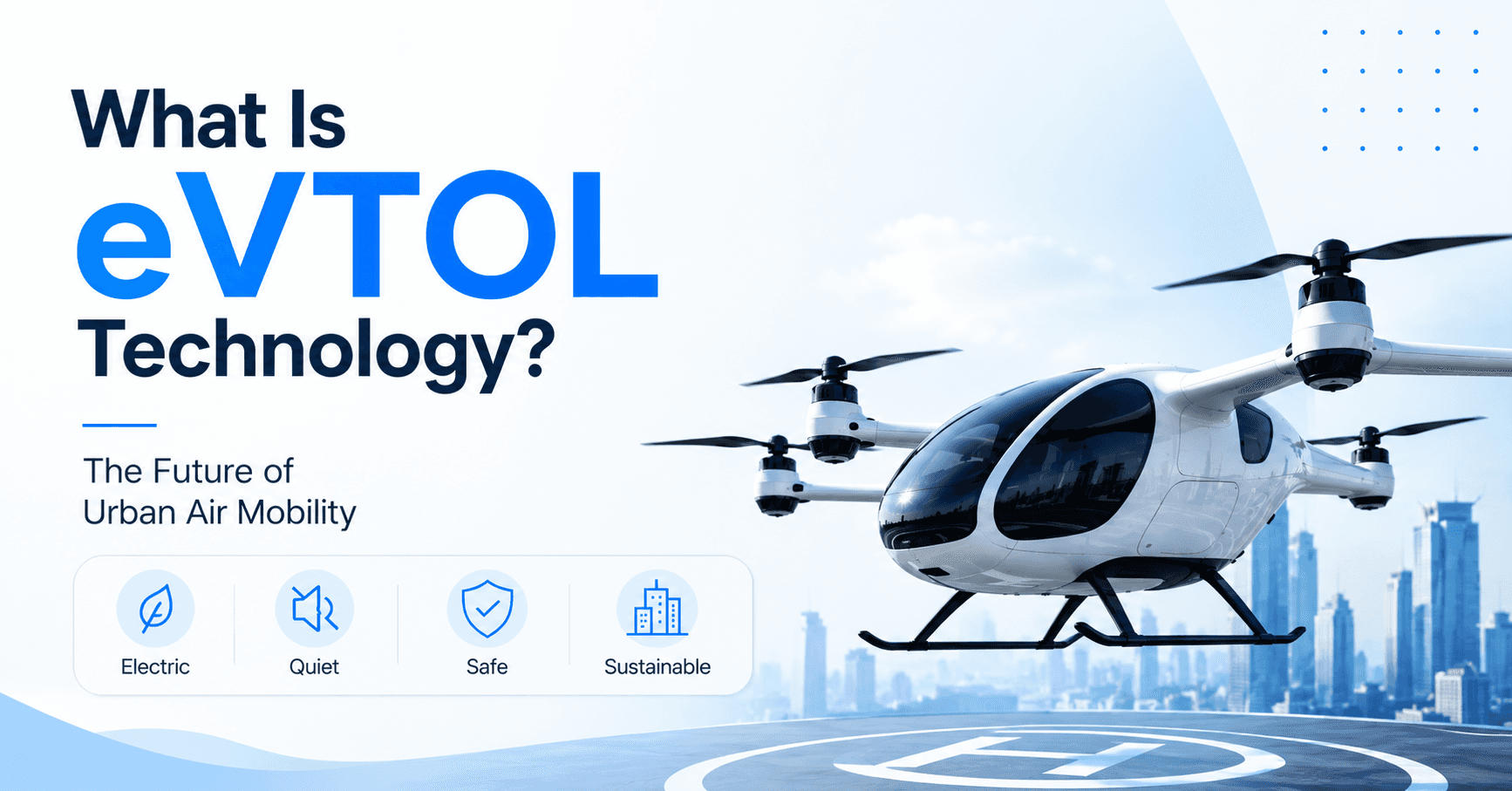
Most eVTOL designs use distributed electric propulsion, meaning the aircraft has multiple independent electric motors (often six to twelve) spread across the airframe rather than a single central engine. This is one of eVTOL's core safety advantages: if one motor fails, the others can typically compensate, unlike a single-engine helicopter, where an engine failure is a far more serious event.
Beyond that shared foundation, eVTOL designs generally fall into a few architectural families:
Tilt-rotor / vectored-thrust designs (used by Joby Aviation and Vertical Aerospace) have rotors that physically tilt from a vertical, helicopter-like orientation for takeoff into a horizontal, airplane-like orientation for forward flight — maximizing both hover efficiency and cruise speed.
Lift-plus-cruise designs (used by Archer Aviation and Eve Air Mobility) use a separate set of rotors for vertical lift and a separate set (or a pusher propeller) for forward flight, trading some efficiency for mechanical simplicity and redundancy.
Multicopter configurations (used by EHang) rely on multiple fixed rotors, similar to a large drone, prioritizing simplicity and short-hop efficiency over range and speed.
Every eVTOL also depends on a battery system to store energy, power electronics (inverters and controllers) to manage the flow of that energy to the motors, and a flight-control system — increasingly fly-by-wire, with some programs adding autonomous or semi-autonomous capability — to keep the aircraft stable through the tricky transition between hovering and forward flight.
eVTOL is meaningfully different from its aviation neighbors. Unlike a traditional helicopter, it typically uses multiple smaller, redundant electric motors instead of one mechanically complex turbine and rotor system, and it produces far less noise. Unlike a conventional airplane, it doesn't need a runway. Unlike a general electric airplane (a fixed-wing aircraft with electric propulsion, like some of BETA Technologies' conventional-takeoff aircraft), an eVTOL specifically incorporates vertical lift capability. Unlike a drone, most eVTOLs under development are designed to carry people or substantial cargo payloads, not just cameras or small packages, and require a correspondingly higher level of certification. And unlike the classic sci-fi "flying car" concept, most eVTOLs are not designed to also drive on roads — a distinction that matters, because a small number of companies, most notably XPeng AeroHT, are pursuing genuine road-and-air hybrids, which occupy a different regulatory and engineering category entirely.
Why Are eVTOL Companies Important in 2027?
Several converging forces explain why eVTOL companies matter more in 2026–2027 than they did even two or three years earlier.
Decarbonization is a real driver: electric propulsion produces zero direct emissions in flight, appealing to airlines, cities, and governments under pressure to reduce transportation-related carbon output. Urban congestion and the difficulty of expanding ground infrastructure in dense cities has pushed planners toward aerial alternatives for short trips — airport connectors in particular. Noise reduction is a genuine technical achievement of distributed electric propulsion; several eVTOL developers cite flyover noise dramatically lower than a helicopter's, which matters enormously for community acceptance of low-altitude flight over residential areas.
Progress on the technology side has also become concrete rather than theoretical. Battery energy density has improved enough that companies like Amprius Technologies now offer cells exceeding 500 Wh/kg — still short of what would make eVTOLs directly competitive with jet fuel on a pure energy basis, but sufficient to support meaningful passenger and cargo missions. Autonomous flight and artificial intelligence have matured to the point that Wisk Aero (backed by Boeing) is now flight-testing a fully autonomous, pilotless passenger aircraft under an active FAA certification program — something that would have seemed premature just a few years ago. Government investment has also grown substantially: the U.S. FAA and Department of Transportation launched the eVTOL Integration Pilot Program (eIPP) in March 2026, selecting eight projects across 26 states specifically to generate real-world operational data ahead of full certification, while China's government has actively promoted a "low-altitude economy" strategy that has helped EHang and AutoFlight reach commercial certification faster than any Western competitor.
Defense applications have become a meaningful secondary market as well, with companies like Archer (via its Anduril partnership) and BETA (via its MV250 platform, developed with GE Aerospace) pursuing dual-use aircraft that serve both civilian and military logistics needs — a diversification strategy that also provides revenue insulation against the slower-than-expected ramp of pure passenger air-taxi demand.
The opportunities are real, but so are the challenges: battery limitations still cap range and payload compared with liquid-fueled aircraft, infrastructure (vertiports, charging networks) remains underbuilt in nearly every target city, and — as Lilium's 2025 collapse demonstrated after roughly $1.5 billion raised — capital requirements for full-scale aircraft certification and manufacturing can exceed what even well-funded companies can sustain.
eVTOL Aircraft Manufacturers vs Suppliers
One of the most common mistakes in eVTOL coverage is treating every company in the ecosystem as an aircraft manufacturer. They are not. The industry is better understood as a layered supply chain, similar to how the automotive or commercial aerospace industries work.
Aircraft developers (also called OEMs — original equipment manufacturers) are the companies responsible for designing, integrating, certifying, and ultimately selling or operating complete aircraft. Joby Aviation, Archer Aviation, Eve Air Mobility, BETA Technologies, Vertical Aerospace, EHang, AutoFlight, Wisk Aero, SkyDrive, Supernal, and XPeng AeroHT all fall into this category, even though their individual strategies — passenger air taxi, autonomous flight, cargo, or flying car — differ substantially.
Propulsion suppliers develop the electric motors, inverters, power electronics, and complete electric propulsion units that convert stored battery energy into thrust. This is a specialized aerospace-electrical-engineering discipline distinct from aircraft design itself; companies like Safran, Evolito, magniX, and H3X Technologies focus specifically here, often supplying multiple aircraft manufacturers rather than building their own aircraft.
Battery suppliers focus on the energy-storage side: high-energy-density cells, aviation-grade battery packs, battery-management software, and the thermal-management systems needed to keep batteries safe and performant across a wide range of flight conditions. Amprius Technologies and H55 are among the most prominent independent suppliers in this category.
Avionics suppliers provide the navigation, flight-computer, sensor, and communication systems that let an aircraft (and, increasingly, an autonomous aircraft) know where it is, what's around it, and how to fly safely. Honeywell, Collins Aerospace, and Garmin all have long histories in conventional aviation avionics that they are now extending into the eVTOL space.
Aerospace component and structural suppliers contribute the physical building blocks — composite materials, structural components, landing gear, actuators, wiring — that make a certifiable airframe possible. Aciturri and Syensqo are examples of companies operating in this layer, often supporting programs like Vertical Aerospace's Valo aircraft.
Understanding this layering matters because a company's role determines what kind of "progress" is actually relevant to track. An aircraft developer's key milestone is type certification; a propulsion supplier's key milestone is a design win and joint certification work with an aircraft manufacturer; a battery supplier's key milestone is energy-density improvement and qualification for aviation use. Conflating these categories — treating a motor supplier's press release the same way you'd treat an aircraft manufacturer's type-certificate announcement — is a common and avoidable source of confusion in eVTOL coverage.
20+ Top eVTOL Companies & Suppliers in 2027
1. Joby Aviation
Headquarters: Santa Cruz, California, USA
Founded: 2009 Primary Focus: Piloted passenger eVTOL air taxi
Aircraft/Technology: S4 — six-tilt-rotor, piloted, four-passenger eVTOL
eVTOL Category: Aircraft developer (passenger)
Key Markets: United States, with planned operations in Dubai/UAE
Notable Partnerships: Toyota, Delta Air Lines, Blade Urban Air Mobility (acquired)
2027 Status: Deep into FAA Stage 4 certification; not yet type-certified as of mid-2026
Joby is one of the longest-running and best-capitalized companies in the eVTOL sector, and it has spent nearly a decade and a half working methodically through the FAA's demanding, multi-stage type-certification process. Its S4 aircraft uses six tilting rotors, is designed to carry a pilot and up to four passengers, and targets roughly 200 mph cruise speed with a range near 100 miles — figures that remain company targets pending final certification testing, not confirmed production specifications.
By March 2026, Joby's first FAA-conforming test aircraft (tail number N547JX) had begun flying at the company's Marina, California facility, entering the Type Inspection Authorization phase in which FAA test pilots directly evaluate the aircraft. Joby's own May 2026 shareholder disclosure reported Stage 4 testing and analysis as only partially complete — a useful corrective to earlier press coverage that had (inaccurately, and later corrected) reported the stage as finished. Joby's manufacturing strategy centers on a pilot production line in Marina, with a second facility being developed in Dayton, Ohio, and a stated goal of reaching roughly four aircraft per month by 2027 — an ambitious but unproven target for a company that has never mass-produced a certified aircraft type before.
What sets Joby apart competitively is the breadth of its commercial ecosystem. Its acquisition of Blade Urban Air Mobility gives it an already-operating, revenue-generating passenger transport business today, using conventional helicopters and fixed-wing aircraft, that can transition toward Joby's own eVTOL fleet as certification completes. Its partnership with Toyota extends into manufacturing support and investment, and its work with Delta Air Lines is aimed at connecting air-taxi trips with commercial airline itineraries. Joby matters in 2027 because it currently represents the most complete, vertically integrated vision of what an eVTOL passenger business could look like — aircraft, manufacturing, an existing operator, and airline-level distribution — even though full commercial eVTOL passenger service still depends on FAA type certification it had not yet received as of mid-2026.
2. Archer Aviation
Headquarters: Santa Clara, California, USA
Founded: 2018
Primary Focus: Piloted passenger eVTOL air taxi, with growing defense diversification
Aircraft/Technology: Midnight — 12-propeller (six tilting, six fixed) lift-plus-cruise design, piloted, four-passenger
eVTOL Category: Aircraft developer (passenger, with dual-use/defense expansion)
Key Markets: United States, UAE/Abu Dhabi
Notable Partnerships: Stellantis, United Airlines, NVIDIA, Palantir, Starlink, Anduril
2027 Status: First to close Phase 3 of the FAA's four-phase type-certification process; in Phase 4 as of mid-2026
Archer has run a genuinely close, parallel race to Joby through the FAA's certification framework, and as of May 2026 had claimed a notable procedural milestone: being the first eVTOL developer to close Phase 3 of the FAA's four-phase process, moving into Phase 4, where Midnight must demonstrate compliance with airworthiness requirements through for-credit testing. That is meaningful progress, though — as with Joby — it is explicitly not the same as holding a final type certificate.
Archer's most distinctive competitive asset is its manufacturing partnership with Stellantis, the automaker behind Jeep, Ram, and Maserati. Together the companies built a roughly 400,000-square-foot high-volume production facility in Covington, Georgia, with a long-term (not near-term guaranteed) ambition of scaling to as many as 650 aircraft annually by 2030 — a scale of ambition that, if realized, would exceed most other eVTOL manufacturing plans by a wide margin. Archer has also built a more diversified technology and defense portfolio than most passenger-focused peers: partnerships with NVIDIA, Palantir, and Starlink support an "AI stack" tied to airspace modernization, while a relationship with Anduril extends into hybrid, autonomous, dual-use VTOL aircraft for military applications.
Commercially, Archer has pursued aggressive international positioning, working with the UAE's General Civil Aviation Authority toward Abu Dhabi operations, and has aligned its U.S. launch ambitions with the 2028 Los Angeles Olympics as a high-visibility showcase. Archer was selected for three of the eight U.S. eIPP demonstration projects in 2026. Its principal financial risk is a growing accumulated deficit — roughly $2.5 billion by the end of Q1 2026 — reflecting the enormous capital intensity of parallel certification and manufacturing buildout. Archer matters in 2027 as the strongest procedural challenger to Joby in the FAA process, with a genuinely larger-scale manufacturing partner and a more diversified revenue base beyond pure passenger transport.
3. Eve Air Mobility
Headquarters: Melbourne, Florida, USA (Embraer-backed, Brazil-linked)
Founded: 2020 (spun off from Embraer)
Primary Focus: Piloted passenger eVTOL, airline-ecosystem integration
Aircraft/Technology: Eve 100 — eight-rotor lift-plus-cruise eVTOL
eVTOL Category: Aircraft developer (passenger)
Key Markets: Brazil, United States, Europe, Australia
Notable Partnerships: Embraer (parent), United Airlines, Alt Air, Skyports Infrastructure
2027 Status: Certifying with Brazil's ANAC, concurrent FAA and EASA validation in progress; entry-into-service target pushed from 2027 to 2028
Eve's core advantage is structural rather than technical: it was spun out of Embraer, a major commercial and regional-jet manufacturer with decades of aircraft-certification experience — a background that few venture-backed eVTOL competitors can match. Eve's Eve 100 completed its first full-scale prototype flight in December 2025 and had completed dozens of test flights by mid-2026, generating performance and systems data toward certification.
Eve's certification strategy is notably multi-jurisdictional: its primary certifying authority is Brazil's ANAC, but the company has also pursued concurrent validation with the FAA since 2023 and, as of July 2026, formally applied to begin EASA Type Certificate validation as well — a coordinated approach aimed at opening multiple major markets simultaneously rather than sequentially. That ambition comes with a caveat worth stating plainly: in May 2026, Eve pushed its own ANAC type-certification and entry-into-service target from 2027 to 2028, citing roughly 12 additional months of conforming-vehicle flight testing still required. Readers should treat 2028, not 2027, as Eve's own current target.
Eve is building a production facility in Taubaté, Brazil, aimed at scaling toward several hundred aircraft annually, and reported roughly $577.7 million in liquidity as of mid-2026 — funding the company says supports it through certification. Its commercial strategy leans heavily on airline and operator partnerships, including agreements in Australia (with Alt Air and Skyports Infrastructure) and letters of intent signed at the 2026 Farnborough Airshow. Eve matters in 2027 less as a near-term certification leader and more as a structurally advantaged long-term contender, backed by genuine large-aircraft manufacturing expertise.
4. BETA Technologies
Headquarters: South Burlington, Vermont, USA
Founded: 2017
Primary Focus: Broad electric-aerospace platform spanning cargo, medical, defense, and eventual passenger transport
Aircraft/Technology: ALIA-250 (CTOL and VTOL variants), MV250 (defense, in development)
eVTOL Category: Aircraft developer (cargo/medical/defense-first, passenger later)
Key Markets: United States
Notable Partnerships: GE Aerospace, NASA, Boeing, United Therapeutics, Surf Air Mobility
2027 Status: First company to launch operations under the U.S. eIPP program (2026); not yet passenger-certified
BETA deserves close attention precisely because it doesn't fit the typical "passenger air taxi" mold most eVTOL coverage defaults to. Its strategy sequences cargo and medical logistics missions — using both fixed-wing/conventional-takeoff (CTOL) and VTOL variants of its ALIA aircraft family — ahead of passenger service, building real operational experience, revenue, and regulatory trust before attempting the harder problem of certifying passenger-carrying flight.
That approach paid off tangibly in 2026: BETA became the first company to fly under the FAA and DOT's newly launched eVTOL Integration Pilot Program, and was selected for seven of the program's eight projects — more than any other developer. In July 2026, BETA and biotech partner United Therapeutics completed a widely covered 275-mile organ-delivery flight under the eIPP framework, a genuinely useful early commercial mission rather than a pure demonstration. BETA also participated in NASA's Electrified Powertrain Flight Demonstration program alongside GE Aerospace and Boeing, completing what the company describes as the first hybrid-electric flight above 30,000 feet — a technical achievement more relevant to conventional high-altitude commercial aviation than to low-altitude urban air taxi routes, underscoring how much broader BETA's ambitions extend beyond the passenger-air-taxi category.
BETA's commercial backlog reached roughly $3.9 billion across more than 1,000 aircraft by mid-2026, and its charging-infrastructure network — over 130 sites and growing via the ACES consortium — is the most extensive among its passenger-focused peers. BETA matters in 2027 as the industry's clearest example of operational maturity built through diversification rather than a singular bet on passenger air-taxi economics.
5. Vertical Aerospace
Headquarters: Bristol, United Kingdom
Founded: 2016
Primary Focus: Piloted passenger eVTOL, European/UK market
Aircraft/Technology: VX4 prototype / Valo (commercial variant) — tilt-rotor design
eVTOL Category: Aircraft developer (passenger)
Key Markets: United Kingdom, Europe
Notable Partnerships: Evolito, Honeywell, Syensqo, Aciturri, GKN, Leonardo
2027 Status: UK certification now targeted for 2028; funding history has been volatile
Vertical Aerospace has demonstrated real technical capability — its VX4 prototype has successfully completed full transition flight, moving from vertical hover into forward, wing-borne flight and back, a genuinely difficult milestone that validates the tilt-rotor concept underlying both the VX4 and its commercial successor, Valo. But the company's certification timeline has slipped multiple times: originally targeting service entry around 2025, later 2026, and now, under its "Flightpath 2030" strategy, UK type certification in 2028.
In February 2026, Vertical announced a new long-term partnership with Evolito to supply the electric propulsion units for Valo — joining Honeywell, Syensqo, and Aciturri as named key suppliers strengthening the aircraft's path to commercialization, with Vertical and Evolito planning to jointly pursue UK CAA certification alongside concurrent EASA validation. Vertical is also developing a hybrid-electric variant of the VX4, aimed at defense, logistics, and air-ambulance missions, with flight testing targeted for mid-2026 — a diversification strategy echoing BETA's approach, though earlier in its development.
Financially, Vertical has faced repeated pressure, including delayed investment tranches and renegotiated debt arrangements with primary creditor Mudrick Capital; the company secured a new financing package in 2026 reportedly providing access to up to $850 million tied to the Valo program, though exact terms should be verified against the company's most current investor disclosures given how frequently such structures have been renegotiated in this sector. Vertical holds close to 1,500 pre-orders from customers including American Airlines, Japan Airlines, GOL, and Bristow. It remains a credible longer-term European contender, but its 2028 certification target places it outside near-term 2027 leadership on timing.
6. EHang
Headquarters: Guangzhou, China
Founded: 2014
Primary Focus: Autonomous (pilotless) passenger eVTOL
Aircraft/Technology: EH216-S — two-passenger, fully autonomous multirotor
eVTOL Category: Aircraft developer (autonomous passenger)
Key Markets: China, expanding to Thailand, Sri Lanka, and other international markets
Notable Partnerships: Local Chinese municipal governments (Guangzhou, Hefei); Civil Aviation Authority of Thailand; Sri Lanka's CAASL
2027 Status: Holds the complete suite of Chinese regulatory approvals (TC, AC, PC, OC); operating ticketed commercial flights
EHang occupies a category of its own: it is, as of mid-2026, one of only two companies in the world holding a full type certificate, production certificate, and airworthiness certificate for a passenger-carrying eVTOL (the other being AutoFlight, in cargo), and the only one additionally holding air operator certificates that permit actual ticketed passenger flights. Its EH216-S is a small, two-passenger aircraft that operates without a human pilot on board, under direct oversight from China's Civil Aviation Administration (CAAC).
Ticketed sightseeing flights have been running at sites in Guangzhou and Hefei since 2025–2026, and by mid-2026 EHang reported the EH216 series had flown in 23 countries with close to 100,000 total flight missions. The company has begun moving beyond single-site hovering and sightseeing toward point-to-point (A-to-B) route operations, with an initial test route entering internal trial operation at its Guangzhou headquarters. In August 2026, EHang launched a "Global Fast Track Program" aimed at accelerating international regulatory approval, with Sri Lanka as the inaugural market and Thailand also targeting a commercial operation certificate within 2026.
It's worth being precise about what EHang's achievement does and doesn't represent: it is genuinely the furthest-along company in the world on actual ticketed, autonomous, passenger-carrying flight — but under a national regulatory system built specifically for a smaller aircraft category, and one that has not been recognized or replicated by the FAA or EASA. EHang matters in 2027 as proof that autonomous passenger eVTOL commercialization is achievable, even as its path to Western market access remains unresolved.
7. AutoFlight
Headquarters: Shanghai/Kunshan, China
Founded: 2017
Primary Focus: Cargo eVTOL (certified) and passenger eVTOL (in progress)
Aircraft/Technology: CarryAll (cargo, certified) and Prosperity (five-seat passenger, in certification)
eVTOL Category: Aircraft developer (cargo, expanding to passenger)
Key Markets: China, with international cargo customers and orders
Notable Partnerships: CATL (battery development investment), Dassault Systèmes, CITIC Offshore Helicopter, CITIC Financial Leasing
2027 Status: CarryAll holds full CAAC type, production, and airworthiness certification; Prosperity passenger variant targeting CAAC type certification in 2026
AutoFlight is arguably the least-covered major success story in the eVTOL industry, in part because its lead product is a cargo aircraft rather than a passenger one. Its CarryAll V2000CG — an uncrewed, lift-and-cruise design above one metric ton maximum takeoff weight — became the first eVTOL above that weight class anywhere to achieve full triple certification under China's CAAC (type certificate in March 2024, production certificate in December 2024, airworthiness certificate in July 2025). In August 2025, AutoFlight delivered a CarryAll to Chinese logistics customer Heli Chuangxing Intelligent following more than 40,000 kilometers of flight testing across China, the UAE, and Japan, and in August 2025 completed a widely cited operational flight for offshore oil company CNOOC — flying cargo 150 kilometers from Shenzhen to an offshore platform in 58 minutes, versus roughly 10 hours by sea.
AutoFlight's five-seat passenger variant, Prosperity, remains in certification, with the company stating in late 2025 that it remained on track for CAAC type certification in 2026, entering the verification and compliance testing phase. AutoFlight has also pursued significant commercial orders, including a 100-aircraft order from CITIC Offshore Helicopter and CITIC Financial Leasing in May 2025, and a battery-development partnership with CATL, one of the world's largest battery manufacturers, aimed at extending range and payload capacity. AutoFlight matters in 2027 as evidence that cargo — not passenger transport — may be where certified, revenue-generating eVTOL operations scale fastest, and as a case study in how quickly a well-capitalized Chinese developer can move from prototype to certified commercial delivery.
8. Wisk Aero
Headquarters: Mountain View, California, USA
Founded: 2019 (as a joint venture; now wholly owned by Boeing)
Primary Focus: Fully autonomous (pilotless) passenger eVTOL
Aircraft/Technology: Generation 6 — 12-propeller lift-and-cruise design, four-passenger, no onboard flight controls
eVTOL Category: Aircraft developer (autonomous passenger)
Key Markets: United States (Houston, Los Angeles, Miami identified as launch markets) Notable Partnerships: Boeing (parent company); Texas Department of Transportation (eIPP) 2027 Status: Active FAA certification program; two Generation 6 test aircraft flying as of mid-2026
Wisk is the clearest U.S. counterpart to EHang's autonomy-first approach, but pursuing it through the FAA's far more demanding certification framework. Now a wholly owned subsidiary of Boeing, Wisk brings a decade of institutional experience to the effort — the company has designed, built, and flown six successive generations of eVTOL aircraft, logging more than 1,750 test flights before Generation 6 ever left the ground, providing a substantial base of control-law and structural data feeding into the current certification effort.
Generation 6 completed its first autonomous hover flight in December 2025 at Wisk's Hollister, California facility, and a second test aircraft joined the flight-test program in May 2026 — a notably fast cadence (roughly four and a half months between first and second airframes) that allows Wisk to generate certification evidence from two aircraft simultaneously. Wisk's aircraft has no onboard flight controls; it is designed to operate under ground-based human supervision at a stated ratio of one supervisor to three aircraft, rather than with a safety pilot aboard — a materially different (and, in some respects, harder to certify) safety case than the piloted aircraft being pursued by Joby, Archer, BETA, and Vertical.
In March 2026, Wisk and the Texas Department of Transportation were selected as the primary private-sector partner for one of the FAA/DOT's eight eIPP projects, giving Wisk a structured pathway to accumulate live National Airspace operating data ahead of full certification. Wisk matters in 2027 as the most credible near-term U.S. test of whether fully autonomous, pilotless passenger flight can clear FAA certification — a milestone that, if achieved, would represent a meaningfully different regulatory and safety precedent than anything the piloted eVTOL developers are pursuing.
9. SkyDrive
Headquarters: Toyota, Aichi Prefecture, Japan
Founded: 2018
Primary Focus: Compact passenger eVTOL for the Japanese advanced air mobility market
Aircraft/Technology: SKYDRIVE (SD-05) — three-seat eVTOL
eVTOL Category: Aircraft developer (passenger)
Key Markets: Japan, with U.S. certification ambitions
Notable Partnerships: Suzuki Motor Corporation (production partner), Osaka Metro, JR Kyushu, JR East
2027 Status: Working toward JCAB type certification; public demonstration flights ongoing through 2026
SkyDrive holds a notable historical distinction: in 2019, it became the first company to fly a crewed eVTOL in Japan. Its current aircraft, the three-seat SKYDRIVE (SD-05), has been demonstrated publicly at Expo 2025 in Osaka and, in February 2026, at a temporary takeoff/landing site near Tokyo Big Sight, in collaboration with the Tokyo Metropolitan Government, Mitsubishi Estate, and Kanematsu Corporation.
SkyDrive's certification strategy runs through Japan's Civil Aviation Bureau (JCAB), with the company also submitting an FAA type-certificate application (accepted in April 2024) intended to build on anticipated JCAB certification. Manufacturing takes place at a plant owned by Suzuki Motor Corporation, SkyDrive's official production partner — echoing the automotive-manufacturing-partnership pattern seen at Archer (Stellantis) and, more loosely, Supernal (Hyundai). Commercially, SkyDrive has partnered with Osaka Metro toward launching operations in Osaka's Morinomiya area, and with JR Kyushu toward scenic and air-taxi services around Beppu Bay — both currently targeted for around 2028. SkyDrive matters in 2027 as Japan's clearest eVTOL commercialization effort, positioned to benefit from strong domestic rail and transit-operator partnerships even as its own certification timeline extends past the 2027 window most Western coverage focuses on.
10. Supernal
Headquarters: Washington, D.C. area, USA (Hyundai Motor Group subsidiary)
Founded: 2020 (spun out of Hyundai's Urban Air Mobility division in 2021)
Primary Focus: Passenger eVTOL, backed by Hyundai's automotive manufacturing expertise
Aircraft/Technology: S-A2 — eight-tilting-rotor, five-seat design
eVTOL Category: Aircraft developer (passenger)
Key Markets: United States, with Singapore partnership
Notable Partnerships: Hyundai Motor Group (parent); Urban-Air Port; Singapore civil aviation authority
2027 Status: Program paused in September 2025 following CEO and CTO departures and significant staff reductions
Supernal's story illustrates how quickly an eVTOL program's trajectory can change, and it is included here specifically because an accurate 2027 industry guide cannot omit a significant pullback. Supernal unveiled its second-generation S-A2 concept at CES 2024, targeting commercial launch by 2028, with a design emphasizing extremely low noise (Hyundai executives described it as "as quiet as a dishwasher") and leveraging Hyundai's automotive manufacturing scale as a long-term cost advantage.
However, Supernal's technology demonstrator did not complete its first untethered test flight until March 2025, and by September 2025 the company had paused work on its aircraft program entirely, following the departure of CEO Jaiwon Shin and CTO David McBride. Additional executive departures — including its chief strategy officer and chief safety officer — followed in the subsequent weeks, alongside reports the company had reduced staff substantially from its earlier headcount. Hyundai has stated the parent group "remains strongly committed" to its advanced air mobility business, but as of mid-2026 there has been no announced restart date or revised timeline for the S-A2 program.
Supernal matters in 2027 less as a near-term certification contender and more as a cautionary example: even a company backed by one of the world's largest automakers, with genuine manufacturing capability and a technically credible aircraft concept, can face program-threatening setbacks when flight-test progress lags behind ambition and leadership turnover follows.
11. XPeng AeroHT (Aridge)
Headquarters: Guangzhou, China
Founded: 2013 (as a division of XPeng Motors)
Primary Focus: Consumer/recreational flying vehicles — a genuine road-and-air hybrid, distinct from urban air-taxi eVTOL
Aircraft/Technology: Land Aircraft Carrier — a six-wheeled "mothership" ground vehicle carrying a detachable, foldable two-seat eVTOL; also developing the A868, a six-seat hybrid-electric tiltrotor
eVTOL Category: Aircraft developer — flying car / consumer recreational category
Key Markets: China, with stated international ambitions
Notable Partnerships: N/A (primarily developed in-house within XPeng's broader EV manufacturing ecosystem)
2027 Status: Land Aircraft Carrier in mass production as of late 2025/2026; targeted for scenic and recreational use, not urban commuting
XPeng AeroHT's approach deserves to be clearly separated from the rest of this list, because it is not pursuing the same urban-air-taxi use case as Joby, Archer, or Eve. Its flagship product, the Land Aircraft Carrier, is a genuine flying-car hybrid: a large, six-wheeled ground vehicle (the "mothership") that carries a small, foldable, two-seat eVTOL in its rear compartment, which can detach and take off from a suitable open site. The company's explicit strategy is to avoid the dense-urban-airspace regulatory challenge altogether by targeting scenic, recreational, and outskirts flying — working with municipalities to establish dedicated "flying parks" and flying zones rather than competing for approval to fly point-to-point over cities.
XPeng AeroHT began mass production at its roughly 120,000-square-meter Guangzhou factory in late 2025, with initial units used for further flight testing ahead of customer deliveries. The company has reported several thousand intent orders for the vehicle, priced under $300,000, and has logged close to 20,000 test flights across its development history. Beyond the Land Aircraft Carrier, XPeng AeroHT unveiled the A868 at its 2025 AI Day — a larger, six-seat hybrid-electric tiltrotor using a range-extending internal-combustion generator alongside electric motors, aimed at longer-range, multi-passenger travel rather than the recreational, short-hop Land Aircraft Carrier. XPeng AeroHT matters in 2027 as the clearest large-scale test of consumer, rather than commercial-fleet, demand for personal flying vehicles — a fundamentally different bet than the air-taxi model most of the rest of this industry is pursuing.
12. Volocopter (Post-Restructuring)
Headquarters: Bruchsal, Germany
Founded: 2011
Primary Focus: Formerly passenger eVTOL air taxi; restructured toward ultralight aircraft following financial distress
Aircraft/Technology: VoloCity (original air-taxi design, program status uncertain)
eVTOL Category: Aircraft developer — reduced/restructured status
Key Markets: Formerly Europe (Paris, Singapore); current market focus narrower
Notable Partnerships: Wanfeng/Diamond (reported rescue investors)
2027 Status: Company reported to have been rescued by Wanfeng/Diamond investors and pivoted toward ultralight aircraft; readers should verify current status directly with the company before treating any prior VoloCity air-taxi timeline as active
Volocopter was, for years, one of Europe's most closely watched eVTOL developers, having demonstrated its VoloCity design at high-profile events and pursued EASA certification alongside Vertical Aerospace and Lilium as the continent's leading contenders. By 2026, however, industry reporting indicated the company had undergone a financial rescue involving Chinese motorcycle and aerospace conglomerate Wanfeng and its Diamond Aircraft subsidiary, with a reported strategic pivot toward ultralight aircraft rather than continuing the original certified-air-taxi program at its prior scope.
Given how quickly Volocopter's situation has evolved — and how much less transparent its current status is compared with publicly traded peers like Joby, Archer, Vertical, and Eve — this entry is included primarily as a caution rather than a confident profile. Readers evaluating Volocopter as a 2027 competitor, partner, or investment consideration should independently verify its current corporate structure, ownership, and product roadmap directly through the company's own most recent statements, since aggregated secondary reporting on distressed eVTOL companies has proven unreliable in this sector before (see Lilium).
Top eVTOL Companies Compared
Company | Country | Aircraft/Technology | Passenger/Cargo Focus | Autonomy | Key Strength | 2027 Position |
|---|---|---|---|---|---|---|
Joby Aviation | USA | S4, tilt-rotor | Passenger | Piloted | Existing Blade revenue; deep FAA progress | Front-runner |
Archer Aviation | USA | Midnight, lift+cruise | Passenger | Piloted | Stellantis manufacturing; fastest FAA phase progress | Front-runner |
Eve Air Mobility | USA/Brazil | Eve 100, lift+cruise | Passenger | Piloted | Embraer aerospace pedigree; multi-authority certification | Strong long-term contender (2028 target) |
BETA Technologies | USA | ALIA-250, MV250 | Cargo/medical/defense, passenger later | Piloted (autonomy planned for MV250) | Real operational hours; largest charging network | Operational leader, not passenger-focused yet |
Vertical Aerospace | UK | VX4/Valo, tilt-rotor | Passenger | Piloted | Deep supplier ecosystem (Evolito, Honeywell, Syensqo, Aciturri) | Long-term contender (2028 target) |
EHang | China | EH216-S, multirotor | Passenger | Fully autonomous | Full CAAC certification; ticketed operations live | Leader in ticketed autonomous ops (China only) |
AutoFlight | China | CarryAll, Prosperity | Cargo (certified), passenger (in progress) | Uncrewed (cargo) / piloted (passenger) | First eVTOL over 1 ton with full CAAC certification | Cargo leader; passenger cert targeted 2026 |
Wisk Aero | USA | Generation 6, lift+cruise | Passenger | Fully autonomous | Boeing backing; six generations of flight heritage | Leading U.S. autonomy contender |
SkyDrive | Japan | SKYDRIVE (SD-05) | Passenger | Piloted | Suzuki manufacturing partnership; rail-operator ties | Steady progress; 2028 commercial target |
Supernal | USA | S-A2 | Passenger | Piloted (planned) | Hyundai manufacturing scale | Program paused since September 2025 |
XPeng AeroHT | China | Land Aircraft Carrier, A868 | Consumer/recreational (not urban air taxi) | Piloted/semi-autonomous | Mass production underway; distinct market category | Leading flying-car/consumer segment |
Volocopter | Germany | VoloCity | Formerly passenger | Piloted | Reported rescue by Wanfeng/Diamond | Status uncertain; verify independently |
This table reflects information verified through mid-2026 and should not be read as a fixed ranking — certification and operational status in this industry continues to shift quarter to quarter.
Joby vs Archer vs Eve vs EHang vs BETA
These five companies represent genuinely different strategic bets, and comparing them fairly requires separating the dimensions rather than picking one "winner."
Aircraft architecture and passenger capacity differ meaningfully: Joby's S4 and Archer's Midnight both target four passengers plus a pilot, using tilt-rotor and lift-plus-cruise designs respectively; Eve's Eve 100 uses an eight-rotor lift-plus-cruise configuration; BETA's ALIA is offered in both conventional-takeoff and VTOL variants depending on mission; and EHang's EH216-S carries just two passengers with no pilot at all.
Range favors BETA's fixed-wing ALIA variant and Joby's S4 (targeting roughly 100 miles) over the short-hop EH216-S, which is designed for brief sightseeing routes rather than longer point-to-point trips.
Autonomy is EHang's clearest differentiator — it is the only company among these five already operating commercially without a pilot on board. Archer and BETA have signaled future autonomy ambitions (via Anduril and the MV250, respectively), but their near-term commercial aircraft remain piloted.
Certification status varies by regulator: Joby and Archer are furthest along the FAA's demanding process but had not received type certificates as of mid-2026; BETA is pursuing FAA certification across multiple configurations but has not announced comparable phase-completion milestones; Eve is pursuing simultaneous ANAC, FAA, and EASA validation but has pushed its own target to 2028; and EHang has already achieved the full suite of certifications required for commercial operation — under China's CAAC specifically.
Manufacturing readiness is led, by sheer facility scale, by Archer's Stellantis-backed Covington, Georgia plant, though BETA's Vermont facility already generates diversified manufacturing revenue today, and EHang has an established, currently producing Chinese manufacturing base.
Partnerships reflect each company's strategic emphasis: Joby (Toyota, Delta, Blade) and Archer (Stellantis, NVIDIA, Palantir, Anduril) both maintain broad networks spanning aerospace, automotive, and technology sectors; Eve leans on its Embraer parentage and airline relationships; BETA's partnerships (GE Aerospace, NASA, Boeing, United Therapeutics) skew toward propulsion technology and cargo/medical logistics; and EHang's key relationships are with Chinese municipal governments and, increasingly, foreign civil aviation authorities pursuing its Global Fast Track Program.
Which company appears strongest for which use case? For U.S. urban air-taxi commuting specifically, Joby and Archer remain the clearest leaders on paper, given their FAA progress and named U.S. launch markets. For cargo, medical logistics, and defense applications, BETA and AutoFlight (profiled above) currently show the most tangible operational traction. For ticketed, ready-today autonomous passenger flight, EHang stands alone. For long-term, airline-integrated regional and international expansion, Eve's Embraer backing and multi-jurisdiction certification strategy are distinctive advantages, even though its near-term timeline lags the U.S. leaders.
Passenger eVTOL vs Cargo eVTOL vs Drone Aircraft
Passenger eVTOL aircraft are designed to carry people — typically a pilot plus two to five passengers — and are being developed for air taxis, airport transfers, urban mobility, and regional transportation. This category faces the highest regulatory bar, since certifying an aircraft to carry members of the public safely is inherently more demanding than certifying cargo transport, requiring extensive human-factors, crashworthiness, and reliability evidence. Joby, Archer, Eve, Vertical Aerospace, SkyDrive, and Supernal are all squarely in this category; EHang and Wisk pursue it via autonomous rather than piloted architectures.
Cargo eVTOL aircraft are designed for logistics, medical-supply delivery, remote-area transport, and industrial cargo movement. This category has, somewhat counterintuitively, moved faster toward full certification than passenger eVTOL in several cases — AutoFlight's CarryAll became the first eVTOL over one metric ton to achieve complete CAAC certification, ahead of any passenger-carrying eVTOL of comparable scale, in part because cargo missions don't require the same human-factors and passenger-safety certification burden. BETA's early eIPP missions, including the United Therapeutics organ-delivery flight, also fall into this category.
Autonomous eVTOL and drone aircraft span a wider range of applications: surveillance, infrastructure inspection, defense reconnaissance and logistics, emergency response, and — in the case of EHang and Wisk specifically — autonomous passenger transportation. The commercial requirements differ substantially across these categories because the acceptable risk profile differs: an uncrewed cargo drone flying over unpopulated terrain faces a fundamentally different regulatory bar than an autonomous aircraft carrying human passengers over a populated city, which is precisely why EHang's Chinese passenger-autonomy certification and Wisk's FAA-track passenger-autonomy certification represent such significant — and still relatively rare — achievements.
What Technologies Are Making eVTOL Aircraft Possible?
Electric motors used in eVTOL applications are prized for their high torque-to-weight ratio, mechanical simplicity relative to turbine engines, and — critically — the redundancy enabled by using many smaller motors instead of one large one. If a single motor in a well-designed distributed-propulsion aircraft fails, the remaining motors can typically still maintain safe, controlled flight, a safety architecture fundamentally different from a single-engine helicopter.
Batteries remain the industry's most binding technical constraint. Energy density (how much energy a battery can store per unit of weight, typically measured in watt-hours per kilogram) directly determines an aircraft's range and payload capacity. Amprius Technologies' 520 Wh/kg cell, recognized at CES 2026, represents meaningful progress, but aviation-grade batteries must also manage weight, safe and fast charging, robust thermal management (to prevent dangerous overheating or thermal runaway), and adequate lifespan across repeated charge cycles — all under far stricter safety-certification requirements than consumer or automotive batteries face.
Power electronics — inverters and controllers that manage how battery energy is distributed to the motors — are a less visible but equally critical technology layer, handled by suppliers like Evolito and H3X Technologies, whose work directly affects how efficiently and reliably an aircraft converts stored energy into usable thrust.
Flight-control systems, increasingly fly-by-wire, incorporate multiple layers of sensor and computer redundancy to ensure that a single software or hardware fault cannot bring down the aircraft — a standard shared with modern commercial airliners, adapted for eVTOL's unique hover-to-forward-flight transition.
Advanced materials, particularly carbon-fiber composites supplied by companies like Syensqo, allow eVTOL airframes to achieve the structural strength needed for certification while minimizing weight — every kilogram saved in the airframe is effectively a kilogram available for battery capacity or payload.
Artificial intelligence and autonomy technology underpins the most ambitious eVTOL programs, including EHang's already-operating pilotless aircraft and Wisk's FAA-track Generation 6 program, covering autonomous navigation, obstacle detection, route optimization, coordination with airspace management systems, and automated landing — capabilities that require extensive validation before regulators will accept them for passenger-carrying flight without a human pilot aboard.
How Much Does an eVTOL Aircraft Cost?
There is no single, universal eVTOL price, and any article claiming otherwise should be treated skeptically. Pricing varies substantially based on aircraft size and passenger capacity, battery technology and range, certification status, production volume, avionics complexity, and intended mission profile.
Where credible pricing information does exist, it varies enormously by category. XPeng AeroHT's Land Aircraft Carrier — a consumer, recreational flying vehicle rather than a commercial air-taxi aircraft — has been priced under $300,000 for the complete ground-and-air modular system, according to the company's own public statements. Commercial passenger air-taxi aircraft from companies like Joby and Archer have not published direct consumer purchase prices, since these are being developed for fleet operators (airlines, air-taxi operators, and the companies' own operating divisions) rather than individual buyers, and pricing depends heavily on eventual production volume and finalized specifications, neither of which was locked in as of mid-2026.
It's also essential to distinguish aircraft purchase price from operating cost and passenger fare. An aircraft's manufacturing cost is only one component of what determines the eventual price of a ticket; operating costs — pilot (or ground-supervisor, for autonomous aircraft) salaries, insurance, maintenance, charging infrastructure fees, and vertiport access charges — will meaningfully affect ticket pricing once commercial service begins, and none of the major passenger-eVTOL developers had published detailed, audited fare structures as of mid-2026.
Are eVTOL Aircraft Safe?
eVTOL safety claims should be evaluated through regulatory certification and demonstrated aircraft performance — not marketing language alone, however well-intentioned that language might be.
On the design side, several safety features are genuinely built into most eVTOL architectures: redundant motors and distributed propulsion mean that most designs can tolerate the loss of one or more motors and still land safely, a meaningful advantage over single-engine helicopters. Multiple, independent flight-control systems with sensor and software redundancy are standard practice across the leading programs, mirroring approaches long used in commercial airliners. Battery safety — particularly protecting against thermal runaway — has become a major engineering focus, with aviation-specific battery suppliers like H55 designing systems from the ground up for aviation certification requirements rather than adapting automotive batteries after the fact. Some designs also incorporate crashworthiness features and emergency-landing capabilities, such as the ability to glide or autorotate to a safe landing even after a partial loss of power.
That said, safety is ultimately proven through certification — the FAA, EASA, CAAC, JCAB, and UK CAA each require extensive testing, documentation, and independent verification before an aircraft can carry paying passengers — and through demonstrated, in-service performance over time, not through a single successful test flight or a company's own safety claims. As of mid-2026, only EHang's EH216-S and AutoFlight's CarryAll had accumulated meaningful in-service commercial operating histories under a full regulatory certification; every other passenger eVTOL discussed in this article remains in the testing and certification phase, meaning their real-world safety records, as opposed to their engineering safety cases, are still being established. Pilot (or, for autonomous aircraft, ground-operator) training requirements, which regulators are still finalizing for several of these aircraft categories, will also be a critical determinant of actual operational safety once commercial service scales.
What Are the Biggest Challenges Facing eVTOL Companies?
Battery energy density remains the single most binding technical constraint on range and payload, despite genuine progress from suppliers like Amprius and H55. Certification timelines have proven far longer than most companies' original public targets across the board — Joby, Archer, Vertical, and Eve have all seen their timelines extend relative to earlier company statements. Airspace integration — safely weaving low-altitude eVTOL traffic into existing controlled airspace alongside conventional aircraft — is an unsolved air-traffic-management challenge that regulators and industry are only beginning to address through programs like the U.S. eIPP.
Infrastructure gaps are significant: vertiports and dedicated charging networks remain underbuilt in nearly every target city, with BETA's roughly 130-site charging network standing out as an exception rather than the norm. Charging speed and grid capacity at scale present their own engineering and utility-coordination challenges beyond simply building physical charging stations. Noise, while dramatically improved relative to helicopters, remains a genuine community-acceptance concern for vertiports sited near residential areas. Manufacturing scale is unproven industry-wide — no eVTOL company has yet demonstrated sustained, quality-controlled production at the volumes their own long-term targets describe.
Maintenance ecosystems for an entirely new aircraft category, including trained technicians and parts supply chains, are still being built from scratch. Pilot availability matters for the piloted programs (Joby, Archer, Vertical, Eve, SkyDrive), while autonomous flight certification presents a distinct and arguably harder regulatory challenge for Wisk and EHang. Public acceptance of low-altitude aircraft flying over cities — addressing both noise and safety perception — will take time to build regardless of the underlying technology's actual safety performance.
Economics remain genuinely unproven: no company has yet demonstrated that eVTOL air-taxi routes can be operated profitably at prices customers are willing to pay, at meaningful scale. Insurance costs and availability for a new aircraft category with limited actuarial history add further uncertainty to operating economics. Weather limitations may constrain eVTOL operations more tightly than larger, heavier conventional aircraft, particularly for smaller designs. And underlying nearly every other challenge is capital requirements — Lilium's collapse after raising roughly $1.5 billion demonstrates that even substantial funding is not automatically sufficient to reach commercial scale in this capital-intensive industry.
What Is the Future of eVTOL Aircraft in 2027 and Beyond?
Near-term commercial opportunities — those plausible within the 2026–2027 window based on verified company targets — center on limited operations: eIPP-style pilot programs in the U.S. (BETA, Archer, Joby, and Wisk all participating), continued and expanding ticketed sightseeing and short-hop autonomous flights in China (EHang), and continued cargo and logistics deployment (AutoFlight, BETA). A first U.S. FAA type certificate for a passenger-carrying eVTOL — likely from Joby or Archer — is a realistic possibility within this window, though independent aviation researchers have suggested it may not arrive until 2027 at the earliest, and possibly later.
Longer-term possibilities — those extending meaningfully beyond 2027 based on companies' own current targets — include scaled, repeatable urban air-taxi networks across multiple cities; UK and EU type certification for Vertical Aerospace's Valo and Eve's Eve 100 (both now targeting 2028); Japan's SkyDrive-led commercial launches around Osaka and Kyushu (also targeting roughly 2028); broader autonomous passenger service beyond China, pending FAA or EASA approval of aircraft like Wisk's Generation 6; and continued expansion of defense and dual-use applications through programs like Archer's Anduril partnership and BETA's MV250.
Regional transportation, medical transport, tourism, and private aviation applications for eVTOL technology are all discussed within the industry as plausible extensions of the core air-taxi and cargo use cases, but as of mid-2026 remain considerably earlier-stage than urban air-taxi and cargo logistics — worth flagging as directional industry conversation rather than confirmed near-term business lines. Flying-car concepts in the XPeng AeroHT mold represent a genuinely distinct consumer category rather than a natural extension of the commercial air-taxi business models pursued by most other companies in this article, and should be evaluated on their own separate commercial and regulatory terms.
How to Choose an eVTOL Company or Technology Partner
For business readers evaluating eVTOL companies as potential partners, suppliers, investment considerations, or competitive benchmarks, several evaluation criteria matter more than headline valuation or media coverage:
Certification status should be assessed precisely — which regulator, which specific stage or phase, and whether a type certificate has actually been issued, versus merely targeted. Technology maturity should be judged against flight-test history (number of flights, flight hours, and specific milestones like transition flight or autonomous operation) rather than rendering quality or announced specifications. Aircraft performance claims (range, speed, payload) should be treated as company targets pending independent verification through certification testing.
Safety architecture — redundancy design, crashworthiness features, and battery safety systems — deserves scrutiny beyond marketing language. Manufacturing capability should be evaluated by actual built facility square footage and demonstrated (not merely planned) production output, alongside the credibility of named manufacturing partners (Stellantis for Archer, Suzuki for SkyDrive, and so on). Supply-chain strength — the maturity and diversity of a company's propulsion, battery, and avionics suppliers — is a meaningful but often overlooked signal of program maturity.
Funding should be assessed not just by total cash raised or current cash balance, but by burn rate relative to remaining milestones, since Lilium's collapse demonstrated that substantial historical fundraising provides no guarantee of surviving to commercial scale. Partnerships should be weighted by whether they involve binding commercial commitments (manufacturing agreements, signed orders) versus non-binding letters of intent or exploratory collaboration announcements. Regulatory progress should be tracked against the specific jurisdiction relevant to a partner's target market, since FAA, EASA, CAAC, JCAB, and UK CAA progress are not interchangeable. Production scalability, maintenance ecosystem development, geographic market fit, and overall commercial strategy coherence round out a genuinely thorough evaluation — and given how quickly circumstances have changed for companies like Lilium, Supernal, and Volocopter, ongoing monitoring rather than a one-time assessment is warranted for any long-term partnership decision in this sector.
Frequently Asked Questions About eVTOL Companies
What are the top eVTOL companies in 2027?
Joby Aviation and Archer Aviation lead on FAA certification progress in the U.S.; EHang and AutoFlight lead on actual achieved certification and commercial operations in China; BETA Technologies leads on real-world operational experience; and Eve Air Mobility and Vertical Aerospace are strong longer-term contenders in Brazil/international and UK/Europe markets respectively, both now targeting 2028 certification.
Which company is leading the eVTOL market?
There is no single leader across every dimension. Different companies lead in different categories — U.S. certification progress, actual ticketed commercial operations, cargo certification, autonomous flight, and manufacturing scale all point to different companies.
What is the difference between Joby and Archer?
Both are U.S.-based, publicly traded companies pursuing FAA-certified, piloted, four-passenger eVTOL aircraft for urban air-taxi service. Joby has an existing revenue-generating passenger business through its Blade acquisition and a somewhat stronger balance sheet; Archer has a larger-scale manufacturing partnership with Stellantis and claimed a slight lead in FAA certification-phase progress during 2026.
Which companies manufacture passenger eVTOL aircraft?
Joby Aviation, Archer Aviation, Eve Air Mobility, Vertical Aerospace, SkyDrive, Supernal (currently paused), Wisk Aero (autonomous), and EHang (autonomous) are all developing passenger-carrying eVTOL aircraft, at varying stages of certification.
What companies supply eVTOL motors?
Evolito, Safran, magniX, and H3X Technologies are among the leading independent electric-propulsion suppliers to the eVTOL industry, alongside aircraft developers like Wisk and Joby that design significant propulsion technology in-house.
Who makes batteries for eVTOL aircraft?
Amprius Technologies and H55 are prominent independent aviation battery suppliers; some aircraft developers, including AutoFlight (via its CATL partnership), also work directly with major battery manufacturers on custom cell development.
Are eVTOL aircraft the same as flying cars?
No. Most eVTOL aircraft are purpose-built aircraft that do not drive on roads. A small number of companies, most notably XPeng AeroHT, are developing genuine road-and-air hybrid "flying cars," which represent a distinct product category and regulatory path from urban air-taxi eVTOLs.
Are eVTOL aircraft autonomous?
Most current eVTOL programs (Joby, Archer, Eve, BETA, Vertical, SkyDrive) are piloted. EHang and Wisk Aero are specifically developing fully autonomous, pilotless passenger aircraft, with EHang already operating commercially in China and Wisk pursuing FAA certification.
How far can an eVTOL aircraft fly?
Range varies significantly by aircraft design and mission. Passenger air-taxi designs like Joby's S4 target roughly 100 miles; short-hop designs like EHang's EH216-S are built for much shorter sightseeing routes; cargo-focused fixed-wing variants, like some of BETA's ALIA configurations, are designed for longer distances.
How much does an eVTOL aircraft cost?
There is no universal price; it depends on aircraft size, passenger capacity, certification status, and production volume. Consumer flying vehicles like XPeng AeroHT's Land Aircraft Carrier have been priced under $300,000; commercial passenger air-taxi aircraft pricing for fleet operators has not been widely published as of mid-2026.
When will eVTOL air taxis become commercially available?
Limited operations under pilot programs are underway in 2026 in the U.S. (BETA, with Archer and Joby following) and China (EHang, commercially since 2025). Broader, scaled commercial passenger air-taxi service across multiple U.S. or European cities is more likely in the 2027–2028 window and beyond, pending final type certification.
Are eVTOL aircraft safe?
Safety should be evaluated through regulatory certification and demonstrated performance rather than company marketing claims. Distributed propulsion and redundant flight-control systems are genuine design advantages, but most eVTOL aircraft remain in the certification and testing phase, meaning long-term, in-service safety records are still being established.
What industries will use eVTOL aircraft?
Urban and regional passenger transportation, cargo and logistics delivery, medical transport, emergency response, defense and dual-use military logistics, and — in a smaller consumer category — recreational and personal flying vehicles.
Which countries are leading eVTOL development?
China currently leads on achieved certification and actual commercial operations, through EHang and AutoFlight. The United States leads on FAA-track certification progress among major Western developers (Joby, Archer, BETA, Wisk) and hosts the newest regulatory tool, the eIPP. Europe (UK and EU) has fewer near-term leaders following Lilium's collapse and Volocopter's restructuring, with Vertical Aerospace now targeting 2028 certification.
Will eVTOL aircraft replace helicopters?
Most industry analysts view eVTOL aircraft as complementary to, rather than an outright replacement for, helicopters in the near term — eVTOL offers lower noise and operating costs for many short-hop missions, but helicopters retain advantages in payload, range, and all-weather capability that eVTOL aircraft have not yet matched.
Final Verdict — Which eVTOL Companies Are Best Positioned for the Future?
Rather than repeating the list above, it's more useful to group these companies by the role they're likely to play in the industry's next phase — because the future of electric aviation will depend on an entire ecosystem working together, not a single winning aircraft company.
Passenger air mobility leaders: Joby Aviation and Archer Aviation remain the clearest U.S. leaders on FAA certification progress and named commercial launch plans, with Eve Air Mobility (Embraer-backed, multi-jurisdiction certification) and Vertical Aerospace (UK/Europe, strong supplier ecosystem) positioned as credible contenders on a slightly longer timeline.
Autonomous eVTOL leaders: EHang has already proven autonomous passenger eVTOL commercialization is achievable, under China's regulatory system. Wisk Aero, backed by Boeing, represents the most credible near-term U.S. test of whether that model can also clear FAA certification.
Cargo and logistics specialists: AutoFlight has moved fastest of any company, anywhere, toward full commercial certification of a heavy-lift eVTOL, and BETA Technologies has built the most extensive real-world operational track record among passenger-adjacent developers by leading with cargo, medical, and defense missions.
Electric propulsion specialists: Evolito, Safran, magniX, and H3X Technologies form the backbone of the industry's propulsion supply chain, converting battery energy into safe, redundant, certifiable thrust across multiple aircraft programs simultaneously.
Battery technology leaders: Amprius Technologies and H55 continue to push aviation-specific energy-density and safety improvements that directly determine how far and how much eVTOL aircraft industry-wide can eventually fly and carry.
Avionics and aerospace suppliers: Honeywell, Collins Aerospace, and Garmin bring decades of certified flight-critical systems experience to an industry that badly needs it, while Aciturri and Syensqo supply the structural and materials expertise that makes lightweight, certifiable airframes possible.
Emerging innovators and cautionary examples: XPeng AeroHT is testing a genuinely different, consumer-facing bet on flying vehicles, distinct from the air-taxi model most of the industry has pursued. Supernal's 2025 pause and Volocopter's restructuring — alongside Lilium's outright collapse — are reminders that even well-funded, technically credible programs can stall or fail, and that a company's current momentum is not a guarantee of its position even one or two years out.
The eVTOL industry heading into 2027 is not a two-company race, and it never really was one. It is a layered ecosystem of aircraft developers pursuing genuinely different missions — urban passenger transport, autonomous flight, cargo logistics, defense, and consumer recreation — built on top of a supply chain of propulsion, battery, avionics, and materials specialists whose incremental technical progress will ultimately determine how far, how safely, and how affordably any of these aircraft can actually fly. The companies that succeed by 2027 and beyond will likely be defined less by which one announced the most ambitious target, and more by which ones — aircraft developers and suppliers alike — can consistently turn certification progress, manufacturing discipline, and real operational data into a business that works, reliably, every day.
This article reflects verified information available as of August 2026. eVTOL certification status, production timelines, corporate leadership, and financial conditions for early-stage aerospace companies change frequently — several companies profiled here (Supernal, Volocopter) have experienced significant status changes within the past year alone. Readers should verify current status directly with each company or through recent regulatory filings before making business, investment, or partnership decisions. This is not investment advice.