Top AI Native Services Providers in the USA: Best Companies in (2027)
Posted on
Web Design
Posted at
By 2026, "AI-native" has stopped being a marketing label and started being a real architectural distinction. Gartner projects that 40% of enterprise applications will ship with task-specific AI agents by the end of this year, up from under 5% in 2025 — and that agentic AI software revenue could approach $450 billion by 2035. At the same time, over 40% of agentic AI pilots are expected to be shelved by 2027 because of unclear ROI, weak governance, or integration debt.
That gap between adoption and value is exactly why the choice of an AI-native development or consulting partner matters so much right now. This guide explains what "AI-native" actually means, how it differs from bolting a chatbot onto legacy software, and profiles a set of real, verifiable AI-native companies operating in the US market — from public enterprise-AI platforms to boutique agentic-AI consultancies — so you can build a shortlist grounded in fact rather than SEO listicle noise.
A transparency note before you read further: many "top AI companies" articles online are written by marketing agencies ranking themselves or paying clients, complete with invented star ratings and fabricated client quotes. This guide does the opposite — every company profile below is built from publicly verifiable information (founding data, headquarters, funding, products, named clients), and we've deliberately left out manufactured "5-star ratings" and unverifiable review counts that you'll see elsewhere.
Table of Contents
What Does "AI-Native" Actually Mean?
Why Businesses Need AI-Native Development Now
AI-Native Market Trends for 2026–2027
How We Selected These Companies
Top AI-Native Companies and Consultancies in the USA
Comparison Tables
AI-Native Services, Explained
The AI-Native Tech Stack
The AI-Native Development Process
How to Choose an AI-Native Partner
What AI-Native Development Costs in 2026
Where AI-Native Development Is Headed
Frequently Asked Questions
What Does "AI-Native" Actually Mean?
Quick answer: AI-native means AI is the foundational architecture a product is built around — not a feature added afterward. An AI-native system is designed from day one for model-driven reasoning, autonomous agents, and continuous learning from data, the way cloud-native systems were designed around elastic infrastructure rather than retrofitted onto physical servers.
It helps to separate four terms that get used almost interchangeably in vendor marketing:
Term | What It Means | Example |
|---|---|---|
Traditional software with AI bolted on | A rules-based or manually coded product gets an AI feature added later, often via a third-party API | A CRM adds a "smart suggestions" sidebar powered by an external LLM call |
AI-enhanced | AI meaningfully improves specific workflows but the core architecture and data model predate AI | A support ticketing tool that auto-suggests replies but still routes tickets with legacy rules |
AI-first | Product strategy centers on AI as the primary value driver, though engineering may still be conventional | A startup whose entire pitch is an AI copilot, built with a fairly standard web stack |
AI-native | The architecture itself — data pipelines, orchestration layer, memory, agent reasoning, evaluation loops — is built assuming models and agents are core infrastructure, comparable to how cloud-native apps assume containers and autoscaling | A customer-service platform where agents plan, call tools, retrieve context, and self-correct as the primary execution path, not an add-on |
The cloud-native analogy is useful because it's the same shift happening one layer up the stack. Cloud-native meant designing for horizontal scaling, statelessness, and infrastructure-as-code instead of lifting-and-shifting a monolith onto a VM. AI-native means designing for non-deterministic model behavior, retrieval-augmented context, agent orchestration, and continuous evaluation instead of wrapping a chatbot widget around an unchanged product.
Key takeaway: If you can rip the AI feature out of a product and the core workflow still functions the same way, it's AI-enhanced, not AI-native.
Why Businesses Need AI-Native Development Now
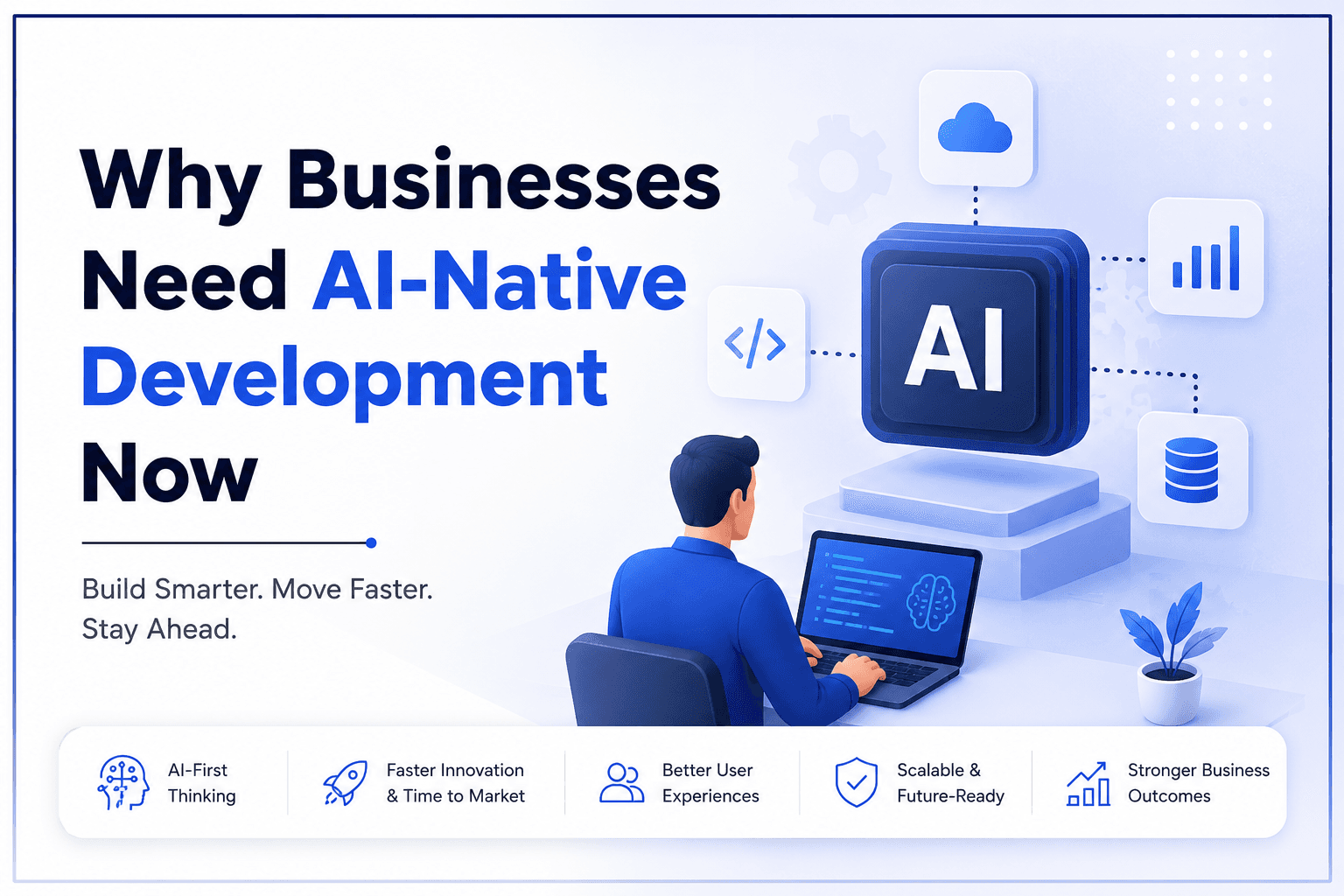
Quick answer: Businesses are moving to AI-native development because task-specific agents, RAG-based knowledge assistants, and workflow automation now deliver measurable operational gains — but only when built on a genuinely agent-ready architecture. Bolting AI onto legacy systems tends to produce demos that don't survive contact with production data and governance requirements.
Common business drivers include:
Internal knowledge assistants — search and Q&A across scattered internal documentation, tickets, and wikis (the category Glean and Moveworks/ServiceNow built businesses around)
Customer support and conversational agents — resolving tickets, calls, and chats autonomously rather than just suggesting replies to a human agent (Sierra's core business)
Coding and engineering agents — autonomous or semi-autonomous software engineering agents that plan, write, test, and open pull requests (Cognition's Devin, GitHub Copilot workspace-style tools)
Sales and revenue AI — lead qualification, call summarization, and pipeline forecasting
Predictive and operational AI — forecasting, anomaly detection, and supply-chain optimization built on enterprise data platforms (Palantir, C3.ai, Databricks territory)
Workflow and process automation — agents that take actions across multiple enterprise systems rather than just answering questions
The business case is straightforward in theory: fewer repetitive tickets, faster decision cycles, and knowledge that doesn't live only in one employee's head. The execution risk is what trips most organizations up — data quality gaps, unclear ownership of agent actions, and integration debt with legacy systems.
AI-Native Market Trends for 2026–2027
Quick answer: Enterprise AI is moving from single-purpose assistants to task-specific and, eventually, collaborative multi-agent systems. Gartner forecasts 40% of enterprise applications will include task-specific agents by the end of 2026, while warning that over 40% of agentic AI projects will be canceled by 2027 due to unclear ROI or weak governance — meaning vendor and architecture selection now carries real financial consequences.
A few grounded data points worth knowing before you evaluate vendors:
Gartner's five-stage model for enterprise AI maturity runs from "AI assistants in nearly every app" (2025) → "task-specific agents" (40% of apps, 2026) → "collaborative agents within apps" (2027) → "agent ecosystems across apps" (2028) → a "new normal" of democratized, business-user-built agents (2029).
Gartner separately projects agentic AI could drive roughly 30% of enterprise application software revenue by 2035, above $450 billion, up from about 2% in 2025.
The same research firm has cautioned that more than 40% of agentic AI projects will likely be scrapped by the end of 2027 due to escalating costs, unclear business value, or inadequate risk controls — a sharp reminder that "we added an agent" isn't the same as "we captured value."
Market-sizing estimates for the AI agents category itself (software specifically built around autonomous agents, as distinct from broader generative AI spend) put 2026 revenue in roughly the $11–12 billion range, growing at a compound annual rate in the mid-40% range through the end of the decade, according to multiple industry trackers.
Model Context Protocol (MCP) — the open standard originally released by Anthropic for connecting agents to tools and data sources — has become a de facto interoperability layer across vendors and was handed to the Linux Foundation for open governance, with SDK downloads in the tens of millions per month by early 2026.
Key takeaway: The market is not short on AI vendors — it's short on vendors who can get agentic systems past the pilot stage into governed production. That's the filter to apply throughout the rest of this guide.
How We Selected These Companies
Rather than aggregating self-submitted marketing copy from vendor directories (the standard practice on most "top AI companies" listicles), this guide prioritized companies where we could verify, from independent public sources, at least the following:
Founding date and headquarters — confirmed via company sites, SEC filings (for public companies), or independent business-data providers
Core AI-native product or service line — not just "we do AI consulting" but a specific, checkable offering
Named enterprise clients or public case studies — where available
Funding, revenue, or public-market status — as a rough proxy for scale and durability
Category fit — a deliberate mix of public enterprise-AI platforms, well-funded AI-agent startups, and large-scale AI-native consultancies/systems integrators, so the list is useful whether you're a startup, mid-market company, or enterprise buyer
We did not assign invented star ratings, fabricate client testimonials, or rank companies 1-through-N by an unweighted composite score, because that kind of precision isn't honestly derivable from public information. Where a source claim (funding amount, employee count, valuation) varies across databases, we've used the most recent and most directly sourced figure available.
Top AI-Native Companies and Consultancies in the USA
This list mixes two categories on purpose: AI-native product companies (you buy or license their platform) and AI-native consultancies/engineering firms (they build custom systems for you, often on top of platforms like the ones listed here). Both are legitimate paths depending on whether you want to build or buy.
Palantir Technologies
Headquarters: Denver, Colorado
Founded: 2003
Status: Public company (NYSE: PLTR)
Core AI services: Enterprise data integration and the Artificial Intelligence Platform (AIP), which lets organizations connect LLM-based agents directly to operational data and let them take governed actions inside real workflows
Industries served: Government/defense, healthcare, energy, manufacturing, financial services
Ideal for: Large enterprises and government agencies with complex, siloed data environments who need agent actions tied to strict audit and access controls
Differentiator: Deepest track record of any company on this list in shipping AI into environments with the strictest security and compliance requirements, including classified government systems
Trade-off to weigh: Historically enterprise/government-oriented pricing and deployment model; less suited to a small team wanting a lightweight pilot
Databricks
Headquarters: San Francisco, California
Founded: 2013
Status: Private, one of the most highly valued private software companies globally
Core AI services: Unified data and AI platform (the "Lakehouse"), Mosaic AI for building, fine-tuning, and serving custom and open-source models, and Agent Bricks for building production agent systems on governed enterprise data
Industries served: Broad horizontal — financial services, retail, healthcare, media, manufacturing
Ideal for: Data-heavy enterprises that want to build custom AI/agent systems on top of their existing data infrastructure rather than adopt a fully packaged vertical product
Differentiator: Strongest position of any vendor here in unifying data engineering, ML, and generative AI into a single governed platform, rooted in the team's origin as the creators of Apache Spark
Trade-off to weigh: A platform, not a turnkey application — you need in-house or partner engineering capacity to get value from it
Sierra
Headquarters: San Francisco, California
Founded: 2023, by Bret Taylor (former Salesforce co-CEO, OpenAI board chair) and Clay Bavor (former Google VP)
Status: Private; reported valuation above $10 billion as of 2026, with named enterprise customers including ADT, Sonos, SiriusXM, and Weight Watchers
Core AI services: Conversational AI agents ("Agent OS") purpose-built for customer service and customer experience, deployed across voice, chat, and phone channels
Industries served: Retail, telecom, insurance, consumer subscriptions
Ideal for: Consumer-facing enterprises replacing scripted chatbots and IVR systems with agents that can actually resolve issues
Differentiator: Outcome-based pricing (billed per resolved interaction rather than per seat), which forces the product itself to be judged on resolution quality rather than deployment volume
Trade-off to weigh: Narrowly focused on customer-experience use cases rather than a general enterprise AI platform
Glean
Headquarters: Palo Alto, California
Founded: 2019, by a team of former Google search engineers led by CEO Arvind Jain
Status: Private; raised over $765 million, valued at roughly $7.2 billion as of mid-2025
Core AI services: Enterprise "Work AI" platform combining unified enterprise search, an AI assistant, and an agent-building layer that connects to 100+ business applications (Slack, Salesforce, GitHub, Confluence, etc.)
Industries served: Technology, financial services, retail, healthcare, government
Ideal for: Organizations whose primary AI pain point is fragmented internal knowledge rather than customer-facing automation
Differentiator: Deep, security-conscious integration layer across the enterprise SaaS stack, plus a research arm (the Work AI Institute, run with Stanford and Harvard researchers) studying what actually drives ROI from workplace AI
Trade-off to weigh: Primarily a platform for internal productivity use cases rather than external customer-facing products
Cognition AI
Headquarters: San Francisco, California
Founded: August 2023, by Scott Wu, Steven Hao, and Walden Yan — former competitive programmers and IOI gold medalists
Status: Private; acquired the Windsurf AI coding editor in 2025
Core AI services: Devin, an autonomous AI software engineering agent that plans, writes, tests, and submits code changes with minimal human intervention, plus the Windsurf IDE
Industries served: Software engineering teams across all verticals
Ideal for: Engineering organizations looking to offload well-scoped coding, debugging, and migration tasks to an autonomous agent rather than a code-completion tool
Differentiator: One of the most advanced fully autonomous (not just assistive) coding agents on the market, built by a team with a strong competitive-programming pedigree
Trade-off to weigh: Best suited to well-defined engineering tasks; like all current coding agents, still benefits from human review on complex or ambiguous work
C3.ai
Headquarters: Redwood City, California
Founded: 2009 (as C3 Energy), by Tom Siebel
Status: Public company (NYSE: AI)
Core AI services: Prebuilt and configurable enterprise AI applications for predictive maintenance, fraud detection, supply chain, and ESG, plus a low-code platform for building custom AI applications
Industries served: Energy and utilities, manufacturing, defense, financial services, government
Ideal for: Asset-heavy industries wanting packaged AI applications rather than building agents from scratch
Differentiator: Long track record (relative to most AI-native startups) in operational AI for physical-asset industries like utilities and manufacturing
Trade-off to weigh: More application-oriented than agent-native; less focused on the newer agentic-AI category than several others on this list
DataRobot
Headquarters: Boston, Massachusetts
Founded: 2012
Status: Private
Core AI services: End-to-end enterprise AI lifecycle platform spanning AutoML, MLOps, model governance, and — more recently — generative AI and agent orchestration for regulated industries
Industries served: Financial services, healthcare, insurance, the public sector
Ideal for: Regulated enterprises that need rigorous model governance and explainability alongside newer generative and agentic capabilities
Differentiator: One of the longest-standing MLOps and model-governance platforms now extending that governance discipline into generative and agentic AI, rather than treating governance as an afterthought
Trade-off to weigh: Historically stronger in traditional predictive ML than in newer LLM-native product categories, though this is actively evolving
Writer
Headquarters: San Francisco, California
Founded: 2020
Status: Private
Core AI services: Full-stack enterprise generative AI platform built on Writer's own Palmyra family of models, covering content generation, agent building, and workflow automation with an emphasis on brand and compliance controls
Industries served: Financial services, healthcare, technology, professional services
Ideal for: Enterprises that want a single vendor owning the model, the guardrails, and the application layer rather than assembling one from separate API providers
Differentiator: Builds and trains its own foundation models rather than solely wrapping third-party APIs, which it positions as giving customers more control over cost, latency, and data handling
Trade-off to weigh: A more vertically integrated (and therefore less model-agnostic) approach than platforms that let you swap between OpenAI, Anthropic, and open-source models freely
Accenture
Headquarters: Dublin, Ireland (with a very large US employee base and US-headquartered AI practice operations)
Founded: 1989 (spun out of Andersen Consulting)
Status: Public company (NYSE: ACN)
Core AI services: Enterprise-scale AI strategy, generative and agentic AI implementation, model integration, and change management delivered through a dedicated AI practice with tens of thousands of AI-focused practitioners
Industries served: Virtually every major industry vertical, globally
Ideal for: Large, multinational enterprises that need AI transformation delivered alongside broader digital and operational transformation programs
Differentiator: Scale — few firms can staff and deliver simultaneous AI programs across dozens of business units and geographies the way a firm of Accenture's size can
Trade-off to weigh: Engagement size and cost structure are generally built for large enterprise budgets, not startups or SMBs
IBM Consulting
Headquarters: Armonk, New York (IBM corporate HQ)
Founded: IBM itself dates to 1911; IBM Consulting operates as IBM's dedicated services arm
Status: Division of IBM (NYSE: IBM)
Core AI services: Enterprise AI strategy and implementation built around IBM's watsonx platform, including AI governance tooling, hybrid-cloud AI deployment, and industry-specific AI solutions
Industries served: Financial services, healthcare, government, manufacturing
Ideal for: Enterprises that want AI governance and hybrid-cloud/on-premises deployment options as a first-class requirement, not an afterthought
Differentiator: One of the few large consultancies with its own foundation-model and AI-governance stack (watsonx.governance) rather than being purely an integrator of third-party tools
Trade-off to weigh: Can be a heavier, slower-moving engagement model than boutique AI-native shops built for faster iteration
EPAM Systems
Headquarters: Newtown, Pennsylvania
Founded: 1993
Status: Public company (NYSE: EPAM)
Core AI services: AI-native software engineering, including generative AI product development, LLM integration, and modernization of legacy platforms into AI-ready architectures
Industries served: Financial services, travel, life sciences, media, retail
Ideal for: Enterprises that need deep custom software engineering talent (not just consulting slideware) to actually build AI-native products
Differentiator: Engineering-first culture with a large global delivery bench, positioned as a build partner rather than a strategy-only advisor
Trade-off to weigh: Less focused on packaged AI products; primarily a custom engineering and modernization partner
Thoughtworks
Headquarters: Chicago, Illinois
Founded: 1993
Status: Private (taken private by Apax Partners in 2024 after a period as a public company)
Core AI services: AI-native software delivery consulting, generative AI product engineering, and technology strategy, with a long-standing reputation for engineering practice rigor (continuous delivery, evolutionary architecture)
Industries served: Financial services, retail, technology, media
Ideal for: Organizations that want engineering-quality discipline applied to AI-native product development, not just proof-of-concept demos
Differentiator: Long-standing thought leadership in software engineering practice (the Technology Radar publication) now extended specifically to agentic and generative AI engineering patterns
Trade-off to weigh: Premium, engineering-led positioning tends to come with premium engagement pricing relative to offshore-heavy competitors
Comparison Tables
Quick-reference: buy a platform vs. hire a builder
Company | Category | Best For |
|---|---|---|
Palantir | Platform (buy) | Government/regulated enterprises needing governed agent actions on sensitive data |
Databricks | Platform (buy/build on) | Data-heavy enterprises building custom AI on unified data infrastructure |
Sierra | Platform (buy) | Consumer brands replacing chatbots with resolution-focused agents |
Glean | Platform (buy) | Enterprises with fragmented internal knowledge and search pain |
Cognition AI | Platform (buy) | Engineering teams offloading coding tasks to an autonomous agent |
C3.ai | Platform (buy) | Asset-heavy industries wanting packaged predictive AI applications |
DataRobot | Platform (buy) | Regulated enterprises needing AI governance plus AutoML/agentic capability |
Writer | Platform (buy) | Enterprises wanting one vendor to own model + guardrails + app layer |
Accenture | Consultancy (build) | Multinational transformation programs at large scale |
IBM Consulting | Consultancy (build) | Hybrid-cloud, governance-first enterprise AI programs |
EPAM Systems | Consultancy (build) | Custom AI-native engineering and legacy modernization |
Thoughtworks | Consultancy (build) | Engineering-rigor-led AI product builds |
Company size and funding snapshot
Company | Founded | HQ | Ownership |
|---|---|---|---|
Palantir | 2003 | Denver, CO | Public (NYSE: PLTR) |
Databricks | 2013 | San Francisco, CA | Private |
Sierra | 2023 | San Francisco, CA | Private, ~$10B+ valuation |
Glean | 2019 | Palo Alto, CA | Private, ~$7.2B valuation |
Cognition AI | 2023 | San Francisco, CA | Private |
C3.ai | 2009 | Redwood City, CA | Public (NYSE: AI) |
DataRobot | 2012 | Boston, MA | Private |
Writer | 2020 | San Francisco, CA | Private |
Accenture | 1989 | Dublin, IE (major US ops) | Public (NYSE: ACN) |
IBM Consulting | 1911 (IBM) | Armonk, NY | Division of IBM |
EPAM Systems | 1993 | Newtown, PA | Public (NYSE: EPAM) |
Thoughtworks | 1993 | Chicago, IL | Private (Apax Partners) |
Funding and valuation figures shift quickly for private companies — verify current numbers directly with the vendor before finalizing a purchase decision.
AI-Native Services, Explained
Quick answer: AI-native service offerings generally fall into six buckets — strategy/consulting, generative AI and LLM application development, agent development, RAG and enterprise-search systems, MLOps/AI infrastructure, and ongoing model/agent maintenance. Most engagements combine several of these rather than buying just one.
AI strategy and consulting — assessing where AI can create measurable value, prioritizing use cases, and building a governance framework before any code is written
Generative AI application development — building products where an LLM generates content, summaries, or code as the core function
AI agent development — building systems where the model plans and takes multi-step actions using tools, not just generating text
LLM development and fine-tuning — adapting a foundation model (via fine-tuning, distillation, or prompt/context engineering) to a specific domain or task
Retrieval-augmented generation (RAG) and enterprise search — connecting models to an organization's proprietary documents and data so responses are grounded in real, current information rather than only the model's training data
Knowledge management and internal copilots — the Glean/Moveworks category — helping employees find answers and get work done across scattered internal systems
Workflow and process automation — agents that trigger actions in other systems (ticketing, CRM, ERP) rather than just answering questions
Computer vision and predictive analytics — the more traditional ML categories that still underpin many "AI-native" products, especially in manufacturing, healthcare imaging, and logistics
MLOps and AI infrastructure — the operational layer: model versioning, evaluation pipelines, monitoring for drift and hallucination, and cost management
Model deployment and maintenance — the unglamorous but essential ongoing work of keeping agents accurate, secure, and cost-efficient as usage and underlying models change
The AI-Native Tech Stack
Quick answer: A typical AI-native stack in 2026 combines a foundation-model layer (OpenAI, Anthropic, Google, or open-source models like Llama, Mistral, or DeepSeek), an orchestration layer (LangChain, LangGraph, CrewAI, Semantic Kernel), a retrieval layer (vector databases like Pinecone, Weaviate, or Milvus), and standard cloud infrastructure (containers, MLOps tooling, and increasingly MCP for agent-to-tool connectivity).
Layer | Common Tools |
|---|---|
Foundation models | OpenAI, Anthropic (Claude), Google (Gemini), Meta (Llama), Mistral, DeepSeek |
Agent orchestration | LangGraph, CrewAI, AutoGen, Semantic Kernel, LangChain |
Retrieval/RAG | LlamaIndex, Pinecone, Weaviate, Milvus, Redis (vector search) |
Interoperability | Model Context Protocol (MCP), now under Linux Foundation governance |
Cloud AI platforms | AWS Bedrock, Azure AI Foundry, Google Vertex AI |
MLOps | MLflow, Weights & Biases, model registries and evaluation pipelines |
Deployment infrastructure | Docker, Kubernetes, standard cloud-native tooling |
Vendor and stack choice should follow the use case, not the other way around — a customer-facing conversational agent, an internal RAG search tool, and an autonomous coding agent have meaningfully different requirements for latency, grounding, and human-in-the-loop review.
The AI-Native Development Process
A mature AI-native build typically moves through these stages, though iteration between them (especially prototype ↔ evaluation) is constant rather than strictly linear:
Discovery and use-case prioritization — identify where agentic or generative AI creates measurable value versus where it's a solution looking for a problem
Data readiness assessment — most AI-native project delays trace back to data access, quality, or governance gaps discovered too late
Architecture design — decide the orchestration approach, model choice(s), retrieval strategy, and human-in-the-loop checkpoints
Prototype — a fast, narrowly scoped proof that the approach works on real (not synthetic) data
MVP and evaluation harness — build repeatable evaluation sets so quality can be measured objectively, not just eyeballed
Development — build the full system, including guardrails, fallback behavior, and audit logging
Testing — includes adversarial/red-team testing specific to LLM failure modes (hallucination, prompt injection, data leakage)
Deployment — staged rollout, typically starting with internal or low-stakes use before customer-facing deployment
Monitoring — ongoing tracking of accuracy, cost per interaction, latency, and drift
Optimization and scaling — tuning cost/performance trade-offs as usage grows
Maintenance — updating for new model versions, changing data sources, and evolving governance requirements
How to Choose an AI-Native Partner
Quick answer: Vet AI-native vendors on production track record (not just demos), data security and IP ownership terms, model flexibility versus lock-in, and whether they can show you a real evaluation methodology — not just an impressive-looking pilot.
Questions worth asking every shortlisted vendor:
Can you show a production deployment (not a demo) with usage at real scale, and what were the actual outcomes?
How do you measure agent/model accuracy, and can we see your evaluation methodology?
Who owns the IP, prompts, fine-tuned models, and any proprietary data pipelines built during the engagement?
What happens to our data — is it used to train your models or anyone else's?
What's your incident response process if an agent takes an incorrect or harmful action?
Are you locked into a single model provider, or can we switch models as the market shifts?
What compliance certifications do you hold (SOC 2, HIPAA, FedRAMP, etc.) relevant to our industry?
Red flags:
Reluctance to discuss failure cases or share a real evaluation framework
Pricing based purely on "AI hype" positioning rather than clear deliverables and milestones
No clear answer on data ownership or model training rights
Case studies that can't be independently verified or attributed to a named client
What AI-Native Development Costs in 2026
Quick answer: Costs vary enormously by scope, but as a rough industry pattern, boutique AI development shops in the US bill in the roughly $50–200+ per hour range, with full custom agentic or RAG systems commonly running from the low tens of thousands of dollars for a narrow pilot to several hundred thousand dollars (or more) for a production-grade enterprise deployment. Large systems-integrator engagements for enterprise-wide AI transformation can run into seven or eight figures.
Independent benchmarking of AI development firms (GoodFirms' 2026 review data) puts the median hourly rate across reviewed US AI firms at roughly $37/hour, though rates vary widely by firm size, specialization, and seniority of engineers involved — larger, more specialized shops and name-brand consultancies typically bill well above that median.
Factors that move the price the most:
Scope of agentic behavior — a Q&A assistant is far cheaper than a multi-step agent that takes real actions across systems
Data readiness — poor-quality or siloed data adds significant discovery and cleaning cost before any AI work begins
Compliance requirements — HIPAA, SOC 2, FedRAMP, or financial-services regulatory requirements add both engineering and audit overhead
Model choice — proprietary frontier-model API usage at scale can carry meaningfully higher ongoing inference cost than fine-tuned open-source models, though it may reduce engineering time
Build vs. buy — licensing an existing platform (Glean, Sierra, Writer, etc.) is typically far cheaper upfront than a fully custom build, with the trade-off being less architectural control
Treat any vendor quoting a precise fixed price before a discovery phase with some skepticism — reputable firms typically scope discovery separately before committing to a fixed-price or capped-time-and-materials estimate for the build itself.
Where AI-Native Development Is Headed
Quick answer: The next phase of enterprise AI moves from single agents completing isolated tasks toward collaborative multi-agent ecosystems, according to Gartner's own maturity model — with 2027 expected to bring agents that work together within applications, and 2028–2029 bringing agent ecosystems that span applications and, eventually, agents that business users build and govern themselves.
Themes worth tracking over the next 12–24 months:
Multi-agent orchestration replacing single-agent point solutions, requiring genuinely new governance and monitoring approaches
Reasoning-focused models that spend more inference-time compute "thinking" before acting, trading latency for reliability on complex tasks
Multimodal agents that work across text, voice, images, and structured data rather than text-only interfaces
Vertical AI — narrower, industry-specific agent products (legal, healthcare, financial services) outcompeting horizontal general-purpose tools on domain accuracy
AI governance maturity becoming a purchasing criterion, not an afterthought, as more organizations have already lived through a canceled or stalled agentic AI pilot
Interoperability standards like MCP continuing to mature as the connective layer between agents, tools, and data across vendors
Frequently Asked Questions
What's the difference between AI-native and AI-enhanced software?
AI-native software is architected from the ground up around models and agents as core infrastructure — data pipelines, orchestration, memory, and evaluation loops are all designed for AI from day one. AI-enhanced software takes an existing, conventionally built product and adds an AI feature on top, often via a third-party API call. You can usually tell the difference by asking what happens if you remove the AI: in AI-enhanced software the core product still works the same way; in AI-native software, the core workflow depends on the model.
Do I need an AI-native platform, or can I add AI to my existing software?
It depends on your use case. If you need a narrow, well-defined feature (like summarizing support tickets), an AI-enhanced add-on may be sufficient and far cheaper. If you're building a product where autonomous decision-making or multi-step reasoning is the core value proposition, a true AI-native architecture will hold up better under real usage and scale.
What is an AI agent, exactly?
An AI agent is a system that uses a language model to plan and take multi-step actions — calling tools, querying data, and adjusting its approach based on results — rather than simply generating a single text response. The key distinction from a chatbot is autonomy: an agent can decide what to do next, not just what to say next.
What is RAG (retrieval-augmented generation) and why does it matter?
RAG connects a language model to an organization's own documents and data at query time, so responses are grounded in specific, current, verifiable information rather than only what the model learned during training. It's the standard approach for reducing hallucination in enterprise AI applications and is central to most internal knowledge-assistant products.
How long does an AI-native project typically take?
A narrowly scoped pilot or proof-of-concept can often be built in 4–8 weeks. A production-grade agentic system with proper evaluation, guardrails, and integration into existing enterprise systems more commonly takes 3–9 months, depending on data readiness and compliance requirements.
Should I build my own AI agents or buy a platform like Glean, Sierra, or Writer?
Buying is usually faster and cheaper to get to production, and makes sense when your use case fits a well-established category (internal knowledge search, customer service agents, content generation). Building makes more sense when your workflow is highly proprietary, you need architectural control, or no existing platform fits your specific data and compliance requirements.
What does "agentic AI" mean, and how is it different from generative AI?
Generative AI generates content — text, code, images — in response to a prompt. Agentic AI goes further: it plans a sequence of actions, uses tools, and often operates with some autonomy toward a goal, adjusting its approach based on intermediate results. Most AI-native products today combine both.
Is AI-native development more expensive than traditional software development?
Not inherently, but total cost of ownership includes ongoing inference costs (paying per API call to a model provider) and continuous evaluation/monitoring that traditional software doesn't require. Build costs can be comparable to or cheaper than a traditional application of similar scope, but the ongoing operational cost profile is different.
What security risks are specific to AI-native systems?
Beyond standard application security, AI-native systems introduce risks like prompt injection (malicious inputs manipulating agent behavior), data leakage through model outputs, and the challenge of auditing non-deterministic decision paths. A credible AI-native vendor should be able to speak specifically to how they test for and mitigate these.
What is MCP (Model Context Protocol) and do I need to care about it?
MCP is an open standard, originally released by Anthropic and now governed by the Linux Foundation, for connecting AI agents to external tools and data sources in a standardized way. You don't need to understand its technical details to buy AI services, but a vendor building on MCP-compatible architecture is generally better positioned for interoperability as the agent ecosystem matures.
How do I measure ROI from an AI-native investment?
Define success metrics before you build — resolution rate, cost per resolved interaction, time saved per employee, or accuracy against a labeled evaluation set, depending on the use case. Vague goals like "improve efficiency" are why so many pilots stall; specific, measurable targets are what let you judge whether to scale a pilot or kill it.
What industries benefit most from AI-native development right now?
Financial services, healthcare, and technology companies have generally moved fastest, largely because they have both the data infrastructure and the volume of repetitive, judgment-heavy tasks (claims processing, customer support, code review) where agents show clear ROI. Regulated industries move more cautiously due to compliance requirements but are increasingly active.
Do AI-native vendors typically require long-term contracts?
It varies widely. Platform vendors often use annual or multi-year enterprise contracts, while boutique consultancies frequently work on a project or capped time-and-materials basis, especially for an initial pilot phase. Ask specifically about exit terms and IP ownership before signing.
What happens to the AI model as underlying foundation models change (e.g., a new GPT or Claude version)?
A well-built AI-native system should include an evaluation harness that lets you test a new model version against your specific use cases before switching, and ideally isn't so tightly coupled to one model's specific quirks that switching requires a full rebuild. This is a good specific question to ask any prospective vendor.
Can a small business or startup realistically afford AI-native development?
Yes, especially by licensing an existing platform rather than building custom agent infrastructure from scratch. Many platforms in this guide (Glean, Writer, Sierra) offer tiers or packages designed for smaller deployments, and boutique development shops can scope narrow pilots at a fraction of enterprise-transformation budgets.
Choosing Your AI-Native Partner
The companies profiled here range from publicly traded enterprise platforms to well-funded startups to century-old consultancies that have rebuilt their practice around agentic AI. None of them is the universally "best" choice — the right partner depends on whether you're licensing a platform or commissioning a custom build, how regulated your industry is, and how much architectural control you need versus how fast you need to move.
If you're early in the process, the highest-leverage next step usually isn't picking a vendor — it's running a focused discovery phase to identify which one or two use cases actually justify AI-native investment right now, and using that scoped, specific brief to get comparable proposals from two or three of the vendors above.