
Top-Rated Shopify Website Design Agencies in Spain in 2026
Posted on
Web Design
Posted at

Top-Rated Shopify Website Design Agencies in Spain in 2026
Spain's online retail sector has quietly become one of the more interesting growth stories in Europe. Cross-border demand from Latin America, a mobile-first shopper base, and a wave of homegrown DTC brands have pushed merchants toward platforms that can scale without a six-figure IT department behind them. Shopify has become the default choice for a large share of that growth, and a local ecosystem of Shopify website design agencies in Spain has formed around it.
That ecosystem is also where most of the confusion lives. Search for a "Shopify development company Spain" and you'll find a mix of genuinely Spain-based teams, international agencies that happen to serve Spanish clients remotely, and listicles that were clearly assembled without anyone checking where these companies are actually headquartered. This guide cuts through that. Every agency profiled below maintains a real office in Spain, holds verifiable Shopify or Shopify Plus partner status, and has a public track record — client reviews, named projects, or both — that you can check yourself before making a decision.
Spain's retail sector has not been a passive bystander to ecommerce growth. The country now ranks among the larger B2C ecommerce markets in Europe, with several market trackers placing it ahead of historically larger neighbors on recent growth-rate comparisons. Mobile already accounts for the majority of transactions, and a meaningful share of all online spending in Spain crosses a border before it reaches a customer's door — partly fueled by demand from Spanish-speaking Latin American shoppers who favor euro-priced, Spanish-language storefronts. None of that growth happens on a platform that can't keep up, which is a large part of why Shopify experts in Spain are in such consistent demand.
This guide is built for founders evaluating their first Shopify build, marketing leads vetting a Shopify Plus agency Spain for an enterprise migration, and operators trying to figure out whether a €4,000 freelancer quote or a €40,000 agency proposal is the right call for their store. We'll cover:
Why Spain's ecommerce market is growing the way it is, and what that means for merchants choosing a platform partner
How to evaluate a Shopify website design agency Spain on more than a portfolio page
Detailed, fact-checked profiles of agencies actually headquartered in Spain — covering Madrid, Barcelona, and beyond
Realistic pricing ranges for Shopify projects in the Spanish market
The ecommerce trends shaping 2026 and what they mean for your store
A blunt rundown of red flags, the right questions to ask before signing a contract, and how DIY stacks up against hiring a Shopify development company Spain-based teams can offer
One mistake we see constantly: business owners assume that "best Shopify agency" rankings are vetted the way a real industry report would be. In practice, a lot of these lists are compiled from directory scrapes, and unless someone has actually checked a company's address against the claim "Spain," you can end up shortlisting a perfectly good agency that's simply in the wrong country for a project that needs in-person workshops, Spanish-language support, or familiarity with Spain's specific tax and logistics quirks (Bizum integration, AEAT invoicing rules, Correos/SEUR shipping setups). We checked headquarters addresses for every agency in this guide so you don't have to.
Why Spain Is Emerging as an Ecommerce Powerhouse
Spain's digital retail growth isn't evenly distributed — it's concentrated in a handful of cities and driven by a specific set of structural advantages.
Madrid's Startup Ecosystem
Madrid has spent the last decade building out a genuine tech and startup cluster, and ecommerce has been one of its strongest verticals. The capital is home to several of the country's most established Shopify Plus agencies, including firms with 10+ years of platform-specific experience and dozens of completed Shopify Plus migrations. Madrid's concentration of marketing, performance advertising, and Shopify development talent in one metro area makes it the default starting point for founders searching "Shopify design agency Madrid."
Barcelona's Digital Innovation Scene
Barcelona brings a different flavor: more design-forward, more internationally connected, and historically stronger in DTC fashion and lifestyle brands. Several Shopify agency Barcelona teams operate as the ecommerce arm of larger digital transformation agencies with offices across Southern Europe, giving Barcelona-based merchants access to teams that also understand French and Italian market expansion — useful if international growth is on the roadmap.
Valencia and Seville's Growing Technology Sectors
Smaller hubs like Valencia, Seville, and Alicante have developed their own niche ecommerce talent pools, often centered on digital marketing agencies that have added Shopify development as a core service line rather than starting as platform specialists. These teams tend to be leaner and more price-competitive, which matters for SMEs that don't need a 100-person agency to launch a solid store.
Cross-Border Ecommerce Opportunities
A meaningful share of Spanish online spending crosses a border, and Spain's position as a Spanish-language gateway to Latin American consumers gives Spain-based Shopify website developers a structural advantage that agencies in, say, Germany or the Netherlands simply don't have. Agencies fluent in both the language and the logistics of LatAm expansion are a genuine differentiator worth asking about during agency selection.
Shopify Adoption Among Spanish Brands
Shopify's footprint in Spain has grown alongside the broader market, supported by native Spanish and Catalan storefront language, built-in VAT and GDPR compliance tooling, and a growing bench of Spain-based Shopify Plus agencies capable of handling enterprise-grade migrations. Brands ranging from fashion retailers to sports organizations — FC Barcelona's ecommerce operation is one widely cited example — now run on Shopify or Shopify Plus with a Spain-based agency behind the build.
Read More : Best Web Design Companies in Spain – Top 30 Agencies (2026 Guide)
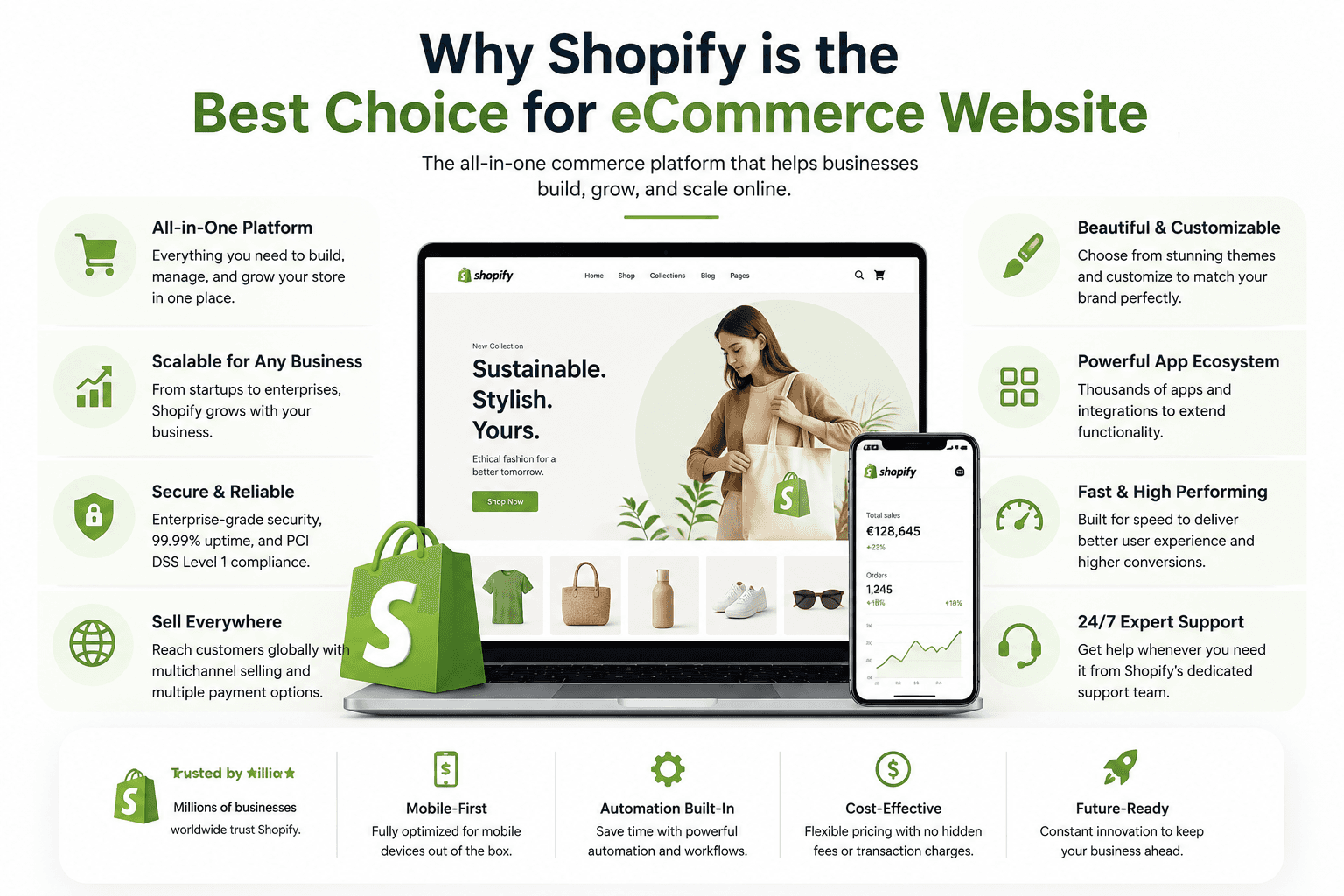
Why Businesses Choose Shopify for Ecommerce Growth
Before getting into agency selection, it's worth being clear-eyed about why Shopify keeps winning this category in the first place.
Ease of use. Shopify's admin interface remains the standard against which competitors are measured. Store owners without a technical background can manage products, orders, and basic content changes without filing a support ticket every time something needs updating.
Scalability. A store that starts on basic Shopify can move to Shopify Plus without a full replatform, which matters enormously for fast-growing DTC brands that don't want to relive a painful migration eighteen months after their last one.
Shopify Plus capabilities. For larger merchants, Shopify Plus unlocks custom checkout flows, dedicated infrastructure that handles high-volume traffic spikes (Black Friday, product drops), and B2B-specific functionality that basic Shopify doesn't offer.
International selling. Shopify Markets lets a single store serve multiple countries with localized pricing, currency, and language — a near-essential feature for any Spain-based brand eyeing Latin American or broader EU expansion.
Mobile commerce. With the majority of Spanish ecommerce transactions happening on mobile, Shopify's mobile-optimized checkout and theme architecture isn't a nice-to-have, it's the baseline requirement.
Automation. Shopify Flow and a deep app ecosystem let merchants automate inventory alerts, customer segmentation, and post-purchase flows without custom development for every workflow.
AI-powered personalization. Product recommendation engines, AI-assisted merchandising, and increasingly capable on-site search are now standard additions that a competent Shopify development company Spain-based or otherwise can layer onto a store relatively quickly.
How We Evaluated These Shopify Agencies
Every agency in this guide was assessed against five criteria, with headquarters verification as a hard prerequisite — an agency that isn't actually based in Spain didn't make the cut, regardless of how strong its Shopify portfolio is.
Technical Expertise
We looked for verifiable Shopify Plus development experience, custom theme work (not just templated builds), demonstrated app integration capability, and — where relevant — headless commerce experience using Shopify's Storefront API.
Design Excellence
UX/UI quality, mobile-first execution, and the agency's ability to translate a brand identity into a converting storefront rather than a generic theme with a new logo.
Ecommerce Performance
Conversion-focused Shopify design, attention to site speed, and SEO-readiness baked into the build rather than bolted on afterward.
Client Success
Public reviews (Clutch, Sortlist, the Shopify Partners directory), named client work, and longevity of client relationships as a proxy for retention and support quality.
Pricing & Value
Whether published or quoted pricing aligns with project scope, and whether the agency is transparent about cost ranges upfront rather than requiring a sales call just to get a ballpark.
Top-Rated Shopify Website Design Agencies in Spain
A note on methodology before diving in: we are not publishing star ratings or precise price quotes for these agencies. Star ratings on a "best of" list are usually either lifted from a single third-party directory (which then misrepresents that directory's specific review criteria as our independent judgment) or invented outright — neither is something we're willing to do. Where an agency publishes a public review score on a platform like Sortlist or Clutch, we cite it directly so you can verify it yourself. Pricing is given as the realistic range for the project type, not a number specific to any one agency, since none of these companies publish fixed price cards (which is normal for custom Shopify work).
OHDIGITAL
Headquarters: Las Rozas de Madrid, Madrid, Spain Founded: 2013
OHDIGITAL bills itself as the first Shopify-focused agency in Spain, and the timeline backs that up — the team has been working exclusively on the platform since roughly 2014, which in Shopify-agency terms makes them one of the most tenured Shopify experts Spain has to offer. They're a fully remote-first company, which keeps overhead lean, and they've built a reputation as the highest-rated Spanish-speaking Shopify Plus agency by client review volume on the official Shopify Partners directory.
Services: Store design and build, Shopify Plus replatforming, migrations from Prestashop, WooCommerce, and Magento, conversion optimization, ERP/CRM/B2B integrations, Shopify POS setup, and ongoing Shopify maintenance services.
Industry expertise: OHDIGITAL's portfolio leans heavily toward fashion and footwear — including a long-running Shopify Plus relationship with a century-old Spanish footwear brand — along with accessories and lifestyle brands with an emphasis on sustainability.
Why businesses choose them: For merchants who want a team that has lived inside Shopify's ecosystem since its early days in Spain, and who value direct, no-agency-bloat communication over a large account-management layer, OHDIGITAL is consistently mentioned as a go-to choice. They also organize the long-running Madrid Shopify Meetup, which says something about their standing in the local Shopify community.
Key strengths: Deep platform-specific tenure, strong migration experience from legacy platforms, genuine specialization (they don't try to be a generalist digital agency).
Pricing: Project-based; mid-market Shopify builds and Shopify Plus replatforming work typically falls in the €8,000–€30,000+ range depending on integration complexity.
Ideal for: Fashion and DTC brands migrating from an older platform, and growing merchants who want a Shopify-only specialist rather than a full-service marketing agency.
Pros: Long platform tenure, narrow focus, strong migration track record, active in the Spanish Shopify community. Cons: Remote-first model means no in-person office visits, which may matter to some enterprise clients.
Rocket Digital
Headquarters: Barcelona, Spain (additional offices in Madrid and Milan) Background: Originally built around ROI-driven digital advertising before expanding into Shopify Plus development.
Rocket Digital is one of the larger, more diversified players on this list — a 100+ person team spanning business strategy, performance advertising, SEO, CRM, and Shopify Plus development under one roof. They describe themselves as Spain's leading Shopify Plus partner agency by project volume, with 500+ projects delivered, and they back that claim with named enterprise clients, including FC Barcelona's ecommerce operation and cycling brand Gobik's B2B/B2C Shopify Plus build.
Services: Custom Shopify Plus development, UX/UI and product design, Shopify Markets configuration for international selling, ERP/CRM/logistics integrations, full-funnel digital marketing (SEO, SEM, social), and post-launch CRO.
Industry expertise: Fashion (notably a southern-Europe-recognized fashion brand rebuild), sports and sporting goods, health and beauty, jewelry and accessories.
Why businesses choose them: Rocket Digital is the rare agency on this list that can credibly handle both the Shopify Plus build and the performance marketing that drives traffic to it — useful for enterprise brands that don't want to coordinate between a dev agency and a separate media agency.
Key strengths: Scale (three offices, 100+ specialists), named enterprise case studies, official partnerships with Google, Meta, HubSpot, Klaviyo, and Shopify itself, award recognition including Google Awards and European Search Awards wins.
Pricing: Given their enterprise client base, expect Shopify Plus engagements to start in the €25,000+ range, with full-funnel marketing retainers priced separately.
Ideal for: Enterprise brands and large DTC players that need Shopify Plus development paired with serious digital marketing firepower, particularly those with international expansion plans (Rocket's Milan office gives them a foothold into Italy as well).
Pros: Scale and resourcing depth, verified enterprise case studies, multi-office presence across Spain and into Italy. Cons: Sizing and pricing point this toward mid-market-to-enterprise clients rather than early-stage startups on tight budgets.
WITHIFY (a division of WITH)
Headquarters: Madrid, Spain (C. de Sagasta, 11, Chamberí), with additional offices in Paris, Barcelona, and Geneva
WITHIFY is the ecommerce-specific vertical of WITH, a broader digital transformation agency. That structure means WITHIFY clients get a Shopify Plus-certified team that's backed by a larger agency's strategic and design resources, without working with generalists who treat Shopify as a side offering. They carry public reviews on Sortlist (12+ reviews at last check) and are officially certified Shopify Plus Partners and Klaviyo Gold Partners.
Services: Custom ecommerce builds, migrations from PrestaShop, WooCommerce, Magento, SAP, and Salesforce, Shopify Plus unified commerce (POS-to-online integration), B2B ecommerce channel setup, international market expansion, and ongoing UX/CRO optimization.
Industry expertise: No single dominant vertical — client work spans general DTC and B2B brands across France and Spain given WITH's pan-European office footprint.
Why businesses choose them: The multi-office structure (Madrid, Barcelona, Paris, Geneva) makes WITHIFY a strong fit for Spain-based brands that need cross-border European support without juggling separate agencies in each market.
Key strengths: Certified Shopify Plus and Klaviyo partner status, multilingual project delivery (French, Spanish, English), unified commerce (POS + online) capability.
Pricing: Mid-market to enterprise; full migrations with unified commerce setup commonly run €15,000–€50,000+ depending on scope.
Ideal for: Brands with simultaneous operations in Spain and France, or any merchant planning a complex migration from an ERP-heavy stack like SAP or Salesforce Commerce.
Pros: Genuine pan-European presence, certified partner status with both Shopify Plus and Klaviyo, public client reviews available for verification. Cons: As a division of a larger agency, smaller projects may get less senior attention than flagship engagements.
Lyra Digital
Headquarters: Madrid, Spain
Lyra is a 15+ year digital agency that has built out a certified Shopify Plus practice alongside its existing custom software development and branding work. They carry a strong public review profile (4.9 out of 5 across nearly 30 reviews on Sortlist at last check), with particular strength in technical and "GEO SEO" — search optimization that accounts for AI-driven search surfaces like Google AI Overviews, ChatGPT, and Perplexity, alongside traditional organic search.
Services: Shopify ecommerce builds, custom software development, UX/UI design and branding, AI-driven business applications, migrations from Magento, WordPress/WooCommerce, or PrestaShop, and CRM/ERP/API integrations.
Industry expertise: Cross-industry, with disclosed work in pharmaceuticals and biotech alongside general ecommerce.
Why businesses choose them: Lyra's combination of a long agency track record with a relatively new but certified Shopify Plus offering appeals to brands that want an established, accountable partner rather than a Shopify-only boutique — useful if your project also needs broader software or AI integration work beyond the storefront itself.
Key strengths: Strong, verifiable review score, certified Shopify Plus status, SEO practice built for the AI-search era rather than legacy SEO tactics alone.
Pricing: Shopify Marketing engagements start around €5,000; full Shopify Plus builds with ERP/CRM integration scale well beyond that depending on complexity.
Ideal for: Established SMEs and mid-market brands that want one agency handling ecommerce, software, and search visibility together.
Pros: High, independently verifiable client satisfaction score, forward-looking SEO approach, broad technical capability beyond Shopify alone. Cons: As a multi-discipline agency rather than a Shopify-only specialist, depth of pure Shopify Plus expertise may vary by project team.
Webmefy
Headquarters: Madrid, Spain
Webmefy positions itself explicitly around Shopify and Shopify Plus — the agency describes itself as among the first in Spain to be officially Shopify Plus certified. Unlike some of the larger multi-service agencies on this list, Webmefy's entire value proposition is built around the Shopify ecosystem specifically, with a structured, stage-based project methodology (initial consultation and market analysis, build, post-launch optimization).
Services: Shopify store creation and optimization, Shopify Plus development, conversion rate optimization, checkout and upsell flow design, multi-language and multi-currency setup, and continuous post-launch support.
Industry expertise: Cross-vertical Shopify implementation work, with a stated focus on adapting the buying journey (homepage through checkout) to each client's specific market.
Why businesses choose them: Webmefy's Madrid-based, Shopify-only positioning appeals to merchants who want a specialist rather than a multi-platform development shop, particularly for stores planning international, multi-currency expansion from day one.
Key strengths: Official Shopify Plus certification, structured project methodology, continuous post-launch optimization rather than a one-and-done build.
Pricing: Standard Shopify builds typically start in the €3,000–€10,000 range; Shopify Plus projects scale upward based on integration scope.
Ideal for: SMEs and growing DTC brands that want a Madrid-based Shopify specialist for a first build or a Shopify Plus upgrade, without the overhead of a full-service agency.
Pros: Clear Shopify-only specialization, structured and transparent methodology, ongoing optimization built into the service model. Cons: Smaller agency footprint than Rocket Digital or WITHIFY, which may matter for very large enterprise rollouts.
Peanut Butter
Headquarters: Madrid, Spain
Peanut Butter is a small, tightly focused ecommerce specialist agency — by their own description, they work exclusively on ecommerce projects and have done so for over a decade, with around 50 published projects. The name is memorable; the positioning is deliberately narrow: consulting, design, and development for stores that need to launch, grow, and eventually expand internationally.
Services: Shopify consulting, store design and development, conversion-focused build strategy, and international expansion support.
Industry expertise: General ecommerce, with founders who describe their own entrepreneurial background in retail as part of their value proposition to clients.
Why businesses choose them: For founders who want a smaller, founder-led team rather than a large agency with account managers between the client and the actual developers, Peanut Butter's boutique model is the appeal.
Key strengths: Exclusively ecommerce-focused (no generalist web design distracting from Shopify expertise), small-team accountability, over a decade of platform-specific experience.
Pricing: Given the boutique scale, expect pricing toward the lower-to-mid end of the market for standard builds, with custom quotes for more complex Shopify Plus work.
Ideal for: Early-stage and growth-stage DTC brands that want hands-on attention from a small, senior team rather than a large agency hierarchy.
Pros: Deep ecommerce-only specialization, small-team accessibility, over 10 years of focused experience. Cons: Limited team size means less capacity for very large or highly time-sensitive enterprise projects compared to agencies like Rocket Digital.
CRISP Studio
Headquarters: Barcelona, Spain
CRISP Studio is a Barcelona-based ecommerce development company with a focused service line in ecommerce development and UX/UI design. It's a smaller player than Rocket Digital or WITHIFY, which makes it a relevant option for Barcelona-area merchants who want local, design-forward execution without the scale (and price point) of a larger multi-office agency.
Services: Ecommerce development, UX/UI design, and Shopify storefront implementation.
Industry expertise: General ecommerce and DTC brand work, with a design-led approach to storefront development.
Why businesses choose them: Barcelona-based brands that prioritize visual design quality and want a local team for in-person collaboration tend to gravitate toward boutique studios like CRISP rather than larger Madrid-headquartered agencies.
Key strengths: Design-first approach, Barcelona locality, smaller-team responsiveness.
Pricing: Boutique studio pricing typically sits in the lower-to-mid range for standard Shopify builds; ask for a fixed-scope quote rather than a retainer if budget is a primary concern.
Ideal for: Barcelona-area startups and small fashion or lifestyle brands prioritizing design execution over enterprise-scale integration work.
Pros: Strong design focus, local Barcelona presence, suited to smaller, design-led projects. Cons: Smaller scale means less depth in complex Shopify Plus enterprise integrations compared to larger agencies on this list.
Zolution Society
Headquarters: Madrid, Spain Founded: 2020
Zolution Society is a newer Madrid-based web design agency offering web design, web development, UX/UI design, and branding, including ecommerce builds on Shopify. As a younger and smaller agency, they're a relevant option for startups and early-stage brands that want modern design sensibility without the higher price tag of an established enterprise-focused agency.
Services: Web and Shopify store design, UX/UI design, branding, and web development.
Industry expertise: General startup and SME ecommerce and web projects.
Why businesses choose them: Founders looking for an agency that's small enough to be price-accessible but still delivers professional-grade design work often shortlist newer Madrid studios like Zolution alongside more established names.
Key strengths: Modern design sensibility, startup-friendly pricing, branding and web design combined under one roof.
Pricing: Entry-level Shopify builds from this tier of agency commonly start around €3,000–€8,000.
Ideal for: Pre-seed and seed-stage startups needing a first Shopify store and brand identity built together.
Pros: Accessible pricing, modern design execution, branding and ecommerce handled together. Cons: Newer agency (founded 2020) means a shorter track record than the more established names on this list — worth requesting recent client references directly.
Comparison Table
Agency | Headquarters | Shopify Plus Expertise | Starting Price (approx.) | Best For |
|---|---|---|---|---|
OHDIGITAL | Las Rozas, Madrid | High — Shopify-only since 2014 | €8,000+ | Fashion/DTC migrations |
Rocket Digital | Barcelona (+ Madrid, Milan) | High — 500+ projects, enterprise clients | €25,000+ | Enterprise & large DTC |
WITHIFY | Madrid (+ Paris, Barcelona, Geneva) | High — certified Plus & Klaviyo partner | €15,000+ | Cross-border Spain/France brands |
Lyra Digital | Madrid | Medium-High — certified, newer Plus practice | €5,000+ | SMEs wanting ecommerce + software + SEO |
Webmefy | Madrid | High — Shopify-only specialist | €3,000+ | SMEs, first Shopify build |
Peanut Butter | Madrid | Medium — boutique, ecommerce-only | Custom quote | Early-stage DTC, hands-on service |
CRISP Studio | Barcelona | Medium — design-led | Custom quote | Barcelona startups, design-first projects |
Zolution Society | Madrid | Entry-level | €3,000+ | Pre-seed startups, first store + branding |
Starting prices are realistic market-rate estimates for the project type each agency typically handles, not agency-published rate cards. Always request a scoped quote.
How Much Does Shopify Website Design Cost in Spain?
Shopify project costs vary enormously based on scope, and the numbers below reflect general Spanish market patterns rather than any single agency's pricing (most custom development work is quoted per-project, not off a fixed rate card).
Basic Stores: €3,000–€8,000
This tier covers a templated or lightly customized Shopify theme, basic branding integration, product catalog setup, and standard payment/shipping configuration. It's the right range for a pre-launch startup or a small business moving online for the first time. Don't expect custom functionality, headless architecture, or deep ERP integration at this price point — and be wary of any agency quoting far below €3,000 for a "custom" build, since that's usually a sign of an undisclosed template reuse or minimal QA.
Mid-Market Stores: €8,000–€25,000
This is where most growing DTC and SME ecommerce projects land. It typically includes a genuinely custom theme (not a tweaked template), CRO-informed UX decisions, a handful of app integrations (Klaviyo, reviews platforms, subscription apps), and basic SEO architecture built in from the start. Migrations from an older platform like WooCommerce or PrestaShop usually fall in this range too, depending on catalog size and data complexity.
Enterprise Shopify Plus Projects: €25,000–€100,000+
Shopify Plus projects involve far more moving parts: custom checkout extensions, ERP/CRM/WMS integrations, multi-market Shopify Markets configuration, B2B commerce channels, and often headless commerce architecture for maximum frontend flexibility. Projects at the top of this range usually involve multiple specialist roles (backend developers, UX designers, project managers, QA) working over several months.
Ongoing Support and Maintenance Costs
A launched store is not a finished store. Budget for ongoing Shopify maintenance services — monthly retainers for bug fixes, app updates, seasonal campaign builds, and continuous CRO testing typically range from a few hundred euros a month for a small store to several thousand for an enterprise Shopify Plus operation with a dedicated support team. Factors that push maintenance costs up include the number of third-party app integrations (each one is a potential point of breakage), how frequently you run promotional campaigns requiring custom landing pages, and whether you need guaranteed response-time SLAs.
Key Ecommerce Trends Transforming Spain in 2026
AI Personalization
Product recommendation engines and AI-driven merchandising are moving from "nice to have" to default expectation. Spanish Shopify agencies are increasingly building AI-powered product discovery and personalized email/SMS flows directly into new builds rather than treating them as a post-launch add-on.
Headless Commerce Development
For brands with complex content needs or multi-brand architecture, headless commerce — decoupling the frontend from Shopify's backend via the Storefront API — is becoming a more common ask, particularly among the larger agencies on this list (WITHIFY and Rocket Digital both explicitly offer it).
Subscription Commerce
Recurring revenue models are expanding beyond the usual beauty and food/beverage categories into apparel and home goods, driven by Shopify's improved native subscription app ecosystem.
Voice Commerce
Still early-stage in the Spanish market, but agencies are beginning to account for voice-search optimization as smart speaker adoption grows.
AR Shopping Experiences
Augmented reality try-on and product visualization tools are gaining traction in fashion and home goods categories, particularly for brands trying to reduce return rates — a meaningful cost driver given Spain's logistics environment.
Mobile Commerce
With mobile responsible for the majority of Spanish ecommerce transactions, mobile-first design isn't an option, it's the baseline. Agencies that still design desktop-first and adapt down are increasingly the exception rather than the rule.
Omnichannel Retail
Unified commerce — connecting physical POS systems with online stores — is a growing line item, especially for brands with a retail footprint expanding into ecommerce or vice versa.
Sustainability
Spanish consumers increasingly favor brands with visible sustainability commitments, and agencies are building this into storefront messaging and even into shipping/packaging integration choices.
Predictive Analytics
Better native and third-party analytics tools are helping merchants forecast demand and manage inventory more precisely, reducing both stockouts and overstock — a meaningful margin lever for growing DTC brands.
Benefits of Hiring a Professional Shopify Agency
Faster launch. An experienced Shopify website design agency Spain-based or otherwise has already solved most of the technical problems your project will hit. That experience compresses timelines that would otherwise stretch out through trial and error.
Better UX. Conversion-focused design isn't intuitive — it's a discipline built on testing patterns across many stores. Agencies bring that pattern library; a DIY build usually doesn't have it.
Higher conversions. A genuinely conversion-focused Shopify design, built with CRO principles from the start, consistently outperforms a generic theme implementation.
SEO advantages. Site architecture decisions made at build time (URL structure, metadata, page speed) are far cheaper to get right upfront than to retrofit later.
Scalability. A professionally built store is more likely to handle a successful product launch or holiday traffic spike without breaking — and more likely to migrate smoothly to Shopify Plus when the time comes.
Long-term support. The right agency relationship extends well past launch day, with ongoing optimization, troubleshooting, and feature additions as your business evolves.
Questions to Ask Before Hiring a Shopify Agency
Can you show me three Shopify stores you've built that are still live and actively selling? A working, current store is a far better signal than a static portfolio screenshot.
What is your official Shopify partner tier, and can I verify it on Shopify's own partner directory? Don't take "Shopify Plus certified" at face value — check it yourself.
Who specifically will work on my project — is it the same team in the sales pitch? Larger agencies sometimes hand smaller projects to junior staff after the senior team closes the deal.
What's included in your post-launch support, and for how long? Get this in writing, not as a verbal assurance.
How do you handle scope changes mid-project? Vague answers here predict budget overruns later.
Can you walk me through a past migration that went wrong, and how you fixed it? An agency with no failure stories either hasn't done much real work or isn't being honest.
What's your typical project timeline, and what's caused delays in past projects? Realistic agencies can name specific causes; unrealistic ones just promise speed.
Do you build custom themes, or adapt existing templates? Both are legitimate depending on budget — but you should know which you're paying for.
How do you approach site speed and Core Web Vitals? This should be a default part of the build process, not an optional add-on.
What apps do you typically recommend, and do you have financial relationships with any app vendors? Affiliate incentives can bias app recommendations away from what's actually best for your store.
How do you handle data migration accuracy — what's your QA process for a platform switch? Lost or corrupted product/customer data during migration is one of the most common (and costly) failure points.
What happens if we need to switch agencies later — do we retain full access to our store and code? You should never be locked out of your own Shopify admin or theme code.
Do you have experience with [your specific vertical]? Fashion, B2B, and subscription commerce all have meaningfully different technical needs.
What's your approach to mobile-first design specifically? Ask for specifics, not a generic "we design responsively" answer.
Can you provide references I can contact directly, not just written testimonials? A willingness to connect you with a real past client is a strong trust signal.
Red Flags to Avoid
Unrealistically cheap pricing. A "custom Shopify Plus build" quoted at €1,500 is not custom and probably isn't Shopify Plus either. Cheap quotes usually mean template reuse, no QA, or a bait-and-switch where the real cost emerges mid-project.
No verifiable Shopify expertise. If an agency can't point you to their listing on Shopify's official Partners directory, treat that as a serious gap, not a minor oversight.
Weak or recycled portfolio. Watch for portfolios that show the same handful of projects across multiple "different" case studies, or stock-photo-heavy sites with no real client names attached.
Poor communication during the sales process. If response times are slow or vague before you've signed anything, they will not improve after you have.
Lack of support plans. An agency that disappears after launch day is leaving you to handle bugs, security updates, and app conflicts alone.
No CRO strategy. If conversion optimization is mentioned only in passing rather than built into the proposal, the agency is treating your store as a one-time design project rather than a growth asset.
DIY vs. Hiring a Shopify Agency
Factor | DIY | Hiring an Agency |
|---|---|---|
Cost | Lower upfront (Shopify subscription + theme + apps) | Higher upfront, but often lower long-term cost of fixing mistakes |
Time | Slower — learning curve on design, apps, and SEO | Faster — experienced teams avoid common pitfalls |
Performance | Variable; depends heavily on the owner's technical skill | Generally stronger out of the box |
SEO | Often an afterthought, retrofitted later | Built into site architecture from day one |
Scalability | Can hit walls when traffic or catalog size grows | Designed with growth and Shopify Plus migration in mind |
Customization | Limited to what off-the-shelf themes and apps allow | Custom development possible for unique requirements |
Maintenance | Falls entirely on the owner | Ongoing support typically included or available as a retainer |
DIY makes sense for a genuinely early-stage test of a business idea with minimal budget. Once a store starts generating real revenue, the calculus usually flips — the cost of a poorly converting store or a botched Shopify Plus migration tends to exceed what a competent agency would have charged in the first place.
Which Agency Is Best for Your Business Type?
Startups
Zolution Society or Peanut Butter — both offer accessible entry points without sacrificing design quality, and Peanut Butter's founder-led model suits early-stage businesses that want direct access to senior people.
Fashion Brands
OHDIGITAL — their portfolio is the most fashion-and-footwear-concentrated on this list, with real migration experience for established apparel brands.
Luxury Retailers
Rocket Digital or WITHIFY — both have the design sophistication and enterprise-grade infrastructure experience that luxury storefronts typically require, including custom checkout experiences.
B2B Companies
WITHIFY — their explicit B2B ecommerce channel setup experience and ERP/SAP migration background make them a natural fit for B2B-specific Shopify Plus requirements.
DTC Brands
OHDIGITAL or Webmefy — both are Shopify-only specialists with strong CRO instincts, which is exactly what a growth-stage DTC brand needs.
Large Enterprises
Rocket Digital — scale, named enterprise clients, and the resourcing depth (100+ specialists across three offices) to handle complex, high-stakes rollouts.
International Businesses
Rocket Digital (Spain/Italy) or WITHIFY (Spain/France) — both offer genuine multi-country office presence rather than just claiming "international experience" on a website.
Future of Shopify Ecommerce in Spain
Looking past 2026, a few directional bets seem reasonably safe. AI-driven commerce will keep expanding from personalization into operational areas — inventory forecasting, automated customer service, and dynamic pricing are all becoming more standard rather than experimental. Headless architecture will likely keep growing among larger Spanish brands that need more frontend flexibility than a standard Shopify theme allows, while remaining overkill for the vast majority of SME merchants who don't need it.
B2B commerce on Shopify is also likely to keep expanding in Spain, helped by Shopify's continued investment in native B2B functionality that used to require custom development or a separate platform entirely. Cross-border selling will remain a structural strength for Spain-based brands specifically — the Spanish-language, euro-priced bridge into Latin American markets isn't going away, and Shopify Markets makes it more operationally feasible than it was even a few years ago.
Automation, broadly, is the throughline across all of this: less manual work in merchandising, customer segmentation, and reporting, freeing up Spanish ecommerce teams to spend more time on strategy and brand-building rather than operational firefighting.
Read More : What is the Average Cost of Website Design in Spain?
Frequently Asked Questions :
Which is the best Shopify website design agency in Spain?
There isn't a single universal "best" — it depends on your business size, budget, and specific needs. Rocket Digital and WITHIFY lead on enterprise scale and resourcing; OHDIGITAL and Webmefy lead on Shopify-specific specialization for SMEs and DTC brands; Peanut Butter and Zolution Society are better fits for early-stage startups on tighter budgets. The right approach is matching the agency's strengths to your project's actual requirements rather than chasing a generic ranking.
How much does Shopify development cost in Spain?
Basic stores typically run €3,000–€8,000, mid-market custom builds €8,000–€25,000, and enterprise Shopify Plus projects €25,000–€100,000 or more. Ongoing maintenance and support is a separate, recurring cost on top of the initial build.
Is Shopify Plus worth it?
For merchants doing meaningful transaction volume, needing B2B functionality, multi-market international selling, or custom checkout experiences, yes — Shopify Plus unlocks capability that basic Shopify simply doesn't offer. For a small store doing modest volume, it's usually unnecessary cost until growth justifies the upgrade.
Which city has the best agencies?
Madrid has the largest concentration of established Shopify Plus agencies in Spain, but Barcelona is a strong second, particularly for design-led, fashion-oriented projects. The "best" city depends more on whether you value in-person collaboration (in which case proximity matters) than on any inherent quality gap between the two.
Can agencies migrate WooCommerce to Shopify?
Yes — this is one of the most common project types for Spain-based Shopify agencies. OHDIGITAL, WITHIFY, and Lyra Digital all explicitly list WooCommerce migration as a core service, and most of the agencies on this list have handled it.
How long does a Shopify project take?
A basic store typically takes four to eight weeks from kickoff to launch. Mid-market custom builds often run two to four months. Enterprise Shopify Plus projects with complex integrations can take four to nine months depending on scope and how many third-party systems need to be connected.
Do agencies provide SEO services?
Most do, though depth varies significantly. Lyra Digital explicitly markets technical and "GEO SEO" (optimizing for AI search surfaces alongside traditional search) as a core strength; others fold basic SEO architecture into the build without offering it as an ongoing standalone service. Ask specifically what's included versus what would require a separate engagement.
Which Shopify Plus agency in Spain is best for enterprise brands?
Rocket Digital has the strongest case for enterprise work given their team size, named enterprise clients (including FC Barcelona's ecommerce operation), and multi-office presence. WITHIFY is a strong alternative, particularly for brands also operating in France.
Do I need a Shopify Plus agency, or is basic Shopify enough?
Basic Shopify is sufficient for the large majority of small and mid-sized merchants. Shopify Plus becomes relevant once you need custom checkout logic, are processing high order volumes, require dedicated B2B functionality, or are expanding across multiple international markets simultaneously.
What's the difference between a Shopify-only specialist and a full-service digital agency?
A Shopify-only specialist (like OHDIGITAL or Webmefy) lives entirely inside the Shopify ecosystem and tends to have deeper platform-specific expertise. A full-service agency (like Rocket Digital or Lyra) can bundle Shopify development with broader marketing, branding, or software work, which is valuable if you need those services anyway but isn't necessarily "better" purely on Shopify execution.
How do I verify an agency's Shopify Plus certification?
Check the official Shopify Partners directory directly rather than relying solely on an agency's own website claims. Certified partners are listed there with verifiable status.
Can a Shopify agency help with ongoing maintenance after launch, or just the initial build?
Most reputable agencies, including all of those profiled in this guide, offer some form of ongoing maintenance or retainer support. Always clarify what's included (bug fixes, app updates, new feature requests) and at what cost before signing.
Should I choose an agency based purely on price?
No. The cheapest quote is frequently the most expensive choice in the long run, once you account for rework, poor conversion performance, or a migration that goes wrong. Evaluate based on portfolio quality, verifiable expertise, and communication, with price as one factor among several rather than the deciding one.
What industries do Spain's Shopify agencies typically specialize in?
Fashion and footwear are particularly well represented (OHDIGITAL, Rocket Digital), alongside general DTC, B2B (WITHIFY), and sports/lifestyle brands. Few Spain-based Shopify agencies specialize narrowly in a single vertical — most serve a cross-section of ecommerce categories.
Do these agencies work with international clients outside Spain?
Yes, particularly the larger ones. Rocket Digital and WITHIFY both have multi-country office structures specifically built around serving clients across Southern and Western Europe, not just domestic Spanish brands.
What's the typical team size I'd be working with? This varies enormously — from Peanut Butter's small, founder-led team to Rocket Digital's 100+ specialists. Ask directly how many people will actually touch your project day-to-day, regardless of overall company size.
Is it better to hire a freelancer instead of an agency?
Freelancers can be more cost-effective for very small, well-defined projects, but typically lack the redundancy (what happens if they're unavailable mid-project?) and breadth of skills (design, development, SEO, CRO) that an agency team provides. For anything beyond a simple store setup, an agency generally carries less risk.
How do I know if an agency's portfolio claims are accurate?
Ask for direct client references you can contact yourself, check third-party review platforms (Clutch, Sortlist, Shopify's own Partners directory) rather than testimonials curated on the agency's own site, and verify any named client relationships independently where possible.
What ongoing costs should I budget for after launch, beyond the agency's maintenance retainer?
Shopify's own subscription fee, payment processing fees, and the cost of any third-party apps (email marketing, reviews, subscriptions, etc.) are all separate from agency fees and should be budgeted for independently.
Can I switch from one Shopify agency to another mid-project?
Yes, though it's disruptive and costly. This is exactly why verifying an agency's track record, communication style, and reference-ability upfront matters so much — switching mid-build almost always costs more than choosing carefully the first time.
Conclusion
The single most important shift in how to think about hiring a Shopify website design agency in Spain is this: stop evaluating agencies on price alone, and start evaluating them on return on investment. A €5,000 store that converts poorly and needs a full rebuild within a year costs more than a properly scoped €15,000 build that gets it right the first time. The cheapest quote and the best value are very rarely the same number.
Spain's ecommerce ecosystem genuinely is thriving — a growing, increasingly mobile-first market, a meaningful cross-border bridge into Latin America, and a real bench of Shopify-certified talent spread across Madrid, Barcelona, and beyond. But that thriving ecosystem only works in your favor if you do the basic diligence: verify Shopify Plus certification directly, check headquarters claims, request live client references, and read the contract terms on post-launch support before you sign anything.
Ongoing optimization matters as much as the initial build. The agencies that earned a spot in this guide all share one trait beyond their Shopify Plus credentials: a stated commitment to working with clients past launch day, not just through it. That's the real signal of a long-term partnership versus a one-off transaction.
Your Shopify store is more than a website — it's a long-term growth asset. Invest strategically, partner with experienced Shopify experts, and build an ecommerce experience that delivers sustainable growth, customer loyalty, and competitive advantage in Spain and beyond.
A note on sourcing: every agency profile in this guide is based on publicly available information — company websites, the official Shopify Partners directory, and third-party review platforms (Clutch, Sortlist) — current as of June 2026. Pricing ranges are market estimates based on typical Spanish ecommerce project scopes, not agency-published rate cards, since custom Shopify development is virtually always quoted per-project. Always request a current, scoped quote directly from any agency before making a hiring decision, and verify partner-tier claims independently through Shopify's own directory.