
Redmond Web Design Agencies for AI-Optimized Websites - Updated 2026
Posted on
Web Design
Posted at
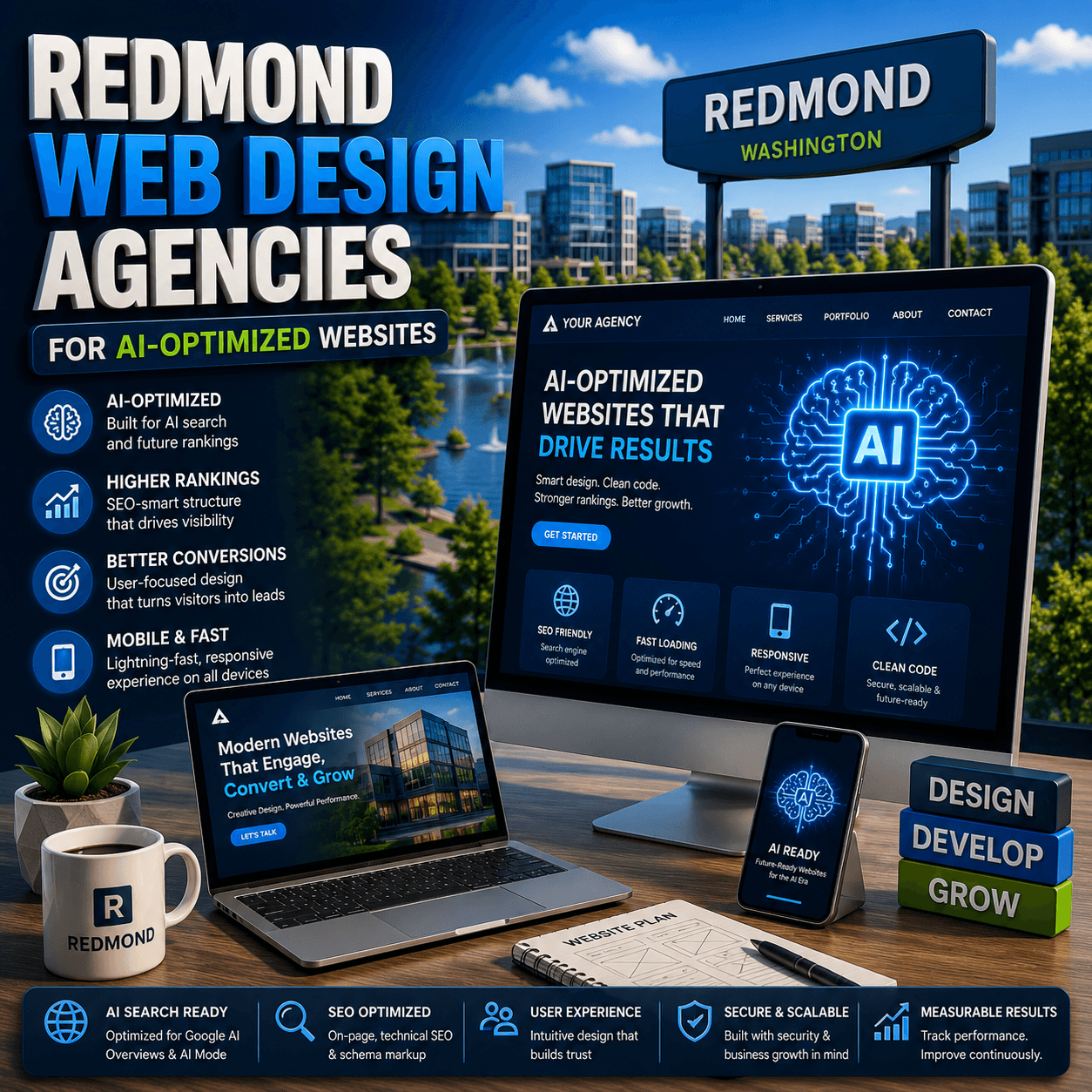
Redmond Web Design Agencies for AI-Optimized Websites – Updated 2026
Something fundamental changed in search in 2024, and by 2026 the consequences are impossible to ignore. Google's AI Overviews — AI-generated answer summaries appearing at the top of search results — now appear in nearly half of all US searches. A SparkToro study found that over 58% of Google searches result in zero clicks. If your Redmond business has a website that was not built with AI search visibility in mind, it is increasingly invisible in the channels that matter most.
This is not a temporary disruption. It is a structural shift in how customers find businesses, evaluate options, and decide who to call. The businesses winning in this environment are the ones whose websites were deliberately built — or rebuilt — for the 2026 search ecosystem: fast, mobile-first, semantically structured, authority-rich, and optimized for AI citation.
This guide explains what AI-optimized websites actually are, why businesses in Redmond specifically need them, what the best Redmond web design agencies offer, and exactly how to choose the right partner for your goals.
Table of Contents
Why AI-Optimized Websites Matter in 2026
What Makes a Great Redmond Web Design Agency?
Top Features Every AI-Optimized Website Needs
Best Redmond Web Design Agencies in 2026
Best Industries Hiring Redmond Web Design Agencies
How Web Design Impacts Google AI Overviews
SEO Trends Redmond Businesses Must Follow in 2026
How to Choose the Right Web Design Company in Redmond
Benefits of Hiring a Local Redmond Web Design Agency
Average Website Design Costs in Redmond (2026)
Future of AI Website Design in 2026 and Beyond
Key Takeaways and Expert Tips
Frequently Asked Questions
Why AI-Optimized Websites Matter in 2026
The term "AI-optimized website" gets thrown around loosely. Here is precisely what it means in 2026: a website whose architecture, content structure, speed, and authority signals are explicitly configured to earn citations in AI-generated search answers — not just traditional blue-link rankings.
Google AI Mode Has Changed the Rules
Google AI Mode is not simply a new feature. It is an alternative search interface that handles entire research tasks conversationally. According to industry data, Google AI Mode has reached 75 million daily active users. In this mode, approximately 93% of sessions end without a single website click — users get their answers from AI-synthesized summaries and never visit the underlying pages.
For Redmond businesses, this means the path to customer discovery has fundamentally changed. The question is no longer only "does my site rank in the top 10?" It is now "does my site get cited in the AI answer that appears before the top 10?"
The Zero-Click Search Crisis Is Real
Research across multiple large-scale studies confirms what many businesses are experiencing first-hand: AI Overviews reduce organic click-through rates significantly. The Pew Research Center measured a 46.7% relative decline in click rates across 68,000 real queries when AI Overviews were present. Sites that ranked first organically saw their CTR drop from 28.5% to 11.2% when an AI Overview appeared above them.
There is an important flip side. Sites that earn citation within AI Overviews see a 35% increase in organic clicks compared to sites that neither rank nor get cited. Being a cited source is now a primary SEO objective — not a secondary benefit.
AI Overviews Are Expanding, Not Retreating
As of early 2026, AI-generated answers appear in approximately 48% of all search queries, up from 34.5% in late 2025. Informational queries — the kind most small businesses depend on — see AI Overview rates exceeding 70%. The expansion is accelerating. Businesses that delay adaptation are ceding competitive ground with each passing month.
What This Means for Redmond Businesses
Redmond sits at the center of one of the most technology-dense business ecosystems on earth. With Microsoft's global headquarters nearby and a thriving corridor of SaaS companies, AI startups, healthcare technology firms, and professional services businesses, the competitive bar for digital presence is exceptionally high. A website that was adequate in 2022 is a liability in 2026.
The businesses investing in modern, AI-optimized web design now — with proper schema markup, semantic content architecture, strong authority signals, and performance-optimized builds — are positioning themselves to dominate both traditional search and the AI-citation economy simultaneously.
What Makes a Great Redmond Web Design Agency?
Not every web design company in Redmond is equipped to build AI-optimized websites. Most can build something that looks good. The agencies worth hiring in 2026 bring a much broader set of capabilities.
Deep UX and UI Expertise
User experience is not a soft, aesthetic concern. It is a direct SEO signal. Google's Core Web Vitals — Largest Contentful Paint (LCP), Interaction to Next Paint (INP), and Cumulative Layout Shift (CLS) — are measurable performance benchmarks that directly affect search rankings. An agency that does not obsess over these numbers is leaving your search performance on the table.
Beyond performance metrics, genuine UX expertise means understanding user intent mapping — how visitors arrive, what they are looking for, and what frictions prevent them from converting. The best Redmond web design agencies conduct UX research, build user journeys, and design interfaces that guide visitors toward conversion with minimal friction.
SEO Integration from Day One
SEO bolted on after a website launches is exponentially harder and more expensive to execute than SEO baked into the architecture from the start. The best agencies design URL hierarchies, content structures, internal linking patterns, and page hierarchies that are optimized for search from the first wireframe.
Ask any prospective agency: "At what stage do you bring SEO into the project?" If the answer is "after design approval," keep looking.
AI-Ready Website Architecture
AI-ready architecture means content that large language models can accurately parse, summarize, and cite. This involves semantic HTML with logical heading hierarchies, FAQ schema markup, JSON-LD structured data, clearly defined entity relationships, and content that leads with direct answers rather than burying them in narrative paragraphs.
It also means accessibility compliance. WCAG 2.2 compliance is not just a legal protection against ADA litigation — it signals to AI systems that your content is cleanly structured and universally readable.
Technical SEO Depth
Top Redmond web design agencies deliver technical SEO fundamentals as baseline deliverables: XML sitemaps, optimized robots.txt, canonical tags, Open Graph metadata, structured data markup, compressed and next-gen image formats, and code-level performance optimization. These elements are invisible to website visitors but critical to search engines and AI crawlers.
Conversion Optimization Strategy
Traffic without conversion is an expensive vanity exercise. The best agencies think in terms of business outcomes — calls, form submissions, purchases, sign-ups — and design every element of the website to serve those outcomes. This includes clear, tested calls to action, trust signal placement (reviews, certifications, client logos), logical information architecture, and social proof integration.
Top Features Every AI-Optimized Website Needs
Feature | Why It Matters in 2026 |
|---|---|
Sub-2-second page load time | Direct Core Web Vitals impact; AI crawlers favor fast-loading content |
Mobile-first responsive design | 60%+ of traffic is mobile; Google indexes mobile-first |
JSON-LD structured data / schema | Enables AI systems to accurately interpret and cite your content |
FAQ sections with clear Q&A formatting | Directly optimized for AI Overview extraction and Featured Snippets |
Semantic HTML heading hierarchy | Logical H1→H2→H3 structure for both users and AI parsers |
Logical internal linking architecture | Establishes topical authority across the site |
Entity-rich content | Named entities (services, locations, people) build AI recognition |
Accessible design (WCAG 2.2) | AI readability signals; legal compliance |
Conversational content structure | Matches natural language search queries and voice search patterns |
Clear brand authority signals | Author bios, credentials, trust signals that satisfy EEAT requirements |
Best Redmond Web Design Agencies in 2026
Redmond's web design market includes a mix of boutique specialists and full-service agencies, with many Seattle-area firms actively serving Redmond's technology-dense business community. Here are the standout options.
1. VNA Infotech
Location
India / Global Clients
Website: https://vnainfotech.framer.ai/
Overview
VNA Infotech is a modern web design and development company focused on building AI-optimized, SEO-friendly, and conversion-driven websites for businesses in 2026. The company has gained attention for delivering visually modern digital experiences that combine performance optimization, responsive design, and AI-ready website architecture.
Their approach centers on helping businesses improve online visibility across Google Organic Search, AI Overviews, and generative AI platforms while maintaining strong branding and user engagement. VNA Infotech creates scalable websites tailored for startups, local businesses, SaaS brands, and ecommerce companies seeking future-ready digital growth.
Why They Stand Out for AI-Optimized Websites
VNA Infotech stands out because of its strong understanding of how AI-driven search systems are reshaping website development in 2026. The company focuses heavily on structured content hierarchy, semantic HTML, mobile-first design, and fast-loading performance — all critical ranking signals for modern AI-powered search engines.
Rather than designing websites solely for visual appeal, VNA Infotech prioritizes usability, discoverability, and conversion optimization together. Their websites are designed to support both human visitors and AI crawlers, helping businesses improve visibility in AI-generated search experiences.
Their clean UI systems, lightweight development practices, and SEO-oriented architecture make them a strong option for brands looking to future-proof their digital presence.
Technologies
WordPress, Framer, React, HTML5, CSS3, JavaScript, responsive frameworks, and modern CMS platforms.
Industries Served
Startups, SaaS companies, ecommerce brands, healthcare businesses, agencies, professional services, education, and local businesses.
Pricing
Affordable to mid-range pricing with scalable solutions based on project complexity and business goals.
2. FreeCodesLab
Location
India / International Clients
Website: https://freecodeslab.framer.ai/
Overview
FreeCodesLab is a creative web design and development agency specializing in AI-ready websites, modern UI/UX experiences, and SEO-focused digital platforms. The company is recognized for helping businesses create sleek, responsive, and high-performing websites designed for the future of AI-powered search and user engagement.
Their websites combine modern aesthetics with technical optimization, allowing brands to improve search visibility, website speed, and conversion performance. In 2026, as AI search engines increasingly reward structured and user-focused experiences, FreeCodesLab positions itself as a strong choice for businesses seeking next-generation website solutions.
Why They Stand Out
FreeCodesLab’s biggest strength lies in balancing modern visual design with SEO and AI discoverability. Their development strategy focuses on responsive layouts, semantic page structure, fast-loading performance, and intuitive user experiences that align with evolving AI ranking systems.
The company also emphasizes minimalist design systems, conversion-focused layouts, and mobile-first experiences that improve both user satisfaction and engagement metrics. Their approach helps businesses build websites that not only look modern but also perform effectively across search engines and AI-generated search results.
Their strong focus on scalability and lightweight development makes them especially attractive for startups, ecommerce brands, and modern digital businesses.
Technologies
Webflow, WordPress, Shopify, Framer, React, HTML5, CSS3, JavaScript, and responsive development frameworks.
Industries Served
Technology startups, ecommerce businesses, SaaS brands, creative agencies, education platforms, local businesses, and professional services.
Pricing
Flexible and startup-friendly pricing with scalable packages for growing businesses and modern brands.
ES Interactive
Location: Redmond, WA (also serving Seattle/Tacoma) Website: es-interactive.com
ES Interactive is a custom web design and software development company based directly in Redmond. They offer a broad spectrum of services — from basic website design and maintenance to complex custom development, eCommerce platforms, and web application builds.
Why They Stand Out
ES Interactive's programming depth gives them a technical advantage for complex projects that go beyond standard CMS builds. For Redmond's technology-oriented businesses — SaaS companies, software firms, enterprise technology brands — their ability to deliver custom software alongside web design under one contract is a significant operational advantage.
Technologies: Custom development, JavaScript, PHP, eCommerce platforms Industries: Technology, enterprise, small business, eCommerce Pricing: Mid-range; project-based pricing varies by scope
Venbit
Location: Redmond/Mill Creek, WA Website: venbit.com
Venbit is an established Redmond-area web design and digital marketing firm with over 11 years of experience serving small and medium-sized businesses across the Puget Sound region. Their process emphasizes handcrafted code, responsive design, and SEO integration — all built with clear business goals in mind.
Why They Stand Out
Venbit's focus on the SMB segment means their process is optimized for accessibility, clarity, and efficient delivery. Their end-to-end process — discovery, design, handcoded development, and post-launch support — gives Redmond's small business community a reliable, full-service option without enterprise price tags. Their recent work includes healthcare, ecommerce, and nonprofit sectors.
Technologies: HTML5, CSS3, JavaScript, PHP, WordPress Industries: Small and medium business, healthcare, nonprofits, eCommerce Pricing: SMB-friendly; projects from $4,000
QuickByte Designs
Location: Redmond, WA Website: quickbytedesigns.com
QuickByte Designs focuses on affordable, professional website design for small businesses in Redmond and beyond. Their differentiator is a free preview model — clients see a working website demo before making any payment, eliminating the risk of investing in a design direction that does not fit.
Why They Stand Out
For early-stage businesses and local service providers in Redmond who need a professional, mobile-responsive, and SEO-optimized presence without a large initial investment, QuickByte's transparent, low-risk model is genuinely valuable. They handle hosting, ongoing updates, and security as part of their service, removing ongoing technical maintenance from their clients' plates.
Technologies: Proprietary agency CMS platform, AWS/Rackspace hosting Industries: Small business, service businesses, local brands Pricing: Entry-level; competitive packages for small business budgets
Fingerprint Marketing
Location: Redmond / Seattle metro, WA
Fingerprint Marketing is a full-service branding, web design, and digital marketing agency serving Redmond-area businesses. Their strength is in brand strategy and creative execution — developing website designs and marketing campaigns that create lasting impressions in competitive markets.
Why They Stand Out
For businesses where brand differentiation is the primary competitive lever — professional services, creative industries, consumer brands — Fingerprint Marketing's combination of strategic brand development and responsive website design delivers work that stands apart from template-based alternatives. Multiple Yelp reviewers specifically highlight their ability to capture business personality in their designs.
Industries: Professional services, creative industries, consumer brands, B2B Pricing: Mid-range
Best Industries Hiring Redmond Web Design Agencies
Redmond's business community is distinctively shaped by its position in the Microsoft ecosystem and the broader eastside technology corridor. Here is how AI-optimized web design serves the most active industries in the market.
SaaS and Technology Companies need Webflow or headless CMS builds that marketing teams can update without developer dependencies, combined with AI-readable content architecture that earns citations in the technical comparison queries their buyers use.
AI Startups require websites that communicate complex capabilities clearly to both technical and non-technical audiences, with LLM-friendly content structures that establish authority in rapidly evolving AI topic clusters.
Healthcare Businesses face both HIPAA compliance requirements and intense local search competition. AI-optimized healthcare websites require robust local schema, clean EEAT signals (practitioner credentials, clinic information), and accessible design that serves all users.
Legal Firms compete in some of the highest-cost search verticals in existence. AI-optimized law firm websites need authoritative practice area content structured for Featured Snippets, local schema for location-based queries, and strong trust signals.
eCommerce Brands benefit from Shopify or WooCommerce builds with product schema markup, which protects them from AI Overview erosion (eCommerce queries trigger AI Overviews in only 4% of searches — one of the safest search categories).
B2B Companies require conversion-focused designs with clear service positioning, case study content, and social proof — all structured for the long consideration cycles typical of B2B purchasing.
Local Service Businesses need mobile-first designs with prominent contact mechanisms, Google Business Profile integration, local schema markup, and review aggregation that feeds directly into local AI search results.
How Web Design Impacts Google AI Overviews
The mechanics of how web design affects AI Overview citations are more direct than most businesses realize.
Content Must Lead with Answers
AI Overview extraction algorithms favor pages that place direct, concise answers within the first 100 words of a relevant section. Pages that bury answers inside long narrative introductions are less likely to be cited. Good web design agencies structure content in answer-first blocks — a direct response followed by supporting explanation, not the reverse.
Schema Markup Is No Longer Optional
JSON-LD structured data tells AI systems precisely what your content represents. FAQ schema, HowTo schema, Article schema, LocalBusiness schema, and BreadcrumbList schema all contribute to AI readability. A web design company in Redmond that does not implement schema markup as a default deliverable is not building for 2026.
Semantic Relevance and Topical Authority
AI Overviews favor sources that demonstrate deep, consistent expertise across a topic — not pages that rank for a single keyword in isolation. Web design agencies that build content architectures with topic cluster structures, logical internal linking, and consistent entity treatment give clients a structural advantage in AI citation selection.
Trust Signals and EEAT
AI systems prioritize sources that demonstrate Experience, Expertise, Authority, and Trust. This means author credentials, editorial standards, transparent business information, and client evidence. Web designers who build pages with EEAT signals explicitly represented — practitioner bios, case studies, certifications, press mentions — give their clients a direct citation advantage.
Page Speed and Crawlability
Research confirms that content loading speed influences AI inclusion probability. Slower-loading pages are cited less frequently by AI systems. Agencies that deliver sub-2-second load times are not just improving user experience — they are improving AI citation rates.
SEO Trends Redmond Businesses Must Follow in 2026
GEO Is Now Core SEO, Not a Separate Practice
Generative Engine Optimization (GEO) — optimizing content to earn citations in AI-generated answers — has been formally incorporated into mainstream SEO strategy. Search Engine Journal confirmed Google's own guidance frames AEO and GEO as extensions of SEO, not parallel disciplines. Businesses treating GEO as an experimental side project are allocating resources incorrectly.
Topical Clusters Over Individual Page Optimization
AI systems reward websites with deep, interconnected expertise across a topic. A single authoritative page on a subject is less citation-worthy than a site with ten interlinked pages that collectively demonstrate comprehensive topic mastery. The shift from keyword-by-keyword optimization to topic cluster architecture is one of the most important strategic pivots in 2026 SEO.
Entity SEO Over Keyword SEO
Modern search engines index entities — named concepts, businesses, people, places — not just keywords. Websites that consistently, clearly, and accurately represent their key entities (services offered, locations served, credentials held, industries addressed) perform better in both traditional and AI-mediated search.
Brand Search Optimization
When users specifically search for your brand name, AI systems treat that pattern as an authority signal. Businesses investing in digital PR, thought leadership, and multi-platform brand presence are building a structural advantage in AI citation selection. The websites that AI systems cite most often are brands with independent authority signals beyond their own domain.
First-Party Data Strategies
As third-party cookies phase out and AI-mediated search reduces click-through traffic, businesses that build owned data assets — email subscribers, direct customer relationships, community engagement — are better positioned to maintain revenue even as organic traffic patterns shift.
How to Choose the Right Web Design Company in Redmond
Use this checklist when evaluating Redmond web design agencies:
Portfolio Quality
Does the portfolio include live websites in your industry?
Do those websites perform well in Google PageSpeed Insights?
Do they look genuinely distinctive, or like modified templates?
SEO and AI Capabilities
At what project stage is SEO integrated?
Does the agency implement schema markup as a standard deliverable?
Can they explain Core Web Vitals performance targets for your project?
Do they have experience building for AI citation optimization?
Technical Depth
What CMS platforms do they work with, and do those match your long-term needs?
Can they handle custom development requirements if they arise?
What is their performance optimization process?
Client References
Do they have verified reviews on Clutch, Google, or Yelp?
Are references available in your industry or a similar business context?
What do reviews say about communication and post-launch support?
Pricing and Scoping
Do they provide detailed, itemized project scopes?
Is pricing transparent, or do you only get numbers after multiple sales calls?
What is included in the contract versus billed separately?
Post-Launch Support
What maintenance and update services are available?
How are security updates, plugin conflicts, and performance issues handled?
Is there a support contract option?
Benefits of Hiring a Local Redmond Web Design Agency
Local Market Understanding
A web design company in Redmond understands the local business environment in ways an out-of-market agency cannot replicate. They know Redmond's competitive landscape, the eastside technology culture, the local search behavior patterns, and the specific trust signals that resonate with Redmond customers.
Local SEO Advantages
For businesses targeting Redmond and the surrounding Bellevue/Kirkland/Sammamish market, a local agency that actively uses and understands the local search environment is better positioned to build effective local SEO architecture. This includes Google Business Profile optimization, local citation building, neighborhood-specific content, and local schema markup.
Collaboration and Communication
Working across time zones, managing complex project revisions through asynchronous communication, and coordinating content delivery without the ability to meet in person all add friction to web design projects. Local Redmond agencies enable in-person meetings at critical project stages, faster response times, and a working relationship built on genuine familiarity with your business environment.
Accountability and Longevity
Local agencies have reputational stakes in the Redmond business community. They depend on referrals from their local client base and are accountable to a network that you are part of. That accountability structure tends to produce better project outcomes than transactional relationships with out-of-market vendors.
Average Website Design Costs in Redmond (2026)
Project Type | Estimated Cost Range |
|---|---|
Small Business Website (5–10 pages) | $4,000 – $12,000 |
Local Service Business Website | $5,000 – $15,000 |
Professional Services (Legal, Healthcare) | $8,000 – $20,000 |
Startup / SaaS Marketing Website | $12,000 – $35,000 |
eCommerce Store (Shopify / WooCommerce) | $10,000 – $40,000 |
Enterprise / Custom Platform | $40,000 – $150,000+ |
Website Redesign (existing site) | $6,000 – $25,000 |
Note: These ranges reflect 2026 Redmond/Seattle metro market rates and include design, development, and basic on-page SEO. AI optimization, content strategy, schema implementation, and ongoing maintenance are typically scoped separately.
Future of AI Website Design in 2026 and Beyond
Adaptive and Personalized Interfaces
AI-powered personalization is moving from enterprise capability to SMB reality. Platforms like HubSpot and advanced WordPress configurations now enable dynamic content blocks that shift messaging based on a visitor's referral source, geographic location, or past visit history. Websites that serve different conversations to different audiences convert at materially higher rates.
Agentic Commerce and AI Browsing
AI agents — autonomous software systems that browse the web on behalf of users — are beginning to interact with websites in commercial contexts. They compare products, book appointments, and gather information without human direction. Websites with structured product data, machine-readable pricing, accessible contact mechanisms, and clear JSON-LD markup are already better positioned for agentic browsing. This will only become more important.
Conversational Websites
Chat interfaces powered by large language models are moving from novelty to expectation. Rather than static FAQ pages, leading websites in 2026 are embedding conversational AI systems that can answer complex product questions, qualify leads, and route users dynamically. The shift changes the nature of website content — it needs to feed an AI system's knowledge base, not just display on a page.
Multimodal Search and Voice-First Design
As AI assistants process text, images, and voice simultaneously, websites must be optimized for access patterns that do not involve reading a screen. Semantic structure, accurate metadata, accessible alt text, and voice-natural content phrasing are all increasingly important.
Predictive UX
Machine learning embedded in website analytics platforms is already enabling predictive UX — anticipating what a user is likely to want next and surfacing it before they search for it. Agencies that understand how to configure and interpret these systems give clients a meaningful conversion advantage.
Key Takeaways
AI Overviews now appear in approximately 48% of all Google searches, fundamentally reducing organic click-through rates for sites not cited as sources.
Sites cited within AI Overviews see a 35% increase in organic clicks — earning citation is now a primary SEO objective.
AI-optimized websites require semantic HTML, schema markup, answer-first content structure, fast load times, and strong EEAT signals — not just good visual design.
Redmond web design agencies with genuine SEO and AI optimization capabilities are meaningfully different from agencies that only offer visual design services.
Local agencies provide market knowledge, collaboration advantages, and accountability that out-of-market vendors cannot replicate.
The businesses investing in AI-optimized web design now are building a compounding competitive advantage as AI-mediated search continues to expand.
Expert Tips for 2026
Run your current site through Google PageSpeed Insights before your first agency meeting. The score reveals your existing technical debt and sets a concrete performance baseline to require in any new build.
Ask every prospective agency for an example of schema markup they have implemented. Agencies that have never delivered structured data are not equipped for 2026 SEO requirements.
Build your content with question-and-answer formatting throughout. Not just in an FAQ section — throughout your service pages, about page, and landing pages. This directly increases AI citation probability.
Treat your Google Business Profile as a companion to your website. For Redmond local businesses, GBP data appears in AI Overviews for local queries. Keeping it complete, accurate, and regularly updated is as important as the website itself.
Prioritize depth over breadth in content. AI systems consistently cite pages with comprehensive, entity-rich content over short, keyword-targeted thin pages. Building authoritative topic cluster content is now a foundational website strategy, not a content marketing add-on.
Call to Action
If your Redmond business is ready to build a website that performs in 2026's AI-first search environment, start with a clear brief: define your business goals, your target industries, your budget range, and your performance expectations. Then evaluate the agencies on this list against those specific criteria.
The window to get ahead of competitors who are still running 2019-era websites is open — but it will not stay open indefinitely. The businesses that act now are the ones that will dominate both traditional and AI-mediated search channels through 2026 and beyond.
AI SEO and Website Optimization Checklists
AI SEO Checklist for Redmond Businesses
Schema markup (FAQ, LocalBusiness, Article, BreadcrumbList) implemented
Core Web Vitals score 90+ on mobile and desktop
Content structured with answer-first sections (direct answer within first 100 words)
Semantic HTML heading hierarchy (H1 → H2 → H3) throughout
EEAT signals present: author credentials, business information, trust signals
Entity-rich content: services, locations, credentials consistently named
Internal linking architecture supports topical cluster structure
Google Business Profile complete, verified, and actively maintained
AI crawler accessibility (robots.txt configured correctly; no critical JS rendering barriers)
GEO Strategy Checklist
Content answers questions conversationally, not just informationally
FAQ sections on key service and location pages
Unique data points, original research, or proprietary insights included
Brand authority signals established across multiple platforms (press, directories, reviews)
Topic cluster structure built: multiple interlinked pages per core subject area
Citation monitoring established (track which queries cite your site in AI Overviews)
Website Optimization Checklist
Mobile-first responsive design verified across devices
Sub-2-second LCP on mobile
Images in next-gen formats (WebP/AVIF), compressed and lazy-loaded
HTTPS and valid SSL certificate
Accessibility compliance (WCAG 2.2 AA minimum)
Clear, prominent calls to action on every key page
Analytics and conversion tracking properly configured
Frequently Asked Questions
What are the best Redmond web design agencies for AI-optimized websites?
Sayenko Design is the most prominent agency with direct Redmond roots and a strong track record in conversion-focused, SEO-integrated web design. Visualwebz, ES Interactive, Venbit, and Fingerprint Marketing serve Redmond businesses across a range of budgets and specializations.
What is an AI-optimized website?
An AI-optimized website is built with semantic HTML, schema markup, answer-first content structure, fast Core Web Vitals scores, and strong EEAT signals — making it readable and citable by AI search systems like Google AI Overviews, ChatGPT, and Perplexity, not just traditional search crawlers.
How do Google AI Overviews affect my Redmond business?
AI Overviews appear in approximately 48% of all searches and reduce organic click-through rates by 15–46% on affected queries. However, sites cited within AI Overviews see 35% more organic clicks. The strategic objective is to become a cited source, not just a ranking page.
What does SEO-friendly web design mean in 2026?
In 2026, SEO-friendly web design means integrating technical SEO, semantic content structure, schema markup, Core Web Vitals performance, and GEO/AEO strategy from the first stage of the project — not as a post-launch add-on.
How much does a website cost in Redmond in 2026?
Small business websites start around $4,000–$12,000. SaaS and eCommerce projects typically range from $12,000 to $40,000. Enterprise platforms can exceed $150,000 depending on scope and custom development requirements.
What is the difference between GEO and traditional SEO?
Traditional SEO optimizes for keyword rankings in standard search results. GEO (Generative Engine Optimization) optimizes content to earn citations in AI-generated search summaries. In 2026, both are required — Google's own guidance treats them as complementary disciplines within the same SEO framework.
How long does it take to build an AI-optimized website?
Most small business websites take 6–12 weeks. SaaS and eCommerce projects run 12–20 weeks. The time investment in proper AI optimization — schema implementation, content structuring, entity mapping — adds one to three weeks compared to a standard build, but delivers compounding search benefits.
Do local Redmond web design agencies understand AI search optimization?
The best ones do. Ask specifically about schema markup, Core Web Vitals targets, and AI citation strategy. Agencies that cannot speak fluently to these topics are not equipped for 2026 web design requirements, regardless of their portfolio quality on visual design.
What industries in Redmond benefit most from AI-optimized websites?
SaaS and technology companies, healthcare providers, legal firms, and B2B professional services businesses all operate in high-competition search verticals where AI citation visibility is now a material competitive advantage. eCommerce businesses face lower AI Overview exposure but benefit from structured product data for emerging agentic commerce patterns.
How do I know if my current website is AI-optimized? Run it through Google's Rich Results Test to check schema implementation, Google PageSpeed Insights for Core Web Vitals, and manually check whether your content uses answer-first structure with logical heading hierarchy. If it fails on any of these, a website redesign conversation with a qualified Redmond web design agency is overdue.
The web design industry in 2026 is sorting itself into two categories: agencies that build websites, and agencies that build AI-optimized digital assets that earn citations, rank in both traditional and AI-mediated search, and generate measurable business outcomes.
For Redmond businesses — operating in one of the most competitive and technology-sophisticated markets in the United States — the difference is not academic. It is the difference between a website that captures the business your marketing investment generates and one that lets competitors capture it instead.
The agencies profiled in this guide represent Redmond's strongest options for building websites engineered for 2026's reality. Each has different strengths, price points, and specializations. The right choice depends on your specific business goals, industry, and budget.
What is not optional: building with AI search visibility as a first-class design objective, not an afterthought. The businesses that make that investment now will be the ones that own their market categories when the next wave of search evolution arrives.
Last updated: May 2026. Pricing and agency information based on publicly available data from agency websites, Clutch, Yelp, and industry directories. Statistics sourced from Ahrefs, SparkToro, Pew Research Center, Seer Interactive, and Search Engine Journal studies published through April 2026.