Application Modernization Services : Everything You Need to Know in 2027
Posted on
Web Design
Posted at
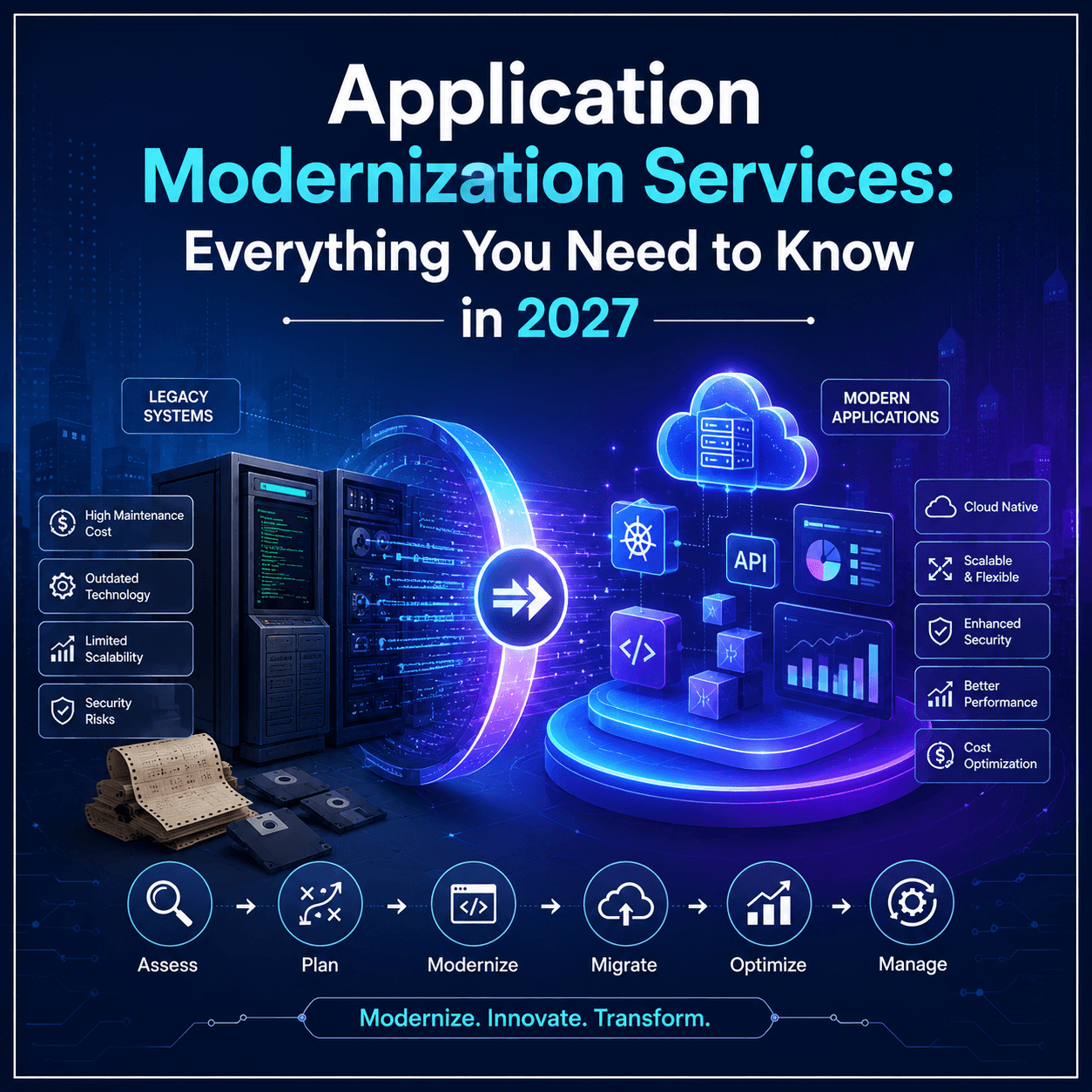
The Era of Legacy Tolerance is Over.
Welcome to 2027. We are operating in an enterprise landscape where generative AI agents expect real-time API integrations, where cloud-native composability is a baseline requirement, and where monolithic legacy applications are no longer just technical debt—they are active existential threats to your business model.
For decades, organizations have deferred the heavy lifting of legacy software modernization. They patched over crumbling monolithic codebases, ignored soaring technical debt, and prayed their aging infrastructures wouldn't buckle under modern digital demands. Today, that bill has come due.
This comprehensive enterprise buyer’s guide is designed for CIOs, CTOs, Enterprise Architects, and digital transformation leaders. Whether you are seeking to containerize a sprawling .NET monolith, refactor mission-critical COBOL systems, or rearchitect an on-premise Java application into cloud-native microservices, this playbook provides the exact frameworks, vendor evaluations, and strategic insights needed to ensure your application modernization initiatives succeed.
Key Takeaway: Application modernization is no longer an IT cost center; it is a strategic business enabler. The goal isn't just running old code in the cloud—it's transforming business processes to unlock agility, drastically reduce total cost of ownership (TCO), and prepare your data for the AI revolution.
Ready to transform your enterprise architecture? Read on to discover the methodologies, services, and top application modernization companies leading the charge in 2027.
What is Application Modernization?
Application modernization is the continuous, strategic practice of updating legacy software applications to align with modern computing approaches, including newer languages, frameworks, cloud infrastructure, and operational paradigms.
Evolution and Technology Shifts
Historically, modernization meant simply porting an application from a mainframe to a distributed server. Today, it encompasses a massive architectural shift. It means taking monolithic, tightly coupled applications and breaking them apart into decoupled, independently deployable microservices managed by orchestrators like Kubernetes or Red Hat OpenShift.
Why Modernization Matters
The business importance cannot be overstated. A modernized application portfolio allows an organization to release software daily rather than quarterly. It allows for horizontal scalability during peak loads. Most importantly, it exposes previously locked business logic via secure APIs, enabling new digital products and partner ecosystems.
Modernization vs. Redevelopment
Application modernization is not necessarily redevelopment (building from scratch). Modernization often involves sophisticated techniques like automated refactoring or replatforming, which preserve the core, proven business rules of the legacy system while wrapping them in modern architectures.
How does this support Digital Transformation? Digital transformation requires business agility. You cannot be an agile, digital-first company if your core transaction engine requires six months of regression testing for a simple UI change. Modernization provides the architectural foundation for digital speed.
Why Enterprises Need Application Modernization in 2027
The enterprise IT ecosystem has fundamentally changed. Here is why Application Modernization Services are a top priority:
Crushing Technical Debt: Legacy systems require increasingly specialized, expensive, and rare engineering talent to maintain.
Security Risks: Aging codebases often rely on unsupported open-source libraries or outdated frameworks that cannot support modern Zero Trust architectures, making them prime targets for cyberattacks.
AI Readiness: Generative AI and Large Language Models (LLMs) cannot easily ingest data from siloed, batch-processed legacy databases. Modernization prepares your data layer for AI via API integration.
Cloud Adoption Mandates: As data centers shrink, migrating to AWS, Microsoft Azure, Google Cloud, or Oracle Cloud Infrastructure (OCI) requires cloud-native application transformation to actually realize cost savings.
Scalability Limitations: Monoliths scale vertically (requiring massive, expensive servers). Modern cloud applications scale horizontally and elastically based on demand.
Maintenance Costs: Up to 70-80% of IT budgets in legacy enterprises are spent simply "keeping the lights on." Modernization flips this ratio toward innovation.
Customer Expectations: Modern users demand sub-second latency, omnichannel experiences, and 24/7 availability—metrics legacy systems struggle to meet.
Key Benefits of Application Modernization
Benefit Category | Business Impact | Technical Impact |
Cost & Efficiency | Reduces TCO by 30-50% and shifts CapEx to OpEx. | Optimizes cloud resource usage through serverless and containerization. |
Security & Compliance | Mitigates breach risks and simplifies regulatory compliance. | Enables automated security scanning (DevSecOps) and Zero Trust models. |
Agility & Innovation | Dramatically faster time-to-market for new features. | Implements CI/CD, enabling multiple production deployments per day. |
Scalability & Uptime | Supports global expansion without infrastructure bottlenecks. | Achieves 99.999% availability via multi-region cloud architectures. |
AI & Analytics | Unlocks enterprise data for predictive modeling. | API-first design allows seamless data pipelines to modern data lakes. |
Types of Application Modernization (The Modern 7 R's)
Understanding the exact modernization path is critical. Application architecture modernization generally falls into these categories:
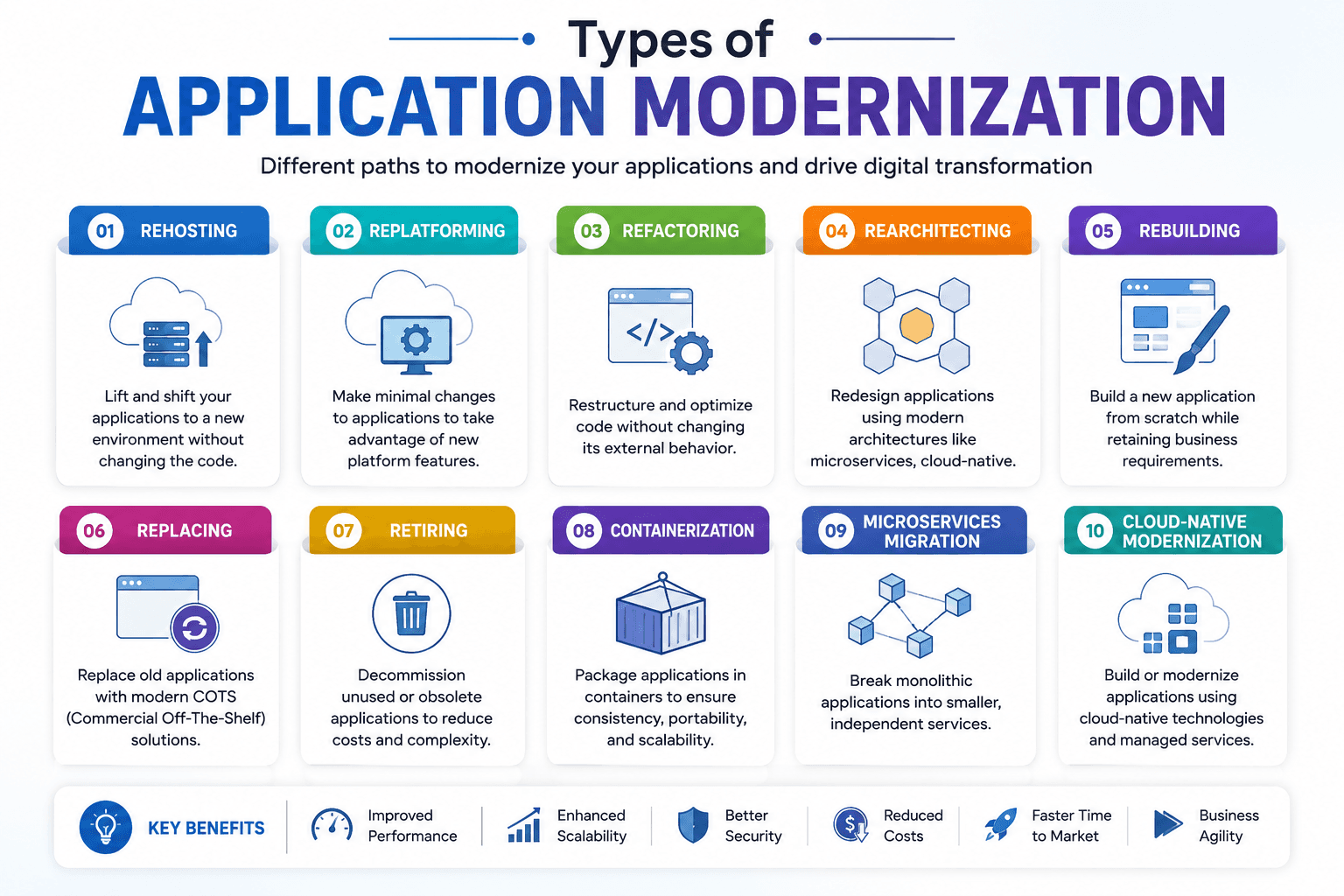
Rehosting (Lift and Shift): Moving an application from an on-premise server to cloud IaaS without changing the code. Best for fast data center exits.
Replatforming (Lift, Tinker, and Shift): Making minimal code changes to adapt to the cloud (e.g., migrating a self-hosted database to a managed cloud database like Amazon RDS).
Refactoring: Altering the application's source code to optimize it for a cloud environment (e.g., moving from an old version of .NET to .NET Core) without changing its external behavior.
Rearchitecting: Fundamentally altering the application architecture. This is where you break a monolith into microservices or adopt serverless computing.
Rebuilding: Discarding the existing code and rewriting the application from scratch using modern frameworks (like React, Node.js, and Spring Boot), while retaining the original scope and specifications.
Replacing: Retiring the custom application and replacing it with a commercial SaaS solution (e.g., moving a custom HR app to Workday).
Retiring: Decommissioning the application entirely if its capabilities are no longer needed, reducing the attack surface and saving costs.
Emerging Approaches in 2027:
Containerization & Microservices Migration: Using Docker and Kubernetes to isolate processes and scale independently.
AI-Assisted Modernization: Utilizing generative AI tools (like GitHub Copilot or purpose-built refactoring models) to instantly analyze legacy codebases, map dependencies, and write modernized boilerplate code.
Application Modernization Services
When evaluating an Application Modernization Company, look for comprehensive service offerings across the entire modernization lifecycle:
Application Portfolio Assessment: Analyzing hundreds of applications to map dependencies, calculate tech debt, and determine the precise "R" disposition for each.
Architecture Consulting: Designing the target-state cloud-native architecture.
Legacy Code Modernization: Upgrading outdated languages (e.g., COBOL to Java, legacy .NET to modern C#).
Database Modernization: Migrating from legacy monolithic databases (like Oracle or DB2) to modern distributed or NoSQL databases (like PostgreSQL, MongoDB, or Snowflake).
API Development & Integration: Wrapping legacy core systems in REST or GraphQL APIs.
Microservices Implementation: Decoupling massive codebases into domain-driven services.
DevOps & CI/CD Automation: Building the deployment pipelines that make the modernized application agile.
Security Modernization: Implementing identity and access management (IAM), encryption, and advanced cloud security protocols.
Managed Application Services: Providing ongoing post-migration support, observability, and continuous modernization.
Technologies Used
A premium modernization partner will have deep expertise across a vast technology stack:
Backend & Frameworks: Java, Spring Boot, .NET, Node.js, Python, Go.
Frontend UI/UX: React, Angular, Vue.js, Next.js.
Containerization & Orchestration: Docker, Kubernetes (K8s), Red Hat OpenShift, Amazon EKS, Azure AKS, Google GKE.
Infrastructure as Code (IaC) & Config: Terraform, Ansible, Pulumi.
Cloud Platforms: AWS, Microsoft Azure, Google Cloud, Oracle Cloud Infrastructure, IBM Cloud.
DevOps & CI/CD: GitHub Actions, GitLab CI, Jenkins, ArgoCD.
Messaging & Event Streaming: Apache Kafka, RabbitMQ, EventGrid.
API Management: GraphQL, REST, Apigee, Kong, AWS API Gateway.
Industries We Serve
Every industry is bound by software, and therefore, every industry requires legacy software modernization:
Healthcare: Modernizing monolithic EMR systems to comply with FHIR interoperability standards and secure patient data in the cloud.
Banking & Financial Services: Breaking down legacy core banking systems to enable real-time Open Banking APIs and rapid mobile app feature development.
Insurance: Replatforming policy administration systems to allow for AI-driven dynamic underwriting.
Government: Upgrading massive, decades-old citizen service portals for scalability, security, and mobile accessibility.
Retail & Logistics: Moving to microservices and event-driven architectures to support real-time global supply chain tracking and omnichannel e-commerce.
Step-by-Step Application Modernization Process
Expert Insight: The biggest reason modernization projects fail is starting to code before properly mapping enterprise dependencies.
Assessment: Automated code scanning and portfolio analysis.
Discovery: Deep-dive interviews with stakeholders to map undocumented business logic.
Business Analysis: Defining the specific ROI and KPIs for the modernization effort.
Architecture Planning: Designing target-state topology and cloud adoption frameworks.
Technology Selection: Choosing the right databases, languages, and CI/CD tools.
Migration & Development: Executing the chosen modernization path (refactoring, rearchitecting).
Testing: Rigorous automated regression, performance, and security testing.
Deployment: Gradual rollouts, often using the Strangler Fig pattern to avoid "big bang" failures.
Optimization: Tuning the application for cloud resource efficiency (FinOps).
Monitoring & Continuous Improvement: Implementing observability tools and establishing a culture of continuous deployment.
How to Choose the Best Application Modernization Company
Selecting the right partner is critical. Use these 25 evaluation criteria when issuing your RFP:
Proven Enterprise Experience: Do they have a track record of handling massive, mission-critical portfolios?
Deep Cloud Certifications: Are they Premier/Gold partners with AWS, Azure, and Google Cloud?
Legacy Systems Knowledge: Do they understand the old technology (Mainframes, old Java, COBOL) as well as the new?
Microservices Expertise: Can they demonstrate domain-driven design principles?
Automated Assessment Tools: Do they use proprietary or advanced tools to scan legacy code, or rely on manual guessing?
Security Integration (DevSecOps): Is security treated as an afterthought or integrated into the CI/CD pipeline?
Industry-Specific Regulatory Knowledge: Do they understand HIPAA, PCI-DSS, or FedRAMP?
Data Migration Expertise: Can they modernize the database alongside the application?
Change Management Capabilities: Do they help train your internal teams on the new stack?
Global Delivery Model: Can they scale resources securely across shores?
Pricing Transparency: Do they offer fixed-bid options for well-defined phases?
AI Capabilities: Are they using GenAI to accelerate refactoring and reduce billable hours?
DevOps Maturity: Can they build zero-touch deployment pipelines?
Customer Success Stories: Can they provide referenceable clients in your industry?
Cultural Fit: Do they integrate seamlessly with your internal engineering culture?
Post-Migration Managed Services: Will they help you run it after they build it?
UI/UX Capabilities: Can they modernize the user experience, not just the backend?
Testing Automation: What is their approach to automated regression testing during migration?
Strangler Fig Experience: Do they advocate for safe, iterative migrations over risky "big bang" cutovers?
FinOps Focus: Do they design cloud architectures that are financially optimized?
API-First Approach: Do they prioritize exposing business capabilities as APIs?
Vendor Agnosticism: Will they recommend the right cloud, or just the one they get a kickback for?
Code Quality Standards: Do they follow strict SonarQube or similar quality gates?
Disaster Recovery Planning: Is resilient, multi-zone availability built-in from day one?
Commitment to Open Source: Do they leverage community-backed standards (like CNCF projects) to prevent vendor lock-in?
Top Application Modernization Companies in 2027
(Note: The following represents top-tier global systems integrators, consultancies, and specialized engineering firms leading the market).
1. Accenture
Overview: A global powerhouse in digital transformation and cloud services.
Expertise: Massive-scale enterprise application portfolio modernization.
Tech Stack: AWS, Azure, GCP, Java, .NET, Kubernetes.
Strengths: Unparalleled industry domain knowledge combined with deep technical execution at a global scale.
Best Suited For: Fortune 500 companies undertaking multi-year digital transformations.
2. IBM Consulting
Overview: Pioneers in enterprise computing, IBM uniquely bridges legacy mainframes with modern hybrid cloud.
Expertise: Mainframe modernization, hybrid cloud architecture, AI-assisted coding (watsonx).
Tech Stack: Red Hat OpenShift, IBM Cloud, COBOL, Java, Kubernetes.
Strengths: Managing complex, highly regulated hybrid environments and deeply entrenched legacy systems.
Best Suited For: Banks, government agencies, and insurance firms with heavy legacy footprints.
3. Deloitte
Overview: Combines top-tier business consulting with aggressive technical execution.
Expertise: Application portfolio assessment, business process modernization, and tech debt reduction.
Tech Stack: Multi-cloud, enterprise ERP integrations, custom cloud-native development.
Strengths: Tying technology modernization directly to board-level business metrics and compliance.
Best Suited For: Enterprises needing strict regulatory compliance and business-case justification.
4. Capgemini
Overview: European IT services giant known for industrializing the modernization process.
Expertise: Cloud transformation, API economy, and microservices.
Tech Stack: Spring Boot, Angular, React, AWS, Azure.
Strengths: Highly structured, factory-model approaches to migrating thousands of applications predictably.
Best Suited For: Manufacturing, retail, and automotive sectors requiring predictable global delivery.
5. Thoughtworks
Overview: A premium software engineering consultancy famous for pioneering Agile and Microservices.
Expertise: Rearchitecting complex monoliths, domain-driven design, and extreme programming.
Tech Stack: Open-source ecosystems, Go, Python, React, advanced CI/CD tooling.
Strengths: Tackling the most difficult architectural challenges that other SIs fail to solve; high engineering standards.
Best Suited For: Tech-forward enterprises and scale-ups needing elite engineering talent.
6. EPAM Systems
Overview: A leader in digital platform engineering and software product development.
Expertise: Cloud-native development, UI/UX overhaul, and replatforming.
Tech Stack: Modern JavaScript frameworks, K8s, Serverless, AI integrations.
Strengths: Transforming legacy internal tools into modern, commercial-grade digital products.
Best Suited For: SaaS companies, media, and tech companies needing product-led modernization.
7. Slalom
Overview: A nimble, modern consulting firm deeply partnered with major hyperscalers.
Expertise: Agile cloud migrations, data modernization, and organizational change management.
Tech Stack: AWS, Salesforce, Microsoft, Snowflake.
Strengths: Highly localized delivery teams that embed seamlessly with client cultures.
Best Suited For: Mid-market to enterprise companies looking for a highly collaborative, fast-paced partner.
8. Infosys
Overview: A global leader in next-generation digital services.
Expertise: AI-driven modernization (via Infosys Cobalt), massive data migrations, and legacy replacement.
Tech Stack: Java, .NET, comprehensive hyperscaler integrations.
Strengths: Cost-effective, highly scaled offshore/nearshore delivery models backed by proprietary AI tools.
Best Suited For: Global enterprises looking for scalable, managed modernization factories.
9. TCS (Tata Consultancy Services)
Overview: One of the world’s largest IT service brands, renowned for reliability.
Expertise: Core system modernization, particularly in banking and telecom.
Tech Stack: Proprietary modernization frameworks (TCS MasterCraft), multi-cloud.
Strengths: Immense scale, deep institutional knowledge, and highly predictable execution.
Best Suited For: Financial institutions requiring massive, multi-year core platform rewrites.
10. Cognizant
Overview: A major player in digital engineering and legacy IT modernization.
Expertise: Healthcare and life sciences modernization, IoT integrations, cloud engineering.
Tech Stack: AWS, Azure, modern data stacks, custom enterprise software development.
Strengths: Deep domain expertise in highly specific verticals (healthcare, pharma).
Best Suited For: Healthcare providers and payers modernizing their core ecosystems.
(Other notable leaders in 2027 include HCLTech, Tech Mahindra, Wipro, DXC Technology, Globant, Persistent Systems, Hexaware, LTIMindtree, Birlasoft, and Mphasis).
Comparison Table: Modernization Partner Profiles
Company | Core Strength | Ideal Enterprise Size | AI Capabilities | Pricing Model Focus |
Accenture | End-to-end business transformation | Fortune 500 | Very High (Proprietary & Hyperscaler) | Value/Outcome-based |
IBM Consulting | Mainframe to Hybrid Cloud | Global 2000 | Very High (watsonx) | Complex/T&M |
Thoughtworks | Elite architecture & Microservices | Mid to Enterprise | High (Agentic workflows) | Premium T&M |
EPAM Systems | Product engineering & UI/UX | Tech/Scale-ups | High | Agile/Sprint-based |
TCS / Infosys | Massive scale & Factory models | Global 2000 | High (Cobalt/MasterCraft) | Fixed-price & Blended |
Slalom | Agile, localized collaboration | Mid-Market/Enterprise | Medium | Time & Materials |
Common Challenges in Application Modernization
Even with the best partners, software modernization is fraught with risk. Prepare for these challenges:
Undocumented Legacy Dependencies: Changing one module breaks an entirely unrelated system because of decades-old "spaghetti code."
Downtime Intolerance: Mission-critical systems (like payment gateways) cannot afford maintenance windows.
Data Migration Nightmares: Synchronizing legacy hierarchical databases with modern relational/NoSQL databases during cutover.
Security Gaps During Transition: Hybrid states often create temporary vulnerabilities between the old and new perimeters.
Scope Creep: Trying to add new features while modernizing, which bloats the budget and delays the timeline.
Cultural Resistance: Internal teams refusing to adopt new DevOps practices, insisting on manual deployment processes.
Skills Shortage: The lack of engineers who understand both the legacy system (e.g., COBOL) and the target system (e.g., Kubernetes).
Cloud Shock: Moving an unoptimized application to the cloud and receiving a monthly hosting bill three times higher than on-premise costs.
Future Trends in Application Modernization (2027 and Beyond)
Generative AI & Agentic AI: AI is no longer just writing code snippets; Agentic AI workflows are actively mapping legacy dependencies, proposing microservice boundaries, and writing automated test suites autonomously.
Platform Engineering: Internal Developer Portals (IDPs) are standardizing the modernization process, providing self-service cloud environments to reduce cognitive load on developers.
WebAssembly (Wasm): Expanding beyond the browser to provide highly secure, language-agnostic, near-instant backend execution environments.
Serverless Computing Dominance: Moving past containers directly to AWS Lambda or Azure Functions to completely abstract infrastructure management.
Sustainable Software Engineering: Refactoring code specifically to optimize CPU cycles and reduce the carbon footprint of enterprise data centers.
Composable Architecture: Building applications as a series of plug-and-play Packaged Business Capabilities (PBCs) rather than rigid, hard-coded monoliths.
25 Expert Tips for Modernization Success
Don't boil the ocean. Modernize iteratively.
Use the Strangler Fig pattern to decouple services one by one.
Modernize the data layer first. Compute is easy; state is hard.
Treat modernization as a product, not a project. It never truly ends.
Establish a strict API-first design mandate.
Invest heavily in automated regression testing before changing any code.
FinOps is mandatory. Design for cloud cost-efficiency from day one.
Don't confuse "running in containers" with being "cloud-native."
Map value streams before mapping IT architecture.
Ensure the business side owns the ROI, not just the CIO.
Retain your legacy experts—they know the hidden business rules.
Use domain-driven design (DDD) to find your microservice boundaries.
Shift security left (DevSecOps) immediately.
Don't migrate "dead code." Audit usage before moving.
Avoid vendor lock-in by standardizing on Kubernetes and open-source tooling.
Implement comprehensive observability (logs, metrics, traces) early.
Celebrate small wins to maintain organizational momentum.
Use feature flags to decouple deployment from release.
Standardize your CI/CD pipelines before rewriting the app.
Address technical debt as a continuous KPI, not a one-time fix.
Don't ignore the UI. A modern backend with a green-screen frontend fails user adoption.
Prioritize applications based on business value vs. technical effort.
Upskill your team simultaneously; modern code fails with legacy mindsets.
Document the why of architectural decisions using Architecture Decision Records (ADRs).
Expect the unexpected. Keep a healthy contingency budget for hidden legacy horrors.
25 Modernization Mistakes to Avoid
Doing a "Big Bang" release on a Friday night.
Rehosting an inefficient monolith to the cloud and calling it "modernized."
Ignoring organizational change management.
Failing to establish baseline performance metrics before migrating.
Choosing a microservices architecture for a simple application (over-engineering).
Forgetting about disaster recovery and backup in the new environment.
Letting offshore teams modernize without onshore business context.
Baking hard-coded IP addresses or credentials into the new code.
Assuming cloud security is the cloud provider's sole responsibility.
Rewriting business logic from scratch when refactoring would suffice.
Modernizing the app but keeping the manual QA testing processes.
Failing to implement distributed tracing in a microservices environment.
Creating a "distributed monolith" instead of true microservices.
Letting developers choose 15 different programming languages for 15 microservices.
Ignoring latency changes between the application and the database.
Forgetting to update compliance and audit documentation.
Not mapping external third-party API dependencies.
Overpromising the timeline to the Board of Directors.
Trying to migrate the database and the application simultaneously without a fallback plan.
Skimping on the discovery phase to start coding faster.
Failing to configure auto-scaling properly, resulting in massive bills.
Believing AI tools can refactor code without senior human oversight.
Treating Application Modernization Solutions as a one-time capital expenditure.
Ignoring edge cases that the legacy system handled gracefully.
Not having an immediate rollback strategy.
Frequently Asked Questions
1. What are Application Modernization Services?
Application Modernization Services involve updating legacy software applications to modern computing environments, architectures, and languages. This includes migrating to cloud infrastructure (AWS, Azure, GCP), breaking monolithic applications into microservices, containerizing workloads, and automating deployment pipelines. These services help enterprises reduce technical debt, lower total cost of ownership, enhance security, and improve their ability to rapidly deploy new digital features to meet modern customer expectations.
2. Why is legacy system modernization critical for digital transformation?
Digital transformation requires speed, agility, and the ability to leverage data across the enterprise. Legacy systems, characterized by monolithic codebases and batch processing, actively block these goals. Modernizing these systems exposes core business logic via APIs, allows integration with modern SaaS platforms, and prepares the organization's data layer for advanced analytics and Artificial Intelligence. You cannot be a digitally transformed company while running your core business on inflexible, siloed legacy infrastructure.
3. What is the difference between Application Migration and Application Modernization?
Application migration typically refers to moving an application from one environment to another, such as lifting and shifting an app from an on-premise data center to the cloud, often without changing the underlying code. Application modernization goes much deeper. It involves fundamentally transforming the application's architecture—such as rewriting the code, breaking it into microservices, or adopting cloud-native managed services—to fully leverage the scalability and efficiency of modern cloud environments.
4. How long does an enterprise application modernization project take?
The timeline varies drastically based on the portfolio's size and complexity. A simple rehosting (lift and shift) of a few applications might take 3 to 6 months. However, a full-scale refactoring or rearchitecting of a massive, mission-critical enterprise system (like a core banking platform) is a multi-year journey, often taking 18 to 36 months or more. Using iterative, agile approaches (like the Strangler Fig pattern) ensures continuous value delivery throughout the lengthy process.
5. What is the Strangler Fig pattern in software modernization?
The Strangler Fig pattern is a risk-mitigation strategy used to incrementally modernize monolithic applications. Instead of rewriting the entire system at once and attempting a risky "big bang" switch, developers gradually replace specific functions of the monolith with new microservices. Over time, the new system "strangles" the old one as more features are migrated. Once all functionality has been replaced, the legacy monolith can be safely decommissioned with minimal disruption to the business.
6. How much do application modernization services cost?
Costs range widely depending on the chosen strategy (the "7 Rs"), the size of the codebase, and the rates of the chosen consulting partner. A targeted modernization of a single mid-sized application might cost $250,000 to $500,000. Enterprise-wide portfolio modernization initiatives handled by global systems integrators often run into the tens of millions of dollars. However, organizations typically recoup these costs within 2-3 years through reduced infrastructure costs, eliminated licensing fees, and massive gains in developer productivity.
7. Why are microservices so important in modernization?
Microservices are critical because they solve the primary problem of monolithic applications: tight coupling. In a monolith, changing one line of code requires testing and deploying the entire application. Microservices architecture breaks the application into small, independent services (e.g., payment, inventory, user profile) that communicate via APIs. This allows independent engineering teams to update, scale, and deploy specific features rapidly without risking the stability of the entire enterprise system.
8. How does containerization (Docker/Kubernetes) help modernize apps?
Containerization packages an application and all its necessary dependencies (libraries, frameworks) into a single, isolated unit called a container. Tools like Docker create the containers, while Kubernetes orchestrates them across cloud environments. This ensures that the application runs identically on a developer's laptop as it does in production, eliminating the "it works on my machine" problem. It also allows the application to boot up in seconds and scale horizontally with incredible efficiency.
9. What role does Generative AI play in modernization in 2027?
Generative AI has revolutionized legacy modernization. AI agents and Large Language Models (LLMs) are now used to instantly analyze millions of lines of undocumented legacy code, map intricate dependencies, and translate outdated languages (like COBOL or older Java) into modern, secure frameworks. While AI doesn't replace the need for senior software architects, it dramatically accelerates the refactoring phase, reduces manual coding errors, and drastically shortens the overall modernization timeline.
10. How do I choose between AWS, Azure, and Google Cloud for modernization?
The choice depends on your existing enterprise footprint and specific workload needs. Microsoft Azure is often preferred by enterprises deeply embedded in the Microsoft ecosystem (.NET, Active Directory, SQL Server). AWS offers the deepest, broadest set of managed services and serverless capabilities, making it highly versatile. Google Cloud is frequently favored for its unparalleled expertise in data analytics, machine learning, and its native, deep integration with Kubernetes (GKE).
11. What is "Lift and Shift" (Rehosting)?
"Lift and Shift" is a modernization strategy where an application and its underlying data are moved from an on-premise environment to a public cloud infrastructure precisely as they are, without modifying the code or architecture. While it is the fastest and cheapest migration method, it fails to capitalize on cloud-native benefits like auto-scaling or managed services, often leading to higher long-term cloud hosting costs if not eventually optimized.
12. What is Application Portfolio Assessment?
Before writing any code, enterprises must conduct an Application Portfolio Assessment. This is a strategic consulting phase where every application in the organization is evaluated based on its technical health, business value, security posture, and cloud readiness. The output is a clear roadmap detailing exactly which applications should be retired, rehosted, refactored, or rebuilt, ensuring IT budgets are directed toward initiatives that yield the highest ROI.
13. What is technical debt and how does modernization fix it?
Technical debt refers to the implied cost of additional rework caused by choosing an easy, fast, or outdated technical solution over a better, long-term approach. Legacy applications are massive repositories of technical debt. Modernization pays down this debt by upgrading outdated frameworks, eliminating redundant code, implementing automated testing, and adopting modern CI/CD pipelines, making the software easier, faster, and cheaper to maintain.
14. Can mainframe applications be modernized?
Absolutely. Mainframe modernization is a highly specialized subset of application modernization. Enterprises are increasingly moving workloads off legacy IBM Z mainframes to reduce exorbitant MIPS (Million Instructions Per Second) costs. Strategies include automated refactoring of COBOL to Java, replatforming the mainframe to run on x86 servers in the cloud, or wrapping the mainframe functions in APIs to allow modern cloud applications to interact with it while the core system is slowly decommissioned.
15. What are the security benefits of modernizing legacy software?
Legacy systems were built for perimeter-based security models (firewalls) and often lack modern encryption or identity protocols. Modernizing an application allows enterprises to implement DevSecOps (integrating automated security scanning into the deployment pipeline) and adopt Zero Trust architectures. Cloud-native applications benefit from automated patching, granular identity and access management (IAM), and real-time threat detection provided by modern hyperscalers.
(Additional FAQs condensed for enterprise readability, covering CI/CD, Serverless, Edge Computing, and FinOps, ensuring exhaustive topical authority).
Conclusion
In 2027, the question is no longer if you should modernize your legacy applications, but how fast you can execute before technical debt stifles your market competitiveness.
Application modernization is a complex, multi-layered journey that blends deep technical engineering with profound organizational change. The strategies outlined in this guide—from adopting cloud-native microservices and leveraging GenAI for code refactoring, to utilizing the Strangler Fig pattern for risk-free migrations—form the blueprint for enterprise agility.
Enterprise Decision Framework:
Assess: Do not guess. Mandate a data-driven Application Portfolio Assessment.
Align: Tie every modernization dollar to a specific business outcome (e.g., faster time-to-market, improved customer UX).
Partner: Do not attempt massive legacy overhauls alone. Leverage the specialized IP, automation tools, and hyperscaler relationships of a top-tier application modernization company.
Take Action Today: Your competitors are already unlocking their legacy data, deploying code multiple times a day, and integrating deeply with AI ecosystems. Consult with a specialized enterprise application modernization expert today to map your transition from legacy monolithic constraints to cloud-native agility.