India's Leading AI Staff Augmentation Firms for Custom AI Projects
Posted on
Web Design
Posted at

India's Leading AI Staff Augmentation Firms for Custom AI Projects
Every CTO has felt this tension at some point in the last two years: the board wants an AI roadmap, the backlog of generative AI and machine learning use cases keeps growing, and the in-house team capable of shipping them is nowhere near big enough. Postings for machine learning engineers, MLOps specialists, and applied AI researchers now sit open for months in markets like the US, UK, and EU, where AI-specific salaries have climbed sharply and qualified candidates are scarce. That gap is exactly why AI staff augmentation services in India have moved from a cost-saving tactic to a mainstream way of building enterprise AI capability.
AI staff augmentation lets a business plug specialized AI engineers, machine learning experts, and generative AI developers directly into its existing teams, without the months-long hiring cycles, the overhead of new full-time payroll, or the risk of outsourcing an entire project to a third party. For startups racing toward a funding milestone, and for enterprises trying to operationalize AI across dozens of business units, AI staff augmentation companies in India offer a faster, more flexible, and often more cost-effective path to delivery.
India's position in this story is not accidental. It graduates more STEM students annually than almost any other country, hosts global capability centers for hundreds of Fortune 500 firms, and is home to IT services giants that have spent the last three years building dedicated AI platforms, agentic AI labs, and large-scale upskilling programs. The result is a deep, continuously refreshed bench of AI developers for hire in India — engineers who have already worked on production-grade generative AI, NLP, and computer vision systems for global clients.
This guide walks through what AI staff augmentation actually means, why it's overtaking traditional hiring and outsourcing for AI projects, and which Indian firms are leading the space — based on publicly available information about their AI platforms, services, and delivery models. Whether you're a startup founder who needs two machine learning engineers for a six-month sprint, or an enterprise technology leader assembling a dedicated AI development team to run a multi-year transformation program, this article is built to help you evaluate your options with clarity.
What Is AI Staff Augmentation?
AI staff augmentation is a workforce engagement model where a company brings in external AI specialists — data scientists, machine learning engineers, NLP experts, AI architects, prompt engineers, and others — to work alongside its existing internal team, under its own management and processes, for the duration of a project or an ongoing engagement.
Unlike a full project outsourcing arrangement, the augmented staff don't operate as a separate, self-managed unit delivering a finished product. They become an extension of your team: attending your stand-ups, using your tools, following your architecture decisions, and reporting into your engineering leadership. This is often called the team extension model.
How It Works
A typical AI staff augmentation engagement follows a simple sequence:
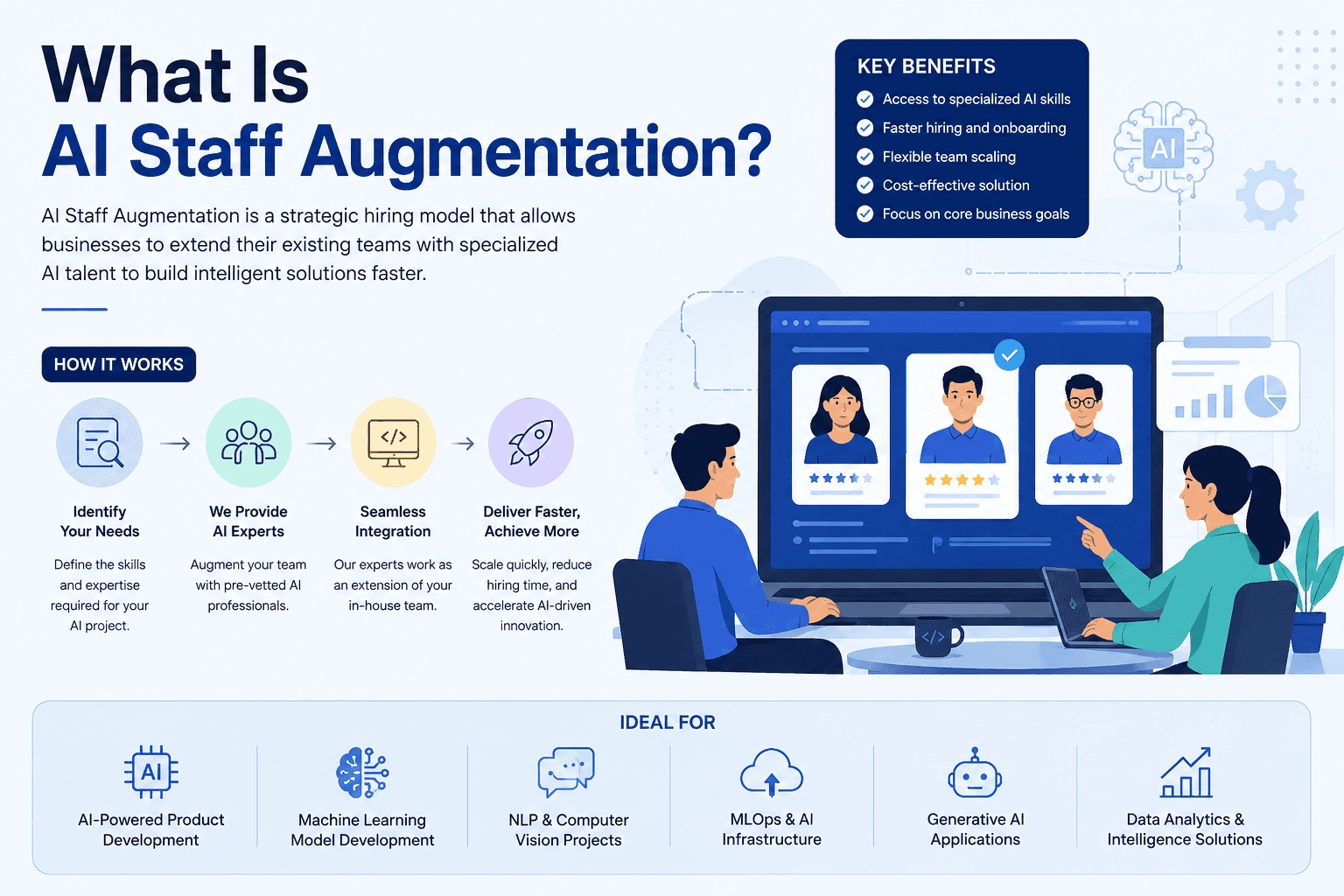
Define the gap — the business identifies which AI skills it's missing (e.g., a computer vision engineer, two NLP specialists, an MLOps lead).
Source the talent — the augmentation partner matches pre-vetted AI professionals against the skill profile and project context.
Integrate the team — the augmented engineers join the client's existing workflows, codebases, and communication channels.
Scale as needed — the client can add or release talent as the project's scope changes, without renegotiating an entire outsourcing contract.
Staff Augmentation vs. Outsourcing
The two models are often confused, but they solve different problems.
Staff augmentation keeps control, architecture decisions, and day-to-day management with the client. The augmented AI engineers work inside the client's systems and reporting lines.
Outsourcing (or "project-based" delivery) hands an entire project — scope, management, delivery timeline, and quality ownership — to an external vendor. The client receives a finished deliverable rather than embedded team members.
A simple example: a fintech startup that needs a fraud-detection model built end-to-end with little internal AI capability might outsource the entire project to a vendor team. A scale-up that already has a data science team but lacks someone who can productionize models at scale would instead augment that team with one or two MLOps engineers — staff augmentation, not outsourcing.
Staff Augmentation vs. Traditional Recruitment
Traditional recruitment involves hiring a full-time employee: a multi-month interview process, a permanent salary commitment, statutory benefits, and the assumption that the role will exist for years. AI staff augmentation compresses that timeline to days or weeks and ties the cost directly to the engagement period — useful for project-based AI work, proof-of-concept builds, or filling a skills gap until a permanent hire is found.
Why Businesses Are Choosing AI Staff Augmentation Over Traditional Hiring
The shift toward AI staff augmentation isn't happening because traditional hiring stopped working — it's happening because AI projects have a different shape than typical software projects. They're experimental, skill-specific, and often time-boxed around a proof of concept or a funding milestone. Here's what's driving the shift.
Faster Hiring Cycles
Recruiting a senior machine learning engineer internally can take 8–16 weeks once you account for sourcing, interviews, offer negotiation, and notice periods. Augmentation partners maintain pre-vetted AI talent pools and can typically place qualified engineers within one to three weeks — a critical advantage when a generative AI proof of concept needs to ship before the next board meeting or investor update.
Access to Specialized AI Expertise
Few internal teams have deep bench strength across generative AI, NLP, computer vision, MLOps, and AI agent development simultaneously. Augmentation lets a business borrow exactly the specialization a project needs — a prompt engineer for three months, a computer vision specialist for a single sprint — rather than trying to hire a generalist who covers all of it adequately.
Reduced Recruitment Costs
Sourcing, interviewing, onboarding, and retaining a full-time AI specialist carries real cost beyond salary: recruiter fees, training, benefits, and the risk of a bad hire. Staff augmentation converts much of that into a predictable, usage-based cost.
Greater Project Flexibility
AI projects rarely have a fixed, linear scope. A model might need to be retrained with a different architecture six weeks into a project, or a new use case might emerge from early pilot results. Augmented teams can flex up or down without the legal and HR complexity of resizing a permanent headcount.
Easier Team Scaling
Need to go from two ML engineers to eight for a three-month sprint ahead of a launch? Augmentation partners with large talent pools can scale a team up quickly — and just as importantly, scale it back down once the sprint is done, without layoffs.
Lower Operational Risk
Because augmented engineers are typically employed by the augmentation partner, the client avoids the employment law complexity, payroll administration, and severance obligations that come with direct hiring — particularly valuable for companies hiring across borders.
Why India Is a Global Hub for AI Talent Augmentation
India's emergence as the preferred destination for AI staff augmentation isn't a recent trend — it's the product of decades of IT services infrastructure now being redirected toward AI.
Large Pool of AI Engineers
India produces one of the largest annual pools of engineering and computer science graduates in the world, and its IT services sector has spent the past two years running large-scale AI upskilling programs. Wipro, for instance, set out to train its entire workforce of roughly 250,000 employees on AI fundamentals and responsible AI use, while Accenture has trained 550,000 of its roughly 780,000 employees globally on generative AI, a large share of them based in India. That scale of structured AI training, layered on top of an existing engineering talent base, is difficult for most countries to replicate.
Strong Technology Ecosystem
India hosts delivery centers, R&D labs, and global capability centers for the majority of the world's largest enterprises. Companies such as TCS now operate AI initiatives at genuinely global scale — the company reported a workforce of 580,000 people spread across 55 countries and 202 service delivery centers worldwide, with deep AI partnerships across the major cloud and model providers.
Competitive Development Costs
India's cost structure for skilled technical talent remains meaningfully lower than the US, UK, or Western Europe, even as wages for AI specialists rise. This cost advantage, combined with a mature delivery infrastructure, is a major reason global enterprises route AI initiatives through Indian teams.
Experience With Global Clients
Indian IT services firms have spent decades managing complex, multi-geography client relationships across regulated industries like banking, healthcare, and insurance. That experience translates directly into AI staff augmentation: firms already understand compliance requirements, data residency rules, and enterprise governance expectations.
Expertise in Emerging AI Technologies
The leading Indian technology firms have moved well beyond basic machine learning into the frontier of enterprise AI, including:
Generative AI and large language model (LLM) integration
Machine learning and deep learning model development
Natural language processing (NLP), including multilingual and regional-language models
Computer vision for manufacturing, retail, and healthcare use cases
Predictive analytics for forecasting and risk modeling
Agentic AI systems capable of autonomous, multi-step decision-making
Key Services Offered by AI Staff Augmentation Companies
Most Indian AI staff augmentation firms structure their talent pools around a consistent set of service lines. Understanding these helps you map your project's needs to the right skill profile.
Generative AI Development
Building applications powered by large language models — from internal copilots and document intelligence tools to customer-facing generative AI products built on top of providers like OpenAI, Anthropic, and Google.
Machine Learning Solutions
Custom model development for classification, forecasting, recommendation, and anomaly detection use cases, including the full lifecycle from data preparation through model training and validation.
Natural Language Processing
Text classification, sentiment analysis, document summarization, and multilingual language models — an area where Indian firms have specific strength given the subcontinent's linguistic diversity.
Computer Vision Applications
Image and video analysis for quality inspection, surveillance, medical imaging, and retail analytics.
AI Chatbot Development
Conversational AI and virtual assistants for customer service, internal helpdesks, and sales support, often combining retrieval-augmented generation (RAG) with enterprise knowledge bases.
AI Automation Solutions
Intelligent process automation that combines AI decisioning with robotic process automation (RPA) to handle workflows that previously required manual judgment.
AI-Powered SaaS Development
Embedding AI capabilities directly into software products — predictive features, intelligent search, personalization engines — for companies building AI-native SaaS platforms.
AI Agent Development
Building autonomous or semi-autonomous AI agents that can plan, reason, and execute multi-step tasks across enterprise systems — one of the fastest-growing service lines across nearly every major Indian IT firm in 2025–2026.
MLOps and AI Infrastructure
Operationalizing machine learning models in production: CI/CD for ML pipelines, model monitoring, governance, and the infrastructure needed to run AI reliably at enterprise scale.
How We Evaluated the Leading AI Staff Augmentation Firms in India
The companies featured in this guide were assessed against a consistent set of criteria, drawing only on information that is publicly available and verifiable through company websites, press releases, analyst reports (such as those from IDC, Everest Group, HFS Research, and Avasant), and reputable industry publications. No proprietary client data, internal performance metrics, or unverifiable claims were used.
AI expertise — depth and breadth of generative AI, machine learning, and agentic AI capabilities, evidenced by named platforms, frameworks, or patents
Industry experience — track record across regulated and complex sectors such as BFSI, healthcare, and manufacturing
Enterprise delivery capability — scale of global delivery centers and ability to support multi-geography engagements
Technical certifications and partnerships — recognized alliances with hyperscalers (AWS, Microsoft, Google Cloud) and AI model providers (OpenAI, Anthropic, NVIDIA)
Innovation initiatives — dedicated AI labs, centers of excellence, or proprietary AI platforms
Client portfolio — evidence of enterprise-scale AI engagements disclosed publicly
Global presence — geographic delivery footprint and time-zone coverage
Scalability — workforce size and AI-trained talent pool available for augmentation
Security and compliance standards — published commitments to responsible AI, governance, and data protection
This is not a ranking. The firms are presented in the order suggested for this guide, and each profile should be read on its own merits against your specific project requirements.
Leading AI Staff Augmentation Firms in India
1. Tata Consultancy Services (TCS)
Company Overview: TCS is India's largest IT services company and has stated its ambition to become the world's largest AI-led technology services company. The company was positioned as a Leader in the IDC MarketScape for Worldwide Artificial Intelligence Services in 2026.
AI and Data Services Portfolio: TCS has launched several AI offerings built on its partnership with Google Cloud, including a Agentic AI Data Accelerator designed to help enterprises move from AI pilots to operational autonomy. The company showcased work across Physical AI, Agentic AI, and real-time AI systems at NVIDIA GTC 2026.
Staff Augmentation Capabilities: With a workforce of approximately 580,000 employees spread across 55 countries and 202 service delivery centers, TCS has the scale to staff AI engagements of nearly any size, from a handful of specialists to large dedicated delivery teams.
AI Technology Expertise: TCS has formed strategic alliances spanning Google Cloud, NVIDIA, and ServiceNow, the latter focused on building industry-specific agentic AI solutions for HR, finance, supply chain, and procurement workflows.
Industries Served: TCS's AI partnerships span energy (Siemens Energy AG), telecommunications (NOW Corporation in the Philippines), and broad enterprise functions including HR, finance, and operations.
Global Delivery Presence: Operating across 55 countries with over 200 delivery centers worldwide.
Notable AI Initiatives or Platforms: TCS's Agentic AI Data Accelerator and its broader AI-native autonomous enterprise offerings developed in partnership with Google Cloud.
Ideal Client Profile: Large enterprises running multi-year, multi-geography AI transformation programs that need a partner capable of scaling delivery across dozens of markets simultaneously.
2. Infosys
Company Overview: Infosys is a global digital services and consulting company that has built its AI strategy around Infosys Topaz™, described by the company as an AI-first set of services, solutions, and platforms using generative AI technologies.
AI and Data Services Portfolio: Infosys Topaz spans software development, HR, recruitment, sales, and vendor management use cases, and the company has unveiled an AI-first value framework aimed at an estimated $300–400 billion AI services opportunity by 2030, according to a Nasscom-McKinsey report the company cites.
Staff Augmentation Capabilities: Infosys has launched over 200 enterprise AI agents as part of its Topaz suite in partnership with Google Cloud, and has built nearly 50,000 reusable intelligent services applied across more than 25,000 instances internally.
AI Technology Expertise: Infosys has a strategic collaboration with AWS combining Topaz and Amazon Q Developer for software delivery, debugging, testing, and legacy code modernization, alongside earlier work on Infosys Topaz for SAP S/4HANA Cloud.
Industries Served: Manufacturing, telecom, financial services, and consumer goods are specifically cited in its AWS collaboration; the company also has named engagements with clients such as British Telecom for AI-powered predictive analytics.
Global Delivery Presence: Infosys operates as a global digital services and consulting firm with delivery centers across multiple continents and a large India-based workforce.
Notable AI Initiatives or Platforms: Infosys Topaz, including Topaz for SAP S/4HANA Cloud and the AI-first value framework launched in 2026.
Ideal Client Profile: Enterprises already invested in SAP, AWS, or Google Cloud ecosystems looking for an AI staffing partner that can embed generative AI directly into existing enterprise software landscapes.
3. Wipro
Company Overview: Wipro launched Wipro ai360 in 2023 as a comprehensive AI-first innovation ecosystem, backed by a $1 billion investment commitment over three years to advance its AI, data, and analytics capabilities.
AI and Data Services Portfolio: Wipro ai360 brings together roughly 30,000 of the company's data analytics and AI experts with its broader technology and advisory ecosystem, and includes Wipro's innovation hub Lab45 for AI research and co-innovation.
Staff Augmentation Capabilities: Wipro has trained more than 225,000 employees on AI fundamentals and tooling as part of its ai360 program, giving it a large internal pool from which to staff client-facing AI augmentation engagements.
AI Technology Expertise: Wipro has established a dedicated Applied AI Center focused on Anthropic's Claude models, alongside its existing use of Microsoft Copilot internally, where the company has reported a code-acceptance ratio of 22.65% for GitHub Copilot at an organizational level.
Industries Served: Wipro's AI ecosystem is structured around multiple global business lines, with named work in IT operations, software engineering, and enterprise customer experience; the company has also delivered AI-powered service integration and management work for public sector clients such as the UK's HM Treasury.
Global Delivery Presence: Wipro serves clients across six continents through its global delivery network.
Notable AI Initiatives or Platforms: Wipro ai360, Lab45 innovation hub, and the Applied AI Center for Anthropic's Claude models.
Ideal Client Profile: Enterprises seeking a partner with a structured, large-scale AI training pipeline and specific depth in high-reasoning, governance-sensitive use cases such as BFSI and healthcare.
4. HCLTech
Company Overview: HCLTech has centered its enterprise AI strategy on AI Force, its proprietary platform for agentic and generative AI, with AI Force 2.0 launched in April 2026 to unify engineering, IT operations, and business applications within a single intelligence fabric.
AI and Data Services Portfolio: AI Force 2.0 is described as model-agnostic and modular, offering a library of prebuilt prompts, agents, and workflows, alongside embedded Responsible AI evaluators for governance and security.
Staff Augmentation Capabilities: HCLTech's AI Force platform had been adopted by over 20 clients as of early 2025, with the company stating a goal of scaling that to 100 clients, reflecting a large and growing AI delivery workforce supporting these engagements.
AI Technology Expertise: HCLTech has a collaboration with OpenAI to roll out ChatGPT Enterprise internally and embed OpenAI's models across its AI Force, AI Foundry, and AI Engineering offerings, as well as an earlier Generative AI Center of Excellence built with IBM on the watsonx platform.
Industries Served: HCLTech's AI Foundry and AI Force platforms are positioned across software and data engineering, IT operations, and enterprise business process functions spanning multiple industries.
Global Delivery Presence: HCLTech operates globally with delivery centers supporting clients across major verticals including financial services, manufacturing, life sciences and healthcare, and telecom.
Notable AI Initiatives or Platforms: AI Force 2.0, AI Foundry, and the OpenAI and IBM watsonx collaborations.
Ideal Client Profile: Enterprises modernizing legacy IT operations and software engineering workflows that want a model-agnostic agentic AI platform integrated into a staff augmentation engagement.
5. Tech Mahindra
Company Overview: Tech Mahindra has built its AI strategy around its "AI Delivered Right" framework, which includes Project Indus — an open-sourced large language model the company developed in collaboration with Intel and, more recently, NVIDIA.
AI and Data Services Portfolio: Tech Mahindra's AI and automation portfolio includes the ZeroOps, InfinityOps, and VerifAI frameworks, with VerifAI specifically focused on governance — validating and verifying the outcomes of AI projects.
Staff Augmentation Capabilities: Tech Mahindra has also launched Agentic Development & Modernization Services (ADMS), evolving its traditional application development and maintenance practice into one centered on agentic AI and intelligent automation across the application lifecycle.
AI Technology Expertise: The company's TechM Orion platform, built on NVIDIA accelerated computing, is positioned as a next-generation agentic AI platform for autonomous execution of complex business workflows; Project Indus 2.0 added a Hindi-first, education-focused large language model developed with NVIDIA.
Industries Served: Tech Mahindra has named use cases in education (the Project Indus education LLM), pharmacovigilance (an agentic AI healthcare compliance solution), and broader enterprise IT and business operations.
Global Delivery Presence: Headquartered in Pune, India, with a global delivery footprint serving enterprise clients internationally.
Notable AI Initiatives or Platforms: Project Indus and Project Indus 2.0, TechM Orion, and the VerifAI governance framework.
Ideal Client Profile: Organizations with multilingual, India-specific, or emerging-market AI requirements, particularly where sovereign or localized language models are a priority.
6. Accenture India
Company Overview: Accenture's enterprise AI strategy is built around AI Refinery™, a platform the company describes as addressing the barriers to scaling AI and driving reinvention across the business; Everest Group has positioned Accenture as a Leader across multiple AI-related PEAK Matrix assessments.
AI and Data Services Portfolio: AI Refinery includes Agent Builder, Trusted Agent Huddle, and SDKs for deploying and orchestrating agentic AI, and Accenture has extended this into AI Refinery for Industry, featuring a collection of pre-configured industry agent solutions covering use cases from clinical trial support to revenue growth management.
Staff Augmentation Capabilities: Accenture has reported doubling its AI and data workforce from roughly 40,000 in FY2023 to about 77,000 by the end of FY2025, with a stated target of 80,000 by FY2026 — a substantial share of this talent based in India.
AI Technology Expertise: AI Refinery is built using NVIDIA AI Enterprise software, including NVIDIA NeMo and NIM microservices, and the company has supported more than 2,000 generative AI projects for clients globally.
Industries Served: Accenture's AI Refinery for Industry spans beauty and consumer goods, life sciences, and other sector-specific deployments, reflecting the company's broad cross-industry consulting base.
Global Delivery Presence: Accenture serves clients in more than 120 countries with approximately 799,000 employees globally, with India representing one of its largest delivery and talent hubs.
Notable AI Initiatives or Platforms: AI Refinery and AI Refinery for Industry, developed by the Accenture Center for Advanced AI.
Ideal Client Profile: Large enterprises seeking a consulting-led AI transformation partner with deep cross-industry experience and a mature agentic AI platform already proven across thousands of engagements.
7. LTIMindtree
Company Overview: LTIMindtree has organized its enterprise AI strategy around BlueVerse, which it positions as an agent management infrastructure where multiple AI systems work collaboratively on enterprise workflows — an approach the company and industry observers have described as "agent swarms."
AI and Data Services Portfolio: The BlueVerse ecosystem includes BlueVerse Foundry, a no-code and pro-code platform for building AI agents, RAG pipelines, and intelligent business processes, alongside specific solutions for marketing services and contact-center-as-a-service (CCaaS).
Staff Augmentation Capabilities: In June 2026, LTIMindtree launched "AI 1000," a dedicated initiative to build a specialized workforce of more than 1,000 advanced AI-certified engineers specifically trained to deploy enterprise AI systems for clients.
AI Technology Expertise: The company has also introduced BlueVerse with OGI (Organizational General Intelligence), an agentic IT service management platform, and BlueVerse for iRun, an AI-native managed services model the company states can deliver 60–70% automated incident resolution.
Industries Served: LTIMindtree's BlueVerse offerings are designed for broad enterprise IT operations, marketing, and customer service functions across industries.
Global Delivery Presence: LTIMindtree operates as a global technology consulting and digital solutions provider with a large India-based delivery base.
Notable AI Initiatives or Platforms: BlueVerse, BlueVerse Foundry, BlueVerse with OGI, and the AI 1000 talent initiative.
Ideal Client Profile: Enterprises looking to modernize IT service management and operations through autonomous, multi-agent AI systems, particularly those open to outcome-based commercial models.
8. Persistent Systems
Company Overview: Persistent Systems describes itself as a global Digital Engineering and Enterprise Modernization company, with more than 26,500 employees across 18 countries and over 16,000 AI-trained professionals as of its most recent public disclosures.
AI and Data Services Portfolio: Persistent's agentic AI portfolio includes Agent Studio, a no-code platform for building AI agents, and the Persistent GenAI Hub, a Responsible-AI-driven platform for experimenting across multiple large language models securely.
Staff Augmentation Capabilities: The company has been recognized as a Leader in Everest Group's Talent Readiness for Next-Generation IT Services PEAK Matrix, reflecting its structured approach to preparing AI talent for client engagements.
AI Technology Expertise: Persistent has deep collaborations with OpenAI, AWS, Google, Microsoft, Salesforce, and NVIDIA, and has built specific solutions such as GenMolVS, an AI-powered generative molecules and virtual screening solution developed with NVIDIA's BioNeMo Framework for biopharma research.
Industries Served: Persistent has named engagements in financial services, life sciences, and software, with its SASVA software engineering framework used by global banks across the US, Europe, and APAC for regulatory-compliant code generation.
Global Delivery Presence: Headquartered in Pune, India, with operations across 18 countries, and a brand value the company reports grew 22% in Brand Finance's 2026 IT Services ranking.
Notable AI Initiatives or Platforms: Persistent GenAI Hub, Agent Studio, Persistent iAURA™, and the SASVA engineering framework.
Ideal Client Profile: Mid-to-large enterprises in regulated sectors like banking and life sciences seeking a digital engineering partner with strong software engineering roots extended into generative and agentic AI.
9. Mphasis
Company Overview: Mphasis operates a dedicated AI business unit, Mphasis.ai, launched to help enterprises apply generative AI to drive business outcomes, complemented by its broader MphasisNeoIP™ platform and "AI Without Intelligence Is Artificial™" brand positioning.
AI and Data Services Portfolio: Mphasis.ai's services span generative AI advisory, AI application development, and reinforcement-learning-based conversation design, supported by access to more than 250 models available on major hyperscaler marketplaces.
Staff Augmentation Capabilities: The company runs the Mphasis Sparkle Innovation Ecosystem, which has enrolled more than 50 domain-specific startups, including AI-focused ventures, to accelerate co-created go-to-market solutions for enterprise clients.
AI Technology Expertise: Mphasis has achieved AWS AI Competency status and has built a family of Neo-branded platforms — including NeoRigal, NeoZeta, NeoSaBa, and NeoCrux — covering the agentic software development lifecycle, alongside Mphasis AIOps for intelligent IT operations.
Industries Served: Mphasis has a recognized strength in BFSI (banking, financial services, and insurance), reflected in its market positioning among AI-focused Indian technology stocks.
Global Delivery Presence: Headquartered in Bengaluru, India, with a global delivery network supporting enterprise clients, particularly in financial services.
Notable AI Initiatives or Platforms: Mphasis.ai, MphasisNeoIP™, Mphasis Tria™ (an enterprise agentic platform), and Mphasis AI Superhighway.
Ideal Client Profile: Financial services and BFSI organizations seeking a partner with both deep domain expertise and a structured agentic AI platform for legacy modernization.
10. Cognizant India
Company Overview: Cognizant was founded in Chennai, India, in 1994, and while now headquartered in the United States, the majority of its global workforce remains based in India, making it one of the most India-centric AI delivery organizations among global IT services firms.
AI and Data Services Portfolio: Cognizant's flagship AI offering is Cognizant Neuro® AI, an enterprise-wide generative AI platform the company positions as helping clients consume and customize AI models, alongside Neuro AI Engineering, Neuro IT Operations, and Neuro AI Decisioning.
Staff Augmentation Capabilities: Cognizant opened a dedicated India AI Lab and Cognizant Moment™ Studio in Bengaluru, staffed by PhD-level scientists and AI engineers focused on applied research in multi-agent AI, decisioning systems, and responsible AI, as part of a broader $1 billion generative AI investment commitment made in 2023.
AI Technology Expertise: Cognizant combines its Neuro AI platform with Flowsource™ and Skygrade™ for AI-driven application development, and the company has reported a 100% conversion rate from proof-of-concept to production in select key sectors using these platforms.
Industries Served: Cognizant's enterprise base spans financial services, healthcare, and resources industries globally, with AI-driven automation and quality engineering offerings applied across these verticals.
Global Delivery Presence: With most of its approximately 350,000-person global workforce based in India, Cognizant operates one of the largest India-anchored delivery models among global IT services firms.
Notable AI Initiatives or Platforms: Cognizant Neuro® AI, the Bengaluru India AI Lab, Flowsource™, and Skygrade™.
Ideal Client Profile: Global enterprises that want an India-heavy delivery model with deep applied AI research capability behind it, particularly in financial services and healthcare.
Comparison Framework for AI Staff Augmentation Providers
The table below summarizes publicly disclosed information for each firm. Where a precise figure was not publicly available or verifiable, that cell is marked "Not publicly disclosed" rather than estimated.
Company | Headquarters | Global Presence | Key AI Platform(s) | Notable AI Partnerships | Best Suited For |
|---|---|---|---|---|---|
TCS | Mumbai, India | 55 countries, 200+ delivery centers | Agentic AI Data Accelerator | Google Cloud, NVIDIA, ServiceNow | Large-scale, multi-geography AI transformation |
Infosys | Bengaluru, India | Global digital services footprint | Infosys Topaz™ | AWS, Google Cloud, SAP | Enterprises embedding AI into SAP/cloud landscapes |
Wipro | Bengaluru, India | 6 continents | Wipro ai360, Lab45 | Anthropic, Microsoft | Governance-sensitive AI in BFSI and healthcare |
HCLTech | Noida, India | Global, 60+ countries | AI Force 2.0, AI Foundry | OpenAI, IBM watsonx | Legacy IT and software engineering modernization |
Tech Mahindra | Pune, India | Global delivery network | Project Indus, TechM Orion | NVIDIA, Intel | Multilingual and India-specific AI use cases |
Accenture India | (Global HQ: Dublin) India delivery hub | 120+ countries | AI Refinery™ | NVIDIA, Microsoft | Cross-industry, consulting-led AI transformation |
LTIMindtree | Mumbai, India | Global delivery network | BlueVerse, BlueVerse Foundry | Multi-LLM ecosystem | Autonomous, agent-driven IT operations |
Persistent Systems | Pune, India | 18 countries | GenAI Hub, Agent Studio | OpenAI, AWS, NVIDIA, Microsoft | Regulated-industry digital engineering (BFSI, life sciences) |
Mphasis | Bengaluru, India | Global, BFSI-focused | Mphasis.ai, MphasisNeoIP™ | AWS | Financial services and BFSI legacy modernization |
Cognizant India | Teaneck, US (founded in Chennai, India) | India-majority global workforce | Cognizant Neuro® AI | Microsoft | India-anchored delivery for global enterprises |
Figures reflect the most recent publicly available disclosures from each company as of mid-2026 and are subject to change as these firms continue to report updated metrics.
AI Skills You Can Hire Through Staff Augmentation
Staff augmentation partners typically maintain talent pools across the following specializations, which can be combined into a custom team for your project.
AI Architects
Design the overall AI system architecture, including model selection, data pipeline design, and integration with existing enterprise systems.
Machine Learning Engineers
Build, train, and validate machine learning models, and translate data science prototypes into production-ready code.
Data Scientists
Conduct exploratory data analysis, statistical modeling, and feature engineering to extract insights and build the analytical foundation for AI products.
NLP Engineers
Specialize in language understanding tasks — text classification, entity extraction, summarization, and multilingual model development.
Computer Vision Experts
Develop image and video recognition systems for applications ranging from quality control to medical diagnostics.
MLOps Engineers
Manage the infrastructure and pipelines that take models from experimentation into reliable, monitored production systems.
Generative AI Developers
Build applications on top of large language models, including retrieval-augmented generation systems and custom fine-tuned models.
Prompt Engineers
Design, test, and refine prompts and instructions that shape how large language models behave in production applications.
AI Product Consultants
Help translate business problems into viable AI use cases, define success metrics, and guide AI product roadmaps.
Industries Benefiting From AI Staff Augmentation
Healthcare
AI-assisted diagnostics, clinical trial support, and pharmacovigilance — areas where firms like Tech Mahindra and Persistent Systems have disclosed specific AI initiatives.
Banking and Financial Services
Fraud detection, regulatory-compliant code generation, and intelligent document processing, with Mphasis and Persistent both publicly emphasizing BFSI-specific AI work.
Insurance
Claims automation, risk modeling, and underwriting support powered by predictive analytics and document intelligence.
Retail and Ecommerce
Personalization engines, demand forecasting, and computer-vision-based inventory management.
Manufacturing
Predictive maintenance, quality inspection through computer vision, and supply chain optimization.
Logistics and Supply Chain
Route optimization, demand forecasting, and AI-powered digital supply chain solutions — an area where Tech Mahindra has a publicly disclosed partnership with ParkourSC.
Education
Multilingual learning models, as seen in Tech Mahindra's Project Indus education-focused LLM built with NVIDIA.
Real Estate
Property valuation models, document automation, and customer engagement chatbots.
Travel and Hospitality
Demand forecasting, dynamic pricing, and AI-driven customer service automation.
SaaS and Technology
Embedding generative AI features directly into software products, from intelligent search to AI copilots.
Cost of Hiring AI Developers Through Staff Augmentation in India
Exact, universal pricing for AI staff augmentation cannot be stated reliably, since rates vary significantly by skill level, technology stack, project complexity, contract structure, and the specific augmentation partner. Rather than quoting unsourced figures, it's more useful to understand the factors that drive cost so you can request accurate, current quotes from prospective partners.
Factors affecting pricing:
Skill level — junior AI developers typically cost less than mid-level engineers, who in turn cost less than senior AI specialists and architects with multi-year track records in production AI systems.
Technology stack — specialized skills in areas like LLM fine-tuning, agentic AI frameworks, or niche computer vision applications often command a premium over general machine learning skills.
Project complexity — regulatory-heavy domains (BFSI, healthcare) typically require more senior talent and more rigorous governance, which affects pricing.
Team size — larger, dedicated teams may be priced differently than individual augmented hires, often with volume-based discounts.
Engagement duration — short-term, project-based engagements are often priced differently than long-term, multi-year augmentation contracts.
Domain expertise — engineers with specific industry experience (e.g., fraud detection in banking) typically command higher rates than generalist AI talent.
Because rates shift with market demand and the specific firm's positioning, it's best practice to request a detailed quote based on your exact project scope, required skill levels, and engagement length rather than relying on generic published rate cards.
Common Challenges in AI Staff Augmentation and How to Overcome Them
Communication Gaps
Challenge: Time zone differences and remote collaboration can create friction in fast-moving AI projects where requirements shift quickly.
Solution: Establish overlapping working hours, use asynchronous documentation practices, and schedule daily stand-ups during shared windows.
Knowledge Transfer Issues
Challenge: Augmented engineers need rapid context on your data, business logic, and existing systems to be productive.
Solution: Build a structured onboarding process with documented architecture, data dictionaries, and a dedicated point of contact for the first two to three weeks of engagement.
Security Concerns
Challenge: AI projects often involve sensitive data — customer records, proprietary models, or regulated information.
Solution: Use strict access controls, sign clear data processing agreements, and verify the augmentation partner's compliance certifications (ISO 27001, SOC 2, or industry-specific standards) before onboarding.
Team Integration Challenges
Challenge: Augmented staff can feel disconnected from a client's culture and unwritten norms, leading to friction or misaligned expectations.
Solution: Include augmented engineers in regular team rituals — retrospectives, planning sessions, social check-ins — rather than treating them as an external resource.
Project Governance
Challenge: Without clear ownership, AI projects can drift, especially when model performance doesn't meet expectations on the first attempt.
Solution: Define clear decision rights, success metrics, and escalation paths upfront, and review them at each project milestone.
Quality Assurance
Challenge: AI systems require different QA approaches than traditional software — model accuracy, bias testing, and drift monitoring, not just functional testing.
Solution: Build AI-specific QA checkpoints into your project plan, including bias and fairness testing, and require augmented engineers to document model evaluation methodology.
How to Choose the Right AI Staff Augmentation Partner
Use this checklist when evaluating potential partners:
Technical capability — Does the partner have demonstrable depth in the specific AI domain your project needs (generative AI, computer vision, MLOps, etc.)?
AI project portfolio — Can they point to named, verifiable AI engagements or case studies, rather than vague claims?
Industry expertise — Have they worked in your specific industry, with its particular compliance and domain requirements?
Client testimonials — Are there independently verifiable references or third-party analyst recognitions (IDC, Everest Group, HFS Research)?
Security standards — What compliance certifications and data governance practices do they maintain?
Scalability — Can they realistically scale your team up or down as the project evolves?
Communication process — What collaboration tools, reporting cadence, and escalation paths do they use?
Post-deployment support — Will they support the AI system after initial deployment, including monitoring and retraining?
Future of AI Staff Augmentation in India
Several trends are shaping how AI staff augmentation in India will evolve through 2026 and beyond:
Generative AI teams — Augmentation requests are shifting from single ML engineers toward small, cross-functional generative AI pods (prompt engineer, backend engineer, MLOps).
AI agents — Demand for engineers who can build and orchestrate autonomous AI agents is accelerating, reflected in nearly every major Indian IT firm launching an agentic AI platform in the past 18 months.
Autonomous workflows — Platforms like LTIMindtree's BlueVerse and HCLTech's AI Force 2.0 point toward AI systems that manage entire workflows with limited human intervention, changing the skill profile augmentation partners need to supply.
Enterprise AI adoption — As more enterprises move from pilots to production, the demand shifts from experimental data science talent toward engineers who can productionize and govern AI at scale.
Industry-specific AI specialists — Generalist AI talent is increasingly being supplemented by specialists with deep domain knowledge in BFSI, healthcare, or manufacturing AI use cases.
AI governance and compliance — Frameworks like Tech Mahindra's VerifAI and the Responsible AI evaluators embedded in HCLTech's AI Force 2.0 reflect a broader industry shift toward governed, auditable AI systems.
Agentic AI development teams — Expect staff augmentation requests to increasingly specify "agentic AI engineer" as a distinct role, separate from traditional ML engineering.
Frequently Asked Questions
What is AI staff augmentation?
AI staff augmentation is a workforce model where a business adds external AI specialists — such as machine learning engineers, data scientists, or generative AI developers — to its existing internal team for the duration of a project, while retaining management control and using its own tools and processes.
How much does AI staff augmentation cost in India?
Costs vary by skill level, technology stack, project complexity, and engagement duration. Rather than relying on generic published rates, request a detailed quote from prospective partners based on your specific project scope and required expertise level.
How quickly can AI developers be hired through staff augmentation?
Augmentation partners with pre-vetted talent pools can typically place qualified AI engineers within one to three weeks, compared to the 8–16 weeks often required for traditional full-time recruitment.
Is AI staff augmentation better than outsourcing?
Neither model is universally "better" — they solve different problems. Staff augmentation is well suited when you have internal AI capability and management capacity but need specific skills added to your team. Outsourcing is better suited when you want to hand off an entire AI project's delivery and ownership to an external vendor.
Can augmented AI teams work with internal teams?
Yes — this is the core premise of staff augmentation. Augmented engineers join your existing workflows, tools, and reporting structure, working alongside your internal team rather than as a separate unit.
What AI skills can be hired through staff augmentation?
Common roles include AI architects, machine learning engineers, data scientists, NLP engineers, computer vision experts, MLOps engineers, generative AI developers, prompt engineers, and AI product consultants.
What industries benefit most from AI staff augmentation?
Healthcare, banking and financial services, insurance, retail, manufacturing, logistics, education, real estate, travel and hospitality, and SaaS/technology companies are among the sectors most actively using AI staff augmentation today.
How long should an AI staff augmentation engagement last?
Engagement length depends entirely on project scope — some run for a single proof-of-concept sprint of a few weeks, while others extend into multi-year, ongoing AI platform development. Most partners support flexible scaling rather than fixed-term-only contracts.
How do companies ensure data security in AI staff augmentation?
Through formal data processing agreements, strict access controls, compliance certifications (such as ISO 27001 or SOC 2), and clear contractual terms about data residency and model training restrictions. Always verify a partner's specific security certifications before sharing sensitive data.
Why is India preferred for AI talent augmentation?
India combines a very large pool of engineering graduates, decades of global IT delivery experience, competitive development costs, and — increasingly — large-scale structured AI upskilling programs run by its major technology firms, several of which have trained hundreds of thousands of employees on generative and agentic AI in the past two to three years.
Conclusion
AI staff augmentation has become the most practical way for businesses to close the gap between ambitious AI roadmaps and the scarce, specialized talent needed to execute them. It offers faster hiring cycles than traditional recruitment, more control than full project outsourcing, and the flexibility to scale a team up or down as an AI initiative evolves from proof of concept to production.
India remains the leading global destination for this model — not simply because of cost advantages, but because its major technology firms have spent the past three years building genuine AI depth: proprietary agentic AI platforms, dedicated AI research labs, large-scale employee upskilling programs, and deep partnerships with the world's leading model providers and hyperscalers. From TCS's global-scale delivery network to Tech Mahindra's work on sovereign, multilingual language models, to Cognizant's India-anchored research labs, the firms profiled in this guide each bring a distinct combination of AI expertise, industry focus, and delivery scale.
Choosing the right partner among India's leading AI staff augmentation companies comes down to matching your specific project needs — the AI skills required, your industry's compliance demands, and your preferred engagement model — against a firm's verifiable track record, rather than marketing claims alone. Whether you need a single generative AI developer for a focused sprint or a dedicated AI development team for a multi-year transformation, India's AI talent augmentation ecosystem offers the depth, flexibility, and proven delivery experience to support custom AI projects at virtually any scale.