
Ecommerce Website design cost in Malaysia in 2027
Posted on
Web Design
Posted at
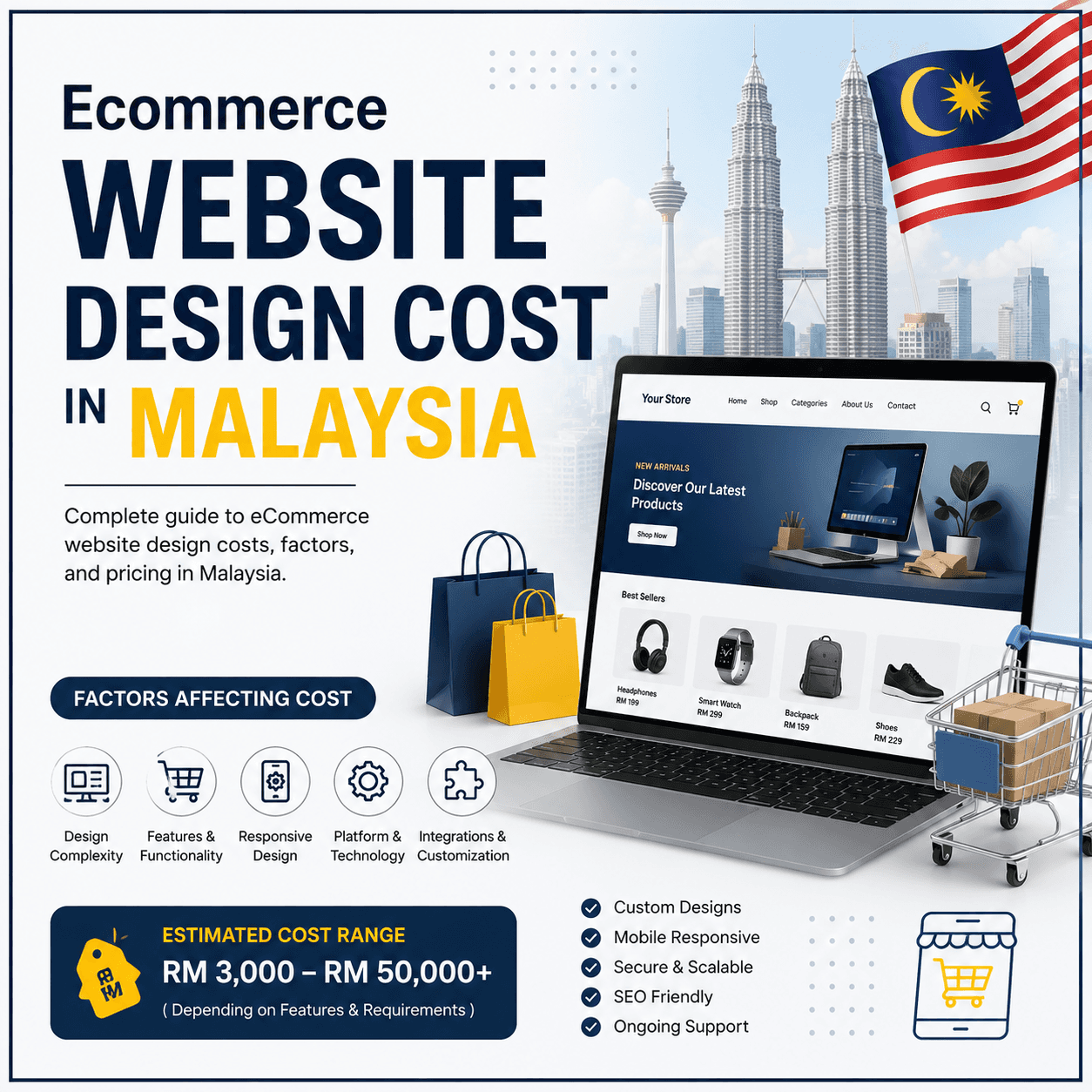
Online shopping in Malaysia has moved from a convenience to a core sales channel. Bank Negara Malaysia's e-payment data, DHL's e-commerce reports, and iPrice/Statista market trackers have all pointed the same direction for years: Malaysian consumers are shifting spend from physical retail to mobile and desktop shopping, and that shift accelerated permanently after 2020. By 2027, a business without a functioning online store isn't "behind the curve" — it's simply invisible to a growing share of its addressable market.
That growth has created a second, less obvious problem for business owners: wildly inconsistent pricing in the web development market. Ask five agencies in Kuala Lumpur, Penang, or Johor Bahru for a quote on "an online store" and you can receive numbers ranging from RM 1,500 to RM 500,000 — for what sounds, on paper, like the same request. Neither number is necessarily wrong. They're answers to different questions, because "eCommerce website" is not one product. It's a category that spans a RM 2,000 Shopify theme install and a RM 400,000 headless commerce platform with ERP integration.
This guide exists to close that gap. We've structured it the way we'd walk a client through a real project scoping conversation — starting with what an eCommerce website actually is, moving through realistic 2027 pricing by business size and platform, breaking down every line item that makes up a final quote, and finishing with the questions you should ask before signing a contract with any Malaysian web development company.
Two things drive the final number on any eCommerce project more than anything else: the platform you choose and the number of custom features and integrations you need. Everything else in this guide builds on that foundation.
Table of Contents
What is an eCommerce Website?
Average eCommerce Website Design Cost in Malaysia (2027)
Complete Cost Breakdown
Factors Affecting Website Cost
Platform Cost Comparison
Cost by Business Size and Industry
AI Features That Increase Development Cost
eCommerce Technology Stack
Hidden Costs Businesses Forget
eCommerce Website Development Timeline
Build vs Template vs Custom
How to Reduce Development Cost
How to Choose an eCommerce Website Design Company in Malaysia
Future Trends in Malaysian eCommerce
Frequently Asked Questions
1. What is an eCommerce Website?
Quick answer: An eCommerce website is an online platform that lets a business list, market, and sell products or services directly to customers with integrated payment, shipping, and order management. In Malaysia, this ranges from single-brand online stores (B2C/D2C) to multi-vendor marketplaces and B2B wholesale portals, each with very different cost structures.
Not every online store serves the same purpose, and the model you're building determines both your feature list and your budget. Here's how the main models break down:
B2C (Business-to-Consumer): A single brand selling directly to individual shoppers. This is the most common setup — think a fashion label or skincare brand with its own Shopify or WooCommerce store.
D2C (Direct-to-Consumer): A subset of B2C where a manufacturer skips traditional retail/distributor channels entirely and sells straight to the end customer, often with a stronger emphasis on brand storytelling and subscription retention.
B2B (Business-to-Business): Wholesale or trade portals where pricing is often tiered, hidden until login, and negotiated per account. Malaysian manufacturers and distributors selling to retailers typically need this model.
Marketplace: A platform where multiple independent sellers list products under one roof (comparable to a mini Shopee or Lazada). Requires vendor onboarding, commission logic, and multi-party payouts.
Multi-vendor: Technically a marketplace variant, but often used for businesses that want to host complementary brands or franchisees under a shared storefront.
Subscription Commerce: Recurring billing models — subscription boxes, SaaS-style product refills, membership stores — that need recurring payment logic and churn management.
Headless Commerce: A decoupled architecture where the frontend (what customers see) and backend (inventory, orders, payments) are built and hosted separately, connected by APIs. Common for larger Malaysian brands that need highly customized, fast storefronts without being locked into a single platform's design system.
Malaysian examples: A local skincare brand running a Shopify store is B2C/D2C. A KL-based F&B distributor selling to restaurants at negotiated bulk pricing is B2B. A Selangor-based furniture group with several sub-brands on one platform is multi-vendor. A fashion retailer that rebuilt its storefront on Next.js while keeping Shopify as the backend is running headless commerce.
2. Average eCommerce Website Design Cost in Malaysia (2027)
Quick answer: In 2027, eCommerce website costs in Malaysia typically range from RM 3,000 for a basic templated store to RM 400,000+ for an enterprise or multi-vendor marketplace platform. Most SMEs building a professional, conversion-ready store should budget between RM 15,000 and RM 60,000.
Table 1: eCommerce Website Cost by Tier (Malaysia, 2027)
Website Tier | Typical Cost Range (RM) | Timeline | Best For |
|---|---|---|---|
Basic Website | RM 3,000 – RM 8,000 | 1–3 weeks | Micro businesses, single product, low SKU count |
Startup Store | RM 8,000 – RM 20,000 | 3–6 weeks | New brands, <200 products, standard theme + light customization |
SME Website | RM 20,000 – RM 45,000 | 6–10 weeks | Growing businesses, 200–2,000 SKUs, custom UI/UX |
Professional Store | RM 45,000 – RM 90,000 | 10–14 weeks | Established brands, integrations, custom checkout flows |
Enterprise Platform | RM 100,000 – RM 300,000+ | 4–9 months | Large retailers, ERP/CRM integration, multi-region |
Marketplace Website | RM 80,000 – RM 350,000+ | 4–8 months | Multi-vendor platforms, commission logic, vendor dashboards |
AI-Powered eCommerce | RM 60,000 – RM 250,000+ | 3–7 months | AI recommendations, chatbots, personalization engines |
B2B Portal | RM 40,000 – RM 180,000 | 3–6 months | Trade pricing, account-based access, bulk ordering |
Wholesale Platform | RM 50,000 – RM 200,000 | 3–6 months | Distributors, MOQ logic, tiered pricing |
Multi-Vendor Marketplace | RM 100,000 – RM 400,000+ | 5–9 months | Vendor onboarding, payouts, commission management |
These figures reflect Malaysian market rates across freelancers, boutique agencies, and established web development companies as of 2027. Projects with heavy custom development (headless architecture, proprietary logic, multiple third-party system integrations) regularly exceed these ranges — the table represents a realistic band, not a ceiling.
Key takeaway: Most Malaysian SMEs land in the RM 20,000–RM 60,000 range for a store that's genuinely conversion-optimized, mobile-first, and integrated with local payment gateways — anything cheaper usually means a stock theme with minimal customization, and anything above that usually reflects custom development or system integrations, not just "better design."
3. Complete Cost Breakdown
Quick answer: A full eCommerce website quote is really a sum of 15–20 line items — discovery, UI/UX design, core page templates, cart/checkout, payment gateway integration, admin tooling, and post-launch infrastructure. Understanding each line item lets you compare quotes fairly instead of comparing single lump-sum numbers that hide very different scopes.
Table 2: Cost Breakdown by Component
Component | Typical Cost Range (RM) | Notes |
|---|---|---|
Business Analysis & Discovery | RM 1,000 – RM 8,000 | Scope definition, competitor audit, user flow mapping |
UI/UX Design (full site) | RM 3,000 – RM 30,000 | Wireframes, mockups, design system, prototyping |
Homepage Development | RM 1,000 – RM 6,000 | Hero banners, featured collections, promo modules |
Category/Listing Pages | RM 1,000 – RM 5,000 | Filters, sorting, pagination, faceted search |
Product Pages | RM 1,500 – RM 8,000 | Variants, galleries, reviews, related products |
Shopping Cart | RM 800 – RM 4,000 | Mini-cart, upsells, promo code logic |
Checkout Flow | RM 2,000 – RM 12,000 | Guest checkout, address validation, multi-step UX |
Payment Gateway Integration | RM 1,500 – RM 8,000 per gateway | FPX, Billplz, iPay88, Stripe, ToyyibPay |
Customer Accounts | RM 1,000 – RM 5,000 | Login, order history, saved addresses |
Wishlist / Save for Later | RM 500 – RM 2,500 | Simple to moderately complex |
Order Tracking | RM 1,000 – RM 5,000 | Status updates, courier tracking API |
CMS Setup | RM 1,500 – RM 8,000 | Blog, landing pages, content blocks |
Admin Dashboard | RM 2,000 – RM 15,000 | Order/product management, custom reporting |
Inventory Management | RM 2,000 – RM 12,000 | Multi-warehouse, stock sync, low-stock alerts |
Shipping Module | RM 1,500 – RM 10,000 | Courier API integration, rate calculation |
Email/SMS Notifications | RM 800 – RM 4,000 | Transactional emails, abandoned cart flows |
SEO Setup (technical) | RM 1,500 – RM 8,000 | Schema, sitemap, site speed, metadata structure |
Analytics & Tracking | RM 500 – RM 3,000 | GA4, Meta Pixel, server-side tracking |
Security Hardening | RM 1,000 – RM 6,000 | SSL, firewall rules, PCI-DSS considerations |
Hosting Setup | RM 500 – RM 5,000 (+ recurring) | Cloud vs shared hosting configuration |
Maintenance Retainer | RM 300 – RM 5,000/month | Updates, bug fixes, monitoring |
Expert tip: When comparing two quotes with a large gap, don't ask "why is one cheaper" — ask "which of these 20 line items did the cheaper quote leave out." In our experience, missing items are almost always checkout customization, inventory sync, and post-launch maintenance — the three things that cause the most pain when skipped.
4. Factors Affecting Website Cost
Quick answer: Twelve variables drive most of the price difference between eCommerce quotes: platform choice, product catalog size, custom feature requirements, third-party integrations, payment and shipping complexity, ERP/CRM connections, AI features, mobile optimization depth, SEO scope, performance requirements, security/compliance needs, and ongoing support level.
Platform selection — A Shopify build and a custom Laravel build solving the same business problem can differ by 3–5x in cost, because one leans on pre-built infrastructure and the other builds it from scratch.
Number of products (SKUs) — More SKUs mean more complex filtering, bulk import tooling, and often custom catalog architecture. A 50-SKU store and a 20,000-SKU store are not the same engineering problem.
Custom features — Anything outside a platform's default behavior (custom bundling logic, loyalty points, complex variant pricing) adds development hours.
Integrations — Every external system (accounting software, CRM, ERP, marketing automation) needs an API connection, error handling, and testing.
Payment gateway complexity — Supporting FPX, e-wallets, cards, and buy-now-pay-later options each adds integration and testing time.
Shipping requirements — Multi-courier rate comparison, East Malaysia vs Peninsular Malaysia shipping rules, and international shipping all add logic.
ERP/CRM integration — Syncing inventory, pricing, and customer data with systems like SAP, SQL Account, or Salesforce is one of the most expensive integration categories.
Marketing automation — Abandoned cart flows, loyalty programs, and personalization engines require both build and ongoing tuning.
AI features — Chatbots, recommendation engines, and predictive analytics (detailed in Section 7) add meaningfully to both development and infrastructure cost.
Mobile optimization depth — A fully custom mobile experience (not just "responsive") is a different design and QA effort than desktop-first development.
SEO requirements — Technical SEO architecture (especially for large catalogs) requires structured data, crawl budget management, and URL strategy work beyond basic setup.
Security and compliance — PCI-DSS considerations, PDPA (Malaysia's Personal Data Protection Act) compliance, and fraud prevention tooling all add scope.
5. Platform Cost Comparison
Quick answer: Shopify and WooCommerce dominate Malaysia's SME eCommerce market due to lower upfront cost and faster launch times, while Magento/Adobe Commerce and custom Laravel builds suit larger businesses needing deep customization. Headless commerce sits at the top of the cost range but offers the best long-term performance and flexibility for scaling brands.
Table 3: Platform Pricing & Capability Comparison
Platform | Setup Cost (RM) | Monthly Cost (RM) | Best For | Scalability |
|---|---|---|---|---|
Shopify | 8,000 – 60,000 | 150 – 2,500+ (plans + apps) | Fast-launching SMEs, DTC brands | Good, app-dependent |
WooCommerce | 6,000 – 50,000 | 100 – 1,500 (hosting + plugins) | Budget-conscious SMEs, content-heavy sites | Moderate, hosting-dependent |
Magento Open Source | 30,000 – 150,000 | 500 – 3,000 (hosting) | Mid-large catalogs needing flexibility | High, needs strong dev team |
Adobe Commerce | 80,000 – 400,000+ | Licensing + hosting, high | Enterprise, complex B2B | Very high |
BigCommerce | 10,000 – 70,000 | 200 – 2,000 | Growing brands wanting SaaS reliability | Good |
OpenCart | 5,000 – 30,000 | 100 – 800 | Very budget-conscious small stores | Low-moderate |
Custom Laravel/Node.js | 40,000 – 300,000+ | Hosting + dev retainer | Unique business logic, full ownership | Very high, fully controlled |
Headless Commerce | 60,000 – 400,000+ | Hosting + API costs, moderate-high | Performance-critical, multi-channel brands | Extremely high |
Table 4: Shopify vs WooCommerce (Malaysia)
Factor | Shopify | WooCommerce |
|---|---|---|
Upfront Cost | Lower to moderate | Lower, but hosting adds up |
Hosting | Included (SaaS) | Self-managed or managed hosting required |
Ease of Use | Very high | Moderate (WordPress knowledge helps) |
Customization | Good, limited by platform rules | Very high (open source) |
Transaction Fees | Applies unless using Shopify Payments | None (WooCommerce itself is free) |
Maintenance | Low (platform-managed) | Higher (plugin/security updates needed) |
Best For | Fast launch, low-maintenance brands | Content-driven, highly customized stores |
Table 5: Magento/Adobe Commerce vs Custom Development
Factor | Magento / Adobe Commerce | Fully Custom (Laravel/Node.js) |
|---|---|---|
Initial Cost | High | High to Very High |
Flexibility | High, within Magento's architecture | Unlimited |
Development Time | Moderate-long | Long |
Long-term Ownership | Platform-dependent | Fully owned codebase |
Best For | Large catalogs, established B2B logic | Truly unique business models |
Expert tip: Don't choose a platform based on the sticker price alone. A RM 15,000 Shopify store with RM 400/month in recurring app fees can cost more over three years than a RM 35,000 WooCommerce build with lower recurring costs. Always model total cost of ownership over 24–36 months, not just launch cost.
6. Cost by Business Size and Industry
Quick answer: eCommerce costs scale with both company size and industry complexity. A fashion startup and a healthcare/pharma retailer at the same revenue size can have very different budgets, because regulated industries and product-configuration-heavy categories (furniture, automotive) require more custom logic than straightforward apparel or F&B stores.
Table 6: Cost by Business Size
Business Size | Typical Budget (RM) | Common Platform Choice |
|---|---|---|
Startup | 5,000 – 20,000 | Shopify, WooCommerce |
Small Business | 15,000 – 40,000 | Shopify, WooCommerce |
Growing Business | 35,000 – 100,000 | WooCommerce, Shopify Plus, BigCommerce |
Large Enterprise | 150,000 – 500,000+ | Magento/Adobe Commerce, Custom, Headless |
Marketplace Operator | 100,000 – 400,000+ | Custom, Headless, Marketplace frameworks |
Table 7: Cost by Industry Vertical
Industry | Typical Budget Range (RM) | Key Cost Drivers |
|---|---|---|
Manufacturing / Wholesale | 40,000 – 200,000 | Tiered pricing, MOQ, B2B portal |
Retail (General) | 15,000 – 80,000 | Catalog size, promotions engine |
Fashion | 20,000 – 90,000 | Variant complexity, lookbook/visual UX |
Healthcare / Pharma | 40,000 – 150,000 | Compliance, prescription workflows |
Electronics | 30,000 – 120,000 | Warranty logic, spec comparison tools |
Food Delivery / F&B | 25,000 – 100,000 | Real-time ordering, delivery zone logic |
Furniture | 30,000 – 130,000 | Product configurators, freight shipping |
Automotive (Parts/Accessories) | 35,000 – 150,000 | VIN/compatibility lookup, large catalogs |
Key takeaway: Two businesses with identical revenue can have a 3x budget difference if one sells 40 fashion SKUs with simple checkout and the other sells 4,000 automotive parts requiring vehicle-compatibility lookup. Catalog complexity, not company size alone, is often the real cost driver.
7. AI Features That Increase Development Cost
Quick answer: AI features are the fastest-growing cost category in Malaysian eCommerce projects for 2027, typically adding RM 5,000–RM 100,000+ depending on sophistication. Simple AI chatbots are relatively affordable; custom recommendation engines, dynamic pricing, and predictive inventory forecasting require significant data engineering and ongoing model tuning.
Table 8: AI Feature Cost Estimates
AI Feature | Estimated Cost Add-on (RM) | Complexity |
|---|---|---|
AI Chatbot (rule-based/FAQ) | 2,000 – 10,000 | Low |
AI Chatbot (LLM-powered, custom trained) | 10,000 – 40,000+ | Moderate-High |
Product Recommendation Engine | 8,000 – 50,000 | Moderate-High |
Visual Search | 15,000 – 60,000 | High |
Voice Search | 10,000 – 40,000 | Moderate-High |
AI-Powered Site Search | 8,000 – 35,000 | Moderate |
Predictive Analytics (sales/demand) | 20,000 – 80,000 | High |
Dynamic Pricing Engine | 25,000 – 100,000+ | Very High |
Inventory Forecasting | 20,000 – 70,000 | High |
AI Content Generation Tools | 5,000 – 25,000 | Low-Moderate |
AI Marketing Automation | 10,000 – 45,000 | Moderate-High |
Expert tip: Most Malaysian SMEs don't need custom-built AI in year one. A well-configured off-the-shelf recommendation app (Shopify/WooCommerce ecosystem) can deliver 70–80% of the value of a custom engine at a fraction of the cost. Reserve custom AI investment for when you have enough transaction data (typically 6–12 months of sales history) to actually train a model that outperforms rule-based logic.
8. eCommerce Technology Stack
Quick answer: A modern Malaysian eCommerce stack typically combines a JavaScript frontend (React or Next.js), a scalable backend (Laravel, Node.js, or a platform-native backend like Shopify/Magento), a relational or hybrid database, cloud hosting (AWS, Azure, or Google Cloud), and local payment rails such as FPX, Billplz, iPay88, and ToyyibPay alongside global processors like Stripe.
Table 9: Common Technology Stack Choices
Layer | Common Options | Notes |
|---|---|---|
Frontend | React, Next.js, Vue, Angular | Next.js favored for SEO + performance |
Backend | Laravel, Node.js, NestJS, Python, .NET, Java | Laravel popular among Malaysian dev teams |
Database | MySQL, PostgreSQL, MongoDB | MySQL/Postgres for structured commerce data |
Cloud Hosting | AWS, Azure, Google Cloud | AWS most common for Malaysian SMEs/enterprise |
Local Payments | FPX, Billplz, iPay88, ToyyibPay | FPX essential for local bank transfers |
Global Payments | Stripe, Razer Merchant Services | Needed for card/international transactions |
Shipping | Courier APIs (J&T, Poslaju, Ninja Van, DHL) | Rate calculation and tracking integration |
ERP/CRM | SAP, SQL Account, Salesforce, HubSpot | Required for larger, process-heavy businesses |
Choosing a stack isn't just a technical decision — it determines your hiring pool for future maintenance. Laravel and WordPress/WooCommerce developers are relatively abundant in Malaysia, which keeps long-term maintenance costs more predictable than niche stacks with a smaller local talent pool.
9. Hidden Costs Businesses Forget
Quick answer: The most commonly underestimated eCommerce costs in Malaysia are ongoing ones: domain renewal, hosting, SSL renewal, payment gateway transaction fees, third-party app subscriptions, content creation, product photography, and post-launch maintenance. These recurring costs often total 15–30% of the original build cost annually.
Table 10: Recurring & Hidden Cost Estimates
Cost Item | Typical Annual Cost (RM) |
|---|---|
Domain Renewal | 50 – 150 |
Hosting (shared to cloud) | 600 – 12,000 |
SSL Certificate | 0 – 800 (many included free via Let's Encrypt) |
Maintenance & Support | 3,600 – 60,000 |
Payment Gateway Fees | 1.5% – 3.5% per transaction |
Third-Party Apps/Plugins | 1,200 – 24,000 |
Email Service (transactional) | 500 – 6,000 |
Marketing & SEO | 6,000 – 60,000+ |
Product Photography | 2,000 – 20,000 |
Security Updates & Monitoring | 1,200 – 12,000 |
Key takeaway: A store with a RM 30,000 build cost can realistically require RM 8,000–RM 20,000/year in combined hosting, apps, maintenance, and gateway fees. Budget for year-one total cost of ownership, not just the launch invoice — this is the single most common budgeting mistake we see among first-time store owners.
10. eCommerce Website Development Timeline
Quick answer: A typical Malaysian eCommerce project moves through eight phases — planning, wireframing, UI design, development, testing, deployment, launch, and post-launch optimization — taking anywhere from 3 weeks for a basic store to 9 months for an enterprise or marketplace platform.
Table 11: Development Timeline by Project Type
Phase | Basic Store | SME Website | Enterprise Platform |
|---|---|---|---|
Planning & Discovery | 2–3 days | 1–2 weeks | 3–6 weeks |
Wireframes | 1–2 days | 1 week | 2–4 weeks |
UI Design | 3–5 days | 2–3 weeks | 4–8 weeks |
Development | 1–2 weeks | 4–6 weeks | 12–24 weeks |
Testing & QA | 2–3 days | 1–2 weeks | 3–6 weeks |
Deployment | 1 day | 2–3 days | 1–2 weeks |
Launch | 1 day | 1 day | 1 week (phased) |
Optimization | Ongoing | Ongoing | Ongoing |
Total | 1–3 weeks | 6–10 weeks | 4–9 months |
Expert tip: Rushed timelines almost always cost more in the long run. Compressed QA phases are the number one cause of post-launch emergency fixes — which typically cost 2–3x more per hour than issues caught during structured testing.
11. Build vs Template vs Custom
Quick answer: Templates (Shopify/WooCommerce themes) offer the fastest, cheapest launch but limit differentiation and scalability. Fully custom development offers unlimited flexibility and ownership at a significantly higher cost. Headless commerce is a middle-to-high path that combines platform reliability on the backend with fully custom frontend performance.
Table 12: Build Approach Comparison
Factor | Template (Shopify/Woo Theme) | Custom Development | Headless Commerce |
|---|---|---|---|
Ownership | Limited (platform-dependent) | Full | High |
Customization | Low-Moderate | Unlimited | Very High |
SEO Control | Moderate | Full | Full |
Performance | Good, platform-dependent | Depends on build quality | Excellent |
Scalability | Moderate | High | Very High |
Cost | Lowest | Highest | High |
Time to Launch | Fastest | Slowest | Moderate-Slow |
Best For | New/small businesses | Unique business models | Scaling brands needing speed + flexibility |
No-code and low-code marketplace builders sit closer to the template end of this spectrum — fast and affordable, but with real ceilings on customization once you outgrow the platform's built-in logic.
12. How to Reduce Development Cost
Quick answer: The most effective ways to control eCommerce budget in Malaysia are launching with an MVP feature set, choosing a platform that matches your actual scale (not your five-year ambition), prioritizing ruthlessly, planning integrations before development starts, and avoiding plugin bloat that creates long-term maintenance debt.
Start with an MVP. Launch with core buying flows (browse, cart, checkout, payment) and add loyalty programs, AI features, and advanced personalization after you have real sales data.
Choose the right platform for today's scale. Building on Adobe Commerce for a 50-SKU launch is over-engineering; you can always migrate up as you grow.
Prioritize features by revenue impact. Rank features by expected impact on conversion rate or average order value, not by what looks impressive in a pitch deck.
Use scalable architecture from day one, even in an MVP — this avoids expensive rebuilds later, even if you're not using the full capability yet.
Avoid unnecessary plugins/apps. Each one adds licensing cost, page-speed weight, and a potential security/compatibility liability.
Plan integrations early. Retrofitting ERP or CRM connections after launch is consistently more expensive than designing for them from the start.
13. How to Choose an eCommerce Website Design Company in Malaysia
Quick answer: Evaluate a Malaysian eCommerce agency on relevant portfolio experience, transparent line-item pricing, post-launch support terms, technical depth (not just design skill), and SEO/performance competency — not on lowest quote alone. Red flags include vague scopes of work, no maintenance plan, and an inability to explain their technology choices in plain language.
What to evaluate:
Experience — Have they built stores in your industry or of similar complexity?
Portfolio — Ask for live sites, not just screenshots (screenshots hide slow load times and broken flows).
Pricing transparency — A credible agency can break a quote into line items, similar to Table 2 above.
Communication — Will you have a dedicated point of contact, or does every question route through a general inbox?
Support — What's covered after launch, and for how long, before hourly billing kicks in?
Technology fit — Do they recommend a platform based on your business, or do they push the same stack to every client?
SEO knowledge — Can they explain how their build handles technical SEO (site speed, structured data, URL structure)?
Performance — Ask for real Core Web Vitals data from a previous project, not just claims of "fast."
Security practices — Ask specifically how they handle PDPA compliance and payment data security.
Questions to ask before signing:
What exactly is included in this quote, line by line?
What's excluded, and what would trigger an additional cost?
Who owns the codebase and design files after launch?
What's the support/maintenance plan post-launch, and its cost?
Can I see a live store you've built that's still operating today?
How do you handle scope changes mid-project?
What's your typical timeline for a project like mine, realistically?
Red flags:
Quotes with no breakdown, just a single number
No mention of post-launch support or maintenance
Reluctance to show live, currently-operating client sites
Pressure to sign quickly without a written scope of work
Prices dramatically below market average with no clear explanation
Table 13: Agency vs Freelancer
Factor | Agency | Freelancer |
|---|---|---|
Cost | Higher | Lower |
Reliability/Continuity | Higher (team-based) | Risk if freelancer becomes unavailable |
Range of Expertise | Broad (design, dev, SEO, PM) | Often narrower, single specialist |
Support Structure | Formal contracts/SLAs | Informal, varies by individual |
Best For | Complex, business-critical projects | Small, simple, budget-constrained projects |
Table 14: Malaysia vs Singapore eCommerce Pricing (Indicative)
Project Tier | Malaysia (RM) | Singapore (SGD, converted to RM equivalent) |
|---|---|---|
Basic Store | 3,000 – 8,000 | ~9,000 – 18,000 |
SME Website | 20,000 – 45,000 | ~45,000 – 100,000 |
Enterprise Platform | 100,000 – 300,000+ | ~250,000 – 700,000+ |
Malaysian development rates remain meaningfully more competitive than Singapore for comparable scope, which is part of why regional brands increasingly choose Malaysian agencies for builds serving multiple Southeast Asian markets.
Table 15: Hosting Cost Comparison
Hosting Type | Monthly Cost (RM) | Best For |
|---|---|---|
Shared Hosting | 20 – 150 | Very small stores, low traffic |
Managed WordPress/WooCommerce Hosting | 150 – 800 | SME WooCommerce stores |
Cloud Hosting (AWS/GCP/Azure) | 300 – 5,000+ | Growing to enterprise stores |
Shopify (included in plan) | Bundled in plan fee | Shopify merchants |
Dedicated/Enterprise Infrastructure | 3,000 – 20,000+ | High-traffic enterprise platforms |
14. Future Trends in Malaysian eCommerce
Quick answer: Malaysian eCommerce is trending toward AI-native shopping experiences, composable/headless architecture, social commerce integration, and richer personalization — trends that will continue to shift budgets away from static template stores and toward flexible, data-driven platforms through the late 2020s.
AI Commerce — AI-assisted shopping (recommendations, conversational search) is moving from "nice to have" to a baseline customer expectation.
Headless & Composable Commerce — More Malaysian mid-market brands are decoupling frontend from backend to control performance and design independently of platform constraints.
Voice Commerce — Still early in Malaysia, but growing alongside broader smart device adoption.
AR Shopping — Particularly relevant for furniture, fashion, and beauty categories where visualization affects purchase confidence.
Live Shopping — Livestream-driven sales, already popular via social platforms, are increasingly being integrated directly into owned eCommerce sites.
AI Agents — Automated agents handling customer queries, order status, and even proactive upsell conversations.
Deeper Personalization — Dynamic homepage and product recommendations based on real-time behavior, not just past purchase history.
Subscription Commerce Growth — More Malaysian brands are testing recurring revenue models beyond traditional subscription boxes.
Social Commerce — Deeper native integration between social platforms and owned storefronts, rather than treating them as separate channels.
Businesses budgeting for a 2027 build should design their architecture with enough flexibility to adopt at least some of these trends within 2–3 years, even if they're not part of the initial launch scope.
Realistic Case Studies
Case Study 1 — Fashion D2C Brand (Kuala Lumpur) A KL-based apparel brand with 300 SKUs needed to migrate from a marketplace-only presence to an owned Shopify store. Budget: RM 28,000. Timeline: 8 weeks. Key challenge: variant-heavy inventory (size/color combinations) required custom filtering. Result: 40% of new sales shifted to the owned store within 6 months, improving margins by removing marketplace commission on that portion of sales. Lesson: owning the customer relationship pays off even when marketplaces remain part of the channel mix.
Case Study 2 — F&B Distributor B2B Portal (Johor Bahru) A food distributor serving restaurants across Johor Bahru and Singapore needed a login-gated B2B portal with tiered pricing. Budget: RM 65,000 on WooCommerce with custom pricing rules. Timeline: 14 weeks. Challenge: syncing pricing tiers with an existing accounting system. Result: order processing time dropped significantly as manual WhatsApp ordering moved online. Lesson: B2B UX (bulk order forms, reorder shortcuts) matters more than visual polish for this audience.
Case Study 3 — Furniture Retailer (Selangor) A furniture retailer with a large catalog and complex shipping (large/freight items) built a custom Laravel store with a product configurator. Budget: RM 110,000. Timeline: 5 months. Challenge: freight shipping rate calculation varied by weight, volume, and delivery zone across Peninsular and East Malaysia. Result: reduced cart abandonment at the shipping-cost step by showing accurate rates upfront. Lesson: shipping transparency is a major conversion factor for large-item categories.
Case Study 4 — Multi-Vendor Marketplace (Penang) A group of independent Penang F&B and craft brands launched a shared marketplace to pool marketing spend. Budget: RM 180,000. Timeline: 7 months. Challenge: commission logic, vendor payouts, and individual vendor dashboards added significant backend complexity. Result: successfully onboarded 40+ vendors in year one. Lesson: marketplace projects need a clear vendor agreement and commission model defined before development starts, not during.
Case Study 5 — Electronics Retailer AI Chatbot Integration (Kuching) An electronics retailer added an AI-powered product recommendation and chatbot layer to an existing WooCommerce store. Budget: RM 32,000 add-on project. Timeline: 10 weeks. Challenge: training the recommendation engine on limited historical sales data. Result: average order value increased through better cross-sell suggestions once enough data accumulated (roughly 3 months post-launch). Lesson: AI features need a data runway — expect a lag before performance gains show up.
15. Frequently Asked Questions
1. How much does a basic eCommerce website cost in Malaysia?
A basic eCommerce website in Malaysia typically costs between RM 3,000 and RM 8,000. This usually covers a templated Shopify or WooCommerce setup, a small product catalog, one payment gateway, and minimal customization. It's suited for micro businesses testing an online sales channel before investing in a fully custom build. Expect a 1–3 week timeline and limited scope for advanced features like custom checkout flows or ERP integration at this price point.
2. How much should an SME budget for an eCommerce website in Malaysia?
Most Malaysian SMEs should budget between RM 20,000 and RM 45,000 for a professional, conversion-focused store. This range typically includes custom UI/UX design, multiple payment gateways, inventory management, SEO setup, and a properly tested checkout flow. It's enough scope to differentiate from competitors using stock templates while remaining realistic for a growing business's budget and timeline expectations (typically 6–10 weeks).
3. Is Shopify or WooCommerce cheaper for a Malaysian business?
WooCommerce is usually cheaper upfront since the software itself is free and you only pay for hosting, plugins, and development. Shopify has a lower barrier to entry with predictable monthly plans but adds transaction fees and app subscription costs over time. Total cost of ownership over 2–3 years can actually favor either platform depending on how many paid apps or plugins your store ends up needing — model both before deciding.
4. How long does it take to build an eCommerce website in Malaysia? Timelines range from 1–3 weeks for a basic templated store to 4–9 months for an enterprise or marketplace platform. An SME-level custom store typically takes 6–10 weeks from discovery to launch. Timeline is driven mainly by the number of custom features, integrations required, and how quickly the client provides content, product data, and design feedback during the process.
5. What payment gateways should a Malaysian eCommerce store support?
Most Malaysian stores need FPX for local bank transfers, at least one e-wallet or card processor (such as iPay88, Billplz, or Razer Merchant Services), and increasingly ToyyibPay for smaller businesses. International-facing stores often add Stripe for card payments from overseas customers. Supporting multiple gateways increases both integration cost and ongoing transaction fee complexity, so match your gateway mix to your actual customer payment preferences.
6. Do I need a custom-built website, or is a template enough?
A template (Shopify or WooCommerce theme) is enough for most businesses launching their first online store or operating with a straightforward product catalog. Custom development becomes worthwhile when your business model includes unique logic — complex pricing tiers, configurators, or marketplace functionality — that templates can't reasonably support. Many businesses start with a template and migrate to custom development once they've validated demand.
7. How much does website maintenance cost after launch in Malaysia?
Ongoing maintenance typically costs between RM 300 and RM 5,000 per month, depending on store complexity and how actively it's updated. This covers security patches, plugin/platform updates, bug fixes, and minor content changes. Larger stores with custom features or high traffic often need a dedicated retainer arrangement rather than ad-hoc hourly support to keep response times fast when issues occur.
8. What's the real cost difference between an agency and a freelancer?
Freelancers are typically 30–60% cheaper than agencies for comparable scope but carry higher continuity risk if they become unavailable mid-project or post-launch. Agencies offer broader in-house expertise (design, development, SEO, project management) and formal support agreements, which matters more for business-critical stores. Many businesses use freelancers for smaller, well-defined projects and agencies for complex, ongoing platforms.
9. How much does a B2B eCommerce portal cost in Malaysia?
A B2B portal in Malaysia typically costs between RM 40,000 and RM 180,000, depending on pricing tier complexity, account-based access requirements, and integration with existing ERP or accounting systems. Costs rise significantly when the portal needs to support negotiated per-customer pricing, minimum order quantities, or bulk ordering tools, since these require custom logic beyond standard eCommerce platform features.
10. What increases eCommerce development cost the most?
Custom integrations (ERP, CRM, accounting systems) and AI features are typically the largest cost drivers beyond the base platform build. Each integration requires API development, error handling, and testing against a live third-party system, which is inherently more unpredictable than building standard storefront features. Businesses often underestimate integration complexity because it's invisible to customers but critical to backend operations.
11. Can I build an eCommerce website myself to save money?
Yes, platforms like Shopify make basic DIY store creation accessible without coding knowledge, and this can work for very early-stage validation. However, DIY builds often lack conversion-optimized UX, proper technical SEO setup, and integration depth, which can cost more in lost sales than the money saved on development. Most businesses that DIY their first store eventually invest in a professional rebuild once they have traction.
12. How much does a multi-vendor marketplace cost to build in Malaysia?
Multi-vendor marketplaces typically range from RM 100,000 to RM 400,000+, reflecting the complexity of vendor onboarding, commission management, individual vendor dashboards, and multi-party payment splitting. This is one of the most expensive eCommerce categories because it essentially requires building two connected products: a customer-facing storefront and a vendor management system.
13. What's the difference between headless commerce and a normal eCommerce website?
Headless commerce separates the frontend (what customers see) from the backend (inventory, orders, payments), connecting them via APIs rather than using a platform's built-in templating system. This allows for highly customized, fast-loading storefronts that aren't constrained by a single platform's design system, at the cost of higher development complexity and cost compared to standard template-based builds.
14. Do I need SSL and how much does it cost?
Yes — SSL is essential for both customer trust and search ranking, and most eCommerce platforms and modern hosting providers now include free SSL certificates (via Let's Encrypt) as standard. Paid SSL certificates with extended validation exist but are rarely necessary for typical SME stores. If a developer is charging a significant separate fee purely for basic SSL setup, it's worth asking why.
15. How much do Malaysian businesses spend on eCommerce SEO?
Ongoing SEO investment for Malaysian eCommerce stores typically ranges from RM 1,500 to RM 8,000 per month, depending on competitiveness of the industry and catalog size. This covers technical SEO maintenance, content creation, and link-building. Technical SEO foundations (site speed, structured data, clean URL structure) should be built into the website itself, while ongoing SEO work builds on that foundation over time.
16. What is PDPA compliance and does my eCommerce store need it?
PDPA (Personal Data Protection Act) is Malaysia's data protection law governing how businesses collect, store, and use customer personal data. Any Malaysian eCommerce store collecting customer information — names, addresses, payment details — needs to handle that data in compliance with PDPA requirements, including having a clear privacy policy and reasonable security safeguards. Non-compliance carries legal risk, so this should be addressed during development, not as an afterthought.
17. How much does product photography cost for an eCommerce store in Malaysia?
Professional product photography in Malaysia typically costs between RM 2,000 and RM 20,000 depending on the number of SKUs, styling complexity, and whether lifestyle/model shots are needed alongside standard product shots. This is frequently underestimated in initial budgets but has a significant, measurable impact on conversion rates — poor product imagery is one of the most common reasons otherwise well-built stores underperform.
18. Should I choose local Malaysian payment gateways or international ones?
Malaysian businesses selling primarily to local customers should prioritize FPX and local e-wallet support, since bank transfer remains one of the most trusted and widely used payment methods domestically. International or card-focused gateways like Stripe become more important if you're selling cross-border or targeting customers who prefer card payments. Most stores benefit from supporting both local and international options rather than choosing one exclusively.
19. How much does it cost to migrate from one platform to another (e.g., WooCommerce to Shopify)?
Platform migrations typically cost between RM 10,000 and RM 60,000, depending on catalog size, historical data (orders, customer accounts) that needs transferring, and how much custom functionality must be rebuilt on the new platform. Migrations are often underestimated because businesses focus on the destination platform's cost and forget that data migration and redirect/SEO preservation work adds significant scope.
20. What ongoing costs should I expect beyond the initial build?
Beyond the initial build, expect recurring costs for hosting, domain renewal, maintenance/support retainers, payment gateway transaction fees, third-party app subscriptions, and marketing/SEO investment. Combined, these typically total 15–30% of the original build cost annually. Businesses that only budget for the launch cost and not year-one operating costs frequently face unplanned expenses within the first few months post-launch.
21. How much does an AI chatbot add to my eCommerce website cost?
A basic rule-based or FAQ chatbot typically adds RM 2,000–RM 10,000 to a project, while a custom LLM-powered chatbot trained on your product catalog and policies can range from RM 10,000–RM 40,000 or more. Cost depends on how much custom training data preparation is needed and whether the chatbot needs to handle transactional queries (order status, returns) versus purely informational ones.
22. What's the minimum viable budget to launch a credible online store in Malaysia?
A credible, professional-looking store with basic customization, one to two payment gateways, and proper mobile optimization can be launched for roughly RM 10,000–RM 15,000 in 2027. Below this range, expect significant compromises in design customization, catalog scalability, or integration capability. This is a reasonable minimum for a business that wants to look established, not just functional.
23. How do I know if a quote from a web development company is fair?
A fair quote should be broken down by line item (similar to the cost breakdown in Section 3 of this guide), fall within the general market ranges for your project tier, and clearly state what's included versus excluded. If a quote is a single lump sum with no breakdown, or significantly below market average with no clear explanation, treat that as a reason to ask more questions before signing.
24. Can an eCommerce website pay for itself?
Yes, when built with conversion-focused UX, proper SEO, and reliable checkout flows, an eCommerce website typically pays for its development cost within the first 6–18 months through direct online sales, depending on average order value and traffic volume. ROI timelines vary significantly by industry and marketing investment, so it's worth modeling expected traffic and conversion rate against your build cost before committing to a budget tier.
25. What's the biggest mistake businesses make when budgeting for an eCommerce website?
The most common mistake is budgeting only for the initial build and ignoring recurring costs (hosting, maintenance, gateway fees, marketing) that continue indefinitely after launch. The second most common mistake is choosing a platform or feature set based on aspirational future scale rather than current business needs, leading to either overspending upfront or an expensive rebuild within a year or two.
Key Takeaways
Most Malaysian SMEs should realistically budget RM 20,000–RM 60,000 for a professional, conversion-ready eCommerce store in 2027.
Platform choice and feature/integration complexity — not company size alone — are the two biggest drivers of final cost.
Always model total cost of ownership over 24–36 months, including hosting, apps, maintenance, and gateway fees, not just the launch invoice.
AI features are increasingly common but should generally be added after you have enough sales data to make them effective, not at initial launch.
When comparing agency quotes, insist on a line-item breakdown — it's the fastest way to spot what's missing from a suspiciously low price.
Final Thoughts
Budgeting for an eCommerce website in Malaysia isn't about finding "the right number" — it's about matching platform, feature scope, and long-term cost of ownership to where your business actually is today, with enough architectural flexibility to grow without a full rebuild in 18 months. The businesses that get the best return on their website investment are rarely the ones who spent the most; they're the ones who scoped honestly, chose a platform suited to their real catalog and operational complexity, and budgeted for the recurring costs that follow launch.
If you're currently scoping a new store, a platform migration, or a custom build with system integrations, it's worth having a structured conversation with an experienced eCommerce development partner before finalizing a budget — the cost of a wrong platform decision made early is almost always higher than the cost of an extra week of proper discovery and planning upfront.
This guide reflects Malaysian market pricing trends as of 2027 based on industry project data and should be used as a directional budgeting reference. Actual quotes will vary by agency, project scope, and specific business requirements — always request a detailed, line-item proposal before committing to a budget.