
Cost to Create a Multi-Vendor Ecommerce Platform in 2026
Posted on
Web Design
Posted at
Introduction
The global online marketplace economy is no longer a trend — it is the dominant model for commerce in 2026. From Amazon and Alibaba to niche vertical platforms serving highly specific industries, multi-vendor ecommerce marketplaces have redefined how buyers and sellers connect at scale. Marketplace-model platforms now account for more than 67% of all global ecommerce gross merchandise value (GMV), and that figure continues to accelerate year over year.
If you are an entrepreneur, startup founder, enterprise decision-maker, or retail business planning to launch your own marketplace, the first and most critical question is always the same: how much does it cost to build a multi-vendor ecommerce platform?
The honest answer is that it depends — and this guide is built to give you every variable you need to make an informed decision. Whether you are building an Amazon-like marketplace, a niche B2B platform, an Etsy-style artisan marketplace, or an AI-powered next-generation commerce hub, understanding the full cost picture is the foundation of a successful launch strategy.
In this article, we break down the multi-vendor ecommerce platform cost in full detail — from core features and technology choices to AI integrations, mobile app development, regional pricing differences, and ongoing operational costs. We also cover how to reduce your investment without sacrificing scalability.
What Is a Multi-Vendor Ecommerce Platform?
A multi-vendor ecommerce platform — sometimes called an online marketplace — is a digital commerce ecosystem where multiple independent sellers or vendors list and sell their products or services to customers through a single, unified storefront managed by a platform owner (the admin).
Unlike a traditional single-vendor online store (such as a brand-owned Shopify store), a multi-vendor marketplace brings together hundreds or thousands of third-party vendors, manages their inventory and orders, and earns revenue through commissions, subscription fees, listing fees, or a combination of all three.
How Multi-Vendor Marketplaces Work
The platform ecosystem typically involves three core roles:
Admin: Manages the entire platform, approves vendors, sets commission rates, monitors analytics, and ensures policy compliance.
Vendors: Register on the platform, create storefronts, upload products, manage orders, and track sales through a dedicated dashboard.
Customers: Browse and purchase products from multiple vendors, often without realising they are buying from different sellers.
Business Models in Multi-Vendor Marketplaces
B2C (Business to Consumer) — Businesses sell directly to end consumers through the marketplace. Examples: Amazon, Flipkart, Zalando.
B2B (Business to Business) — Wholesale or trade transactions between businesses. Examples: Alibaba, ThomasNet, Faire.
C2C (Consumer to Consumer) — Individuals sell to other individuals. Examples: eBay, Etsy, Vinted.
Hybrid — Combines B2C and C2C, or B2B and B2C models. Examples: Amazon Marketplace, Fiverr, Airbnb.
Understanding which business model your marketplace will operate under is critical — it directly shapes the features required, the development complexity, and ultimately the ecommerce marketplace development cost.
Why Multi-Vendor Marketplaces Are Growing in 2026
The marketplace economy is entering its most expansive phase yet. Several powerful macro forces are converging in 2026 to make multi-vendor platforms the most attractive ecommerce investment for founders and enterprises alike.
Key Growth Drivers
AI-Driven Commerce Personalisation: AI is no longer optional. Marketplaces in 2026 deploy machine learning models to personalise product feeds, predict buying intent, and optimise pricing in real time. This creates higher conversion rates and larger average order values.
Mobile Shopping Dominance: Over 72% of ecommerce transactions in Europe and North America now originate from mobile devices. Multi-vendor platforms without mobile-first architecture lose competitive ground immediately.
Cross-Border Ecommerce Expansion: The EU Digital Single Market, simplified cross-border payment rails, and improved logistics networks have made it viable for UK, German, French, Italian, Spanish, and Dutch businesses to launch pan-European marketplaces.
Niche Marketplace Opportunities: Category-specific platforms — for sustainable goods, professional services, industrial B2B supplies, or digital products — are outpacing general marketplaces in customer loyalty and lifetime value.
Subscription-Based Marketplace Models: SaaS-style marketplaces offering vendors monthly subscriptions rather than transaction commissions are gaining significant traction in the B2B space.
The US B2B ecommerce market alone is projected to surpass $3 trillion by the end of 2026. Meanwhile, UK and European marketplace GMV is growing at 18–22% year-over-year. These figures make the investment case for marketplace website development exceptionally strong.
Key Features of a Multi-Vendor Ecommerce Platform
Before calculating the multi-vendor platform development cost, you need a clear picture of what features your marketplace requires. Below is a comprehensive breakdown of all major platform capabilities.
Admin Panel Features
Vendor Management: Approve, suspend, or manage vendor accounts. Configure commission tiers per vendor or category.
Commission Engine: Set flat-rate, percentage-based, or tiered commission structures. Automate vendor payouts.
Analytics Dashboard: Real-time GMV, orders, revenue, vendor performance, and customer behaviour reporting.
AI Sales Reports: Predictive analytics for seasonal trends, demand forecasting, and revenue projections.
Inventory Monitoring: Centralised visibility into vendor stock levels with low-stock alerts.
Product Approvals: Review and approve or reject vendor product listings before they go live.
Vendor Dashboard Features
Dedicated Vendor Storefront: Customisable vendor profiles with branding, bios, and product galleries.
Bulk Product Upload: CSV/XML import tools for high-volume vendors.
Order Management: View, process, fulfil, and track orders from a single dashboard.
Sales Analytics: Revenue charts, top-performing products, return rates, and conversion tracking.
AI Pricing Suggestions: Dynamic pricing recommendations based on competitor data, demand signals, and margin targets.
Customer-Facing Features
Advanced Product Search: Full-text search with filters, faceted navigation, and AI-powered semantic search.
AI Product Recommendations: Personalised product feeds using collaborative filtering and behavioural data.
Reviews and Ratings: Verified purchase reviews with photo uploads and seller response functionality.
Wishlist and Saved Items: Persistent wishlists synced across devices.
AI Chatbot Support: 24/7 customer service powered by LLM-based chatbots for order queries, returns, and product questions.
Secure Multi-Vendor Checkout: Cart aggregation across vendors with split-payment processing and fraud screening.
Advanced Platform Features
AI Personalisation Engine: Real-time behavioural analysis for homepage, search, and email personalisation.
Multi-Language and Multi-Currency Support: Essential for UK, EU, and cross-border platforms. Includes localised checkout and tax handling.
Mobile App Integration (iOS and Android): Native or cross-platform apps with full marketplace functionality.
Real-Time Notifications: Push notifications for order updates, price drops, and vendor messages.
Fraud Detection and Prevention: ML-based transaction monitoring and chargeback management.
Voice Search: Conversational search integration for Alexa, Google Assistant, and in-app voice queries.
Headless Commerce Architecture: Decoupled frontend for maximum performance and flexible CX delivery.
GDPR and Compliance Tools: Cookie management, data export/deletion, and privacy consent workflows — critical for UK and EU operations.
Cost to Create a Multi-Vendor Ecommerce Platform in 2026
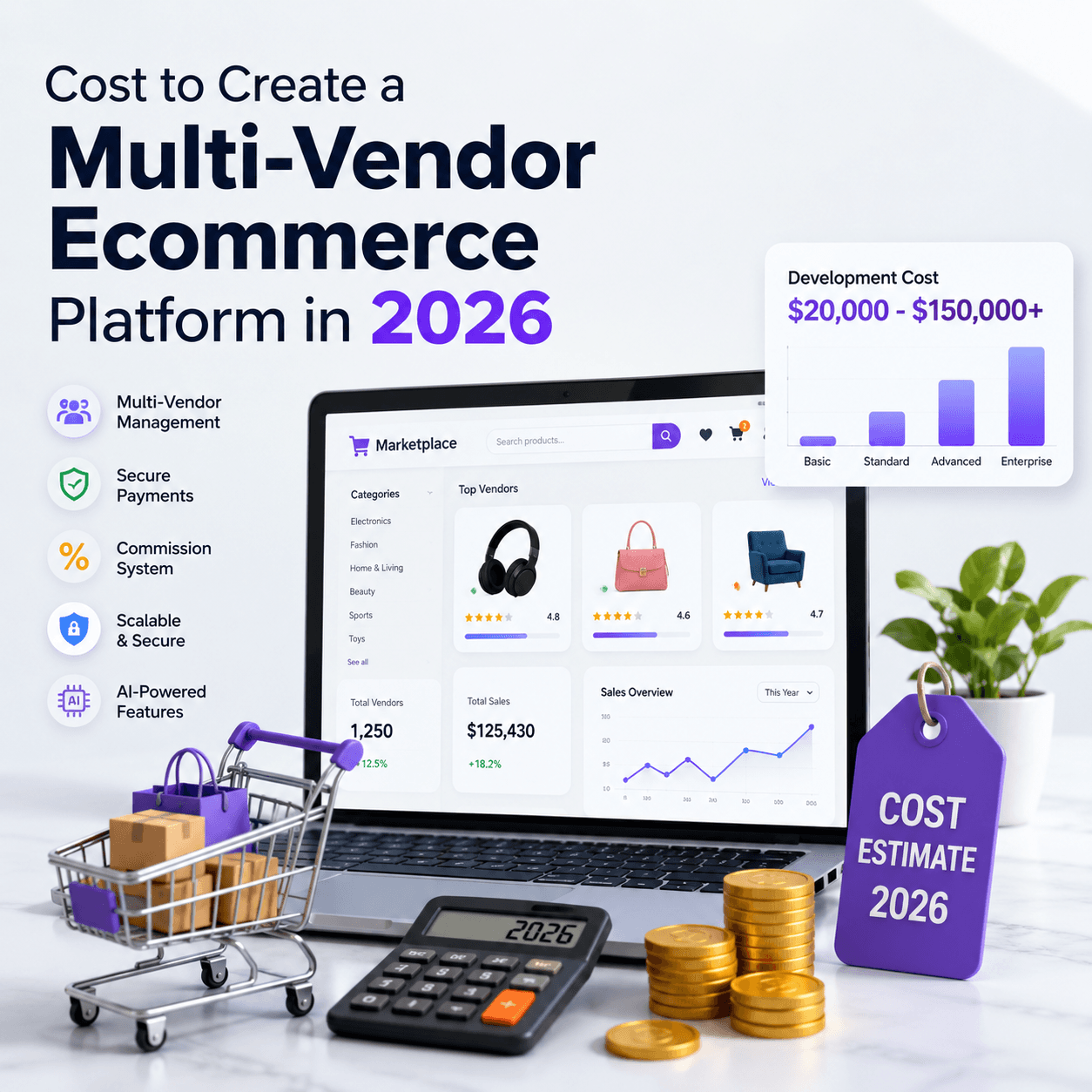
This is the section most founders and businesses need most urgently. The cost to build a multi-vendor marketplace varies enormously based on scope, geography, and technology choices. Below are realistic estimates across three development tiers.
Tier 1 — Small Marketplace / MVP
An MVP (Minimum Viable Product) marketplace includes the core features needed to validate your business model: vendor registration, product listings, customer-facing storefront, basic admin panel, and payment processing.
Component | Estimated Cost (USD) |
|---|---|
Core Platform Development | $15,000 – $30,000 |
UI/UX Design | $3,000 – $6,000 |
Basic Admin and Vendor Dashboard | $4,000 – $8,000 |
Payment Gateway Integration | $2,000 – $4,000 |
Cloud Hosting Setup (1 year) | $1,200 – $2,400 |
QA and Testing | $2,000 – $4,000 |
Total Estimated Range | $27,000 – $54,000 |
Tier 2 — Mid-Size Marketplace
A mid-size marketplace adds advanced vendor tools, AI-powered features, mobile apps, and deeper integrations — suitable for serious market entry with a competitive feature set.
Component | Estimated Cost (USD) |
|---|---|
Full Platform Development | $50,000 – $100,000 |
Advanced UI/UX and Branding | $8,000 – $15,000 |
AI Recommendations and Search | $10,000 – $20,000 |
Mobile App (iOS + Android) | $20,000 – $40,000 |
Multi-Language / Multi-Currency | $5,000 – $10,000 |
Third-Party API Integrations | $5,000 – $12,000 |
Security and GDPR Compliance | $4,000 – $8,000 |
QA and Performance Testing | $5,000 – $10,000 |
Total Estimated Range | $107,000 – $215,000 |
Tier 3 — Enterprise Marketplace
Enterprise marketplaces require custom architecture, high-availability infrastructure, deep AI automation, and support for tens of thousands of vendors and millions of SKUs.
Component | Estimated Cost (USD) |
|---|---|
Custom Architecture and Development | $150,000 – $400,000+ |
AI and ML System Integration | $30,000 – $80,000 |
Enterprise Mobile Apps | $40,000 – $80,000 |
ERP / CRM / WMS Integrations | $20,000 – $50,000 |
Advanced Security and Compliance | $15,000 – $30,000 |
DevOps, CI/CD and Cloud Infrastructure | $20,000 – $50,000 |
QA, Load Testing and Penetration Testing | $15,000 – $35,000 |
Total Estimated Range | $290,000 – $725,000+ |
Development Hourly Rates by Region (2026)
Region | Hourly Rate (USD) | Typical Use Case |
|---|---|---|
USA / Canada | $100 – $200/hr | High-value enterprise projects, local teams |
United Kingdom | $80 – $160/hr | UK-focused marketplaces, regulated industries |
Western Europe (DE, FR, NL) | $75 – $150/hr | EU-compliant platforms, GDPR expertise |
Eastern Europe (PL, UA, RO) | $35 – $70/hr | Quality offshore development, strong tech talent |
India / South Asia | $20 – $45/hr | Cost-efficient MVP and full-scale development |
Southeast Asia | $25 – $50/hr | Growing tech talent pool, competitive pricing |
Factors That Affect Marketplace Development Cost
Understanding the variables that drive marketplace website development cost helps you make smarter trade-offs and avoid budget overruns.
Platform Complexity: The number of user roles, workflow automations, and business rules directly multiplies development hours.
Feature Scope: Each advanced feature — AI search, vendor analytics, fraud detection — adds meaningful cost. Prioritising an MVP feature set is the single biggest lever for cost control.
AI Integrations: Machine learning models, LLM-powered chatbots, and recommendation engines require specialised engineers and ongoing model training infrastructure. Expect AI features to add 15–30% to total development cost.
Mobile App Development: Native iOS and Android apps roughly double the frontend development investment. Cross-platform frameworks like Flutter or React Native can reduce this by 30–40%.
UI/UX Design Quality: A generic template-based design costs $3,000–$6,000. A custom-designed marketplace experience for competitive markets — fashion, electronics, B2B — can reach $20,000–$40,000.
Technology Stack Choices: Open-source stacks (Node.js, React, PostgreSQL) reduce licensing costs significantly versus enterprise platforms with per-seat pricing.
Third-Party APIs: Payment gateways (Stripe, Adyen, Mollie for EU), shipping carriers, tax compliance tools (Avalara, TaxJar), and identity verification services all carry integration costs and recurring fees.
Cloud Hosting Architecture: A scalable, auto-scaling AWS, GCP, or Azure deployment adds initial DevOps setup costs but reduces long-term downtime risk significantly.
Security Requirements: PCI-DSS compliance, SSL certificates, WAF (Web Application Firewall), and penetration testing are non-negotiable for payment-processing marketplaces.
GDPR Compliance: For UK and EU-focused platforms, GDPR compliance engineering — consent management, data residency, right-to-erasure workflows — adds $5,000–$15,000 to the project.
Scalability Architecture: Designing for horizontal scalability from day one adds cost but prevents expensive re-architecting as the platform grows.
Best Technologies for Multi-Vendor Marketplace Development
Your technology stack is one of the most consequential decisions in your marketplace's lifecycle. The right choices provide performance, scalability, and developer availability. The wrong ones create technical debt that compounds over time.
Frontend Technologies
React.js: The dominant frontend framework for marketplace UIs. Enables component reusability, excellent SEO support via Next.js, and a vast ecosystem of UI libraries.
Next.js: The preferred React framework for production marketplaces. Server-side rendering (SSR), static generation, and edge rendering deliver exceptional Core Web Vitals scores.
Vue.js: A lighter-weight alternative to React, well-suited to vendor dashboard development and progressive enhancement of existing platforms.
Backend Technologies
Node.js: Excellent for high-concurrency marketplace APIs, real-time features such as live inventory and notifications, and microservices architectures.
Laravel (PHP): A mature, feature-rich framework widely used in European ecommerce development. Strong ORM, queuing, and authentication out of the box.
Django (Python): The preferred backend for AI-heavy marketplaces — Python's ML ecosystem (scikit-learn, TensorFlow, PyTorch) integrates naturally with Django APIs.
AI and Machine Learning Technologies
OpenAI APIs: GPT-4o and newer models power product description generation, AI chatbots, search intent understanding, and vendor onboarding automation.
AI Recommendation Engines: Collaborative filtering models via AWS Personalize, Google Recommendations AI, or custom-built systems personalise product feeds and cross-sell widgets.
Predictive Analytics: Demand forecasting, churn prediction, and fraud scoring using time-series models and gradient boosting frameworks like XGBoost and LightGBM.
Vector Search: Tools like Pinecone, Weaviate, or OpenSearch with k-NN enable semantic product search that understands meaning, not just keywords.
Ecommerce Platform Options
Platform | Best For | Multi-Vendor Support | Typical Cost Range |
|---|---|---|---|
Shopify Plus + Apps | SME marketplaces, fast launch | Via third-party apps | $2,000–$15,000/yr SaaS + dev |
Magento / Adobe Commerce | Enterprise custom marketplaces | Via Multi-Vendor extensions | $50,000–$300,000+ custom |
WooCommerce + Dokan | Budget-conscious WordPress MVPs | Built-in with Dokan plugin | $5,000–$30,000 |
CS-Cart Multi-Vendor | Dedicated marketplace software | Native multi-vendor architecture | $15,000–$80,000 |
Custom Build | Unique requirements, full control | Fully custom | $50,000–$500,000+ |
How AI Features Are Changing Marketplace Development Costs in 2026
Artificial intelligence is no longer a premium add-on for well-funded enterprise projects. In 2026, AI features are becoming table stakes for competitive marketplaces — and they are reshaping the cost equation at every tier.
AI Feature | Description | Added Development Cost (USD) |
|---|---|---|
AI Product Recommendations | Personalised product feeds using ML models | $8,000 – $20,000 |
AI Chatbot / Virtual Assistant | LLM-powered support and shopping assistant | $5,000 – $15,000 |
AI Pricing Engine | Dynamic pricing based on demand and competition signals | $10,000 – $25,000 |
Semantic / Vector Search | Intent-aware product search beyond keywords | $6,000 – $15,000 |
Generative AI Content | Auto-generated product descriptions and SEO copy | $4,000 – $10,000 |
AI Fraud Detection | Real-time ML-based transaction risk scoring | $8,000 – $18,000 |
Voice Commerce Integration | Voice search and purchase via smart assistants | $5,000 – $12,000 |
AI Analytics and Forecasting | Demand prediction, churn analysis, revenue modelling | $10,000 – $25,000 |
The total cost of a comprehensive AI layer for a mid-size marketplace typically ranges from $25,000 to $80,000 in additional development investment. However, platforms that implement AI effectively report 25–40% increases in average order value and 30–50% improvements in customer retention — making the ROI compelling for any serious marketplace operator.
Marketplace Mobile App Development Cost
A marketplace without a mobile app in 2026 is at a serious competitive disadvantage. Mobile commerce accounts for the majority of online shopping sessions globally, and app-native experiences consistently outperform mobile web for conversion rates and repeat purchase frequency.
App Type | Platforms | Features | Cost Range (USD) |
|---|---|---|---|
Basic Customer App | iOS + Android | Browse, search, cart, checkout, push notifications | $15,000 – $30,000 |
Full Customer App | iOS + Android | AI recommendations, AR try-on, voice search, payments | $35,000 – $70,000 |
Vendor App | iOS + Android | Order management, inventory, analytics, payouts | $12,000 – $25,000 |
Cross-Platform (Flutter / RN) | iOS + Android | Shared codebase, 80–90% feature parity | $20,000 – $50,000 |
Enterprise Native Apps | iOS + Android separate | Full custom native, maximum performance | $60,000 – $120,000+ |
Cross-platform frameworks like Flutter and React Native are the recommended choice for most marketplace projects in 2026. They deliver 80–90% feature parity with native apps at 40–50% of the cost, and the tooling has matured significantly. Only the most performance-sensitive enterprise platforms warrant the premium of fully native development.
Custom Development vs Ready-Made Marketplace Solutions
One of the most important strategic decisions for any marketplace founder is whether to build a fully custom platform or start with a ready-made marketplace solution. Both approaches have legitimate use cases — and the right choice depends on your timeline, budget, technical requirements, and long-term vision.
Criteria | Custom Development | SaaS Platform | Open-Source Solution |
|---|---|---|---|
Time to Market | 4–18 months | 2–8 weeks | 2–4 months |
Upfront Cost | $50,000 – $500,000+ | $500 – $3,000/month | $10,000 – $80,000 |
Scalability | Unlimited (designed to spec) | Platform-dependent | Moderate (self-managed) |
AI Customisation | Fully custom | Limited to platform APIs | Moderate |
Vendor Lock-in | None | High | Low |
Ongoing Costs | Hosting + dev team | Monthly SaaS fees | Hosting + maintenance |
Best For | Enterprise, unique requirements | Fast MVP validation | Budget-conscious with tech team |
Popular Ready-Made Marketplace Solutions
Sharetribe: Excellent SaaS platform for rental and service marketplaces. Low-code setup, GDPR-compliant EU hosting, and affordable pricing make it ideal for early-stage concept validation.
CS-Cart Multi-Vendor: Purpose-built marketplace software with strong vendor management features. A one-time license model suits mid-size platforms seeking control without a full custom build.
Shopify + Marketplace Apps (Webkul, Marketcube): Quick setup for product marketplaces. Best suited to early-stage product businesses, but limited by Shopify's architecture for complex multi-vendor workflows.
Magento / Adobe Commerce with Multi-Vendor Extensions: Highly customisable open-source option, but requires significant developer expertise to maintain and scale effectively.
Ongoing Costs After Marketplace Launch
The launch investment is only the beginning. Multi-vendor marketplaces require substantial ongoing investment to remain competitive, secure, and scalable. Founders who plan only for development costs and overlook operational expenditure frequently face cash flow crises within 12–18 months of launch.
Cost Category | Small Platform | Mid-Size Platform | Enterprise Platform |
|---|---|---|---|
Cloud Hosting and Infrastructure | $5,000 – $15,000/yr | $15,000 – $50,000/yr | $50,000 – $200,000+/yr |
Security, SSL and WAF | $1,200 – $3,600/yr | $3,600 – $10,000/yr | $10,000 – $30,000/yr |
Platform Maintenance and Updates | $8,000 – $20,000/yr | $20,000 – $60,000/yr | $60,000 – $150,000/yr |
AI Software Subscriptions | $2,400 – $8,000/yr | $8,000 – $30,000/yr | $30,000 – $100,000+/yr |
Payment Gateway Fees | 2–3% per transaction | 1.5–2.5% + monthly fees | Custom enterprise rates |
Customer Support Team | $24,000 – $60,000/yr | $60,000 – $150,000/yr | $150,000 – $500,000+/yr |
SEO and Digital Marketing | $12,000 – $30,000/yr | $30,000 – $100,000/yr | $100,000 – $500,000+/yr |
Mobile App Updates | $3,000 – $8,000/yr | $8,000 – $25,000/yr | $25,000 – $80,000+/yr |
Budget for ongoing costs from day one. A well-run mid-size marketplace should allocate $80,000–$275,000 per year in operational expenditure beyond the initial build investment.
How to Reduce Multi-Vendor Marketplace Development Costs
Building a marketplace does not have to break your budget. Here are the most effective, practitioner-tested strategies for reducing ecommerce marketplace development cost without compromising long-term platform quality.
Start with an MVP. Validate your marketplace concept with the minimum feature set that delivers value to vendors and customers. Add complexity only when you have market evidence to justify the investment.
Use scalable open-source frameworks. React, Node.js, and PostgreSQL give you enterprise-grade performance without licensing fees. Avoid proprietary platforms with expensive per-seat or per-transaction pricing unless transaction volume justifies it.
Choose cross-platform mobile development. Flutter or React Native apps deliver 80–90% of native performance at 40–50% of the cost. For most marketplace categories, this trade-off is entirely acceptable.
Prioritise core revenue-generating features. Commission management, vendor onboarding, and checkout flow directly impact revenue. Defer bells and whistles like gamification, AR features, and social commerce integrations to Phase 2.
Outsource strategically to Eastern Europe or South Asia. Development teams in Poland, Romania, Ukraine, India, and Vietnam offer exceptional technical quality at 40–70% lower hourly rates than US or UK teams. Combine offshore development with onshore product management for best results.
Leverage managed cloud services. AWS, Google Cloud's managed databases, and Cloudflare's CDN reduce DevOps complexity and allow small teams to operate enterprise-grade infrastructure without a large in-house ops team.
Adopt a phased development roadmap. Break your platform into quarterly releases. Each phase is funded by revenue generated in the previous one — avoiding the need for massive upfront capital.
Use pre-built integrations and APIs. Payment gateways (Stripe), shipping (EasyPost), tax compliance (Avalara), and authentication (Auth0) are much cheaper to integrate as APIs than to build from scratch.
Leading Multi-Vendor Marketplace Development Companies in 2026
Selecting the right development partner is as important as selecting the right technology stack. Below is an overview of leading marketplace development agencies serving clients in the USA, UK, and Europe.
VNA Infotech
VNA Infotech is a growing ecommerce and marketplace development company focused on delivering scalable multi-vendor ecommerce platforms for startups, SMEs, and modern digital businesses. The company provides end-to-end marketplace development services including custom ecommerce solutions, AI-powered integrations, mobile commerce applications, vendor management systems, and performance optimization.
The agency has experience building multi-vendor marketplaces across industries such as retail, fashion, electronics, B2B commerce, healthcare, and service marketplaces. Their development approach emphasizes user-friendly UI/UX design, scalable architecture, AI-enabled automation, secure payment systems, and long-term platform growth.
VNA Infotech is particularly suited for businesses seeking affordable yet modern marketplace development with custom functionality and post-launch technical support. The company also offers integrations with leading ecommerce technologies including Shopify, WooCommerce, Magento, and custom frameworks.
Services: Multi-vendor marketplace development, AI ecommerce solutions, mobile app development, custom ecommerce development, marketplace automation, vendor dashboard systems, payment gateway integration, UI/UX design, maintenance & support.
Best For: Startups, growing ecommerce brands, B2B marketplaces, service marketplaces, and mid-sized businesses.
Pricing Estimate: $25,000 – $200,000+ depending on features, AI integrations, scalability, and platform complexity.
Countries Served: USA, UK, Canada, Australia, UAE, and global markets.
FreeCodeslab
FreeCodeslab is a modern web and ecommerce development agency specializing in custom marketplace platforms, AI-powered ecommerce solutions, and scalable online business systems. The company focuses on helping startups and growing businesses launch feature-rich multi-vendor ecommerce platforms with modern technologies, automation capabilities, and mobile-first user experiences.
Their expertise includes marketplace website development, AI-powered recommendation systems, ecommerce app development, smart search integration, custom vendor management systems, and ecommerce performance optimization. FreeCodeslab works with businesses across multiple industries including retail, digital products, services, electronics, and niche marketplace startups.
The agency is known for delivering cost-effective marketplace solutions with scalable infrastructure, responsive design, secure architecture, and flexible customization options suitable for both small businesses and expanding online marketplaces.
Services: Multi-vendor ecommerce development, AI marketplace integrations, custom ecommerce platforms, marketplace mobile app development, AI chatbot integration, vendor management systems, payment integrations, ecommerce automation, UI/UX design, support & maintenance.
Best For: Startups, ecommerce entrepreneurs, SMBs, niche marketplaces, and businesses seeking affordable marketplace development solutions.
Pricing Estimate: $15,000 – $150,000+ depending on project scope, AI functionality, and customization requirements.
Countries Served: USA, UK, Europe, Canada, UAE, and international markets.
Scandiweb
A Europe-based ecommerce agency specialising in performance-first Magento and headless commerce implementations. Strong GDPR and EU compliance expertise makes them a natural fit for European marketplace projects. Services include custom marketplace development, headless commerce, PWA, and performance optimisation. Pricing estimate: $60,000 – $400,000+. Countries served: Germany, France, Netherlands, UK, USA.
Netguru
A Poland-based digital product studio with strong marketplace and platform development capabilities. Known for design-forward development and startup partnerships. Services span product strategy, UX/UI design, custom platform development, and AI integration including ML-powered recommendation systems. Best for VC-backed startups and scale-ups seeking product-quality development with European timezone alignment. Pricing estimate: $80,000 – $500,000+. Countries served: UK, Germany, France, USA, Netherlands.
FreeCodeslab
A specialist marketplace development agency focused on multi-vendor platforms, with experience across B2C, B2B, and service marketplace models. Services include multi-vendor platform builds, AI feature development, vendor portal engineering, and mobile app development. Best for startups and SMEs requiring dedicated marketplace expertise at competitive rates. Pricing estimate: $15,000 – $150,000. Countries served: USA, UK, Canada, Australia.
Frequently Asked Questions (FAQ)
How much does it cost to build a marketplace website?
The cost to build a marketplace website ranges from $27,000–$54,000 for an MVP, $107,000–$215,000 for a mid-size platform with AI features and mobile apps, and $290,000–$725,000+ for an enterprise-grade marketplace. The final figure depends on features, team location, and technology choices.
What is the cost of Amazon-like marketplace development?
Building a platform with Amazon-level features — AI personalisation, multi-vendor management, logistics integration, and mobile apps — typically costs $300,000 to $1,000,000+ for a full custom build. A focused MVP with Amazon-inspired core features can be built for $80,000–$200,000.
Which platform is best for multi-vendor ecommerce?
The best platform depends on your requirements. For MVPs and fast launch, Sharetribe or CS-Cart Multi-Vendor are excellent starting points. For scalable enterprise platforms, a custom build on Node.js/React or Adobe Commerce is recommended. For midmarket, Shopify Plus with multi-vendor apps or a custom Laravel/Django solution are strong options.
How long does marketplace development take?
An MVP marketplace can be launched in 3–5 months with a focused team. A mid-size platform typically takes 6–10 months. Enterprise marketplaces often require 12–24 months for the full initial build, including integrations and performance testing.
Is AI important for ecommerce marketplaces in 2026?
Yes — AI is critical. Platforms with AI-powered product recommendations, dynamic pricing, semantic search, and personalised user experiences consistently outperform non-AI competitors on conversion rates, average order value, and customer lifetime value. AI is increasingly a baseline expectation rather than a differentiator.
Can startups afford multi-vendor marketplace development?
Yes. A well-scoped MVP marketplace can be built for $30,000–$60,000 using cross-platform mobile frameworks, offshore development teams, and a prioritised feature set. The key is starting lean, validating the concept quickly, and reinvesting marketplace revenue into platform expansion.
What is the cheapest way to build a marketplace?
The most cost-efficient approach is: (1) use a SaaS platform like Sharetribe for early validation; (2) then migrate to a custom build once the business model is proven. Alternatively, using CS-Cart Multi-Vendor or WooCommerce + Dokan with an Eastern European development team can deliver a production-ready platform for $20,000–$50,000.
How much does marketplace app development cost?
A cross-platform mobile app (iOS + Android) for a marketplace typically costs $20,000–$50,000 using Flutter or React Native. Full-featured native apps for both platforms range from $60,000 to $120,000+. A dedicated vendor app adds $12,000–$25,000 to the budget.
What payment gateways are best for EU and UK marketplaces?
For European and UK marketplaces, Stripe Connect and Adyen MarketPay are the leading choices for multi-vendor split payments. Mollie is popular for Netherlands, Belgium, and German merchants. Checkout.com is strong for enterprise UK platforms. All support SEPA, BACS, and local payment methods.
What is GDPR compliance and how does it affect development cost?
GDPR governs how personal data is collected, stored, and processed for users in the EU and UK. Compliance engineering — including cookie consent management, data residency configuration, right-to-erasure workflows, and privacy impact assessments — typically adds $5,000–$15,000 to marketplace development projects targeting European customers.
What is the difference between headless commerce and traditional ecommerce?
Headless commerce decouples the frontend presentation layer from the backend commerce engine, allowing developers to build highly custom, lightning-fast UIs using React, Next.js, or Vue.js while using a headless API for business logic and data. For marketplaces competing on user experience, headless architecture delivers significant performance and flexibility advantages — at an additional development cost of 20–35%.
How do I choose the right marketplace development agency?
Evaluate agencies on five criteria: (1) a portfolio of live marketplace projects, not just general ecommerce; (2) experience with your target geography and its regulatory requirements; (3) demonstrated AI and mobile app capability; (4) transparent hourly rates and project management methodology; (5) post-launch support and maintenance contracts. Always request case studies, client references, and a detailed technical proposal before committing.
Conclusion:
The opportunity to build a successful multi-vendor ecommerce marketplace has never been greater. The tools, frameworks, and talent are more accessible than ever before. AI technology is democratising capabilities that were once exclusive to Amazon-scale platforms. And the appetite among consumers and businesses to transact through marketplace models continues to grow in every major market — from the USA and UK to Germany, France, the Netherlands, and beyond.
The cost to create a multi-vendor ecommerce platform in 2026 spans a wide range: from a lean $30,000 MVP to a $500,000+ enterprise powerhouse. But the investment is justified by a business model with extraordinary unit economics — when you earn a commission on every transaction, growth compounds in your favour.
The most important thing is not to have the biggest budget. It is to have the right strategy: start with a validated MVP, choose a technology stack that scales with your business, integrate AI from the beginning, build for mobile first, and partner with a development agency that has delivered live marketplaces — not just ecommerce stores.
The marketplaces that will win in the next five years are being built right now. The question is whether yours will be among them.