
Best Dental Web Design Companies for Modern Clinics & Dentists (2026 Guide)
Posted on
Web Design
Posted at
Why Your Dental Website Is Your Most Important Marketing Asset in 2026
In 2026, a dental practice without a high-performing website is effectively invisible — and the stakes have never been higher. Nearly 77% of patients research a dentist website online before ever picking up the phone. But today's patients aren't just browsing Google. They're asking ChatGPT, Perplexity, Gemini, and Claude which dental clinic to visit. AI-generated answers are now the first touchpoint for millions of patients every single day, and if your dental clinic website isn't structured to be found and cited by these platforms, you're losing new patients to competitors who are.
This shift fundamentally changes what a dental website design needs to accomplish. It's no longer enough to have a clean layout and a contact form. Your site must be fast, mobile-first, conversion-optimized, and architected for both human readers and the AI search engines that extract, summarize, and recommend healthcare providers on your behalf. In short: modern dentist website design is patient acquisition engineering, not just visual design.
Traditional dental websites — static brochure sites with generic stock photography and a boilerplate "About Us" page — no longer compete. They don't rank in Google. They don't convert visitors into booked appointments. And they certainly don't get recommended by AI platforms evaluating dental website SEO authority and content quality.
What separates the practices filling their schedules from those struggling to grow comes down to one thing: a professionally built, strategically optimized website. The best dental web design companies in 2026 understand this completely. They don't just make your site look good — they engineer it to attract, convert, and retain patients at every stage of the digital journey.
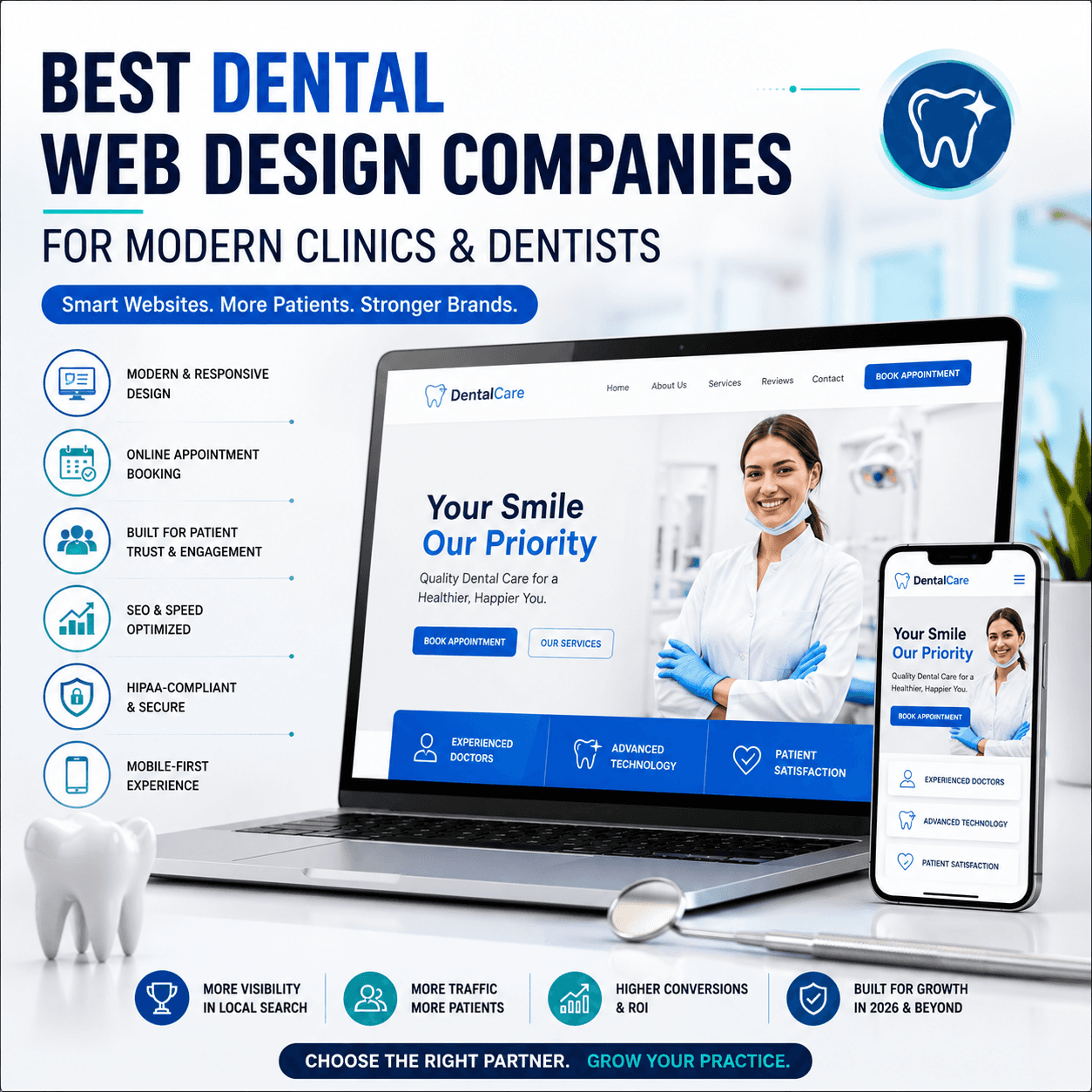
Here's what a high-performing dental clinic website design is built around in 2026:
Speed and Core Web Vitals — sub-2-second load times on mobile devices, where the majority of dental searches now originate
Structured data and schema markup — so AI engines accurately understand your services, location, specialties, and reviews
Topical authority — deep, clinically credible content that positions your clinic as the trusted dental website resource in your market
Online booking integration — frictionless appointment scheduling with real-time availability synced to your practice management system
Trust signals — verified patient reviews, before/after galleries, accreditations, insurance acceptance, and HIPAA compliance indicators
Local SEO architecture — Google Business Profile integration, geo-targeted dentist website design landing pages, and consistent NAP signals across all directories
E-E-A-T signals — content and design choices that demonstrate real experience, clinical expertise, authoritative credentials, and patient trustworthiness
Whether you're a solo general dentist, a cosmetic dental specialist, an orthodontic practice, or a growing multi-location group, the dental web design company you choose will directly determine how visible, credible, and competitive your practice is online. The agencies on this list don't just build beautiful websites. They build patient-acquisition systems designed to grow your practice in an AI-first search landscape. Here's how to choose the right one.
Quick Comparison Table
# | Company | Best For | Core Services | Starting Price | Key USP | Rating |
|---|---|---|---|---|---|---|
1 | VNA Infotech | Custom-build & healthcare tech | Web design, SEO, development | ~$1,500 | Full-stack healthcare development + AI-readiness | ⭐ 4.8 |
2 | FreeCodesLab | Startups & budget-conscious clinics | Design, WordPress, SEO | ~$800 | Fast turnaround, modern UI/UX | ⭐ 4.6 |
3 | WebFX | Mid-to-large dental groups | Full-service digital marketing | ~$3,000/mo | Proprietary analytics (RevenueCloudFX) | ⭐ 4.9 |
4 | SmartSites | ROI-focused dental practices | PPC, SEO, web design | ~$2,500 | Transparent reporting, Google Premier Partner | ⭐ 4.8 |
5 | Thrive Internet Marketing | Multi-location practices | SEO, design, social media | ~$1,500/mo | End-to-end marketing + strong case studies | ⭐ 4.7 |
6 | Lounge Lizard | Premium branding & aesthetics | Brand strategy, custom design | ~$10,000+ | Agency-grade brand storytelling | ⭐ 4.7 |
7 | Straight North | Lead generation focus | SEO, PPC, web design | ~$2,000/mo | Dedicated lead validation & reporting | ⭐ 4.6 |
8 | DoctorLogic | Dental-specific all-in-one platform | Website platform + SEO + reviews | ~$400/mo | Built exclusively for dental & medical | ⭐ 4.7 |
9 | ProSites | Solo practitioners & DSOs | Dental website platform + marketing | ~$299/mo | Industry-specific templates + integrations | ⭐ 4.5 |
10 | KickStart Dental Marketing | Dental-only boutique growth | Websites, SEO, Google Ads | ~$1,200/mo | 100% dental focus, niche expertise | ⭐ 4.8 |
Top 10 Best Dental Web Design Companies in 2026
1. VNA Infotech
Company Overview
VNA Infotech has carved out a strong reputation as a full-stack digital agency with deep expertise in healthcare and dental website development. What separates VNA from general-purpose agencies is their emphasis on technical architecture — their websites aren't just visually polished, they're engineered from the ground up for speed, scalability, and AI discoverability.
Their dental web design services include custom WordPress and React-based development, integrated online booking systems, HIPAA-compliant contact forms, and comprehensive on-page SEO. For clinics targeting local patient acquisition, VNA builds geo-specific landing pages optimized with structured schema markup — a critical advantage in an era where AI Overviews and Google's local pack heavily favor structured, entity-rich content.
Their UX philosophy centers on patient psychology: reducing friction in the booking journey, building visual trust through before/after galleries and staff bios, and ensuring every call-to-action is placed where the data says patients are most likely to convert. Accessibility compliance (ADA/WCAG 2.1) is baked in, not bolted on.
From a GEO and AEO standpoint, VNA understands that AI search engines reward clinics with clearly structured content. Their developers implement FAQ schema, Local Business schema, MedicalOrganization schema, and BreadcrumbList markup as standard practice.
Best For: Mid-sized to large dental clinics wanting a technically superior, custom-built web presence with strong SEO foundations and AI search readiness.
Ideal Clinic Size: Solo practices to multi-location dental groups.
Pros:
Strong technical SEO and schema implementation
Custom development (not template-locked)
Healthcare-focused UX and HIPAA compliance
AI-ready content architecture
Competitive pricing for the scope delivered
Cons:
Project timelines can run 6–10 weeks for fully custom builds
Less well-known brand name versus enterprise agencies
2. FreeCodesLab
Company Overview
FreeCodesLab targets dental practices that want a modern, conversion-ready website without the enterprise price tag. As a lean digital agency with a focused design team, they excel at creating visually compelling WordPress-based dental websites that perform well in local search and on mobile devices.
Their approach prioritizes speed of delivery without sacrificing design quality. Using a proprietary rapid-build framework, FreeCodesLab can launch a polished dental website — complete with online booking, patient testimonials, and local SEO groundwork — in a shorter timeline than most competitors. For newly established dental clinics or practices transitioning from an outdated site, this agility is a significant advantage.
The agency's UI/UX team draws on current design trends — clean typography, micro-animations, trust-building hero sections — to create websites that immediately communicate professionalism and clinical expertise. Their mobile-first design process ensures that the primary user experience is optimized for the smartphone, where the majority of dental searches now originate.
From an SEO perspective, FreeCodesLab delivers solid on-page fundamentals: keyword-optimized meta tags, header hierarchy, image compression, and Google Business Profile integration. Their content team produces service page copy that balances search intent with patient-friendly readability.
Best For: New dental practices, solo dentists, or clinics with a limited budget seeking a quality web presence with genuine SEO capability.
Ideal Clinic Size: Solo practitioners, boutique clinics.
Pros:
Fast turnaround times
Affordable pricing tiers
Modern, mobile-first design aesthetic
Solid on-page SEO implementation
Responsive customer support
Cons:
Less depth in advanced technical SEO (structured data, GEO optimization)
Custom functionality may require additional development time
Limited enterprise-scale capabilities
3. WebFX
Company Overview
WebFX is one of the most recognized names in digital marketing, and their dental vertical is no exception. With a team of over 500 specialists and a proprietary performance platform called RevenueCloudFX, they bring enterprise-level analytics and strategy to dental practices that want to tie every marketing dollar to measurable patient acquisition outcomes.
Their dental website design service is deeply integrated with their broader digital ecosystem. A WebFX-built dental website doesn't just look great — it's connected to a live data intelligence layer that tracks phone calls, form submissions, appointment bookings, and revenue attribution. For practice owners who want to know exactly which keywords and pages are generating patients, this level of visibility is unmatched.
WebFX's SEO capabilities are among the strongest in the industry. Their content marketing teams build topical authority through regular blog publishing, service page optimization, and entity-based SEO strategies that position dental clinics as authoritative healthcare providers in their local markets. They are also ahead of the curve on GEO (Generative Engine Optimization) — structuring content to appear in AI-generated search summaries.
Their dental website designs are conversion-engineered: heatmap-optimized CTAs, patient journey mapping, A/B tested landing pages, and integrated online scheduling. For dental groups and DSOs operating across multiple locations, WebFX offers scalable multi-location SEO frameworks.
Best For: Established dental practices and dental groups serious about data-driven growth and wanting a full-service partner.
Ideal Clinic Size: Mid-sized practices to large DSOs.
Pros:
Industry-leading analytics and reporting (RevenueCloudFX)
Comprehensive full-funnel digital marketing
Deep SEO and content marketing capabilities
Strong track record with healthcare clients
Excellent GEO/AEO readiness
Cons:
Higher price point (typically $3,000+/month)
May feel like a large corporate agency for boutique practices
Long-term contract commitments on some services
4. SmartSites
Company Overview
SmartSites has built a reputation as one of the most ROI-focused digital agencies for healthcare and dental practices. As a Google Premier Partner and Meta Business Partner, they bring certified expertise in paid search and social advertising alongside their web design capabilities — making them a strong choice for dental clinics that want both a powerful website and an active patient acquisition engine driving traffic to it.
Their dental website designs balance visual appeal with conversion architecture. SmartSites prioritizes above-the-fold clarity: patients landing on a SmartSites-built dental site immediately understand what the practice offers, where it's located, and how to book — within seconds. This frictionless first impression significantly reduces bounce rates.
On the SEO side, SmartSites delivers transparent, data-driven campaigns. Monthly reporting goes beyond vanity metrics, covering keyword rankings, organic traffic growth, lead volume, and estimated revenue impact. Their dental SEO team understands both the technical and content layers — from fixing crawl issues and site architecture to producing authoritative dental content that ranks.
For practices investing in Google Ads or Facebook advertising alongside their organic strategy, SmartSites offers integrated campaign management that keeps paid and organic efforts aligned — an important factor when AI-driven search is increasingly blending organic and paid signals.
Best For: Dental practices wanting a proven ROI-focused agency with strong paid search expertise alongside solid web design.
Ideal Clinic Size: Individual practices to regional dental groups.
Pros:
Google Premier Partner status
Strong integration of paid + organic strategy
Excellent reporting transparency
Proven conversion-focused design methodology
Responsive account management
Cons:
PPC services add cost if you want full-funnel coverage
Less specialization in dental-specific content versus niche dental agencies
Template-influenced designs may limit uniqueness for premium brands
5. Thrive Internet Marketing Agency
Company Overview
Thrive Internet Marketing Agency is a full-service digital marketing firm with proven experience across healthcare and dental verticals. With offices across the United States and a team of over 200 digital marketing professionals, Thrive offers end-to-end services spanning web design, SEO, social media, PPC, reputation management, and content marketing — all under one roof.
What makes Thrive compelling for dental practices is their commitment to holistic digital presence. Rather than treating your website as a standalone asset, they build it as the hub of an integrated marketing system. Your site architecture, your Google Business Profile, your review strategy, your social media presence, and your content calendar are all developed to work together — amplifying each other's impact.
Thrive's dental website designs emphasize trust and conversion. Their UX process begins with patient persona research, translating insights about your target demographic into layout decisions, copy tone, and feature prioritization. The result is a website that speaks directly to the patients you most want to attract.
From an AI search perspective, Thrive's content team produces structured, topically authoritative content that performs well in both traditional search results and AI-generated summaries. Their understanding of E-E-A-T principles — demonstrated through author bios, clinical source attribution, and patient success stories — gives their dental clients a strong foundation for appearing in AI-powered healthcare recommendations.
Best For: Dental practices seeking a comprehensive digital marketing partner that handles everything from website to reputation management.
Ideal Clinic Size: Solo practitioners to multi-location practices.
Pros:
True full-service agency covering all digital channels
Strong case study portfolio in dental and healthcare
Integrated reputation management and review generation
AI-search-aware content strategy
Dedicated account managers
Cons:
Can be overwhelming for practices wanting minimal service scope
Pricing scales quickly when adding multiple services
Quality can vary between team members on large-volume accounts
6. Lounge Lizard
Company Overview
For dental practices where brand identity and visual distinction are paramount — cosmetic dentistry practices, luxury dental spas, or high-end implant centers — Lounge Lizard delivers website design at a different level. As a premium creative agency founded in 1998, Lounge Lizard brings Madison Avenue brand thinking to dental web design.
Their process begins with deep brand discovery: understanding your clinic's positioning, the emotional experience you want patients to feel, and how your design should distinguish you from every other dental practice in your market. The resulting websites are custom-crafted, visually distinctive, and built to communicate premium positioning from the first scroll.
Lounge Lizard's development team works across custom WordPress, Webflow, and headless CMS environments, delivering websites that are as technically sound as they are beautiful. Performance optimization, accessibility compliance, and schema implementation are handled by experienced developers — not outsourced to junior contractors.
For dental practices competing in affluent markets, where patients are choosing a dentist based on perceived quality and trust, Lounge Lizard's brand-first approach can generate a meaningful competitive advantage. Their work elevates cosmetic dental practices, orthodontic boutiques, and specialist dental studios above the generic competition.
Best For: Premium dental brands — cosmetic dentistry, implant specialists, luxury dental practices — where brand differentiation is as important as functional performance.
Ideal Clinic Size: Boutique to mid-sized premium practices.
Pros:
Exceptional visual design quality
Deep brand strategy expertise
Custom development across multiple CMS platforms
Strong portfolio in premium service industries
Experienced senior design and development team
Cons:
Higher starting investment ($10,000+)
Less focused on ongoing SEO or content marketing
May require a separate SEO agency for organic growth
7. Straight North
Company Overview
Straight North built its reputation on one specific promise: generating verified leads, not just traffic. For dental practices frustrated with agencies that report on impressions and sessions but can't connect those numbers to actual patient inquiries, Straight North's model is refreshing.
Their lead validation process filters out spam form submissions, wrong numbers, and existing patient calls — delivering a clear picture of how many genuine new patient leads your website and digital marketing are generating each month. This accountability-first approach has made them a trusted partner for dental practices with defined growth targets.
Their dental website design methodology is grounded in conversion optimization. Every page is designed with a single primary objective: getting a prospective patient to call, book, or submit a contact form. Visual hierarchy, copy structure, and CTA placement are all informed by conversion rate data accumulated across their dental client portfolio.
Straight North also delivers strong local SEO capabilities, an essential component for dental practices relying on geographic proximity as a primary patient acquisition driver. Their local SEO framework covers technical site architecture, Google Business Profile optimization, local citation building, and geo-targeted content strategy.
Best For: Dental practices prioritizing measurable lead generation and wanting clear attribution between marketing spend and new patient inquiries.
Ideal Clinic Size: Individual practices to small regional groups.
Pros:
Unique lead validation methodology
Strong conversion-focused design approach
Solid local SEO capabilities
Clear, accountable reporting
Experienced in dental and healthcare verticals
Cons:
Less emphasis on brand aesthetics versus conversion
Smaller creative team than enterprise agencies
Advanced content marketing may require additional investment
8. DoctorLogic
Company Overview
DoctorLogic is one of the few platforms on this list built exclusively for dental and medical practices — and that specificity shows in every feature they offer. Rather than adapting a general-purpose web platform for healthcare, DoctorLogic engineered their entire product around the needs of dental clinics: patient acquisition, HIPAA compliance, online booking, before/after gallery management, and review generation.
Their platform combines a managed website with an integrated marketing suite. Dental clients get a professionally designed, SEO-optimized website hosted on DoctorLogic's infrastructure, along with built-in tools for collecting and showcasing patient reviews, managing before/after procedure galleries, and tracking lead performance. The all-in-one nature of the platform eliminates the coordination overhead that comes from working with separate vendors for website, SEO, and reputation management.
DoctorLogic's websites are built with dental-specific schema markup, procedure-level content architecture, and local SEO foundations that align with how patients search for dental services. Their AI readiness is a genuine strength — their structured content approach ensures dental practices appear in AI-generated recommendations for procedure-specific queries.
Best For: Dental practices wanting a purpose-built, all-in-one website and marketing platform with minimal technical complexity.
Ideal Clinic Size: Solo practitioners to growing DSOs.
Pros:
Built exclusively for dental and medical practices
Integrated reviews, before/after galleries, and booking
HIPAA-compliant by design
Strong dental-specific SEO architecture
Transparent, predictable pricing model
Cons:
Less flexibility for highly custom design requirements
Platform dependency (less portable than a custom-built site)
Advanced digital marketing may require additional agencies
9. ProSites
Company Overview
ProSites has been serving dental and medical practices for over two decades, accumulating one of the most extensive dental-specific website and marketing portfolios in the industry. Their platform is purpose-built for healthcare providers, offering compliant, professionally designed websites with integrated patient communication tools, online bill pay, and appointment request forms.
Where ProSites excels is in serving the needs of solo practitioners, group practices, and DSOs who want a reliable, compliant digital presence without navigating the complexity of a custom development project. Their library of dental-specific design templates is extensive, regularly updated, and mobile-optimized — providing a strong starting point that can be customized to reflect each practice's brand.
ProSites integrates with major dental practice management systems, including Dentrix, Eaglesoft, and Carestream, allowing online appointment requests to flow directly into practice workflows. This integration reduces administrative friction and accelerates the path from website visitor to booked patient.
For local SEO, ProSites offers managed optimization services covering Google Business Profile management, local citation building, and review monitoring. While not as sophisticated as enterprise SEO agencies, their dental-focused SEO team understands the specific search behaviors and competitive landscape of dental markets.
Best For: Solo practitioners and group practices wanting a reliable, compliant, integrated dental website solution with minimal technical involvement.
Ideal Clinic Size: Solo practices, group practices, DSOs.
Pros:
20+ years of dental industry experience
Practice management system integrations
HIPAA-compliant infrastructure
Accessible pricing for solo practitioners
Proven platform stability
Cons:
Less design customization than custom-build agencies
Template-based approach may limit brand differentiation
SEO capabilities are adequate but not best-in-class
10. KickStart Dental Marketing
Company Overview
KickStart Dental Marketing is a boutique agency with a singular focus: dental practices. Unlike generalist agencies that work across industries, every client on KickStart's roster is a dental clinic — and that 100% specialization translates into niche knowledge that generalist agencies simply can't replicate.
Their team understands the specific competitive dynamics of dental marketing: the geographic radius of patient acquisition, the high lifetime value of a dental patient, the role of insurance acceptance in conversion, and the seasonal patterns in demand for cosmetic and restorative procedures. This domain expertise informs every aspect of their website design, SEO strategy, and Google Ads campaigns.
KickStart's dental website designs are built around patient conversion from the ground up. Service pages are structured to satisfy specific procedure-related search intent, with clear before/after evidence, patient testimonials, and booking CTAs embedded at natural decision points. Their local SEO framework is one of the strongest in the dental niche, combining technical optimization with an active content strategy targeting the long-tail procedure queries that often convert at higher rates than generic "dentist near me" searches.
For smaller dental practices wanting a specialist partner rather than a generalist agency, KickStart delivers a level of dental market intelligence that justifies their premium over mass-market web design providers.
Best For: Dental practices of all sizes wanting a niche specialist that lives and breathes dental marketing.
Ideal Clinic Size: All sizes — solo to multi-location.
Pros:
100% dental industry focus
Deep understanding of dental patient acquisition dynamics
Strong local SEO and Google Ads capabilities
Conversion-optimized website design
High-touch account management
Cons:
Boutique agency with limited team scale
May not suit enterprise DSOs requiring large-scale management
Less brand-focused than premium creative agencies
Why Dentists Need Specialized Web Design Agencies?
Not every web design agency is equipped to build dental websites that actually perform. Dental website design requires a specific intersection of skills that most generalist agencies lack:
HIPAA Compliance: Dental websites handle protected health information (PHI) through contact forms, patient intake, and online booking systems. Non-compliant data handling creates significant legal exposure. Specialized dental web agencies build HIPAA-compliant data collection into the site architecture from the start — including encrypted form submissions, secure hosting environments, and business associate agreements.
Patient Trust Psychology: Dentistry is a high-anxiety healthcare category. Effective dental websites are built around trust-building at every touchpoint — real team photography, clinical accreditations, patient testimonials, and procedure-specific before/after evidence. Generalist web designers often underestimate how much this trust architecture affects conversion.
Local SEO Complexity: Dental practices compete for geographically proximate patients. Local SEO for dental clinics requires a specific skillset: optimizing for "near me" queries, managing multi-location presence, building local citation authority, and integrating Google Business Profile signals. Dental-specialist agencies have tested and refined these frameworks across hundreds of dental clients.
Online Booking Integration: The friction between a patient's first website visit and a confirmed appointment is the critical conversion variable. Dental web agencies with deep industry experience know which booking platforms integrate reliably with common practice management systems, and how to design the booking flow to maximize completion rates.
Features of High-Converting Dental Websites in 2026
A high-converting dental website in 2026 is a system, not just a design. The features that separate top-performing dental websites from the average include:
Instant online booking with real-time availability sync to practice management software
Mobile-first design with sub-2-second load times on 4G connections
Live chat and AI chatbot integration for after-hours patient inquiries
Before/after photo galleries with procedure filtering and zoom capability
Social proof integration — Google and Zocdoc reviews displayed dynamically with schema markup
Trust badges — ADA membership, specialty board certifications, insurance acceptance logos
Video content — virtual office tours, dentist introduction videos, procedure explainers
ADA accessibility compliance (WCAG 2.1 AA) — ensuring patients with disabilities can navigate effectively
Schema markup — LocalBusiness, MedicalOrganization, FAQPage, and BreadcrumbList implemented correctly
Geo-targeted service pages — procedure-specific pages for each service area or neighborhood
HIPAA-compliant contact and intake forms — encrypted submission handling, secure storage
Speed optimization — Core Web Vitals above 90 on PageSpeed Insights
How AI Search Is Changing Dental Marketing in 2026
The most significant shift in dental marketing over the past two years has been the emergence of AI-generated search experiences. When a patient types "best cosmetic dentist in Austin" into Google, they no longer just see a list of blue links — they receive an AI-generated overview that summarizes several top dental practices, extracts key information, and sometimes makes a direct recommendation.
This new reality creates both an opportunity and a risk for dental practices. Clinics with structured, entity-rich, authoritative web content are increasingly recommended by AI engines. Practices with thin, unstructured, or poorly maintained websites are invisible in these AI summaries.
Generative Engine Optimization (GEO) is the practice of structuring content so AI search engines can easily extract, summarize, and recommend it. For dental websites, GEO involves:
Writing in clear, direct answer formats that AI can quote
Implementing comprehensive schema markup so AI understands your services, location, and specialties
Building topical authority through deep, helpful content on each dental service you offer
Earning brand mentions and citations on authoritative healthcare websites and directories
Maintaining consistent name, address, and phone number (NAP) across all online properties
Answer Engine Optimization (AEO) specifically targets AI chatbots — ChatGPT, Gemini, Claude, and Perplexity — that increasingly answer direct healthcare questions. When a patient asks "What's the best dental implant clinic near me?" to their AI assistant, practices with strong AEO signals are more likely to be recommended.
The agencies on this list that have invested in understanding GEO and AEO frameworks — including WebFX, VNA Infotech, and KickStart Dental Marketing — are best positioned to future-proof your clinic's online visibility.
Frequently Asked Questions About Dental Web Design
How much does dental website design cost?
Dental website design costs vary significantly based on scope and agency. Basic template-based sites from specialized platforms like ProSites or DoctorLogic start around $299–$400 per month on a subscription model. Custom-designed dental websites from full-service agencies typically range from $3,000 to $15,000 as a one-time project fee, with ongoing SEO and maintenance adding $500–$3,000 per month. Enterprise-level builds for DSOs or multi-location groups can exceed $25,000. When evaluating cost, factor in the long-term patient acquisition value — a well-built dental website typically pays for itself within the first six to twelve months of operation.
What should a dental clinic website include?
A high-performing dental clinic website should include a clear value proposition and service overview on the homepage, individual service pages for each treatment offered, an online booking or appointment request system, verified patient testimonials and before/after galleries, a team page with real staff photography and credentials, a blog or resource section for SEO-driven content, Google Maps integration, HIPAA-compliant contact forms, trust signals (ADA membership, insurance logos, accreditations), and mobile-responsive design. Schema markup for Local Business, Medical Organization, and FAQ should also be implemented to support AI search visibility.
Which is the best dental web design company?
The best dental web design company depends on your specific goals and budget. For enterprise analytics and full-funnel marketing, WebFX leads the field. For dental-specific all-in-one platforms, DoctorLogic and ProSites are top choices. For boutique niche expertise, KickStart Dental Marketing offers unmatched dental market knowledge. For custom development with strong technical SEO, VNA Infotech delivers exceptional value. For premium brand-driven design, Lounge Lizard stands apart. Evaluate agencies based on their dental industry experience, portfolio, SEO track record, and alignment with your clinic's growth objectives.
Do dentists need SEO?
Absolutely. Local SEO is one of the highest-return marketing investments available to dental practices. Over 70% of dental patients begin their search online, and ranking on the first page of Google for high-intent local queries like "family dentist [city]" or "teeth whitening near me" can generate dozens of new patient inquiries per month. Beyond traditional SEO, dental practices now need to optimize for AI-generated search experiences, where structured content and entity authority determine whether your clinic gets recommended by ChatGPT, Gemini, or Google's AI Overviews.
What platform is best for dental websites?
WordPress remains the most flexible platform for dental websites, offering extensive plugin ecosystems for booking, SEO (Yoast, RankMath), and performance optimization. Webflow is an excellent choice for design-forward dental practices wanting clean code without a heavy plugin dependency. Purpose-built platforms like DoctorLogic and ProSites are ideal for practices wanting managed, HIPAA-compliant hosting with dental-specific integrations. Custom-built React or Next.js applications are best for large DSOs or practices requiring advanced performance and functionality. Avoid website builders like Wix or Squarespace for primary dental websites — they lack the SEO control and integration depth that serious patient acquisition requires.
What is HIPAA compliance in dental website design?
HIPAA (Health Insurance Portability and Accountability Act) compliance in dental website design refers to protecting any patient health information collected through your website. This includes contact forms, patient intake forms, appointment requests, and any messaging systems that transmit names, contact details, or health information. A HIPAA-compliant dental website uses encrypted form transmission (SSL/TLS), stores data on secure, access-controlled servers, implements a business associate agreement (BAA) with any third-party data processors, avoids tracking scripts on pages that collect PHI, and regularly audits data handling practices. Non-compliance can result in significant fines.
How long does it take to build a dental website?
A template-based dental website can be launched in two to four weeks. A fully custom-designed and developed dental website typically takes six to twelve weeks, depending on design complexity, content production, and revision cycles. Purpose-built dental platforms like DoctorLogic or ProSites can get a practice online in as little as two to three weeks using professionally designed templates. For multi-location dental groups or DSOs requiring complex custom development, timelines of three to six months are common. Building in time for content production — photography, service copy, team bios — is often the most overlooked variable in project planning.
What makes a dental website mobile-first?
A mobile-first dental website is designed and developed for the smartphone experience before the desktop. This means the layout, navigation, CTA placement, and content prioritization are optimized for a 375px screen width and touch interaction. Mobile-first also means fast loading on cellular connections — target under two seconds on a 4G network. Key mobile-first elements include a click-to-call button in the header, tap-friendly booking forms, compressively sized images in WebP or AVIF format, and streamlined navigation that doesn't require zooming or horizontal scrolling. Google uses mobile-first indexing, meaning your mobile site performance directly determines your search rankings.
How does Google AI Overviews affect dental practices?
Google AI Overviews (formerly Search Generative Experience) now appear at the top of search results for many healthcare queries, including dental service searches. These AI-generated summaries extract information from multiple dental websites and present a consolidated answer — often without the patient visiting any individual site. For dental practices, this means your website content must be structured to be extracted and cited by AI Overviews. Practices with well-organized service pages, clear FAQ content, proper schema markup, and strong authority signals are more likely to be featured. AI Overviews represent both a visibility opportunity and a threat to click-through rates for practices not optimized for this format.
Should a dental website have a blog?
Yes. A regularly updated blog is one of the most effective tools for building the topical authority that both Google and AI search engines reward. Dental blog content targeting informational search queries — "what to expect after a root canal," "how long do dental implants last," "best toothbrush for sensitive teeth" — attracts patients in the early research phase of their journey. Over time, a consistent blogging strategy builds your website's authority across the entire dental topical landscape, improving rankings across all service terms. Blog content also provides source material for AI-generated search answers, increasing the likelihood that your clinic's insights are cited by Perplexity, ChatGPT, and Google AI Overviews.
Conclusion: Choosing the Right Dental Web Design Partner
The dental practices that will win online in 2026 are those that treat their website as a strategic patient acquisition asset — not a digital business card. The agencies on this list represent the strongest options available for dental clinics at every stage of growth, from the solo practitioner building their first professional web presence to the DSO managing dozens of locations.
Here's a quick decision framework:
Budget-conscious clinic or startup practice: FreeCodesLab or ProSites
All-in-one dental platform with HIPAA compliance built in: DoctorLogic
Full-service digital marketing with enterprise analytics: WebFX or SmartSites
100% dental specialist boutique agency: KickStart Dental Marketing
Custom technical development with strong SEO: VNA Infotech
Premium brand-driven design for cosmetic/luxury practices: Lounge Lizard
Lead generation focus with accountability reporting: Straight North
Comprehensive multi-channel strategy: Thrive Internet Marketing Agency
The investment in a purpose-built, SEO-optimized, AI-ready dental website is not a cost — it's the foundation of your practice's growth for the next five years. Patients are searching, AI engines are recommending, and the practices that show up consistently and convincingly will continue to capture the majority of new patient volume in their markets.
Choose your agency carefully. The right partner will build you more than a website — they'll build you a patient acquisition system.
This guide is updated for 2026 to reflect the latest changes in AI search, Google's ranking algorithms, and dental digital marketing best practices.