AI-Enabled Shopify Store Design Cost in India: (2026 Guide)
Posted on
Web Design
Posted at
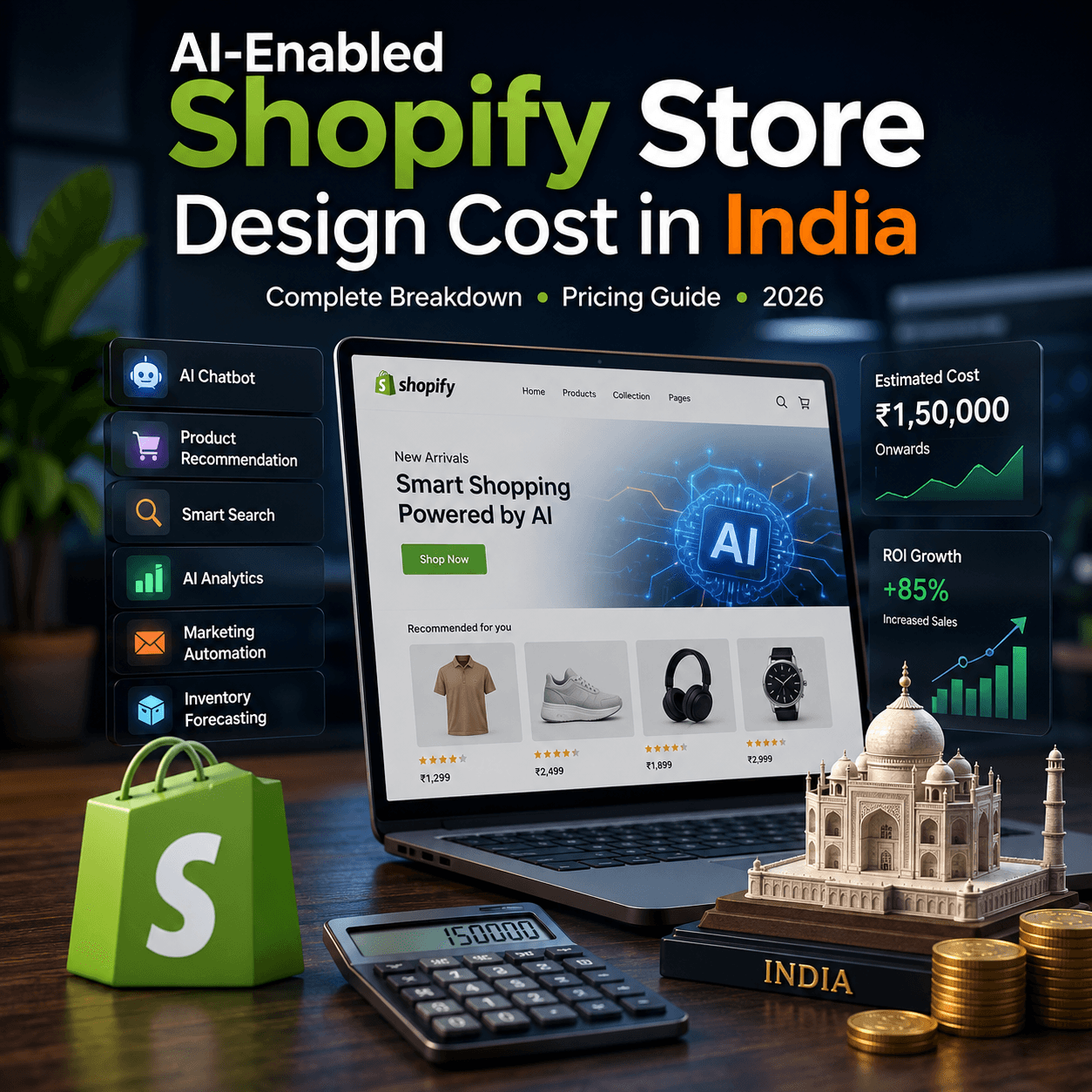
AI-Enabled Shopify Store Design Cost in India: Complete Pricing Breakdown for 2026
Artificial intelligence is no longer a futuristic buzzword — it is the engine actively reshaping global ecommerce. From smart product discovery to automated customer service and predictive inventory management, businesses across the world are integrating AI-powered capabilities into their digital storefronts at an unprecedented pace. In this rapidly evolving landscape, understanding the AI-Enabled Shopify Store Design Cost in India has become a critical planning step for any business serious about building a competitive online presence. Whether you are a startup testing the market or an established enterprise scaling operations, knowing what drives AI development costs helps you plan smarter, invest confidently, and achieve measurable results.
Shopify has grown into one of the world's most trusted ecommerce platforms, and its popularity in India mirrors global adoption trends. For startups, SMEs, D2C brands, and large enterprises, Shopify provides a flexible, scalable foundation that can be enhanced with AI capabilities to dramatically improve store performance. However, integrating these intelligent features meaningfully impacts the overall Shopify website development cost India. When businesses explore AI Shopify development cost India, they quickly discover that the investment scope varies widely based on the complexity of AI tools chosen, the level of customisation required, and the scale of ecommerce operations planned.
This guide provides a comprehensive, no-jargon breakdown of everything you need to know before commissioning an AI-powered Shopify store in India. By the time you finish reading, you will understand the complete pricing structures for different types of Shopify stores, detailed costs associated with individual AI features, hidden expenses that often catch business owners off guard, realistic ROI expectations, and practical advice on selecting the right Shopify development partner to match your budget and business goals. Let us begin.
What Is an AI-Powered Shopify Store?
A traditional Shopify store is an online retail presence built on Shopify's platform — featuring product listings, shopping cart functionality, payment processing, and order management. An AI-powered Shopify store goes significantly further. It layers intelligent systems on top of this foundation, enabling the store to learn from customer behaviour, automate repetitive operations, personalise experiences at scale, and make data-driven decisions without constant manual intervention.
The difference is not merely technical — it is commercial. AI-powered Shopify stores typically report higher conversion rates, stronger customer retention, and improved average order values compared to their traditional counterparts. For Indian businesses competing in an increasingly crowded ecommerce market, these performance advantages translate directly into revenue growth and sustainable competitive positioning.
Key AI Features Used in Modern AI-Powered Shopify Stores
Today's AI-powered Shopify store draws on a rich ecosystem of intelligent tools and capabilities. Here are the most impactful features businesses are deploying in 2026:
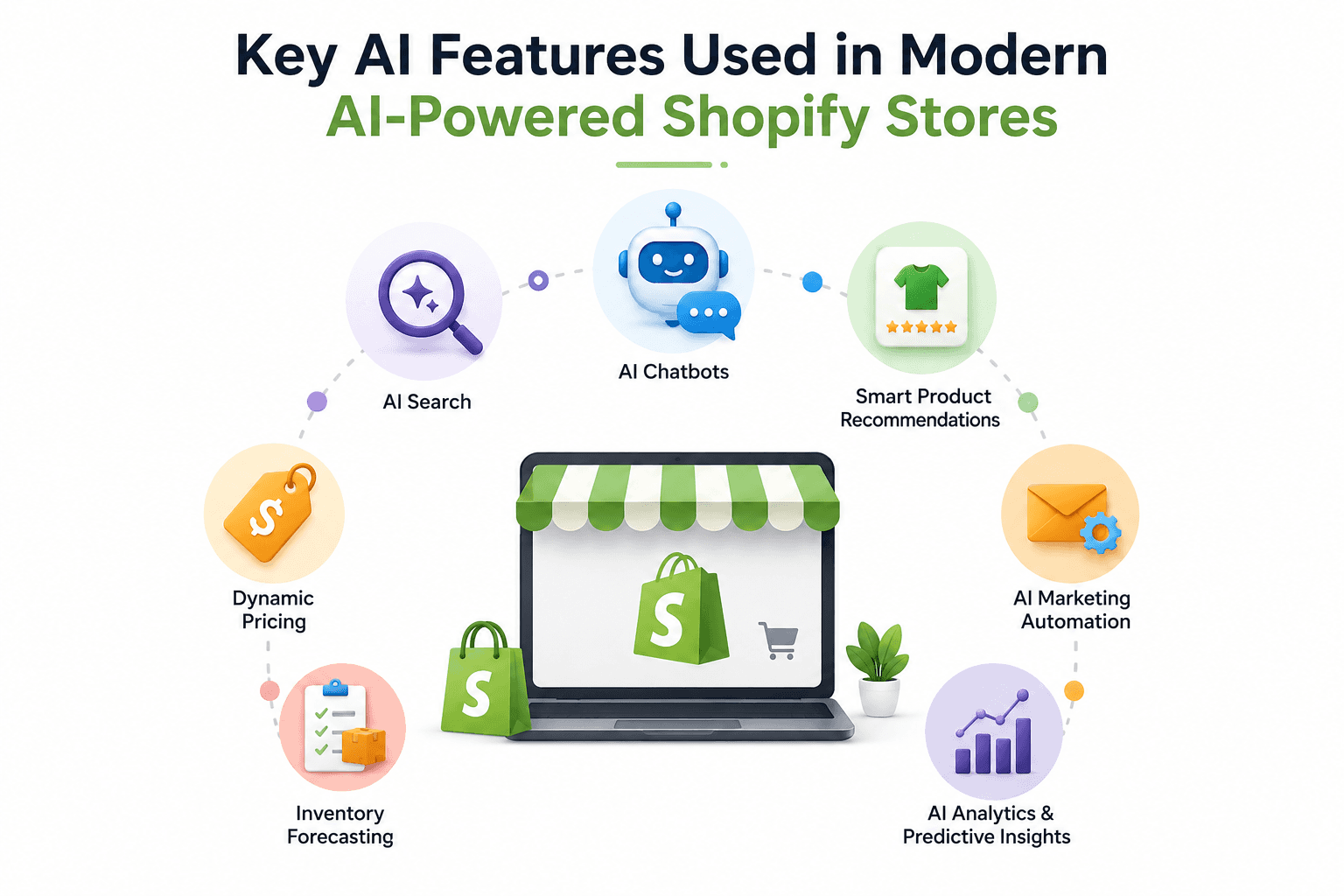
• AI Chatbots: Conversational AI tools that handle customer inquiries, process basic orders, resolve complaints, and qualify sales leads around the clock — reducing support costs while improving response times.
• Smart Product Recommendations: Machine learning algorithms that analyse browsing history, purchase patterns, and session behaviour to suggest the most relevant products to each visitor, significantly boosting upsell and cross-sell revenue.
• AI-Powered Search: Natural language processing (NLP) engines that understand shopper intent, handle misspellings, and deliver semantically relevant results — dramatically reducing search abandonment.
• Dynamic Pricing: AI systems that adjust product prices in real time based on demand signals, competitor pricing, inventory levels, and customer segments.
• Predictive Analytics: Data science tools that forecast sales trends, customer lifetime value, and churn risk — empowering business owners to make informed stock and marketing decisions.
• Automated Marketing: AI platforms that trigger personalised email campaigns, SMS messages, and push notifications based on individual customer behaviour and purchase stage.
• Inventory Forecasting: Machine learning models that predict future stock requirements, helping businesses avoid costly overstock and stockout situations.
• AI Content Generation: Tools that automatically produce product descriptions, SEO metadata, ad copy, and personalised email content — saving content teams significant time.
Why Businesses Are Investing in AI Ecommerce Solutions
The surge in investment in AI ecommerce solutions across India is not happening by accident. Several powerful market forces are driving businesses of all sizes to embrace AI-powered online stores as a strategic priority rather than a technological luxury.
Consumer behaviour has fundamentally shifted. Today's shoppers expect personalised, frictionless buying experiences. They want stores that understand their preferences, remember their past interactions, and surface relevant products without requiring manual browsing. Businesses that fail to meet these expectations lose customers to competitors who do.
Competition in Indian ecommerce has intensified dramatically. With thousands of new online stores launching every month, differentiation through product alone is no longer sufficient. AI-powered experiences — smarter search, personalised recommendations, proactive customer service — create meaningful competitive moats that are difficult and expensive for competitors to replicate quickly.
The return on investment case for ecommerce automation has also become much clearer. Businesses that have deployed AI tools are reporting measurable improvements: conversion rate increases of 15% to 35%, customer service cost reductions of 30% to 50%, and average order value improvements of 20% or more. These numbers make the case for AI investment compelling at virtually every business size.
AI-Enabled Shopify Store Design Cost in India: Major Pricing Factors
The AI-Enabled Shopify Store Design Cost in India is not a fixed number. It is the sum of several interconnected investment categories, each of which varies significantly based on business requirements, chosen features, and the development partner engaged. Understanding these factors individually empowers business owners to make informed budgeting decisions.
Shopify Subscription Costs
Read More : Cost to Create a Shopify Dropshipping Store in 2026
Every Shopify store begins with a platform subscription. Shopify offers four primary plans in 2026:
Plan | Monthly Cost (USD) | Best For |
Basic Shopify | $29/month | New small businesses and solo entrepreneurs |
Shopify (Grow) | $79/month | Growing businesses with more staff and needs |
Advanced Shopify | $299/month | Scaling businesses requiring advanced reporting |
Shopify Plus | From $2,300/month | Enterprise businesses and high-volume merchants |
For AI-intensive operations, Shopify Plus is often the preferred tier because it offers greater API access, customisation flexibility, and dedicated support — all of which are critical when integrating complex AI systems.
Website Design Complexity
Design costs in India range from affordable template customisation to bespoke enterprise UI/UX. Four broad categories define the design investment spectrum:
• Template-Based Store: Minimal customisation of an existing Shopify theme. Cost: INR 15,000 to INR 50,000. Suitable for early-stage businesses testing the market.
• Customised Theme Design: Significant modification of a premium theme to match brand identity. Cost: INR 50,000 to INR 1,50,000. Popular with growing D2C brands.
• Premium UI/UX Design: Fully custom design crafted from wireframes and prototypes, with detailed attention to conversion optimisation. Cost: INR 1,50,000 to INR 4,00,000.
• Enterprise Ecommerce Experiences: Complex, multi-section, multi-language designs for large catalogues and diverse customer bases. Cost: INR 4,00,000 to INR 15,00,000 and above.
Number of Products and Categories
Store size directly impacts development time and cost. A 50-product store requires far less setup than a 5,000-product catalogue. Product migration, taxonomy design, bulk content entry, attribute configuration, and SEO metadata work all scale with catalogue size. Budget an additional INR 500 to INR 2,000 per product for large catalogue stores requiring individual product optimisation.
Custom Shopify Development Requirements
Custom Shopify development is where project costs can vary most dramatically. Standard Shopify themes cover common ecommerce use cases, but businesses with unique workflows, proprietary loyalty systems, specialised checkout processes, or complex product configurations require custom development. This encompasses custom Liquid theme code, custom Shopify apps, API integrations with ERP systems, CRM platforms, and warehouse management tools. Custom Shopify development in India typically costs INR 80,000 to INR 5,00,000 depending on scope and complexity.
AI Feature Requirements
The AI features chosen have the largest individual impact on total project cost. A basic AI chatbot integration costs significantly less than building a proprietary recommendation engine trained on your specific customer data. Businesses must be realistic about which AI capabilities will deliver the greatest ROI for their specific context. The following section breaks down individual AI feature costs in detail.
Cost Breakdown of Popular AI Features in Shopify Stores
Shopify Chatbot Integration Cost
Shopify chatbot integration is typically the first AI investment businesses make because it delivers immediate, visible returns through 24/7 customer support automation, sales assistance, and lead capture. In India, chatbot integration costs fall into three tiers:
• Basic Rule-Based Chatbot (using platforms like Tidio or Freshchat): INR 20,000 to INR 60,000 setup cost, plus SaaS subscription fees of INR 2,000 to INR 8,000 per month.
• AI-Powered Conversational Chatbot (NLP-based, trained on your product data): INR 80,000 to INR 2,50,000 for custom development and training.
• Enterprise Conversational AI (multi-language, omnichannel, integrated with CRM and order management): INR 2,50,000 to INR 8,00,000 and above.
A well-implemented chatbot typically reduces customer support ticket volumes by 40% to 60%, delivering fast payback on the initial investment.
AI Product Recommendation Engine Cost
The AI product recommendation engine is arguably the highest-ROI AI investment available to ecommerce businesses. By surfacing the right products to the right customers at the right moment — through homepage carousels, product page suggestions, cart upsells, and post-purchase email — recommendation engines directly increase average order value and repeat purchase frequency.
• Third-Party Recommendation Apps (Shopify App Store tools like Frequently Bought Together, Personalised Recommendations): INR 3,000 to INR 15,000 per month subscription.
• Mid-Tier AI Recommendation Integration (tools like Nosto or Barilliance): INR 40,000 to INR 1,00,000 setup, plus monthly fees.
• Custom ML Recommendation Engine (trained on your own customer data, integrated directly into Shopify): INR 3,00,000 to INR 12,00,000 for development and deployment.
Businesses with large product catalogues and repeat customer bases see the strongest returns from custom recommendation engines, typically reporting 15% to 30% increases in average order value within six months.
AI Search and Smart Navigation Cost
Standard Shopify search is basic and unforgiving of customer typos or natural language queries. AI-powered search dramatically improves product discovery by understanding shopper intent. Solutions range from Shopify-native AI search tools (included in some plans) to enterprise-grade semantic search engines. Integration costs in India: INR 25,000 to INR 1,50,000 depending on the solution chosen and degree of customisation required. Premium tools like SearchPie, Boost Commerce, or custom Elasticsearch implementations sit at the higher end.
AI Marketing Automation Cost
AI marketing automation connects customer behaviour signals — browsing patterns, abandoned carts, purchase history, email engagement — to personalised, triggered communications that drive conversion and retention. Platforms like Klaviyo, Omnisend, and Drip offer varying levels of AI automation capability. Setup and integration costs in India range from INR 30,000 to INR 2,00,000, with ongoing platform subscription fees of INR 5,000 to INR 50,000 per month depending on contact list size and feature requirements.
AI Analytics and Business Intelligence Cost
Advanced analytics platforms powered by AI give business owners deep visibility into customer behaviour, revenue trends, product performance, and marketing attribution. Google Analytics 4 with enhanced ecommerce tracking is a cost-effective starting point, but businesses seeking actionable AI-driven insights typically invest in tools like Triple Whale, Glew, or custom Power BI dashboards. Implementation costs in India: INR 40,000 to INR 3,00,000, depending on data volume, integration complexity, and reporting requirements.
Inventory Forecasting and Supply Chain Automation Cost
For businesses managing complex inventory across multiple warehouses or suppliers, AI-powered demand forecasting can dramatically reduce working capital tied up in excess stock while preventing costly stockouts. Tools range from Shopify-native inventory apps to enterprise solutions integrated with ERP systems. Development and integration costs in India: INR 1,00,000 to INR 6,00,000 depending on the complexity of the supply chain and degree of automation required.
Shopify Website Design Cost in India (2026)
To provide a clear reference for budgeting, here is a consolidated view of Shopify website design pricing across store tiers, reflecting current Indian market rates in 2026. These figures represent total project investment inclusive of design and front-end development but exclusive of AI features and ongoing maintenance.
Read More : Top 10 AI-Powered Ecommerce Development Companies 2026
Store Type | Estimated Cost (INR) | Timeline | Ideal For |
Basic Ecommerce Store | INR 25,000 – INR 75,000 | 2–4 weeks | Solo entrepreneurs, small retailers, early-stage startups |
Professional Shopify Store | INR 75,000 – INR 2,50,000 | 4–8 weeks | Growing D2C brands, SME retailers with 100–500 products |
Advanced Ecommerce Website | INR 2,50,000 – INR 7,00,000 | 8–16 weeks | Established brands, multi-category retailers, custom functionality |
Enterprise Shopify Platform | INR 7,00,000 – INR 25,00,000+ | 16–32 weeks | Enterprise businesses, Shopify Plus deployments, multi-market stores |
These ranges reflect the Indian market's competitive development landscape and assume professional development teams with Shopify expertise. Freelancer rates will typically fall 30% to 50% below agency pricing, though with corresponding trade-offs in project management, quality assurance, and ongoing support.
Shopify Website Development Cost India: Complete Breakdown
Beyond design, the Shopify website development cost India encompasses a range of technical components that together determine the full investment required to launch and operate a professional store.
Frontend Development
Frontend development covers the customer-facing layer of the store — theme customisation, responsive layouts, interactive UI elements, page speed optimisation, and accessibility compliance. Cost range in India: INR 30,000 to INR 3,00,000 depending on design complexity and number of custom sections required.
Backend Development
Backend development includes custom Shopify apps, server-side logic, database design for custom data storage, and webhook implementations. For AI-enabled stores, backend complexity increases significantly due to API connections with AI platforms, data pipelines, and real-time processing requirements. Cost: INR 50,000 to INR 5,00,000.
Shopify App Integrations
Most Shopify stores require integration with third-party tools — accounting software, shipping platforms, CRM systems, ERP solutions, customer feedback tools, and review management platforms. Each integration carries both setup cost (INR 5,000 to INR 50,000 per integration) and ongoing subscription fees.
Payment Gateway Setup
India's ecommerce market demands support for multiple payment methods — UPI, net banking, cards, wallets, and buy-now-pay-later options. Setting up and testing payment gateways including Razorpay, PayU, and international options like Stripe typically costs INR 15,000 to INR 40,000.
Security Configuration
SSL certification, PCI-DSS compliance configuration, fraud detection setup, and data privacy compliance (PDPB in India) are non-negotiable for ecommerce operations. Budget INR 10,000 to INR 50,000 for initial security configuration, with ongoing monitoring costs beyond that.
Performance Optimisation
Page load speed directly impacts both conversion rates and search rankings. Performance optimisation — including image compression, lazy loading, CDN configuration, code minification, and Core Web Vitals compliance — typically adds INR 20,000 to INR 80,000 to the project budget.
Mobile Responsiveness
With over 70% of Indian ecommerce traffic coming from mobile devices, mobile-first design and rigorous cross-device testing are essential. Professional mobile optimisation adds INR 15,000 to INR 60,000 to development costs, though many agencies include this within their base development pricing.
Traditional Shopify Store vs AI-Powered Shopify Store
To understand the value proposition of AI investment, this comparison illustrates the key differences between traditional and AI-powered Shopify implementations:
Feature | Traditional Shopify Store | AI-Powered Shopify Store |
Initial Investment | INR 25,000 – INR 5,00,000 | INR 1,50,000 – INR 25,00,000+ |
Monthly Maintenance | INR 5,000 – INR 25,000 | INR 20,000 – INR 1,00,000+ |
Automation Level | Low (primarily manual) | High (AI-driven automation) |
Customer Experience | Standard, generic | Personalised, adaptive |
Conversion Rates | Avg. 1.5% – 2.5% | Avg. 2.5% – 4.5% (with AI) |
Customer Service | Manual support teams | AI chatbots + human escalation |
Product Discovery | Basic search and filters | AI search + smart recommendations |
Marketing | Manual campaigns | Behavioural automation |
Inventory Management | Manual forecasting | AI demand prediction |
Scalability | Moderate | High (AI scales with traffic) |
ROI Potential | Standard | Significantly higher long-term |
Hidden Costs of AI Shopify Development
One of the most common planning mistakes businesses make is underestimating the total cost of ownership for an AI-powered Shopify store. Beyond the initial development investment, several recurring and one-time costs must be factored into the annual budget.
AI Software Licensing
Many AI tools operate on subscription models with costs that scale based on usage volume, number of users, or data processed. Annual licensing costs for AI platforms can range from INR 50,000 to INR 10,00,000 or more for enterprise-grade solutions. Always request full pricing details for scale-up scenarios before committing to a platform.
Shopify App Subscription Fees
The Shopify App Store offers thousands of tools that enhance store functionality, many of which are subscription-based. A typical AI-enabled store may rely on 8 to 15 paid apps simultaneously, with combined monthly subscription costs ranging from INR 15,000 to INR 80,000.
API Consumption Charges
AI features that rely on external API calls — for language processing, image recognition, or predictive analytics — generate consumption-based costs that grow with store traffic and order volume. These charges can be difficult to predict in advance and should be modelled carefully against projected traffic scenarios.
Maintenance Costs
Shopify maintenance cost is an often-overlooked budget line. Platforms update, apps evolve, and AI models require retraining as customer behaviour patterns shift. Professional Shopify maintenance in India typically costs INR 10,000 to INR 50,000 per month depending on store complexity and the level of support required.
Cloud Infrastructure Expenses
Custom AI models — particularly recommendation engines and predictive analytics systems built on proprietary data — require cloud computing infrastructure for training, deployment, and serving. AWS, Google Cloud, or Azure infrastructure costs for AI workloads can range from INR 5,000 to INR 1,00,000 per month depending on computational requirements.
Technical Support Costs
AI systems occasionally produce unexpected outputs, and integrations between platforms can break during updates. Retaining a technical support team or engaging a dedicated managed services provider adds INR 15,000 to INR 75,000 to monthly operating costs.
Security and Compliance Costs
As AI stores handle increasing volumes of customer data, security and regulatory compliance become ongoing investments. Data security audits, PDPB compliance assessments, and security incident response capabilities should be budgeted annually at INR 30,000 to INR 2,00,000.
Benefits of Investing in an AI-Powered Ecommerce Website
Understanding the costs of an AI-powered ecommerce website is important, but so is understanding the business value that justifies the investment. Here are the measurable benefits that make AI-powered Shopify stores a compelling proposition in 2026.
Improved Customer Experience
AI creates genuinely personalised shopping experiences. Customers see products relevant to their tastes, receive timely support, and encounter a store that seems to understand their needs. This quality of experience builds brand loyalty and drives organic word-of-mouth growth.
Higher Conversion Rates
Every AI feature — better search, smarter recommendations, proactive chatbot assistance, personalised pricing — directly reduces friction in the purchase journey. Businesses consistently report conversion rate improvements of 30% to 80% after implementing comprehensive AI capabilities.
Better Customer Retention
AI-driven loyalty programs, personalised retention campaigns, and predictive churn intervention tools help businesses keep customers coming back. Improving customer retention by just 5% can increase profits by 25% to 95%, according to well-established ecommerce research.
Increased Average Order Value
AI recommendation engines and dynamic bundling tools reliably increase average order values by 15% to 35%. When a customer adding a running shoe to their cart sees perfectly matched socks, water bottles, and fitness trackers — curated by AI based on their profile — supplementary purchases become the natural choice.
Reduced Operational Costs
Ecommerce automation powered by AI eliminates manual work across customer service, inventory management, order processing, and marketing operations. Businesses typically reduce operational headcount requirements by 20% to 40% after full AI implementation, freeing resources for higher-value strategic work.
Faster Business Growth
AI-powered Shopify stores scale more efficiently than manually operated competitors. As order volumes grow, AI systems handle increased complexity without proportional increases in staffing or operational costs — creating a powerful flywheel effect that compounds growth over time.
How to Choose the Best Shopify Development Company in India
Selecting the right Shopify development company India or Shopify website design company India is one of the most important decisions you will make for your ecommerce project. The wrong partner can cost you time, money, and market momentum. Here is what to evaluate carefully.
Industry Experience
A development partner with experience in your specific industry understands the nuances of your customer base, competitive landscape, and operational requirements. Ask for examples of projects in sectors similar to yours and enquire about the business outcomes those clients achieved.
Shopify Expertise
Verify that the team holds official Shopify Partner or Shopify Expert status. Examine their portfolio for evidence of advanced Shopify capabilities — custom app development, Shopify Plus deployments, headless commerce implementations, and complex integration projects.
AI Development Capabilities
AI integration is a specialist skill distinct from standard Shopify development. Request specific evidence of previous AI implementations — recommendation engines built, chatbots deployed, analytics platforms integrated. Ask to speak with references from AI projects specifically, not just general ecommerce builds.
Portfolio Evaluation
A strong portfolio demonstrates range, quality, and relevance. Look for diversity of store types, evidence of conversion-focused design thinking, and stores that have scaled successfully since launch. Be cautious of portfolios heavy in static design screenshots without evidence of live, performing stores.
Client Testimonials
Authentic client reviews on Google, Clutch, or industry directories provide independent validation of a development company's claims. Pay particular attention to testimonials that mention project timelines, communication quality, post-launch support, and actual business performance improvements.
Technical Support
Your store will need ongoing support after launch — platform updates, feature additions, bug fixes, and performance tuning. Confirm that your chosen partner offers structured post-launch support packages and has the team capacity to respond to urgent issues within agreed timeframes.
Pricing Transparency
Reputable Shopify website design company India partners provide detailed, itemised project proposals. Be wary of vague scope-of-work documents or partners who resist breaking down their pricing. Hidden costs are most likely to arise when project scope is inadequately documented at the outset.
Why Businesses Prefer AI-Focused Shopify Development Partners
The difference between a generalist Shopify developer and an AI-focused Shopify development partner is not just technical — it is strategic. AI-focused partners bring several specific advantages that justify their typically higher project fees.
• Better AI Implementation: Specialists who work exclusively with AI tools understand which solutions genuinely deliver ROI versus which are overhyped. They will guide you toward investments with proven returns rather than expensive experiments.
• Faster Deployment: Experienced AI development teams have pre-built frameworks, tested integration architectures, and trained ML pipelines that dramatically reduce time to market compared to teams learning AI on your project.
• Long-Term Scalability: AI systems need to grow with your business. Partners with deep AI experience design architectures that scale gracefully as your data volumes, product catalogues, and customer bases expand.
• Lower Operational Costs: Properly implemented AI automation reduces your ongoing operational expenses. A skilled AI partner designs these cost savings into the system architecture from day one.
• Competitive Advantages: Early AI adopters in Indian ecommerce are building data advantages that compound over time. The more customer data your AI systems process, the smarter and more accurate they become — creating a moat that late adopters will struggle to close.
Future of AI in Shopify Ecommerce
The AI capabilities available to Shopify merchants in 2026 are impressive — but they represent only the beginning of what is possible. Several emerging technologies are set to reshape ecommerce experiences and cost structures significantly over the next three to five years.
Generative AI Shopping Assistants
Large language model-powered shopping assistants will evolve beyond scripted chatbots into genuinely intelligent retail advisors capable of understanding complex requirements, making nuanced product recommendations, and handling sophisticated pre-sales conversations. Shopify AI integration services that connect these tools to product catalogues and customer data will become a standard investment for competitive retailers.
Voice Commerce
Smart speaker adoption in India is growing steadily, and voice-optimised shopping experiences are beginning to gain traction. Shopify stores that build voice search compatibility and voice-activated purchasing flows will be well positioned as this channel matures.
Visual Search Technology
Visual search allows customers to photograph a product and find it — or similar items — in a store's catalogue instantly. As image recognition costs decrease and accuracy improves, visual search will become a standard feature of fashion, furniture, and lifestyle ecommerce stores.
Predictive Commerce
The most advanced AI implementations will move beyond responding to customer behaviour toward anticipating it. Predictive commerce systems will proactively present offers, replenishment reminders, and product recommendations at the precise moment a customer is most likely to purchase — even before they initiate a shopping session.
Hyper-Personalisation
Personalisation will evolve from segment-based to genuinely individual. Every customer will experience a version of the store specifically optimised for their preferences, price sensitivity, browsing habits, and life stage — making the concept of a single storefront experience obsolete.
Autonomous Ecommerce Operations
AI systems will increasingly manage inventory replenishment, dynamic pricing, customer reactivation campaigns, and supplier negotiations with minimal human oversight — allowing lean teams to operate stores at enterprise scale.
Frequently Asked Questions
1. What is the average cost of an AI-enabled Shopify store in India?
The average cost ranges from INR 1,50,000 for a basic AI-integrated store to INR 25,00,000 or more for a fully custom enterprise AI Shopify platform. The specific investment depends on store complexity, number of AI features, and the development partner engaged.
2. How long does it take to build an AI-powered Shopify store?
A professional AI-powered Shopify store typically takes 8 to 24 weeks to design, develop, integrate AI features, test, and launch. Enterprise implementations with extensive custom development can take 6 to 12 months.
3. Is Shopify Plus required for AI integrations?
Not always. Many AI tools work with standard Shopify plans. However, Shopify Plus provides greater API access, customisation flexibility, and dedicated support that becomes important for sophisticated AI implementations. Businesses planning advanced AI capabilities often find Plus worth the investment.
4. What AI features deliver the fastest ROI for Shopify stores?
AI chatbots and product recommendation engines consistently deliver the fastest returns, with most businesses recovering their investment within 3 to 6 months through reduced support costs and increased average order values respectively.
5. Can small businesses afford AI-powered Shopify stores?
Yes. Entry-level AI capabilities — including basic chatbots, SaaS-based recommendation tools, and email automation — are accessible at investment levels starting from INR 50,000 to INR 1,50,000, making AI adoption viable for well-funded small businesses and growing D2C brands.
6. How much does ongoing Shopify maintenance cost in India?
Professional Shopify maintenance services in India cost between INR 10,000 and INR 50,000 per month depending on store size, AI feature complexity, and the level of proactive support included in the service agreement.
7. What is the difference between a Shopify Partner and a Shopify Expert?
Shopify Partners are agencies and developers who have registered in Shopify's official partner program and have access to development stores and partner-level tools. Shopify Experts are a curated subset of Partners who have been vetted by Shopify for demonstrated expertise and client success — a stronger quality signal when selecting a development partner.
8. Should I use a freelancer or a development agency for my AI Shopify store?
For AI-enabled Shopify stores, a specialist development agency is generally the safer choice. AI implementation requires a team with diverse skills spanning machine learning, backend engineering, Shopify theme development, and UX design. Freelancers can excel at individual components but rarely bring all required capabilities under one umbrella.
9. How important is data quality for AI features to work effectively?
Data quality is foundational to AI performance. Recommendation engines and predictive analytics systems are only as accurate as the customer and product data they learn from. Businesses with clean, structured, historical data will see faster and stronger AI performance than those starting from poor data foundations.
10. How do I know if an AI feature is worth the investment for my specific store?
Request case studies from your development partner showing results achieved for stores similar in size, category, and customer profile to yours. Reputable AI-focused Shopify development partners will be transparent about realistic performance expectations rather than making sweeping promises.
Conclusion
Artificial intelligence has moved from the periphery to the core of successful ecommerce strategy. Businesses that embrace AI-powered Shopify stores are not simply adopting a technological trend — they are building structural advantages in customer experience, operational efficiency, and revenue performance that compound meaningfully over time. The question for Indian businesses in 2026 is no longer whether to invest in AI ecommerce capabilities, but how to invest strategically to maximise returns at each stage of business growth.
Shopify remains one of the world's leading ecommerce platforms precisely because it provides the flexibility and ecosystem depth needed to support both foundational retail operations and sophisticated AI capabilities. Its combination of ease of use, powerful API architecture, extensive app ecosystem, and enterprise-grade Shopify Plus tier makes it an ideal foundation for businesses building AI-powered digital commerce experiences at any scale.
The AI-Enabled Shopify Store Design Cost in India varies significantly based on the specific combination of design complexity, AI feature requirements, catalogue size, and integration scope chosen. As this guide has demonstrated, investment ranges from INR 1,50,000 for a well-implemented entry-level AI Shopify store to INR 25,00,000 or more for enterprise-grade custom platforms. Understanding the AI Shopify development cost India in detail — including the AI feature components, Shopify website development cost India components, and hidden operational costs — empowers business owners to budget accurately and evaluate development proposals with confidence.
The businesses that will lead Indian ecommerce in the next five years are making their AI investments today. With the right development partner, a clearly scoped project brief, and a realistic understanding of both costs and expected returns, the path to a high-performing AI-powered Shopify store is well within reach for businesses across every size and sector. We encourage you to take the next step: consult with a professional Shopify and AI development company to receive a tailored project estimate aligned to your specific business goals, product catalogue, target audience, and growth ambitions. The investment you make today will determine the competitive position you hold tomorrow.
Ready to Build Your AI-Powered Shopify Store?
Connect with our expert Shopify and AI development team today for a free consultation and customised project estimate tailored to your business goals.