
Top 10 Website Builders for Small Business in 2026
Posted on
Web Design
Posted at
Top 10 Website Builders for Small Business in 2026
Author: Senior Web Development Team @ VNA Infotech
Last Verified: January 21, 2026
Industry Vertical: Enterprise Resource Planning (ERP) | SaaS Architecture | Digital Transformation
Focus Keywords: website builders for small business, website creator for small business, small business website, website designers for small business, free website creator for small business
Estimated Reading Time: 18 Minutes (Deep Dive)
Is your small business invisible? In 2026, if you don't have a website—or if your website takes more than 3 seconds to load—you might as well be.
The digital landscape has shifted aggressively. With 73% of small businesses now operating fully functional websites and 81% of shoppers conducting research online before buying, the "nice-to-have" era is over. A website is your 24/7 salesperson, your brand ambassador, and your primary growth engine.
But here is the challenge: The market is flooded with tools. From AI-powered generators to complex CMS platforms, finding the best website builder for small business in 2026 can feel like navigating a minefield. Do you need the drag-and-drop simplicity of Wix? The e-commerce power of Shopify? Or the custom, search-engine-dominating performance of a partner like VNA Infotech?
This guide cuts through the noise. We have tested, compared, and ranked the top 10 solutions to help you build a SEO-friendly website that doesn't just look good—it converts.
Why Choosing the Right Website Builder Matters in 2026
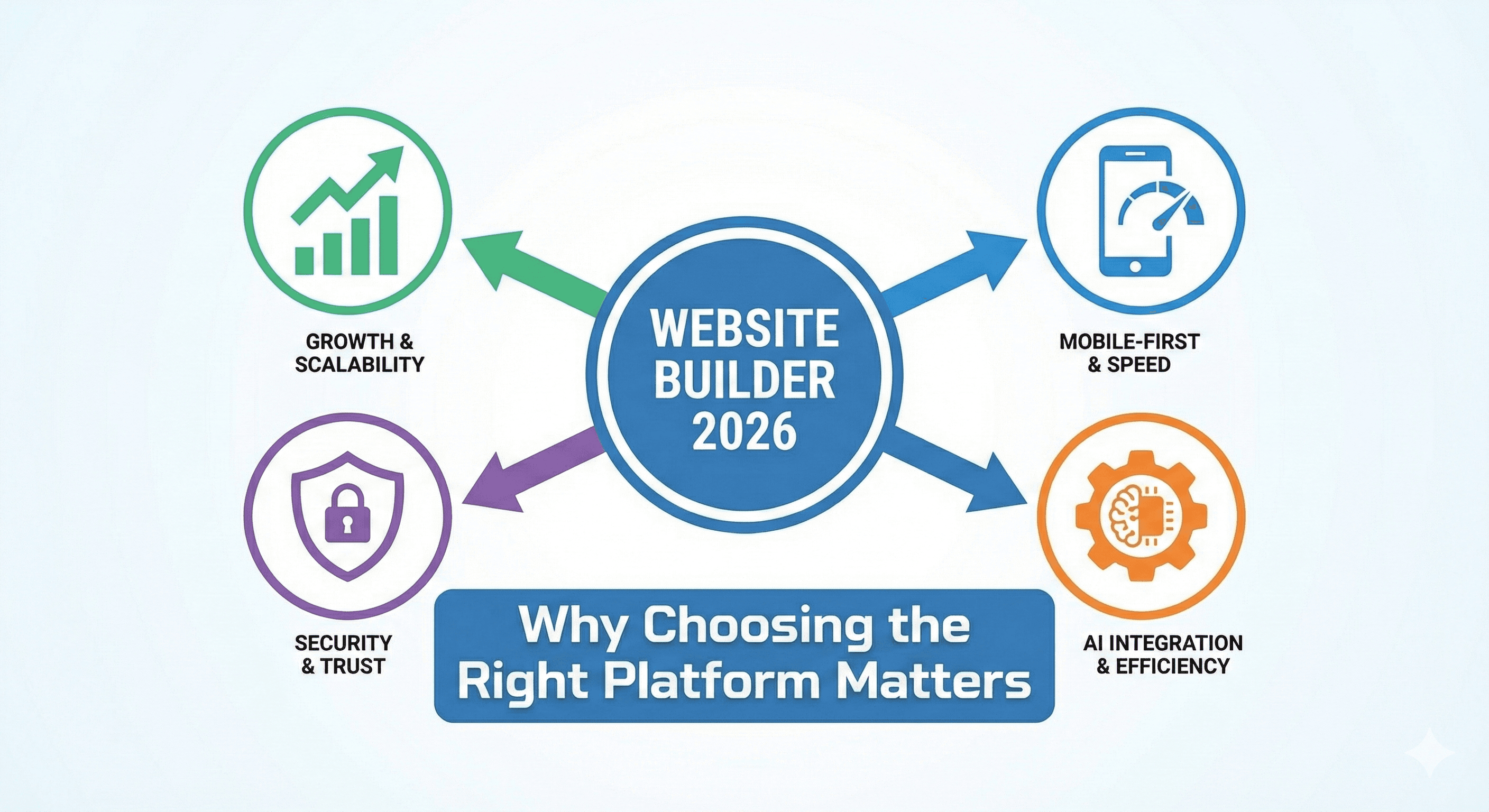
In 2026, a website builder is no longer just a tool to put text and images on a screen. It is the infrastructure of your business. The wrong choice can lead to slow load times, security vulnerabilities, and a "digital ceiling" that stops you from growing.
Here is what matters most this year:
1. Mobile-First and Core Web Vitals
Google’s "Core Web Vitals" are now a mature ranking factor. In 2026, mobile-first indexing is the default. If your builder creates code-bloat that slows down your site on a 5G smartphone, your rankings will plummet. The best builders now automatically optimize images and scripts to ensure you pass these vitals without coding.
2. AI-Assisted Web Design
Artificial Intelligence has moved from a gimmick to a necessity. The top website creators for small business now use AI to:
Auto-generate SEO-optimized copy.
Suggest layouts based on user behavior data.
Create dynamic personalized experiences for visitors (e.g., showing different banners to returning customers).
3. SEO and Schema Integration
A pretty site that no one sees is useless. SEO-friendly website builders in 2026 must go beyond basic meta tags. They need to support Schema markup (so Google understands your reviews, products, and FAQs) and clean URL structures.
4. Security & Compliance
With cyberattacks on small businesses rising by 43% in recent years, security is non-negotiable. Your platform must provide automated SSL certificates, GDPR/CCPA compliance tools, and regular backups.
5. Scalability vs. Customization
Most DIY builders have a ceiling. You might start with a template, but what happens when you need a custom CRM integration or a unique checkout flow? This is where the debate between DIY builders (like Wix) and Custom Services (like VNA Infotech) becomes critical.
Expert Insight: "The biggest mistake small businesses make is choosing a platform for where they are today, not where they will be in two years. Migration is costly; choosing scalable infrastructure from day one is free."
Comparison Table — Top 10 Website Builders (At a Glance)
Below is a quick comparison of the top platforms and services available in 2026.
Website Builder | Best For | Pricing (Monthly Est.) | E-Commerce | SEO Features | Ease of Use | Overall Score |
VNA Infotech | Professional Custom Growth | Custom / Quote | Unlimited | Expert Optimization | Done-For-You | 9.8/10 |
Wix | All-round DIY | $17 - $159 | Good | Good | Very Easy | 9.2/10 |
Shopify | E-commerce Stores | $39 - $399 | Excellent | Strong | Moderate | 9.0/10 |
Squarespace | Visual/Creative Brands | $16 - $65 | Good | Moderate | Easy | 8.8/10 |
WordPress + Elementor | Content & Scalability | Free + Hosting ($10+) | Excellent (Woo) | Expert | Hard Learning Curve | 8.7/10 |
Webflow | Designers & Custom Control | $14 - $39 | Moderate | Strong | Hard | 8.5/10 |
BigCommerce | Large Retailers | $29 - $299 | Excellent | Strong | Moderate | 8.3/10 |
Zyro (Hostinger) | Budget & AI Tools | $3 - $15 | Basic | Basic | Easy | 8.0/10 |
GoDaddy | Speed & Simplicity | $10 - $30 | Basic | Weak | Very Easy | 7.8/10 |
Weebly | Absolute Beginners | $10 - $26 | Basic | Basic | Very Easy | 7.5/10 |
VNA Infotech — Best for Custom Professional Growth
Best For: Small businesses that want a "Done-For-You," high-performance website without the DIY headache.
Overview: Unlike the DIY tools above, VNA Infotech offers custom website development services. They don't just give you a tool; they build the house for you. Based in Ahmedabad but serving clients globally, they specialize in CMS, Headless architecture, and SEO-first design.
Key Features: Custom UI/UX design, mobile-first development, integrated digital marketing strategy, and ongoing maintenance.
SEO: Superior. Because the site is custom-built, VNA Infotech ensures 100/100 Core Web Vitals scores and perfect technical SEO implementation from day one.
Pros: No learning curve (they do it all); unique design (no templates); enterprise-grade security; scalable as you grow.
Cons: Higher upfront investment than a $17/month DIY plan (but higher ROI).
Verdict: The best choice if you treat your website as a serious business asset, not a DIY project.
Squarespace — Best for Visual Brands
Best For: Photographers, restaurants, and portfolios.
Overview: Squarespace is the "Apple" of website builders—sleek, curated, and impossible to make ugly. In 2026, they have added "Blueprint AI" to help structure your site faster.
Key Features: Award-winning designs, built-in scheduling tools, podcast hosting.
SEO: Clean code, but less customizable metadata than WordPress.
Pros: Stunning aesthetics; all-in-one platform (no plugin mess).
Cons: Editor is section-based (not full drag-and-drop); e-commerce is weaker than Shopify.
Verdict: Perfect if your brand image is your https://www.google.com/search?q=%231 selling point.
Shopify — Best for E-Commerce
Best For: Businesses where selling products is the primary goal.
Overview: If you are building a store, Shopify is the undisputed king. It powers millions of businesses and integrates with every sales channel (Instagram, Amazon, TikTok).
Key Features: Inventory management, abandoned cart recovery, massive app ecosystem.
SEO: Strong for products, but blogging features are weaker than WordPress.
Pros: Scales infinitely; handles taxes/shipping easily.
Cons: Expensive (monthly fees + app costs + transaction fees).
Verdict: The gold standard for selling online.
WordPress + Elementor — Best for Scalability
Best For: Content-heavy sites and businesses planning aggressive SEO strategies.
Overview: Powering over 62% of the CMS market, WordPress gives you ownership. Paired with a builder like Elementor, it becomes visual.
Key Features: Infinite plugins (Yoast, WooCommerce), total code control.
SEO: The best platform for SEO, period—if you know how to configure it.
Pros: You own your data; cheapest entry point (just hosting).
Cons: You are responsible for security, updates, and backups. High learning curve.
Verdict: For the serious business owner willing to learn or hire help.
Webflow — Best for Design Freedom
Best For: Startups and agencies who want a custom look without writing code.
Overview: Webflow sits between a builder and coding. It generates clean, exportable HTML/CSS.
Key Features: "Interactions" for complex animations; fast hosting.
SEO: excellent control over on-page elements.
Pros: Cleanest code of any builder; highly professional look.
Cons: Steep learning curve; e-commerce is limited.
Verdict: High power, high complexity.
GoDaddy Website Builder — Best for Speed
Best For: Service businesses that need a site up today.
Overview: GoDaddy prioritizes speed of creation over design flexibility.
Key Features: "GoDaddy Airo" AI builder; integrated appointment booking.
Pros: extremely fast setup; integrated marketing tools (email/social).
Cons: Very limited customization; SEO features are weak; difficult to move away from.
Verdict: Good for a quick brochure site, bad for growth.
Framer — Best for Designers & Visual Brands
Best For: Creative agencies, startups, and designers who want "Figma-like" freedom without code.
Overview: Framer has exploded in popularity in 2026, transitioning from a prototyping tool to a powerhouse website builder. If you can design it, you can build it. Unlike grid-based builders (like Squarespace), Framer offers a free-form canvas that lets you place elements anywhere, making it the top choice for high-end, custom-looking sites that need to stand out.
Key Features: "Wireframer" AI layout generator, advanced scroll animations/effects, and zero-code CMS for blogs/portfolios.
Pros: Unmatched design control; generates extremely clean, fast-loading code; huge library of community templates.
Cons: Steeper learning curve for non-designers; e-commerce features are basic compared to Shopify.
Verdict: The ultimate tool for visually stunning sites that don't need complex backend logic.
Weebly — Best for Beginners
Best For: Simple brick-and-mortar stores.
Overview: owned by Square, Weebly is solid for simple e-commerce but has seen few updates recently.
Key Features: Square payment integration is seamless.
Pros: Very easy to learn.
Cons: Dated designs; limited SEO control.
Verdict: Reliable but aging.
BigCommerce — Best for Large E-Commerce
Best For: High-volume sellers who dislike Shopify’s transaction fees.
Overview: A robust e-commerce engine that includes more native features than Shopify.
Key Features: Multi-currency support; 0% transaction fees.
Pros: Powerful out of the box.
Cons: Small community compared to Shopify; complex editor.
Verdict: A heavy-hitter for big inventories.
Wix — The Best All-Rounder
Best For: Small business owners who want creative control without coding.
Overview: Wix remains the market leader for DIYers in 2026. Its "Wix Studio" update has improved responsiveness, allowing elements to scale perfectly across devices.
Key Features: 900+ templates, heavy AI integration (text/image generation), and a massive App Market.
SEO: Great for basics, though the code can sometimes be heavy for Core Web Vitals.
Pros: True drag-and-drop freedom; massive support community.
Cons: Once you choose a template, it’s hard to switch; transaction fees on lower plans.
Verdict: The safe bet for general small businesses.
In-Depth Feature Comparison
Feature | Wix | Shopify | WordPress | VNA Infotech (Custom) |
Mobile-Friendly | ✔ | ✔ | ✔ | ✔ (Native Optimization) |
SEO Tools | Good | Strong | Expert | Full Service Strategy |
Design Freedom | High | Medium | High | Unlimited |
AI Integration | High | High | Via Plugins | Strategic Implementation |
Support | Ticket/Chat | 24/7 | Community | Dedicated Expert Team |
Maintenance | Auto | Auto | Manual | Managed |
How to Choose the Right Website Builder
Selecting a website creator for small business isn't just about price. It is about matching the tool to your business model.
Define Your Goal
Service Business (Plumber, Lawyer): You need lead generation forms and booking capabilities. VNA Infotech or Wix are ideal.
E-Commerce (Clothing, Digital Goods): You need cart functionality. Shopify is the winner.
Content/Blog (News, Affiliate): You need traffic. WordPress is best.
The "Hidden" Costs of DIY
Many small business owners choose a DIY builder to save money, only to find themselves spending 40+ hours learning design, debugging mobile views, and fighting with SEO settings.
Ask yourself: Is your time worth more than $50/hour? If so, hiring a partner like VNA Infotech is often cheaper than building it yourself.
Scalability Check
Can the platform handle 100 products? 10,000 visitors a day?
DIY limits: Platforms like GoDaddy or Weebly often crash or slow down under load.
Custom benefits: A solution built by VNA Infotech is designed to scale on robust architecture (like Headless CMS) that handles growth effortlessly.
Self-Assessment Checklist
[ ] Do I need to sell products online?
[ ] Do I have 20+ hours to dedicate to building this site?
[ ] Is ranking https://www.google.com/search?q=%231 on Google a critical financial goal?
[ ] Do I need a unique design, or is a template okay?
If you answered "No" to having time and "Yes" to ranking/unique design, you need a custom service, not a builder.
SEO & Website Trends for Small Business in 2026
To compete this year, your website must adhere to these cutting-edge trends:
Core Web Vitals & "Interaction to Next Paint" (INP)
Google now measures how quickly your site reacts to a click. Slow builders fail this test. Custom-optimized sites excel here, offering buttery-smooth navigation that keeps users happy.
Voice Search & Semantic SEO
People are searching with their voices: "Hey Google, find a plumber near me who is open now."
Your site needs Schema Markup to answer these questions. While Wix/Squarespace have basic schema, custom developers can implement "Local Business" schema that dominates local search results.
Progressive Web Apps (PWAs)
A PWA turns your website into an "app" on a customer's phone without the App Store. It allows for offline browsing and push notifications—a massive trend for 2026 small business retention.
Accessibility (A11y)
Legal requirements for website accessibility are tightening. In 2026, your site must be navigable by screen readers. Custom developers (like the team at VNA Infotech) build with WCAG compliance in mind, protecting you from lawsuits and opening your market to everyone.
Common Mistakes Small Businesses Make
1. Ignoring Mobile Speed
Mistake: Designing on a desktop and forgetting to check the phone view.
Solution: Use a mobile-first approach. If you work with VNA Infotech, this is standard procedure.
2. "Set It and Forget It"
Mistake: Launching the site and never updating content. Google hates dormant sites.
Solution: Commit to a monthly blog or news update.
3. Using "Free" Domains
Mistake:
mybusiness.wixsite.com. It looks unprofessional.Solution: Always buy your own
.comdomain.
4. Choosing the Wrong Builder for SEO
Mistake: Using a builder that uses "Flash" or heavy Javascript (like older Wix versions) that Google can't read.
Solution: Stick to the top 10 list above or hire an SEO-focused agency.
FAQs
What is the easiest website builder for small business?
Wix is generally considered the easiest due to its true drag-and-drop editor and AI creation tools, making it perfect for non-technical users.
Which website builder is best for SEO in 2026?
WordPress remains the king of SEO flexibility. However, for a "hands-off" superior SEO performance, a custom site by VNA Infotech is often better because they optimize the technical code structure for you.
Is WordPress better than Wix?
For scalability and SEO, yes. For ease of use and quick setup, no. WordPress requires management; Wix is managed for you.
Do I need a custom website instead of a builder?
If you need unique functionality, high security, or top-tier speed, yes. A custom site avoids the "cookie-cutter" look of templates.
How much should a small business invest in a website?
A DIY site might cost $300/year. A custom professional site might cost $1,500–$5,000+ upfront. The latter usually delivers a much higher Return on Investment (ROI) via better conversion rates.
Can I switch builders later?
It is difficult. Most builders do not allow you to export your code. This is why choosing the right partner (like VNA Infotech) or a portable CMS (like WordPress) initially is crucial.
Does my small business really need a blog?
Yes. A blog is the primary way to target keywords and bring in free traffic from Google.
Conclusion:
In 2026, your website is the heart of your business identity. While DIY builders like Wix and Shopify have made it easier than ever to get online, they often come with a "performance ceiling" that can hinder your growth in SEO rankings and user experience.
The Bottom Line:
If you have zero budget and lots of time: Start with Wix or Zyro.
If you are building a serious e-commerce brand: Go with Shopify.
If you want a high-performance, SEO-dominating machine that sets you apart from competitors without you lifting a finger: Choose Custom.
Ready to grow your business?
Don't settle for a generic template. Partner with VNA Infotech for professional, custom website design services. Whether you need a headless CMS, a high-speed corporate site, or a complex web application, VNA Infotech delivers SEO-ready solutions built for speed, conversion, and future growth.
👉 Contact VNA Infotech Today to get a free consultation and turn your small business website into your best-performing asset.


