
Shopify Developer Cost, Time & Hiring Options: Partners vs. Freelancers
Posted on
Web Design
Posted at
Introduction: The High Stakes of eCommerce in 2026
Building a successful Shopify store in 2026 is no longer about simply choosing a theme, uploading product images, and hoping for the best. The era of "set it and forget it" eCommerce is over. Today’s digital landscape is hyper-competitive, algorithmically driven, and obsessed with performance.
In this saturated market, your Shopify store is not just a website; it is a complex software product that must compete with global giants. It requires lightning-fast load speeds to satisfy Google’s Core Web Vitals, seamless UX to convert fleeting mobile traffic, and robust architecture to handle scale. Consequently, the quality of the Shopify developer you hire is the single most significant variable impacting your store’s speed, scalability, conversion rates, and long-term profitability.
This extensive guide provides a transparent look at the reality of Shopify developer costs, project timelines, and hiring options in 2026. We will dissect the financial and operational differences between hiring independent Freelancers versus certified Shopify Partners (Agencies). Furthermore, we will explore why forward-thinking brands are increasingly selecting VNA Infotech as their strategic development partner to future-proof their digital revenue.
Understanding Shopify Development in 2026
The Evolution from Configuration to Engineering
Shopify development in 2026 is fundamentally different from what it was just a few years ago. In the early days of the platform, "development" largely meant selecting a pre-built theme, tweaking a few colors, installing a dropshipping app, and launching. While that approach lowered the barrier to entry, it created a massive sea of identical, low-performing stores.
Today, modern Shopify development has evolved into a strategic, performance-driven discipline. It blends advanced software engineering, user psychology, data analytics, and technical SEO. Businesses now expect their Shopify store to act as a dynamic revenue engine.
From Simple Store Setup to Advanced Digital Commerce Platforms
In 2026, a competitive Shopify store is expected to handle sophisticated requirements that go far beyond basic retail. Stores must support:
High Traffic Concurrency: Handling flash sales and viral traffic without crashing or slowing down.
Omnichannel Integration: Seamlessly syncing inventory and data across social commerce, physical POS systems, Amazon, and ERPs.
Complex Catalog Management: Managing thousands of SKUs with intricate variant logic and dynamic pricing.
Global Expansion: Native handling of multi-currency, multi-language, and international tax compliance.
This evolution has shifted the definition of "development" from basic configuration to advanced architectural planning. Developers must now build platforms that are scalable, flexible, and chemically resistant to technical debt.
The Rise of the "Digital Commerce Architect"
Given these requirements, a professional Shopify developer in 2026 is not just a coder. They function as a Digital Commerce Architect. Their role involves:
Translating Business Goals into Code: Understanding that a feature isn't just a script, but a tool to increase Average Order Value (AOV) or Lifetime Value (LTV).
Designing Scalable Architecture: Building a codebase that allows for easy updates and feature additions without breaking existing functionality.
Security & Compliance: Ensuring customer data is handled with the highest security standards, essential for building trust.
What Does a Shopify Developer Actually Do?
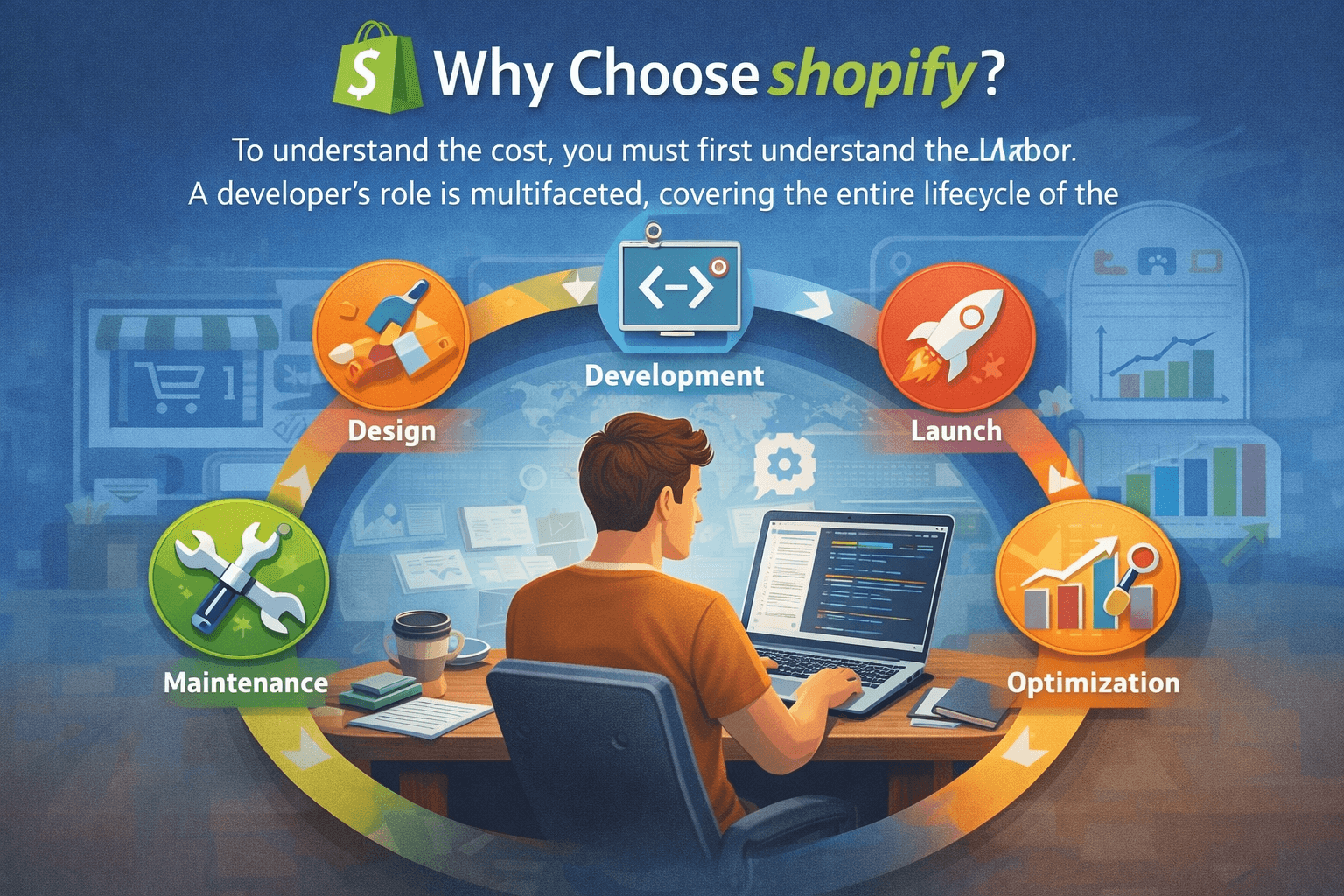
To understand the cost, you must first understand the labor. A developer's role is multifaceted, covering the entire lifecycle of the store.
-> Store Architecture & Backend Setup
The architecture is the invisible skeleton of your store. If the skeleton is weak, the body collapses under weight.
Collection Structure: Logically organizing products to maximize crawlability for search engines and discoverability for users.
Checkout Flow Configuration: While Shopify’s checkout is locked down for non-Plus merchants, developers optimize every allowed setting to reduce friction and cart abandonment.
Backend Logic: Configuring shipping scripts, tax rules, and inventory management protocols to automate operations.
-> Theme Customization & UI/UX Design
In 2026, "Premium Themes" are common, but they are rarely unique. Professional developers customize Liquid code (Shopify's templating language) to:
Brand Alignment: ensure the digital experience matches the physical brand identity perfectly.
Conversion-Driven UX: Repositioning "Add to Cart" buttons, sticky headers, and trust badges based on heat-mapping data to increase conversions.
Mobile Responsiveness: Writing custom CSS to ensure elements stack, fold, and display perfectly on the thousands of screen sizes available today.
-> Custom Shopify Functionality & Apps
Growing businesses often hit the ceiling of native Shopify features. This is where high-level development comes in.
Custom App Development: Building private apps using Node.js or React to handle unique business logic (e.g., a custom product builder or a B2B quote engine).
API Integrations: Connecting the store to third-party logistics (3PL), ERPs (like NetSuite or SAP), and marketing automation tools (like Klaviyo).
Middleware Solutions: Creating bridges between legacy systems and modern Shopify storefronts.
- > Performance & Speed Optimization (Core Web Vitals)
Speed is a ranking factor and a revenue driver. Developers at agencies like VNA Infotech focus on:
Code Minification: Reducing the size of HTML, CSS, and JavaScript files.
Asset Optimization: Implementing next-gen image formats (WebP/AVIF) and lazy-loading techniques.
Script Management: deferring non-essential third-party scripts to ensure the "Largest Contentful Paint" (LCP) happens almost instantly.
--> SEO & Technical Optimization
SEO is not just keywords; it is code.
Structured Data (Schema): implementing JSON-LD code so Google understands products, reviews, and prices for rich snippets.
Canonicalization: Managing URL structures to prevent duplicate content penalties.
Site Architecture: Ensuring a flat depth structure so crawlers can reach every product page efficiently.
Types of Shopify Development Projects :
Understanding your project type is the first step toward accurate budgeting.
Basic Shopify Store Setup
Ideal For: Startups, local businesses, dropshippers.
Scope: Selecting a theme, installing it, uploading products, setting up Stripe/PayPal, and basic domain configuration.
Timeline: 1–2 Weeks.
Mid-Level Custom Store
Ideal For: D2C brands generating steady revenue, scaling businesses.
Scope: Extensive customization of a premium theme, specific app integrations (reviews, loyalty), speed optimization, and branded UX design.
Timeline: 3–6 Weeks.
Advanced Custom & Shopify Plus Development
Ideal For: Enterprise brands, high-volume merchants, B2B wholesalers.
Scope: Full custom theme development (from scratch), Headless commerce (React/Hydrogen), multi-store architecture for different countries, custom ERP integration.
Timeline: 6–12+ Weeks.
Note: This is the tier where VNA Infotech excels, providing enterprise-grade architecture at competitive rates.
Shopify Developer Cost – Complete 2026 Breakdown
"How much does a Shopify developer cost?" is a complex question. Costs vary based on geography, engagement model, and expertise.
Model 1: Hourly Pricing
Best for ongoing maintenance, small tweaks, or debugging.
India: ₹800 – ₹3,500 INR ($10 – $45 USD)
Analysis: This offers the highest ROI. Indian developers are often highly certified and English-proficient. Agencies like VNA Infotech operate in this bracket but deliver quality rivaling US agencies.
USA: $50 – $150+ USD
Analysis: High cost due to cost of living. Best for projects requiring on-site meetings or strict US time zone alignment.
Europe: €40 – €120 EUR
Analysis: High quality, particularly for design-centric or GDPR-heavy projects.
Model 2: Fixed Project Cost
Best for new builds where the scope is clearly defined.
Basic Store: ₹40,000 – ₹80,000 ($500 - $1,000)
Custom Store: ₹1,00,000 – ₹3,00,000 ($1,200 - $4,000)
Enterprise / Shopify Plus: ₹5,00,000+ ($6,000 - $50,000+)
Model 3: Monthly Retainer
Best for scaling brands that need a "technical partner" on call.
Scope: Continuous CRO (Conversion Rate Optimization), A/B testing, app management, and seasonal updates.
Agencies like VNA Infotech recommend retainers for stability, ensuring your store evolves alongside market trends.
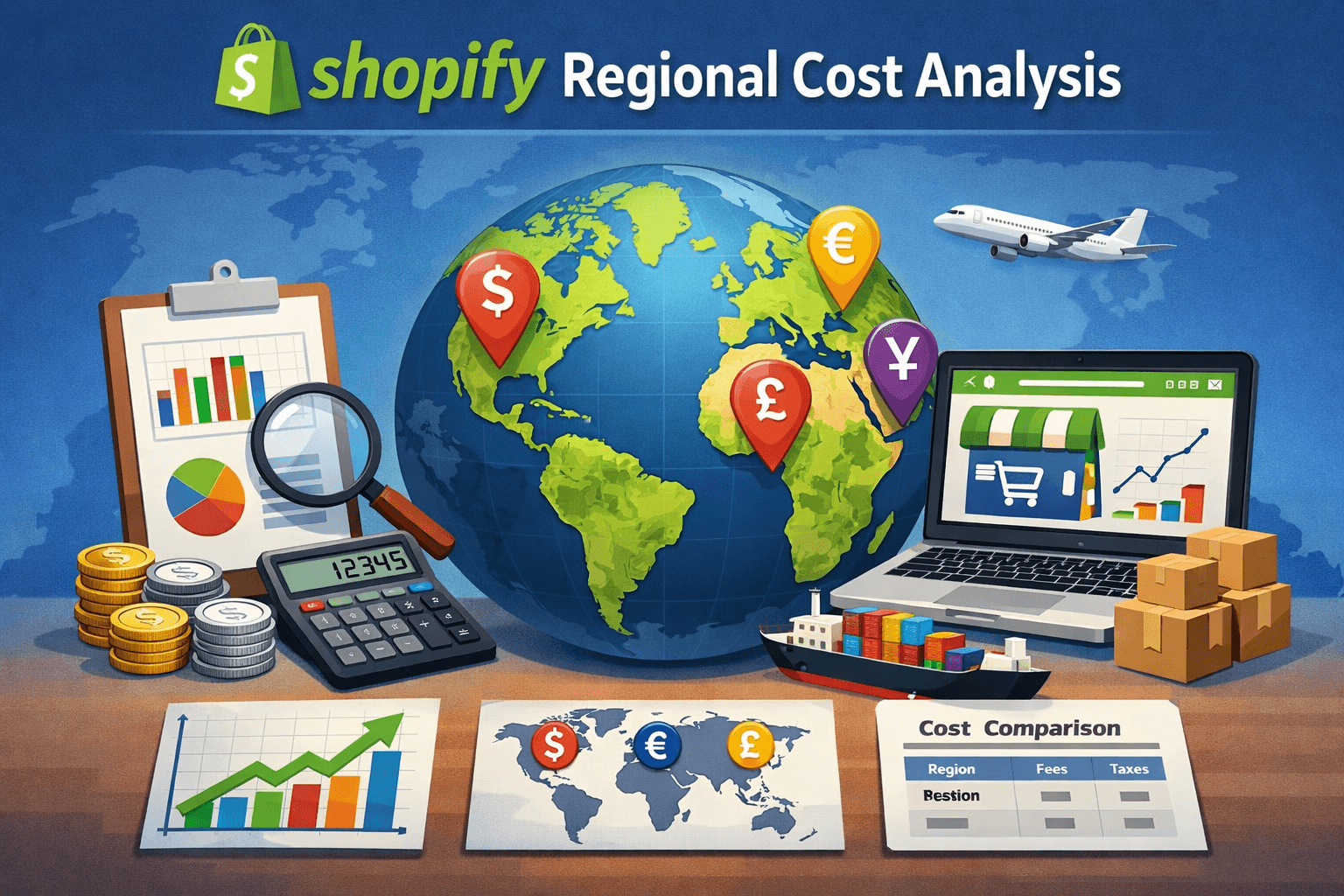
Deep Dive: Regional Cost Analysis
1. India – The Global Value Leader
India remains the powerhouse of Shopify development. The cost advantage is not due to lower quality, but lower cost of living.
Pros: Extremely high availability of talent, strong English skills, time zone flexibility (many work overlapping shifts), and cost-efficiency.
Why VNA Infotech: VNA bridges the gap, offering Indian cost structures with Western project management standards.
2. USA & Canada – The Premium Tier
Pros: Cultural nuances are understood implicitly; same time zone.
Cons: Extremely expensive. A simple task that costs $100 in India might cost $800 in the US.
3. Eastern Europe – The Middle Ground
Pros: Strong engineering culture, convenient time zones for Western Europe.
Cons: Prices are rising rapidly, narrowing the gap with Western Europe.
4. Remote/Freelance Markets (Upwork/Fiverr)
Pros: Cheapest option ($10-$20/hr).
Cons: Highest risk. Lack of accountability. Code is often "spaghetti code" that breaks later.
Factors That Inflate or Reduce Cost :
Why does one quote say $2,000 and another $10,000?
Project Complexity: Adding a custom "Build Your Own Bundle" feature requires custom logic, whereas a standard product page does not.
Design Customization: Using a template "as is" is cheap. Asking a developer to match a Figma design pixel-perfectly requires hours of CSS coding and testing.
Data Migration: Moving from WooCommerce or Magento to Shopify involves complex data mapping for customers, orders, and passwords. This is a high-risk, high-skill task.
SEO & Performance Scope: A cheap developer will ignore SEO. A professional will spend hours on schema, meta tags, and alt text automation. You pay more upfront for traffic later.
Shopify Hiring Options: Freelancers vs. Partners
This is the most critical decision a merchant makes.
Option A: Hiring a Freelancer
Freelancers are solo operators.
The Persona: A "Jack of all trades." They might code, design, and do SEO.
The Pros:
Cheaper hourly rates.
Direct communication with the person doing the work.
Flexible for ad-hoc tasks.
The Cons:
Single Point of Failure: If they get sick or take a vacation, your store support vanishes.
Skill Gaps: A great coder is rarely a great designer. You may get a fast site that looks ugly, or a pretty site that is slow.
Scalability: They cannot handle large, complex projects alone.
Option B: Hiring a Shopify Partner Agency (VNA Infotech)
Shopify Partners are vetted agencies with access to Shopify’s developer resources and support.
The Persona: A structured team.
The Pros:
Holistic Expertise: You get a Project Manager, a UI/UX Designer, a Backend Developer, and an Shopify SEO specialist all in one contract.
Reliability: If one developer is out, another steps in. The agency guarantees delivery.
Strategic Growth: Agencies work with many clients and bring industry insights ("This strategy worked for Client X, let's try it for you").
QA Testing: Code is reviewed by a lead developer before going live, reducing bugs.
The Cons:
Higher upfront cost than a solo freelancer.
Comparison Table: Freelancer vs. Agency
Feature | Freelancer | Shopify Partner (VNA Infotech) |
Cost | Low | Moderate / Strategic |
Reliability | Low (Individual dependency) | High (Team redundancy) |
Skill Depth | Generalist | Specialist Team |
Turnaround | Variable | Structured / Milestone-based |
SEO Focus | Often overlooked | Built-in from Day 1 |
Long-term Support | Difficult | Guaranteed |
Latest Trends: Preparing for the Future
Hiring a developer today means preparing for the trends of tomorrow.
AI-Driven Personalization
2026 is the year of AI in eCommerce. Developers are now integrating AI to show dynamic content based on user behavior (e.g., showing winter coats to a user browsing from New York, and swimsuits to a user from Florida).
Headless Commerce
For maximum speed and design freedom, brands are decoupling the frontend (what users see) from the Shopify backend. This "Headless" approach requires elite developers but offers unparalleled speed.
B2B & Subscription Commerce
The lines between B2B and B2C are blurring. Developers are building complex wholesale portals with tiered pricing and automated recurring billing loops.
SEO-First Development
With paid ads becoming more expensive, Organic Search is the holy grail. Development is now deeply intertwined with SEO strategy, focusing on site structure and semantic HTML.
VNA Infotech is a leading Shopify expert agency specializing in store design, development, and SEO. We build high-performing, conversion-driven Shopify stores that rank higher, load faster, and scale with your business.
Why Businesses Choose VNA Infotech
In the crowded market of 2026, VNA Infotech has emerged as a preferred partner for businesses that view their website as an investment, not an expense.
1. Business-First Development Approach
VNA does not just write code; they analyze business models. They ask, "How will this feature increase revenue?" before building it. This alignment ensures that development dollars translate to ROI.
2. SEO & Performance DNA
Unlike many agencies that outsource SEO or treat it as an afterthought, VNA Infotech integrates technical SEO into the build process. Stores launch with optimized Core Web Vitals, ensuring they rank on Google faster.
3. Scalable Architecture
VNA builds for the future. They utilize modular coding practices that allow features to be added or removed without breaking the site. This is crucial for brands planning to scale from $1M to $10M in revenue.
4. Transparent Communication
One of the biggest pain points in outsourcing is communication. VNA provides clear timelines, regular Zoom updates, and transparent reporting tools, bridging the gap between technical execution and business management.
5. Long-Term Partnership
VNA Infotech operates not as a vendor, but as a growth partner. They offer ongoing maintenance packages that keep stores secure, fast, and updated with the latest Shopify features (like Shopify Markets or B2B).
Final Verdict: Who Should You Hire?
The choice between a freelancer and a partner agency ultimately depends on your business stage and risk tolerance.
Choose a Freelancer IF: You are a pre-revenue startup, have a very limited budget, need simple cosmetic tweaks, and are comfortable managing the project yourself.
Choose a Shopify Partner IF: You are a growing brand, you rely on your store for primary revenue, you value speed and SEO, and you want a team that takes ownership of the technical success of your business.
In 2026, the cost of bad code is higher than ever. A slow site loses customers; a broken checkout loses revenue. Investing in a professional partner like VNA Infotech is an investment in stability, scalability, and sustainable growth.
Ready to scale your Shopify business? Contact VNA Infotech today for a technical consultation and discover how professional development can transform your eCommerce revenue.


