Premium AI-Powered SaaS Development Companies Worldwide
Posted on
Web Design
Posted at

Introduction
The global SaaS market is experiencing unprecedented transformation. By 2026, artificial intelligence has become the defining factor separating market leaders from stagnating competitors. Businesses investing in AI-powered SaaS platforms are witnessing remarkable returns: improved operational efficiency, enhanced customer experiences, and accelerated revenue growth.
Yet building an AI-powered SaaS application is fundamentally different from traditional software development. It requires specialized expertise in machine learning, advanced cloud infrastructure, and sophisticated data pipelines. According to industry analysis, organizations that partner with experienced AI SaaS development companies complete projects 40% faster and achieve 60% better outcomes than those attempting in-house development.
This comprehensive guide explores the world's premium AI-powered SaaS development companies, examines selection criteria, and provides actionable insights to help startup founders, CTOs, and enterprise decision-makers choose the right development partner for their next-generation software product.
What Is AI-Powered SaaS Development?
AI-powered SaaS development combines three critical domains: Software-as-a-Service architecture, artificial intelligence capabilities, and cloud-native engineering practices.
SaaS fundamentals establish the foundation: multi-tenant cloud applications accessible via web browsers, hosted on scalable infrastructure, and monetized through recurring subscription models. This delivery model eliminates installation complexity, enables automatic updates, and provides instant global accessibility.
Artificial Intelligence integration transforms standard SaaS applications into intelligent systems. Modern AI-powered SaaS platforms leverage:
Machine Learning Models: Algorithms that improve with data exposure, enabling personalized recommendations, predictive analytics, and automated decision-making
Generative AI Features: Technologies producing original content, generating code, creating synthetic data, and automating complex workflows
Natural Language Processing: Understanding and responding to human language, powering chatbots, sentiment analysis, and document intelligence
Computer Vision: Processing visual information for image recognition, quality control, and visual search
Predictive Analytics: Forecasting trends, identifying risks, and enabling data-driven decision-making
The integration of these technologies creates SaaS applications that don't merely execute instructions—they learn, adapt, and anticipate user needs.
Practical business examples illustrate this transformation:
A customer support SaaS platform incorporating AI chatbots handles 70% more inquiries without additional staff
A financial services application using predictive analytics detects fraudulent transactions 95% faster than rule-based systems
A healthcare SaaS platform leveraging computer vision assists radiologists in analyzing medical imaging with greater accuracy
Why Businesses Are Investing in AI-Powered SaaS Platforms
The ROI case for AI-powered SaaS solutions is compelling and multifaceted.
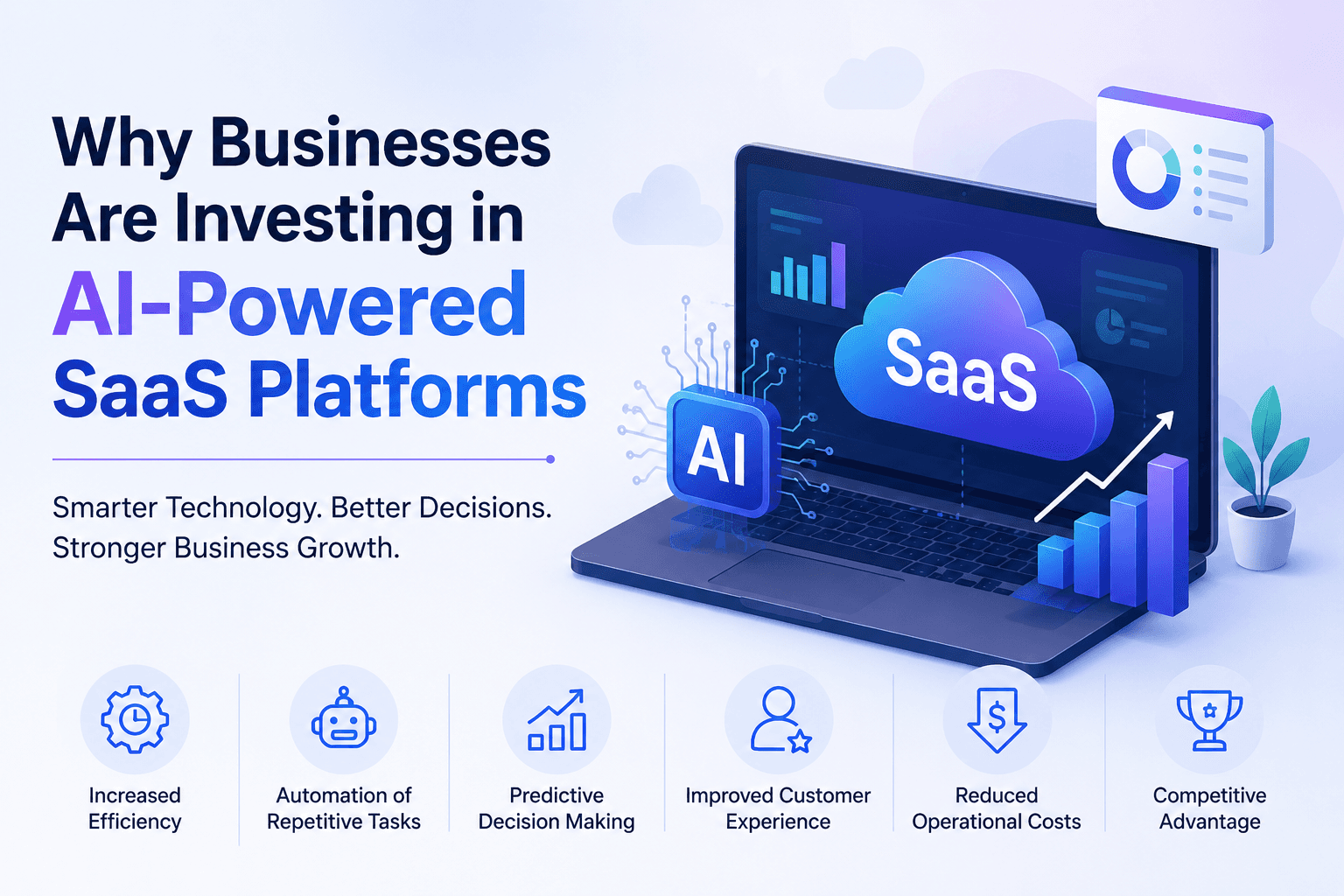
Increased Efficiency and Automation
AI-powered SaaS applications automate repetitive, time-consuming tasks that previously required manual intervention. Customer data validation, invoice processing, lead qualification, and report generation—all traditionally demanding significant human resources—are now executed by intelligent systems in seconds.
A logistics company implementing an AI-powered SaaS platform for route optimization reduced delivery times by 23% while cutting fuel costs by 18%.
Predictive Decision Making
Traditional software provides insights into historical data. AI-powered SaaS applications predict future outcomes. Marketing teams identify customers most likely to churn before it happens. Healthcare providers anticipate patient deterioration. Manufacturing plants predict equipment failures before breakdown occurs.
Improved Customer Experience
Personalization at scale becomes possible with AI. E-commerce platforms recommend products with precision rivaling in-person shopping. Customer support responds instantly with relevant solutions. Content platforms deliver individually tailored experiences to millions simultaneously.
Competitive Advantage
Organizations deploying AI-powered SaaS solutions establish defensible market positions. First-mover advantage in AI adoption creates network effects and data advantages that competitors struggle to replicate.
Reduced Operational Costs
While development investment increases initially, operational costs decline significantly. AI-powered SaaS applications handle workload spikes automatically, eliminate redundant processes, and reduce human error. A financial services firm reduced customer onboarding costs by 45% through AI automation.
Scalable Growth
AI-powered SaaS platforms grow efficiently. Unlike traditional software requiring proportional staffing increases, these systems handle exponential user growth with minimal additional infrastructure investment.
Key Features of Modern AI SaaS Applications
Contemporary AI-powered SaaS solutions share sophisticated feature sets:
AI Chatbots and Virtual Assistants: Conversational interfaces handling customer queries, internal processes, and complex workflows through natural dialogue.
Recommendation Engines: Algorithms personalizing user experiences by analyzing behavior patterns, preferences, and contextual data—the technology powering Netflix suggestions and Amazon product recommendations.
Natural Language Processing: Understanding user intent from unstructured text, enabling sentiment analysis, document intelligence, and conversational computing.
Computer Vision Capabilities: Processing visual information for quality control, fraud detection, visual search, and automated inspection.
Workflow Automation: Intelligent process automation that replaces manual procedures with self-executing workflows triggered by specific conditions.
Predictive Analytics: Machine learning models forecasting future outcomes—from customer behavior to equipment failures to market trends.
Data Intelligence Layers: Platforms transforming raw data into actionable insights through sophisticated analysis, visualization, and automated discovery.
AI-Powered Dashboards: Real-time visualization featuring intelligent anomaly detection, automated insights, and predictive indicators.
Voice Intelligence: Converting speech to actionable insights, enabling voice commands, and analyzing acoustic patterns.
Generative AI Integration: Leveraging foundation models for content generation, code production, synthetic data creation, and creative applications.
How We Selected the Premium AI-Powered SaaS Development Companies
Our evaluation methodology prioritizes verifiable expertise and demonstrated capability.
Selection Criteria:
AI and Machine Learning Expertise: Proven capability in implementing ML models, neural networks, and generative AI technologies at production scale
SaaS Architecture Mastery: Demonstrated experience building multi-tenant, cloud-native applications with enterprise-grade reliability
Portfolio Quality: Case studies showing successful AI SaaS launches, particularly in regulated industries
Client References and Reviews: Verified testimonials from recognized enterprise clients
Global Presence: Infrastructure and team capacity for distributed projects and 24/7 support
Security and Compliance: Certifications including SOC 2 Type II, GDPR, HIPAA, and ISO 27001
Scalability Expertise: Proven ability to architect solutions handling millions of users
Innovation Track Record: Demonstrated commitment to emerging technologies and research-driven development
Post-Launch Support: Comprehensive maintenance, optimization, and feature development services
Top Premium AI-Powered SaaS Development Companies Worldwide
1. Accenture
Headquarters: Dublin, Ireland
Founded: 1989
Team Size: 740,000+ employees globally
Core Services: AI SaaS development, cloud engineering, digital transformation
Accenture operates as a global technology and consulting powerhouse with extensive AI-powered SaaS development capabilities. Their Applied Intelligence division focuses specifically on AI implementation, having invested billions in AI research and development.
AI Expertise: Accenture has developed proprietary AI platforms and maintains partnerships with major cloud providers (AWS, Azure, Google Cloud). Their AI technology labs research cutting-edge applications in machine learning, generative AI, and intelligent automation.
Industries Served: Financial services, healthcare, retail, manufacturing, telecommunications
Notable Strengths: Extensive enterprise experience, proprietary AI methodologies, global delivery network, strong security practices
Why Choose Them: For organizations requiring AI SaaS solutions integrated with existing enterprise systems and needing proven execution at massive scale.
Best For: Enterprise transformation, complex AI integration projects, organizations with legacy system constraints
2. IBM Consulting
Headquarters: Armonk, New York, USA
Founded: 1911 (Consulting division established 1995)
Team Size: 200,000+ employees
Core Services: Enterprise AI solutions, SaaS platform development, cloud infrastructure
IBM Consulting combines decades of enterprise software experience with modern AI capabilities. Their Watson platform revolutionized business AI applications.
AI Expertise: IBM's AI/Data division employs thousands of data scientists and AI engineers. Watson platform capabilities include natural language understanding, computer vision, and machine learning. IBM maintains extensive AI research facilities and contributes significantly to AI standards development.
Industries Served: Healthcare (diagnostic imaging), finance (risk analysis), insurance (claims processing), manufacturing, telecommunications
Notable Strengths: Deep industry expertise, proprietary AI technologies, enterprise infrastructure, regulatory compliance knowledge
Why Choose Them: Organizations requiring AI SaaS solutions in regulated industries, especially healthcare and finance.
Best For: Enterprise implementations, regulated industry solutions, AI-first product development
3. Cognizant
Headquarters: Teaneck, New Jersey, USA
Founded: 1994
Team Size: 340,000+ employees
Core Services: AI platform development, digital engineering, cloud transformation
Cognizant operates extensively in AI SaaS development with dedicated AI practices and technology centers focused on emerging technologies.
AI Expertise: Cognizant's dedicated GenAI and Machine Learning practices employ specialized engineers. They've published substantial research on AI implementation patterns and maintain innovation labs experimenting with cutting-edge AI technologies.
Industries Served: Banking and financial services, insurance, retail, healthcare, automotive, technology
Notable Strengths: Proven delivery at scale, strong AI research capabilities, cost-effective solutions for growth-stage companies, extensive client base
Why Choose Them: Growth-stage SaaS companies seeking experienced partners with proven scalability and cost optimization.
Best For: Scaling SaaS platforms, rapid development cycles, industry-specific AI applications
4. Thoughtworks
Headquarters: Chicago, Illinois, USA
Founded: 1993
Team Size: 10,000+ employees
Core Services: Software product engineering, AI/ML engineering, cloud architecture
Thoughtworks specializes in innovative software engineering and maintains focused expertise in AI-driven application development.
AI Expertise: Thoughtworks emphasizes technology leadership and maintains dedicated practices in machine learning engineering, generative AI, and AI architecture. They publish the industry-influential Technology Radar identifying emerging AI trends.
Industries Served: Financial technology, media and entertainment, healthcare technology, e-commerce, automotive
Notable Strengths: Cutting-edge technology practices, emphasis on engineering excellence, strong startup experience, thought leadership
Why Choose Them: Startups and innovators prioritizing technological excellence and forward-thinking approaches.
Best For: Innovative AI SaaS startups, next-generation product development, technology-first organizations
5. EPAM Systems
Headquarters: Newtown, Pennsylvania, USA
Founded: 1993
Team Size: 60,000+ employees
Core Services: Custom software development, AI/ML services, digital platform engineering
EPAM maintains substantial AI and machine learning engineering capabilities with deep expertise in SaaS platform development.
AI Expertise: EPAM's AI/ML division delivers machine learning models, generative AI implementations, and intelligent automation solutions. They maintain dedicated centers of excellence for AI technologies and regularly contribute to open-source AI projects.
Industries Served: Financial services, healthcare, technology, telecommunications, media
Notable Strengths: Strong technical depth, rapid innovation, proven SaaS expertise, cost-competitive model
Why Choose Them: Organizations seeking technical depth with cost-effective delivery models.
Best For: Complex AI implementations, technical innovation projects, scalable SaaS development
6. Intellectsoft
Headquarters: San Francisco, California, USA
Founded: 2007
Team Size: 1,200+ employees
Core Services: AI/ML development, SaaS product engineering, enterprise software
Intellectsoft focuses specifically on AI-powered solutions with particular expertise in enterprise and startup applications.
AI Expertise: Intellectsoft maintains dedicated artificial intelligence and machine learning practices. Their engineers specialize in implementing computer vision, NLP, predictive analytics, and generative AI. The company has developed solutions for Fortune 500 companies and venture-backed startups.
Industries Served: Financial technology, healthcare, logistics, e-commerce, insurance
Notable Strengths: AI specialization, startup ecosystem connections, rapid prototyping capabilities, innovative solutions
Why Choose Them: SaaS startups and enterprises wanting partners with deep AI focus and startup experience.
Best For: AI-first SaaS startups, innovative product development, rapid MVP validation
7. ScienceSoft
Headquarters: Minsk, Belarus
Founded: 1989
Team Size: 1,300+ employees
Core Services: AI/ML development, SaaS engineering, cloud solutions
ScienceSoft provides specialized expertise in artificial intelligence and SaaS platform development with emphasis on practical implementation.
AI Expertise: ScienceSoft's AI services include machine learning model development, generative AI integration, and intelligent automation. They maintain expertise across all major AI technologies and cloud platforms.
Industries Served: Healthcare IT, finance, logistics, retail, manufacturing
Notable Strengths: Specialized AI focus, cost-effectiveness, strong healthcare experience, technical depth
Why Choose Them: Organizations prioritizing cost-effective AI development without compromising technical quality.
Best For: Healthcare AI applications, cost-optimized SaaS development, technical innovation
8. Globant
Headquarters: Buenos Aires, Argentina
Founded: 2003
Team Size: 27,000+ employees
Core Services: Digital innovation, AI engineering, cloud-native development
Globant emphasizes innovation and maintains strong expertise in modern AI technologies for SaaS platforms.
AI Expertise: Globant's Innovation Labs focus on emerging AI technologies including generative AI, autonomous agents, and intelligent automation. They partner closely with cloud providers to deliver integrated AI solutions.
Industries Served: Media and entertainment, automotive, retail, financial services, telecommunications
Notable Strengths: Innovation focus, startup mentality, rapid prototyping, global delivery capacity
Why Choose Them: Organizations wanting innovation-focused partners with strong cloud and AI capabilities.
Best For: Innovative SaaS products, digital transformation, rapid development cycles
9. BairesDev
Headquarters: Buenos Aires, Argentina (USA operations in Wilmington, Delaware)
Founded: 2009
Team Size: 3,500+ developers
Core Services: AI/ML development, SaaS engineering, software product development
BairesDev maintains dedicated expertise in artificial intelligence and machine learning for SaaS applications.
AI Expertise: BairesDev's AI/ML division delivers production-grade solutions across computer vision, NLP, predictive analytics, and generative AI. They specialize in scaling AI applications for enterprise use.
Industries Served: Financial technology, healthcare, e-commerce, logistics, marketing technology
Notable Strengths: Flexible engagement models, technical specialization, startup experience, quality assurance
Why Choose Them: Startups and mid-market companies needing flexible, specialized AI development.
Best For: Growth-stage SaaS, specialized AI implementations, augmented development teams
10. Capgemini
Headquarters: Paris, France
Founded: 1967
Team Size: 320,000+ employees
Core Services: Enterprise transformation, AI services, cloud platforms
Capgemini operates as a global technology consultant with substantial AI SaaS development capabilities.
AI Expertise: Capgemini's dedicated AI division focuses on practical enterprise AI implementations. They've invested in AI research laboratories and maintain partnerships across cloud and technology leaders.
Industries Served: Banking, insurance, automotive, retail, manufacturing, telecommunications
Notable Strengths: Enterprise scale, global presence, industry-specific solutions, transformation expertise
Why Choose Them: Large enterprises requiring AI transformation with global delivery capacity.
Best For: Enterprise SaaS transformation, large-scale implementations, complex integrations
Industries Benefiting Most from AI SaaS Solutions
Healthcare
AI-powered SaaS solutions transform healthcare delivery. Diagnostic imaging platforms assist radiologists in detecting diseases at earlier stages. Patient management systems predict hospital readmissions, enabling preventive interventions. AI-driven clinical decision support systems improve treatment outcomes. Telemedicine platforms powered by AI handle initial patient triage, improving efficiency while reducing physician workload.
Finance and Banking
AI SaaS applications protect financial institutions through fraud detection systems identifying suspicious transactions in milliseconds. Risk management platforms assess portfolio exposure comprehensively. Robo-advisors provide personalized investment recommendations at scale. Algorithmic trading platforms execute complex strategies automatically.
Insurance
Claims processing traditionally consumed significant time and resources. AI-powered SaaS platforms automatically verify claims, detect fraud, and estimate payouts—reducing processing time from weeks to hours. Risk assessment models price policies with unprecedented precision.
Retail and E-Commerce
Recommendation engines power personalized shopping experiences, increasing average order value by 15-35%. Inventory optimization systems reduce stockouts while minimizing overstock situations. Dynamic pricing algorithms maximize revenue in response to market conditions. Demand forecasting prevents lost sales and excess inventory.
Logistics and Supply Chain
Route optimization platforms reduce delivery costs while improving speed. Warehouse automation systems manage inventory intelligently. Predictive maintenance prevents equipment failures that disrupt operations. Demand forecasting aligns supply chain operations with anticipated demand.
Manufacturing
Predictive maintenance systems identify equipment degradation before failure, preventing costly production stoppages. Quality control systems using computer vision detect defects at higher rates than human inspection. Production optimization algorithms maximize throughput while minimizing waste.
Human Resources
Talent acquisition platforms identify ideal candidates more effectively. Employee engagement systems predict and prevent turnover. Performance management systems provide objective, data-driven assessments. Learning platforms deliver personalized skill development.
Education
Personalized learning platforms adapt to individual student needs, improving outcomes. Assessment systems provide immediate, detailed feedback. Administrative platforms automate scheduling, grading, and resource allocation.
Emerging Trends in AI-Powered SaaS Development
Generative AI Integration
Generative AI represents the fastest-growing segment in AI SaaS development. Large language models powering chatbots, content generation, and code assistance are becoming standard features in business applications. Organizations embedding generative AI into their platforms are gaining significant competitive advantages.
AI Agents and Autonomous Systems
Beyond executing predefined tasks, modern SaaS applications incorporate autonomous agents—AI systems capable of independent reasoning, planning, and action within defined parameters. These agents handle complex workflows without human intervention.
Multimodal AI Systems
Next-generation AI SaaS applications process multiple data types simultaneously—text, images, audio, and video—providing richer insights and more nuanced understanding.
Vertical SaaS Platforms
Industry-specific SaaS applications incorporating AI deliver superior value compared to horizontal solutions. Vertical AI SaaS for legal technology, real estate, construction, and specialized manufacturing are experiencing rapid growth.
Explainable AI (XAI)
As AI SaaS applications make critical decisions affecting customers, businesses demand transparency. Explainable AI ensures users understand AI reasoning, essential for regulatory compliance and trust building.
AI Copilots
AI-assisted tools helping humans make better decisions are becoming standard. Data analysis copilots, coding assistants, content creation copilots, and decision support copilots augment human capabilities.
Autonomous Workflows
Sophisticated automation chains orchestrating across multiple systems without human intervention, from lead-to-invoice automation in sales to incident-to-resolution automation in IT operations.
Cost of Developing an AI-Powered SaaS Platform
AI SaaS development costs vary dramatically based on complexity and scope.
Pricing Factors:
Project Scope: MVP development costs $150K-$400K; production platforms cost $500K-$3M+
AI Complexity: Simple recommendation engines cost less than computer vision or NLP systems; generative AI integration commands premium pricing
Team Composition: In-house development costs 30-50% more than offshore partnerships; distributed teams increase coordination complexity
Infrastructure Requirements: Enterprise-grade cloud infrastructure costs $5K-$50K monthly depending on scale
Integration Complexity: Integrating with existing systems increases development effort significantly
Data Pipeline Development: Quality data infrastructure represents 30-50% of AI implementation costs
Regulatory Compliance: Healthcare and financial SaaS require substantial compliance investment
Estimated Development Costs:
MVP (Proof of Concept): $150K-$400K, 3-6 months
Startup SaaS (Single Feature Focus): $400K-$1.5M, 6-12 months
Growth-Stage SaaS (Multiple Features): $1.5M-$5M, 12-24 months
Enterprise SaaS (Full Platform): $5M+, 24+ months
How to Choose the Right AI SaaS Development Company
Selection Checklist:
Technical Credentials: Verify expertise through published research, conference presentations, and technical team credentials
AI Experience: Request specific case studies demonstrating AI implementation at production scale
Portfolio Quality: Examine actual client projects, not just testimonials; look for enterprise clients
Security Practices: Verify SOC 2 Type II certification, penetration testing procedures, and incident response capabilities
Scalability Approach: Understand how they architect applications to grow from thousands to millions of users
Communication Processes: Assess how frequently they communicate, how they handle stakeholder alignment
Post-Launch Support: Clarify maintenance, optimization, and feature development procedures
Cost Transparency: Request detailed pricing breakdowns; avoid partners with vague estimates
Team Stability: Understand engineer retention rates and leadership continuity
Common Mistakes to Avoid
Choosing Based Solely on Price: The cheapest development option typically delivers expensive outcomes. Rework, security vulnerabilities, and poor scalability cost far more than premium initial development.
Ignoring AI Expertise: Not all software developers understand AI implementation challenges. Evaluate team credentials specifically in AI/ML, not just general software engineering.
Failing to Plan for Scalability: AI applications serving thousands of users operate fundamentally differently than those serving millions. Ensure architecture plans for growth.
Weak Security Practices: AI SaaS applications often process sensitive data. Verify robust security practices before engagement.
Poor Requirement Documentation: Vague specifications lead to misaligned deliverables. Invest in thorough requirements definition before development begins.
Neglecting Post-Launch Support: The most critical work occurs after launch—optimization, feature development, and scaling. Verify comprehensive post-launch support structures.
The Future of AI-Powered SaaS Development (2026-2030)
AI-Native Software Design: Software increasingly designed for AI-first operation, rather than adding AI to existing applications.
Autonomous Business Systems: Integrated AI systems managing entire business functions independently, from customer acquisition to financial management.
AI-First Startups: New organizations built entirely around AI capabilities from inception, unencumbered by legacy constraints.
Enterprise AI Transformation: Organizations view AI as central to competitive strategy, requiring comprehensive transformation initiatives.
Next-Generation SaaS Ecosystems: Interconnected AI SaaS platforms creating unprecedented value through intelligent data flow and autonomous coordination.
Conclusion
Selecting the right AI-powered SaaS development partner represents one of the most critical decisions technology leaders make. The companies profiled in this guide have demonstrated exceptional capability in delivering sophisticated, production-grade AI SaaS applications across industries.
The competitive landscape will only intensify as AI capabilities become table-stakes for market leadership. Organizations that move decisively to embrace AI-powered SaaS solutions—with experienced, capable partners—will establish defensive competitive positions that challengers struggle to replicate.
Next Steps: Evaluate your organization's AI SaaS requirements, consult with 3-5 development companies from the guide, request detailed case studies demonstrating relevant experience, and invest in thorough due diligence before engagement. The quality of your development partner directly correlates with the success of your AI SaaS initiative.
Frequently Asked Questions
What is the difference between AI SaaS development and traditional software development?
AI SaaS development requires specialized expertise in machine learning, data engineering, and AI architecture. Traditional software engineering focuses on logical instruction execution; AI SaaS development must manage training datasets, model performance metrics, inference optimization, and continuous learning feedback loops.
How long does AI SaaS platform development typically take?
Development timelines vary dramatically: MVPs require 3-6 months, growth-stage platforms 12-24 months, and enterprise solutions 24+ months. Complexity, team size, and requirement clarity significantly influence duration.
What should I budget for AI SaaS development?
MVPs require $150K-$400K; production platforms cost $500K-$5M+; enterprise solutions exceed $5M. Budget varies based on AI complexity, team location, integration requirements, and scalability needs.
Which development company is best for startups?
Thoughtworks, Intellectsoft, and BairesDev excel with startup-stage projects, offering innovation focus, flexibility, and reasonable cost structures. Accenture and IBM suit larger, more structured initiatives.
How important is geographic location for AI SaaS development companies?
Geographic location influences cost but less so quality. Skilled AI engineers are globally distributed. Ensure appropriate time zone overlap for communication and select companies with proven 24/7 support infrastructure.
What security certifications should AI SaaS development companies maintain?
Essential certifications include SOC 2 Type II, GDPR compliance, ISO 27001, and industry-specific certifications (HIPAA for healthcare, PCI DSS for payments). Verify active certifications through audit reports.
How do AI SaaS companies handle data privacy and model bias?
Ethical AI development requires sophisticated practices: diverse training data preventing bias, anonymization protecting privacy, explainability ensuring transparency, and continuous auditing detecting degradation. Qualified partners demonstrate explicit commitment to responsible AI practices.
What post-launch support should AI SaaS partners provide?
Comprehensive support includes continuous monitoring, performance optimization, retraining models with new data, feature development, security updates, and incident response. Clarify support timelines and escalation procedures before engagement.