Legacy Software Modernization Services for Enterprises: A Complete Guide
Posted on
Web Design
Posted at

Every large organization eventually reaches the same uncomfortable moment: the system that has quietly run the business for fifteen or twenty years starts costing more to keep alive than it would cost to replace. Nobody wants to touch it. Nobody fully understands it anymore. And yet the invoices keep going out, the claims keep getting processed, the trades keep clearing — because that old application, whatever its flaws, still works.
This tension is the starting point for almost every conversation about legacy software modernization services. Enterprises don't modernize because it's trendy. They modernize because the alternative — standing still — has become the riskier option.
By 2027, that risk calculus has shifted further. AI-native competitors are shipping features in weeks instead of quarters. Cyber-insurance underwriters are asking pointed questions about unsupported platforms. Regulators in finance, healthcare, and government are tightening data-handling requirements that older architectures simply cannot meet. And the engineers who still remember how the mainframe batch jobs actually work are retiring.
This guide is written for the people who have to make the call: CTOs, CIOs, IT directors, and business leaders who need a clear-eyed, practical understanding of what modernization actually involves — not the marketing version, the real one. We'll walk through what legacy software is, why it persists, the six core modernization strategies, a realistic process roadmap, cost ranges by project size, common risks and how experienced teams mitigate them, and how to evaluate a modernization partner without getting burned.
Why 2027 Specifically
Every year someone argues it's "the year" for modernization, so it's fair to ask what's actually different now. A few forces are converging in a way that makes 2027 a genuinely different moment than, say, 2022.
First, the AI tooling available for code analysis, automated refactoring, and documentation generation has matured to the point where it materially shortens the discovery and translation phases of a modernization project — work that used to consume months of specialist time. That doesn't make modernization free or instant, but it does change the cost-benefit math in ways that make previously "too expensive to touch" systems newly viable candidates.
Second, the talent pool that understands the oldest legacy technologies — COBOL, Delphi, classic mainframe operations — is retiring, and it isn't being replenished. Every year that passes makes maintaining these systems more expensive and riskier, not less, regardless of what happens with AI tooling.
Third, cyber-insurance underwriters and regulators have both become noticeably more specific about unsupported infrastructure and outdated security practices, turning what used to be a purely internal IT decision into something that shows up in insurance premiums, audit findings, and board-level risk reporting.
None of these forces are new in isolation. What's new in 2027 is that they're all pressing at the same time, on the same systems, which is exactly why modernization has moved from "someday" to "this budget cycle" on so many enterprise roadmaps.
Key Takeaways
Legacy modernization is a business risk-management decision as much as a technical one.
There are six recognized modernization strategies — rehost, replatform, refactor, rearchitect, rebuild, and replace — and most enterprises use a mix, not just one.
Costs in 2027 typically range from $50,000 for narrow, single-application projects to $5 million or more for enterprise-wide transformations.
AI-assisted code analysis and automated refactoring have meaningfully shortened modernization timelines compared to five years ago, though human governance is still essential.
The biggest failures come from underestimating discovery and testing, not from choosing the "wrong" technology.
What Is Legacy Software?
Legacy software is any application, platform, or system that is still in active production use but is built on outdated technology, unsupported infrastructure, or architecture that can no longer be efficiently maintained, secured, or extended.
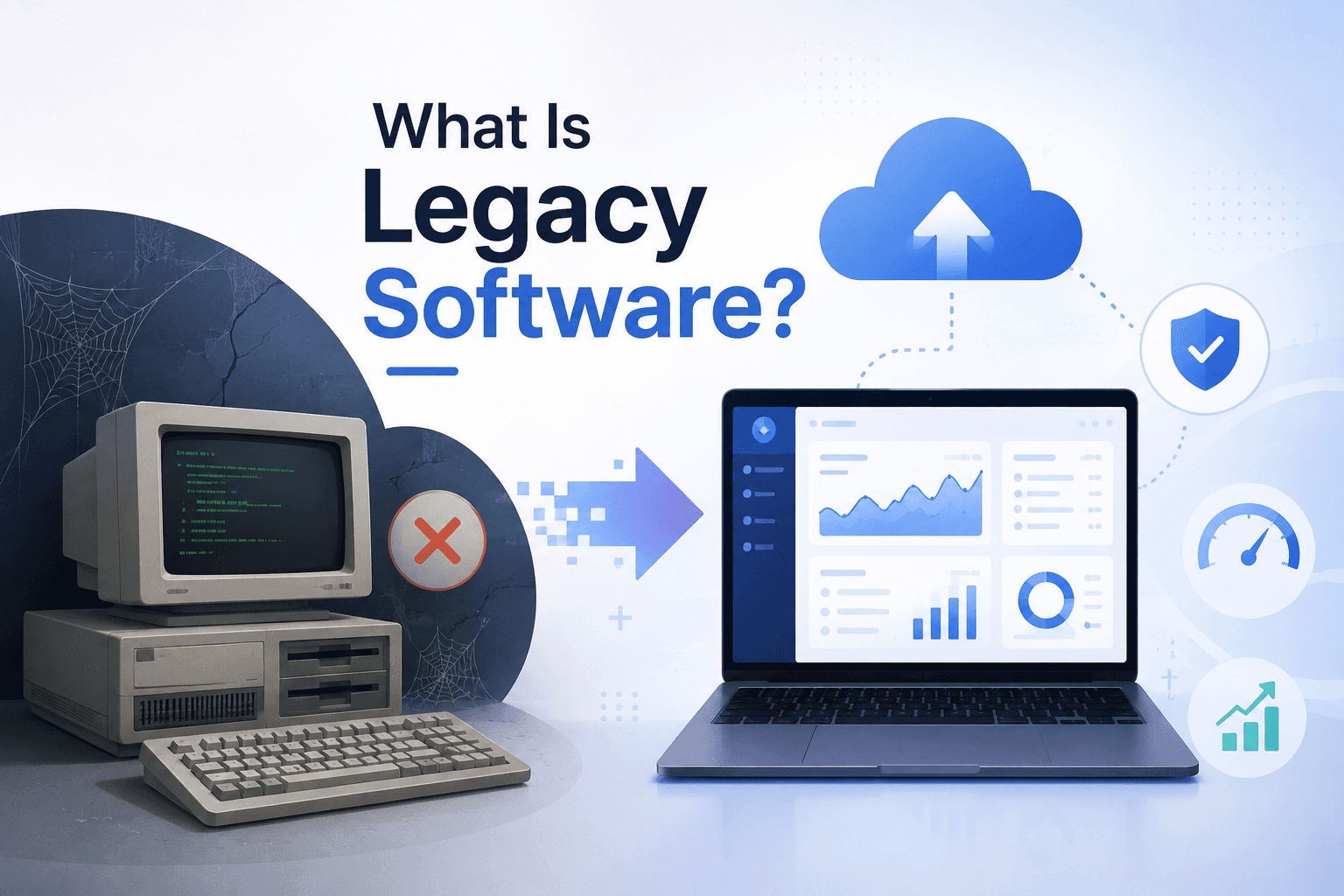
Age alone doesn't make software "legacy." A ten-year-old system built on a well-supported, still-updated framework isn't automatically a liability. What actually defines legacy status is a combination of factors:
The vendor has stopped issuing security patches or has announced end-of-life.
The talent pool that understands the codebase is shrinking.
Integration with modern tools (APIs, cloud services, AI systems) is difficult or impossible.
The system can't scale to meet current transaction volumes or user loads.
Documentation is incomplete, outdated, or nonexistent.
Common Examples of Legacy Systems
A COBOL-based core banking platform running on an IBM mainframe since the 1980s.
A Visual Basic 6 inventory management tool that hasn't been updated since 2008.
A custom Lotus Notes workflow application used for internal approvals.
An Oracle Forms application handling insurance policy administration.
A monolithic Java EE application from the mid-2000s still processing supply chain logistics.
Industries Most Reliant on Legacy Software
Banking and financial services, insurance, government agencies, healthcare providers, manufacturing, and logistics companies carry the heaviest legacy footprints — largely because these industries built their core operational software decades ago, when the systems were state of the art, and have layered new functionality on top ever since rather than replacing the foundation.
There's a pattern behind why this keeps happening. Core systems in regulated industries tend to be extremely stable and extremely hard to replace safely, so the natural incentive for decades has been to patch and extend rather than rebuild. A bank's core ledger, an insurer's policy administration engine, a hospital's patient record system — these are the applications everything else depends on, which makes them simultaneously the most valuable candidates for modernization and the riskiest ones to touch. That combination is exactly why so many of them are still running today, largely unchanged, thirty years after they were written.
It's also worth separating "legacy" from "old but fine." A twenty-year-old application running on a currently supported platform, with active documentation and a healthy talent pool, isn't a modernization emergency. The real warning sign is a widening gap between what the business needs the system to do and what the system, or the people who understand it, can realistically deliver.
Did You Know?
Many enterprises don't actually know how many legacy applications they're running until the discovery phase of a modernization program uncovers them. It's common for a formal inventory exercise to surface systems that finance, security, and even IT leadership were only partially aware of — informal tools built by a single department years ago that quietly became mission-critical. This "shadow legacy" problem is one of the strongest arguments for treating discovery as a non-negotiable first step rather than a formality to rush through.
What Are Legacy Software Modernization Services?
Legacy software modernization services refer to the specialized consulting, engineering, and migration work involved in transforming outdated applications, infrastructure, and architectures into modern, secure, scalable systems — without disrupting the business operations that depend on them.
Scope of Modernization Services
A modernization engagement typically covers some combination of:
Technical assessment and codebase analysis
Architecture redesign
Cloud migration
Database modernization
API and integration development
UI/UX redesign
Security hardening and compliance alignment
DevOps and CI/CD pipeline implementation
Post-migration support and optimization
Business and Technical Value
The business value is straightforward: lower operating costs, reduced security exposure, faster feature delivery, and the ability to integrate with modern tools including AI systems. The technical value is what makes that possible — cleaner codebases, elastic infrastructure, automated testing, and architecture that doesn't require a specialist who happens to remember 1998.
It helps to separate these two layers explicitly when building a business case for modernization, because they persuade different audiences. A CFO evaluating a modernization proposal generally responds to the business value framing — reduced maintenance spend, faster revenue-generating feature delivery, lower risk of a costly outage. A CTO or engineering leader is usually more focused on the technical value — reduced complexity, better test coverage, and an architecture the team can actually reason about and extend safely. A strong modernization business case speaks to both, rather than leaning entirely on one or the other.
Who Delivers These Services
Legacy software modernization services are delivered by a mix of provider types, and understanding the differences helps in scoping the right engagement. Global systems integrators bring scale and deep governance for enterprise-wide, multi-year transformations. Boutique specialist firms often bring deeper hands-on expertise in a specific legacy technology — COBOL, Delphi, Oracle Forms — because that's their core focus rather than one offering among many. Cloud providers themselves (AWS, Microsoft, Google) offer migration tooling and partner networks, though they typically focus on infrastructure migration rather than the deeper architectural and business-logic work. And a growing number of independent consultants and smaller teams handle narrowly scoped modernization work, particularly for mid-market companies whose projects don't require enterprise-scale delivery teams.
Why Enterprises Modernize Legacy Applications
The decision to modernize is rarely driven by a single factor. It's usually a convergence of several pressures reaching a breaking point simultaneously.
Security. Older systems accumulate unpatched vulnerabilities, and many run on platforms that vendors no longer support at all, which means new vulnerabilities simply never get fixed.
Performance. Legacy architectures — especially monoliths — struggle under modern transaction volumes and often can't be scaled horizontally without a fundamental redesign.
Scalability. Cloud-native, containerized systems can scale on demand; legacy on-premise systems typically require expensive hardware upgrades planned months in advance.
Customer experience. Slow, clunky interfaces and downtime during peak periods directly damage customer trust and retention.
Integration. Modern business runs on interconnected systems — CRM, ERP, analytics, AI tools. Legacy systems built before APIs were standard often can't participate in that ecosystem without expensive custom middleware.
Automation. Manual workarounds that compensate for legacy system limitations are themselves a hidden operating cost that modernization eliminates.
AI readiness. Most AI and machine learning tools require structured, accessible data and API connectivity — conditions legacy systems rarely meet out of the box.
Compliance. Regulatory frameworks increasingly specify data handling, auditability, and security standards that older architectures were never designed to satisfy.
Cost savings. Maintaining legacy systems — specialized talent, hardware, licensing, emergency fixes — frequently costs more annually than the amortized cost of modernization.
The Hidden Cost of Standing Still
Enterprises weighing whether to modernize often compare the cost of a modernization project against the cost of "doing nothing" — but doing nothing is rarely actually free. The real comparison is between a known, planned modernization investment and an unpredictable, growing stream of costs that legacy systems generate quietly over time: emergency contractor rates for developers with increasingly rare skills, opportunity cost from features that simply can't be built, cyber-insurance premium increases tied to unsupported infrastructure, and the compounding risk of a major outage or breach that could cost far more than any modernization program.
This is why experienced technology leaders frame the modernization decision not as "should we spend money on this" but as "which spending pattern do we prefer" — a planned, governed investment with a clear roadmap, or an unplanned, rising maintenance burden with no end date. Framed that way, the decision tends to answer itself for any system already showing several of the warning signs below.
Signs Your Enterprise Needs Modernization
If several of the following apply to your organization, modernization should already be on the roadmap:
Your vendor has announced or already reached end-of-life support.
Finding engineers who know the underlying technology is difficult or expensive.
Every new feature takes disproportionately long to build and test.
The system has experienced repeated, unplanned downtime in the last year.
Security audits consistently flag the same unresolved vulnerabilities.
IT spends more time firefighting than improving the system.
The system cannot integrate with modern APIs or third-party tools.
Reporting requires manual data extraction and spreadsheet work.
Mobile or remote access to the system is limited or nonexistent.
Your competitors are shipping features noticeably faster than you.
Regulatory audits require workarounds to demonstrate compliance.
The system runs on hardware that is no longer manufactured or supported.
Employee onboarding to the system takes weeks due to its complexity.
Data is siloed and difficult to access for analytics or AI initiatives.
Licensing or maintenance costs have risen sharply year over year.
Business continuity plans can't guarantee recovery within an acceptable window.
None of these signs, on their own, necessarily means a full modernization program needs to start tomorrow. But when three or more of them apply to the same system, that system has usually crossed from "aging but manageable" into "actively accumulating risk," and the cost of addressing it only grows the longer it's deferred. A useful exercise for IT leadership is to score every major application against this list quarterly — not as a formal audit, just a working checklist — so that the decision to prioritize modernization is based on a documented pattern of warning signs rather than a single dramatic outage forcing the issue.
Common Legacy Technologies Still in Production
Understanding what you're modernizing away from matters as much as understanding what you're modernizing toward. The most common legacy technologies enterprises are still running in 2027 include:
COBOL — still processing an enormous share of global banking transactions on mainframes.
Visual Basic (VB6/VBA) — common in internal tools built in the 1990s–2000s.
Delphi — used heavily in manufacturing and healthcare desktop applications.
Lotus Notes — legacy workflow and email/collaboration platforms in large enterprises.
Oracle Forms — widely used in government and insurance for data-entry applications.
Mainframe systems (IBM z/OS) — core to banking, airlines, and government.
Classic ASP — pre-.NET web applications still running on IIS servers.
Java EE (early versions) — monolithic enterprise applications from the 2000s.
Legacy PHP frameworks — pre-Laravel/Symfony custom PHP applications.
Windows desktop applications — thick-client software tied to specific OS versions.
What Modernizing Each of These Typically Involves
COBOL systems are rarely rewritten wholesale in one step. The more common path is extracting and documenting business rules first, then either wrapping the mainframe logic behind modern APIs as an interim step, or incrementally translating modules to a modern language while keeping the mainframe running in parallel until each translated piece is fully validated.
Visual Basic and VBA tools are often smaller in scope than core banking or ERP systems, which makes them good rehost or rebuild candidates — frequently rebuilt as lightweight web or low-code applications rather than preserved as desktop software.
Delphi applications, common in manufacturing and healthcare, often get replatformed onto modern databases first, since the core Pascal-based application logic can sometimes be preserved longer than the aging infrastructure underneath it.
Lotus Notes environments are increasingly replaced outright, since modern collaboration and workflow platforms typically cover the same functionality with far lower maintenance overhead — this is one of the more common "replace" candidates in enterprise portfolios.
Oracle Forms applications, heavily used in government and insurance, are frequently refactored into modern web applications that preserve the underlying database schema and business rules while replacing the aging presentation layer entirely.
Mainframe systems generally follow the same phased translation approach as COBOL specifically, given the overlap, with particular attention to preserving batch-processing schedules and audit trails that regulators expect to see continue functioning identically.
Classic ASP applications are commonly rebuilt on modern web frameworks, since the underlying technology has been out of active development for so long that refactoring in place offers limited long-term value compared to a clean rebuild.
Early Java EE monoliths are strong rearchitecture candidates — the JVM ecosystem itself remains well-supported, so the work is less about escaping an unsupported platform and more about breaking apart tightly coupled monolithic modules into independently deployable services.
Legacy PHP frameworks typically get refactored onto modern PHP frameworks (rather than a full language change), since this preserves developer familiarity while gaining modern tooling, security patching, and performance improvements.
Windows desktop applications are usually rebuilt as web or cross-platform applications, both to escape OS-version lock-in and to enable the remote and mobile access modern users expect.
Legacy Modernization Strategies
There is no single "right" way to modernize. Experienced architects choose from six recognized strategies — often referred to as the "6 R's" — based on the system's business criticality, technical debt, and budget constraints.
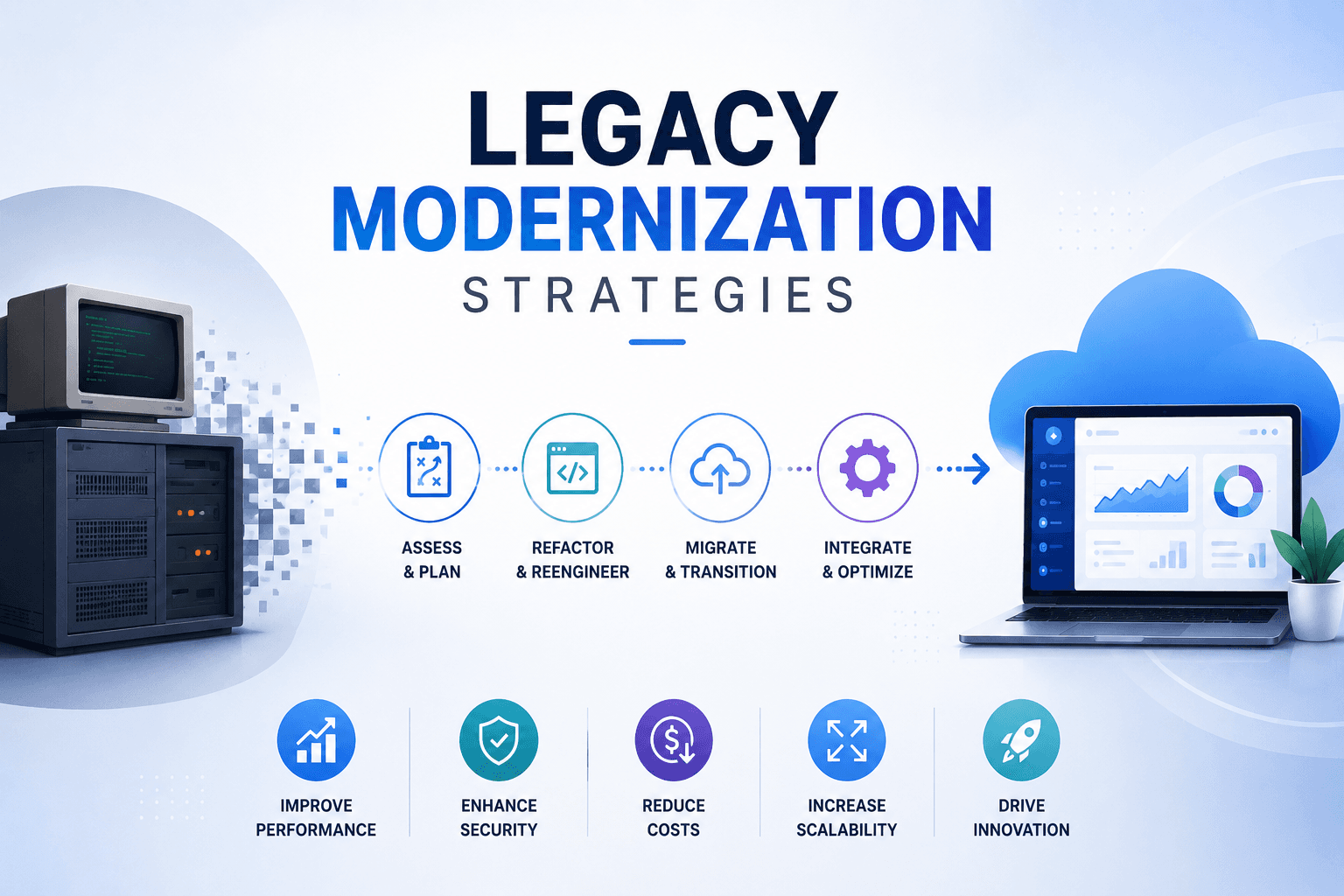
Rehost ("lift and shift"). Move the application to new infrastructure — typically the cloud — with minimal code changes. Fastest and cheapest option, but it doesn't resolve underlying architectural problems.
Replatform. Make targeted changes to take advantage of a new platform's capabilities (e.g., moving a database to a managed cloud service) without rewriting the core application.
Refactor. Restructure and clean up the existing codebase to improve maintainability and performance while preserving external behavior. Good middle ground between cost and long-term benefit.
Rearchitect. Fundamentally redesign the application's architecture — commonly breaking a monolith into microservices — to unlock scalability and agility.
Rebuild. Rewrite the application from scratch using modern technology while retaining the original scope and business logic.
Replace. Retire the legacy system entirely in favor of a commercial off-the-shelf (COTS) or SaaS solution.
Modernization Strategy Comparison Table
Strategy | Cost | Speed | Risk | Long-Term Value | Best For |
|---|---|---|---|---|---|
Rehost | Low | Fast | Low | Low–Moderate | Quick cloud exit from data centers |
Replatform | Low–Moderate | Fast | Low–Moderate | Moderate | Targeted infrastructure upgrades |
Refactor | Moderate | Moderate | Moderate | Moderate–High | Improving maintainability without a full rewrite |
Rearchitect | High | Slow | Moderate–High | High | Systems needing scalability and agility |
Rebuild | High | Slow | High | Very High | Systems too outdated to salvage |
Replace | Varies | Varies | Moderate | High | Non-differentiating functions (HR, payroll, etc.) |
Pro tip: Most enterprise modernization programs don't pick just one strategy. A single portfolio review often results in rehosting three low-priority systems, refactoring a core application, and replacing an HR tool with SaaS — all in parallel.
How to Choose Between the Six Strategies
The right strategy for a given system usually comes down to answering three questions honestly.
How business-critical is this system? Mission-critical systems — the ones that, if they went down for a day, would show up in a board meeting — deserve more caution and, often, more investment in rearchitecting or rebuilding rather than a quick rehost that just moves the same fragility to a new address.
How much technical debt has accumulated? A codebase riddled with undocumented workarounds, hard-coded business rules, and dead code is a poor candidate for refactoring, because there's too little clean structure left to refactor around. In those cases, a rebuild — however more expensive up front — is often cheaper over a five-year horizon than continuing to patch something that fights back at every change.
What's the realistic budget and timeline? Boards rarely approve unlimited modernization budgets. Rehosting and replatforming exist precisely because not every system can get the rearchitect-or-rebuild treatment in year one. A well-run modernization program sequences work: quick wins first to build momentum and free up budget, deeper transformation of core systems on a longer timeline.
A useful discipline here is scoring every application in the portfolio against business criticality and technical debt on a simple two-by-two grid. High criticality plus high technical debt is where the real risk lives, and that's where a rearchitect or rebuild investment tends to pay for itself fastest. Low criticality plus low technical debt, meanwhile, often doesn't need touching at all — not every legacy system requires modernization just because it's old.
The Legacy Modernization Process: A Complete Roadmap
A disciplined modernization program follows a structured sequence. Skipping steps — particularly discovery and testing — is the single most common cause of failed projects.
Discovery — Inventory every system, dependency, integration point, and data flow. Nothing gets modernized safely without first understanding what actually exists.
Assessment — Evaluate technical debt, security posture, business criticality, and modernization readiness for each application.
Planning — Define scope, sequencing, budget, and success metrics. Prioritize based on business risk and value.
Architecture — Design the target-state architecture, including cloud environment, data model, and integration approach.
Code Analysis — Use automated (often AI-assisted) tools to map dependencies, dead code, and business logic buried in the legacy codebase.
Cloud Migration — Execute the actual movement of workloads, data, and infrastructure to the target environment.
Testing — Validate functional parity, performance, and security through automated and manual testing.
Security Review — Conduct penetration testing, vulnerability scanning, and compliance verification before go-live.
Deployment — Roll out using a phased or parallel-run approach to minimize business disruption.
Monitoring — Track system performance, error rates, and user experience post-launch.
Continuous Optimization — Iterate based on real usage data, cost telemetry, and evolving business needs.
Did You Know? Enterprises that run a formal discovery phase before scoping a modernization project reduce budget overruns significantly compared to those that skip straight to development — because most cost surprises come from undocumented dependencies discovered mid-project, not from the coding work itself.
A Closer Look at Each Phase
Discovery is where experienced teams spend more time than clients expect, and it's usually the phase clients most want to rush. It involves interviewing the people who actually operate the system, tracing data flows end to end, and cataloguing every integration — including the informal ones nobody put on an architecture diagram. Skipping or shortening this phase is the single most reliable predictor of a modernization project running over budget.
Assessment takes the discovery inventory and scores each system against business criticality, technical debt, security exposure, and modernization complexity. The output should be a prioritized list, not just a technical report — business stakeholders need to see why one system is being tackled before another.
Planning turns priorities into an actual delivery plan: sequencing, resourcing, budget allocation, and a governance model for handling scope changes, because scope changes will happen.
Architecture is where the target-state design gets built — not just "we're moving to the cloud," but specific decisions about data models, service boundaries, API contracts, and how the new system will coexist with whatever hasn't been modernized yet.
Code analysis increasingly leans on AI-assisted tooling to map dependencies and flag business logic buried inside decades-old code, but the output still needs an experienced engineer to validate what the tooling found, particularly around edge cases the original developers handled through undocumented exceptions.
Cloud migration is the physical (or virtual) move — provisioning target infrastructure, migrating data, and standing up the new environment alongside the old one for validation.
Testing should be more rigorous than testing a greenfield application, because the bar isn't just "does this work," it's "does this behave identically to a system whose exact behavior nobody fully documented." Parallel-run testing, where old and new systems process the same inputs side by side, is the gold standard here.
Security review needs to happen continuously through the process, not as a single gate at the end — vulnerabilities introduced during migration are just as dangerous as the ones being fixed.
Deployment works best as a phased rollout: a pilot group or business unit first, full rollout once real-world usage confirms the system holds up.
Monitoring after go-live should track not just uptime, but user-reported friction, since some issues only surface once real users — not test scripts — are working the system.
Continuous optimization is what separates a modernization project from a modernization capability. The work doesn't stop at go-live; the best-run programs keep iterating based on real usage data indefinitely.
Technologies Powering Modern Enterprise Systems
Modern replacement architectures typically draw from the same core technology stack, regardless of industry:
Cloud platforms (AWS, Azure, Google Cloud) providing elastic infrastructure.
Containers and Kubernetes for portable, scalable application deployment.
Docker for consistent packaging across environments.
APIs enabling integration with internal and third-party systems.
Microservices architecture replacing monolithic designs.
DevOps practices aligning development and operations teams.
CI/CD pipelines automating build, test, and deployment cycles.
Serverless computing for event-driven, cost-efficient workloads.
Event-driven architecture enabling real-time data processing.
AI and machine learning layered on top for automation, prediction, and decision support.
How These Pieces Fit Together in Practice
It's easy to read this list as a menu of separate technologies, but in a well-designed modern architecture, they function as a connected system rather than independent components. A typical modernized enterprise application today runs as a set of containerized microservices, orchestrated by Kubernetes, each service independently deployable through a CI/CD pipeline. Those services communicate through well-defined APIs — both internally with each other and externally with third-party systems — rather than the tightly coupled, direct database calls common in older monolithic designs. Event-driven architecture handles the parts of the system that need real-time responsiveness, such as processing a transaction the moment it happens rather than in a nightly batch job, which was the norm in most legacy systems.
Serverless computing typically handles the more sporadic, event-triggered workloads — a nightly report, an on-demand file conversion — where paying for constantly running infrastructure would be wasteful. DevOps practices tie the whole thing together operationally, ensuring that development and operations teams share responsibility for reliability rather than throwing code over a wall the way many legacy organizations historically operated.
AI and machine learning sit on top of this foundation, and this is worth emphasizing: AI capabilities are dramatically easier to add to a system built this way than to a legacy monolith, because AI tools generally need clean, accessible, well-structured data and API connectivity to function — exactly the conditions this architecture is designed to provide. This is one of the most concrete, practical reasons AI readiness keeps coming up as a modernization driver: it's not that AI requires modernization in the abstract, it's that AI tooling simply doesn't work well against the kind of tightly coupled, poorly documented systems that define most legacy environments.
Common mistake to avoid: Enterprises sometimes adopt these technologies piecemeal — containerizing an application without addressing its underlying monolithic design, for instance — and end up with modern infrastructure running the same tightly coupled, hard-to-change software they started with. Containers and Kubernetes solve deployment and scaling problems; they don't solve architectural problems. Getting the full benefit of this technology stack requires addressing both the infrastructure layer and the application architecture layer together, not just the one that's easier to change first.
Benefits of Legacy Software Modernization
Business benefits: faster time-to-market, improved competitive positioning, and better alignment between IT capability and business strategy.
Operational benefits: reduced downtime, simplified maintenance, and fewer manual workarounds.
Financial benefits: lower total cost of ownership over a multi-year horizon, despite the upfront investment.
Technical benefits: cleaner codebases, better test coverage, and infrastructure that scales without manual intervention.
Customer experience benefits: faster, more reliable, mobile-friendly interfaces that meet current user expectations.
Employee productivity benefits: internal teams spend less time on manual data entry and system workarounds.
Innovation benefits: modern architecture makes it realistically possible to adopt AI, analytics, and automation.
Competitive advantage: the ability to ship new capabilities in weeks rather than quarters becomes a durable differentiator.
Measuring Whether Modernization Actually Delivered
Benefits only matter if they're measured. Enterprises that get the most value out of modernization typically define success metrics before the project starts, not after — things like reduction in unplanned downtime hours, time-to-deploy for a new feature, mean time to resolve a production incident, infrastructure cost per transaction, and results from the next security audit compared to the last one. Customer-facing metrics matter too: page load times, mobile conversion rates, support ticket volume tied to system reliability.
The organizations that struggle to justify future modernization investment are usually the ones that skipped this step — they know the new system "feels better," but can't point to numbers that prove it to a board or finance committee. Building a simple before-and-after scorecard, agreed with stakeholders at the outset, turns "we think it helped" into a data-backed case for the next phase of investment.
Enterprise Use Cases by Industry
Banking. A regional bank moved core account-processing logic off a COBOL mainframe onto a cloud-hosted microservices platform, cutting new-product launch time from over a year to a few months while maintaining strict regulatory audit trails. The project ran in phases over roughly eighteen months, with the mainframe kept running in parallel until the new platform had processed several full quarterly cycles without discrepancy — a caution that regulated financial institutions rarely skip, and shouldn't.
Insurance. An insurer refactored a decades-old Oracle Forms policy administration system, enabling straight-through processing for simple claims that previously required manual review. The refactor preserved the original underwriting rules — which had never been fully documented anywhere except in the code itself — by extracting and formally documenting the business logic before any code was rewritten, avoiding the risk of accidentally changing how claims got approved.
Healthcare. A hospital network modernized a legacy patient records system to meet current interoperability and data-privacy requirements while integrating with modern scheduling and telehealth platforms. Because patient safety was directly on the line, the rollout was sequenced department by department rather than facility-wide, giving clinical staff time to adapt and giving the project team a controlled way to catch issues before they affected the entire network.
Manufacturing. A manufacturer replatformed a Delphi-based production tracking system onto a cloud database, enabling real-time visibility across multiple plants for the first time. Plant managers who had previously relied on end-of-shift paper reports could see production data as it happened, which surfaced bottlenecks that had gone unnoticed for years simply because no one had real-time data to spot them.
Retail. A retail chain rearchitected a monolithic inventory system into microservices to support real-time omnichannel stock visibility during peak shopping periods. The old system had a history of slowing to a crawl during high-traffic sales events; the new architecture's ability to scale individual services independently — rather than the whole monolith at once — resolved the bottleneck without requiring the retailer to over-provision infrastructure year-round for a handful of peak days.
Logistics. A logistics provider replaced a legacy dispatch system with a modern platform integrated via APIs to routing and telematics providers, cutting dispatch errors substantially. Drivers who had previously worked from printed manifests moved to a mobile app with live routing updates, which also gave dispatchers visibility they'd never had into real-time delivery status.
Education. A university system consolidated multiple legacy administrative tools into a single modern student-information platform, replacing a patchwork of department-specific systems that had never talked to each other and required students to submit the same information multiple times across different offices.
Government. A state agency modernized a legacy benefits-processing system to reduce processing backlogs and meet updated accessibility and security standards. Because the system served a large and vulnerable population, the agency ran an extended parallel period and built an explicit rollback plan for every release — a level of caution that public-sector modernization programs generally can't skip.
Telecom. A telecom operator modernized legacy billing infrastructure to support real-time usage-based pricing models, which the old batch-processed billing system architecturally could not support at all, regardless of how it was tuned.
SaaS. A software company refactored its original monolithic product architecture into microservices to support enterprise-scale customers without performance degradation, a step the company found unavoidable once its largest customers began pushing transaction volumes the original architecture was never designed to handle.
Key takeaway: Across every industry, the pattern is the same — the systems most worth modernizing are the ones sitting at the intersection of high business value and high operational friction, and the projects that succeed are the ones that treat the legacy system's undocumented business logic as something to be carefully preserved, not casually rewritten.
Cost of Legacy Modernization in 2027
Modernization costs vary enormously based on scope, industry regulation, data volume, integration complexity, and chosen strategy. The following ranges reflect typical 2027 market rates across established application modernization services providers.
Pricing Factors
Number and complexity of applications in scope
Data volume and quality
Regulatory and compliance requirements
Chosen modernization strategy (rehost is far cheaper than rebuild)
Availability of documentation and institutional knowledge
Degree of custom integration required
Geographic location of the delivery team
Cost Comparison Table
Project Size | Typical Scope | Estimated Cost (USD) | Typical Timeline |
|---|---|---|---|
Small | Single application, rehost/replatform | $50,000 – $250,000 | 2–4 months |
Medium | Multiple applications, refactor/rearchitect | $250,000 – $1,200,000 | 4–9 months |
Enterprise | Portfolio-wide transformation, rebuild/replace mix | $1,200,000 – $5,000,000+ | 9–24+ months |
Global Pricing Comparison
Rates for application modernization consulting vary by region: North American and Western European firms typically bill $120–$220 per hour for senior architecture work, while established delivery centers in Eastern Europe, India, and Latin America offer comparable expertise in the $40–$90 per hour range — often used in blended onshore/offshore delivery models to balance cost and governance.
What Actually Drives the Price Up or Down
Enterprise buyers evaluating quotes from different legacy application modernization vendors are often surprised by how widely estimates vary for what looks like the same project on paper. A few factors explain most of the gap.
Documentation quality matters more than almost anything else. A system with clear technical documentation and accessible source code can be assessed and scoped in weeks. A system where the documentation is incomplete, outdated, or simply doesn't exist requires far more expensive discovery work before anyone can even produce a reliable estimate.
Regulatory scope adds real cost. A modernization project touching PCI-DSS, HIPAA, or similar regulated data typically requires additional compliance review, audit trail preservation, and security testing that a comparable unregulated project wouldn't need.
Data volume and quality affects migration cost directly. Migrating a clean, well-structured database is straightforward; migrating decades of inconsistent, duplicated, or partially corrupted data requires a cleansing effort that can rival the cost of the migration itself.
Integration complexity — the number of upstream and downstream systems that depend on the application being modernized — tends to be the single most underestimated cost driver in enterprise projects, because those dependencies are exactly what a rushed discovery phase misses.
Team composition also matters. A blended team with senior architects overseeing a larger delivery team of mid-level engineers typically costs less than an all-senior team, but requires stronger project governance to avoid quality gaps — something worth asking a prospective vendor about directly.
A reasonable rule of thumb for budgeting purposes: build in a contingency of 15–20% above the initial estimate for any project beyond the "small" category, and treat any vendor quote that doesn't include a documented discovery phase with healthy skepticism.
Timeline Expectations
Small, narrowly scoped rehost projects can complete in as little as two months. Medium-complexity refactoring or rearchitecture projects typically take four to nine months. Full enterprise transformations — spanning dozens of interconnected systems — commonly run nine months to two years, often executed in phased waves rather than a single cutover.
Risks in Legacy Modernization — and How to Mitigate Them
Data loss. Mitigate with comprehensive backups, parallel-run validation, and staged data migration with reconciliation checks at each step.
Downtime. Mitigate with blue-green deployments, phased rollouts, and off-peak cutover windows.
Security exposure during transition. Mitigate with security review baked into every phase, not just before go-live.
Scope creep. Mitigate with a tightly governed change-control process and a clearly defined minimum viable modernization scope.
Budget overruns. Mitigate with thorough upfront discovery — most overruns trace back to undocumented dependencies found mid-project.
Vendor lock-in. Mitigate by favoring open standards and portable architectures (containers, open APIs) over proprietary platform-specific solutions where feasible.
Building a Risk Register That Actually Gets Used
Most modernization programs produce a risk register at kickoff and then rarely look at it again — which defeats the purpose. A risk register that's actually useful gets reviewed at every project milestone, with each risk assigned an owner, a likelihood and impact rating, and a specific mitigation action, not just a description of the problem. For a mission-critical system, it's worth walking through the risk register with executive sponsors directly, in plain language, so that if a risk does materialize mid-project, it isn't the first time leadership is hearing about the possibility.
It's also worth distinguishing between risks that are manageable through process discipline — downtime, scope creep, budget overruns — and risks that are largely a function of how the vendor relationship is structured, like vendor lock-in. The former are addressed through the project's internal governance; the latter are addressed at the contracting stage, before the first line of code is written, which is exactly why vendor and architecture decisions deserve as much scrutiny as the technical plan itself.
Best Practices for Legacy Modernization Success
Start with a comprehensive discovery and dependency mapping phase.
Prioritize systems by business risk, not just technical age.
Involve business stakeholders from day one, not just IT.
Choose the modernization strategy per-system, not portfolio-wide.
Preserve institutional knowledge by interviewing long-tenured staff before they retire.
Build a rollback plan for every deployment phase.
Use parallel-run validation before fully decommissioning legacy systems.
Invest in automated testing early — it pays for itself repeatedly.
Treat security review as continuous, not a final gate.
Avoid "big bang" cutovers for mission-critical systems.
Document everything as you go, not after the fact.
Set realistic timelines that account for regulatory review cycles.
Use AI-assisted code analysis to accelerate — not replace — human review.
Define clear, measurable success metrics before starting.
Budget contingency of at least 15–20% for unexpected complexity.
Maintain a single source of truth for architecture decisions.
Train internal staff on the new systems well before go-live.
Avoid unnecessary customization that recreates old technical debt in new technology.
Keep executive sponsors informed with regular, honest status updates.
Choose cloud-native patterns that avoid unnecessary vendor lock-in.
Validate compliance requirements with legal and audit teams early, not at the end.
Use feature flags to de-risk incremental releases.
Plan for post-launch support, not just the cutover itself.
Retire legacy systems formally — don't let them linger "just in case."
Treat modernization as an ongoing capability, not a one-time project.
Why These Practices Matter More Than the Technology Choice
It's tempting to treat modernization success as primarily a technology question — which cloud provider, which framework, which architecture pattern. In practice, the projects that go sideways almost never fail because someone picked the "wrong" database. They fail because of process discipline gaps: a discovery phase that got compressed to save time, a stakeholder group that wasn't consulted until the system was already in testing, or a rollback plan that existed on paper but had never actually been rehearsed.
A few of the practices above are worth expanding on, because they're the ones most often skipped under deadline pressure.
Preserving institutional knowledge before it walks out the door deserves more attention than it typically gets. The employee who has maintained a legacy system for two decades often holds business logic in their head that was never written down anywhere — exception-handling rules, historical workarounds for old data quality issues, undocumented dependencies. Interviewing that person systematically, early in discovery, is one of the highest-leverage steps in the entire process, and one of the easiest to skip when everyone's focused on the technical work.
Avoiding "big bang" cutovers is a lesson usually learned the hard way, once. Moving an entire mission-critical system from old to new in a single weekend cutover concentrates all of the project's risk into a few hours, with limited ability to course-correct if something goes wrong. Phased rollouts — by business unit, by geography, by transaction type — spread that risk out and give teams the chance to catch problems while the blast radius is still small.
Budgeting realistic contingency isn't pessimism, it's just accuracy. Modernization projects routinely uncover complexity that wasn't visible until the codebase or data was actually examined closely. Treating a 15–20% contingency as optional, rather than standard practice, is one of the more common reasons executive sponsors lose confidence in a project midstream.
How AI Is Transforming Legacy Modernization
AI has meaningfully changed what's possible in modernization work over the past few years, particularly in areas that used to require enormous manual effort.
AI code analysis can scan millions of lines of legacy code and map dependencies, dead code, and business logic far faster than manual review.
Automated refactoring tools can suggest and, in constrained cases, directly perform code transformations — such as converting older syntax patterns to modern equivalents — under human supervision.
Documentation generation tools can produce readable documentation from undocumented legacy codebases, recovering institutional knowledge that would otherwise be lost.
AI-assisted testing can generate test cases based on observed application behavior, improving coverage on systems that were never properly tested to begin with.
Security scanning tools use AI to identify vulnerability patterns across large codebases more efficiently than traditional static analysis alone.
Migration assistants and AI copilots help engineering teams translate legacy code (such as COBOL) into modern languages, though outputs still require expert review before production use.
Pro tip: AI tools dramatically accelerate the analysis and translation phases of modernization, but they do not replace the judgment required for architecture decisions, business logic validation, or compliance sign-off. Treat AI as a force multiplier for your team, not a substitute for expert oversight.
Where AI Genuinely Helps — and Where It Doesn't Yet
It's worth being precise about this, because vendor marketing in 2027 tends to overstate what AI can do unsupervised in a modernization context.
AI is genuinely strong at pattern recognition across large codebases — finding duplicated logic, flagging dead code, mapping which modules call which, and surfacing likely business rules buried in conditional statements that a human reviewer might take days to find manually. It's also strong at generating a first draft of documentation, a first draft of test cases based on observed behavior, and a first pass at translating syntax from one language to a modern equivalent.
AI is not yet reliable at making final judgment calls about ambiguous business logic, understanding regulatory nuance without human guidance, or validating that a translated system behaves identically to the original in every edge case — particularly the undocumented edge cases that only show up in real production data. This is precisely why parallel-run testing, human code review, and compliance sign-off remain non-negotiable steps even on AI-accelerated projects.
The practical result is that AI has compressed timelines most dramatically in the discovery and code-analysis phases — the parts of the process that used to require weeks of manual code reading — while testing, security review, and architecture decisions still require the same level of expert human involvement they always have. Enterprises evaluating a software modernization company's AI capabilities should ask specifically which phases the AI tooling accelerates, and what the human review process looks like around it, rather than accepting "AI-powered" as a blanket claim.
How to Choose the Right Modernization Partner
Selecting a software modernization company is one of the highest-stakes vendor decisions an enterprise will make this decade. A poor choice doesn't just waste budget — it can put mission-critical operations at risk.
Evaluation Checklist
Proven experience in your specific industry and regulatory environment
Demonstrated expertise with your legacy technology stack
Transparent, itemized pricing rather than vague bundled estimates
Strong references from comparable enterprise engagements
Clear methodology for discovery, testing, and rollback
In-house security and compliance expertise
Realistic timelines rather than aggressive marketing promises
Cultural and communication fit with your internal teams
Questions to Ask a Prospective Vendor
Can you walk us through a comparable project, including what went wrong and how you handled it?
What is your approach to discovery and dependency mapping?
How do you handle data migration validation and rollback?
What does your team's day-to-day communication and reporting look like?
How do you structure contracts — fixed price, time and materials, or hybrid?
What happens if scope changes mid-project?
Red Flags to Watch For
Reluctance to provide detailed references
Pricing that seems too good to be true relative to project scope
No clear discovery phase in the proposed methodology
Overreliance on offshore junior staff without senior oversight
Vague answers about security and compliance practices
Pressure to sign before a proper technical assessment
Vendor Comparison Matrix
Criteria | Boutique Specialist Firm | Global SI (Systems Integrator) | Freelance/Independent |
|---|---|---|---|
Industry depth | High (if niche match) | Moderate–High | Varies widely |
Cost | Moderate–High | High | Low–Moderate |
Scalability of team | Moderate | High | Low |
Governance rigor | High | Very High | Low–Moderate |
Best fit | Mid-size, focused projects | Enterprise-wide transformation | Narrow, well-defined tasks |
Structuring the Contract to Protect Your Enterprise
Beyond choosing the right vendor, how the engagement is contracted matters almost as much. Fixed-price contracts work well for narrowly scoped, well-understood projects like a straightforward rehost, because both sides know exactly what's being delivered. Time-and-materials arrangements tend to fit better for larger, more exploratory rearchitecture or rebuild projects, where scope will legitimately evolve as discovery uncovers more about the system — but they require strong governance and transparent reporting to avoid budget drift. A hybrid structure, with a fixed-price discovery and assessment phase followed by time-and-materials delivery once scope is well understood, is increasingly common for enterprise engagements and tends to give both sides the right incentives at each stage.
Whatever the structure, enterprise buyers should insist on milestone-based payments tied to concrete deliverables, clearly defined acceptance criteria for each phase, and explicit language covering what happens if a phase reveals the original scope was wrong — because on legacy systems, it often is.
Future Trends in Legacy Modernization (2027–2032)
AI-native enterprise software. Future systems are increasingly being designed with AI integration as a core architectural assumption, not an afterthought bolted on later.
Autonomous modernization. Early tooling is emerging that can autonomously handle portions of code translation and testing, with human teams shifting toward review and governance roles.
Agentic AI. Multi-step AI agents are beginning to handle discrete modernization tasks — such as dependency mapping or test generation — with increasing autonomy under defined guardrails.
Low-code modernization. Low-code and no-code platforms are increasingly used to rebuild narrower legacy applications faster and with smaller engineering teams.
Cloud-native platforms. The shift toward cloud-native design as the default (not the aspiration) continues to accelerate.
Edge computing. Industries with real-time, distributed operations (manufacturing, logistics) are pushing more processing to the edge rather than centralizing everything in the cloud.
Green software engineering. Energy-efficient architecture is becoming a procurement criterion, particularly for public-sector and large enterprise contracts.
Platform engineering. Internal developer platforms are emerging as a way to standardize and accelerate how modernized systems get built and maintained going forward.
What This Means for Modernization Planning Today
None of these trends suggest enterprises should pause current modernization plans to wait for a more advanced future state — that's a common and costly mistake. A system still running on an unsupported mainframe in 2027 doesn't benefit from waiting for autonomous modernization tooling to mature; it benefits from being modernized now, on an architecture flexible enough to absorb these capabilities as they arrive.
The more useful planning implication is architectural: enterprises modernizing today should favor designs — API-first, containerized, cloud-native, with clean data structures — that will be able to plug into agentic AI tooling, autonomous testing, and platform engineering practices as those mature, rather than architectures that solve today's problem while creating a new modernization headache five years from now. In practice, this means the modernization decisions being made this year are also, implicitly, decisions about how ready an enterprise will be for the next wave of AI-driven operational tooling.
Frequently Asked Questions
1. What is the difference between legacy application modernization and a full system replacement?
Modernization preserves and improves existing business logic and data, while replacement retires the system entirely in favor of a new commercial or custom platform.
2. How long does legacy system modernization typically take?
Timelines range from two months for narrow rehost projects to two years or more for enterprise-wide transformations, depending on scope and complexity.
3. What is the average cost of legacy software migration services?
Costs typically range from $50,000 for small, single-application projects to several million dollars for enterprise-wide programs, depending on scope and strategy.
4. Is rehosting a good long-term modernization strategy?
Rehosting is a fast, low-cost way to exit outdated infrastructure, but it doesn't resolve underlying architectural or code-quality issues, so it's often a first step rather than an end state.
5. How do enterprises modernize COBOL mainframe systems?
Common approaches include refactoring in place, AI-assisted translation to modern languages, or rearchitecting core logic into cloud-native microservices while preserving transaction integrity.
6. What are the biggest risks in enterprise application modernization?
Data loss, unplanned downtime, security exposure during transition, scope creep, and budget overruns are the most common risks, all of which are manageable with disciplined planning.
7. How is AI used in legacy software modernization today?
AI accelerates code analysis, automated refactoring, documentation generation, test case generation, and security scanning, though human oversight remains essential for critical decisions.
8. What industries rely most heavily on legacy systems?
Banking, insurance, healthcare, government, and manufacturing carry the heaviest legacy technology footprints.
9. Should modernization be done in-house or outsourced to a specialist firm?
Most enterprises use a hybrid model — internal teams retain institutional knowledge and governance, while a specialist application modernization consulting partner provides surge capacity and technical expertise.
10. What is the difference between refactoring and rearchitecting?
Refactoring improves code quality and maintainability while preserving the existing architecture; rearchitecting fundamentally redesigns the system's structure, such as moving from a monolith to microservices.
11. How do you measure ROI on a modernization project?
Common metrics include reduced maintenance costs, faster feature delivery times, reduced downtime, improved security audit results, and measurable customer experience improvements.
12. Can legacy modernization be done without downtime?
Significant downtime can usually be avoided using parallel-run strategies, blue-green deployments, and phased cutovers, though brief planned maintenance windows are common.
13. What is cloud application modernization?
It refers specifically to migrating and redesigning applications to take full advantage of cloud infrastructure — elasticity, managed services, and pay-as-you-go economics.
14. How do you prioritize which legacy systems to modernize first?
Prioritization typically weighs business criticality, security risk, technical debt severity, and vendor end-of-life timelines.
15. What happens to institutional knowledge when legacy systems are retired?
Experienced modernization partners capture institutional knowledge through stakeholder interviews and automated documentation generation before decommissioning legacy systems.
16. Are low-code platforms a viable modernization path for enterprises?
For narrower, well-defined applications, yes — low-code platforms can significantly reduce development time, though they're less suited to highly complex core systems.
17. How do enterprises avoid vendor lock-in during modernization?
Favoring open standards, containerized architectures, and portable cloud design patterns reduces dependency on any single vendor's proprietary tooling.
18. What compliance considerations apply to legacy modernization in regulated industries?
Data residency, audit trail requirements, encryption standards, and industry-specific regulations (such as HIPAA or PCI-DSS) must be validated throughout the modernization process, not just at the end.
19. How do you evaluate a legacy software modernization services provider?
Look for industry-specific experience, transparent pricing, strong client references, a rigorous discovery methodology, and clear security and compliance practices.
20. Is it better to modernize incrementally or all at once?
Incremental, phased modernization is almost always lower risk than a single "big bang" cutover, particularly for mission-critical systems.
21. What role should internal IT staff play during a modernization project delivered by an external partner?
Internal staff should retain ownership of architecture governance, business logic validation, and institutional knowledge transfer, even when an external partner handles the bulk of the engineering work — this ensures the enterprise isn't dependent on the vendor to understand its own systems after the project ends.
22. How do enterprises handle modernization when the original system has no documentation at all? Teams typically rely on a combination of stakeholder interviews with long-tenured staff, automated code analysis to infer business logic from the code itself, and careful behavioral testing against real production data to reconstruct how the system is actually supposed to work.
23. What's a realistic first step for an enterprise that hasn't started modernizing yet?
A focused discovery and assessment engagement — inventorying systems, scoring them by risk and business criticality, and producing a prioritized roadmap — is a lower-risk, lower-cost starting point than committing to a full modernization program before understanding the scope.
24. How does legacy modernization affect employee training and change management?
Successful projects budget dedicated time for training and change management, typically starting before go-live, since even a technically superior system will face adoption resistance if users aren't prepared for how it changes their daily workflow.
Conclusion
Legacy modernization isn't a project with a finish line so much as a discipline enterprises need to keep practicing. The systems that feel stable today will, on a long enough timeline, become tomorrow's legacy risk. What separates organizations that manage this well from those that get blindsided by it is whether they treat modernization as a continuous capability — with ongoing discovery, prioritization, and investment — rather than a one-time emergency response to a system finally breaking down.
If your organization is weighing where to start, begin with an honest inventory of what you're running today, prioritize based on business risk rather than just technical age, and choose a modernization strategy — or more likely, a mix of strategies — that matches each system's actual criticality. Bring in specialist legacy software modernization services expertise where your internal team lacks bandwidth or specific technical depth, but keep governance and institutional knowledge in-house.
The enterprises that get ahead of this in 2027 won't just avoid a future crisis. They'll be the ones positioned to actually use the AI and automation tools reshaping every industry — because their systems will finally be built to support them.