Best LLM Advertising Agencies in the USA (2027 Guide)
Posted on
Web Design
Posted at

Best LLM Advertising Agencies in the USA (2027 Guide)
A practical, research-based buying guide to Generative Engine Optimization (GEO) and AI search marketing agencies.
Introduction
For twenty-five years, "getting found online" meant one thing: ranking on Google. That's no longer the whole story. A growing share of people now start their research inside a chat window instead of a search box — asking ChatGPT to compare software, asking Perplexity for a "best of" list, asking Gemini to summarize a category before they've even opened a browser tab. Google itself has leaned into the shift with AI Overviews, which now sit above the traditional blue links for a large share of queries and answer the question before the click ever happens.
This matters for a simple, uncomfortable reason: an AI Overview or a ChatGPT answer either mentions your business, or it doesn't. There's no page two. If a generative engine has never learned to associate your brand with the problem it solves, you are functionally invisible to a growing slice of your market — no matter how well you rank in traditional search. That's exactly why the search for the best LLM advertising agencies in the USA has picked up so fast over the past year: businesses are realizing visibility inside AI answers has to be actively managed, not assumed.
That's the gap a new category of agency has grown up to fill. Depending on who you ask, the discipline goes by several names — LLM advertising, Generative Engine Optimization (GEO), AI search optimization, or Answer Engine Optimization (AEO). Search for LLM Advertising Agencies USA today and you'll find firms branding themselves in different ways — some as an AI advertising agency, others as a ChatGPT advertising agency or an LLM marketing agency — but the underlying goal is the same: get a brand recognized, cited, and recommended by the AI systems people now consult the way they used to consult Google.
It's worth being precise about what this is not. LLM advertising is not the same as buying a sponsored placement inside a chatbot (that market barely exists yet in any standardized form). It's closer to a hybrid of classic SEO, digital PR, and structured-data engineering — done with a different end reader in mind. Instead of writing primarily for a human skimming a results page, the strongest AI Advertising Agencies in the USA write and structure content so a language model can parse it cleanly, trust it as a source, and quote or paraphrase it accurately when someone asks a related question.
The businesses moving fastest here are the ones that noticed their organic traffic softening even as their rankings held steady — a pattern increasingly explained by "zero-click" AI answers absorbing the query before a click ever happens. B2B software companies have been early movers, in part because buyers now routinely use AI tools during vendor research; one widely cited 2025 buyer-experience study found the large majority of B2B buyers now use generative AI tools somewhere in their purchase process. Healthcare, financial services, ecommerce, and local service businesses are catching up fast, and many are now actively researching the top LLM marketing companies 2027 has to offer before committing budget to a channel they still barely understand.
This guide is built to answer the questions anyone evaluating this space actually has: what LLM advertising is, how it differs from traditional SEO and PPC, what it costs, and — most practically — who the best LLM marketing agencies are doing credible, checkable work in the U.S. market right now. We'll also cover how to avoid hiring a firm that has simply relabeled its old SEO deck with the word "AI." We'll be direct about one thing up front: this is a young, fast-moving discipline. Pricing isn't standardized, case studies are thinner than in mature channels like paid search, and "GEO expert" is not yet a licensed credential — anyone can claim it. Treat every agency's stats, including the ones in this guide, as a starting point for your own due diligence, not a guarantee.
What Is LLM Advertising?
LLM advertising (used broadly here to include GEO and AEO) is the practice of optimizing a brand's digital presence so that large language models — ChatGPT, Gemini, Claude, Perplexity, Copilot, Grok, and Google's AI Overviews — are more likely to mention, cite, and recommend that brand when answering relevant user questions.
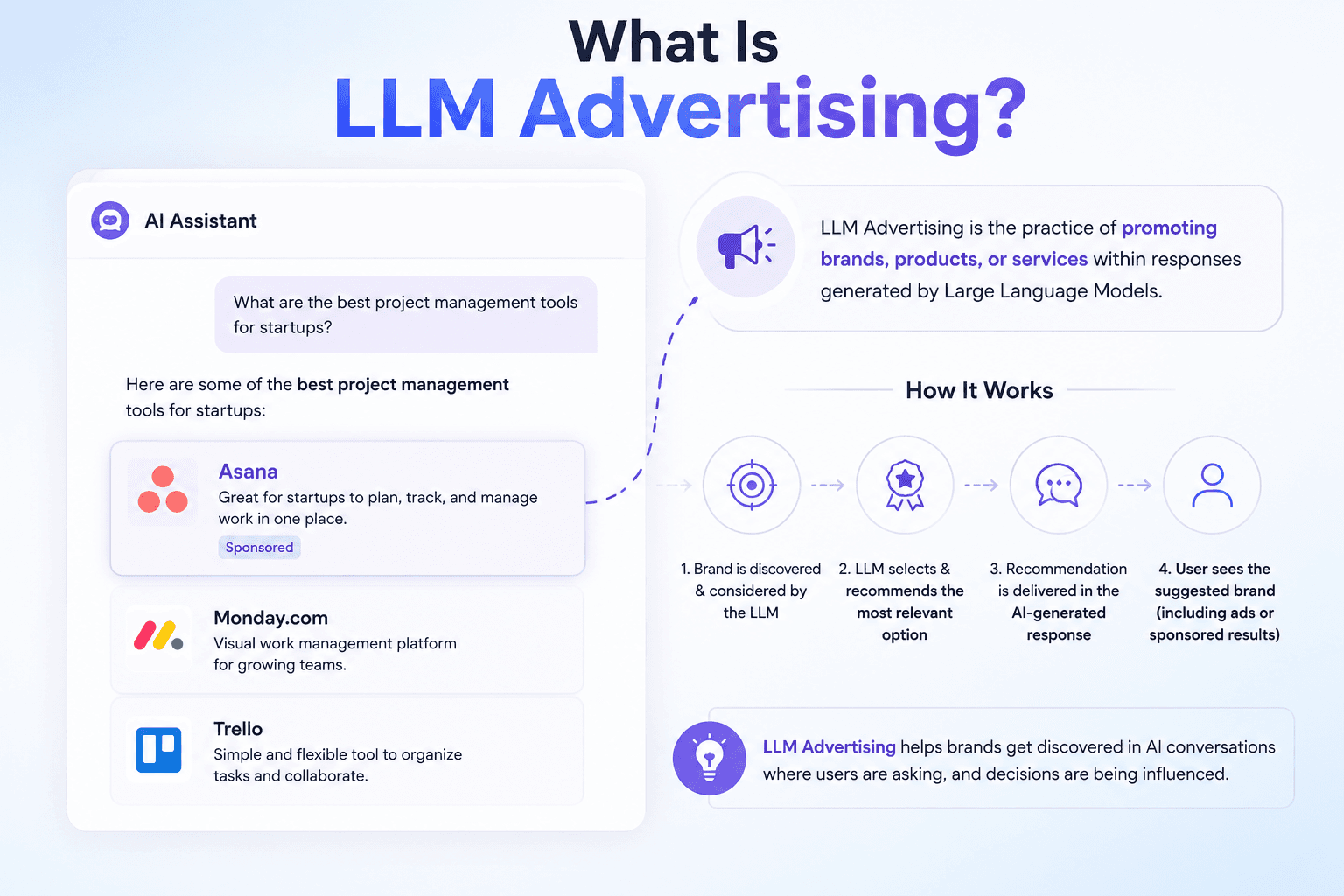
It works because these systems generate answers by drawing on two things: what they learned during training, and what they retrieve in real time from the web (via search integrations or retrieval-augmented generation, "RAG"). GEO practitioners try to influence both — building content today that's structured and authoritative enough to be retrieved and cited now, while also building the kind of consistent, well-corroborated brand presence across the web that shapes how future model training understands who you are and what you're good at.
Concretely, this includes:
Entity optimization — making sure a brand is clearly and consistently defined as a distinct "entity" across its website, Wikipedia/Wikidata (where relevant), knowledge panels, and third-party profiles, so AI systems don't confuse it with a competitor.
Structured data and schema markup — machine-readable tags that help crawlers and retrieval systems understand what a page is actually about.
Citation building — earning mentions on the kinds of sites (review platforms, comparison articles, trade press, forums like Reddit) that LLMs draw on heavily when forming an answer.
Answer-ready content structure — writing in a way that directly answers a likely question in the first few sentences, rather than burying the answer under 800 words of preamble built for keyword density.
AI visibility tracking — monitoring, often with specialized tools, how and whether a brand shows up across ChatGPT, Perplexity, Gemini, and AI Overviews for a target set of prompts.
LLM Advertising vs. Traditional PPC
Traditional PPC (Google/Meta Ads) | LLM Advertising / GEO | |
|---|---|---|
How you "buy" visibility | Bid on keywords/placements | No standardized ad marketplace yet; visibility is earned through content, structure, and authority |
Speed to results | Near-immediate | Typically weeks to months |
Measurement | Mature (clicks, CPC, ROAS) | Immature; relies on AI-visibility trackers and citation monitoring |
Control | High — you control the exact ad | Low-to-moderate — you influence, but don't control, what the model says |
Durability | Stops the moment budget stops | Can compound over time as authority builds |
Primary lever | Bid + ad quality score | Entity clarity, structured data, third-party citations, content quality |
Why LLM Advertising Matters in 2027
A few converging trends explain why this category has moved from "interesting experiment" to "board-level priority" for many marketing teams:
AI Overviews are now a default part of Google search results for a large share of informational and commercial-investigation queries, which means brands can rank well organically and still lose the click to a synthesized answer.
ChatGPT, Gemini, and Copilot have become research tools, not just chat novelties — people ask them to shortlist vendors, compare products, and explain unfamiliar categories before ever visiting a company's website.
Perplexity has built its entire product around citations, making it one of the clearest environments to actually see whether — and why — a brand gets referenced.
Voice assistants and multimodal search are extending the same "one answer, no results page" dynamic to phones, earbuds, and smart speakers.
The practical effect: the funnel is compressing. A prospect can now form a shortlist, and even a preliminary opinion of your brand, without a single visit to your site. If your competitor is the one being cited when that happens, you're losing the deal before you know it exists.
How LLM Advertising Works: The Process
Most credible agencies in this space follow a version of the same core sequence:
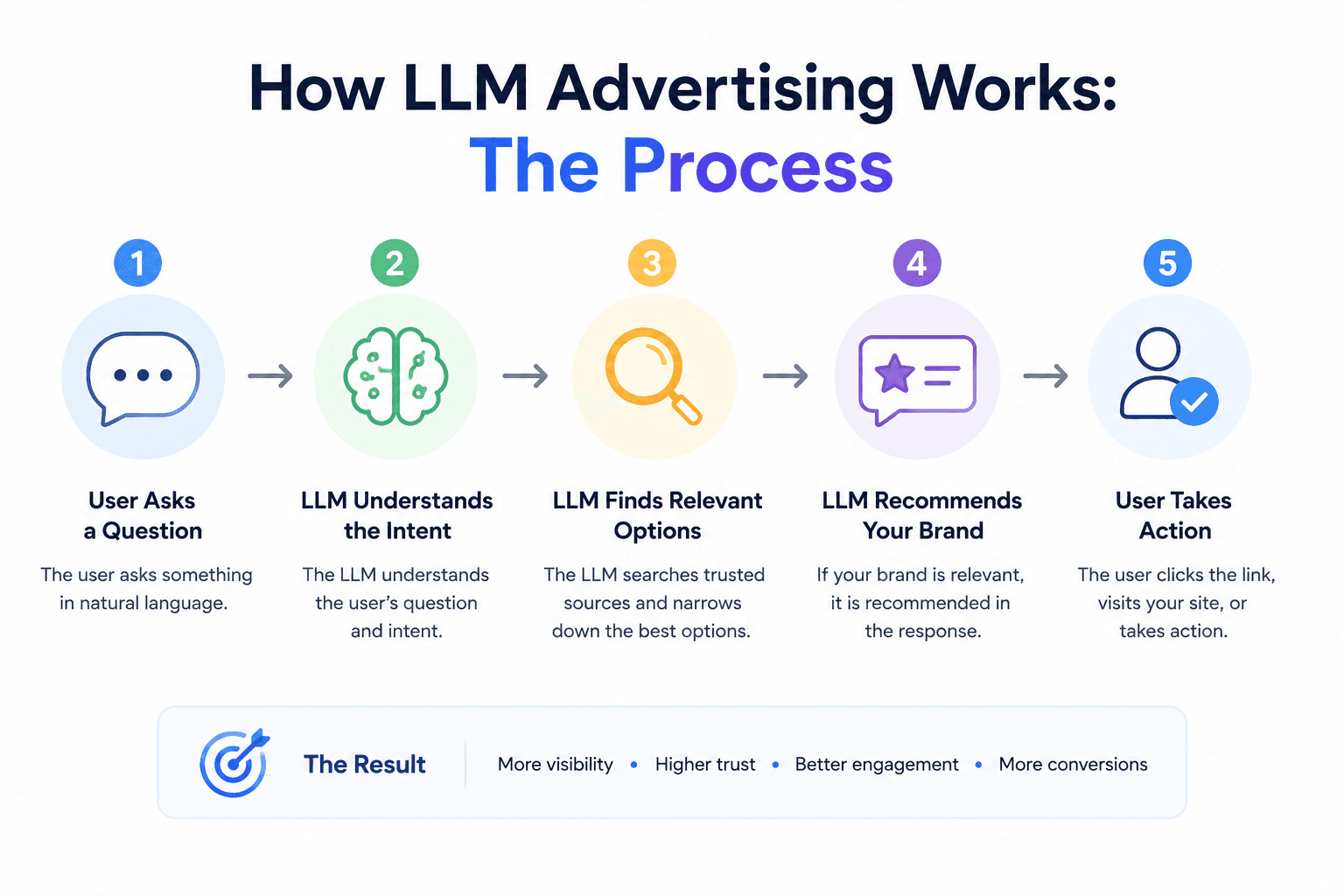
AI visibility audit — testing a set of realistic prompts across ChatGPT, Gemini, Claude, Perplexity, and AI Overviews to see whether, how, and how favorably the brand currently appears, and who the AI systems cite instead.
Entity and knowledge-graph cleanup — resolving inconsistencies in how the brand is described across its own site, directories, review platforms, and structured data.
Technical GEO foundation — schema markup, clean crawlability for AI bots, fast and accessible page structure.
Content restructuring and creation — rewriting or building content that answers real questions directly, supports claims with evidence, and is organized so a model can extract a clean, accurate summary.
Citation and digital PR — earning coverage and mentions on the third-party sites that generative engines lean on most heavily as corroborating sources.
Ongoing measurement and iteration — re-running the prompt audit on a cadence (often monthly) to see whether visibility and citation share are moving in the right direction, since model behavior shifts as the underlying systems are updated.
Top LLM Advertising / GEO Agencies in the USA
The list below draws on agencies that appear repeatedly across independent 2026 GEO rankings and have documented, checkable service offerings in this space. Where an agency publishes specific results or founding details, we've noted them and, where possible, indicated the source is the agency's own claim rather than independently audited. Treat client-reported statistics as directional, not verified, and confirm current pricing directly with each agency — public pricing is rare in this category.
1. Verbinden
An agency built specifically around GEO/AEO rather than SEO-with-an-AI-label-added. Founded in 2018, Verbinden has developed a methodology that maps conversational queries, topic clusters, and structured data signals that AI systems favor, then builds content ecosystems designed to earn consistent citations across ChatGPT, Google AI Overviews, Perplexity, and other generative platforms.
Best for: B2B companies wanting an AI-first (not SEO-retrofitted) partner.
Watch for: As a newer, GEO-only shop, it has a shorter overall agency track record than the multi-decade generalists on this list.
2. Silverback Strategies
Frames GEO as an extension of performance marketing rather than a stand-alone experiment. Silverback runs 500-plus tests per year across SEO, paid media, community visibility, and emerging AI search environments, and its reporting goes beyond surface-level visibility metrics to connect generative search presence and community/social discovery to qualified outcomes.
Best for: Performance-marketing teams that want GEO tied to revenue reporting, not just visibility scores.
3. Siege Media
A content-and-authority-first agency with a longer track record in traditional SEO now applying that model to GEO. Siege Media has built one of the most respected content marketing and GEO practices in the industry, with particular strength in B2C markets, and has worked with major consumer brands including Adidas and EverlyWell.
Best for: Consumer brands that need high-volume, high-quality content as the primary GEO lever.
4. Victorious
One of the longest-established firms now offering a dedicated AI-visibility line. Victorious, headquartered in Houston, Texas and founded in 1999, offers AI visibility, LLM visibility, SEO, structured data, and digital growth consulting, and its answer-engine-optimization line focuses on structuring and validating pages so systems can surface them as credible answers.
Best for: Brands that want GEO from an agency with a long, auditable SEO history rather than a GEO-only startup.
5. WebFX
A large, full-service digital marketing shop that has built a proprietary platform for AI-visibility tracking. WebFX delivers GEO through its OmniSEO platform, blending technical SEO, authoritative content, and trust signals to secure citations in ChatGPT, Perplexity, Google AI Overviews, Copilot, and Meta AI, starting audits with its RevenueCloudFX tool to track AI visibility across ten-plus platforms.
Best for: Companies wanting GEO bundled with broader digital marketing (PPC, social, content) under one roof.
6. Go Fish Digital
A technically minded agency that treats GEO as a mix of content, technical accessibility, and citation-driven tactics. Go Fish Digital's internal toolkit includes a Semantic Content Audit, an AI Overview Analyzer, and a proprietary tool called Barracuda that evaluates pages against Google-patent-related signals.
Best for: Enterprise sites with technical or crawlability issues blocking AI visibility.
7. SeoProfy
An Orlando-based agency with an unusually long testing history for this category. SeoProfy's team has been testing AI search tactics since early 2023 and has applied that work across 200-plus clients in different niches.
Best for: Mid-market brands wanting a proven, iterative GEO process rather than a first-time offering.
8. Genevate
A GEO-and-PR hybrid built specifically for the generative-AI era. Founded by Brett Kleinberg, a veteran New York public relations strategist, Genevate pairs GEO with strategic PR to drive lead generation and strengthen brand reputation, working across real estate, law, healthcare, education, and executive search.
Best for: Professional-services brands where trust and third-party validation matter as much as content volume.
9. Intero Digital
A large, multi-service agency with a trademarked GEO methodology. Intero Digital offers a trademarked "Intero GRO" (Generative Response Optimization) service that combines modern SEO, digital PR, customized content strategy, and cross-platform engagement, supported by a proprietary crawler-simulation tool called InteroBot.
Best for: Companies that want GEO as one line item inside a broad, established marketing program.
10. Directive
A B2B-focused agency positioning itself squarely around GEO for that segment. Directive positions itself as a top generative engine optimization agency for B2B brands, with over a decade of experience and a process built to get client content and messaging inside ChatGPT, Gemini, and other LLMs.
Best for: B2B SaaS and enterprise software marketers.
11. Thrive Agency
A large agency offering flexible, non-long-term-contract GEO engagements. Thrive centralizes AI-visibility reporting into a single dashboard and operates on a month-to-month engagement model rather than long-term contracts, keeping the relationship performance-driven.
Best for: Companies that want to test GEO without a 12-month commitment.
12. Mint Studios
A boutique agency specializing in a single, high-compliance vertical. Mint Studios is a GEO and SEO content marketing agency specialized in financial services, built around ensuring compliance, authority, and content structured so LLMs can parse and reuse it without distorting the message.
Best for: Regulated industries (finance, insurance, healthcare) where AI answers can easily oversimplify or misstate complex claims.
A note on smaller and niche players: Firms like Growth Hackers, Organic Hackers, Position Digital, LSEO, Seeders, Minuttia, and Chilli Fruit also show up consistently in independent 2026 GEO rankings, often with vertical specializations (construction, SaaS, cross-border markets, senior living, and similar). If none of the twelve above fit your industry or budget, they're worth a look — but confirm any performance claim before you cite it in a decision memo.
Services Offered by LLM Advertising Agencies
A mature GEO engagement typically bundles some combination of:
AI visibility audits — baseline testing across ChatGPT, Gemini, Claude, Perplexity, and AI Overviews
Entity and knowledge-graph optimization — cleaning up how a brand is defined across the web
Schema and structured data implementation
Content strategy and creation built for answer-readiness
Digital PR and citation building
Technical GEO auditing (crawlability, page structure, machine-readability)
AI analytics and ongoing citation tracking
Prompt-based competitive monitoring (who gets cited instead of you, and why)
Very few agencies currently sell standalone "AI ads" in the sense of paid placement inside a chatbot response — that market infrastructure largely doesn't exist yet in the U.S. What's being sold today is almost entirely earned visibility work, dressed in advertising-adjacent language because that's the budget line clients understand.
Read More : Top 10 ChatGPT Ad Agencies in India
How Much Do LLM Advertising Agencies Charge?
Public pricing is scarce in this category — most agencies quote custom scopes after an initial audit. The ranges below are estimates based on how comparable digital marketing and SEO services are typically priced, not confirmed rate cards, and should be validated with each agency directly.
Tier | Typical Monthly Retainer (Est.) | Typical Scope |
|---|---|---|
Starter / Small Business | $1,500 – $4,000 | Basic AI visibility audit, light schema cleanup, limited content |
Growth | $4,000 – $10,000 | Ongoing content production, citation building, monthly AI-visibility tracking |
Enterprise | $10,000 – $30,000+ | Full technical GEO program, dedicated PR/citation team, custom dashboards |
Fortune 500 / Complex | Custom, often six figures annually | Multi-brand, multi-market programs with proprietary tooling |
Project-based pricing (a one-time audit or content sprint) commonly runs from a few thousand dollars into the low tens of thousands, depending on site size. Hourly consulting, where offered, tends to sit in the same general band as senior SEO or digital strategy consulting. Performance-based pricing tied to AI citation share is emerging but still rare, largely because citation tracking itself isn't fully standardized yet — be cautious of any agency promising guaranteed placement in a specific AI answer, since no agency controls what a model outputs.
How to Choose the Right Agency: A Checklist
Do they show real, checkable GEO case studies — not just repurposed SEO wins with "AI" added to the title?
Can they explain, in plain language, how RAG and citation retrieval actually work? Vague answers here are a warning sign.
Do they test across multiple platforms (ChatGPT, Gemini, Claude, Perplexity, Copilot, AI Overviews) rather than optimizing for just one?
Do they have their own visibility-tracking tooling, or are they relying entirely on manual spot-checks?
Is content quality genuinely strong, independent of AI framing — GEO does not work on thin, generic content?
Do they understand entity and schema markup at a technical level, not just conceptually?
How do they report results, and how often? Monthly citation tracking is a reasonable minimum cadence given how fast model behavior shifts.
Are they transparent about what's estimated versus measured? Good agencies are upfront that this channel's measurement is still maturing.
Do they understand your specific industry's compliance and accuracy requirements (especially in healthcare, finance, and legal)?
Can they scale the engagement as you move from a single-market test to a broader program?
Questions to Ask Before Hiring
Which AI platforms do you actively test and optimize for?
Can you show a before/after AI visibility audit from a real client?
What's your process for identifying which prompts matter for our category?
How do you measure success beyond "we got mentioned once"?
Who are the specific people who'll work on our account, and what's their background?
Do you build proprietary tools, or rely on third-party platforms like Semrush and Ahrefs?
How do you handle schema and structured data implementation — in-house or subcontracted?
What's your approach to digital PR and third-party citation building?
How often do you re-run visibility audits, and why that cadence?
How do you keep up with changes to how ChatGPT, Gemini, or Google AI Overviews source information?
What happens if a platform's algorithm update tanks our visibility?
Can you separate GEO-attributable results from normal organic SEO growth in your reporting?
What's your minimum contract length, and is there a lower-commitment pilot option?
How do you handle factual accuracy and compliance review for regulated industries?
Do you have experience in our specific vertical?
What does a typical first 90 days look like?
How do you prioritize which pages or topics to optimize first?
Do you offer any performance-based pricing, and how is performance defined?
What tools do you use for AI visibility tracking, and can we get direct dashboard access?
How do you handle content that AI models are misrepresenting or getting wrong about our brand?
What's realistic to expect in 3 months versus 12 months?
How transparent will your reporting be about what's working versus what isn't?
Do you outsource any part of the work, and to whom?
What happens to our content, data, and dashboards if we end the engagement?
Can you provide two or three references we can call directly?
Red Flags to Watch For
Guaranteed placement in a specific AI answer — no agency controls model output.
"AI" bolted onto an unchanged SEO deck with no evidence of platform-specific testing.
No willingness to show a live AI-visibility audit for a prospective client (even a rough one).
Vague or evasive answers about how RAG, citations, or entity optimization actually function.
Pricing that's suspiciously cheap relative to the scope promised — GEO is labor-intensive, not automated.
No mention of measurement or reporting cadence beyond "trust the process."
Overreliance on a single AI platform, ignoring the fact that ChatGPT, Gemini, Perplexity, and AI Overviews behave differently.
Long lock-in contracts with no early off-ramp, in a discipline this immature.
AI and SEO Tools Used by Top Agencies
Tool | Why It Matters for GEO |
|---|---|
ChatGPT / Gemini / Claude / Perplexity (direct testing) | Ground-truth checks of actual current visibility |
Semrush / Ahrefs | Backlink and authority data that still underpins a lot of AI-citation weighting |
Clearscope / Surfer SEO / MarketMuse / Frase | Content structuring and topical-coverage scoring |
Screaming Frog | Technical crawl audits to find AI-crawler accessibility issues |
Google Search Console / GA4 | Baseline organic traffic data to isolate GEO's incremental effect |
Looker Studio | Client-facing dashboards combining traditional and AI-visibility metrics |
Proprietary AI-visibility trackers (agency-specific, e.g., WebFX's RevenueCloudFX, Go Fish's AI Overview Analyzer) | Platform-specific citation and mention tracking, increasingly the differentiator between agencies |
LLM Advertising vs. Traditional Digital Marketing
Channel | Primary Goal | Time to Results | Measurability | Control Over Output |
|---|---|---|---|---|
SEO | Rank in search results | Months | High | Moderate |
PPC | Immediate paid visibility | Immediate | Very high | High |
Social Media | Engagement, brand awareness | Weeks–months | High | High |
Direct conversion, retention | Immediate | Very high | High | |
Content Marketing | Authority, organic demand | Months | Moderate | High |
PR | Earned media, reputation | Weeks–months | Low–moderate | Low |
LLM Advertising / GEO | Citation and recommendation in AI answers | Weeks–months | Low–moderate (maturing) | Low |
Future Trends (2027–2030)
Agentic AI marketing — AI agents that don't just answer questions but complete tasks (booking, purchasing, comparing) on a user's behalf, making "being the default recommendation" even more valuable.
AI shopping assistants built directly into browsers and operating systems, compressing the ecommerce funnel further.
Formalized AI ad marketplaces — expect platforms to eventually introduce more structured, paid placement mechanisms, though the standards for this remain unsettled as of mid-2026.
Multimodal and voice-first search growing as a discovery surface, particularly for local and product queries.
Predictive, personalized AI recommendations that vary answer content based on inferred user intent and history.
Maturing measurement standards — expect third-party AI-visibility tracking tools to consolidate and standardize, the way rank trackers did for SEO in the 2010s.
Final Recommendation by Business Type
Startups: Start lean — a single AI-visibility audit and a focused content sprint on your core 10–20 use-case questions, before committing to a large retainer.
SaaS: Prioritize agencies with genuine B2B GEO experience (Directive, Verbinden) and comparison-content strength, since buyers heavily research software categories via AI tools.
Healthcare: Compliance-aware content and rigorous fact-checking matter more than volume; prioritize accuracy review processes over speed.
Finance: Look for agencies with regulated-industry experience (e.g., Mint Studios) given how easily AI systems can oversimplify financial claims.
Ecommerce: Content-led, high-volume agencies (Siege Media) tend to fit best, paired with strong product schema markup.
Enterprise: Favor agencies with proprietary tracking tools and technical depth (WebFX, Go Fish Digital, Silverback) that can operate at scale across large sites.
Local businesses: GEO is still maturing for hyper-local queries; a lighter-touch engagement focused on directory consistency, reviews, and local schema is usually sufficient before investing in a full program.
Frequently Asked Questions
What is LLM advertising?
LLM advertising refers to strategies that help a brand get mentioned, cited, or recommended by AI systems like ChatGPT, Gemini, Claude, and Perplexity when users ask relevant questions. It's closer to a hybrid of SEO, digital PR, and structured-data engineering than to traditional paid advertising, since there's currently no standardized way to simply buy a placement inside an AI-generated answer.
How does ChatGPT recommend brands?
ChatGPT draws on a combination of what it learned during training and, when connected to web search or retrieval tools, real-time information it retrieves from the web. Brands with clear, consistent, well-corroborated information across authoritative sources are more likely to be recognized and cited accurately.
Are LLM ads replacing Google Ads?
Not currently. Paid placement inside AI chat responses isn't a standardized, purchasable product in the U.S. market yet. What's growing is earned visibility (GEO), which sits alongside, rather than replaces, paid search.
What is GEO? Generative Engine Optimization is the practice of optimizing content, structure, and third-party citations so generative AI platforms are more likely to surface and recommend a brand in their answers.
How much does LLM marketing cost?
Estimates for agency retainers commonly range from roughly $1,500/month for small-business scopes up to $30,000+/month for enterprise programs, though public pricing is rare and every quote should be confirmed directly with the agency.
Which agency is best?
There's no single "best" — the right choice depends on industry, budget, and whether you need a GEO specialist or GEO bundled into broader digital marketing. Compare case studies, platform coverage, and reporting transparency rather than relying on a ranked list alone.
How long does AI visibility take to build?
Most agencies report early movement within 4–8 weeks for narrow, well-defined topics, with meaningful, durable visibility typically taking 3–6 months or longer, especially in competitive categories.
Can small businesses benefit from GEO?
Yes, particularly for well-defined, low-competition questions in their niche, but small businesses should start with a narrow scope rather than a full enterprise-style program.
Is LLM advertising measurable?
Partially. AI-visibility tracking tools can show whether and how often a brand is mentioned across platforms, but the discipline lacks the mature, standardized attribution models that exist for PPC or email marketing.
What's the difference between SEO and AI search optimization?
Traditional SEO optimizes primarily for ranking in a results list that a human scans. AI search optimization (GEO) optimizes for being accurately extracted, summarized, and cited inside a single synthesized answer — which places more weight on clarity, structured data, and third-party corroboration.
Do I need a separate agency for GEO, or can my SEO agency handle it?
Many established SEO agencies now offer GEO as an add-on. The key question isn't whether they have SEO experience — it's whether they can show platform-specific testing and results for AI systems specifically, not just repackaged SEO tactics.
What industries benefit most from LLM advertising right now?
B2B software, professional services, and consumer categories with high research intent (finance, healthcare, major purchases) tend to see the clearest early value, since buyers in those categories are more likely to consult AI tools before purchasing.
Can GEO hurt my traditional SEO?
Done well, no — the underlying work (better structured, more authoritative, more clearly written content) tends to support both. Be cautious of tactics aimed narrowly at "gaming" AI citations at the expense of genuine content quality, which can backfire in both channels.
How do I know if my brand is already being cited by AI platforms?
Run a set of realistic prompts a customer might ask — directly in ChatGPT, Gemini, Claude, and Perplexity — and note whether your brand appears, how it's described, and who's cited instead. This manual check is a reasonable first step before hiring anyone.
Is this a passing trend or a permanent shift?
The underlying behavior change — people asking AI systems questions they used to type into a search box — appears durable given current adoption trends, even though the specific tools, platforms, and measurement standards are still very much in flux.
Disclosure: Agency descriptions and statistics above are drawn from each agency's own public claims and independent third-party GEO rankings current as of mid-2026, and are presented as reported, not independently audited. Pricing figures are estimates for planning purposes only. Confirm current details directly with each agency before making a hiring decision.