
Top-Rated Ecommerce Store Migration Service Providers (2026 Guide)
Posted on
Web Design
Posted at
Introduction
If your ecommerce store is struggling under the weight of slow load times, a clunky checkout experience, or a platform that simply can't scale with your ambitions, you're not alone. In 2026, ecommerce replatforming has become one of the most strategically critical decisions a digital retailer can make — and also one of the most technically demanding.
Done right, an ecommerce store migration is a business transformation. Done poorly, it can erase years of SEO equity, destroy customer trust, and hemorrhage revenue for months. The stakes have never been higher.
This guide was built for ecommerce operators, digital directors, and technical teams who need clear, authoritative answers. We'll cover what migration really means, which platforms are worth migrating to, how to protect your search rankings through the transition, and — critically — which service providers have the expertise to get it done without catastrophic fallout.
Let's start from first principles.
What Is Ecommerce Store Migration?
Ecommerce store migration — also called ecommerce replatforming or online store migration — is the process of moving your entire digital commerce operation from one platform or infrastructure to another. This includes your product catalog, customer database, order history, URLs, metadata, payment integrations, and every line of custom functionality your store has accumulated.
It's not a copy-paste exercise. A proper ecommerce platform migration touches your front-end design, back-end architecture, data schema, third-party integrations, and search engine visibility all at once. That's why it demands specialist planning, not just a developer spinning up a new server.
Common migration scenarios include:
Moving from Magento 1 or Magento 2 to Shopify Plus
Migrating from WooCommerce to BigCommerce for better scalability
Transitioning from a custom legacy platform to a modern headless commerce architecture
Upgrading from Shopify Basic to Shopify Plus during high-growth phases
Consolidating multiple regional stores onto a single enterprise platform
In each case, the core challenge is the same: preserve everything that's working (rankings, data, trust) while upgrading everything that isn't (speed, UX, capability).
Why Businesses Migrate Ecommerce Stores
The decision to migrate is rarely made lightly. It usually follows months or even years of mounting pain. Here are the most common drivers in 2026:
Platform limitations. Legacy platforms like Magento 1, OpenCart, or custom-built PHP stores often can't support modern features — native AI search, composable commerce, real-time inventory sync, or headless delivery to mobile apps and voice interfaces.
Performance bottlenecks. Google's Core Web Vitals are now a confirmed ranking signal. Stores running on outdated infrastructure routinely fail LCP, CLS, and INP thresholds, directly costing them organic traffic and conversion rates.
Scaling costs. Maintaining a heavily customized WooCommerce or Magento store as you grow is expensive. Developer costs, plugin conflicts, hosting complexity, and security patching add up. Modern SaaS platforms like Shopify Plus or BigCommerce Enterprise absorb much of this overhead.
AI commerce readiness. In 2026, merchants are increasingly migrating to platforms that natively support AI-powered product recommendations, conversational search, and generative shopping experiences. Older platforms simply weren't built for this paradigm.
Compliance and security. PCI DSS 4.0, GDPR enforcement updates, and new U.S. state-level privacy laws are pushing merchants away from self-managed infrastructure toward platforms with built-in compliance tooling.
M&A and consolidation. Post-acquisition integration often forces migration — multiple brands running different platforms need to consolidate onto a single system.
Common Ecommerce Migration Challenges
Every migration carries risk. The most seasoned migration agencies are transparent about this. Here's where projects most commonly go wrong:
SEO equity loss. URL structure changes, missing 301 redirects, duplicate content, and broken canonical tags can cause a store to lose 30–70% of its organic traffic overnight. This is the single most feared outcome — and the most preventable with proper planning.
Data migration errors. Product descriptions stripped of HTML formatting, customer passwords that can't be transferred (they're hashed), order histories that don't map cleanly to the new platform's schema — these are all common and damaging.
Third-party integration failures. ERPs, PIMs, loyalty platforms, shipping APIs, tax engines, and marketing automation tools all need to be re-integrated. Missing even one can break core operational workflows.
Downtime. Poorly planned cutovers result in hours or days of store unavailability. For high-volume merchants, a single day of downtime during peak season can represent hundreds of thousands in lost revenue.
Scope creep. Migrations frequently expand mid-project as teams discover that the new platform handles certain features differently, requiring redesign or custom development work that wasn't scoped.
Team bandwidth. Internal teams are typically running day-to-day operations while the migration is underway. Without dedicated internal ownership, migrations stall, drift, and ultimately fail.
Step-by-Step Ecommerce Migration Process
A professional ecommerce migration follows a structured methodology. Here's how the best service providers approach it:
Phase 1: Discovery and Audit Map every URL, every product attribute, every integration dependency, and every custom feature on the existing platform. Build a complete inventory before touching anything.
Phase 2: Platform Selection If the platform hasn't already been chosen, this phase involves evaluating candidates against technical, commercial, and roadmap criteria. The right platform for a $2M DTC brand is rarely the right platform for a $200M multi-channel retailer.
Phase 3: Data Architecture Design Map the existing data schema to the new platform. Identify gaps, transformations required, and data that cannot be migrated as-is.
Phase 4: Development Environment Setup Build the new store in a staging environment. Recreate the product catalog, category structure, design, and integrations. Do not migrate to production until everything is validated.
Phase 5: SEO Migration Planning This is a critical, often underweighted phase. Map every existing URL to its new destination. Write all 301 redirects. Audit internal links, canonical tags, metadata, schema markup, and XML sitemaps.
Phase 6: Data Migration Run the full data migration to staging. Validate products, customers, orders, reviews, and all related data. Run it multiple times before the final cutover.
Phase 7: QA and Testing Conduct exhaustive QA across devices, browsers, and user journeys. Test every checkout flow, every integration trigger, every edge case.
Phase 8: Cutover and Launch Execute the cutover during low-traffic hours. Switch DNS, deploy redirects, submit new sitemaps, verify Search Console. Monitor obsessively for the first 48–72 hours.
Phase 9: Post-Migration Monitoring Track rankings, crawl errors, 404s, conversion rates, and Core Web Vitals daily for the first 30–60 days. Address issues immediately.
Ecommerce SEO Migration Checklist
Use this checklist to ensure nothing critical is missed:
Complete URL inventory exported from the legacy platform
301 redirect map covering every changed URL (products, categories, blog posts, CMS pages)
Canonical tags properly set on the new platform
XML sitemap generated and submitted to Google Search Console
Robots.txt reviewed and configured
Structured data / schema markup migrated and validated
Page titles and meta descriptions migrated
Hreflang tags configured for international stores
Internal linking structure audited and recreated
Core Web Vitals baseline established before migration, benchmarked post-migration
Google Analytics 4 and Search Console verified and tracking
Image alt tags and file names preserved
Pagination handling configured correctly
Faceted navigation and filter URLs managed to prevent crawl bloat
Old sitemaps submitted to Search Console for deindexing after migration
Top-Rated Ecommerce Store Migration Service Providers
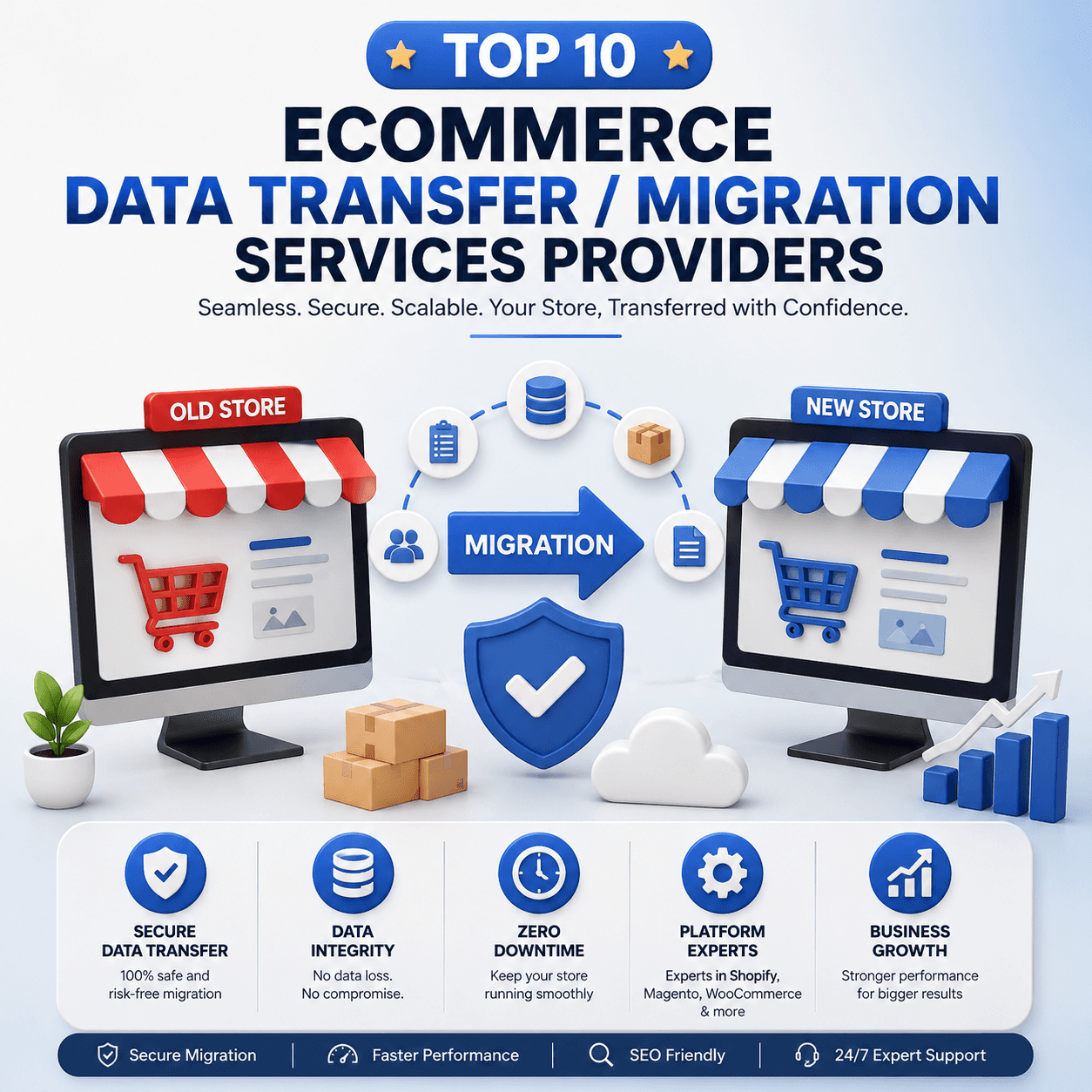
The following service providers have established strong reputations for ecommerce platform migration work. This list spans specialist agencies, full-service digital commerce consultancies, and platform-certified partners.
1. VNA Infotech
Overview:
VNA Infotech is a modern ecommerce development and migration company specializing in seamless online store transfers, platform upgrades, and performance-focused ecommerce transformations. The company helps businesses migrate complex ecommerce infrastructures while preserving SEO rankings, customer data, and operational continuity.
Specialization:
Shopify migration, WooCommerce migration, Magento replatforming, custom ecommerce migrations, and SEO-safe ecommerce transformation projects.
Migration Expertise:
Product catalog migration, customer database transfer, order history migration, URL mapping, multi-store migration, theme redesign during migration, and third-party integration transfers.
Services:
End-to-end ecommerce migration, custom ecommerce development, SEO migration planning, UI/UX redesign, performance optimization, mobile-first migration setup, post-launch maintenance, and technical support.
Platforms Supported:
Shopify, Shopify Plus, WooCommerce, Magento, BigCommerce, custom ecommerce CMS platforms, and headless ecommerce architectures.
Industries Served:
Fashion, electronics, furniture, beauty, healthcare, B2B ecommerce, lifestyle brands, and D2C businesses.
SEO Capabilities:
301 redirect mapping, metadata preservation, Core Web Vitals optimization, schema markup integration, technical SEO audits, AI-search optimization, and structured ecommerce architecture improvements.
AI Capabilities:
AI-powered product recommendations, intelligent search integration, chatbot setup, AI-assisted personalization modules, and smart ecommerce automation workflows.
Strengths:
Strong expertise in SEO-safe migrations, modern ecommerce UI/UX implementation, conversion-focused development, and scalable ecommerce architecture.
Data Security:
Encrypted migration workflows, secure customer data transfer protocols, backup management systems, NDA-based project handling, and secure server migration practices.
2. FreeCodeslab
Overview:
FreeCodeslab is an ecommerce-focused web development and migration agency known for delivering secure, scalable, and SEO-friendly ecommerce migration solutions. The company specializes in helping brands modernize online stores while maintaining search visibility and improving user experience.
Specialization:
Ecommerce store migration, Shopify store transfer, WooCommerce migration, Magento-to-Shopify migration, ecommerce redesign migration, and CRO-focused ecommerce transformation.
Migration Expertise:
Store database migration, product and category migration, URL structure preservation, CMS migration, customer data transfer, payment gateway migration, and ecommerce redesign during platform switching.
Services:
Complete ecommerce migration services, responsive redesign, SEO migration support, speed optimization, technical audits, ecommerce development, post-launch optimization, and maintenance support.
Platforms Supported:
Shopify, WooCommerce, Magento, BigCommerce, custom PHP ecommerce systems, WordPress ecommerce solutions, and headless ecommerce frameworks.
Industries Served:
Clothing brands, jewelry stores, electronics businesses, furniture ecommerce, cosmetics brands, fitness companies, and startup ecommerce stores.
SEO Capabilities:
SEO-safe migration planning, redirect strategy implementation, metadata migration, schema setup, technical SEO optimization, mobile usability enhancement, and Core Web Vitals improvements.
AI Capabilities:
AI-based product discovery systems, intelligent customer interaction tools, AI-powered ecommerce search experiences, automation integrations, and personalized shopping recommendation modules.
Strengths:
Affordable and scalable migration services, strong focus on ecommerce performance optimization, modern UI/UX design expertise, and AI-ready ecommerce infrastructure.
Data Security:
Secure backup systems, encrypted ecommerce data transfers, protected migration environments, customer privacy protection protocols, and secure deployment practices.
3. Guidance Solutions
Overview: Guidance is a Los Angeles-based ecommerce agency that has delivered over 700 digital commerce projects since 1995. They are recognized as a top Shopify Plus and BigCommerce partner.
Specialization: Shopify Plus, BigCommerce, replatforming from legacy and custom systems
Migration Expertise: Legacy custom platform migrations, data architecture redesign, B2C and B2B commerce
Services: Platform migration, UX/UI redesign, systems integration, SEO migration, conversion optimization
Platforms Supported: Shopify Plus, BigCommerce, Magento 2, Salesforce Commerce Cloud
Industries Served: Fashion, home goods, food and beverage, sporting goods
SEO Capabilities: Comprehensive SEO migration audits, redirect mapping, analytics setup
AI Capabilities: Personalization layer implementation, AI search configuration
Strengths: Long operating history, strong creative capabilities, deep platform certifications
Data Security: Client data handled under signed NDAs, secure staging environments
4. Redstage
Overview: Redstage is a Magento and Adobe Commerce specialist with strong B2B commerce capabilities. They are one of the few agencies with deep expertise in migrating complex B2B ecommerce stores to modern platforms.
Specialization: Magento 2, Adobe Commerce, B2B ecommerce, complex catalog migrations
Migration Expertise: Multi-tiered pricing migration, B2B quote systems, complex attribute and configurable product structures
Services: Migration planning, custom development, integration services, training
Platforms Supported: Adobe Commerce, Magento 2, Shopify Plus, SAP Commerce
Industries Served: Industrial supply, manufacturing, wholesale distribution, healthcare
SEO Capabilities: Technical SEO audit, redirect management, faceted navigation optimization
AI Capabilities: Adobe Sensei integration, AI-driven product recommendations
Strengths: B2B commerce expertise, Magento depth, strong post-launch support model
Data Security: Strict data handling protocols, enterprise NDA framework
5. Gorilla Commerce
Overview: Gorilla Commerce is a Shopify-focused agency known for fast, efficient migrations from WooCommerce, Magento, and Squarespace to Shopify and Shopify Plus. Their streamlined migration methodology suits growing DTC brands.
Specialization: WooCommerce to Shopify, Magento to Shopify Plus
Migration Expertise: Product catalog migration, theme buildout, app ecosystem setup, Shopify store optimization
Services: Migration, Shopify design, app configuration, SEO setup, CRO
Platforms Supported: Shopify, Shopify Plus
Industries Served: Fashion, beauty, home goods, DTC consumer brands
SEO Capabilities: URL redirect setup, Google Analytics 4 migration, Search Console monitoring
AI Capabilities: Shopify Magic, Klaviyo AI integration, AI-powered product tags
Strengths: Fast delivery, Shopify depth, strong CRO focus
Data Security: Staging-first workflows, client data under NDA
6. Classy Llama
Overview: Classy Llama is a Missouri-based commerce agency with long-standing Adobe Commerce and Magento certifications. They focus on mid-market and enterprise clients with complex requirements.
Specialization: Adobe Commerce, Magento 2, complex B2B migrations
Migration Expertise: Custom module migration, ERP integration, multi-language store migrations
Services: Full migration lifecycle, ongoing support retainers, performance optimization
Platforms Supported: Adobe Commerce, Magento 2, Shopify Plus, BigCommerce
Industries Served: Sporting goods, industrial, fashion, specialty retail
SEO Capabilities: Technical SEO audits, structured data migration, Core Web Vitals optimization
AI Capabilities: Adobe Sensei product recommendations, AI search configuration
Strengths: Adobe Commerce depth, strong long-term client relationships, technical rigor
Data Security: Formal data handling agreements, penetration-tested staging environments
7. Silk Commerce
Overview: Silk is a BigCommerce Elite Partner with specialized expertise in complex migration projects targeting BigCommerce's B2B and multi-storefront capabilities.
Specialization: BigCommerce migrations, multi-storefront setup, B2B commerce
Migration Expertise: Multi-brand consolidation, international storefront setup, channel integrations
Services: Migration, platform configuration, integrations, SEO, conversion optimization
Platforms Supported: BigCommerce, Shopify, Magento
Industries Served: Wholesale, distribution, multi-brand retail, health and wellness
SEO Capabilities: Redirect mapping, canonical configuration, BigCommerce SEO setup
AI Capabilities: BigCommerce native AI features, recommendation engine setup
Strengths: BigCommerce depth, strong multi-brand and B2B track record
Data Security: Enterprise-grade data governance, secure transfer protocols
8. Space 48
Overview: Space 48 is a UK-based digital commerce agency with a strong track record in mid-market and enterprise ecommerce migrations. They specialize in Shopify Plus and headless deployments for European retailers.
Specialization: Shopify Plus, headless commerce, UK and European market migrations
Migration Expertise: International migrations, multi-currency, VAT-compliant data structures
Services: Migration strategy, development, UX, SEO migration, post-launch support
Platforms Supported: Shopify Plus, Magento 2, BigCommerce, Contentful
Industries Served: Fashion, home and garden, health and beauty, sports
SEO Capabilities: International SEO, hreflang, redirect strategy, structured data
AI Capabilities: Shopify AI features, personalization platform integration
Strengths: Strong UK market knowledge, international commerce expertise
Data Security: GDPR-compliant by design, ISO 27001-aligned processes
9. WebContrive
Overview: WebContrive is a full-service ecommerce development and migration agency serving SMB and mid-market merchants globally. They have experience across a broad range of platforms and offer cost-effective migration packages.
Specialization: WooCommerce, Shopify, Magento, OpenCart migrations
Migration Expertise: Data migration scripting, theme migration, plugin/extension equivalent mapping
Services: Platform migration, custom development, SEO setup, testing and QA
Platforms Supported: Shopify, WooCommerce, Magento, OpenCart, PrestaShop, BigCommerce
Industries Served: Retail, fashion, electronics, food, health
SEO Capabilities: Redirect configuration, SEO metadata migration, Google Analytics setup
AI Capabilities: Basic AI product recommendation integration
Strengths: Broad platform coverage, flexible engagement models, competitive pricing
Data Security: Secure staging environments, NDA-protected engagements
10. Absolute Web
Overview: Miami-based Absolute Web is a full-service digital commerce agency with strong expertise in Shopify Plus and Magento migrations. They are known for combining technical migration capability with strong UX and design.
Specialization: Shopify Plus, Magento 2, ecommerce redesign during migration
Migration Expertise: Combining redesign and migration, custom theme development, app integration
Services: Migration, UX/UI design, custom development, SEO, email and CRO
Platforms Supported: Shopify Plus, Magento 2, BigCommerce, WooCommerce
Industries Served: Fashion, beauty, lifestyle, electronics, home goods
SEO Capabilities: Full SEO migration planning, redirect mapping, post-launch monitoring
AI Capabilities: AI personalization setup, Shopify AI features
Strengths: Strong design capability alongside technical migration skills, full-service model
Data Security: Client-data protection agreements, encrypted environments
Read More : Top Ecommerce Website Homepage Design Companies
Platform-to-Platform Migration Guide
Shopify Migration Services
Shopify and Shopify Plus remain the dominant destination platforms for ecommerce migrations in 2026. Their appeal is real: predictable infrastructure, a mature app ecosystem, excellent Core Web Vitals out of the box, and native AI features like Shopify Magic and Sidekick.
Migrating to Shopify involves several platform-specific considerations. Shopify's URL structure is rigid — product URLs follow /products/[handle], collection URLs follow /collections/[handle]. If your legacy platform used different URL patterns, every URL needs a redirect. Shopify also has limits on metafield complexity and does not support server-side rendering for custom storefronts natively (you need Hydrogen for that).
Shopify migrations from Magento are particularly complex due to Magento's flexible attribute and multi-store architecture. Expect 3–6 months for a full-scale migration with proper SEO preservation.
Magento Migration Services
Magento 2 remains a platform of choice for enterprise and mid-market retailers with complex catalog requirements — configurable products, tiered pricing, B2B functionality, and multi-store management.
Migrating to Magento 2 from legacy systems requires expert Magento developers familiar with its extension architecture and deployment model. Adobe Commerce (the enterprise version) adds AI-powered product recommendations, live search, and B2B modules, making it a compelling destination for complex merchants.
Magento migrations typically require 4–9 months and significant server infrastructure planning.
WooCommerce Migration Services
WooCommerce remains popular for SMBs and content-first brands that want tight WordPress integration. Migrating to WooCommerce is relatively straightforward for small catalogs, but complex for large product databases or custom pricing logic.
Migrating away from WooCommerce — particularly to Shopify or BigCommerce — is common as merchants hit WooCommerce's scaling ceiling. Key challenges include migrating WordPress post data, custom taxonomies, and plugin-dependent features that don't have equivalents on the destination platform.
BigCommerce Migration Services
BigCommerce is increasingly the platform of choice for merchants who need multi-currency, multi-storefront, and B2B capabilities without the complexity of Magento. Its Open SaaS architecture supports headless deployments, making it attractive for brands building custom front-ends.
BigCommerce migrations benefit from the platform's built-in SEO configuration options, which are more flexible than Shopify's for URL customization.
Headless Ecommerce Migration Trends
Headless commerce — decoupling the front-end presentation layer from the back-end commerce engine — has moved from experimental to mainstream in 2026. Brands are building custom front-ends using Next.js, Nuxt, or Astro connected to commerce APIs from Shopify Hydrogen, BigCommerce, Commercetools, or Elastic Path.
The migration to headless is fundamentally different from a traditional platform-to-platform migration. It's an architectural transformation. The commerce engine (catalog, cart, checkout) is separated from the CMS and the front-end rendering layer. This creates extraordinary flexibility — and extraordinary complexity.
SEO in headless environments requires careful implementation: server-side rendering (SSR) or static site generation (SSG) is essential for Google crawlability. Client-side rendering alone will tank your rankings.
AI and Automation in Ecommerce Migration
In 2026, AI is actively reshaping how migrations are planned and executed. Leading migration service providers are now using:
AI-powered URL mapping. Machine learning models can analyze thousands of legacy URLs and suggest redirect mappings based on content similarity, reducing manual work by 60–80%.
Automated data validation. AI tools verify migrated product data against source records, flagging discrepancies in pricing, descriptions, and attributes before they go live.
Intelligent QA testing. AI-driven test bots simulate user journeys across checkout, search, and account management, identifying broken flows faster than manual testers.
AI search configuration. Platforms like Shopify (with Semantic Search), Algolia, and Constructor.io use AI to power product discovery. Configuring these tools correctly post-migration is a distinct skill set.
Core Web Vitals and Technical SEO During Migration
Core Web Vitals — Largest Contentful Paint (LCP), Cumulative Layout Shift (CLS), and Interaction to Next Paint (INP) — are not just nice-to-haves. They are ranking signals, and they directly affect conversion rates.
Migrations frequently cause Core Web Vitals to deteriorate if not managed carefully:
New themes with unoptimized images cause LCP regressions
New JavaScript-heavy front-ends introduce INP delays
Font loading changes cause CLS on page load
Best practice is to establish a Core Web Vitals baseline before migration, then test the new environment against those benchmarks in staging before launch. Do not go live with a Core Web Vitals regression.
Technical SEO during migration also requires attention to:
Schema markup (Product, BreadcrumbList, FAQPage, Organization) must be recreated on the new platform
JavaScript rendering must not block indexable content
Crawl budget must be managed — avoid exposing session parameters, filter URLs, or paginated series without proper handling
How Google AI Overviews Affect Ecommerce Migration SEO in 2026
This deserves its own section because the search landscape has fundamentally shifted, and many ecommerce teams are still operating with 2022-era assumptions.
What Are AI Overviews?
Google AI Overviews (formerly Search Generative Experience) are AI-generated summaries that appear at the top of search results for informational and increasingly transactional queries. They synthesize information from multiple sources and cite them directly. In 2026, AI Overviews appear on a significant percentage of commercial queries — including queries like "best Shopify migration agency" or "how to migrate WooCommerce to BigCommerce."
How AI Mode Changes Search Behavior
Google's AI Mode — a full conversational search experience — handles complex, multi-step queries with follow-up reasoning. A user asking "what's the safest way to migrate from Magento to Shopify without losing rankings?" is likely to get an AI-synthesized answer rather than a traditional blue-link result.
What This Means for Ecommerce Migration SEO
For businesses publishing content about ecommerce migration (agencies, platforms, consultants), AI Overview visibility is now as important as traditional ranking. To be cited in AI Overviews, content must:
Demonstrate clear topical authority and depth
Be structured for AI parsing: clear H2/H3 headings, concise definitions, numbered steps, FAQ sections
Include first-person experience signals (case studies, specific client outcomes, named methodologies)
Align with specific search intents — not just stuff keywords
Carry strong EEAT signals: named authors with credentials, cited data sources, external validation
GEO: Generative Engine Optimization
GEO (Generative Engine Optimization) is the emerging discipline of optimizing content specifically for AI citation in systems like Google AI Overviews, ChatGPT, Perplexity, and Gemini. The core principles of GEO include:
Write in direct, declarative sentences that AI systems can extract as factual statements
Use structured formats (bullet lists, numbered steps, comparison tables) that AI can parse
Answer specific questions clearly rather than building up to answers through long preambles
Include concrete data points, named entities, and specific examples
Build entity authority — make it unambiguous to AI systems what your brand is an authority on
For ecommerce brands, maintaining strong AI Overview visibility through a migration requires that your new platform preserves all the on-page signals that earned those citations. This means migrating your content architecture, not just your data.
Ecommerce Brand Strategy for AI Search in 2026
Ecommerce brands can protect and grow their AI search visibility during migration by:
Ensuring all category and product pages have comprehensive, well-structured content
Adding FAQ sections to key landing pages targeting conversational queries
Building blog and resource content that answers migration-adjacent questions your customers ask
Structuring product descriptions with clear attributes, specifications, and use-case context
Implementing robust schema markup (Product, Offer, Review, BreadcrumbList) that AI systems can parse as structured facts
How to Choose the Right Ecommerce Migration Company
Not every agency that says "we do migrations" has actually delivered a complex, high-stakes ecommerce replatforming project. Here's how to evaluate candidates seriously:
Ask for migration-specific case studies. Not general ecommerce development work — specifically, migrations. Ask for before/after organic traffic data. Ask about the SEO outcomes.
Evaluate their SEO methodology. If their migration proposal doesn't include a detailed redirect strategy, Core Web Vitals benchmarking, and a Search Console monitoring plan, walk away.
Assess platform depth. Agencies that specialize deeply in one or two platforms will outperform generalists. Find the agency that has certified expertise on your specific destination platform.
Understand their data migration tooling. Ask how they handle product data migration, customer records, and order history. Do they use automated tools, custom scripts, or manual processes? What's their validation methodology?
Evaluate post-launch support. The first 30–60 days after a migration launch are the highest-risk period. Confirm the agency will be available to respond to issues rapidly during this window.
Pricing and Cost Breakdown
Ecommerce migration costs vary enormously based on platform complexity, catalog size, integration depth, and the level of custom development required.
Small store migration (under 1,000 products, minimal custom features): $5,000–$20,000
Mid-market migration (1,000–50,000 products, multiple integrations): $25,000–$100,000
Enterprise migration (complex catalog, B2B features, multi-store, full redesign): $100,000–$500,000+
These figures do not include the cost of the destination platform license, ongoing hosting, or post-launch optimization retainers.
The most common mistake is under-scoping the data migration and SEO components. Redirects, data transformation scripts, and Search Console recovery work are frequently added mid-project when they should have been budgeted from day one.
Future of Ecommerce Migration in 2026 and Beyond
Several trends are shaping how ecommerce migrations will evolve:
Composable commerce adoption is accelerating. More brands are moving toward MACH architecture (Microservices, API-first, Cloud-native, Headless), which means migrations are no longer just platform swaps — they're infrastructure redesigns.
AI-native platforms are emerging. Platforms built from the ground up around AI — with generative product descriptions, AI merchandising, and conversational checkout — will attract migration investment from merchants whose current platforms can't support these capabilities.
Migration automation is maturing. AI-assisted migration tools are reducing the time and cost of data migration and redirect mapping significantly, making migrations more accessible for SMBs.
Post-migration optimization is becoming a distinct service. The 90 days after launch are now recognized as a critical phase. Agencies are building dedicated post-migration monitoring and recovery services.
Frequently Asked Questions
What is ecommerce store migration?
Ecommerce store migration is the process of moving an online store from one platform or infrastructure to another, including products, customers, orders, URLs, integrations, and design.
Which ecommerce migration service is best?
The best migration service depends on your platform, catalog complexity, and budget. Agencies like Folio3, Guidance, and Redstage are consistently recognized for high-stakes migrations. Always evaluate based on migration-specific case studies, not general ecommerce development portfolios.
How much does ecommerce migration cost?
Ecommerce migration costs typically range from $5,000 for simple small-store migrations to $500,000+ for complex enterprise replatforming projects with full redesign and integration work.
How long does ecommerce migration take?
Most professional migrations take 3–9 months. Simple platform swaps with small catalogs can be completed in 6–10 weeks. Enterprise migrations involving custom development and multi-store consolidations regularly run 6–12 months.
Can ecommerce migration affect SEO?
Yes — significantly. Poorly executed migrations can cause major drops in organic traffic due to broken redirects, lost metadata, URL structure changes, and Core Web Vitals regressions. A properly planned SEO migration minimizes these risks.
How do I migrate Shopify to WooCommerce?
Migrating from Shopify to WooCommerce involves exporting products, customers, and orders from Shopify, transforming the data to WooCommerce's import format, configuring WooCommerce and its extensions, and implementing 301 redirects from all old Shopify URLs to the new WooCommerce URLs. Professional tooling and manual validation are recommended.
What is ecommerce replatforming?
Ecommerce replatforming is another term for ecommerce store migration — specifically the process of moving from one commerce platform to another.
How can I protect rankings during migration?
Protect rankings by creating a comprehensive 301 redirect map, preserving URL structure where possible, migrating all metadata and schema markup, testing Core Web Vitals before launch, and monitoring Google Search Console intensively post-launch.
What is GEO in SEO?
GEO stands for Generative Engine Optimization — the practice of optimizing content for citation and visibility in AI-generated search results from systems like Google AI Overviews, ChatGPT, Perplexity, and Gemini.
How do AI Overviews affect ecommerce websites?
Google AI Overviews now appear for many commercial and informational queries related to ecommerce. They cite specific sources, meaning structured, authoritative, well-organized content is more likely to appear. Ecommerce brands that publish expert-level category, guide, and FAQ content are better positioned for AI Overview visibility than those relying solely on product pages.
Read More : Best Magento to Shopify Migration Companies in 2026
Final Conclusion
Ecommerce store migration is one of the highest-stakes technical decisions a digital commerce business will make. The difference between a migration that accelerates growth and one that destroys it comes down to planning, expertise, and execution discipline.
The right migration partner doesn't just move your data. They protect your search equity, preserve your customer relationships, and position your store to take advantage of the platform capabilities you migrated for in the first place.
In 2026, that increasingly means optimizing not just for traditional search rankings, but for AI-generated answers, conversational queries, and generative engine citations. The migration itself is an opportunity to rebuild your content architecture for the AI search era.
Choose your agency based on proven migration outcomes. Invest in SEO migration as a first-class workstream, not an afterthought. And treat the 60 days post-launch as a critical phase, not a finish line.
Your next ecommerce platform should be the foundation for years of growth. Make sure the migration gets you there safely.