
What is Sitefinity CMS? Complete Guide to Hiring Expert Sitefinity Developers
Posted on
Product Design
Posted at
Introduction: Why Sitefinity CMS Matters in 2026
In the rapidly evolving digital landscape, businesses need websites and web applications that are scalable, secure, and easy to manage. Choosing the right content management system (CMS) is critical, especially for enterprises and growth-oriented startups. Sitefinity CMS has emerged as one of the most trusted enterprise-level CMS platforms, offering advanced features for web developers, marketers, and IT teams.
Unlike open-source platforms like WordPress or Joomla, Sitefinity focuses on enterprise-grade scalability, security, and flexibility, allowing businesses to deliver personalized user experiences, integrate with other enterprise systems, and automate marketing campaigns. Its modular architecture ensures that organizations can build everything from simple websites to complex eCommerce platforms and progressive web applications (PWAs).
This guide will walk you through what Sitefinity CMS is, its key benefits, target audience, developer expertise, cost structures, and tips for hiring expert Sitefinity developers. By the end, you’ll have a clear understanding of how Sitefinity can help your business achieve digital growth and maximize ROI.
What is Sitefinity CMS?
Sitefinity CMS is a .NET-based content management system developed by Progress Software. It is designed to manage enterprise websites, eCommerce platforms, and digital marketing initiatives efficiently. Its standout features include scalability, personalization, marketing automation, and security, making it a popular choice for organizations with complex web requirements.
Key Features of Sitefinity CMS:
Content Management: Intuitive WYSIWYG editor, media library, and flexible templates
Marketing Automation: Personalized campaigns, A/B testing, and detailed analytics
E-commerce Integration: Enterprise-grade online stores with multi-channel support
Progressive Web Apps (PWAs): Mobile-first experiences for users
Security & Compliance: Enterprise-level security features and GDPR compliance
API-First Architecture: Allows seamless integrations with CRM, ERP, and third-party tools
Sitefinity CMS vs Other Popular CMS Platforms
Feature | Sitefinity CMS | WordPress | Drupal | Sitecore |
|---|---|---|---|---|
Scalability | High | Medium | High | Very High |
Enterprise Features | Advanced | Limited | Advanced | Advanced |
Security | Enterprise-Grade | Moderate | High | Very High |
E-commerce | Built-in | Plugins | Plugins | Enterprise |
Marketing Automation | Built-in | Limited | Plugins | Advanced |
API & Integration | API-First | Limited | Moderate | Enterprise |
This comparison highlights why Sitefinity CMS is a go-to solution for enterprises and complex projects that require robust infrastructure, security, and scalability.
Who Should Choose Sitefinity CMS?
Sitefinity CMS caters to a broad range of businesses, from startups to global enterprises. Here’s a breakdown of potential users:
Enterprises: Companies needing multi-site management, workflow automation, and integration with ERP/CRM systems
Medium-Sized Businesses: Organizations seeking scalable websites, marketing automation, and eCommerce capabilities
E-commerce Brands: Businesses looking to implement feature-rich online stores with multi-channel support
Startups: Companies planning for future growth, scalable digital architecture, and integration-ready solutions
While Sitefinity is powerful, very small businesses or simple blogs may find lightweight CMS platforms like WordPress, Wix, or Squarespace sufficient for their needs.
Benefits of Sitefinity CMS :
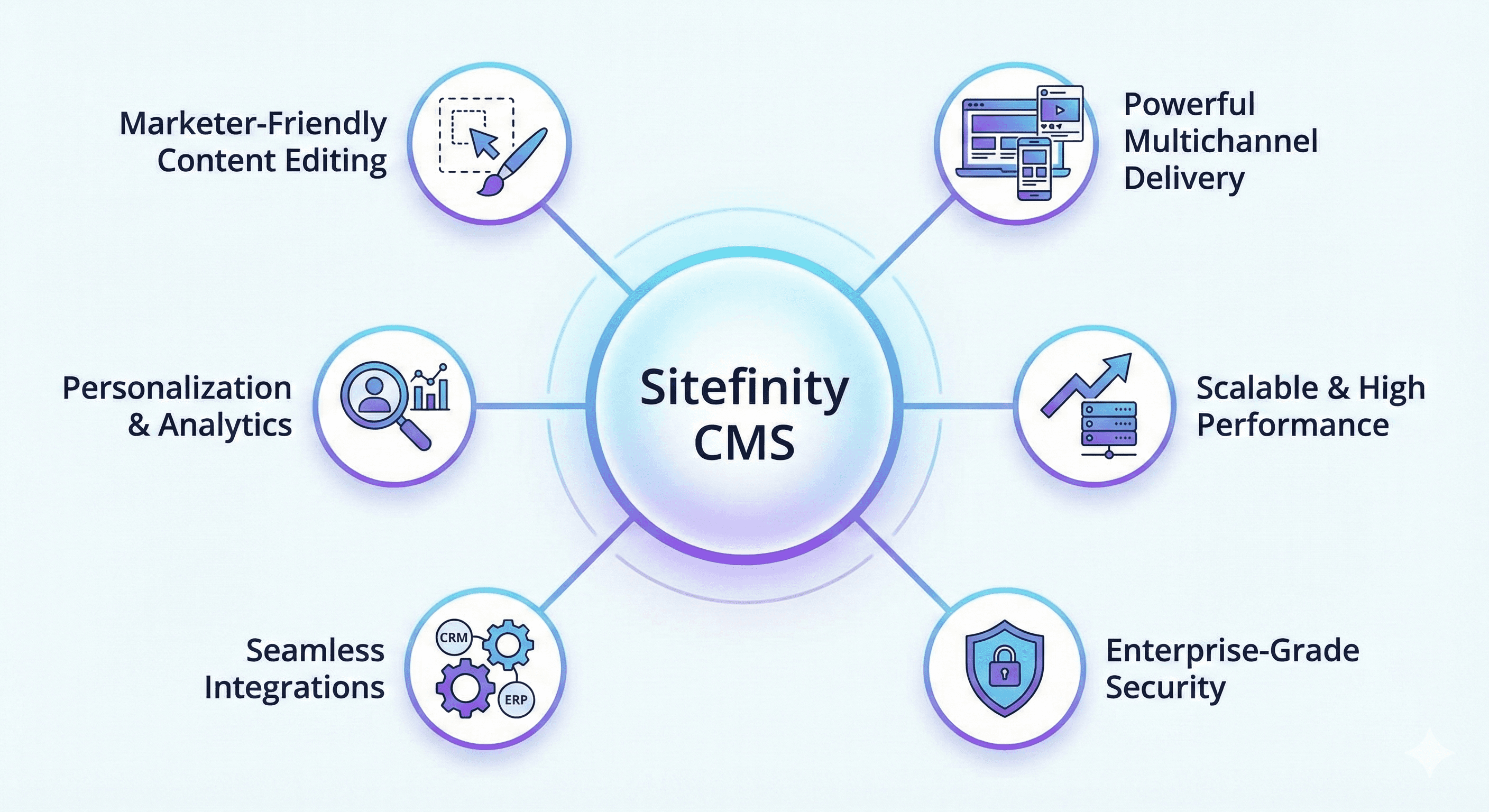
Using Sitefinity CMS offers several benefits that make it a valuable investment for digital-first organizations:
User-Friendly Content Management: Drag-and-drop page editor, reusable templates, and intuitive media library.
Marketing Automation & Personalization: Targeted campaigns, segmentation, analytics, and real-time personalization.
Omnichannel Publishing: Manage content seamlessly across websites, mobile apps, and social media platforms.
Enterprise Scalability: Supports high traffic and complex workflows without performance bottlenecks.
SEO Optimization: Built-in SEO tools, structured data support, and URL management.
Security & Compliance: Enterprise-grade security, GDPR, and HIPAA-ready features.
Headless & API-First: Enables headless CMS implementations for modern frontend frameworks.
Integration Ready: Connects with CRM, ERP, marketing, analytics, and payment systems.
These advantages make Sitefinity suitable for long-term digital strategies, ensuring both performance and growth.
How to Hire Expert Sitefinity Developers :
Hiring the right Sitefinity CMS developers is critical for project success. Here’s a guide to ensure you hire the right talent:
Essential Skills & Expertise
Strong understanding of Sitefinity CMS architecture
Proficiency in C# and .NET Core
Experience with API integrations and cloud deployments
Familiarity with frontend frameworks (React, Angular, Vue.js) for headless CMS
Knowledge of eCommerce and enterprise-level integrations
Understanding of SEO, performance optimization, and accessibility standards
Hiring Models :
Model | When to Choose | Pros | Cons |
|---|---|---|---|
Freelancer | Small projects, enhancements | Cost-effective, flexible | Limited support, reliability varies |
Dedicated Team | Medium to large projects requiring multiple developers | Full-time focus, accountability | Higher cost than freelancer |
Development Agency | Full-service approach: strategy, design, development | End-to-end solutions, expertise | Most expensive option |
Cost of Hiring Sitefinity Developers :
Hourly Rate Comparison (2026)
Developer Level | India | USA | Europe | Eastern Europe |
|---|---|---|---|---|
Junior | $10–20 | $50–70 | $40–60 | $25–40 |
Mid-Level | $20–35 | $70–100 | $60–80 | $40–60 |
Senior | $35–60 | $100–150 | $80–120 | $60–90 |
Project-Based Pricing:
Project Type | Estimated Cost | Notes |
|---|---|---|
Small Business Website | $3,000–$8,000 | CMS setup, theme customization |
Enterprise Website | $15,000–$50,000 | Custom modules, API integrations, workflow automation |
E-commerce Website | $20,000–$60,000 | Full-featured online store with payment and shipping integrations |
Country-Wise Comparison for Sitefinity Development
USA & Western Europe: Premium cost, high-quality development, long-term support
Eastern Europe: Cost-effective with strong technical skills and good quality
India & South Asia: Affordable rates, variable quality—ensure vetted developers
Remote Global Teams: Balanced cost and access to experienced Sitefinity developers
Generic Case Studies
Case Study 1 – Enterprise Website Migration
Challenge: Company needed to replace a legacy CMS with a scalable platform
Solution: Migrated to Sitefinity CMS with custom workflows, multi-language support, and API integrations
Result: Improved website speed by 3x and increased engagement by 150%
Case Study 2 – E-Commerce Platform Launch
Challenge: Startup needed a modern, mobile-first online store
Solution: Built on Sitefinity CMS with headless architecture and PWA capabilities
Result: Boosted online sales by 200% in the first six months
FAQs:
Q1. What is Sitefinity CMS used for?
Sitefinity CMS is used for enterprise websites, digital marketing platforms, and eCommerce applications requiring scalable and secure content management.
Q2. How do I hire Sitefinity CMS developers?
Hire via freelancers, dedicated teams, or development agencies with proven Sitefinity experience and portfolios.
Q3. What are the benefits of Sitefinity CMS?
Benefits include marketing automation, personalization, omnichannel publishing, SEO optimization, and enterprise-grade security.
Q4. How much does it cost to hire a Sitefinity developer?
Hourly rates range from $10–150 depending on region and experience, with project-based pricing based on complexity.
Q5. Can Sitefinity CMS handle eCommerce websites?
Yes, it supports feature-rich online stores, payment gateways, and multi-channel selling.
Q6. What skills should a Sitefinity developer have?
Skills include .NET/C# expertise, API integration, frontend framework knowledge, eCommerce and enterprise integration experience.
Q7. Is Sitefinity better than WordPress?
For enterprise and large-scale projects, Sitefinity is more secure, scalable, and marketing automation-friendly.
Q8. Can Sitefinity integrate with other business tools?
Yes, it integrates with CRM, ERP, marketing, analytics, and payment systems.
Q9. How long does it take to build a Sitefinity website?
Small websites: 4–8 weeks; Enterprise websites: 12–24+ weeks depending on complexity.
Q10. Who should use Sitefinity CMS?
Enterprises, medium-sized businesses, eCommerce brands, and startups planning scalable and enterprise-ready web platforms.
Conclusion:
Sitefinity CMS is a robust, flexible, and enterprise-ready platform ideal for businesses that demand scalability, security, and marketing automation. Hiring the right Sitefinity developers ensures your project meets technical requirements while driving business growth and ROI.
👉 Ready to build a high-performance Sitefinity CMS website? Connect with expert developers or agencies today to kickstart your project with confidence.


