
What Is Frontier Technology? : The Future of AI, Robotics & Beyond
Posted on
Product Design
Posted at
The World Is Changing Faster Than You Think
Something extraordinary is happening right now. Across laboratories, boardrooms, hospitals, and factory floors, a new class of technologies is rewriting the rules of what's possible. AI systems are diagnosing diseases earlier than human doctors. Robots are building cars with zero human supervision. Quantum computers are cracking mathematical problems that would take traditional machines millions of years to solve.
Welcome to the era of frontier technology — a term that captures the most powerful, transformative, and disruptive innovations humanity has ever developed. If the Industrial Revolution rewrote civilization once, frontier technologies are poised to do it again, only faster, deeper, and on a global scale.
Governments are racing to fund it. Businesses are betting billions on it. Universities are redesigning curricula around it. And individuals like you — curious, forward-thinking, and informed — are watching it unfold in real time.
Between 2026 and 2030, analysts and technologists widely agree that we're entering the biggest technological transformation window in modern history. AI is already influencing what you read, how your bank protects your money, how your doctor diagnoses illness, and how entire supply chains operate. This is just the beginning.
So what exactly is frontier technology? Which technologies fall under this umbrella? How are they changing industries, creating new jobs, and raising important questions about ethics and the future of work? And most importantly — what does it all mean for you?
This guide answers all of that and more.
What Is Frontier Technology?
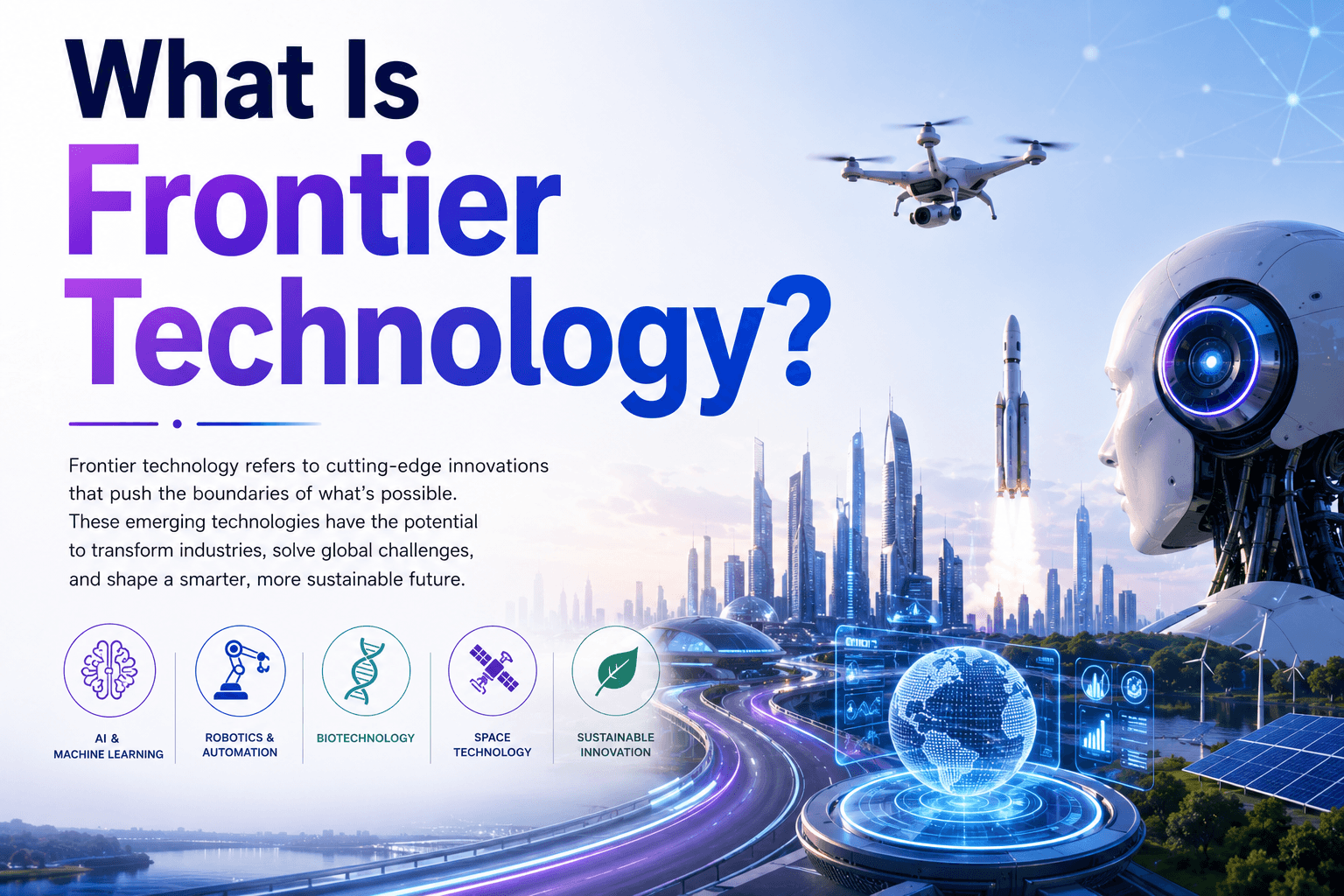
At its simplest, frontier technology refers to the most advanced, cutting-edge innovations that push the boundaries of what science and engineering can achieve. These are technologies operating at the frontier of human knowledge — where research, experimentation, and real-world application are still being actively developed, refined, and explored.
The term "frontier" is deliberately chosen. Just as geographical frontiers represented unexplored territory where new discoveries awaited, technological frontiers represent areas where the full potential remains unknown. These technologies are not fully mature. They're actively evolving, and their ultimate impact on society is still being written.
Unlike traditional technologies — which are stable, widely understood, and incrementally improved — frontier technologies are fundamentally disruptive. A spreadsheet software is traditional technology. An AI that writes, analyzes, and acts on the contents of that spreadsheet autonomously is frontier technology. The difference isn't just technical sophistication; it's the scale and nature of transformation.
Frontier technologies share a few defining characteristics. They are typically interdisciplinary, combining insights from computer science, biology, physics, and engineering simultaneously. They are exponential in growth — doubling in capability in ways that feel sudden and surprise even experts. They are network-driven, meaning their value multiplies as more industries, devices, and people connect to them. And they are genuinely unpredictable in their long-term consequences, for better and for worse.
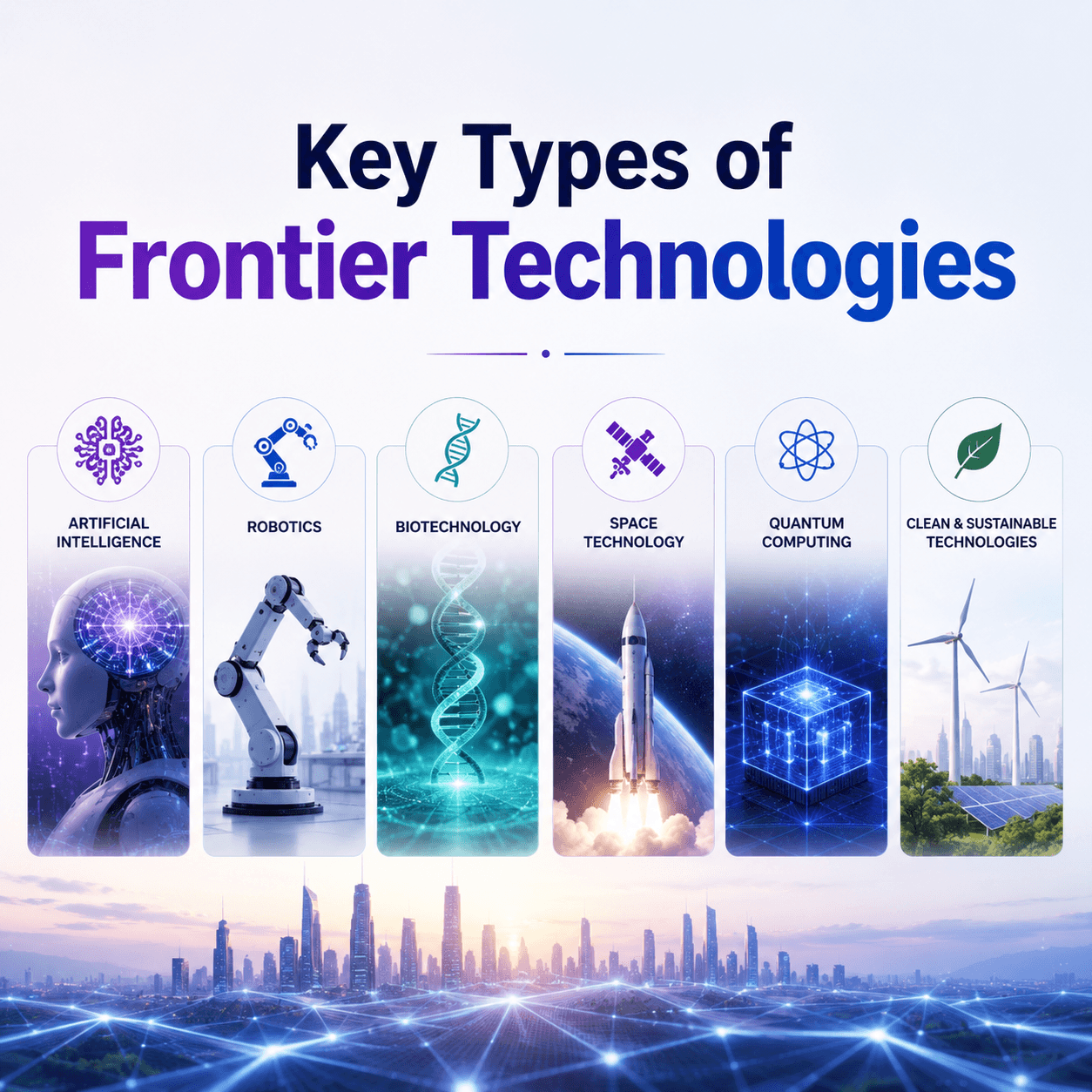
The core technologies considered part of the frontier technology ecosystem today include Artificial Intelligence, Robotics, Quantum Computing, Biotechnology, Nanotechnology, Blockchain, the Internet of Things, Space Technology, Augmented and Virtual Reality, and Advanced Automation. Together, these fields are not advancing independently — they are converging and amplifying each other in ways that make the total transformation far greater than the sum of its parts.
Why Frontier Technology Matters in 2026 and Beyond
A decade ago, conversations about AI and robotics were largely academic or science-fictional. Today, they're operational realities inside the world's most competitive industries. The question is no longer whether frontier technologies will reshape business and society — it's how quickly and how profoundly.
For businesses, the stakes are enormous. Companies that adopt frontier technologies early gain compounding advantages: faster product development cycles, smarter customer experiences, lower operational costs, and entirely new revenue streams. McKinsey estimates that AI alone could add $13 trillion to global economic output by 2030. Businesses that wait to adopt these tools risk not just falling behind — they risk becoming irrelevant.
In healthcare, AI-powered diagnostics can detect cancers, heart conditions, and rare diseases far earlier than traditional methods, leading to better outcomes and lower treatment costs. In banking, machine learning models process millions of transactions per second, detecting fraud in real time with remarkable accuracy. In manufacturing, smart factories equipped with industrial robots and IoT sensors are achieving precision and output levels that were physically impossible five years ago.
Education is transforming too. AI-powered learning platforms adapt in real time to each student's pace, strengths, and gaps — delivering genuinely personalized instruction that a single teacher managing 30 students simply cannot. In transportation, autonomous vehicle technology is steadily reducing the human error responsible for 94% of traffic accidents. Retail is evolving from a guessing game about consumer preferences into a data-science discipline, where AI recommendations drive a growing share of global ecommerce revenue.
Even agriculture — one of the world's oldest industries — is being transformed by precision farming technologies that combine IoT sensors, satellite imagery, AI analytics, and robotics to optimize yields, reduce water usage, and predict crop disease before it spreads. The pattern is consistent: wherever frontier technology is applied, productivity accelerates, costs fall, and outcomes improve.
Early adoption isn't just strategic — it's increasingly existential. Markets move faster than ever, and competitive advantages built on frontier technology can compound so quickly that catching up becomes nearly impossible.
Key Types of Frontier Technologies
Artificial Intelligence (AI)
Artificial Intelligence is arguably the most consequential technology of our era. At its core, AI refers to systems that simulate human cognitive functions — learning from data, recognizing patterns, making decisions, and improving with experience without being explicitly reprogrammed.
The sub-field of machine learning underpins most AI applications today, enabling systems to train on vast datasets and make increasingly accurate predictions or decisions. Generative AI — the technology behind large language models, image generators, and AI coding assistants — has pushed the boundaries even further, creating systems that can produce human-quality text, code, artwork, music, and video from a simple prompt.
Businesses are deploying AI across operations in ways that were unthinkable just a few years ago. Customer support chatbots handle millions of queries daily with near-human quality, freeing human agents for complex cases. AI-driven analytics platforms help executives spot trends, anomalies, and opportunities in real time. In marketing, AI tools personalize every customer interaction at scale — adjusting messaging, offers, and content dynamically.
Looking ahead, the conversation is increasingly turning toward Artificial General Intelligence (AGI) — systems with the flexible reasoning capabilities of a human mind. While AGI timelines remain debated, even the pursuit of it is already generating enormous investment and innovation. The AI future isn't decades away. Much of it is already here.
Robotics and Intelligent Machines
Modern robotics has moved well beyond the rigid, pre-programmed machines of the 20th century. Today's robots are intelligent, adaptive, and increasingly autonomous — capable of learning from their environment, collaborating with humans, and performing complex physical tasks with extraordinary precision.
Industrial robots now dominate automotive assembly lines, electronics manufacturing, and logistics facilities. Companies like Amazon have deployed hundreds of thousands of robots in their fulfillment centers, enabling same-day delivery at a scale that would be humanly impossible to achieve without them. Smart factories — sometimes called "lights-out" facilities because they can operate in complete darkness without human workers present — represent the logical endpoint of industrial robotics, and they're becoming operational realities rather than distant concepts.
Healthcare robotics is one of the most exciting frontiers within the field. Surgical robots like the da Vinci system give surgeons superhuman precision in minimally invasive procedures, reducing recovery times and complication rates. Rehabilitation robots help stroke patients relearn movement through guided, repetitive physical therapy. Autonomous hospital robots transport medications, deliver meals, and disinfect rooms with ultraviolet light.
The emergence of humanoid robots — machines designed to navigate and operate in environments built for human bodies — marks a particularly significant shift. Companies investing heavily in this space envision humanoid robots eventually working in warehouses, construction sites, and care homes. How quickly that vision becomes widespread reality will depend on parallel advances in AI reasoning and motor control.
Quantum Computing
Classical computers process information in binary — ones and zeros. Quantum computers process information using qubits, which can exist in multiple states simultaneously thanks to the principles of quantum superposition and entanglement. The result is a fundamentally different kind of computational power, capable of solving certain classes of problems that would take classical supercomputers millions of years to complete.
The practical implications are staggering. In drug discovery, quantum computers can simulate molecular interactions at the subatomic level, potentially compressing pharmaceutical research timelines from decades to years. In finance, they can optimize portfolios and model risk across millions of variables simultaneously. In cryptography, they pose both a threat and an opportunity — capable of breaking current encryption standards while also enabling new, theoretically unbreakable quantum-secure communication protocols.
Quantum computing is still largely in its research and early commercial phase, with major technology companies and national governments investing heavily in the race to achieve practical, fault-tolerant quantum systems. IBM, Google, and a growing field of specialized quantum startups are reporting meaningful progress year on year. The full commercial impact may still be several years away, but the directional trajectory is clear and accelerating.
Blockchain and Web3
Blockchain technology established its public profile through cryptocurrency, but its significance extends far beyond Bitcoin and Ethereum. A blockchain is fundamentally a distributed, tamper-resistant ledger — a way of recording and verifying information across a network of computers without requiring a central authority.
The innovation of smart contracts — self-executing code that automatically performs actions when predefined conditions are met — has made blockchain a foundation for an entirely new class of applications. In supply chain management, blockchain creates end-to-end traceability, letting businesses and consumers verify the origin and handling of products at every step. In financial services, it enables near-instant cross-border payments and settlements that currently take days and involve multiple intermediaries.
Web3 represents the vision of a decentralized internet built on blockchain infrastructure — one where users own their own data, digital assets, and identities rather than surrendering them to centralized platforms. While the Web3 ecosystem remains early and evolving, the underlying principles of decentralization, digital ownership, and trustless verification are finding practical application in enterprise contexts, from real estate transactions to intellectual property management.
Biotechnology and Genetic Engineering
Biotechnology is perhaps the most intimate of frontier technologies — operating at the level of DNA, cells, and the fundamental biological machinery of living organisms. The development of CRISPR-Cas9 gene editing technology gave scientists an extraordinarily precise tool for modifying genetic sequences, opening possibilities that range from curing hereditary diseases to engineering more resilient crops.
Personalized medicine — treatment tailored to an individual's unique genetic makeup — is transitioning from research aspiration to clinical reality. Cancer treatments that target the specific genetic mutations driving a tumor in a particular patient, rather than applying the same chemotherapy to everyone, are already showing dramatically improved outcomes. AI is accelerating this transformation by identifying patterns in genomic data that human researchers would need decades to analyze manually.
Beyond medicine, biotechnology is reshaping food production, materials science, and environmental remediation. Lab-grown meat companies are scaling production of cultured proteins that require a fraction of the land, water, and carbon footprint of conventional livestock farming. Synthetic biology startups are engineering microorganisms to produce fuels, plastics, and medicines from renewable feedstocks. The implications for sustainability and human lifespan are profound.
Internet of Things (IoT)
The Internet of Things describes the network of physical objects — devices, vehicles, buildings, appliances, industrial equipment — embedded with sensors, software, and connectivity that allows them to collect and exchange data in real time. In practical terms, it means the physical world is becoming data-generating, intelligent, and responsive in ways it never was before.
In the home, smart thermostats learn occupant patterns and optimize energy use automatically. Smart refrigerators track food inventory and expiration dates. Security systems recognize faces and send alerts. But the consumer smart home is just the most visible layer of a far more consequential industrial transformation. In manufacturing, IoT sensors monitor machine performance in real time, predicting failures before they happen and enabling maintenance that is proactive rather than reactive — dramatically reducing downtime and costs.
The concept of smart cities extends IoT thinking to urban infrastructure — intelligent traffic management systems that reduce congestion dynamically, connected utilities that balance loads and detect leaks, public safety networks that coordinate emergency response with real-time awareness. Singapore, Amsterdam, and several Chinese cities are already operating significant smart city infrastructure, offering a preview of what urban life could look like globally within the coming decade.
Space Technology
Space has rapidly transitioned from the exclusive domain of government agencies to a thriving commercial frontier, driven by the emergence of private space companies that have fundamentally changed the economics of access to orbit. Launch costs have fallen by orders of magnitude since SpaceX pioneered reusable rocket technology, unlocking entirely new categories of commercial activity.
Satellite internet constellations are bringing high-speed broadband connectivity to remote and underserved regions worldwide — a development with profound implications for global economic inclusion. Earth observation satellites generate continuous streams of imagery and data supporting agriculture, insurance, environmental monitoring, and national security applications. Space tourism is moving from billionaire novelty toward an addressable market, while longer-horizon visions of lunar resource extraction, asteroid mining, and eventual Martian settlement are attracting serious investment and engineering effort.
The space economy is projected to reach $1 trillion by the early 2040s. The technologies being developed to achieve that vision — advanced propulsion, life support, in-space manufacturing, and radiation-hardened electronics — will generate spinoff innovations with broad terrestrial applications, as they have throughout space history.
Real-World Examples of Frontier Technology
The language of frontier technology can sometimes feel abstract, so it's worth grounding it in concrete examples already operating in the world.
OpenAI's ChatGPT crossed 100 million users faster than any platform in history, demonstrating consumer demand for conversational AI that was previously unimagined. Google's DeepMind developed AlphaFold, an AI system that predicted the three-dimensional structure of virtually every known protein — solving a 50-year scientific grand challenge in months and immediately accelerating drug discovery globally.
Waymo's autonomous ride-hailing service is operating commercially in multiple US cities, accumulating millions of driverless miles and refining the safety case for self-driving vehicles. Tesla's Autopilot and Full Self-Driving features are gathering real-world driving data from millions of vehicles simultaneously, training AI systems at a scale that no traditional approach could match. Amazon Prime Air and Wing (owned by Alphabet) are conducting commercial drone delivery operations in select markets, offering a preview of last-mile logistics that could transform retail fulfillment.
In healthcare, IBM Watson Oncology assists oncologists in treatment decision-making by analyzing thousands of peer-reviewed studies against individual patient data. The FDA has cleared dozens of AI-based medical imaging systems that detect diabetic retinopathy, pneumonia, bone fractures, and breast cancer with diagnostic accuracy matching or exceeding human radiologists.
Cybersecurity firm Darktrace uses AI to monitor enterprise networks in real time, identifying novel attack patterns — including previously unknown zero-day threats — without needing predefined signatures. This approach fundamentally changes the nature of digital defense from a reactive to a proactive posture.
How Frontier Technology Is Changing Industries
Healthcare
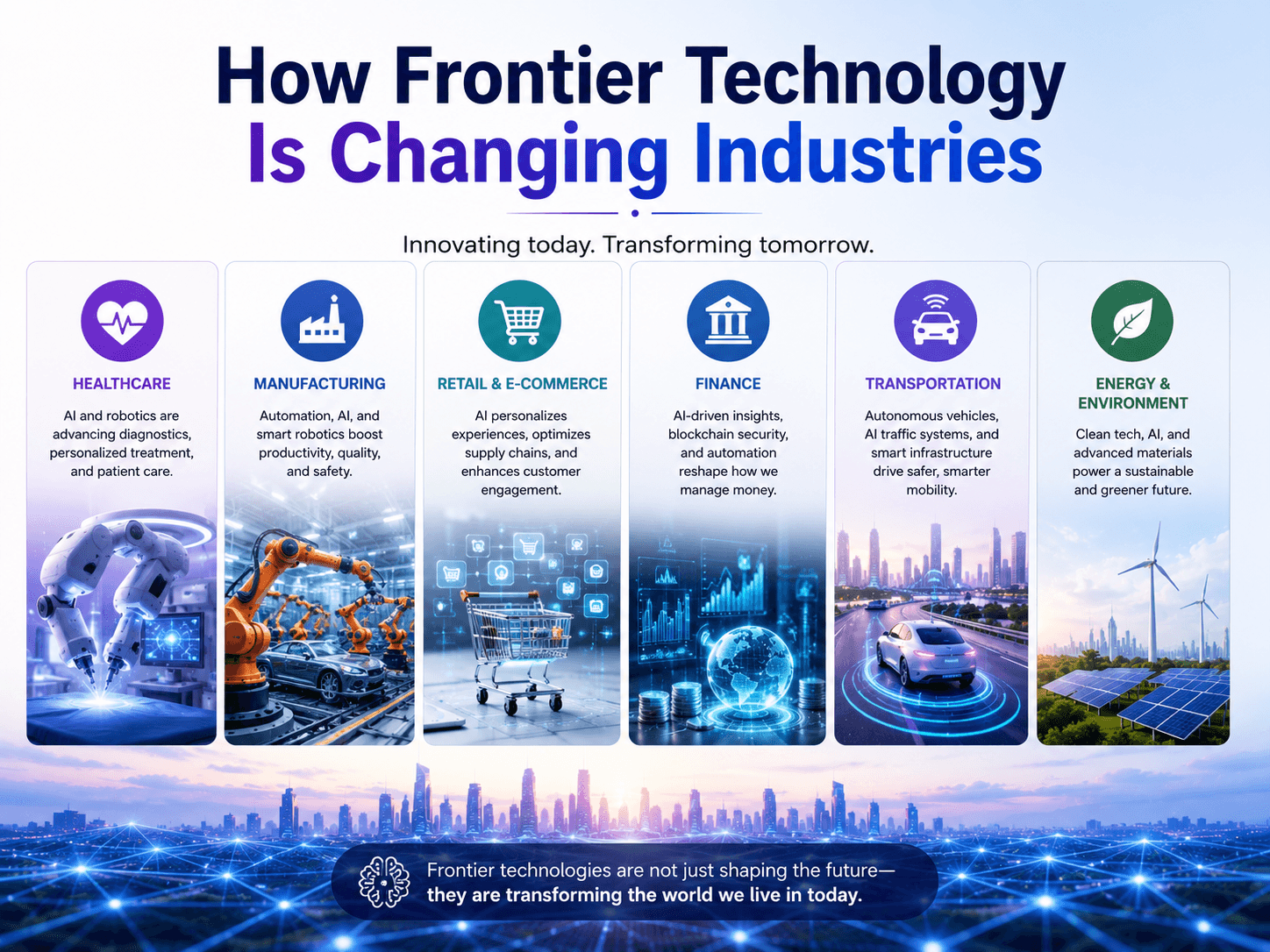
Artificial intelligence is transforming diagnostics, treatment planning, drug discovery, and administrative workflows simultaneously. AI imaging analysis catches subtle anomalies in radiology scans that human eyes miss. Predictive models identify patients at high risk of hospital readmission or sepsis early enough to intervene. Robotic surgery platforms are expanding the range of procedures accessible to minimally invasive approaches, reducing patient recovery times dramatically. Meanwhile, AI-powered drug discovery platforms are compressing pharmaceutical development timelines, with some researchers suggesting that what once took 12–15 years could eventually take 2–3.
Education
Adaptive learning platforms powered by AI analyze student performance data in real time and adjust content, pacing, and difficulty accordingly — delivering the kind of individualized instruction that traditional classroom models structurally cannot provide at scale. Virtual reality creates immersive learning environments where medical students practice complex procedures, engineers simulate stress-testing of designs, and history students experience reconstructed historical environments. These technologies are gradually shifting education from a one-size-fits-all delivery model toward a personalized, outcome-driven system.
Finance
AI is deeply embedded in modern financial services — from high-frequency trading algorithms that execute millions of orders per second to fraud detection models that spot suspicious transactions in milliseconds. Risk assessment models built on machine learning evaluate creditworthiness with far greater accuracy than traditional scoring methods, improving access to credit while reducing default rates. Blockchain is streamlining settlement processes that currently involve multiple intermediaries, days of processing time, and significant counterparty risk — potentially making financial infrastructure faster, cheaper, and more resilient.
Manufacturing
Smart factories are redefining industrial production. Collaborative robots — "cobots" — work alongside human employees on assembly lines, handling precision tasks without safety cages while humans manage quality control, exception handling, and complex decision-making. Digital twin technology creates virtual replicas of physical manufacturing environments, allowing engineers to simulate process changes, identify bottlenecks, and test optimizations without disrupting actual production. Predictive maintenance systems using IoT sensors and AI dramatically reduce unplanned downtime — one of the most expensive problems in industrial operations.
Retail and Ecommerce
Recommendation engines powered by machine learning drive a substantial share of global ecommerce revenue by matching customers with products they're likely to want before they even search for them. Computer vision technology enables checkout-free retail — Amazon's Just Walk Out system is the highest-profile example — where shoppers select items and their account is charged automatically without interaction with a cashier. Voice commerce, powered by AI assistants like Alexa and Google Assistant, is growing as an ordering channel for repeat purchases.
Transportation
Autonomous vehicles are advancing steadily through increasingly complex real-world environments. The technology combines computer vision, radar, LiDAR, AI decision-making, and high-definition mapping to navigate dynamically in ways that traditional programmed systems cannot. Electric vehicles are scaling rapidly, with most major markets setting targets for internal combustion phase-outs. Smart traffic management systems using real-time data are reducing urban congestion in pilot cities, with efficiency improvements that cascade into lower emissions, faster commutes, and fewer accidents.
Benefits of Frontier Technology
The aggregate benefits of frontier technology adoption are transformational. At the business level, automation and AI drive productivity improvements that allow organizations to do significantly more with the same or fewer resources — a compounding advantage over time. Data-driven decision-making replaces intuition-driven choices with approaches grounded in evidence, reducing costly errors and identifying opportunities that human analysis would miss.
For consumers, frontier technology is increasingly delivering personalized experiences that were previously the exclusive privilege of wealth — custom medical treatment plans, financial advice tailored to individual circumstances, education adapted to individual learning styles. Costs fall over time as these technologies scale, gradually democratizing access.
At the societal level, frontier technologies offer genuine pathways to addressing humanity's most pressing challenges. AI-accelerated drug discovery could compress timelines for pandemic response from years to months. Precision agriculture technology can feed a growing global population with a shrinking environmental footprint. Renewable energy, grid optimization, and materials science innovations are making decarbonization economically viable at scale. Smart city infrastructure can improve air quality, reduce congestion, and enhance quality of life for billions of urban residents.
The productivity gains, healthcare improvements, and sustainability solutions that frontier technology enables represent the difference between a future where humanity thrives and one where it struggles with resource constraints and accumulated challenges.
Challenges and Risks of Frontier Technology
A clear-eyed account of frontier technology must acknowledge its risks alongside its opportunities. These are not trivial or hypothetical concerns — they are real, active, and require deliberate attention.
AI bias is a well-documented problem. When AI systems are trained on historical data that reflects human prejudices — in lending, hiring, criminal justice, or healthcare — they can encode and amplify those prejudices at machine scale. Ensuring that AI systems are tested for bias and held to rigorous fairness standards is an ongoing technical and regulatory challenge.
Job displacement is a legitimate concern, though the historical pattern of technology-driven economic transformation suggests that new roles tend to emerge to replace those lost, often in adjacent or entirely new fields. The transition, however, is not automatic, painless, or equally distributed. Workers in repetitive manual or clerical roles face the most immediate disruption, and the pace of retraining programs and educational adaptation has historically lagged behind the pace of technological change.
Privacy erosion is an increasingly acute issue as ubiquitous sensors, AI-powered analysis, and data aggregation create surveillance capabilities — both commercial and governmental — of unprecedented scope. The legal and regulatory frameworks governing data collection and use are struggling to keep pace with technological capability.
Cybersecurity risks compound with complexity. Every new connected device, AI system, and cloud service expands the potential attack surface available to malicious actors. AI itself is being weaponized for more sophisticated phishing, social engineering, and autonomous cyberattacks.
Responsible innovation — the principle that developing powerful technology carries obligations to understand and mitigate its risks — is not optional. It's a prerequisite for ensuring that the benefits of frontier technology are broadly distributed rather than concentrated, and that its dangers are contained rather than amplified.
Future Trends in Frontier Technology (2026–2035)
The trajectory over the next decade is likely to be defined by convergence and acceleration. Technologies that are currently powerful in isolation will become exponentially more so as they combine.
AI-human collaboration will increasingly define knowledge work. Rather than AI replacing human judgment, the most productive workflows will integrate AI's pattern recognition and processing speed with human creativity, contextual understanding, and ethical reasoning — in much the same way that calculators didn't make mathematicians obsolete but made them far more capable.
Hyperautomation — the combination of AI, robotic process automation, machine learning, and advanced analytics to automate not just tasks but entire business processes end-to-end — is a concept gaining serious traction. Organizations pursuing hyperautomation envision systems that can identify automatable processes, build the automation, deploy it, and continuously improve it with minimal human direction.
Brain-computer interfaces, pioneered by companies like Neuralink, represent perhaps the most profound long-term frontier — technologies that create direct communication channels between the human nervous system and digital devices. Early clinical applications focus on restoring mobility and communication to patients with paralysis; long-term implications for cognitive augmentation are still speculative but extraordinary.
Quantum internet — leveraging quantum entanglement for theoretically unbreakable secure communication — is in early research stages but represents a potential step-change in cybersecurity infrastructure. The quantum computing arms race has enormous geopolitical dimensions, with the US, China, and Europe investing billions in national quantum programs.
Advanced humanoid robots with substantially improved motor control and AI reasoning capabilities are likely to emerge commercially in the 2027–2032 window. AI-driven scientific discovery — where AI systems autonomously generate and test hypotheses — is already accelerating progress in materials science, climate research, and drug development. The scientific method itself is being augmented.
Future Jobs and Career Opportunities in Frontier Technology
One of the most common questions surrounding frontier technology is what it means for employment — and the answer is more nuanced than either dystopian fears or utopian promises suggest.
Some roles will be significantly reduced or eliminated: data entry, routine customer service, basic financial analysis, and certain categories of manufacturing work are already in transition. But the frontier technology ecosystem is generating demand for talent across a wide range of new and evolving roles.
AI engineers and machine learning specialists are among the most sought-after professionals globally, commanding salaries that reflect an acute talent shortage relative to demand. Data scientists who can translate raw data into business insights, robotics engineers who can design and program intelligent machines, and quantum computing researchers who can advance the science of next-generation computation are all in high demand and growing scarcity.
The emergence of AI ethics as a discipline has created genuine career pathways for professionals with backgrounds in philosophy, policy, law, and social science who can help organizations navigate the responsible deployment of powerful AI systems. Cybersecurity analysts with expertise in AI-powered threat detection are increasingly valuable as attack surfaces expand. Prompt engineers — specialists who design effective inputs to maximize the output quality of large language models — represent an entirely new category of technical role that didn't exist five years ago.
For students and professionals considering their trajectories, the imperative is clear: developing literacy in frontier technologies, even without deep technical specialization, is becoming a baseline competitive requirement across virtually every industry.
How Businesses Can Prepare for Frontier Technology
The strategic imperative for businesses is not simply to adopt frontier technologies piecemeal but to build the organizational capabilities, culture, and infrastructure that allow continuous adaptation as these technologies evolve.
Digital transformation — the comprehensive integration of digital technology into all aspects of business operations — provides the necessary foundation. Without clean, accessible data architecture, no AI system can deliver its potential value. Without cloud infrastructure, the computational resources for AI workloads are inaccessible. Getting the foundations right matters enormously.
Employee upskilling is non-negotiable. The most significant constraint on frontier technology adoption in most organizations is not the cost of technology — it's the scarcity of people who can effectively deploy, manage, and improve it. Organizations that invest in continuous learning programs, partnerships with educational institutions, and internal knowledge-sharing create durable advantages.
AI adoption should be approached with clear business problem framing — identifying the specific operational challenges where AI can deliver measurable improvement — rather than pursuing technology for its own sake. Proof of concept pilots that demonstrate value in controlled environments before scaling are a proven approach to managing risk while building organizational confidence.
Equally important is developing ethical AI frameworks — formal guidance for how AI systems will be tested for bias, how human oversight will be maintained, and how accountability will be assigned when automated systems make consequential decisions. Regulators globally are moving toward formal requirements in this space; organizations that build principled approaches proactively will navigate the evolving regulatory environment more smoothly.
Is Frontier Technology Good or Dangerous?
The question itself reveals a common category error. Technology is not inherently good or dangerous — it is a tool, shaped by the intentions, incentives, and governance structures surrounding its development and deployment. The same AI capabilities that can accelerate drug discovery can also generate synthetic disinformation. The same automation that reduces industrial accidents can displace workers without adequate support. The same biotechnology that can cure genetic disease can also, in principle, be misused.
The relevant question is not whether frontier technology is safe but whether the humans, institutions, and societies deploying it are making wise choices. The evidence is mixed. On one hand, there is genuine seriousness and engagement with safety and ethics within the AI research community, backed by growing regulatory attention from governments in the EU, UK, US, China, and internationally. On the other hand, competitive pressures — commercial and geopolitical — create incentives to move faster than safety considerations warrant.
The trajectory toward responsible innovation is not inevitable. It requires sustained, deliberate effort from technologists who build safety into systems from the start, policymakers who develop thoughtful governance frameworks without stifling beneficial innovation, businesses that refuse to deploy technology they cannot account for, and citizens who demand accountability.
Optimism about frontier technology's potential and vigilance about its risks are not in tension — they are both necessary. The future this technology enables depends on the choices made about how to develop and govern it today.
Conclusion: The Future Belongs to Those Who Understand It
Frontier technology is not a distant abstraction or a science fiction scenario. It is the operating reality of the world's most competitive businesses, healthcare systems, research institutions, and governments. Understanding what it is, how it works, and where it is heading is no longer optional for anyone who wants to navigate the coming decade effectively.
Artificial intelligence, robotics, quantum computing, biotechnology, blockchain, IoT, and space technology are not separate stories — they are converging chapters of a single transformation that will reshape every industry, every profession, and every dimension of daily life in the years ahead. The fundamental drivers — exponential improvement in computational power, availability of training data, advances in materials science, and falling technology costs — show no sign of reversing.
For businesses, the imperative is to engage deliberately and strategically with these technologies rather than waiting for the transformation to arrive from outside. For individuals, the imperative is to develop literacy, curiosity, and adaptability in a world where the most in-demand skills of 2030 are categories that barely existed in 2020. For policymakers and civic institutions, the imperative is to govern these technologies wisely — capturing their benefits while managing their risks with both speed and care.
The frontier is open. What gets built there, and who shapes it, will determine the kind of future we all inhabit.
Frequently Asked Questions (FAQs)
1. What is frontier technology in simple words?
Frontier technology refers to the most advanced and cutting-edge innovations that push the boundaries of what's currently possible in science and engineering. These are technologies like artificial intelligence, robotics, quantum computing, and biotechnology that are still actively evolving and have the potential to fundamentally transform industries and society.
2. What are examples of frontier technologies?
Key examples include generative AI systems like large language models, autonomous vehicles, humanoid robots, CRISPR gene editing tools, quantum computers, blockchain-based smart contract platforms, satellite internet constellations, and industrial IoT systems. These technologies share the quality of operating at the edge of current human knowledge.
3. How is AI considered frontier technology?
AI qualifies as frontier technology because it is still rapidly evolving, its full capabilities are not yet understood, and its applications are actively transforming fields from healthcare to manufacturing to education. Generative AI and the research toward Artificial General Intelligence represent particularly active frontiers where fundamental advances are still being made regularly.
4. What industries use frontier technology?
Virtually every major industry is actively deploying frontier technologies. Healthcare, finance, manufacturing, transportation, agriculture, retail, logistics, defense, and education are all experiencing significant transformation driven by AI, robotics, IoT, and related technologies. The pace and depth of adoption varies, but no major sector is untouched.
5. Is frontier technology good for businesses?
Yes, when adopted thoughtfully. Frontier technologies offer businesses substantial advantages in productivity, cost efficiency, customer experience quality, and innovation speed. Companies that develop strategic AI and automation capabilities consistently outperform those that delay adoption, particularly in data-intensive industries.
6. What is the future of robotics and AI?
The trajectory points toward increasingly capable, autonomous, and broadly deployable systems. AI is advancing toward reasoning capabilities that approach human-level performance on specific task categories. Robotics is progressing toward machines that can navigate unstructured environments and collaborate naturally with humans. The convergence of AI and robotics — intelligent machines that learn and adapt — represents one of the most significant near-term frontiers.
7. How does quantum computing work?
Quantum computers use qubits, which exploit quantum mechanical properties like superposition (existing in multiple states simultaneously) and entanglement (correlating the states of different qubits) to perform certain computations exponentially faster than classical computers. They are not universally faster — they excel at specific problem types including optimization, simulation of molecular systems, and certain cryptographic applications.
8. What skills are needed for frontier technology careers?
Technical roles require programming, data science, machine learning engineering, and domain-specific expertise (robotics, quantum physics, genomics). Non-technical but essential skills include AI ethics, technology policy, product management for AI systems, and the ability to translate technical capabilities into business strategy. Foundational skills in data literacy, critical thinking, and continuous learning apply across all frontier technology career paths.
9. What are the risks of frontier technology?
The primary risks include algorithmic bias in AI systems, job displacement during technology transitions, erosion of privacy through pervasive data collection, cybersecurity vulnerabilities created by expanding digital infrastructure, and the potential for powerful technologies to be misused. Managing these risks requires technical safeguards, thoughtful governance, and ongoing societal dialogue.
10. How will frontier technology affect jobs?
The impact will be uneven and evolving. Repetitive, routine, and rule-based tasks across both manual and knowledge work are most susceptible to automation. Simultaneously, frontier technology is creating substantial demand for new categories of roles — AI specialists, data engineers, robotics technicians, cybersecurity analysts, and AI ethicists — and augmenting the productivity of workers in many existing roles. Net employment effects depend heavily on how quickly workforce retraining programs can adapt to rapid change.
11. What is the difference between deep tech and frontier technology?
The terms overlap significantly. Deep tech typically refers to technologies grounded in substantial scientific or engineering advances — quantum computing, synthetic biology, advanced materials — that require long development timelines and significant R&D investment. Frontier technology is a somewhat broader concept that includes both deep tech and technologies that are frontier primarily because of the pace and scale of their transformative impact, like current-generation AI.
12. Which companies are leading in frontier technology?
In AI, Anthropic, OpenAI, Google DeepMind, and Meta AI are at the leading edge of research. In robotics, Boston Dynamics, Agility Robotics, and Tesla Optimus represent significant humanoid advances. IBM, Google, and IonQ are advancing quantum computing commercially. SpaceX, Blue Origin, and Rocket Lab are reshaping the space economy. In biotech, Moderna's mRNA platform and Genentech's precision medicine programs represent frontier applications at clinical scale.