
Best 25 Solidity Blockchain Developers & Pricing by Country (2026)
Posted on
Web Design
Posted at
The 2026 Solidity Developer Gold Rush
The blockchain industry is no longer a niche experiment — it is a global financial infrastructure. By mid-2026, total value locked (TVL) in DeFi protocols has surpassed $480 billion, NFT trading volumes have rebounded to record highs on Layer-2 networks, and enterprise blockchain adoption has expanded into healthcare, logistics, real estate, and government services. At the center of this explosive growth sits one critical role: the Solidity blockchain developer.
Solidity, the programming language of the Ethereum Virtual Machine (EVM), powers smart contracts across dozens of blockchains — Ethereum, Polygon, BNB Chain, Avalanche, Arbitrum, Optimism, and more. As demand for decentralized applications, tokenization protocols, and on-chain governance systems accelerates, the global shortage of qualified Solidity developers has reached a critical inflection point.
According to a 2026 Web3 Talent Report by CoinTelegraph Research, demand for blockchain developers has grown 340% since 2022, while the global supply of senior Solidity engineers has grown by only 89% in the same period. This supply-demand imbalance has created a high-stakes global talent competition — and a wide disparity in developer costs depending on geography.
This is precisely why thousands of startups, SaaS companies, crypto exchanges, and enterprise CTOs are now turning to offshore and remote Solidity developers. Hiring a senior Solidity engineer in San Francisco costs $180–$250 per hour. The same caliber of talent in India or Eastern Europe costs $30–$75 per hour — with comparable technical output, especially for DeFi and smart contract projects.
In this comprehensive guide, we break down:
• The real cost of hiring Solidity developers in 25 countries
• Quality, timezone, and ecosystem maturity for each market
• The best countries for startups, enterprises, and long-term teams
• Actionable hiring strategies that top Web3 companies use in 2026
2. What Does a Solidity Blockchain Developer Do?
Before comparing costs across countries, it is essential to understand the full scope of what a Solidity developer actually does. The role has evolved dramatically since the early days of basic ERC-20 token contracts. In 2026, a senior Solidity engineer is part architect, part security auditor, part systems designer.
Smart Contract Development
Smart contracts are self-executing agreements encoded directly on a blockchain. Solidity developers write, test, and deploy these contracts to EVM-compatible blockchains. A single production-grade DeFi protocol may contain dozens of interconnected contracts managing billions of dollars in user funds. Bugs in this code are irreversible — making precision and security expertise non-negotiable.
Ethereum Blockchain Architecture
Solidity developers must understand Ethereum's account model, gas optimization, storage patterns, proxy contracts, and upgrade mechanisms. Writing gas-efficient code can save end users and protocols hundreds of thousands of dollars in transaction fees annually.
DeFi Protocol Development
Decentralized Finance remains the largest consumer of Solidity talent. DeFi developers build lending protocols (like Aave and Compound), automated market makers (Uniswap V4-style), yield aggregators, stablecoin systems, liquid staking derivatives, and real-world asset (RWA) tokenization protocols. These systems require deep knowledge of economic security, oracle manipulation prevention, and flash loan attack vectors.
NFT Marketplace Development
NFT marketplaces, generative art platforms, on-chain gaming economies, and digital identity systems all rely on Solidity. ERC-721, ERC-1155, and emerging token standards like ERC-6551 (token-bound accounts) require specialized implementation expertise.
DAO Development and Governance
Decentralized Autonomous Organizations require Solidity developers to build governance contracts, timelock mechanisms, voting systems, multi-sig treasury management, and token-weighted proposal systems. High-profile DAO attacks have made robust governance architecture a top priority.
Layer-2 Integrations
The Layer-2 landscape has matured dramatically. Developers now need expertise in bridging assets between L1 and L2, using L2-specific precompiles, integrating with rollup sequencers, and optimizing contracts for zkEVM environments like Polygon zkEVM, zkSync Era, and Scroll.
Smart Contract Auditing
Security auditing is a premium subspecialty within Solidity development. Auditors review code for reentrancy vulnerabilities, integer overflow, front-running risks, oracle manipulation, and logic errors. Top auditing firms charge $20,000–$150,000+ per audit, and internal audit capability has become a core competency for serious Web3 teams.
Web3 Wallet and dApp Integrations
Beyond contracts, many Solidity developers also handle frontend Web3 integration — connecting smart contracts to React-based interfaces via ethers.js, wagmi, viem, and WalletConnect. Full-stack Web3 developers who bridge Solidity and frontend are among the most sought-after (and expensive) professionals in the market.
3. Why Businesses Are Hiring Remote Solidity Developers in 2026
The shift toward remote and offshore blockchain development is not a cost-cutting compromise — it is a strategic advantage that the world's leading Web3 companies have embraced. Here is why:
The Global Talent Shortage
The United States, United Kingdom, and Western Europe simply do not have enough qualified Solidity developers to meet demand. Solidity requires mastery of cryptographic primitives, EVM bytecode, economic security modeling, and protocol architecture — a skill set that takes years to develop. Less than 4% of software engineers globally have production-grade Solidity experience, according to the 2026 Developer Skills Report by Stack Overflow.
Prohibitive Local Hiring Costs
In major US tech hubs, a senior Solidity engineer commands a base salary of $200,000–$320,000 per year — before equity, bonuses, and benefits. For a funded startup, hiring even two senior engineers locally can consume 40–60% of a seed round. The financial mathematics strongly favor global hiring.
The Rise of Distributed Web3 Teams
Web3 is inherently borderless. The most successful protocols — Uniswap, Aave, Chainlink, Compound — were built by globally distributed teams from day one. This cultural norm means that remote-first engineering teams face zero social stigma in blockchain circles and often attract better talent precisely because they offer location flexibility.
Faster MVP Development
Access to multiple time zones enables around-the-clock development cycles. A startup working with a US-based product lead and an India or Eastern Europe development team can achieve 18–22 hours of productive development daily — compressing typical 6-month MVP timelines to 10–14 weeks.
Specialized Blockchain Ecosystems
Countries like India, Ukraine, Poland, and Estonia have developed concentrated blockchain developer communities with deep protocol expertise. Developers in these markets often have published open-source Solidity libraries, contributed to EIPs (Ethereum Improvement Proposals), and worked on production DeFi protocols — making them genuinely world-class, not just affordable.
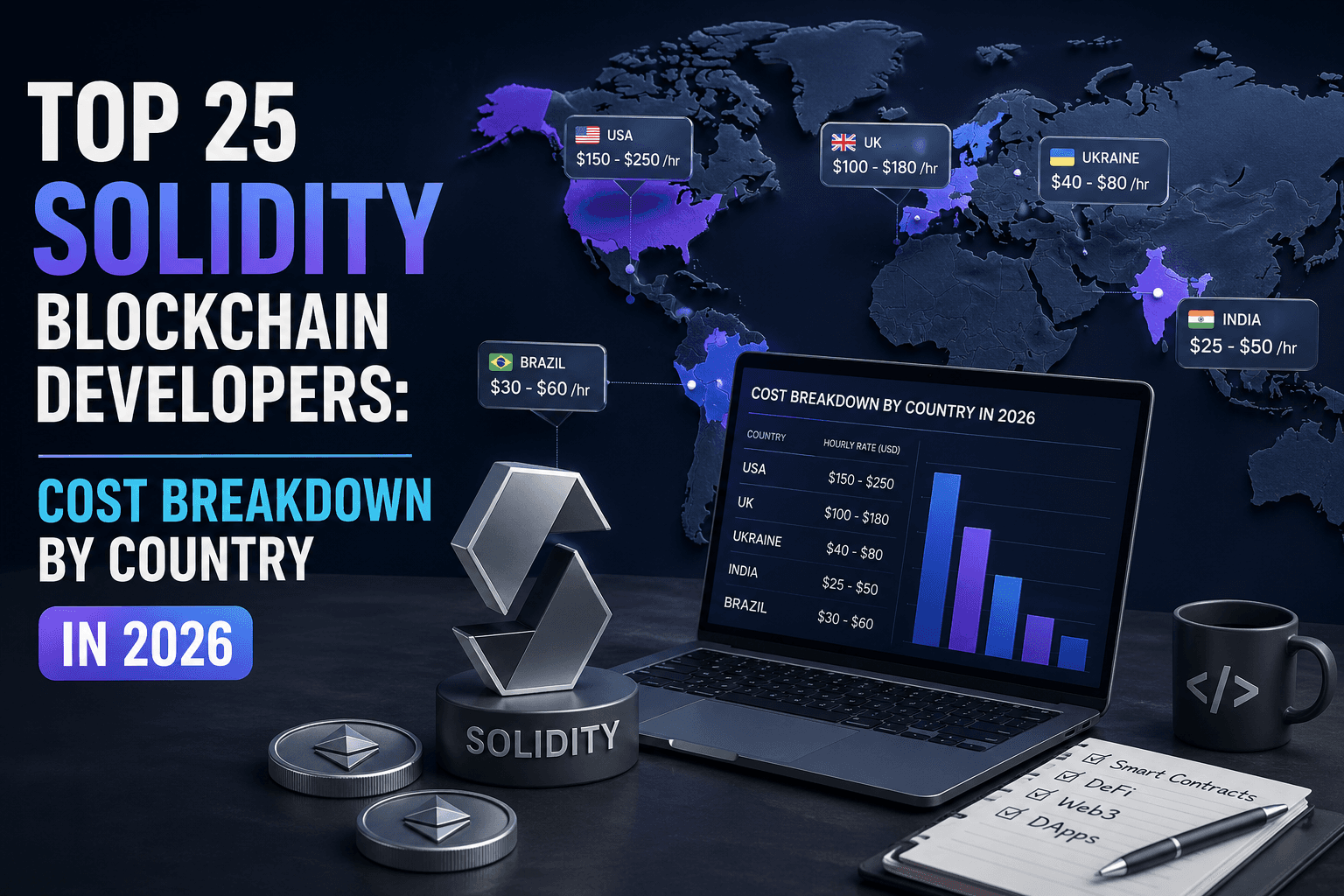
4. Average Solidity Developer Hourly Rates by Country (2026)
The table below presents verified average hourly rates for Solidity developers across key hiring markets. Data is compiled from Toptal, Upwork, Deel, and direct agency rate cards as of Q1 2026. Rates reflect USD equivalents and represent the middle 60th percentile (excluding extreme outliers).
Country | Junior Rate/hr | Mid-Level Rate/hr | Senior Rate/hr | Monthly Cost (Full-time) | Best For |
India | $18–$28 | $30–$50 | $55–$80 | $4,800–$12,800 | Cost efficiency, large teams |
United States | $90–$130 | $140–$180 | $190–$260 | $30,400–$41,600 | Premium quality, compliance |
Ukraine | $30–$45 | $50–$75 | $80–$120 | $8,000–$19,200 | DeFi expertise, EU time zone |
Poland | $35–$50 | $55–$80 | $85–$130 | $8,800–$20,800 | Enterprise blockchain, EU access |
Canada | $75–$100 | $110–$150 | $160–$220 | $25,600–$35,200 | North America quality, lower cost |
Germany | $60–$85 | $90–$130 | $140–$200 | $22,400–$32,000 | Enterprise, fintech compliance |
United Kingdom | $65–$90 | $95–$140 | $150–$210 | $24,000–$33,600 | Financial services, DeFi |
Vietnam | $15–$25 | $28–$45 | $50–$75 | $4,480–$12,000 | Budget teams, growing ecosystem |
Philippines | $15–$22 | $25–$40 | $45–$65 | $4,000–$10,400 | English fluency, cost efficiency |
Brazil | $22–$35 | $38–$60 | $65–$95 | $6,080–$15,200 | Latin America timezone |
Argentina | $20–$32 | $35–$55 | $60–$90 | $5,600–$14,400 | Strong tech culture, US timezone |
UAE | $40–$60 | $65–$95 | $100–$150 | $10,400–$24,000 | Middle East market, tax-free |
Singapore | $50–$75 | $80–$120 | $130–$185 | $12,800–$29,600 | APAC hub, top Web3 ecosystem |
Australia | $65–$90 | $95–$140 | $150–$200 | $24,000–$32,000 | APAC quality, English |
South Africa | $20–$30 | $35–$55 | $60–$85 | $5,600–$13,600 | Africa entry, EU timezone |
Note: Rates for contract/freelance work are approximately 1.3–1.6x higher than equivalent full-time employment rates in the same market, reflecting contractor premiums, self-employment taxes, and the absence of benefits packages.
5. Top 25 Countries to Hire Solidity Blockchain Developers in 2026
Below is a detailed breakdown of each major developer market — covering talent quality, ecosystem maturity, communication, and strategic fit for different types of Web3 projects.
1. India
Avg. Hourly Rate: $18–$80 | Talent Pool: 85,000+ blockchain developers
India is the undisputed global leader in offshore Solidity development. Cities like Bangalore, Hyderabad, Pune, and Chennai have produced world-class smart contract engineers who have contributed to Chainlink's oracles, Polygon's architecture, and multiple top-20 DeFi protocols by TVL.
• English communication: Excellent — India produces more English-speaking engineers than any other offshore market
• Timezone: IST (UTC+5:30) — ideal for asynchronous collaboration with EU and US East Coast
• Blockchain ecosystem: Mature — India hosts 40+ Web3 accelerators and 200+ active blockchain startups
• Best for: Large development teams, DeFi protocol backends, Layer-2 integrations, cost-sensitive MVPs
• Pros: Enormous talent pool, strong English, competitive rates, proven Web3 track record
• Cons: High variance in quality — rigorous vetting is essential; timezone gaps with US West Coast
2. United States
Avg. Hourly Rate: $90–$260 | Talent Pool: 28,000+ blockchain developers
The United States remains the global center of blockchain venture capital, protocol governance, and regulatory strategy. US Solidity developers often combine deep technical expertise with product strategy, investor relations fluency, and legal/compliance awareness — making them invaluable for enterprise and regulated DeFi applications.
• English communication: Native
• Timezone: ET/PT — perfect for domestic collaboration
• Blockchain ecosystem: World-leading — home to Coinbase, Uniswap Labs, ConsenSys, and hundreds of funded protocols
• Best for: Enterprise blockchain, regulatory-compliant DeFi, tokenization of financial assets
• Pros: Highest quality, protocol-level expertise, legal/compliance knowledge
• Cons: Extremely expensive; severe talent scarcity; non-compete clauses common
3. Ukraine
Avg. Hourly Rate: $30–$120 | Talent Pool: 22,000+ blockchain developers
Ukraine's blockchain developer community is among the most technically sophisticated in the world. Ukrainian engineers are known for their mathematical rigor, cryptography expertise, and deep familiarity with DeFi protocol architecture. Kyiv, Lviv, and Kharkiv have produced engineers who have audited top DeFi protocols and built Layer-2 systems from scratch.
• English communication: Good to Excellent
• Timezone: EET (UTC+3) — strong EU alignment
• Blockchain ecosystem: Very mature — multiple top-tier Solidity development agencies
• Best for: DeFi protocols, cryptography-heavy applications, smart contract auditing
• Pros: Exceptional technical depth, competitive rates, strong work ethic
• Cons: Geopolitical risk considerations; some timezone friction with US West Coast
4. Poland
Avg. Hourly Rate: $35–$130 | Talent Pool: 18,000+ blockchain developers
Poland has emerged as Central Europe's blockchain talent powerhouse. Warsaw and Krakow host major blockchain conferences (like ETHWarsaw) and have cultivated a developer community deeply embedded in the Ethereum ecosystem. Polish developers are renowned for clean code architecture, thorough documentation, and enterprise-grade delivery.
• English communication: Very good
• Timezone: CET (UTC+1) — ideal for Western European clients
• Blockchain ecosystem: Strong — growing DeFi and tokenization sector
• Best for: Enterprise blockchain, EU-regulated DeFi, fintech integrations
• Pros: High code quality, EU legal framework, excellent documentation
• Cons: Rates rising as demand increases; smaller talent pool than India
5. Canada
Avg. Hourly Rate: $75–$220 | Talent Pool: 12,000+ blockchain developers
Canada offers near-US quality at 20–35% lower rates, with the added benefit of cultural alignment and shared time zones. Toronto and Vancouver are emerging as significant Web3 hubs, attracting blockchain talent from across Asia and Eastern Europe through skilled worker immigration programs.
• English communication: Native
• Timezone: ET/PT — seamless US collaboration
• Blockchain ecosystem: Strong — Ethereum Foundation has Canadian leadership; multiple DeFi protocols headquartered in Toronto
• Best for: US companies wanting near-shore quality with cost savings
• Pros: Cultural alignment, time zone, high talent quality, immigration-fed talent pool
• Cons: Still expensive relative to offshore alternatives
6. Germany
Avg. Hourly Rate: $60–$200 | Talent Pool: 14,000+ blockchain developers
Germany's engineering culture — precision, documentation, rigorous testing — makes German Solidity developers particularly valuable for enterprise blockchain and regulated financial applications. Berlin has become a global blockchain hub with strong institutional backing from Deutsche Bank's digital assets division and multiple Web3 accelerators.
• English communication: Very good
• Timezone: CET (UTC+1)
• Blockchain ecosystem: Strong — significant institutional DeFi and tokenization activity
• Best for: Enterprise blockchain, financial tokenization, EU MiCA-compliant protocols
• Pros: Rigorous engineering standards, strong EU regulatory knowledge
• Cons: High rates; German labor laws make contractor arrangements complex
7. United Kingdom
Avg. Hourly Rate: $65–$210 | Talent Pool: 16,000+ blockchain developers
London remains a major global blockchain hub, particularly for DeFi, fintech integration, and regulated digital asset platforms. The UK's Financial Conduct Authority (FCA) has established relatively clear crypto regulations, making British Solidity developers well-versed in compliance-adjacent development.
• English communication: Native
• Timezone: GMT (UTC+0) — bridges US and Asia
• Blockchain ecosystem: Very strong — major DeFi protocols, trading infrastructure
• Best for: Financial services blockchain, DeFi with compliance requirements
• Pros: English native, strong fintech ecosystem, regulatory expertise
• Cons: Expensive; post-Brexit talent movement complications
8. Vietnam
Avg. Hourly Rate: $15–$75 | Talent Pool: 15,000+ blockchain developers
Vietnam has rapidly expanded its blockchain developer community, driven by a young, tech-hungry population and government support for digital innovation. Ho Chi Minh City and Hanoi now host active Web3 developer communities. While senior talent is still developing, Vietnam offers exceptional value for mid-level smart contract work and integration tasks.
• English communication: Moderate — improving rapidly among younger developers
• Timezone: ICT (UTC+7) — good for APAC clients; challenging for US
• Best for: Budget-conscious teams, NFT development, integration work
• Pros: Very competitive rates, growing talent pool, strong work ethic
• Cons: English fluency varies; senior Solidity expertise limited
9. Philippines
Avg. Hourly Rate: $15–$65 | Talent Pool: 12,000+ blockchain developers
The Philippines combines low costs with excellent English communication — a rare combination in offshore development. Filipino developers have been early adopters of Web3, driven partly by the country's familiarity with crypto payments and NFT gaming (Axie Infinity was hugely popular here). Communication overhead is minimal compared to non-English markets.
• English communication: Excellent — official language
• Timezone: PHT (UTC+8) — APAC aligned
• Best for: Client-facing Web3 projects, NFT development, dApp frontend integration
• Pros: Excellent English, low cost, cultural alignment with Western clients
• Cons: Senior DeFi expertise is still developing
10. Brazil
Avg. Hourly Rate: $22–$95 | Talent Pool: 18,000+ blockchain developers
Brazil is the largest blockchain talent market in Latin America. Sao Paulo hosts a vibrant crypto startup ecosystem, and Brazil was one of the first countries to adopt Bitcoin as legal tender for transactions. Brazilian developers offer near-US time zone alignment with significantly lower costs.
• English communication: Moderate — better among metropolitan developers
• Timezone: BRT (UTC-3) — strong alignment with US East Coast
• Best for: LatAm-focused DeFi projects, payment tokenization, US-aligned teams
• Pros: Good time zone, growing ecosystem, passionate developer community
• Cons: English proficiency varies; economic instability can affect retention
11. Argentina
Avg. Hourly Rate: $20–$90 | Talent Pool: 10,000+ blockchain developers
Argentina's economic history with currency instability has made it a nation of early crypto adopters, which has organically produced a technically sophisticated blockchain developer community. Argentine developers are known for strong mathematical foundations and passion for decentralized finance.
• English communication: Good
• Timezone: ART (UTC-3) — US East Coast friendly
• Best for: DeFi development, stablecoin protocols, LatAm market projects
• Pros: Deep crypto culture, competitive rates, strong technical foundations
• Cons: Economic volatility affects pricing stability; talent retention challenges
12. United Arab Emirates (UAE)
Avg. Hourly Rate: $40–$150 | Talent Pool: 8,000+ blockchain developers
Dubai has positioned itself as the world's most crypto-friendly regulatory jurisdiction. The Virtual Assets Regulatory Authority (VARA) has created clear frameworks for DeFi, NFTs, and digital asset services. The UAE attracts top international blockchain talent through zero income tax and residency programs specifically designed for Web3 entrepreneurs.
• English communication: Excellent — international business language
• Timezone: GST (UTC+4) — bridges EU and Asia
• Best for: Middle East market entry, regulated DeFi, Islamic finance tokenization
• Pros: Progressive regulation, tax-free, international talent hub
• Cons: Higher cost than other offshore markets; talent often non-permanent
13. Singapore
Avg. Hourly Rate: $50–$185 | Talent Pool: 9,000+ blockchain developers
Singapore is the undisputed Web3 capital of Southeast Asia. The Monetary Authority of Singapore (MAS) has developed one of the world's most sophisticated digital asset regulatory frameworks. Major protocols like Aave, Bybit, and Nansen have APAC headquarters in Singapore.
• English communication: Excellent — official language
• Timezone: SGT (UTC+8)
• Best for: APAC market DeFi, institutional blockchain, digital securities
• Pros: World-class regulatory environment, English-speaking, top-tier talent
• Cons: Increasingly expensive; talent scarcity in senior DeFi roles
14. Australia
Avg. Hourly Rate: $65–$200 | Talent Pool: 10,000+ blockchain developers
Australia has a growing blockchain ecosystem anchored by government digital identity initiatives and a strong fintech sector. Australian developers offer English-native communication with APAC time zone coverage, filling a unique gap for US and UK companies needing Asian-hours coverage.
• English communication: Native
• Timezone: AEST (UTC+10/11) — APAC coverage
• Best for: APAC-facing dApps, enterprise blockchain, digital identity
• Pros: High quality, English native, good regulatory awareness
• Cons: Expensive; smaller talent pool than major offshore markets
15. Netherlands
Avg. Hourly Rate: $55–$170 | Talent Pool: 8,000+ blockchain developers
Amsterdam is one of Europe's most important blockchain innovation hubs, home to Ethereum's early developer community and ongoing EVM research. Dutch developers are known for their rigorous approach to security and protocol design.
• English communication: Excellent
• Timezone: CET (UTC+1)
• Best for: Protocol-level development, security auditing, EU DeFi
• Pros: Protocol expertise, excellent English, EU compliance knowledge
• Cons: High rates; limited talent pool
16. Romania
Avg. Hourly Rate: $28–$95 | Talent Pool: 9,000+ blockchain developers
Romania offers an outstanding combination of technical excellence, EU time zone alignment, and competitive rates. Bucharest and Cluj-Napoca have produced strong blockchain developer communities. Romanian engineers are known for strong computer science fundamentals and meticulous code quality.
• English communication: Very good
• Timezone: EET (UTC+2) — ideal for EU clients
• Best for: EU-facing DeFi projects, smart contract auditing, enterprise blockchain
• Pros: Excellent value in EU timezone, strong CS foundations, EU legal framework
• Cons: Growing demand is pushing rates upward
17. Pakistan
Avg. Hourly Rate: $15–$60 | Talent Pool: 20,000+ blockchain developers
Pakistan has one of the world's largest freelance developer populations. Lahore, Karachi, and Islamabad have produced prolific Solidity developers, many of whom have built significant open-source Web3 portfolios on GitHub. For budget-constrained projects with strong project management, Pakistan offers compelling value.
• English communication: Good
• Timezone: PKT (UTC+5) — similar to India
• Best for: Budget projects, token development, smaller DeFi integrations
• Pros: Very competitive rates, large talent pool, English communication
• Cons: Quality variance is high; strong vetting process essential
18. Bangladesh
Avg. Hourly Rate: $12–$45 | Talent Pool: 8,000+ blockchain developers
Bangladesh represents one of the most cost-effective Solidity developer markets globally. Dhaka has an active blockchain developer community, and several local agencies have built credible track records in NFT and DeFi development.
• English communication: Moderate
• Timezone: BST (UTC+6)
• Best for: Simple smart contract deployments, token creation, budget NFT projects
• Pros: Lowest rates globally for Solidity work, young developer population
• Cons: Senior expertise limited; quality assurance requires extra diligence
19. South Africa
Avg. Hourly Rate: $20–$85 | Talent Pool: 7,000+ blockchain developers
South Africa is Africa's most developed blockchain market. Cape Town and Johannesburg host growing Web3 communities. South African developers offer EU time zone alignment with competitive rates — a rare combination that makes them attractive to European companies.
• English communication: Excellent — official language
• Timezone: SAST (UTC+2) — excellent EU alignment
• Best for: EU-aligned teams needing cost efficiency, African DeFi market
• Pros: English native, EU timezone, competitive rates
• Cons: Smaller talent pool; limited senior DeFi specialization
20. Mexico
Avg. Hourly Rate: $22–$85 | Talent Pool: 12,000+ blockchain developers
Mexico City has become a Web3 hotspot, partly driven by remittance use cases for crypto and government digital currency experiments. Mexican developers offer strong alignment with US Central/Eastern time zones.
• English communication: Moderate to Good
• Timezone: CST (UTC-6) — strong US alignment
• Best for: US-nearshore teams, LatAm DeFi, remittance protocols
• Pros: US time zone, growing ecosystem, competitive rates
• Cons: Senior Solidity expertise developing; English varies
21. Indonesia
Avg. Hourly Rate: $15–$65 | Talent Pool: 14,000+ blockchain developers
Indonesia is the fastest-growing blockchain market in Southeast Asia. Jakarta has produced notable Web3 gaming and NFT developers, driven by the country's large gaming culture. The developer community is young, enthusiastic, and rapidly upskilling.
• English communication: Moderate
• Timezone: WIB (UTC+7)
• Best for: NFT development, Web3 gaming, APAC market projects
• Pros: Low cost, large young talent pool, strong gaming/NFT focus
• Cons: Senior DeFi expertise limited; English communication can be a barrier
22. Turkey
Avg. Hourly Rate: $20–$80 | Talent Pool: 11,000+ blockchain developers
Turkey has one of the world's highest crypto adoption rates per capita, driven by currency depreciation concerns. This has produced a technically capable and deeply motivated blockchain developer community in Istanbul and Ankara.
• English communication: Good
• Timezone: TRT (UTC+3)
• Best for: Middle East/EU hybrid projects, stablecoin protocols
• Pros: High crypto culture, competitive rates, EU/MENA timezone bridge
• Cons: Political/economic instability; talent retention challenges
23. Serbia
Avg. Hourly Rate: $28–$100 | Talent Pool: 6,000+ blockchain developers
Serbia has emerged as a quiet gem in Eastern European blockchain development. Belgrade's developer community is technically rigorous, deeply embedded in the Ethereum ecosystem, and significantly more affordable than Western European counterparts.
• English communication: Very good
• Timezone: CET (UTC+1)
• Best for: EU-facing DeFi, protocol development, smart contract auditing
• Pros: Excellent technical depth, EU timezone, competitive rates
• Cons: Smaller talent pool — top talent books up quickly
24. Portugal
Avg. Hourly Rate: $35–$120 | Talent Pool: 7,000+ blockchain developers
Lisbon has transformed into Europe's hottest tech and Web3 destination. The Web Summit conference, crypto-friendly tax policies for new residents, and a growing international tech community have attracted blockchain developers from across Europe and beyond. Portugal's developer community blends local talent with internationally experienced expat engineers.
• English communication: Very good
• Timezone: WET (UTC+0/+1)
• Best for: EU DeFi, international Web3 teams, startup development
• Pros: Crypto-friendly environment, EU legal framework, diverse talent pool
• Cons: Rates rising rapidly; talent pool still relatively small
25. Estonia
Avg. Hourly Rate: $40–$140 | Talent Pool: 4,000+ blockchain developers
Estonia is a blockchain nation. The Estonian government runs the world's most advanced national blockchain infrastructure (X-Road), issues e-residency, and has produced a disproportionate number of world-class blockchain developers per capita. Tallinn is the EU's most blockchain-literate capital city.
• English communication: Excellent
• Timezone: EET (UTC+2)
• Best for: Government blockchain, digital identity, EU-regulated DeFi
• Pros: World-leading blockchain culture, EU legal base, top-tier engineers
• Cons: Very small talent pool; demand significantly exceeds supply
6. Best Countries for Different Hiring Goals
Best Budget-Friendly Countries
For teams prioritizing cost efficiency without sacrificing core competency, these markets offer the best value:
• India — Best overall value: massive talent pool + competitive rates + strong English
• Pakistan — Most affordable for simple to mid-complexity contracts
• Bangladesh — Lowest entry point for basic smart contract work
• Vietnam — Best budget option for APAC-aligned teams
• Philippines — Best budget option with native English communication
Best Enterprise-Quality Countries
For mission-critical protocols, financial tokenization, or institutional-grade applications:
• United States — Highest caliber, best for compliance-heavy work
• Germany — Rigorous engineering, EU regulatory expertise
• Netherlands — Protocol-level depth, Ethereum core community connections
• Estonia — Blockchain-native culture, EU legal framework
• Singapore — APAC enterprise quality, strong MAS regulatory compliance
Best Timezone-Friendly Countries
For seamless real-time collaboration:
• Canada / Argentina / Brazil / Mexico — US time zone alignment
• Poland / Germany / Romania / Serbia — EU time zone alignment
• South Africa / Ukraine — EU+Africa time zone bridge
• Singapore / Philippines / Australia — APAC time zone coverage
Best Countries for Startups
Startups need speed, value, and flexibility. These markets consistently deliver for early-stage Web3 ventures:
• India — Largest certified talent pool, fastest team scaling
• Ukraine — Senior DeFi expertise at startup-friendly rates
• Argentina — Deep crypto culture, US-friendly hours, passion for decentralized tech
• Philippines — English-native, affordable, strong dApp integration skills
Best Countries for Long-Term Hiring
For companies building permanent distributed teams:
• India — Deep talent bench ensures easy replacement and scaling
• Poland — Strong retention rates, EU employment stability
• Canada — Cultural alignment for US companies building long-term teams
• Portugal / Estonia — EU legal stability, growing blockchain communities
7. Key Factors That Affect Solidity Developer Costs
Beyond geography, multiple variables determine what you will actually pay for a Solidity developer in 2026:
Experience Level and Protocol Depth
A junior developer deploying standard ERC-20 tokens costs a fraction of a senior engineer who has built production DeFi liquidation engines or zkEVM-compatible smart contract systems. The difference between mid-level and senior rates is not just years of experience — it is battle-tested protocol knowledge and security intuition earned through real production deployments.
Smart Contract Complexity
Simple projects (token deployment, basic NFT contracts) command standard rates. Complex systems — automated market makers, cross-chain bridges, yield optimization vaults — require architectural thinking and deep security expertise that carries a 40–80% premium over baseline rates.
DeFi vs NFT vs Enterprise Blockchain
DeFi protocol developers command the highest premiums because their work directly manages user funds and must be economically secure against adversarial actors. NFT developers are more abundant and slightly less expensive. Enterprise blockchain developers (Hyperledger, private chains) are priced separately and often command different rate structures.
Security Auditing Expertise
Developers with verified smart contract auditing credentials (Certora, Trail of Bits, OpenZeppelin background) command 30–60% premium over developers without formal security training. As protocol hacks continue costing hundreds of millions of dollars annually, security expertise pricing has increased faster than any other Solidity subspecialty.
Layer-2 and zkEVM Experience
Developers with hands-on production experience in Arbitrum, Optimism, zkSync, Polygon zkEVM, or Starknet are significantly rarer and more expensive. zk-proof expertise specifically can add $20–$50/hour to baseline Solidity rates.
Project Duration and Engagement Model
Long-term engagements (6+ months) typically allow for 10–20% rate negotiation compared to short-term sprint work. Agencies generally include project management overhead (15–25% of developer cost) but also provide quality assurance and bench coverage. Freelancers offer flexibility but expose clients to single-point-of-failure risk.
8. Freelancers vs Blockchain Development Agencies: A Strategic Comparison
Factor | Freelancer | Development Agency |
Cost | Lower (no overhead) | Higher (PM, QA included) |
Reliability | Higher risk — single POF | More reliable — team backup |
Scalability | Limited — one person | Scalable — add resources quickly |
Communication | Direct but inconsistent | Structured, managed |
Security | Lower oversight | NDA, audit trails, IP protection |
Project Mgmt | Self-managed by client | Included — PMs provided |
Best For | Small, defined tasks | Complex, long-term builds |
Vetting | Client responsibility | Agency pre-vetted talent |
For projects under $20,000, experienced freelancers from platforms like Toptal, Upwork, or Braintrust offer excellent value. For production DeFi protocols, token launches, or enterprise blockchain systems exceeding $50,000 in scope, a specialized blockchain development agency provides significantly better risk management and delivery assurance.
9. How to Hire the Right Solidity Developer in 2026
Technical Skills to Evaluate
• Solidity proficiency: ERC standards, proxy patterns (UUPS, Transparent), gas optimization
• Development frameworks: Hardhat, Foundry, Truffle — Foundry expertise signals modern developer
• Testing: Property-based testing (Foundry fuzzing), unit tests, integration tests
• Security awareness: Reentrancy, flash loan attacks, oracle manipulation, access control
• Layer-2: Experience with Arbitrum, Optimism, or zkSync deployment
• Web3 stack: ethers.js v6, wagmi, viem for frontend integration
GitHub and Portfolio Evaluation
Request GitHub profiles and review: commit history consistency, smart contract repositories with tests, contributions to open-source protocols, and audit reports they have authored or received. A developer's GitHub tells you more than their resume.
Interview Questions That Reveal True Expertise
• Explain the checks-effects-interactions pattern and why it matters
• How would you design an upgradeable smart contract system for a lending protocol?
• What are the gas implications of using storage vs memory vs calldata?
• Walk me through how a flash loan attack works and how you prevent it
• What is the difference between UUPS and Transparent proxy patterns?
Red Flags to Avoid
• No testnet deployment history — anyone can write contracts; deploying and debugging them is proof of competency
• No security audit experience or awareness — unacceptable for production DeFi
• Cannot explain proxy patterns — essential for upgradeable systems
• Uses outdated Truffle-only workflow without Foundry familiarity (2026 signal of stale knowledge)
• Vague answers about gas optimization — a genuine expert can quantify savings
Recommended Hiring Platforms
• Toptal — Pre-vetted top 3% of blockchain developers; higher cost, lower vetting burden
• Upwork — Large pool; requires rigorous client-side vetting
• Braintrust — Talent-owned network with strong Web3 developer community
• Deel — Preferred for managing international contractor compliance
• LinkedIn + ETHGlobal community — Direct sourcing from hackathon participants
• Immunefi / Code4rena — Source from competitive audit platforms for security-focused hires
10. The Future of Solidity Development in 2026 and Beyond
AI-Augmented Smart Contract Development
AI code generation tools (specialized for Solidity) are reshaping developer productivity in 2026. Tools trained specifically on audited Solidity codebases can generate boilerplate contracts and suggest gas optimizations — but they also introduce new security risks when used without expert oversight. Senior developers who can effectively leverage AI tools while maintaining security rigor are the most valuable engineers of the current cycle.
DeFi 2.0 and Real-World Asset Tokenization
The tokenization of real-world assets — US Treasury bonds, real estate, private equity, commodities — represents the largest expansion of Solidity development use cases in 2026. BlackRock's BUIDL fund, Franklin Templeton's tokenized money market, and dozens of fintech startups are building Solidity-based RWA platforms. This has created massive demand for developers who combine Solidity expertise with financial instrument knowledge.
Zero-Knowledge Proof Integration
Zero-knowledge technology has matured from academic cryptography into production infrastructure. Solidity developers who understand zkSNARKs, zkSTARKs, and zkEVM architecture are among the rarest and most sought-after professionals in Web3. ZK-based privacy protocols, zkRollup development, and ZK-identity systems represent the bleeding edge of Solidity development in 2026.
Layer-2 and Multi-Chain Development
The EVM ecosystem has expanded from Ethereum to dozens of compatible chains. Modern Solidity developers must be multi-chain fluent — deploying and adapting contracts for Arbitrum, Optimism, Base, zkSync, Polygon, Avalanche, and emerging chains simultaneously. Cross-chain bridge development and interoperability protocols are high-growth specializations.
Web3 Gaming and Digital Economies
On-chain gaming has evolved from simple NFT ownership to complex on-chain game economies with Solidity-powered loot systems, land ownership, governance tokens, and player-owned economies. The intersection of Solidity development and game design is one of the most exciting and rapidly growing developer niches of 2026.
Hiring Demand Forecast
By 2028, analyst firm Gartner projects that 25% of the Fortune 500 will have active smart contract deployments on public blockchains. This trajectory guarantees continued strong demand growth for Solidity developers — and suggests that current rate differentials between markets will persist or widen as premium demand outpaces talent supply.
11. Final Conclusion and Hiring Recommendations
The global market for Solidity blockchain developers in 2026 presents extraordinary opportunities for businesses that hire strategically. Here is the definitive summary:
Best Overall Countries for Hiring Solidity Developers
India — Best combination of pool size, cost efficiency, and technical quality. Ideal for most companies.
Ukraine — Premium DeFi expertise at offshore prices. Best for protocol-level work.
Poland — Enterprise quality at competitive EU rates. Best for EU-regulated projects.
Best Low-Cost Destinations
Pakistan / Bangladesh — Lowest rates for straightforward smart contract work with rigorous vetting.
Vietnam / Philippines — Affordable with strong English communication (Philippines) or rapid skill growth (Vietnam).
Best Premium Markets for Enterprise or High-Stakes Protocols
United States / Canada — For compliance-heavy, regulated, or high-value financial applications.
Estonia / Netherlands — For protocol-level or government blockchain with EU legal framework requirements.
Final Recommendation Framework
• Seed-stage startup building an MVP: India or Philippines — balance of cost, speed, and quality
• Series A DeFi protocol: Ukraine or Poland — senior expertise without US pricing
• Enterprise blockchain (Fortune 500): United States or Germany — compliance, documentation, rigor
• Web3 gaming or NFT platform: Indonesia, India, or Philippines — specialized teams at competitive rates
• RWA tokenization or regulated DeFi: UAE, Singapore, or United Kingdom — regulatory expertise built in
The most important takeaway: geography determines pricing, but it does not determine quality. The world's best Solidity engineers live in every country on this list. What differentiates hiring outcomes is not where you look — it is how rigorously you evaluate technical depth, security awareness, and protocol experience during the hiring process.
Ready to hire a top Solidity developer for your Web3 project? Start with a clear scope, a security-first mindset, and this guide as your foundation. The right blockchain developer — at the right cost — is out there. Now you know exactly where to look.
12. FAQ: Hiring Solidity Developers in 2026
Q1: What is the average hourly rate for a Solidity developer in 2026?
Hourly rates range from $12–$15/hr for junior developers in Bangladesh or Vietnam to $200–$260/hr for senior developers in the United States. The global average for a qualified mid-level Solidity developer is approximately $55–$80/hr across all markets.
Q2: Which country offers the best value for hiring Solidity developers?
India consistently offers the best balance of cost, quality, English communication, and talent pool size. For EU-timezone projects, Ukraine and Romania offer exceptional value. For English-native budget hiring, the Philippines is the top choice.
Q3: How long does it take to hire a Solidity developer?
Through curated platforms like Toptal, hiring typically takes 1–2 weeks. Direct hiring through job boards takes 4–8 weeks. Working with a blockchain development agency can mobilize a vetted team in 3–7 days for urgent projects.
Q4: Is it safe to hire offshore Solidity developers for DeFi protocols?
Yes, with proper vetting. Evaluate GitHub portfolios, conduct technical code reviews, require test-driven development practices, mandate smart contract audits before mainnet deployment, and use milestone-based payment structures for large engagements.
Q5: What is the difference between a Solidity developer and a blockchain developer?
A Solidity developer specializes specifically in writing smart contracts for EVM-compatible blockchains. A blockchain developer is a broader term that may include developers working on consensus mechanisms, node infrastructure, non-EVM chains (Rust-based Solana, Cosmos), or blockchain data indexing.
Q6: How much does it cost to build a DeFi protocol in 2026?
A basic DeFi protocol (single-asset lending or AMM) costs approximately $80,000–$200,000 for development and auditing. A full-featured DeFi protocol with multiple assets, governance, and security auditing typically ranges from $300,000–$800,000 using offshore teams, or $1M–$3M+ with US-based teams.
Q7: Should I hire a freelance Solidity developer or a blockchain development agency?
For projects under $25,000 with well-defined scope, an experienced freelancer from a curated platform provides good value. For complex protocols, long-term builds, or any project managing user funds, a specialized agency provides superior risk management, accountability, and delivery assurance.
Q8: What technical skills should a senior Solidity developer have in 2026?
Core competencies include: Solidity proficiency with ERC standards, proxy contract patterns, gas optimization; Foundry or Hardhat expertise; security awareness (reentrancy, flash loans, access control); Layer-2 deployment experience; Web3 integration skills (ethers.js, wagmi); and ideally, formal verification or smart contract auditing experience.
Q9: Are AI tools replacing Solidity developers in 2026?
No. AI tools are augmenting developer productivity — helping with boilerplate code and basic auditing suggestions — but they cannot replace the security intuition, protocol architecture thinking, and adversarial threat modeling that senior Solidity engineers provide. In fact, senior developers who effectively leverage AI tools are commanding higher premiums, not lower ones.
Q10: Which country has the largest blockchain developer talent pool in 2026?
India has the largest blockchain developer talent pool globally, with over 85,000 developers having blockchain-related skills as of 2026. The United States has the most senior protocol-level talent per capita, while China has a large pool primarily focused on domestic blockchain infrastructure.


