
OpenCart vs Umbraco: Which One Should You Choose (2026)?
Posted on
Web Design
Posted at
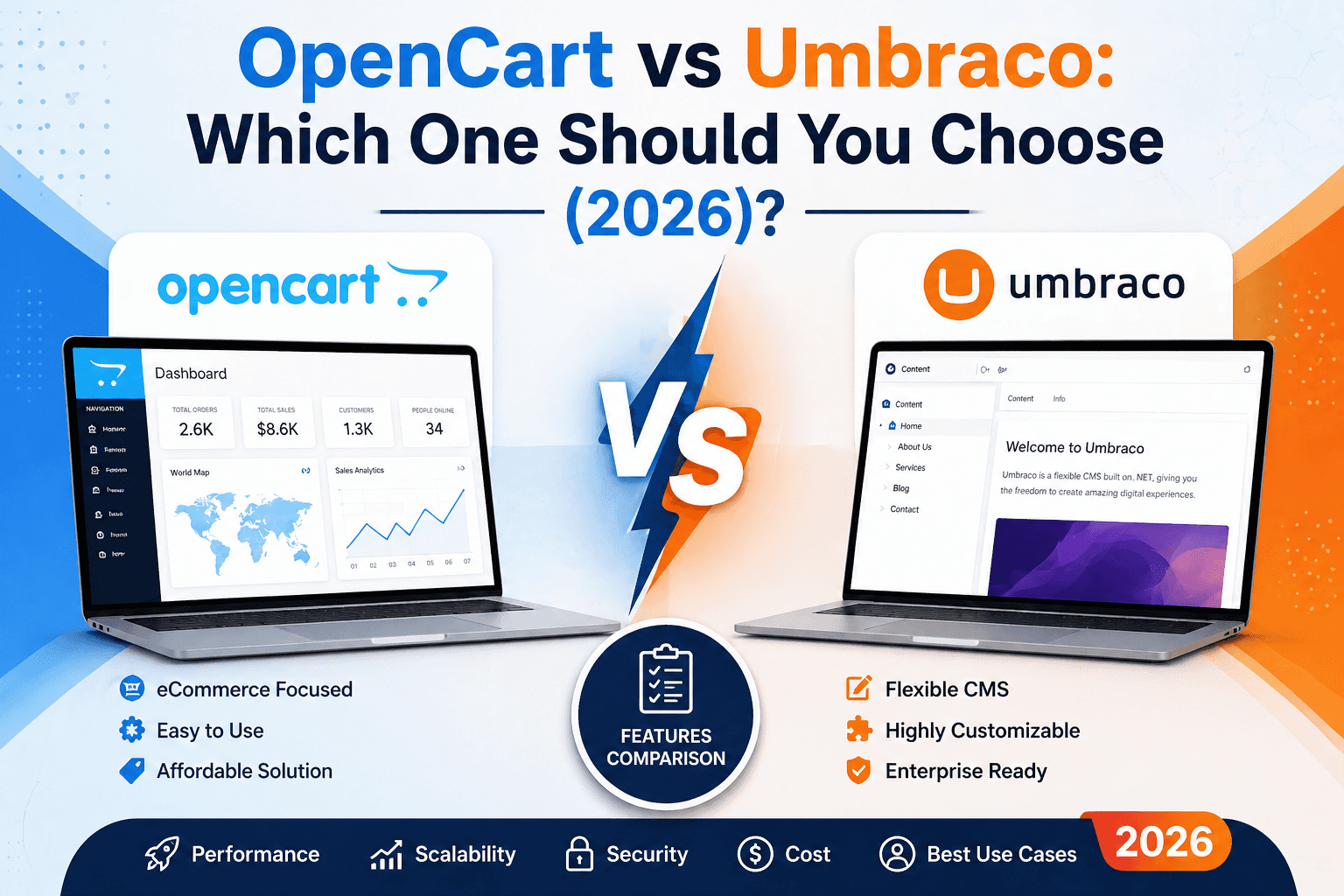
Introduction
Imagine you're a business owner ready to build your online presence in 2026. You've narrowed it down to two platforms — OpenCart and Umbraco — but every article you read feels like it was written by someone who's never actually used either. You need a real answer, not a feature dump.
Here's the honest truth: OpenCart and Umbraco are built for fundamentally different purposes. One is a battle-tested eCommerce engine. The other is a powerhouse content management system that can handle commerce — but only if you build it that way. Choosing between them without understanding this distinction could mean months of wasted development time or a platform that quietly limits your growth.
This guide breaks down everything you need to know — features, pricing, SEO readiness, real-world use cases, and a clear final recommendation — so you can make a confident call.
Quick Summary – OpenCart vs Umbraco (2026)
Direct Answer: Choose OpenCart if your primary goal is selling products online and you want a purpose-built, cost-effective eCommerce store. Choose Umbraco if you need a highly customized digital experience — especially one where rich content, enterprise workflows, and deep developer control matter more than out-of-the-box shopping functionality.
Feature | OpenCart | Umbraco |
|---|---|---|
Primary Purpose | eCommerce platform | Content management system (CMS) |
Tech Stack | PHP / MVC-L | .NET (C#) |
Open Source | Yes | Yes |
eCommerce Out of Box | Yes — native | Requires third-party integration |
Ease of Use | Moderate | Moderate to steep |
Best For | SMBs, online stores | Enterprises, content-heavy sites |
Hosting | Self-host or cloud | Self-host, Azure, or Umbraco Cloud |
Base Cost | Free (self-host) | Free (self-host) |
Extensions/Plugins | 13,000+ marketplace | Packages via Umbraco Marketplace |
SEO Capability | Built-in basic SEO | Highly customizable SEO |
Multilingual | Yes | Yes |
Headless Support | Yes (REST API) | Yes (Heartcore headless CMS) |
What Is OpenCart?
OpenCart is a free, open-source eCommerce platform originally launched in 2005 and rewritten in PHP. It's designed from the ground up for merchants — whether you're selling physical goods, digital downloads, or subscriptions.
By 2026, OpenCart has evolved significantly. Version 4.x introduced AI-assisted admin features, B2B modules, improved REST API support, and Progressive Web App (PWA) compatibility. It's no longer just a "budget Shopify alternative" — for developer-led teams, it's a serious contender.
Key Features:
Multi-store management from a single dashboard
13,000+ extensions and themes in the marketplace
Built-in support for 20+ payment gateways
Advanced product management (variants, bundles, digital downloads)
Customer groups and loyalty tools
Built-in reporting and sales analytics
OCMOD modification system for non-destructive customization
Headless commerce via REST API
Best Use Cases:
Small to medium-sized online stores
Businesses needing multi-store management without enterprise pricing
Agencies building custom eCommerce solutions for clients
B2B sellers needing quote management and customer-group pricing
Global sellers needing multilingual and multi-currency support
What Is Umbraco?
Umbraco is an open-source .NET CMS (Content Management System) founded in Denmark in 2000. With over 500,000 active installs worldwide, it's one of the most respected developer-friendly CMS platforms in the Microsoft ecosystem.
Unlike OpenCart, Umbraco doesn't come with a shopping cart built in. It's a blank canvas — extremely powerful, but requiring a developer to bring your vision to life. The upside? You can build almost anything with it.
In 2026, Umbraco offers three distinct products: the self-hosted open-source CMS (free), Umbraco Cloud (Azure-hosted SaaS), and Umbraco Heartcore (a headless CMS with managed APIs and GraphQL support).
Key Features:
Flexible content modeling with document types and compositions
Intuitive back-office editing experience
Customizable workflows and approval chains
Multilingual and multi-site support
Deep .NET integration and extensibility
Umbraco Cloud with Azure-backed hosting and deployment pipelines
Heartcore headless option with GraphQL and CDN
Active community of 200,000+ developers
Best Use Cases:
Enterprise websites with complex content structures
B2B portals and corporate intranets
Content-heavy digital experiences (media, publishing, education)
Organizations already invested in the Microsoft/.NET stack
Agencies building bespoke digital solutions with long-term scalability
OpenCart vs Umbraco: Key Differences Explained
Ease of Use
OpenCart wins here for merchants and non-developers. The admin dashboard is purpose-built for store management — adding products, setting discounts, managing orders, and viewing reports all feel natural. That said, customizing templates or installing extensions still assumes some technical comfort.
Umbraco's back-office is genuinely pleasant for content editors once it's set up. The interface is clean and intuitive. But "once it's set up" is the key phrase — initial configuration, content modeling, and theme development require a skilled .NET developer. Out of the box, you have a CMS skeleton, not a finished website. The learning curve is steeper, especially if your team lacks .NET experience.
Winner: OpenCart for merchants. Umbraco for developer teams with proper resourcing.
Customization & Flexibility
This is where Umbraco shines. Its content modeling system — built around document types and compositions — gives you the freedom to architect any kind of data structure. You're not constrained by product/category paradigms. If you need a complex directory, a job board, a real estate listing engine, and a blog all in one platform, Umbraco can handle it without hacky workarounds.
OpenCart is flexible within its eCommerce domain. The OCMOD system allows non-destructive customizations, and the extension marketplace covers most common needs. But if your project requires complex custom content types or non-commerce features, you'll be fighting against OpenCart's architecture rather than working with it.
Winner: Umbraco for flexibility. OpenCart for eCommerce-specific customization.
eCommerce Capabilities
OpenCart is simply the better eCommerce platform — it's what it was built for. You get product management, inventory tracking, order management, multi-currency, multi-language, customer reviews, coupon systems, abandoned cart recovery, and B2B pricing tools all out of the box or through well-maintained extensions.
Umbraco can absolutely support eCommerce, but it requires a third-party integration. The most common option is pairing Umbraco with Vendr or uCommerce — both capable solutions, but adding cost and complexity. If commerce is your primary goal, you're essentially building a commerce platform on top of a CMS rather than starting with one.
Winner: OpenCart, clearly, for eCommerce.
SEO & Performance
Both platforms support strong SEO, but they approach it differently.
OpenCart offers built-in SEO fields (meta titles, descriptions, URL aliases, canonical tags) and integrates well with Google Analytics and tag management tools. The main SEO weakness? It has historically struggled with duplicate URLs and canonical tag handling — something developers need to address manually.
Umbraco gives developers complete control over URL structure, meta data, Open Graph tags, structured data (schema.org), and rendering logic. For technical SEO, it's arguably the more powerful tool — but that power only exists if your development team implements it correctly. For AI-driven search (Google SGE, Bing Copilot), Umbraco's ability to generate highly structured, semantically rich content makes it well-suited to the direction search is heading in 2026.
Winner: Tie — OpenCart for ease; Umbraco for technical SEO ceiling.
Scalability
OpenCart scales reasonably well for most SMB use cases. Large catalogues (hundreds of thousands of SKUs) and high traffic volumes are achievable with proper hosting and caching (Varnish, Redis, CDN), but at enterprise scale you may hit performance walls without significant server-side investment.
Umbraco is designed for enterprise scalability. Built on .NET and deployable on Azure, it handles high-traffic, complex multi-site environments comfortably. Umbraco Cloud further simplifies scaling with managed infrastructure.
Winner: Umbraco for enterprise scale. OpenCart is sufficient for most SMBs.
Security
Both platforms have solid security track records as open-source projects with active maintenance.
OpenCart releases regular security patches. You're responsible for applying them on self-hosted installs. The extension marketplace introduces risk — not all third-party developers maintain rigorous security standards, so vetting plugins matters.
Umbraco's .NET foundation benefits from Microsoft's security ecosystem. Umbraco Cloud, being Azure-backed, comes with enterprise-grade infrastructure security. The smaller attack surface of the .NET stack compared to PHP also means fewer known vulnerabilities historically.
Winner: Slight edge to Umbraco, particularly on managed hosting.
Pricing
Both platforms are free to download and use under open-source licenses. Real costs come from hosting, development, and extensions.
Pricing Comparison (2026)
OpenCart
Cost Factor | Estimated Range |
|---|---|
Platform license | Free |
Shared hosting | $5–$20/month |
VPS/cloud hosting | $20–$100/month |
Themes (one-time) | $0–$100 |
Extensions/plugins | $0–$300 per plugin |
Developer setup | $500–$5,000+ |
Ongoing maintenance | $100–$500/month |
Real-world estimate: A functional OpenCart store for a small business can be live for under $1,000 in setup costs. A feature-rich, custom-designed store with several paid extensions will typically run $3,000–$10,000.
Umbraco
Cost Factor | Estimated Range |
|---|---|
Platform license (open source) | Free |
Self-hosted server | $20–$200/month |
Umbraco Cloud (Starter) | ~$40/month |
Umbraco Cloud (Professional) | ~$75/month |
Enterprise/custom plans | Custom pricing |
Developer hourly rate | $50–$150/hour (avg. $73 on DesignRush) |
Basic project budget | $1,000–$10,000 |
Complex enterprise project | $50,000+ |
Real-world estimate: A well-built Umbraco site from a qualified agency typically starts at $5,000–$15,000 for a mid-complexity project. Enterprise solutions with custom workflows, integrations, and multi-site setups can reach $50,000 or more.
Bottom line on pricing: OpenCart is the more budget-accessible option for most businesses. Umbraco's ongoing costs are competitive, but the higher developer specialization required means initial and customization costs are steeper.
Pros and Cons of OpenCart
Pros:
Free and open-source with no monthly licensing fees
Purpose-built eCommerce with all core features included
Large extension marketplace (13,000+) for quick feature additions
Strong multi-store and multi-currency support
Active global community and extensive documentation
PHP-based — wide pool of affordable developers
Low barrier to entry for basic stores
Cons:
Can suffer from extension conflicts and technical debt at scale
SEO requires manual attention (canonical tags, duplicate URLs)
Not ideal for content-heavy or non-commerce use cases
Performance can degrade with large catalogues without optimization
Core design and UX of default themes feels dated
Limited enterprise-grade workflow and access control features
Pros and Cons of Umbraco
Pros:
Extremely flexible content modeling — build any structure you need
Clean, intuitive editing experience for content teams
Enterprise-grade scalability on Azure/Umbraco Cloud
Strong .NET security ecosystem
Headless capability via Umbraco Heartcore
Multi-site, multilingual, and multi-tenant support built in
Excellent for complex workflows, approvals, and permissions
Cons:
No native eCommerce — commerce requires third-party add-ons
Requires skilled .NET developers — expensive and less available
Steeper initial setup and configuration investment
Upgrades between major versions can be complex and time-consuming
Smaller community than WordPress or Shopify ecosystems
Higher project budgets for quality implementations
When Should You Choose OpenCart?
OpenCart is the right call when your core objective is selling products online and you want to move fast without a large development budget.
Choose OpenCart if:
You're building a dedicated online store (physical goods, digital products, subscriptions)
You want eCommerce features working from day one without heavy custom development
You have a tight budget and need a cost-effective solution
You're managing multiple stores from one admin panel
You need a PHP-based platform that most freelancers and agencies can work with
You're a small to medium business that doesn't require complex content workflows
You want to sell globally with multi-currency and multilingual support built in
When Should You Choose Umbraco?
Umbraco is the right call when you need a content-first digital experience with deep customization, and you have the development resources to build it properly.
Choose Umbraco if:
You're building an enterprise website, corporate portal, or digital experience platform
Your content structure is complex — beyond simple pages and blog posts
Your organization already uses Microsoft/.NET infrastructure
You need sophisticated editorial workflows, approvals, and role-based access
You want to deliver content headlessly across multiple channels (web, app, digital signage)
You're a high-traffic publisher, university, government, or large B2B company
You have budget for professional .NET development
OpenCart vs Umbraco for SEO in 2026
AI Search Readiness
In 2026, Google's AI Overviews (SGE), Bing Copilot, and other LLM-based search surfaces are reshaping how content gets discovered. Both platforms can be optimized for this new landscape, but they require different approaches.
OpenCart's structured product data (prices, reviews, availability) feeds well into Google's shopping AI features and rich snippets. Schema.org markup for products is achievable through extensions.
Umbraco's flexible content modeling makes it easier to implement entity-based content — the kind of structured, semantically rich content that AI engines prioritize. With the right development, you can architect content that reads naturally to both human visitors and AI crawlers.
Technical SEO
OpenCart covers the basics: custom meta titles, descriptions, canonical tags, XML sitemaps, and SEO-friendly URLs. Watch out for the duplicate URL issue — it's a known weakness that needs developer attention.
Umbraco gives developers full control over the HTML output, URL structure, hreflang for multilingual SEO, JSON-LD structured data, and page speed optimization. In the right hands, Umbraco sites can achieve exceptional technical SEO scores.
Content Flexibility
For content marketing — blog posts, landing pages, guides, case studies — Umbraco is the more capable platform. OpenCart's CMS features are secondary; they exist but aren't where the platform shines. If content is a core part of your acquisition strategy, this matters.
Real-World Use Cases
Scenario 1: Fashion Retailer — 500 SKUs, Multi-Currency A fashion brand selling to customers in 10 countries, managing variants (size, color), running seasonal promotions, and needing abandoned cart recovery. OpenCart wins — everything they need is available natively or through inexpensive extensions. Total setup: ~$3,000–$5,000.
Scenario 2: B2B Industrial Supplier — Complex Content + Catalogue A manufacturer with technical product documentation, case studies, dealer portal logins, and a product catalogue that needs both detailed specs and eCommerce functionality. Umbraco wins — the content modeling flexibility and access control features handle this complexity. They'd integrate a commerce layer (Vendr) for the catalogue. Budget: $15,000–$40,000.
Scenario 3: Digital Agency Building Client Stores An agency managing 10–20 eCommerce clients across various industries, needing a platform their PHP developers know well. OpenCart wins — cost-effective, reusable, and approachable for most PHP developers.
Scenario 4: University Department Microsites A university building a network of department sites with custom content types, multi-editor workflows, and integration with a student information system. Umbraco wins — no contest.
Final Verdict: Which One Is Better in 2026?
There is no single winner — the right platform depends entirely on what you're trying to build.
Choose OpenCart if your goal is a focused, cost-effective online store. It's battle-tested for eCommerce, widely supported, and gets you selling fast without enterprise-level investment. For the majority of SMBs and independent merchants, OpenCart delivers exactly what you need.
Choose Umbraco if you're building a complex digital experience that prioritizes content, customization, and enterprise scalability over out-of-the-box commerce. If you have .NET developers and a serious content strategy, Umbraco will serve you better over the long term.
And if you genuinely need both — a rich content experience and serious eCommerce — consider whether OpenCart with a strong content extension, or Umbraco with a commerce integration, better fits your team's skills and your available budget.
The worst decision you can make is choosing a platform because it sounds impressive. Choose the one that fits your actual project, your team, and your timeline.
FAQs:
Is OpenCart better than Umbraco? It depends on your goal. OpenCart is better for building online stores — it's purpose-built for eCommerce. Umbraco is better for complex content-driven websites and enterprise digital experiences. Neither is universally superior.
Which is easier to use, OpenCart or Umbraco? OpenCart is generally easier for merchants managing a store. Umbraco has an intuitive editing interface for content teams, but requires more technical setup. Both have learning curves for non-developers.
Which is better for SEO in 2026? Both can achieve strong SEO results. OpenCart handles product-specific SEO well with proper configuration. Umbraco offers more flexibility for technical SEO, structured data, and AI-ready content architecture.
Can Umbraco be used for eCommerce? Yes, but not out of the box. Umbraco requires a third-party eCommerce package like Vendr or uCommerce. This adds cost and development time compared to a platform like OpenCart where commerce is native.
What is the cost difference between OpenCart and Umbraco? Both are free to download. OpenCart projects typically cost less to initiate ($1,000–$10,000 for most setups) due to the wider availability of affordable PHP developers. Umbraco projects generally cost more upfront ($5,000–$50,000+) due to the specialized .NET development requirement.
Can OpenCart handle large product catalogues? Yes, with proper server configuration, caching (Redis, Varnish), and CDN setup. Hundreds of thousands of SKUs are achievable, though performance tuning becomes critical at scale.
Does Umbraco support headless CMS? Yes. Umbraco Heartcore is a fully managed headless CMS offering with GraphQL support, CDN, and managed APIs — suitable for omnichannel content delivery.
Which platform has better community support? OpenCart has a large global PHP developer community. Umbraco has a strong and loyal community of 200,000+ developers, though the .NET ecosystem is smaller than PHP overall. Both have active forums and documentation.
Is OpenCart secure? Yes, when properly maintained. OpenCart releases regular security patches. Security depends significantly on keeping the platform updated and vetting third-party extensions carefully.
Which platform is better for international businesses? Both support multilingual and multi-currency out of the box. OpenCart has a slight edge for international eCommerce specifically, given its native multi-store and multi-currency infrastructure.
Can I switch from OpenCart to Umbraco later? Yes, but it's a significant migration project. Commerce data (products, orders, customers) will need to be migrated, and Umbraco's content architecture is fundamentally different from OpenCart's. Plan for this upfront rather than as an afterthought.
Which is better for a startup in 2026? A startup launching an online store should default to OpenCart for cost and speed reasons. A startup building a content platform or SaaS product with complex user experiences may be better served by Umbraco — or potentially by a more opinionated framework altogether.


