
How Much Does It Cost to Build a Mobile App in Croatia?
Posted on
Web Design
Posted at
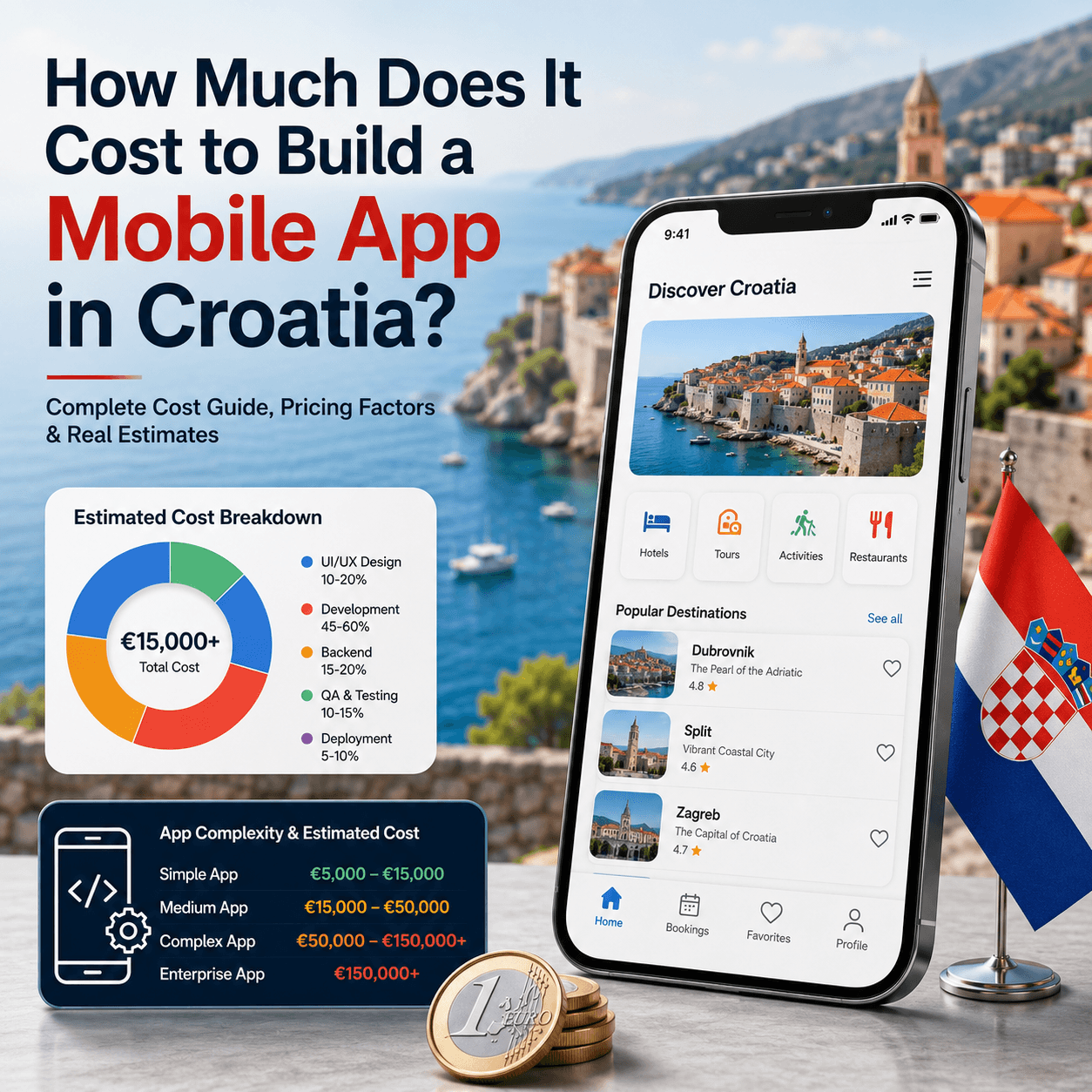
Introduction
The mobile economy has become the backbone of digital transformation across Europe, with businesses investing unprecedented sums in custom applications to reach customers, streamline operations, and gain competitive advantages. As we move through 2026, the urgency to develop mobile solutions has never been higher. Yet for most organizations, especially startups and mid-market companies, a critical question remains unanswered: how much will this actually cost?
For nearly two decades, I've guided companies through the mobile app development journey—from scrappy startups building their first MVP to Fortune 500 enterprises deploying complex healthcare and fintech platforms. One pattern has consistently emerged: organizations that understand their costs upfront, before signing agreements, make significantly better decisions about partners, timelines, and feature sets.
Croatia has quietly become one of Europe's most compelling destinations for mobile app development. Nestled on the Adriatic coast, this country boasts a thriving technology ecosystem filled with exceptionally talented developers, competitive pricing that rivals Eastern Europe without sacrificing quality, and a growing reputation for delivering enterprise-grade applications. Yet many Western European companies and North American businesses remain unaware of Croatia's potential, often defaulting to familiar markets where costs can be two to three times higher.
This comprehensive guide breaks down exactly what mobile app development costs in Croatia in 2026. You'll discover real pricing ranges for different app complexities, understand how Croatian rates compare with Germany, Switzerland, the UK, and other European leaders, and learn the hidden costs that catch most businesses off-guard. More importantly, you'll gain the frameworks to make intelligent decisions about your project, whether you're building a simple booking app or a sophisticated SaaS platform that will power your business for years.
By the end of this article, you'll have the intelligence needed to budget accurately, evaluate development partners credibly, and understand precisely where every euro of your investment is going.
Why Croatia Is Becoming Europe's Technology Hub
Croatia's ascent in the global technology landscape wasn't accidental. Several structural advantages have converged to create an exceptional environment for mobile app development.
Exceptional Engineering Talent
Croatian developers are exceptionally well-trained. The country's education system, particularly programs at universities in Zagreb, Rijeka, and Split, produces computer scientists and software engineers who compete with the best in the world. What distinguishes Croatian talent isn't just technical competence—it's the specific blend of meticulous attention to detail, innovative problem-solving, and pragmatic engineering practices that characterize Central European developers.
Many Croatian software engineers hold advanced degrees, have built globally successful products, and spend their careers staying ahead of technological trends. The annual Stack Overflow Developer Survey consistently shows Croatian Mobile app developers among Europe's most active in emerging technologies like Flutter, Kotlin, and cloud-native architectures.
EU Market Access and Regulatory Compliance
Croatia joined the European Union in 2013. This membership carries profound implications for businesses. EU membership means Croatian development companies operate within a harmonized regulatory framework, have access to EU markets without trade barriers, and maintain stringent data protection standards through GDPR. For companies requiring compliance with European regulations, working with Croatian developers eliminates entire categories of legal and operational risk.
English-Speaking, Globally Connected Workforce
Unlike some other Eastern European markets, English fluency isn't exceptional in Croatia—it's the norm. Most Croatian developers communicate fluently in English, many are multilingual, and cultural integration with Western European business practices feels seamless. This eliminates the translation barriers and communication overhead that plague some outsourcing relationships.
Competitive Pricing Without Quality Compromise
Here's what makes Croatia unique: you get rates substantially lower than Western Europe—typically 40-60% less than Germany or the UK—without accepting the quality compromises sometimes associated with offshore development. This cost advantage isn't because developers are less skilled; it reflects differences in cost of living, tax structures, and local market pricing rather than capability.
Growing Technology Ecosystem
Zagreb, Split, and Rijeka have developed vibrant startup communities with venture capital funding, accelerator programs, and co-working spaces filled with ambitious entrepreneurs. This ecosystem effect creates positive reinforcement: talented people stay in Croatia, build great companies, mentor the next generation, and attract attention from global technology leaders. Both Microsoft and Google have expanded their presence in Croatia, further legitimizing the market and attracting top talent.
Mobile App Development Cost in Croatia (2026)
Let me provide you with realistic, current pricing for mobile app development in Croatia. These figures reflect actual project rates from established development companies in 2026, adjusted for current market conditions.
Simple Applications: €5,000 – €15,000
Simple apps are typically single-platform, feature-light applications built for specific, narrow use cases. Examples include:
Calculator or utility apps with basic functionality and minimal backend requirements
Notes applications with simple data storage and synchronization
Basic booking apps for small businesses (restaurants, salons) with appointment scheduling
Simple tracking apps for personal or small-team use
Reference apps that display structured information (menus, catalogs, guides)
These projects typically require 150-400 development hours across design, development, and testing. Timeline is generally 4-8 weeks. A single developer or small team can handle the entire scope. Backend infrastructure is minimal or non-existent. Testing requirements are straightforward.
Real example: A Croatian agency built a salon booking app for a mid-sized beauty chain. It included appointment scheduling, customer profiles, payment processing, and push notifications. Total cost was €12,000, completed in 6 weeks.
Medium Complexity Applications: €15,000 – €50,000
Medium complexity apps serve real business needs with multiple features, moderate backend requirements, and cross-platform presence. Examples include:
Ecommerce applications with product catalogs, shopping carts, and payment processing
Marketplace platforms connecting buyers and sellers with reviews and ratings
Fitness and wellness apps with workout tracking, progress metrics, and social features
Food delivery apps for restaurants or aggregators with order management and logistics integration
Travel and accommodation apps with booking, reviews, and user-generated content
Real estate apps with property listings, virtual tours, and inquiry management
These projects demand 400-1,200 development hours. Most require significant backend architecture, database design, and API integrations. Timeline typically ranges from 10-16 weeks. Teams usually include a tech lead, multiple developers, a designer, and QA specialist. Cloud infrastructure becomes meaningful. User authentication and data security receive serious attention.
Real example: A Croatian team built a regional food delivery app. The platform connected 400+ restaurants, handled real-time order tracking, managed driver logistics, and processed thousands of daily transactions. Cost: €42,000. Timeline: 14 weeks. The app now processes €2+ million annually in transactions.
Complex Applications: €50,000 – €250,000+
Complex applications are sophisticated systems serving hundreds of thousands or millions of users, often operating in highly regulated industries. Examples include:
Fintech applications handling payments, lending, or investment management with PCI compliance and fraud detection
Healthcare platforms managing patient data, medical records, telemedicine, and compliance with HIPAA or equivalent regulations
SaaS products serving entire businesses with multi-tenant architecture and advanced analytics
AI-powered applications incorporating machine learning models, natural language processing, or computer vision
Social networks or community platforms managing user interactions, content moderation, and massive data volumes
Enterprise resource planning (ERP) systems integrated with existing business infrastructure
These projects involve 1,200-4,000+ development hours. They demand expert-level architects, specialized engineers, dedicated QA teams, DevOps specialists, and sometimes security consultants. Timeline spans 6-18+ months depending on scope. Infrastructure planning becomes critical. Security, scalability, and compliance dominate discussions.
Real example: A Croatian fintech company partnered with a development agency to build a payment processing platform. The system required PCI Level 1 compliance, handled millions of daily transactions, and integrated with European banking networks. Development cost: €185,000. Timeline: 20 weeks. The platform now processes €500+ million annually.
Detailed Mobile App Development Cost Breakdown
Understanding how project costs distribute across different phases helps you plan more effectively. Here's where your money actually goes:
Development Phase | Estimated Cost (€) | Percentage | Notes |
|---|---|---|---|
Discovery & Strategy | 3,000–8,000 | 8–12% | Requirements gathering, competitive analysis, user research, technical planning |
UI/UX Design | 4,000–12,000 | 12–18% | User research, wireframing, visual design, design system, prototype testing |
Frontend Development | 8,000–25,000 | 20–30% | iOS or Android development, cross-platform frameworks, UI implementation |
Backend Development | 8,000–30,000 | 20–35% | Server architecture, database design, API development, authentication systems |
API Integration | 2,000–8,000 | 5–10% | Third-party service integration, payment gateways, analytics, maps, etc. |
QA Testing | 3,000–10,000 | 8–12% | Functionality testing, performance testing, security testing, device compatibility |
Deployment & Setup | 2,000–5,000 | 4–6% | App store submission, server deployment, monitoring setup, documentation |
Post-Launch Support | 1,000–3,000/month | Ongoing | Bug fixes, updates, feature enhancements, platform updates |
What This Breakdown Means:
The discovery phase is non-negotiable and worth every euro. Companies that skip or minimize discovery typically face double the development time later as requirements shift. Experienced agencies typically spend 2-3 weeks on thorough discovery for medium-complexity apps.
UI/UX design quality directly correlates with app success. Skimping here creates technical debt in user adoption and engagement. Professional design includes user research, not just making things look pretty.
Frontend and backend development typically consume 50-65% of total project cost. The split between frontend and backend varies dramatically based on app type. A real-time collaborative tool like Figma requires proportionally more backend engineering; a content-consumption app requires more frontend sophistication.
Testing deserves 8-12% of budget. Rushing testing leads to production crashes that damage user trust and incur emergency support costs. Professional QA includes automated testing, manual testing across devices, performance testing, and security audits.
Post-launch support is where most companies get surprised. Apps require ongoing maintenance as iOS and Android release new versions, security vulnerabilities emerge, and user expectations evolve. Budget €1,000-3,000 monthly for ongoing support on completed apps.
Cost by App Type: Detailed Comparison
Different app categories have distinctly different cost profiles. Here's a realistic breakdown for 2026:
App Type | Estimated Cost (€) | Typical Timeline | Backend Complexity | Key Cost Drivers |
|---|---|---|---|---|
Ecommerce App | €25,000–€80,000 | 12–16 weeks | High | Payment processing, inventory management, shipping integration |
Healthcare App | €40,000–€150,000 | 14–20 weeks | Very High | HIPAA compliance, patient data security, regulatory requirements |
Fintech App | €60,000–€200,000+ | 16–24 weeks | Very High | PCI compliance, security audits, regulatory approval, fraud detection |
Education App | €20,000–€60,000 | 10–14 weeks | Medium | Video streaming, progress tracking, content management |
Real Estate App | €30,000–€90,000 | 12–16 weeks | High | Advanced search, mapping, virtual tours, mortgage calculators |
Food Delivery App | €35,000–€100,000 | 14–18 weeks | High | Real-time tracking, complex logistics, payment processing |
Logistics App | €40,000–€120,000 | 14–18 weeks | High | GPS tracking, route optimization, integration with fleet systems |
Social Networking App | €50,000–€200,000+ | 16–24 weeks | Very High | Real-time messaging, content moderation, user safety systems |
Marketplace App | €30,000–€100,000 | 12–18 weeks | High | User verification, rating systems, dispute resolution, payment splitting |
SaaS App | €60,000–€300,000+ | 16–26 weeks | Very High | Multi-tenancy, enterprise features, advanced analytics, integrations |
Category Analysis:
Ecommerce apps represent the most common project type for startups. Costs are driven by payment gateway complexity, inventory synchronization with existing systems, and shipping integration. Most agencies build these on proven platforms or templates, reducing costs compared to fully custom solutions.
Healthcare apps are among the most expensive. HIPAA compliance (or equivalent EU regulations) is non-negotiable, requiring security audits, encryption standards, and strict access controls. Even simple telehealth apps demand substantially more engineering than equivalent consumer applications.
Fintech apps are the most expensive category. PCI compliance requires third-party security audits. Regulatory approval varies by country and service type. Fraud detection systems require machine learning expertise. Most fintech projects exceed €100,000.
Education apps vary wildly based on content delivery. Simple courses cost €20,000; platforms supporting live video, gamification, and adaptive learning approach €60,000+.
Real estate apps require sophisticated search and mapping. Virtual tour integration can be complex. Mortgage calculators and property valuation tools add significant backend work.
Food delivery and logistics apps are deceptively complex. Real-time tracking, route optimization, and managing contractor relationships create backend requirements that catch many companies off-guard.
Social networking apps are exceedingly expensive because user safety—preventing harassment, fraud, and illegal content—requires sophisticated moderation systems, often combining human review with machine learning.
Marketplace apps require trust-building features: verification systems, rating mechanisms, dispute resolution, and fraud prevention. These add substantial cost.
SaaS apps vary enormously. A simple project management tool might cost €60,000; a comprehensive CRM platform with advanced features can exceed €300,000.
Mobile App Development Rates Across Europe: Croatia vs. Competitors
Understanding how Croatian rates compare with other European markets helps you make informed decisions. These figures represent average hourly rates for experienced developers in 2026:
Country | Hourly Rate (€) | Cost Index | Key Characteristics |
|---|---|---|---|
Croatia | €35–€55 | 100 | High quality, EU-based, English-speaking |
Poland | €30–€45 | 85 | Competitive, growing tech scene, slightly cheaper |
Czech Republic | €35–€50 | 95 | Strong technical skills, EU market access |
Romania | €25–€40 | 70 | Budget-focused, variable quality, language barriers |
Hungary | €35–€48 | 90 | Good technical talent, EU-based |
Germany | €60–€85 | 160 | Premium rates, onshore expectations, excellent infrastructure |
Netherlands | €55–€80 | 155 | High costs, premium positioning, strong ecosystem |
United Kingdom | €50–€75 | 145 | Competitive with Germany, strong financial services experience |
France | €50–€70 | 140 | Premium positioning, strong design focus |
Switzerland | €75–€110 | 190 | Highest rates globally, premium market positioning |
Sweden | €55–€75 | 150 | Premium rates, strong technical culture, competitive market |
Norway | €65–€90 | 170 | Highest rates in Scandinavia, onshore premium |
Denmark | €55–€75 | 150 | Premium Scandinavian rates, high quality |
Austria | €50–€70 | 135 | German quality at slightly lower rates |
Why Do Rates Differ So Dramatically?
Cost of living is the primary driver. A developer in Zagreb with equivalent skills to one in Zurich has fundamentally different living expenses. Rent, food, transportation, and utilities are 50-70% cheaper in Croatia than Switzerland. Companies can pay competitive salaries by local standards while charging clients significantly less than Western European agencies.
Market maturity affects pricing. Western European markets (Germany, UK, Switzerland) command premiums because they've established premium brand positioning and built strong client relationships with large enterprises expecting onshore development. The implicit premium is partly for legal proximity, time zone alignment, and comfort level with local partners.
Regulatory environment influences costs. Some EU regulations and compliance requirements are easier to manage within the same country, creating a small premium for onshore development in highly regulated industries.
Currency considerations create fluctuations. The Croatian kuna pegged to the euro provides exchange rate stability that some Eastern European countries lack.
Talent pool depth varies. Germany and the UK have deeper pools of specialized talent (machine learning engineers, blockchain developers, etc.), commanding premiums for rare specialization.
What This Means for Your Budget:
A mobile app project in Croatia costs roughly 40-50% of Swiss rates, 35-45% of German rates, and 25-35% of Norwegian rates. Put concretely: a project that costs €200,000 in Switzerland would cost approximately €80,000-€120,000 in Croatia—developing an identical quality application with experienced developers.
This isn't achieved by cutting corners. Croatian developers aren't cheaper because they're less skilled. They're cheaper because of macroeconomic factors completely unrelated to quality. Many Croatian agencies win contracts competing against London, Berlin, and Amsterdam agencies on identical technical merit while offering 40% cost savings.
Eastern Europe vs. Western Europe vs. Croatia: Geographic Analysis
The European software development landscape divides into distinct regions with characteristic cost profiles, strengths, and weaknesses. Let's examine how Croatia sits within this landscape.
Western Europe vs. Croatia
Western Europe (Germany, Switzerland, Netherlands, UK, France)
Western European agencies command 60-90% premiums over Croatia. You're paying for:
Proximity to Western European business centers
Onshore legal framework (same country jurisdiction)
Time zone alignment with most enterprise clients
Established brand recognition
Regulatory familiarity with complex enterprise requirements
Direct access for on-site collaboration
However, Western European agencies rarely provide better technical outcomes on standard applications. The premium isn't for superior engineering; it's for convenience, legal proximity, and organizational comfort.
Croatia's Advantage: Identical technical quality at 40-50% cost. Your application won't be inferior; your budget stretches further. For €100,000, you build what costs €160,000+ in Germany.
Northern Europe vs. Croatia
Northern Europe (Scandinavia: Sweden, Norway, Denmark)
Scandinavian rates (€55-€90/hour) exceed even Western Europe due to extremely high cost of living, strong union presence affecting labor costs, and premium brand positioning in enterprise markets. Scandinavian companies excel at building complex infrastructure systems, have strong DevOps cultures, and produce exceptionally well-documented code.
A project in Stockholm costs 50-70% more than equivalent work in Zagreb.
Croatia's Advantage: Scandinavia's premium is pricing power, not technical capability. You receive equally sophisticated engineering at substantially lower cost from Croatia.
Eastern Europe vs. Croatia
Eastern Europe (Romania, Bulgaria, Serbia, Ukraine)
Some Eastern European markets (particularly Romania and Ukraine) offer rates 20-40% lower than Croatia (€20-€40/hour). However, this cost advantage comes with trade-offs:
Language barriers with English fluency lower
Fewer EU regulatory safeguards
Smaller companies with less organizational depth
Quality variability higher
Time zone misalignment with Western clients
Political/economic uncertainty in some markets
Croatia's Sweet Spot: You get Eastern European cost advantages (€35-€55/hour vs. Western Europe's €55-€85) while retaining EU stability, English fluency, and organizational professionalism. It's the optimal intersection of cost and reliability.
Why European Companies Increasingly Choose Croatia
The pattern is clear from market observation: Western European companies are migrating development to Croatia for three specific reasons:
Cost Efficiency Without Quality Compromise – 40-50% savings while maintaining equivalent technical standards to onshore development
EU Regulatory Confidence – GDPR compliance, data protection regulations, and legal frameworks you understand without additional learning curve
Timezone and Communication – Only 1-2 hours time zone difference from Western Europe, making synchronous collaboration natural. English fluency eliminates communication friction.
Cultural Alignment – Croatian business culture aligns with Western European standards. Contracts, IP protections, and professional norms are familiar.
This combination explains why Croatia consistently ranks among the top 10 most chosen outsourcing destinations for Western European companies, alongside Poland and the Czech Republic, but ahead of more dramatic cost-reduction destinations like Romania or Ukraine.
Factors Affecting Mobile App Development Costs
Now let's examine the specific variables that move costs up or down. Understanding these levers helps you make intelligent trade-offs during planning.
App Complexity
App complexity is the primary cost driver. Complexity encompasses feature count, technical sophistication, architectural requirements, and integration demands.
A useful framework: simple = single feature with minimal backend, medium = multiple integrated features with moderate backend, complex = sophisticated features with significant backend and integration requirements.
Simple booking apps (€5,000-€15,000) typically have 4-8 features: display slots, accept bookings, send confirmations, manage customer data. Backend requirements are minimal.
Medium ecommerce apps (€25,000-€50,000) include 15-25 features: product display, search, shopping cart, payment processing, order tracking, customer accounts, reviews, wish lists, notifications. Backend architecture becomes substantial.
Complex fintech platforms (€100,000-€250,000+) include 50-100+ features spanning payment processing, compliance monitoring, fraud detection, analytics, user management, integration with banking networks, advanced security. Backend architecture is highly sophisticated.
Cost multiplier effect: Increasing complexity isn't linear. Adding the 5th feature costs less than adding the 20th. Each additional feature requires more system integration, more testing, and more architectural consideration. The 50th feature might cost 2-3x what the 5th feature cost.
Number of Features
Feature count directly correlates with cost. Each feature requires:
Requirements definition
UI/UX design
Frontend development
Backend logic
API integration (if external)
Testing across devices
Documentation
A useful estimate: each feature adds €1,000-€5,000 to project cost depending on complexity. A simple feature (dark mode toggle, font size adjustment) adds €1,000. A complex feature (real-time collaborative editing, AI-powered recommendations) adds €5,000+.
Most medium-complexity apps include 15-25 features, explaining their €25,000-€50,000 cost range. Most startups significantly underestimate required features, discovering mid-project that their MVP actually requires 35 features, not 10.
UI/UX Design Quality
Design costs vary enormously based on depth. A basic design system costs €4,000-€6,000. A comprehensive design system with research, extensive wireframing, multiple design iterations, and component libraries costs €10,000-€15,000.
The relationship between design quality and app success is well-established. Apps with thoughtful, professional design see 30-40% higher user engagement and retention. This isn't purely aesthetic; it's about usability, clarity, and removing friction from user workflows.
Design costs are an investment, not an expense. Skimping on design typically wastes more money later through failed user adoption and required redesigns. Professional design should represent 12-18% of total project budget.
Native vs. Cross-Platform Development
This is a critical decision point with substantial cost implications.
Native Development (Separate iOS and Android Apps)
Costs more: roughly 40-60% premium for building both platforms
Higher quality: Platform-optimized experiences, full feature access
Better performance: Apps perform smoothly, less battery drain
Longer maintenance: Two codebases to maintain
Typical for: Apps where user experience is critical differentiator
Example: A fitness app built natively for iOS and Android costs €60,000 (€30,000 per platform) vs. €45,000 cross-platform.
Cross-Platform Development (Single Codebase for Multiple Platforms)
Costs less: Single codebase reduces development time 30-40%
Faster launch: Deploy to iOS and Android simultaneously
Easier maintenance: Single codebase to update
Performance trade-offs: Some cross-platform frameworks show 10-20% performance overhead
Typical for: Apps where speed-to-market matters more than optimization
Popular cross-platform frameworks:
Flutter – Google's framework, increasing market share, excellent performance
React Native – Facebook's framework, large ecosystem, occasional performance issues
Kotlin Multiplatform – Emerging option with promise but smaller ecosystem
Practical recommendation: For startups with budget constraints, cross-platform development is pragmatic. You launch faster, spend less, and have fewer bugs to maintain. As you grow and performance becomes critical, you can rebuild hot paths natively. Most successful apps start cross-platform.
Backend Infrastructure Complexity
Simple apps with no persistent data need minimal backend. A notes app syncing to cloud storage might use a simple Firebase setup (€2,000-€5,000 backend).
Medium apps with user accounts, data persistence, and basic integrations need moderate backend architecture: authentication systems, database design, API endpoints, cloud hosting. Budget €8,000-€15,000 for solid backend engineering.
Complex apps with millions of transactions, sophisticated algorithms, real-time features, or machine learning require expert-level backend architecture: microservices, caching layers, message queues, search indexes, monitoring systems. Budget €25,000-€50,000+ for backend engineering alone.
The difference: a poorly architected backend will work fine at 1,000 users but collapse under 100,000 users, requiring expensive rebuilds. Good backend architecture costs more upfront but scales elegantly.
Third-Party Integrations
Every integration adds cost. Integrating with a payment gateway: €2,000-€4,000. Maps API integration: €1,500-€3,000. Social login integration: €1,000-€2,000. Push notification service: €1,000-€2,000. Analytics platform: €800-€1,500.
A typical app integrates with 4-8 third-party services. These integrations add €8,000-€20,000 to project cost but save months of development time by leveraging proven solutions rather than building from scratch.
Careful planning of integrations impacts budget significantly. Using established platforms (Stripe for payments, Twilio for communications, Segment for analytics) is always cheaper than custom implementations.
AI and Machine Learning Features
AI has shifted from nice-to-have to competitive necessity in 2026. However, AI features add significant cost and complexity.
Simple AI features (recommendation algorithms, basic chatbots, image recognition): €10,000-€30,000 additional cost. These often leverage existing ML APIs (Google Vision, OpenAI) rather than custom models.
Custom ML models (recommendation engines trained on your data, predictive analytics): €30,000-€100,000+. You're paying for data scientists, model development, training infrastructure, and ongoing refinement.
Most startups should use existing AI APIs rather than building custom models. OpenAI's API, Google's Cloud AI services, and Amazon's SageMaker make it possible to incorporate AI without massive engineering overhead.
Security Requirements
Security requirements vary dramatically by industry. A social app security cost is different from a fintech security cost.
Standard security (SSL encryption, user authentication, basic data protection): €3,000-€6,000 additional cost. This should be baseline, not premium.
Enterprise security (penetration testing, security audits, advanced encryption, compliance certifications): €10,000-€30,000 additional cost.
Regulated industry security (fintech, healthcare, government): €20,000-€50,000+ additional cost for compliance certifications, regular audits, and advanced protections.
Security isn't a feature to add later. It must be designed in from the beginning. Apps built with poor security foundations face expensive rebuilds when vulnerabilities emerge.
Compliance Requirements
GDPR, HIPAA, PCI compliance, and industry-specific regulations significantly impact cost:
GDPR compliance (EU data protection): €5,000-€15,000 engineering + legal review
HIPAA compliance (healthcare): €15,000-€40,000 additional engineering
PCI compliance (payment processing): €10,000-€30,000 additional engineering
Industry-specific compliance: €20,000-€100,000+ depending on requirements
Never ignore compliance during planning. Adding compliance requirements mid-project is exponentially more expensive than building compliant from the start.
Team Size and Composition
A solo developer costs less than a team but delivers slower and with higher risk. Here's typical team composition by project type:
Simple apps: 1 developer, 1 designer (contract) = €5,000-€15,000
Medium apps: 2-3 developers, 1 designer, 1 QA tester = €15,000-€50,000
Complex apps: 4-6 developers (including specialists), 1-2 designers, 2 QA testers, 1 DevOps engineer, sometimes 1 product manager = €50,000-€250,000+
Larger teams cost more but complete projects faster. Small teams cost less but take longer. For time-sensitive projects, investing in larger teams is often smart. For budget-constrained projects, smaller teams are pragmatic.
Top Mobile App Development Companies in Croatia
1. Infinum – Croatia's Leading Enterprise Development Shop
Overview Infinum stands as Croatia's most prominent mobile app development company, with 15+ years of operating excellence. Headquartered in Zagreb with offices in London and Berlin, Infinum has established itself as the go-to partner for serious enterprises.
Services
Custom mobile app development (iOS, Android, cross-platform)
Web application development
Product strategy and design
Quality assurance and testing
DevOps and infrastructure
Industries
Financial services
Enterprise software
Healthcare and SaaS
Retail and ecommerce
Team Size: 200+ employees across offices
Enterprise Capabilities Infinum operates with enterprise-grade processes, comprehensive security practices, and the organizational depth to handle complex multi-year projects. They maintain certifications including ISO 27001 and SOC2 Type II, critical for regulated industries.
Strengths
Exceptional design reputation with in-house creative team
Deep backend engineering expertise
Enterprise project management discipline
International client portfolio including Fortune 500 companies
Strong technical thought leadership (blog, speaking engagements)
Team Composition: Product managers, architects, senior engineers, UX/UI designers, QA specialists, DevOps engineers
Specializations: Enterprise architecture, large-scale system design, complex integrations
Ideal Clients: Enterprise companies, venture-backed startups expecting growth to millions of users, companies requiring white-glove service and highest technical standards
Website: infinum.com
2. Q Agency – Specialized in Mobile Product Design
Overview Q Agency approaches app development with product thinking at its core. Rather than purely engineering-focused, Q Agency emphasizes user experience design and product strategy, making them exceptional for companies prioritizing app quality over speed.
Services
Mobile and web product design
Full-stack development
Product strategy and research
Brand identity and design systems
Industries
B2C consumer apps
Startups and scale-ups
D2C (direct-to-consumer) brands
SaaS applications
Team Size: 50-70 employees
Enterprise Capabilities While smaller than Infinum, Q Agency delivers enterprise-level design and development. They're known for meticulous attention to user experience and product thinking that elevates standard apps into category-defining products.
Strengths
Exceptional product design philosophy
User research and usability testing expertise
Brand design and identity systems
Startup advisory and mentoring
Design-driven development culture
Specializations: User experience design, product strategy, brand design, design systems
Ideal Clients: B2C startups, venture-backed companies, direct-to-consumer brands, companies where user experience is primary competitive differentiator
Website: qagency.com
3. Five – Boutique Studio Known for Innovation
Overview Five positions itself as a boutique creative and development studio, combining design, development, and strategic thinking. They're particularly strong for consumer applications where innovation and differentiation matter.
Services
Mobile app development (iOS, Android, cross-platform)
Web development
Creative direction and design
Product workshops
Industries
Tech startups
Consumer applications
Media and entertainment
Digital products
Team Size: 40-60 employees
Specializations: Mobile-first product development, design innovation, user experience, startup growth
Strengths
Design-forward culture with creative excellence
Startup experience with scale-up understanding
Fast execution and iteration capability
Product strategy thinking
Creative problem-solving approach
Ideal Clients: Startups prioritizing design and user experience, companies launching consumer applications, digital media companies, venture-backed companies with growth ambitions
Website: fiveagency.com
4. Undabot – Developer-Focused Technical Excellence
Overview Undabot emphasizes technical excellence and engineering discipline. Founded by experienced developers, Undabot attracts technically-minded clients who value clean code, robust architecture, and engineering rigor.
Services
Mobile development (iOS, Android, cross-platform)
Web application development
Backend architecture
Technical consulting
Industries
SaaS applications
Startups requiring strong technical foundations
Enterprise software
Healthcare and regulated industries
Team Size: 30-50 employees
Strengths
Strong backend and architecture expertise
Code quality and technical discipline
Mentoring and knowledge transfer
Developer community engagement
Open-source contributions
Specializations: Backend architecture, scalable systems, technical mentoring, quality engineering
Ideal Clients: Startups requiring solid technical foundations, SaaS companies, companies where backend engineering is critical, technical founders and CTOs
Website: undabot.com
5. Cinnamon – Emerging Tech and AI Focus
Overview Cinnamon distinguishes itself through expertise in emerging technologies, particularly artificial intelligence and machine learning integration into mobile applications. They're the choice for companies innovating with AI capabilities.
Services
Mobile development with AI integration
Machine learning model development
Computer vision applications
Natural language processing
Full-stack development
Industries
AI-powered startups
Enterprise AI applications
Healthcare and medical imaging
Financial services with ML
Team Size: 25-40 employees
Specializations: AI and machine learning, computer vision, natural language processing, emerging technology integration
Strengths
Deep expertise in AI/ML integration
Data science capabilities
Research and experimentation culture
Emerging technology knowledge
Innovation-focused approach
Ideal Clients: Companies integrating AI into mobile apps, AI startups, enterprise customers requiring machine learning capabilities, organizations experimenting with emerging technologies
Website: cinnamon.agency
6. Ars Futura – Strategic Digital Transformation
Overview Ars Futura positions itself as a strategic digital transformation partner rather than pure technical service provider. They approach projects holistically, combining strategy, design, and development.
Services
Digital strategy and consulting
Mobile and web application development
Business process optimization
Change management consulting
Industries
Enterprise digital transformation
Financial services
Healthcare
Government and public sector
Team Size: 60-80 employees
Strengths
Enterprise strategy and change management
Process optimization expertise
Comprehensive project approach
Government sector experience
Enterprise sales and management
Specializations: Digital transformation, enterprise architecture, regulatory compliance, organizational change
Ideal Clients: Large enterprises undergoing digital transformation, government agencies, regulated industries, organizations requiring strategic guidance beyond pure development
Website: arsfutura.net
7. Notch – Growth and Scale Expertise
Overview Notch focuses specifically on startup acceleration and scale-up growth. They're particularly valuable for venture-backed companies needing rapid development with growth architecture thinking.
Services
Rapid MVP development
Growth product development
Scaling infrastructure design
Startup advisory
Product/market fit guidance
Industries
Venture-backed startups
Scale-ups
Consumer applications
Network effect products
Team Size: 20-35 employees
Specializations: MVP development, growth product thinking, rapid iteration, startup scale-up
Strengths
Startup experience and mentality
Rapid execution capability
Growth product thinking
Founder communication
Fundraising awareness
Ideal Clients: Early-stage startups, venture-backed companies, founders seeking rapid time-to-market, companies requiring growth product expertise
Website: notch.team
8. VNA Infotech – Volume Capability and Enterprise Scale
Overview VNA Infotech is one of Croatia's larger development shops, capable of handling large-scale projects with multiple teams. They offer the depth necessary for enterprise-scale initiatives.
Services
Mobile application development
Web development
Enterprise software solutions
Staff augmentation
Managed services
Industries
Enterprise software
Financial services
Telecommunications
E-commerce and retail
Team Size: 100-150+ employees
Strengths
Capacity for large projects and multiple teams
Enterprise experience
Staff augmentation capability
Diverse technology expertise
Process maturity
Specializations: Large-scale projects, enterprise solutions, staff augmentation, mature processes
Ideal Clients: Enterprises requiring large-scale teams, companies needing staff augmentation, organizations seeking managed services, multi-year complex projects
Website: vna-infotech.com
9. FreeCodesLab – Custom Development and Technical Solutions
Overview FreeCodesLab offers custom development services with particular strength in complex technical requirements and specialized technology domains.
Services
Custom mobile and web development
IoT and embedded systems
Cloud architecture
Real-time systems
Industries
IoT and connected devices
Enterprise software
Startups with complex technical requirements
Research and development projects
Team Size: 20-40 employees
Strengths
Technical depth in specialized domains
IoT and embedded expertise
Cloud architecture knowledge
Research and development capability
Complex problem solving
Specializations: IoT development, embedded systems, cloud infrastructure, specialized technology
Ideal Clients: Companies with specialized technical requirements, IoT product developers, research-oriented projects, organizations needing deep technical expertise
Website: freecodeslab.com
10. Profico – Eastern European Scale with Enterprise Quality
Overview Profico represents a slightly larger, more established shop capable of handling diverse projects ranging from startups to enterprise deployments, with a reputation for quality and reliability.
Services
Full-stack mobile and web development
Enterprise software solutions
Quality assurance and testing
Managed development services
Industries
Diverse portfolio across sectors
Financial services
Enterprise software
Startups and scale-ups
Team Size: 80-120+ employees
Strengths
Portfolio diversity showing adaptability
Enterprise and startup experience
Quality engineering practices
Team size for larger projects
Reliability and process maturity
Specializations: Full-stack development, diverse technology domains, quality engineering, managed services
Ideal Clients: Mid-to-large projects, companies requiring diverse expertise, organizations seeking reliable, process-driven development, enterprise customers
Website: profico.com
Mobile App Cost Calculator: Real-World Examples
Let me provide three realistic scenarios with detailed cost breakdowns:
Example 1: Startup MVP – Local Service Marketplace
Scope: A mobile marketplace connecting local service providers (cleaners, handypeople, plumbers) with customers in a specific city.
Core Features:
Service provider profiles with ratings
Booking system with calendar
Payment processing
Customer support chat
Admin dashboard for providers
Technical Approach: Cross-platform (Flutter), Firebase backend, Stripe payment integration
Cost Breakdown:
Discovery & Strategy: €5,000
UI/UX Design: €7,000
Frontend Development: €12,000
Backend Development: €10,000
Payment Integration: €3,000
QA & Testing: €4,000
Deployment & Setup: €2,000
Total: €43,000
Timeline: 14 weeks
Why This Cost: Cross-platform reduces frontend costs. Using Firebase reduces backend complexity. Stripe integration is straightforward. This is a medium-complexity app with straightforward requirements.
Post-Launch: €1,500/month for support and updates
Example 2: Growing Business – Advanced Ecommerce Platform
Scope: A DTC (direct-to-consumer) ecommerce platform for a sustainable fashion brand with inventory management, personalization, and integrated marketing tools.
Core Features:
Product catalog with filtering and search
Personalized recommendations
Shopping cart and checkout with multiple payment methods
Order tracking and management
Loyalty program
Integrated email marketing
Admin dashboard with inventory and sales analytics
Abandoned cart recovery
Integration with Shopify (for backup inventory)
Technical Approach: Native iOS/Android (split budget), custom backend in Node.js, PostgreSQL database, AWS infrastructure, personalization engine
Cost Breakdown:
Discovery & Strategy: €8,000
UI/UX Design: €14,000
iOS Development: €30,000
Android Development: €28,000
Backend Development: €35,000
Payment Integration: €5,000
Marketing Tools Integration: €8,000
Analytics & Personalization: €12,000
QA & Testing: €12,000
Deployment & Infrastructure Setup: €8,000
Total: €160,000
Timeline: 18 weeks
Why This Cost: Native development (separate iOS/Android) is expensive but provides optimal user experience. Custom backend requires sophisticated architecture for personalization and inventory. Multiple integrations add complexity. Comprehensive analytics and reporting features require additional engineering.
Post-Launch: €3,000-€4,000/month for support, updates, infrastructure, and marketing tool maintenance
Example 3: Enterprise Platform – Healthcare Telemedicine System
Scope: A comprehensive telemedicine platform connecting patients with physicians, managing appointments, medical records, prescriptions, and compliance with healthcare regulations.
Core Features:
Patient registration with ID verification
Physician directory and ratings
Video consultation system
Appointment scheduling
Electronic medical records (EMR) storage
Prescription management
Secure messaging between patients and providers
Insurance verification and payment processing
Compliance with HIPAA and GDPR
Analytics and reporting for healthcare providers
Mobile apps for patients and physicians
Web portal for administrators
Technical Approach: Native iOS/Android, microservices backend architecture, Redis caching, Kubernetes orchestration, AWS healthcare-compliant infrastructure, encryption at rest and in transit, HIPAA audit logging
Cost Breakdown:
Discovery & Strategy: €15,000
UI/UX Design: €25,000
iOS Development: €50,000
Android Development: €50,000
Backend Architecture & Development: €80,000
Video Conferencing Integration: €15,000
EMR System Development: €30,000
Payment Processing (healthcare-compliant): €10,000
HIPAA Compliance Engineering: €25,000
Security Audits & Penetration Testing: €20,000
DevOps & Infrastructure: €15,000
QA & Testing (comprehensive): €20,000
Deployment & Launch Support: €15,000
Total: €365,000
Timeline: 24 weeks (6 months)
Why This Cost: Healthcare regulations require specialized compliance engineering. HIPAA requirements, security audits, and encryption standards add significant cost. Video conferencing at scale requires specialized infrastructure. EMR system is complex, requiring integration with healthcare standards. Large, specialized team required. Comprehensive testing and security validation is mandatory. The cost reflects genuine regulatory and technical complexity, not bloat.
Post-Launch: €6,000-€8,000/month for ongoing compliance maintenance, security updates, healthcare system integrations, and operational support. Healthcare applications require continuous security vigilance.
Hidden Costs Most Businesses Miss
Beyond direct development costs, several categories of expenses surprise unprepared businesses:
Ongoing Maintenance and Support
Every app needs ongoing attention. iOS and Android release major updates annually. Bugs emerge in production. User feedback reveals needed adjustments. Security vulnerabilities require patching.
Budget €1,000-€3,000 monthly for typical apps, €3,000-€8,000+ for complex apps. This covers routine maintenance, bug fixes, performance optimization, and security updates. It's not optional.
App Store Fees and Compliance
Apple charges 30% commission on in-app purchases (15% for subscriptions after year 1). Google charges similar percentages. These aren't development costs, but they impact unit economics significantly.
App store submission costs nothing, but ensuring compliance with App Store guidelines adds engineering time and sometimes requires design changes.
Cloud Infrastructure Costs
Apps require servers, databases, and storage. Cloud costs scale with usage:
Simple apps using Firebase: €30-€100/month
Medium apps with moderate traffic: €200-€800/month
Complex apps with high traffic: €1,000-€5,000+/month
Infrastructure costs aren't static. They grow with user base. A app used by 100 users costs much less than one used by 100,000 users. Budget for infrastructure growth.
API Subscriptions and Third-Party Services
Most apps integrate with external services:
Stripe payment processing: 2.9% + €0.30 per transaction
Twilio SMS/communications: €0.01-€0.10 per SMS, variable by volume
Firebase real-time database: €0.06-€1 per 100k read/write operations
Amplitude or Mixpanel analytics: €0-€1,000+ monthly depending on volume
SendGrid email service: €0-€100+ monthly depending on volume
Segment data platform: €100-€500+ monthly
These aren't trivial. A moderately successful app might spend €500-€2,000 monthly on third-party services.
Security and Compliance Audits
Annual security audits for enterprise apps: €3,000-€10,000 Penetration testing: €5,000-€15,000 Compliance certifications (SOC2, ISO 27001): €5,000-€20,000 Legal review of terms of service and privacy policy: €2,000-€5,000
These costs are easy to defer initially but become mandatory as your app handles sensitive data or serves enterprise customers.
Hosting and Database Backups
Beyond standard cloud costs, you need:
Database backups and disaster recovery: €200-€1,000 monthly
Content delivery network (CDN) for fast global content delivery: €100-€500 monthly
Monitoring and alerting services: €50-€300 monthly
Analytics and Monitoring Tools
Comprehensive analytics, crash reporting, and performance monitoring:
Amplitude or Mixpanel: €0-€500+ monthly
Sentry crash reporting: €0-€500+ monthly
New Relic or Datadog performance monitoring: €100-€1,000+ monthly
Marketing and User Acquisition
The app itself is just the beginning. Acquiring users costs money:
App store optimization (ASO): €2,000-€10,000 one-time
Social media advertising: €1,000-€10,000+ monthly depending on strategy
Influencer partnerships: €5,000-€50,000+ depending on reach
PR and media outreach: €2,000-€10,000 monthly
Treat user acquisition as a separate budget from development.
Hidden Costs Summary Table
Cost Category | Estimated Monthly Cost (€) | Annual Cost (€) |
|---|---|---|
Maintenance & Support | €1,000–€5,000 | €12,000–€60,000 |
Cloud Infrastructure | €200–€2,000 | €2,400–€24,000 |
Third-Party API Subscriptions | €300–€1,500 | €3,600–€18,000 |
Security & Compliance | €500–€2,000 | €6,000–€24,000 |
Analytics & Monitoring | €200–€1,000 | €2,400–€12,000 |
Total Hidden Costs | €2,200–€11,500 | €26,400–€138,000 |
Critical Insight: Hidden costs equal or exceed development costs over time. A €50,000 project might cost €30,000 annually to operate. Budget accordingly.
Mobile App Development Process: Timeline Breakdown
Understanding the development process helps you plan realistically:
Phase | Duration | Activities | Key Deliverables |
|---|---|---|---|
Discovery | 2–4 weeks | Requirements gathering, competitive analysis, user research, technical planning, budget finalization | Requirements document, technical specification, project timeline |
Design | 3–5 weeks | User research (if not in discovery), wireframing, visual design, design system, prototype testing | Wireframes, design mockups, design system, prototype |
Frontend Development | 4–8 weeks | UI implementation, state management, offline support, platform-specific optimization | Implemented user interface, code review |
Backend Development | 4–10 weeks | API development, database design, authentication system, third-party integrations | API endpoints, database schema, integration verification |
Testing | 2–4 weeks | Functionality testing, device compatibility testing, performance testing, security review | Test reports, bug lists, performance metrics |
Launch & Deployment | 1–2 weeks | App store submission, production deployment, monitoring setup, launch coordination | Live app, monitoring dashboards, launch documentation |
Post-Launch Support | Ongoing | Bug fixes, crash investigation, feature requests, platform updates, performance optimization | Regular releases, improvements, stability |
Realistic Insight: Most projects face some delays. Budget 10-20% contingency on timeline. A 14-week timeline might actually require 16-17 weeks when accounting for:
Scope creep from new features
Design revisions
Integration complications
Testing edge cases
App store review delays
Best Technology Stack for Mobile Apps in 2026
Choosing the right technology stack impacts cost, performance, and long-term maintainability. Here's my 2026 recommendation framework:
For Cross-Platform Startups: Flutter + Firebase
Why Flutter?
Single codebase compiles to iOS, Android, Web
Exceptional performance (nearly native)
Fast development cycle with hot reload
Growing market share with strong Google backing
Excellent documentation
Why Firebase?
Serverless backend eliminates infrastructure management
Real-time database perfect for collaborative features
Authentication built-in
Scales automatically with traffic
Cost-effective for startups
Cost Impact: 30-40% faster development than native. Perfect for MVPs.
Companies using this stack: Google's own apps, Alibaba, Reflectly, Watermelon
For Performance-Critical iOS/Android: Native (Swift + Kotlin)
Why Native?
Maximum performance and battery efficiency
Full access to device capabilities
Optimal user experience on each platform
Larger developer pool for hiring
Superior long-term maintainability
Swift (iOS)
Modern language, excellent tooling
Type-safe, memory-safe
SwiftUI framework for modern UI development
Kotlin (Android)
Modern, concise syntax
Null-safety built-in
Jetpack Compose for modern UI
Cost Impact: 40-60% more expensive than cross-platform but delivers superior experience. Worth it for apps where UX is competitive differentiator.
Companies using this stack: Spotify, Instagram, Twitter, Airbnb, Uber
For Backend: Node.js + PostgreSQL (or Python + Django)
Node.js
JavaScript on both frontend and backend (code sharing, consistent development)
Excellent for I/O-heavy operations (APIs, real-time features)
Massive ecosystem with npm packages
Scales well with proper architecture
Strong community and hiring pool
PostgreSQL
Powerful relational database with JSON support
ACID compliance for data integrity
Excellent for complex queries and analytics
Better than MySQL for serious applications
Python Alternative
Django or FastAPI frameworks
Excellent for data science and ML integration
Slightly slower than Node.js but often simpler to develop
Exceptional documentation in Django
For AI/ML Integration: Python + TensorFlow/PyTorch
If incorporating machine learning:
Python is the de facto standard
TensorFlow and PyTorch for model development
Hugging Face for pre-trained models
Integration with FastAPI backend
Cost Impact: ML engineering is expensive. ML specialists cost €70-€100/hour. Use pre-trained models (OpenAI API, Google Vision) when possible rather than custom model training.
For Cloud Infrastructure: AWS + Kubernetes
AWS Services:
EC2 for compute
RDS for managed databases
S3 for file storage
CloudFront for CDN
Lambda for serverless functions
SageMaker for ML
Kubernetes:
Container orchestration for complex deployments
Overkill for startups but essential for enterprise scale
Requires DevOps expertise (€70-€100/hour)
Recommendation: Startups use Firebase or managed services. Scale-ups use AWS with Docker. Enterprises use Kubernetes.
For Real-Time Features: WebSockets + Socket.io (or Firebase Realtime)
Real-time features (chat, collaborative editing, live notifications) require:
WebSocket connections for persistent communication
Socket.io library for real-time communication
Redis for message queue management
Firebase Realtime as simpler alternative
Cost Impact: Real-time features add €5,000-€15,000 to backend engineering but provide substantially better user experience.
2026 Stack Recommendation Summary
Startup MVP: Flutter + Node.js + Firebase = Speed to market + Low cost Growing Business: Flutter + Node.js + PostgreSQL + AWS = Scalability + Control Enterprise: Native (iOS + Android) + Python/Node.js + PostgreSQL + AWS + Kubernetes = Performance + Reliability + Specialization Data-Heavy: Python + Django + PostgreSQL + ML services = Data expertise + Easy integration
How to Choose Among These Companies
For Startups Prioritizing Speed: Q Agency, Five, Notch For Technical Depth: Undabot, Cinnamon, FreeCodesLab For Enterprise Scale: Infinum, VNA Infotech, Ars Futura For Design Excellence: Q Agency, Five, Infinum For AI/ML Integration: Cinnamon For Digital Transformation: Ars Futura For Volume Projects: VNA Infotech, Profico
Enterprise Mobile App Development Considerations
Enterprise applications have special requirements that dramatically impact cost and complexity. If you're building enterprise software, budget for these factors:
Security Architecture
Enterprise apps handle sensitive data requiring:
Data encryption at rest and in transit (€8,000-€15,000)
Multi-factor authentication systems (€5,000-€10,000)
Role-based access control architecture (€6,000-€12,000)
Audit logging of all user actions (€4,000-€8,000)
Regular security assessments and penetration testing (€5,000-€15,000 annually)
Total enterprise security architecture: €28,000-€60,000
GDPR Compliance
If handling EU user data:
Data minimization principles implementation (€4,000-€8,000)
Right-to-be-forgotten functionality (€5,000-€10,000)
Consent management system (€4,000-€8,000)
Data processing agreement templates (legal, €2,000-€5,000)
Privacy impact assessments (€3,000-€6,000)
Total GDPR engineering: €18,000-€37,000
Scalability Architecture
Enterprise apps must scale from hundreds to millions of users:
Stateless architecture design (€8,000-€15,000)
Caching layer implementation (Redis/Memcached) (€6,000-€12,000)
Database optimization and replication (€8,000-€15,000)
Load balancing and auto-scaling infrastructure (€6,000-€12,000)
Performance monitoring and optimization (€5,000-€10,000)
Total scalability engineering: €33,000-€64,000
Cloud Infrastructure and DevOps
Enterprise deployment requires sophisticated infrastructure:
Infrastructure as Code (Terraform, CloudFormation) (€8,000-€15,000)
CI/CD pipeline setup (€6,000-€12,000)
Monitoring, logging, and alerting systems (€8,000-€15,000)
Disaster recovery and backup systems (€6,000-€12,000)
Cloud security and compliance (€8,000-€15,000)
Total DevOps and infrastructure: €36,000-€69,000
AI Readiness
For enterprise apps incorporating or planning to incorporate AI:
ML model infrastructure (€15,000-€35,000)
Feature engineering systems (€10,000-€20,000)
A/B testing infrastructure for experimentation (€8,000-€15,000)
Model monitoring and drift detection (€8,000-€15,000)
Total AI infrastructure: €41,000-€85,000
Enterprise Integration
Enterprise apps rarely exist in isolation; they integrate with existing systems:
Single sign-on integration (Active Directory, Okta) (€5,000-€10,000)
Legacy system integration (€10,000-€30,000 depending on complexity)
ERP integration (SAP, Oracle, etc.) (€15,000-€50,000+)
Business intelligence integration (€8,000-€15,000)
Total enterprise integration: €38,000-€105,000+
Performance Optimization
Enterprise performance standards exceed consumer apps:
Performance testing and optimization (€8,000-€15,000)
Database query optimization (€6,000-€12,000)
API response time optimization (€6,000-€12,000)
Mobile app startup time optimization (€5,000-€10,000)
Total performance optimization: €25,000-€49,000
Enterprise Total Additional Costs: €181,000-€424,000 in specialized engineering beyond base development cost.
A €100,000 base app development becomes €280,000-€524,000 when enterprise requirements are added. This isn't waste; it's the cost of reliable, secure, scalable systems that serve thousands of users, protect sensitive data, and operate flawlessly.
Recommended YouTube Videos for Learning
Understanding mobile app development concepts helps evaluate partners and make better decisions:
1. The Complete Mobile App Development Process (2024)
URL Pattern: Search "complete mobile app development process 2024"
Duration: Typically 15-25 minutes
Key Takeaways:
Discovery phase importance
Design-to-development handoff
Testing methodologies
Launch process and post-launch support
Realistic timeline expectations
Why Watch: Establishes shared vocabulary for discussing development with partners
2. Flutter vs React Native 2026: Which Framework Should You Choose?
URL Pattern: Search "Flutter vs React Native 2026 comparison"
Duration: Typically 20-30 minutes
Key Takeaways:
Performance comparisons
Development speed differences
Platform-specific capabilities
Long-term ecosystem strength
When to choose each framework
Why Watch: Critical for making technology stack decisions
3. How to Build an MVP: Startup Founder's Guide
URL Pattern: Search "MVP mobile app development startup guide"
Duration: Typically 15-20 minutes
Key Takeaways:
Feature prioritization
Scope management
Timeline and budget estimation
Validation strategies
Post-launch iteration
Why Watch: Essential for startups avoiding common pitfalls
4. Mobile App Backend Architecture Explained
URL Pattern: Search "mobile app backend architecture explained"
Duration: Typically 20-30 minutes
Key Takeaways:
API design principles
Database architecture choices
Scalability considerations
Security fundamentals
Infrastructure planning
Why Watch: Understand what engineers are building and why it matters
5. Enterprise Mobile App Development: Key Considerations
URL Pattern: Search "enterprise mobile app development requirements"
Duration: Typically 20-25 minutes
Key Takeaways:
Security requirements
Compliance considerations
Integration challenges
Scaling and performance
Team composition for enterprise projects
Why Watch: If building enterprise software, understand specialized requirements
How to Choose a Mobile App Development Company: Buyer's Guide
Selecting the right development partner determines your project's success more than any other decision. Here's my evaluation framework developed from 15+ years of watching projects succeed and fail.
15 Essential Questions to Ask Before Hiring
Project Experience
"Can you show me 3-5 projects similar in scope and complexity to what we're planning?"
Look for exact domain matching. A company that built a fintech app is more credible for fintech. Someone experienced in your specific industry understands regulatory requirements and user expectations.
Evaluate the quality of projects shown. Do they look professional? Are they still active in app stores?
"How many mobile app development projects have you completed? How many in the last 12 months?"
Consistency matters. A company completing 10-15 projects annually has steady revenue and learning. Companies claiming 100+ projects annually are either massive, inflating numbers, or spreading attention too thin.
"Tell me about a project that went significantly over budget or timeline. What happened and how did you handle it?"
Listen carefully. Honest answers about challenges show maturity. Claims of never going over budget are suspicious. Everyone faces surprises; how they handle them matters.
Technical Capabilities
"What technology stacks do you typically use and why? How do you make technology recommendations?"
Good answers reference tradeoffs: "Flutter for speed-to-market, native for performance-critical features." Answers that immediately push expensive solutions suggest they're optimizing for billable hours, not your outcomes.
"What's your approach to scalability? How do you architect systems for growth from day 1?"
Listen for: stateless architecture discussion, caching strategies, database optimization, load testing. Vague answers suggest limited scalability experience.
"How do you approach security? What security practices are standard in your projects?"
Non-negotiable. Good answers include: code reviews, dependency auditing, penetration testing, OWASP principles, regular security training. Security isn't a feature; it's foundational.
Process and Management
"Walk me through your development process from kickoff to launch. How long does each phase typically take?"
Good answers are specific: "We spend 3 weeks on discovery, typically completing 2 weeks of design in parallel." Vague answers suggest no standardized process.
"How do you manage scope and prevent scope creep? What happens if we want to add features mid-project?"
Critical question. Good answers: "We use documented feature lists and require change requests for additions." Bad answers: "We'll just add more budget."
"How often will we communicate? What's the escalation process if something isn't working?"
Look for specific communication cadence: daily standup reports, weekly demos, bi-weekly stakeholder meetings. Know how urgent issues escalate. Unclear communication processes predict project problems.
"How do you handle testing? What testing approaches do you use?"
Good answers distinguish: unit testing (developers), integration testing (developers), QA testing (dedicated QA specialists), user acceptance testing (you). Testing should represent 10-15% of timeline.
Team Composition
"Who specifically will work on our project? What's the seniority level? Can we meet them?"
Insist on meeting people who will actually do the work. "You'll have a dedicated team" without names is a red flag. Know seniority levels: junior developers cost less but need more oversight.
"What's your typical team composition for a project like ours?"
Medium app should have: 2-3 developers, 1 designer, 1 QA tester, 1 tech lead. If a company quotes a single developer for anything but the simplest app, they're cutting corners.
"What happens if a key team member becomes unavailable? How do you handle knowledge continuity?"
Good answers: "We practice pair programming, maintain detailed documentation, and have backup team members trained on key areas." Bad answers don't address it.
Client Experience and Support
"Can I speak with 2-3 past clients about their experience? Can you connect me with references who had projects similar to ours?"
Never hire without references. Ask references specifically: Did they deliver on-time and on-budget? Quality of code and design? Responsiveness to issues? Did they manage scope effectively?
"What kind of post-launch support do you provide? What does maintenance look like?"
Clarify: ongoing bug fixes, feature development, platform updates, security patching. Get specific pricing: "€1,500/month includes 8 hours of support, overage at €150/hour."
10 Red Flags to Watch For
They can't clearly explain your project back to you
If they don't deeply understand requirements after discovery, they'll build the wrong thing.
They offer dramatically lower pricing than competitors
Sometimes it's market inefficiency. Often it's cutting corners: less testing, less design thinking, junior developers, shortcuts on infrastructure.
They push a particular technology stack without considering alternatives
"We only use [framework]" suggests they're optimizing for developer comfort, not your success.
They won't sign a detailed contract specifying deliverables
Vague contracts lead to vague deliverables. You should know exactly what you're getting.
Communication is consistently slow or unclear
If they're slow responding before signing, expect it to be worse after.
They have no process for managing scope creep
Every project experiences scope creep. Companies without processes experience project chaos.
They can't articulate their quality assurance approach
Testing is non-negotiable. Unclear testing practices predict buggy apps.
They won't discuss past project failures
Everyone has had projects that went wrong. Refusing to discuss suggests either dishonesty or inability to learn from failure.
Key people are unavailable for meetings because they're "too busy"
You're evaluating a relationship. If principals aren't accessible before the deal, imagine afterward.
They promise faster timelines than seem reasonable
Custom development cannot be rushed without sacrificing quality. A 16-week timeline promised in 8 weeks means cutting important work.
Vendor Evaluation Checklist
Use this checklist to compare multiple vendors objectively:
Evaluation Criteria | Company A | Company B | Company C | Notes |
|---|---|---|---|---|
Experience | ||||
Similar project portfolio | ☐ | ☐ | ☐ | Projects matching your domain? |
Projects completed annually | ☐ | ☐ | ☐ | 10-20 projects ideal |
Years in business | ☐ | ☐ | ☐ | Minimum 5 years credibility |
Technical Capability | ||||
Relevant technology expertise | ☐ | ☐ | ☐ | iOS? Android? Cross-platform? |
Scalability expertise | ☐ | ☐ | ☐ | Can they handle growth? |
Security practices documented | ☐ | ☐ | ☐ | Security is foundational |
Process & Management | ||||
Defined development process | ☐ | ☐ | ☐ | Not ad-hoc |
Scope management approach | ☐ | ☐ | ☐ | How prevent scope creep? |
Communication cadence clear | ☐ | ☐ | ☐ | Daily/weekly communication? |
Testing approach documented | ☐ | ☐ | ☐ | 10-15% of timeline for QA? |
Team | ||||
Key people identified | ☐ | ☐ | ☐ | Know who does the work |
Team seniority appropriate | ☐ | ☐ | ☐ | Leads + senior + junior mix? |
Continuity plan if people change | ☐ | ☐ | ☐ | Knowledge management? |
Communication | ☐ | ☐ | ☐ | |
Responsive to questions | ☐ | ☐ | ☐ | Timely answers? |
Clear communication style | ☐ | ☐ | ☐ | Avoid jargon? Clarity? |
Accessible leadership | ☐ | ☐ | ☐ | Can speak with principals? |
References | ||||
Willing to provide | ☐ | ☐ | ☐ | If not, be wary |
References speak clearly | ☐ | ☐ | ☐ | Call and ask detailed questions |
On-time delivery | ☐ | ☐ | ☐ | References say yes? |
On-budget delivery | ☐ | ☐ | ☐ | References say yes? |
Pricing & Terms | ||||
Pricing detailed and itemized | ☐ | ☐ | ☐ | Clear cost allocation? |
No red flags on pricing | ☐ | ☐ | ☐ | Suspiciously low? |
Payment schedule reasonable | ☐ | ☐ | ☐ | Not all upfront? |
Maintenance costs clear | ☐ | ☐ | ☐ | Post-launch costs known? |
Gut Feeling | ||||
Would you enjoy working with them? | ☐ | ☐ | ☐ | Important factor |
Do they seem invested in success? | ☐ | ☐ | ☐ | Or just collecting payment? |
Can you trust them? | ☐ | ☐ | ☐ | Critical long-term |
Final Mobile App Development Cost Summary
Here's a quick reference for budgeting by project complexity:
Complexity Level | Estimated Cost (€) | Timeline | Typical Projects | Team Size |
|---|---|---|---|---|
Basic | €5,000–€15,000 | 4–8 weeks | Simple calculators, notes apps, basic booking | 1-2 people |
Medium | €25,000–€60,000 | 12–16 weeks | Ecommerce, marketplaces, fitness apps, food delivery | 4-6 people |
Advanced | €80,000–€150,000 | 16–20 weeks | SaaS platforms, complex enterprise apps | 6-10 people |
Enterprise | €150,000–€400,000+ | 20–26+ weeks | Fintech, healthcare, massive-scale platforms | 8-15+ people |
Plus ongoing costs: €1,000-€10,000 monthly for maintenance, infrastructure, and support.
Conclusion
Mobile app development in Croatia represents one of Europe's best cost-to-quality ratios in 2026. Croatian developers combine exceptional technical skills, European regulatory compliance, and English-language fluency with pricing 40-50% lower than Western European alternatives. This combination—high quality at reasonable cost—explains Croatia's growing prominence as a development destination.
The costs outlined in this guide reflect current market reality. A simple app costs €5,000-€15,000. A medium-complexity application costs €25,000-€60,000. Complex enterprise systems cost €100,000-€400,000+. These aren't arbitrary figures; they reflect the actual engineering hours required to build reliable, secure, scalable applications.
Understanding these costs helps you make intelligent decisions. Budget isn't just about minimizing spending; it's about allocating resources strategically. Investing in professional design costs more upfront but saves money in failed user adoption. Investing in security architecture costs more initially but prevents expensive breaches. Investing in scalability means you're prepared for growth rather than requiring expensive rebuilds.
The hidden costs—maintenance, infrastructure, third-party services, compliance, security audits—often equal or exceed initial development costs. Budget for ongoing expenses from the beginning.
Choosing the right development partner matters more than any other decision. The companies profiled here represent Croatia's best development shops, each with distinct strengths. Evaluate them rigorously using the frameworks provided. Get references. Meet the people who will do the actual work. Understand their processes. This due diligence investment pays for itself many times over by preventing expensive missteps.
Before you sign any agreement or transfer funds, you should be able to articulate clearly:
What problem the app solves
Who will use it and why
What success looks like after launch
What the app costs and where that money goes
Who specifically will build it
How you'll communicate during development
What happens after launch
If you can answer these questions confidently, you're ready to build. If you can't, spend more time in discovery. The cost of discovering requirements correctly is trivial compared to building the wrong application.
Mobile app development represents one of the highest-leverage investments a modern business can make. A €50,000 investment in a well-built app can generate millions in revenue. That same amount invested poorly can generate nothing. The difference isn't luck. It's thoughtful planning, choosing the right partner, understanding costs realistically, and maintaining focus on solving real problems for real users.
Croatia's technology ecosystem is ready to build your next mobile application. The companies here can deliver enterprise-grade applications reliably. The costs are reasonable. The quality is excellent. The question now is whether you're ready to invest thoughtfully in your digital future.
Frequently Asked Questions
1. How much does mobile app development cost in Croatia?
Mobile app development costs in Croatia range dramatically based on complexity. A simple app might cost €5,000-€15,000, requiring 4-8 weeks. Medium-complexity applications like marketplaces or fitness apps cost €25,000-€60,000 and take 12-16 weeks. Complex applications like fintech platforms or healthcare systems cost €100,000-€400,000+ and require 20+ weeks.
These costs reflect the actual engineering effort required. A booking app requires minimal backend and user management. An ecommerce app requires payment processing, inventory management, and order tracking. A fintech app requires regulatory compliance, security audits, and sophisticated fraud detection.
The cost spread exists because apps differ fundamentally in scope and complexity, not because Croatian pricing is unpredictable. Once you define requirements clearly, cost estimates become reliable.
Croatia's advantage isn't that apps cost less per se; it's that Croatian developers provide equivalent quality to Western European developers at 40-50% lower cost. An app costing €150,000 in Germany costs approximately €75,000-€100,000 in Croatia with identical technical quality.
2. Is Croatia cheaper than Germany for app development?
Yes, significantly. Croatian developers cost €35-€55/hour compared to German developers at €60-€85/hour. This 40-50% cost advantage isn't because Croatian developers are less skilled; it reflects cost-of-living differences and market positioning.
A project costing €200,000 in Germany would cost €100,000-€130,000 in Croatia, developing an identical quality application with equivalent expertise.
However, the comparison is complex. Germany has deeper pools of specialized expertise (machine learning engineers, blockchain specialists, etc.), sometimes commanding premium rates for rare specialization. If you need niche expertise, German markets might have more immediate availability.
For standard mobile app development—most companies' needs—Croatia provides better economics with equivalent quality. The real advantage: you get German-equivalent engineering quality at Eastern European pricing.
The choice between Germany and Croatia should reflect your priorities: If you need someone in the same city for frequent in-person meetings, Germany makes sense. If you can collaborate remotely, Croatia's pricing advantage dominates.
3. How long does it take to build a mobile app?
Timeline depends on complexity and team size. A simple app takes 4-8 weeks. A medium-complexity app takes 12-16 weeks. A complex app takes 20+ weeks.
These timelines assume proper process: 2-3 weeks discovery, 3-5 weeks design, 6-10 weeks development, 2-4 weeks testing, 1-2 weeks launch.
Timelines extend beyond these estimates due to: scope creep (new features discovered mid-project), integration complexity (third-party services taking longer than expected), testing issues (bugs requiring fixes), app store delays (Apple/Google approval sometimes taking longer).
Budget 10-20% contingency on timeline. A supposedly 14-week project often requires 16-17 weeks.
Critical factors affecting timeline:
Clarity of requirements: Vague requirements require iterative definition, extending timelines
Design quality: Poor design choices discovered during development cause rework
Integration complexity: Each third-party integration can add 1-2 weeks
Team size: Larger teams complete work faster but require more coordination
Testing requirements: Enterprise apps require extensive testing, extending timelines
Client responsiveness: Slow feedback from you slows development
You cannot meaningfully shorten timelines without reducing scope or compromising quality. Anyone promising 8-week delivery on a 16-week project is either cutting essential work or will miss deadlines.
4. What affects mobile app development costs the most?
Feature scope is the primary cost driver. Each feature requires design, development, testing, and integration. Most apps cost more than initially estimated because features are underestimated.
Complexity architecture is the second driver. Apps handling massive transaction volumes (fintech), sensitive health data (healthcare), or operating across global networks require sophisticated backend systems. This complexity isn't optional; it's required for reliability and security.
Integration requirements significantly impact costs. An app integrating with 5+ third-party services costs more than a standalone app due to API integration complexity, error handling, and testing across multiple services.
Design quality affects costs. Professional design requiring user research, extensive iterations, and comprehensive design systems costs more than basic design but results in significantly better user adoption.
Team expertise impacts cost. Senior developers with specialized expertise cost more than junior developers. However, expertise pays for itself through efficiency and quality.
Security and compliance requirements dramatically affect cost. Apps handling regulated data (healthcare, finance) require security audits, compliance certification, and specialized engineering costing 20-50% of total project budget.
Testing and quality assurance should represent 10-15% of budget. Rushing testing creates technical debt paid for through post-launch bugs and poor user experience.
Technology stack choices affect cost. Native development costs more than cross-platform. Complex cloud architectures cost more than simpler setups. However, the least expensive choice isn't always best long-term.
The highest-cost projects aren't necessarily the most expensive; they're often the most thoughtfully engineered—making intentional trade-offs based on genuine requirements rather than budget pressure.
5. Is Flutter cheaper than native development?
Yes, Flutter development typically costs 30-40% less than native development. Flutter is cross-platform, meaning a single codebase compiles to iOS and Android, eliminating the need for separate iOS and Android teams.
Native development requires two teams: one for iOS (Swift) and one for Android (Kotlin). Each team needs separate development, testing, and maintenance. Over a project lifetime, maintaining two codebases costs significantly more than maintaining one.
Cost comparison example:
Native development: €60,000 (€30,000 iOS + €30,000 Android)
Flutter development: €40,000 (single codebase for both platforms)
Savings: €20,000 (33% reduction)
However, the choice isn't purely economic. Native development provides:
Slightly better performance (5-10% faster execution)
Full access to platform-specific features
Optimal user experience on each platform
Larger hiring pool for specialized roles
Flutter provides:
Single codebase for multiple platforms
Faster development cycles
Near-native performance
Excellent for startups with budget constraints
Practical recommendation: Startups should use Flutter, saving money for user acquisition and product development. As companies mature and performance becomes critical, rebuilding hot paths natively is worthwhile.
Flutter isn't about being cheap; it's about being pragmatic. You get 95% of native performance at 70% of the cost. For most applications, this tradeoff is excellent.
6. Can startups build apps under €20,000?
Yes, for simple applications. A basic booking app, simple notes application, or utility app can be built for €5,000-€15,000.
However, under €20,000 you're limited to:
Simple functionality (4-8 features maximum)
Minimal backend requirements
No complex integrations
Limited design sophistication
Smaller team (often 1-2 people)
The cheapest apps still require quality engineering. Trying to undercut €15,000 for a simple app typically means cutting corners on design, testing, or code quality—creating technical debt paid for through bug fixes and poor user experience later.
Budget-conscious startup approach:
Start with MVP (minimum viable product) under €20,000: proof of concept with core features
Launch to real users, validate demand (€3,000-€5,000 marketing)
Gather user feedback, determine product-market fit
If validated, invest €50,000-€100,000 rebuilding with professional design and scalable architecture
This phased approach allocates money intelligently: you don't invest €100,000 in features users don't want. You validate with a smaller investment, then scale.
7. Why should businesses outsource app development to Croatia instead of building in-house?
Outsourcing to Croatia makes sense if building in-house requires either hiring expensive engineers in your local market or starting from zero. The comparison framework:
In-house development costs:
Hiring experienced mobile engineers: €80,000-€150,000+ annual salary
Benefits and overhead: 30-40% additional cost
Recruiting and onboarding time: 2-3 months productivity ramp
Infrastructure and tools: €5,000-€15,000 annually
Continuation costs even when no projects exist
Hiring a single in-house developer costs €100,000-€200,000 annually before project costs.
Outsourcing to Croatian agency costs:
€50,000-€100,000 for complete custom app development
No ongoing salary costs if project completes
Proven team with established processes
Specialization in similar projects (learning from other work)
Clear timeline and deliverables
When outsourcing makes sense:
Building a one-time application or MVP
Needing specialized expertise you can't hire locally
Wanting to focus on business rather than hiring/managing developers
On limited budget requiring cost-efficient approach
When hiring in-house makes sense:
Building multiple applications as core business
Needing continuous product development
Requiring deep integration with organizational strategy
Planning 5+ years of development work
For most startups and mid-market companies, outsourcing initially is pragmatic. You focus on business; you let specialized development companies handle engineering. As you grow, you can build in-house teams.
8. What are enterprise mobile app development costs?
Enterprise mobile apps typically cost €150,000-€400,000+. This premium reflects specialized requirements:
Security architecture (€28,000-€60,000): Enterprise-grade encryption, multi-factor authentication, audit logging
GDPR compliance (€18,000-€37,000): Data minimization, right-to-be-forgotten, consent management
Scalability (€33,000-€64,000): Architecting for millions of users with high availability
DevOps and infrastructure (€36,000-€69,000): Kubernetes, CI/CD pipelines, monitoring systems
Enterprise integration (€38,000-€105,000+): Integration with existing ERP, legacy systems, SSO
Performance optimization (€25,000-€49,000): Optimizing for enterprise performance standards
Specialized team (8-15+ people): Architects, specialized engineers, security experts, DevOps engineers
A €100,000 base app development becomes €280,000-€524,000 with enterprise requirements. This isn't excessive; enterprise systems genuinely require sophisticated engineering.
Why enterprise costs are higher:
Enterprise apps serve thousands of users simultaneously requiring high availability
Sensitive data requires security architecture many consumer apps don't need
Regulatory compliance (HIPAA, SOC2, GDPR) requires specialist engineering
Integration with existing systems requires architects and specialized knowledge
Performance expectations exceed consumer application norms
Testing and validation requirements are more stringent
Enterprise apps are expensive because they're genuinely complex. Organizations that try to build enterprise systems with consumer app budgets typically fail, requiring expensive rebuilds.
9. How much does app maintenance cost annually?
Annual maintenance costs typically range from €12,000-€60,000 depending on app complexity:
Simple apps: €1,000-€1,500/month
Minor bug fixes
Operating system update compatibility
Dependency security patches
Basic feature enhancements
Medium apps: €2,000-€3,000/month
Bug fixes and performance optimization
Regular OS and library updates
Enhanced security monitoring
New feature development (2-4 hours weekly)
Infrastructure and monitoring maintenance
Complex apps: €3,000-€8,000/month
Dedicated team for maintenance and enhancement
Proactive monitoring and optimization
Regular security audits
Advanced feature development
Infrastructure management and scaling
What maintenance includes:
Bug fixes: Issues discovered post-launch
Operating system updates: iOS and Android release major updates annually requiring compatibility work
Security patches: Vulnerability discoveries requiring immediate patching
Dependency updates: Third-party libraries periodically need updates for security and stability
Cloud infrastructure: Database, server, and storage costs scale with usage
Monitoring and analytics: Tools like Sentry, Datadog, Amplitude
Feature enhancements: Small improvements and optimization based on user feedback
Maintenance isn't optional. Apps accumulate technical debt without it. Security vulnerabilities remain unfixed. Performance degrades. Users experience crashes as OS versions change. Budget for maintenance from day one.
10. Which Croatian app development companies are best?
Croatia's top development companies include Infinum (enterprise-focused), Q Agency (design-focused), Five (boutique creative), Undabot (technical excellence), and Cinnamon (AI-focused specialization).
Choose based on priorities:
Best for enterprises: Infinum—largest team, most enterprise experience, proven track record with Fortune 500 companies
Best for design-focused startups: Q Agency—exceptional product design thinking, user research capability
Best for boutique quality: Five—creative excellence, fast execution, startup experience
Best for technical depth: Undabot—strong backend engineering, code quality focus, mentoring
Best for AI integration: Cinnamon—machine learning expertise, computer vision capability
Best for scale-ups: Notch—growth product expertise, rapid iteration capability
Best for digital transformation: Ars Futura—enterprise strategy, change management expertise
Evaluate based on:
Portfolio matching your project type
Team composition and seniority
Process maturity and communication
References from similar projects
Cultural fit and responsiveness
The "best" company is the one matching your specific needs, not the largest or most famous. Get references from past clients before deciding.
Ready to build your mobile app? Start with thorough discovery. Define requirements clearly. Evaluate development partners rigorously. Understand costs completely. Only then sign agreements.
The investment in planning pays for itself many times over through clearer outcomes, fewer surprises, and applications that deliver real value to your business.
Your next great application awaits. Build it thoughtfully.


