
Figma to HTML: Time and Cost Breakdown ( Updated 2026 )
Posted on
UX/UI
Posted at
Jan 8, 2026
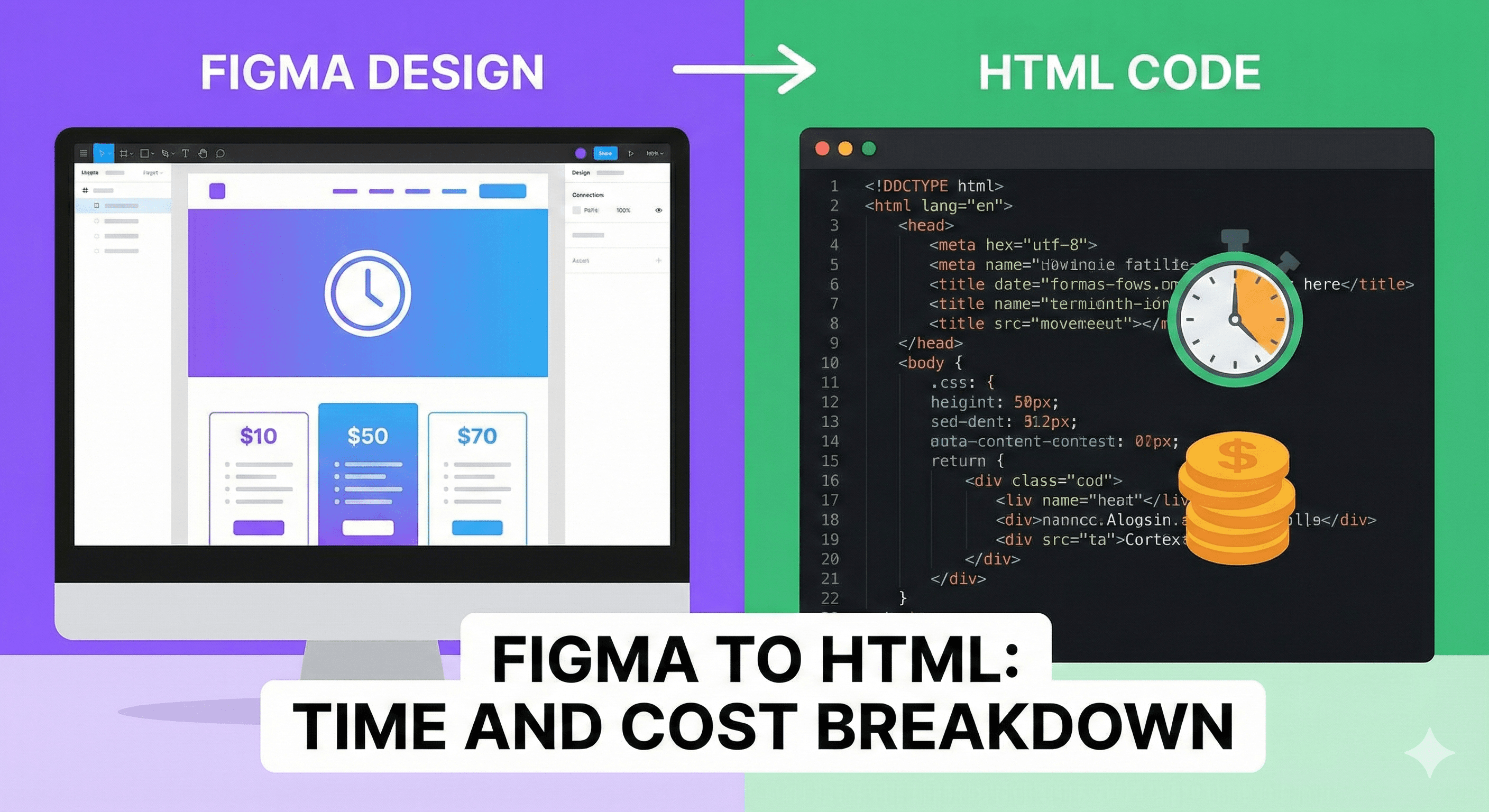
In the lifecycle of building a digital product, few phases are as critical—or as misunderstood—as the handoff from design to development. You have a stunning visual prototype in Figma; the colors are perfect, the typography is crisp, and the layout is approved. But right now, it is just a picture. It isn't a website yet.
The process of converting Figma to HTML is where the magic happens. It is the bridge between a static vision and a dynamic, user-facing reality. However, for startup founders and product managers, this phase is often a black box. How long should it take? Why does one agency quote $500 while another quotes $5,000?
This comprehensive guide breaks down the time and cost mechanics of Figma to HTML conversion, ensuring you have the knowledge to budget accurately and hire the right talent.
What is Figma to HTML Conversion?
At its core, Figma to HTML conversion is the technical process of translating a visual design file into code. Figma produces vector-based designs, which are essentially mathematical descriptions of lines, shapes, and colors. Browsers (Chrome, Safari, Edge) do not understand Figma files; they understand HTML (structure), CSS (styling), and JavaScript (behavior).
The Three Layers of Conversion
To understand the cost, you must understand the layers involved:
Structure (HTML5): The developer looks at your design and defines the skeleton. Is this a header? Is that a button or a link? This is crucial for accessibility and SEO.
Presentation (CSS3/SASS): This mimics the look. It handles responsiveness (mobile vs. desktop), gradients, shadows, and spacing (padding/margins).
Interaction (JavaScript): This is the functional layer. It handles what happens when you click a button, submit a form, or scroll down the page (animations).
Why Not Use "Export to HTML" Plugins?
Many clients ask, "Can't we just use a plugin to export code?"
While tools like Anima or Builder.io exist, they generate "spaghetti code"—code that is messy, bloated, and unreadable. Automated code is often penalized by Google (hurting SEO) and is a nightmare to maintain. For a professional business site, manual coding is non-negotiable.
Detailed Breakdown: Factors Affecting Time
Time is money. In web development, time is calculated based on "development hours." Here is exactly what eats up those hours.
A. Design Complexity & Asset count
A minimalist design with a white background and standard text blocks is fast. However, if your Figma file includes:
Custom Illustrations: That need to be exported as SVGs and optimized.
Overlapping Elements: Elements breaking the grid (e.g., an image floating halfway off the screen) require complex CSS positioning.
Custom Fonts: Integrating and licensing web fonts properly to avoid "layout shift."
Background Blurs/Glassmorphism: Modern UI trends require advanced CSS filters which take time to test across browsers.
B. Interactivity Level
This is the biggest time multiplier.
Static: Just text and images? Fast.
Low Interactivity: Hover effects on buttons, simple mobile menu toggles. Standard.
High Interactivity: Parallax scrolling, elements fading in as you scroll, carousels/sliders, complex data tables, or custom calculators. Slow. (Adds 30-50% more time).
C. Responsiveness (The Multi-Device Rule)
A developer doesn't just build one website; they build three:
Desktop View (1440px+)
Tablet View (768px - 1024px)
Mobile View (320px - 480px)
The developer must write "Media Queries" to reshape the layout for each device. If your design looks drastically different on mobile than desktop, the development time effectively doubles.
3. Realistic Time Estimates (Man-Hours)
Here is a realistic look at how long a professional developer takes for different assets.
Component / Page Type | Complexity | Estimated Development Time |
Navbar + Footer | Standard | 2 – 4 Hours |
Simple Landing Page | Text + Images, No JS | 8 – 12 Hours (1–1.5 Days) |
Complex Landing Page | Animations, Sliders, Form | 16 – 24 Hours (2–3 Days) |
Blog Listing + Detail | Grid layout, typography | 10 – 16 Hours (1.5–2 Days) |
E-commerce Home | Product grids, carousels | 20 – 30 Hours (3–4 Days) |
Full 5-Page Website | Home, About, Service, Contact | 40 – 60 Hours (1–1.5 Weeks) |
Note: These estimates assume a "clean" Figma file. If the developer has to guess fonts or measure pixels manually because the file is messy, add 20% buffer time.
4. Factors Affecting Cost
Pricing is rarely arbitrary. It is a calculation of Hourly Rate × Estimated Hours. However, three specific factors dictate that hourly rate.
1. Developer Location (Geo-Arbitrage)
The single biggest factor in pricing is the cost of living in the developer's country.
North America/Western Europe: $80–$150/hour. High cost, usually ensures culture/time-zone alignment.
Eastern Europe (Poland, Ukraine, Romania): $40–$80/hour. Excellent technical skills, moderate cost.
Asia (India, Philippines, Vietnam): $20–$50/hour. Most cost-effective. India, specifically, is a hub for high-quality frontend developers at competitive rates due to the lower cost of living, not lower skill.
2. Engagement Model
Fixed Price: You pay a set amount (e.g., $500 for a page). Good for small, well-defined tasks. The developer takes the risk if it takes longer.
Hourly: You pay for time spent. Better for complex projects where requirements might change. You take the risk if it takes longer.
3. Tech Stack Requirements
HTML/CSS/Bootstrap: The most affordable. Standard for marketing sites.
Tailwind CSS: Slightly higher due to the modern skillset required.
React / Vue / Next.js: Most expensive. This isn't just "slicing" images; it's building a software application component system. Expect to pay 30–50% more.
5. Comparative Cost Breakdown
Let’s price out a Standard 5-Page Corporate Website (Home, About, Services, Blog, Contact).
Option A: The Freelancer (Upwork/Fiverr)
Typical Rate: $25 - $60 / hour
Total Cost: $1,000 – $2,500
Timeline: 2 – 3 Weeks
Risk: High. Freelancers can get sick, ghost you, or juggle too many clients. Quality assurance (QA) is on you.
Option B: The Offshore Agency (India/Eastern Europe)
Typical Rate: $30 - $70 / hour (Agency rate)
Total Cost: $1,500 – $4,000
Timeline: 1 – 2 Weeks
Risk: Low/Medium. Agencies have Project Managers (PMs) and QA testers. If one dev is sick, they swap in another. This is the sweet spot for most startups.
Option C: The Local Boutique Agency (USA/UK)
Typical Rate: $120 - $200 / hour
Total Cost: $6,000 – $15,000+
Timeline: 3 – 5 Weeks (Includes meetings, onboarding)
Risk: Very Low. You are paying for premium service, contracts, and legal recourse.
6. Technical Quality Checklist (What are you paying for?)
When you receive a quote that seems "too cheap," ask if it includes these essentials. A professional conversion must include:
Semantic HTML5
Bad developers use <div> for everything. Good developers use <header>, <nav>, <main>, <section>, and <article>.
Why it matters: Google reads these tags to understand your content. Semantic code ranks higher in search results.
Cross-Browser Compatibility
Your site might look great in Chrome on a Mac, but does it work on Safari on an iPhone? Does it break on Firefox on Windows?
Requirement: The cost should include testing on Chrome, Firefox, Safari, and Edge.
Speed Optimization (Core Web Vitals)
Image Compression: Are they using Next-Gen formats like WebP?
Lazy Loading: Do images below the fold load only when scrolled to?
Minification: Are CSS/JS files compressed to reduce file size?
Goal: Google PageSpeed score of 90+.
Interactive States
Did the developer code the "Focus" state? When you tab through a form using a keyboard, does the input highlight? This is a legal requirement for accessibility (ADA compliance) in many countries.
7. Common Pitfalls & How to Avoid Them
Mistake #1: Designing for Desktop Only
Designers often forget to design the "Mobile Menu." How does the navigation look on a phone? Is it a hamburger menu? A bottom bar?
Solution: Always provide a mobile view in Figma, or give the developer creative license to adapt it using standard best practices.
Mistake #2: Ignoring Dynamic Content
In Figma, a blog title might be one line: "Best SEO Tips."
In reality, the client might write: "The Ultimate Guide to Search Engine Optimization for Small Businesses in 2025."
The Issue: The design breaks when the text wraps to three lines.
Solution: Ask the developer to build flexible components that can expand vertically without breaking the layout.
Mistake #3: Missing Assets
You send the Figma link, but the developer can't download the icons because they are flattened images, not vectors.
Solution: Ensure all icons are SVGs and all photos are high-resolution. Use the "Mark for Export" feature in Figma.
8. Conclusion: The Value of Clean Code
Converting Figma to HTML is not a commodity service; it is the foundation of your digital business. Cheap, messy code is a "technical debt" that you will pay for later with slow loading speeds, poor Google rankings, and high maintenance costs.
My Professional Recommendation:
For MVP / Testing: Hiring a freelancer ($500-$1000) is acceptable.
For Primary Business Site: Hire a specialized agency or a senior consultant ($2,000+). The ROI on speed, SEO, and scalability will outweigh the initial savings of a cheap conversion.
Remember, visitors don't see your Figma file. They experience your HTML. Make sure it's built to perform.