
Cost of AI-Integrated Website Design: Pricing & Factors (2026)
Posted on
Web Design
Posted at
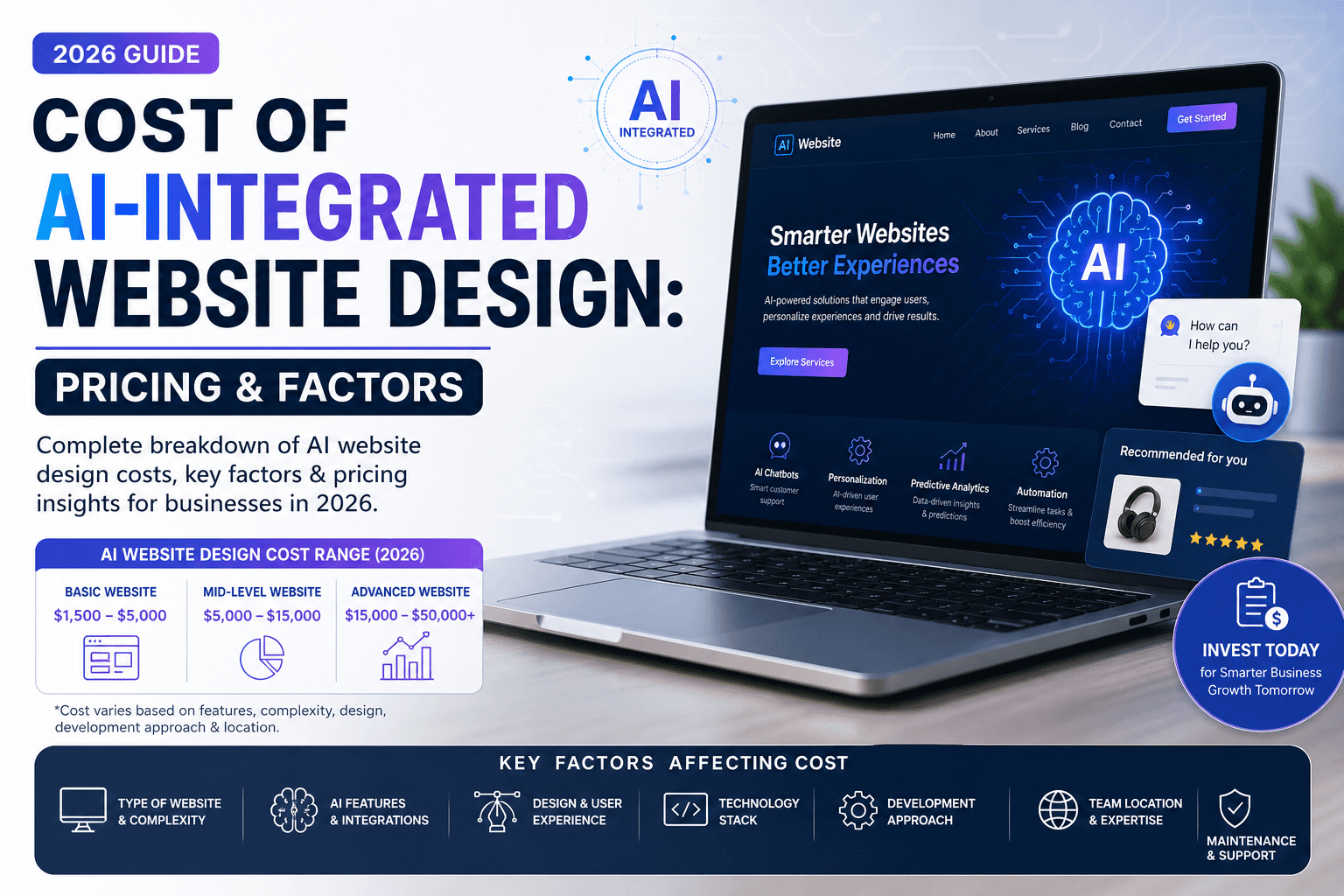
Cost of AI-Integrated Website Design: Pricing & Factors (2026 Guide)
The internet is in the middle of a quiet but fundamental transformation. Across every industry, websites are evolving from static information displays into intelligent, responsive systems — ones that learn from user behavior, anticipate needs, and deliver personalized experiences at scale. AI-integrated websites are no longer a premium novelty reserved for tech giants. In 2026, they're becoming the new baseline expectation for businesses serious about their digital performance.
But here's the challenge most business owners face: the moment you add "AI" to any project, pricing becomes murky. Vendors quote wildly different numbers. The feature lists grow abstract. And it becomes genuinely difficult to understand what you're actually buying, what it's worth, and whether the investment will pay off.
This guide exists to cut through that confusion. Whether you're a startup building your first AI-powered product, an eCommerce business considering intelligent personalization, or a service company exploring chatbot automation, the goal here is simple — give you an honest, practical picture of what AI-integrated website design actually costs in 2026, what drives those costs, and how to make a smart investment decision. No inflated promises, no vague estimates.
What Is an AI-Integrated Website?
Before discussing cost, it's worth being precise about what we're actually talking about — because "AI website" means different things to different people, and those differences translate directly into price.
A traditional website is essentially a curated set of static pages. Content is the same for every visitor. Interactions are limited to clicking links and submitting forms. The website doesn't adapt, learn, or respond intelligently to individual users.
An AI-integrated website uses machine learning, natural language processing, or predictive algorithms to make the experience dynamic. It does at least one of the following: it responds intelligently to user inputs (like a conversational chatbot), it adapts content based on user behavior (like a recommendation engine), it predicts what a user is likely to need next, or it automates tasks that previously required human intervention.
In practice, the most common AI features businesses are adding to websites in 2026 include:
Conversational chatbots — ranging from simple FAQ bots to sophisticated assistants powered by large language models like GPT-4 or Claude that can handle complex queries, qualify leads, and book appointments.
Personalized content recommendations — e-commerce product suggestions, content feeds that adapt to reading history, or landing pages that adjust messaging based on the visitor's source, location, or behavior.
AI-powered search — semantic search that understands intent rather than just matching keywords, dramatically improving how users find what they need on content-rich or product-heavy sites.
Voice assistants — interfaces that allow users to navigate or query a website using natural speech, increasingly relevant as smart speakers and voice-first browsing grow.
Predictive analytics and behavioral scoring — systems that analyze user patterns to predict conversion probability, churn risk, or next best action, feeding that intelligence back into the interface in real time.
The combination of features you choose, and the sophistication with which they're implemented, determines almost everything about your project's cost.
Why Businesses Are Investing in AI Websites in 2026
The business case for AI-integrated websites has shifted from "interesting experiment" to "competitive necessity" remarkably quickly. Three forces are driving the investment.
User expectations have risen. People interact with AI-powered interfaces every day — through streaming recommendations, voice assistants, and AI chatbots in the apps they use most. When they arrive on a business website that doesn't adapt, doesn't respond intelligently, and treats every visitor identically, the gap feels jarring. Businesses that meet modern expectations benefit from measurably higher engagement and lower bounce rates.
Conversion economics are improving. Personalized eCommerce recommendations drive between 10% and 30% of revenue on mature platforms, according to McKinsey. AI-powered chatbots that can qualify leads and book appointments autonomously reduce sales cycle friction significantly. Predictive behavioral scoring allows marketing teams to focus attention where it's most likely to convert. These aren't theoretical benefits — they're measurable ROI that makes the upfront cost easier to justify.
Automation is changing the cost of operations. AI websites reduce the labor cost of handling repetitive customer interactions. A chatbot that resolves 60% of support queries before they reach a human agent doesn't just improve the customer experience — it directly reduces headcount or frees existing staff for higher-value work. For service businesses with high enquiry volumes, this alone can deliver a compelling return on investment.
The industries moving fastest are eCommerce (personalization and intelligent search), SaaS (onboarding automation and in-product guidance), professional services (lead qualification and appointment booking), and healthcare (triage chatbots and information retrieval). But virtually every sector is in some stage of adoption.
Cost of AI-Integrated Website Design in 2026 (Overview)
The honest answer to "how much does an AI website cost?" is: it depends on what you build. But that's not very useful without anchors, so here's a practical framework.
Tier | Typical Investment | What's Included |
|---|---|---|
Basic | $1,500 – $5,000 | Template-based design, single AI feature (typically a chatbot using a third-party platform like Tidio or Intercom AI), basic analytics |
Mid-Level | $5,000 – $15,000 | Custom or semi-custom design, 2–3 AI features (chatbot + personalization or AI search), integration with CRM or marketing tools |
Advanced | $15,000 – $50,000+ | Fully custom design and development, multiple AI features, custom model integration or fine-tuning, complex integrations, ongoing optimization |
Enterprise | $50,000 – $250,000+ | Multi-market platforms, custom AI model development, proprietary data pipelines, enterprise security, dedicated support |
These ranges assume a professional agency engagement in a mid-cost market. Freelance rates are lower; premium agencies in the US or UK charge more. Regional pricing is discussed in detail later in this guide.
A few important caveats. Pricing tiers are not just about features — they're about how those features are implemented. A chatbot built on a third-party platform like Drift or Intercom costs fundamentally less to implement than a custom LLM-powered assistant fine-tuned on your company's knowledge base. The first might cost $800 to integrate; the second might cost $15,000 or more, plus ongoing API costs.
Key Factors That Affect AI Website Design Cost
Understanding what drives your project's cost is more valuable than any single price estimate. Here are the factors that matter most.
Type of Website
A standard informational business website with an AI chatbot is a very different project from a multi-vendor eCommerce platform with AI-powered recommendations and personalized pricing. The baseline complexity of the website type sets the floor for your budget — AI features add on top of that foundation, not instead of it.
A business or service website typically costs $3,000–$20,000 as a base, depending on size and customization. Adding AI features might add $1,000–$10,000 depending on complexity. An eCommerce platform starts higher — $8,000–$40,000 for a solid build — and AI personalization features can add $5,000–$25,000 on top. A SaaS product website with integrated in-app guidance, onboarding automation, and AI search might range from $20,000 to $100,000+ as a full engagement.
AI Features and Complexity
This is usually the largest single variable. A rule of thumb: the more a feature requires custom data, custom model behavior, or real-time processing, the more it costs.
A basic FAQ chatbot using a pre-built platform costs relatively little to set up. An intelligent assistant that can access your product catalog, customer account data, and CRM history — and respond with contextually accurate answers in natural language — requires custom engineering and ongoing infrastructure.
The same logic applies to recommendation engines. A product recommendation plugin that uses generic collaborative filtering (as Shopify apps do) costs a few hundred dollars a year. A recommendation system trained on your specific user behavior data, with A/B testing infrastructure and real-time personalization, is a multi-thousand-dollar development project.
Design and User Experience (UX/UI)
AI features need interfaces that make them feel natural and accessible. This is an underappreciated cost driver. A chatbot widget dropped onto an existing design adds minimal UX cost. A voice-first interface, an AI-driven search experience with semantic results, or a personalized homepage that adapts dynamically — all require significant design investment to feel coherent and trustworthy.
Custom UX design for AI-integrated experiences typically adds $3,000–$15,000 to a project budget, depending on the number of AI touchpoints and the complexity of the interactions being designed.
Development Approach
Freelancers offer the lowest rates but limited capacity for complex, multi-feature builds. Expect hourly rates of $25–$80 in lower-cost markets, $80–$150 in Western Europe and North America. Suitable for single-feature additions or smaller builds.
Agencies charge more but bring project management, QA, and cross-discipline capability — essential for anything beyond a single AI integration. Mid-tier agency rates range from $80–$200 per hour depending on region. Full-service AI web projects typically run $15,000–$75,000.
No-code and low-code platforms like Webflow combined with AI tool APIs (Botpress, OpenAI) have dramatically lowered the cost of basic AI integrations. A skilled no-code developer can build a chatbot-integrated, personalized marketing site for $3,000–$8,000 — territory that previously required $20,000+ in custom development.
Technology Stack
The APIs and infrastructure underpinning your AI features are a significant cost consideration — both at build and over time.
OpenAI's GPT-4 API, Anthropic's Claude API, and Google's Gemini API all charge on a per-token basis. For a chatbot handling hundreds of conversations per day, monthly API costs can range from $50 to several thousand dollars depending on conversation volume and length. These are operational costs that continue indefinitely after launch — and they need to be factored into your total cost of ownership, not just the build cost.
Database infrastructure for recommendation engines and behavioral analytics also adds ongoing cost — cloud hosting, vector databases for semantic search, and data pipeline maintenance all contribute.
Integration Requirements
Most AI features become significantly more valuable — and significantly more expensive to implement — when connected to your existing business systems. A chatbot that can access customer account data from your CRM, check order status from your ERP, and push qualified leads into your marketing automation platform delivers far more value than a standalone bot. But building those integrations requires time, API access, and careful data architecture. Integration complexity routinely adds $2,000–$15,000 to AI web projects.
Detailed Cost Breakdown of AI Features
Here's a practical per-feature cost reference for the most common AI additions to websites in 2026.
AI Feature | Basic Implementation | Advanced Custom Build |
|---|---|---|
AI Chatbot | $500 – $2,000 | $5,000 – $20,000+ |
Recommendation Engine | $1,000 – $4,000 | $8,000 – $25,000 |
AI-Powered Search | $800 – $3,000 | $5,000 – $15,000 |
Voice Assistant Interface | $2,000 – $6,000 | $10,000 – $30,000 |
Predictive Analytics | $3,000 – $8,000 | $15,000 – $40,000 |
AI Content Personalization | $1,500 – $5,000 | $8,000 – $20,000 |
Automated Lead Scoring | $1,000 – $4,000 | $6,000 – $18,000 |
AI Chatbot — The most common entry point for businesses new to AI integration. A basic bot using a platform like Tidio, Drift, or ManyChat can be configured and deployed for $500–$2,000. A custom LLM-powered assistant that understands your business context, accesses your data, and handles complex queries requires custom engineering — expect $5,000–$20,000 plus ongoing API costs.
Recommendation Engine — Particularly valuable for eCommerce and content platforms. Pre-built solutions (like those available via Shopify apps or WordPress plugins) are affordable but generic. Custom recommendation systems trained on your user data and optimized for your specific conversion metrics represent a significant engineering investment, but can deliver 15–35% improvements in average order value.
AI-Powered Search — Standard keyword search frustrates users on large websites. Semantic search powered by embedding models understands intent — a user searching "something to wear to a summer wedding" returns relevant results even without exact keyword matches. Basic implementations using platforms like Algolia's AI features start around $800–$3,000 to integrate; fully custom semantic search built on vector databases costs more.
Voice Assistant — Still in early adoption for commercial websites, but growing rapidly in e-commerce, hospitality, and accessibility-focused applications. Implementation complexity is high because voice interfaces require entirely different UX thinking — errors, ambiguities, and conversational state management all need careful design and engineering attention.
Predictive Analytics — Systems that score leads, predict churn, or identify high-value users in real time require data pipelines, model training infrastructure, and careful integration with your CRM or marketing tools. This is the most technically demanding category on the list and is rarely appropriate for businesses without substantial existing user data.
Freelancer vs Agency vs In-House: Cost Comparison
The choice of who builds your AI website significantly affects both upfront cost and long-term outcomes.
Approach | Project Cost Range | Pros | Cons |
|---|---|---|---|
Freelancer | $2,000 – $20,000 | Lower rates, flexibility | Limited capacity, coordination risk |
Agency | $8,000 – $100,000+ | Full-service, process, QA | Higher cost, less personal |
In-House Team | $150,000+ per year | Control, iteration speed | Highest cost, talent difficult to hire |
Freelancers make sense for clearly scoped, single-feature additions or smaller sites where budget is tight and requirements are stable. The risk is capacity — a single freelancer cannot simultaneously design, develop, train an AI model, and maintain infrastructure at the pace an agency can. For complex AI builds, coordination across multiple freelancers adds project management overhead that often erodes the cost savings.
Agencies deliver the most reliable outcomes for complex, multi-feature AI web projects. Project management, QA, and cross-discipline collaboration are built into the engagement model. The premium over freelance rates is real — but so is the reduction in risk. For businesses where the website is a critical revenue asset, agency delivery significantly reduces the probability of costly rebuilds.
In-house teams are only economically rational for businesses building AI web capabilities as a core, ongoing competency. A mid-level AI engineer commands $100,000–$180,000 per year in the US; a UX designer $70,000–$130,000. The cost of assembling and retaining a team capable of building and maintaining AI-integrated web experiences is substantial — justified only when the volume and frequency of AI web work warrants it.
Cost Based on Region (Global Comparison)
Geography remains a significant pricing variable in web development, even as remote work has narrowed some gaps.
Region | Hourly Rate Range | Notes |
|---|---|---|
USA / Canada | $100 – $250/hr | Highest rates, strong talent pool |
UK / Western Europe | $80 – $180/hr | Premium quality, strong design culture |
Eastern Europe (Poland, Estonia, Ukraine) | $40 – $90/hr | Excellent technical quality, growing AI capability |
India | $20 – $60/hr | Large talent pool, very competitive pricing |
Latin America | $30 – $80/hr | Good quality, convenient time zones for US clients |
Southeast Asia | $20 – $55/hr | Competitive rates, variable quality |
India deserves particular mention. It hosts one of the world's largest developer talent pools, and AI development capability has grown rapidly. For well-scoped AI integration projects, Indian agencies and freelancers deliver genuine value — particularly for backend AI development, API integration, and data engineering work. The key success factor is specification quality: detailed briefs and clear technical requirements consistently produce better outcomes than vague briefs at any price point.
Eastern Europe (Poland, Estonia, Ukraine, Romania) offers arguably the strongest combination of technical quality and competitive pricing outside of North America and Western Europe. Estonian agencies in particular have built strong AI and product design capabilities — partly driven by the country's position as a European tech hub — at rates 40–60% below UK or US equivalents.
Latin America has emerged as a strong option for US-based businesses seeking experienced teams in compatible time zones. Argentina, Colombia, and Mexico all have growing pools of AI-capable developers working at rates significantly below North American equivalents.
Hidden Costs of AI Website Development
The costs that appear in an agency proposal are rarely the full picture. Several categories of cost are chronically underestimated in initial budgets.
Ongoing API fees are the most commonly overlooked. Every query to an OpenAI, Google, or Anthropic API costs money. For a site with moderate chatbot traffic, monthly API fees typically run $50–$500. For high-traffic platforms with multiple AI features in active use, monthly API costs can reach $2,000–$10,000 or more. Build this into your financial model before committing to a particular AI architecture.
Maintenance and updates are often treated as optional post-launch — they're not. AI models drift as language patterns, user expectations, and your business context evolve. Chatbot training data becomes outdated. Recommendation models need retraining as your catalog changes. Allocate 15–25% of your initial build cost annually for AI-specific maintenance.
Data infrastructure costs — storage, processing, and security for the behavioral data that powers your AI features — are real and ongoing. Cloud infrastructure for a modest AI-powered site runs $100–$500 per month; for larger platforms with substantial data volumes, costs escalate quickly.
Security and compliance add cost that's easy to defer and painful to pay for later. AI features that process personal data are subject to GDPR in Europe, CCPA in California, and an evolving patchwork of AI-specific regulations globally. Privacy engineering, security audits, and compliance review are not optional extras for responsible businesses.
How to Reduce AI Website Development Cost
Smart cost management isn't about buying less — it's about buying the right things at the right time.
Start with an MVP mindset. Rather than building every AI feature you can imagine from day one, identify the single highest-value AI addition to your current website and build that first. Measure its impact. Use that data to justify and inform the next investment. This approach reduces initial risk and ensures that each subsequent AI feature is informed by real user behavior rather than assumptions.
Use pre-built AI tools where the use case is generic. Not every chatbot needs to be custom-built. Not every recommendation engine requires custom model training. Platforms like Tidio, Algolia, Klaviyo, and Hotjar's AI features offer mature, well-tested AI capabilities at a fraction of custom development cost. Reserve custom development for the features where your specific data, context, or user experience requirements genuinely can't be met by an existing platform.
Choose an agency that understands AI cost architecture. Some agencies propose custom development for everything because that's what they know how to build. Others have genuine experience evaluating when a third-party API or platform solves the problem more cost-effectively. The distinction matters enormously for total project cost.
Avoid over-engineering your first version. Many AI web projects fail not because the technology is wrong but because the scope is too ambitious. A chatbot that answers 70% of common queries reliably is more valuable than a sophisticated assistant that attempts to answer everything and fails unpredictably. Reliability and accuracy at a narrower scope consistently outperform ambition at a broader one.
Is AI Website Design Worth the Cost?
The ROI case for AI-integrated websites is strong — but it's context-dependent. Here's a practical way to think through the question for your specific situation.
If your website receives significant traffic but converts poorly, AI personalization and behavioral targeting can move conversion rates measurably. If your team spends significant time answering the same customer questions repeatedly, a well-trained chatbot can recapture that time. If your search function is weak and users leave your site to find what they're looking for elsewhere, AI-powered search pays back quickly in reduced bounce rates and increased session depth.
The businesses that see the weakest ROI from AI website investment are typically those building AI features before they have the traffic volume or user data that makes AI valuable, or those adding AI to websites with fundamental UX or content problems. AI amplifies what's already working — it doesn't fix what isn't.
A conservative ROI model for a mid-level AI investment ($10,000–$20,000): if AI chatbot automation saves 10 hours of staff time per week at $30/hour, that's $15,600 per year in recovered capacity — paying back the investment in year one. A 15% improvement in eCommerce conversion rate from personalization on a site generating $500,000 in annual revenue represents $75,000 in incremental sales. The math gets compelling quickly when AI is applied to high-leverage problems.
Future Trends in AI Website Design (2026 and Beyond)
The trajectory of AI website development is moving in several directions simultaneously, each with cost implications for businesses planning investments.
Generative UI is the most transformative emerging trend. Rather than serving fixed layouts to all users, generative UI systems compose interfaces dynamically based on user context, device, behavior history, and stated preferences. This is nascent in 2026 but will likely become a standard capability in premium web platforms within three to five years. Early investment in design systems and structured content architecture positions businesses well for this shift.
Voice-first interfaces are accelerating as ambient computing devices proliferate. Websites designed primarily for voice interaction require fundamentally different UX architecture — state management, error handling, and conversational design patterns that most agencies are still developing capability in. Budget for this being more expensive and more experimental than comparable visual interface work.
AI agents replacing forms is already happening at the leading edge. Instead of multi-step forms to request quotes, book appointments, or configure products, conversational agents guide users through the same process naturally. The UX improvement is significant; the implementation complexity is higher than it appears.
Hyper-personalization at the individual level — where every user sees a meaningfully different version of a website based on their specific context and history — will become more accessible as AI infrastructure costs fall and more sophisticated personalization platforms enter the market at accessible price points.
How to Choose the Right AI Web Development Partner
Choosing well here saves money and frustration in roughly equal measure.
Start by asking for examples of AI-specific work, not just general web design portfolios. Ask which AI features they've built, which third-party platforms they use versus build custom, and what the ongoing operational costs looked like for clients post-launch. Agencies with genuine AI experience answer these questions specifically and confidently.
Ask how they handle scope and cost estimation for AI features. Because AI development involves a level of experimentation and iteration that standard web development doesn't, the best agencies use phased delivery models with defined decision points — rather than quoting a fixed price for a feature whose full complexity won't be known until development is underway. Be skeptical of very precise fixed-price quotes for complex AI builds.
Watch for red flags: agencies that propose custom AI development for every requirement without evaluating pre-built platforms, those that can't explain their AI cost architecture clearly, or those that treat AI features as interchangeable plug-ins rather than business-critical systems requiring careful design and testing. Also be cautious of any agency that can't describe how they handle AI drift, model retraining, or post-launch optimization — because these are inevitable realities of AI system ownership.
Good questions to ask: What will our monthly AI operating costs look like six months after launch? How will you handle chatbot training and improvement post-launch? What happens if the AI feature underperforms after delivery? How do you handle GDPR compliance for behavioral data collection?
Conclusion
AI-integrated website design in 2026 is no longer a luxury investment for a handful of well-funded businesses. It's a practical, increasingly affordable capability that companies of all sizes are deploying to improve user experience, automate operations, and compete more effectively in digital markets.
The cost ranges in this guide are honest ones — wide because the range of what "AI website" can mean is genuinely vast. A chatbot on a small business site and a hyper-personalized eCommerce platform with predictive analytics are both "AI websites," in the same way that a bicycle and a Formula 1 car are both "vehicles." Understanding exactly what you need, what it will cost to build and operate, and what return you can realistically expect is the work that determines whether your AI web investment creates value or simply adds complexity.
The businesses that invest most successfully in AI website design tend to share a few characteristics: they start with a specific, measurable problem rather than a general ambition to "add AI." They choose partners with genuine AI experience and honest cost communication. They budget for operational costs, not just build costs. And they treat the first AI feature as a learning exercise, not a final destination.
Done thoughtfully, AI website investment pays back reliably. This guide is your starting point for doing it thoughtfully.
Frequently Asked Questions :
How much does an AI-integrated website cost in 2026?
The range is broad: from $1,500–$5,000 for a basic website with a single pre-built AI feature, to $15,000–$50,000 for a mid-to-advanced custom AI web platform. Enterprise builds with proprietary AI models and complex integrations can exceed $250,000. The primary cost drivers are the number and complexity of AI features, the degree of customization required, and the region where development is performed.
What is the cheapest way to build an AI website?
The most cost-effective approach is combining a no-code website builder (like Webflow or Squarespace) with pre-built AI tool integrations. Platforms like Tidio for chatbots, Algolia for AI search, and Klaviyo for personalized email deliver meaningful AI capabilities without custom development. A skilled no-code developer can implement this stack for $2,000–$6,000.
Are AI websites expensive to maintain?
Ongoing costs vary significantly. Expect monthly API fees of $50–$500 for moderate-traffic sites, cloud hosting for AI infrastructure at $100–$400 per month, and periodic maintenance for model retraining and feature updates at $200–$1,000 per month. Total annual operating cost for a mid-level AI website typically runs $3,000–$15,000 beyond the initial build.
Can small businesses afford AI websites?
Yes, if the investment is scoped intelligently. A small business doesn't need a $50,000 AI platform — it might need a $2,000 chatbot that handles after-hours enquiries, or a $1,500 AI search upgrade that helps visitors find products more easily. Starting with one high-impact, affordable AI feature and measuring the return before expanding is a sound approach for businesses with limited budgets.
Which AI features give the best ROI?
For most businesses, AI chatbots (particularly for lead capture and customer support automation) and personalized product or content recommendations offer the fastest and most measurable return. AI-powered search is high-ROI for content-heavy or large-catalog eCommerce sites. Predictive analytics offers strong returns but requires substantial existing user data to work well.
Is no-code AI website development worth it?
For many use cases, absolutely. No-code tools have matured significantly, and the gap between what they can achieve and what custom development produces has narrowed considerably for standard AI features. The limits become apparent in highly custom AI interactions, complex data integrations, or performance-critical applications — but for the majority of SME use cases, a well-executed no-code build with AI integrations delivers excellent value.
How long does it take to build an AI-integrated website?
A basic AI website takes six to ten weeks. A mid-level build with multiple integrated AI features typically runs three to five months. Complex enterprise AI web platforms often require six to twelve months, including discovery, build, testing, and phased rollout.
What AI features are most common in 2026?
The most widely deployed AI features on commercial websites in 2026 are conversational chatbots, personalized content or product recommendations, AI-powered search, and automated lead scoring. Voice interfaces and generative UI are growing in adoption but remain less common outside of technology-forward sectors.
How do API costs affect the total cost of an AI website?
API costs are an ongoing operational expense that many businesses underestimate. Conversational AI features using GPT-4 or Claude charge per token — roughly per word processed. A chatbot handling 500 conversations per day at average length can cost $200–$800 per month in API fees alone. Build these costs into your business case before choosing an AI architecture.
Can I add AI to an existing website, or do I need to rebuild?
In most cases, AI features can be added to existing websites without a full rebuild. Chatbot widgets, recommendation plugins, and AI search tools typically integrate via JavaScript snippets or API connections. More complex AI personalization that requires changes to how content is structured and served may require more substantial rework — but a full rebuild is rarely necessary for adding AI to a functional existing site.
Planning to build or upgrade to an AI-powered website? [Contact VNA Infotech - web development specialist] to discuss your requirements, or use this guide to build a clear brief before approaching agencies for proposals. For more on choosing the right development partner, see our [related guide on evaluating web agencies].


