
AI Shopping Agents: The Future of Ecommerce Experiences
Posted on
Web Design
Posted at
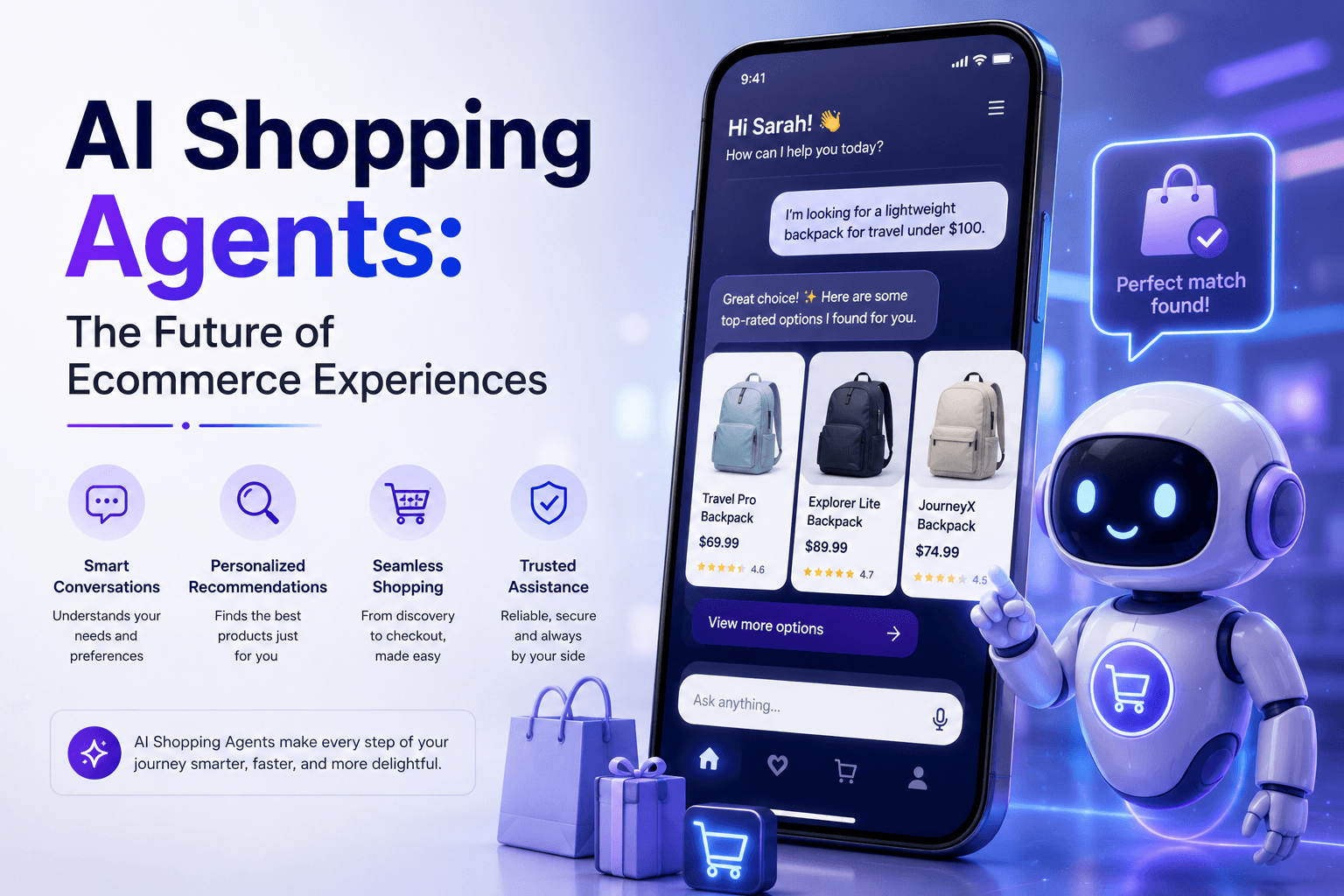
The New Face of Online Shopping
Not long ago, buying something online meant opening a browser, searching for a product, scrolling through dozens of listings, reading reviews, and — if you were lucky — finding what you needed within the first half-hour. Fast forward to 2026, and that experience feels almost quaint.
Ecommerce has undergone a dramatic transformation. What started as digital storefronts imitating physical shops has evolved into intelligent, responsive ecosystems that know what you want before you type a single word. The driving force behind this shift? Artificial intelligence — and more specifically, a new breed of AI-powered systems known as AI shopping agents.
These aren't your average chatbots or recommendation widgets. AI shopping agents are autonomous, intelligent systems that can understand your preferences, search products across platforms, compare prices, answer complex questions, handle post-purchase issues, and even complete purchases on your behalf — all in real time, all without human intervention.
Consumer expectations have changed in lockstep. Today's shoppers want instant answers, frictionless checkout, and product suggestions that feel eerily personal. They don't want to wade through irrelevant results or wait 48 hours for a customer support email. They want experiences that anticipate their needs — and that's exactly what AI shopping agents are built to deliver.
According to industry data, the global AI in retail market is projected to surpass $45 billion by 2027, with AI-driven shopping tools at the center of that growth. For ecommerce businesses — from scrappy startups to established enterprise brands — the question is no longer whether to adopt AI, but how fast.
This article unpacks what AI shopping agents really are, how they work under the hood, what they mean for your business, and why they represent the most significant shift in ecommerce since the mobile revolution.
What Are AI Shopping Agents?
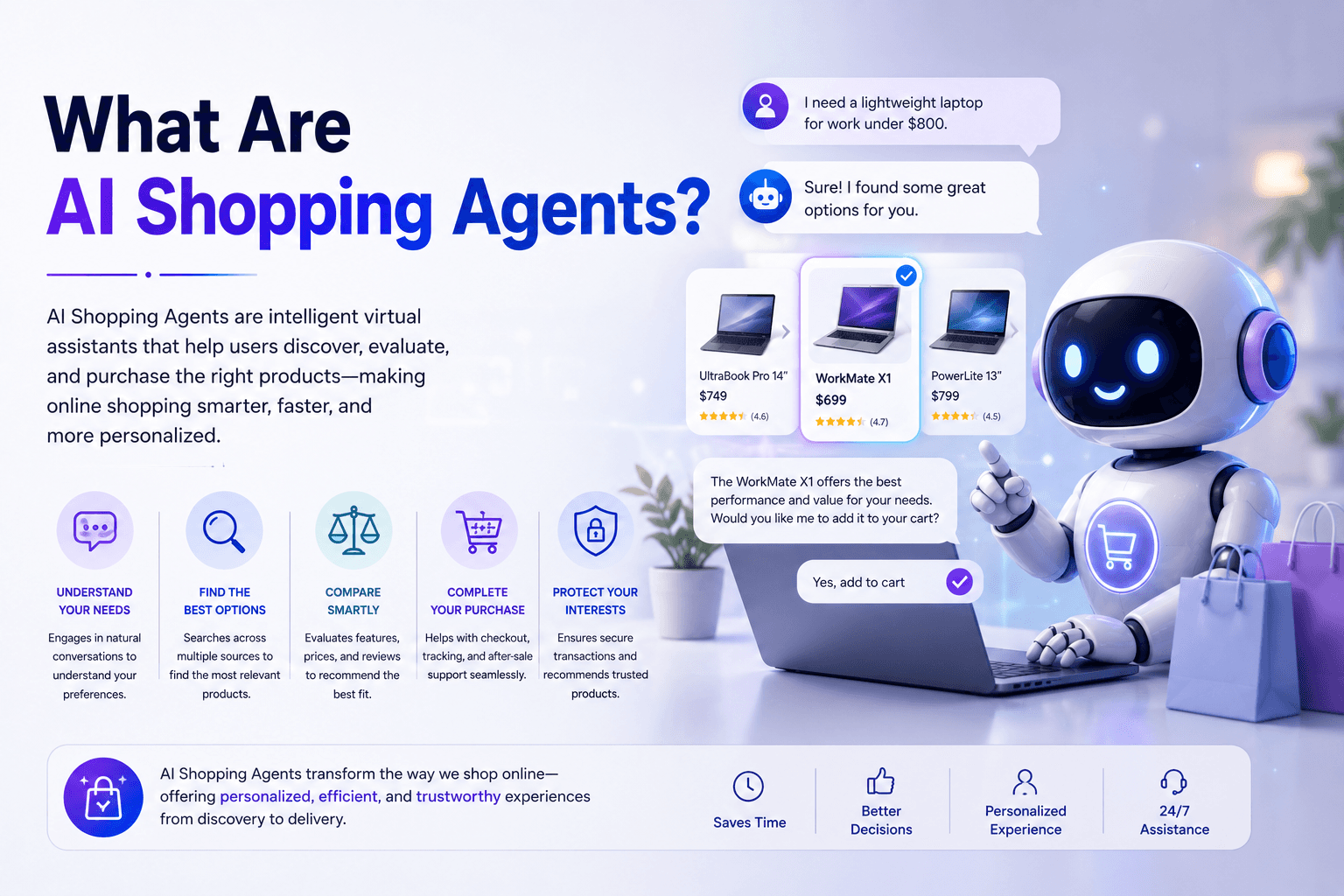
If you've interacted with a basic chatbot on a retail website, you already have a partial picture — but AI shopping agents operate on an entirely different level. Think of a basic chatbot as a vending machine: it gives you predefined answers to predefined questions. An AI shopping agent is closer to a knowledgeable personal shopper who learns from every conversation, adapts in real time, and takes meaningful action on your behalf.
At their core, AI shopping agents are software systems that combine machine learning, natural language processing (NLP), generative AI, and autonomous decision-making to assist customers throughout the entire shopping journey. They don't just respond — they reason, plan, and act.
What makes these systems "agentic" is their capacity for autonomous action. A traditional chatbot asks, "What are you looking for?" An AI shopping agent might proactively notice that a customer has been browsing running shoes for ten minutes, cross-reference their purchase history, check current stock levels, apply a relevant discount code, and then suggest three products ranked by relevance — without the customer prompting it at all.
These agents can handle a remarkably broad set of tasks: recommending products tailored to individual preferences, comparing prices across vendors, tracking orders and proactively flagging delays, negotiating promotional pricing, resolving support tickets, predicting when a customer is likely to reorder, and in some advanced implementations, completing purchases autonomously within predefined parameters.
The technological foundation includes several interconnected components. Large language models (LLMs) power conversational understanding and generation. Recommendation engines analyze behavioral data to surface relevant products. Predictive analytics anticipate future needs. Retrieval-augmented generation (RAG) allows agents to pull real-time inventory, pricing, and product data. And orchestration frameworks tie these components into coherent workflows that can span multiple systems and touchpoints.
The result is something genuinely new: a digital shopping companion that gets smarter with every interaction, operates across every channel, and never clocks out.
How AI Shopping Agents Work
Understanding the mechanics behind AI shopping agents helps demystify their capabilities — and their limitations. These systems don't run on magic; they run on data, algorithms, and increasingly sophisticated reasoning chains.
Step 1 — Understanding Customer Intent
Every interaction begins with intent recognition. When a customer types "I need a birthday gift for my 8-year-old who loves dinosaurs under $40," the AI agent must parse multiple layers of meaning: the occasion, the recipient's age, the theme, and the budget constraint. Modern NLP models handle this nuance far more accurately than keyword-matching ever could. They understand context, idioms, emotional tone, and even implied preferences based on prior conversation history.
Step 2 — Analyzing Behavioral Context
Alongside the immediate query, the agent draws on a rich behavioral profile. Which pages has this customer visited? What did they buy last month? Which price ranges do they typically browse? Have they responded to discounts in the past? This contextual layer transforms a generic search into a highly personalized one. A customer who consistently buys premium brands gets different recommendations than one who prioritizes value — even if they submit the same query.
Step 3 — Matching and Ranking Products
With intent and context established, the agent queries the product catalog — often in real time — to identify candidates. Ranking algorithms evaluate relevance, availability, margin, popularity, and customer satisfaction scores. Generative AI can compose rich, conversational product summaries rather than serving raw database fields, making recommendations feel natural and curated rather than algorithmic.
Step 4 — Personalizing the Recommendation
This is where AI shopping agents truly differentiate from traditional search. Rather than returning a static list, the agent might say: "Based on the LEGO sets your nephew loved last year, you might want to look at this Jurassic World dinosaur kit — it's within your budget and has 4.8 stars from parents of kids his age." That kind of contextual, narrative recommendation is only possible because the agent understands the whole picture.
Step 5 — Assisting During Checkout
Cart abandonment is one of ecommerce's most stubborn problems. AI shopping agents tackle it by intervening at friction points — offering to auto-fill shipping details, flagging a better payment option, applying a forgotten coupon code, or simply asking "Did you want to complete your order?" at the right moment. Some agents can complete checkout entirely on behalf of trusted users who have pre-authorized this behavior.
Step 6 — Post-Purchase Support
The relationship doesn't end at the confirmation page. AI agents handle order tracking, return requests, product usage questions, and review solicitation — reducing the load on human support teams while keeping customers engaged and informed throughout the fulfillment cycle.
Key Features of AI Shopping Agents
Personalized Product Recommendations
Personalization is the feature customers notice most — and the one that drives the most revenue. AI shopping agents analyze purchase history, browsing patterns, wish lists, demographic data, and real-time session behavior to surface products that genuinely match what a specific customer wants right now. Unlike static recommendation widgets, agentic systems update their recommendations dynamically within a session, responding to signals as subtle as how long a user pauses on a product image.
Retailers using advanced AI personalization report conversion rate improvements of 20–30% compared to generic recommendation systems. For high-volume stores, that difference compounds dramatically over time.
Conversational Shopping Experience
Shopping doesn't have to start with a search bar anymore. AI shopping agents enable fully conversational interactions — customers can describe what they need in natural language, ask follow-up questions, request alternatives, and get genuinely helpful responses. This is particularly transformative for complex purchases like electronics, furniture, or fashion, where the path from "I need something" to "I'll buy this" involves multiple back-and-forth exchanges.
Voice commerce, powered by AI agents, takes this even further. A customer cooking dinner can ask their smart speaker to reorder the olive oil they ran out of — and the agent handles the rest, pulling from purchase history and applying loyalty discounts automatically.
Automated Customer Support
AI agents provide round-the-clock support without the cost of a 24/7 human team. They handle common queries like order status, return policies, product specifications, and troubleshooting — resolving them instantly and escalating to human agents only when genuinely necessary. Modern agentic support systems handle 60–80% of tier-one queries without human involvement, freeing support teams to focus on complex, high-value interactions.
Smart Product Search
Semantic search powered by AI understands meaning, not just keywords. A customer searching "comfortable shoes for standing all day at a wedding" gets results optimized for their actual need, not just shoes that match individual words in the query. Visual search adds another dimension: customers can upload a photo of a product they love and find similar items in your catalog instantly.
Dynamic Pricing Intelligence
AI agents can monitor competitive pricing in real time and recommend dynamic adjustments that maximize both conversion and margin. For customers, this manifests as time-sensitive offers that feel genuinely relevant. For businesses, it means staying competitive without constant manual price management.
AI-Based Upselling and Cross-Selling
When done by a human salesperson, upselling feels like a service. When done poorly by a rule-based system, it feels like spam. AI shopping agents hit the middle ground: they recommend complementary products or upgrades based on genuine contextual understanding. A customer buying a DSLR camera doesn't just need a bag (obvious cross-sell) — they might also need a specific memory card speed based on the video modes they've described wanting to use. That level of intelligent suggestion dramatically increases average order value without annoying the customer.
Predictive Shopping Assistance
Proactive assistance is one of AI's most powerful capabilities in commerce. Agents can predict when a consumable product is running low and send a timely restock reminder. They can anticipate seasonal needs based on past behavior — suggesting sunscreen in May, not July. They can alert customers to price drops on wish-listed items or notify them when a previously out-of-stock favorite is available again.
Multi-Platform Shopping Assistance
Today's customer doesn't shop on a single channel. They discover products on Instagram, research on Google, browse the website on desktop, add to cart on mobile, and ask questions on WhatsApp. AI shopping agents operate cohesively across all these touchpoints, maintaining context and continuity across sessions and devices. A customer who abandons a cart on mobile can pick up the conversation on a web chat two days later — and the agent remembers exactly where they left off.
Benefits of AI Shopping Agents for Ecommerce Businesses
The business case for AI shopping agents is compelling across virtually every dimension of ecommerce performance.
Higher Conversion Rates are perhaps the most immediate benefit. By personalizing the shopping experience and intervening at friction points, AI agents convert browsers into buyers more consistently. Businesses implementing AI-driven personalization typically see conversion lifts between 15% and 35%, depending on their baseline and implementation quality.
Increased Average Order Value follows naturally from intelligent upselling and cross-selling. When recommendations are genuinely relevant, customers buy more — not because they're being pushed, but because they're being helped.
Lower Operational Costs emerge from AI's ability to automate high-volume, repetitive work. Handling thousands of simultaneous customer conversations without additional headcount is transformative for margins, particularly for growing businesses that can't yet justify large support teams.
Better Customer Retention comes from experiences that feel personal and effortless. Customers who feel understood return more often. AI agents that remember preferences, anticipate needs, and resolve issues quickly build the kind of loyalty that sustains long-term business growth.
Smarter Inventory Management is an underappreciated benefit. AI systems that analyze purchasing patterns and seasonal trends help businesses stock the right products at the right time, reducing both overstock costs and lost sales from stockouts.
Data-Driven Decision Making improves across the board when AI agents are generating rich interaction data. Every conversation reveals something about customer intent, pain points, and preferences — intelligence that can inform product development, merchandising, and marketing strategy.
For small ecommerce businesses, AI shopping agents level the playing field, enabling experiences previously only possible for companies with large personalization teams. For enterprise brands, they enable scale that human teams alone could never achieve.
Benefits of AI Shopping Agents for Customers
From the customer's perspective, AI shopping agents solve real, everyday frustrations with online shopping.
Faster Shopping is the most obvious win. Instead of navigating category trees, comparing product pages manually, and Googling reviews, customers can describe what they need and get a curated answer in seconds. The time from "I want this" to "I have this" compresses dramatically.
Reduced Decision Fatigue matters more than most retailers realize. The paradox of choice is real — too many options lead to paralysis, not purchases. AI agents filter the noise and present a shortlist of genuinely relevant options, making the decision easier without making the customer feel railroaded.
Personalized Experiences feel fundamentally different from generic ones. When a customer returns to a store and the AI agent says "Welcome back — the jacket you were eyeing last week just went on sale," that's not creepy surveillance; it's attentive service that customers genuinely appreciate.
Better Deals and Discounts reach the customers most likely to use them. AI agents can surface relevant promotions at exactly the right moment — when a customer is on the fence about a purchase — rather than blasting generic discount emails that get ignored.
Instant, Accurate Support removes one of online shopping's biggest pain points. Customers no longer have to submit a ticket and wait. They get answers immediately, at any hour, in natural language. For post-purchase anxiety — "Where is my order?" — instant resolution transforms customer satisfaction.
Seamless Omnichannel Journeys mean customers can shop however and whenever they want without losing context. The AI agent is there on the website, on mobile, on WhatsApp, and on voice — maintaining the thread of the conversation and the continuity of the relationship.
Real-World Examples of AI Shopping Agents
The technology isn't theoretical — it's already reshaping how the world's largest retailers operate, and increasingly accessible to smaller businesses too.
Amazon remains the most prominent example of AI-driven ecommerce. Its recommendation engine, which accounts for an estimated 35% of total revenue, analyzes purchasing history, browsing behavior, wish lists, and even data from Kindle and Alexa to surface highly relevant suggestions. Alexa's shopping integration goes further, allowing customers to reorder products, check Prime deals, and add items to their cart entirely by voice.
Shopify has aggressively integrated AI across its platform. Shopify Magic powers automated product descriptions, email campaign copy, and customer segmentation. Sidekick, Shopify's AI assistant, helps merchants manage their stores through natural language commands — a feature that democratizes sophisticated store management for entrepreneurs without technical teams.
Walmart uses AI agents to power its search experience, making it far more semantic and context-aware than traditional keyword search. Its AI personalization engine adapts the homepage and product listings dynamically for each user based on shopping history and real-time behavior.
Sephora's AI-powered Beauty Advisor is a retail AI success story. The system combines skin tone analysis, product preference modeling, and conversational AI to recommend skincare and makeup products with a level of nuance that previously required an in-store consultation. Customers who engage with the advisor convert at significantly higher rates than those who don't.
Stitch Fix built its entire business model around AI-assisted personal styling. Its algorithms analyze style preferences, fit feedback, and purchase history to curate clothing selections that are mailed directly to customers — a model that blends AI efficiency with human styling judgment in genuinely novel ways.
ChatGPT-powered shopping integrations are proliferating rapidly, with retailers embedding AI chat into their websites to handle complex product queries that traditional search can't address. Customers can ask "What's the best mattress for a side sleeper with lower back pain who runs hot?" and get a genuinely thoughtful, catalog-specific answer.
Agentic AI vs Traditional Ecommerce Automation
Understanding what makes AI shopping agents distinct from what came before helps clarify both their power and their appropriate use cases.
Capability | Rule-Based Systems | Basic AI Chatbots | Agentic AI Shopping Agents |
|---|---|---|---|
Decision-Making | Predefined rules only | Pattern-matched responses | Autonomous reasoning and action |
Context Understanding | None | Limited, within-session | Deep, multi-session, multi-signal |
Personalization | Generic segments | Basic user preferences | Hyper-individual, real-time adaptive |
Learning Ability | None | Minimal | Continuous improvement |
Action Scope | Single tasks | Q&A only | End-to-end workflows |
Proactive Behavior | None | Triggered responses | Self-initiated based on predictions |
Traditional automation tools — email flows, basic search filters, rule-based promotions — were a significant advance over fully manual processes. But they operate within rigid parameters. A rule-based system can send an abandoned cart email three hours after abandonment; it cannot decide, based on the customer's browsing behavior and time of day, whether an email or a WhatsApp message would be more effective, or whether offering a specific discount would be more persuasive than free shipping.
AI shopping agents don't just execute predefined playbooks. They reason about situations, weigh options, and choose actions — getting better at those choices over time as they accumulate more data and feedback.
How AI Shopping Agents Are Transforming Ecommerce Experiences
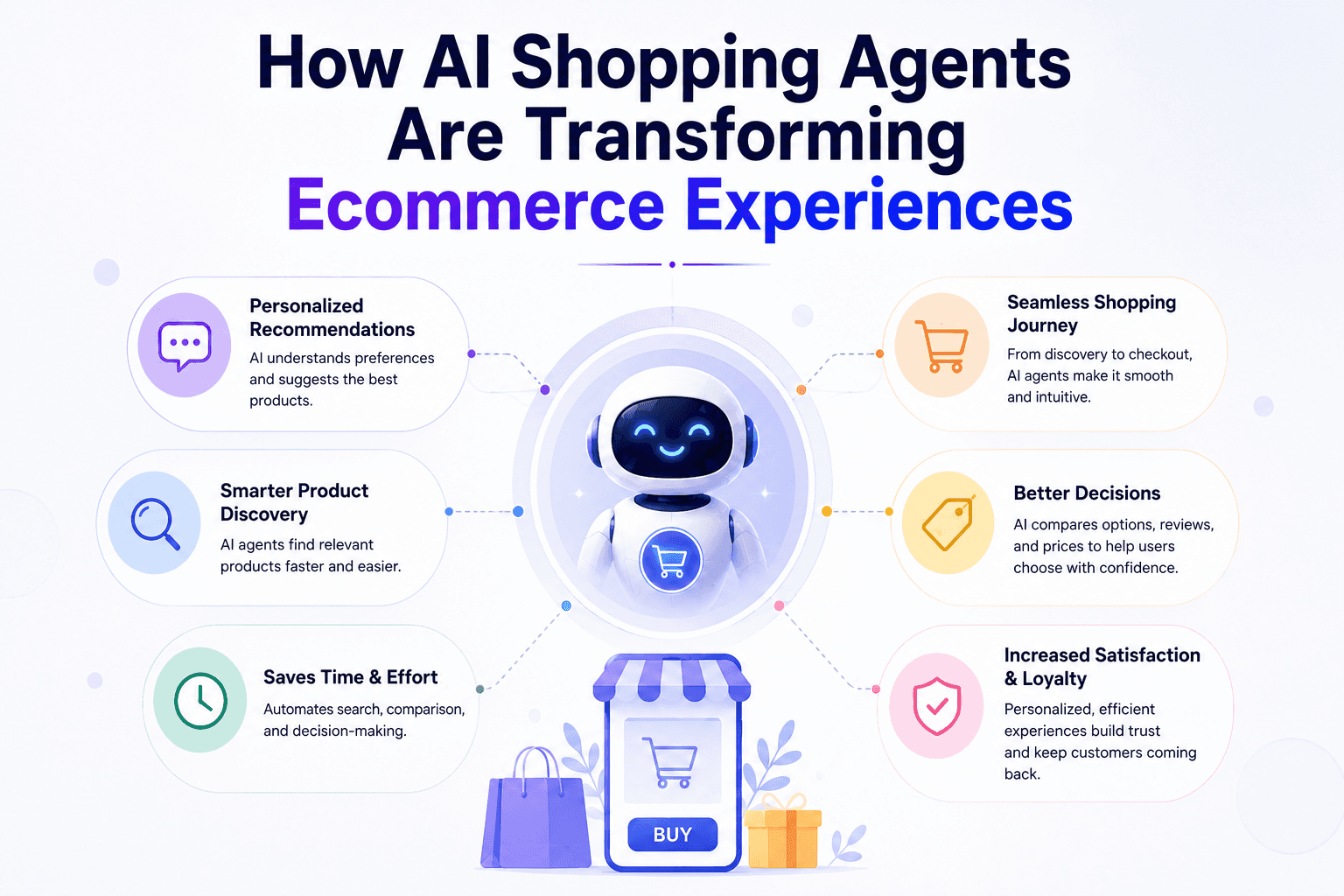
The macro impact of AI shopping agents extends far beyond individual features or metrics. They're fundamentally changing the architecture of how ecommerce works.
Hyper-personalized storefronts are becoming the norm rather than the exception. Rather than presenting every customer with the same homepage, AI systems dynamically assemble product grids, hero banners, and featured collections tailored to each individual visitor's profile and intent. Two customers visiting the same store at the same moment might see completely different interfaces, optimized for their specific preferences.
AI-driven product discovery is shifting how customers find products. Instead of navigating categories, more customers are relying on AI search and conversational interfaces to surface products they didn't even know they were looking for. This changes the merchandising calculus for retailers — visibility is increasingly about AI discoverability rather than traditional SEO or paid placement.
Frictionless checkout powered by AI is reducing cart abandonment at scale. Agents that predict abandonment signals and intervene with the right offer at the right moment, or that pre-populate checkout forms intelligently, measurably improve completion rates.
Autonomous buying systems are beginning to emerge for routine repurchases. Subscription services enhanced by AI don't just ship on a fixed schedule — they adapt based on actual usage signals, customer feedback, and inventory availability. The future version sends you coffee just as you're running out, not just on the 30th of every month.
The UX implications are profound. As AI agents become more capable, the traditional ecommerce interface — category pages, filters, product grids — may give way to more conversational, intent-driven experiences that feel less like browsing a catalog and more like consulting an expert.
Future Trends of AI Shopping Agents in 2026 and Beyond
Looking ahead, the trajectory of AI shopping agents points toward capabilities that would have seemed like science fiction just a few years ago.
Fully autonomous AI buyers are perhaps the most transformative near-term possibility. Imagine an AI agent with standing instructions — "keep my pantry stocked with organic produce, never spend more than $200 a week" — that monitors inventory, compares vendors, places orders, and manages deliveries entirely on your behalf. Early versions of this already exist in enterprise procurement; consumer implementations are close behind.
AI-to-AI commerce will emerge as agentic systems become ubiquitous. A consumer's personal AI agent might negotiate pricing with a retailer's AI selling agent — two autonomous systems reaching an optimal transaction without either human directly participating. This isn't speculative; the technical foundations are being laid right now.
Emotion-aware AI assistants will adapt their tone, pacing, and recommendations based on detected emotional signals in customer interactions. A customer expressing frustration will be handled differently than one expressing excitement. This emotional intelligence layer will make AI interactions feel dramatically more human.
Augmented reality shopping with AI will allow customers to virtually place furniture in their homes, try on clothing, or preview appliances in their kitchens — with AI agents providing real-time guidance about fit, compatibility, and styling.
AI wearable shopping systems will integrate with smartwatches and other wearables, enabling truly ambient commerce. Running low on a supplement you take daily? Your wearable health monitor knows, and your AI shopping agent has already added it to your next order.
The trajectory is clear: AI shopping agents will increasingly blur the line between wanting something and having it, making commerce more effortless, more personalized, and more integrated into daily life than ever before.
Challenges and Risks of AI Shopping Agents
For all their promise, AI shopping agents introduce real challenges that businesses and consumers must navigate thoughtfully.
Privacy and data security sit at the top of the concern list. The personalization that makes AI shopping agents valuable is built on extensive behavioral data. Customers and regulators are increasingly scrutinizing how this data is collected, stored, and used. GDPR, CCPA, and emerging AI-specific regulations impose real compliance obligations — and reputational risks for companies that handle data carelessly.
AI bias is a genuine problem. If an AI shopping agent's training data reflects historical purchasing patterns that skew by demographics, it may serve inferior recommendations to certain customer groups — perpetuating or amplifying existing inequities. Responsible AI development requires ongoing auditing for bias across demographic dimensions.
Overdependence on AI creates fragility. Businesses that fully automate customer interactions without maintaining human fallback options risk catastrophic service failures when AI systems malfunction — and they do malfunction. A well-designed AI system should escalate gracefully to human agents when it reaches the limits of its competence.
Transparency and trust are persistent challenges. Customers have a right to know when they're talking to an AI system, and to understand how their data is being used to shape their experience. Companies that obscure AI involvement, or that use behavioral data in ways customers would find unsettling if they knew, risk significant trust erosion.
Fake AI reviews and manipulation represent an emerging threat. As AI systems become better at generating authentic-seeming content, the potential for AI-generated fake reviews to poison recommendation systems grows. Detecting and filtering this content is an ongoing arms race.
Responsible AI implementation — transparent, privacy-respecting, bias-audited, and human-overseen — isn't just an ethical position. It's increasingly a business necessity.
How Ecommerce Businesses Can Prepare for AI Shopping Agents
Adopting AI shopping agents successfully isn't simply a technology procurement decision — it requires organizational and strategic preparation.
Start with data infrastructure. AI shopping agents are only as good as the data they run on. Businesses that haven't established clean, unified customer data platforms — connecting behavioral, transactional, and demographic data — will find AI implementations underperform. Invest in data quality before AI tooling.
Pursue omnichannel integration thoughtfully. AI agents need to operate consistently across every touchpoint where your customers engage. A disjointed experience — great AI on desktop, none on mobile, legacy chat on WhatsApp — undermines the continuity that makes agentic systems valuable. Map your customer touchpoints and prioritize integration accordingly.
Define clear AI governance policies. Before deploying autonomous AI systems that can take actions on customers' behalf, establish clear policies about what those systems can and cannot do, how errors are handled, and how customers can override AI decisions. Governance isn't bureaucracy — it's risk management.
Train your team for AI collaboration. The most effective implementations pair AI capabilities with human judgment. Customer service teams need to understand when AI escalations are appropriate, how to review AI-generated recommendations, and how to provide feedback that improves system performance. AI isn't replacing your team; it's changing what your team does.
Test extensively before full deployment. AI systems behave differently in production than in testing environments. Run phased rollouts, monitor key metrics closely, and build feedback loops that surface problems early. The cost of a poor AI experience — in customer trust and brand perception — is high.
Optimize your ecommerce website for AI interactions. Structured product data, comprehensive product descriptions, well-tagged attributes, and clear pricing signals all improve AI agent performance. Treat your product catalog as a data asset that AI systems will read and reason about.
Best AI Tools and Platforms for Ecommerce Businesses
The AI ecommerce tooling landscape has matured significantly, with options available at every budget level and complexity tier.
Shopify Magic integrates AI natively into the world's most popular ecommerce platform, generating product descriptions, email content, and customer segments automatically. For Shopify merchants, it's the most accessible entry point into AI-powered selling.
Dynamic Yield (acquired by Mastercard) provides enterprise-grade personalization capabilities — dynamic content, product recommendations, A/B testing at scale — used by some of the world's largest retailers. It's a sophisticated platform for businesses with the data infrastructure and team capacity to leverage it fully.
Klaviyo AI enhances email and SMS marketing with predictive send-time optimization, churn risk scoring, and AI-generated copy suggestions. For marketing teams, it turns behavioral data into actionable campaign intelligence.
Salesforce Commerce Cloud AI integrates Einstein AI capabilities across the commerce lifecycle — from personalized search and recommendations to AI-assisted merchandising and customer service automation.
Adobe Sensei, Adobe's AI layer, powers intelligent features across Commerce (Magento), including product recommendations, live search with semantic understanding, and automated catalog management.
Google AI tools for ecommerce include Vertex AI for custom model development, Product Discovery solutions for semantic and visual search, and Performance Max campaigns that use AI to optimize ad placement and creative across Google's entire inventory.
For businesses just beginning their AI journey, starting with a single, well-integrated tool — typically a personalization or customer support AI — and expanding from there is more effective than attempting a wholesale transformation at once.
Will AI Shopping Agents Replace Human Sales Teams?
This question generates more anxiety than it deserves — and the honest answer is more nuanced than either utopian or dystopian framings suggest.
AI shopping agents will unquestionably replace some tasks currently performed by humans. High-volume, repetitive customer service interactions — order status inquiries, basic product questions, return initiations — are already being handled by AI systems at scale, and that trend will continue. Jobs that consist primarily of scripted, transactional interactions are genuinely at risk of automation.
But the picture looks very different for roles built on human strengths: empathy, creativity, complex judgment, and relationship-building. A skilled human sales associate at a luxury brand doesn't primarily provide information — they provide an experience of feeling understood and valued. AI can augment that experience, but it cannot replicate it. Customers navigating a difficult purchase decision, or seeking resolution of a complex complaint, often want human assurance that no AI interaction currently provides.
The most likely trajectory is a genuine collaboration model where AI handles the volume and humans handle the nuance. Customer service teams become smaller but higher-skilled. Sales roles shift toward relationship management and complex consultation. Merchandising teams work with AI tools rather than spreadsheets. The total number of ecommerce jobs may decline, but the quality and compensation of remaining roles may increase as AI absorbs the lower-complexity work.
For businesses, the strategic imperative is to think carefully about which human touchpoints add genuine value — and protect those, while letting AI handle the rest.
Conclusion: The Agentic Future of Commerce
We're standing at the beginning of a transformation in how humans and commerce interact — one that will ultimately make buying things feel as natural and effortless as conversation.
AI shopping agents represent the convergence of several decades of technological progress: the internet's ability to connect buyers and sellers globally, the smartphone's ability to make commerce ambient and continuous, and now AI's ability to make every interaction intelligent, personalized, and autonomous. The result is an ecommerce ecosystem that doesn't just respond to demand — it anticipates it.
For businesses, the opportunity is enormous — and the window for early-mover advantage is open right now. Companies that invest in AI shopping agents today are building the customer relationships, data assets, and technical capabilities that will define competitive advantage for the next decade. Those that wait will find themselves scrambling to catch up in a market where AI-driven personalization has become table stakes, not differentiation.
For customers, the future is genuinely exciting. Shopping will become less of a chore and more of an experience — faster, smarter, and more attuned to individual needs than anything that's come before.
The digital shopping companion is no longer a concept. It's here, it's learning, and it's getting better every day.
Frequently Asked Questions
What are AI shopping agents?
AI shopping agents are autonomous software systems that use artificial intelligence — including machine learning, NLP, and generative AI — to assist customers throughout the shopping journey. Unlike basic chatbots, they can take independent actions: recommending products, comparing prices, handling support, and in advanced implementations, completing purchases on a customer's behalf.
How do AI shopping agents work?
AI shopping agents process customer queries and behavioral data to understand intent, match relevant products, personalize recommendations, assist during checkout, and provide post-purchase support. They combine language models for conversation, recommendation engines for product matching, and predictive analytics for anticipating needs — all coordinated through an autonomous workflow system.
What is the difference between chatbots and AI shopping agents?
Traditional chatbots follow predefined scripts and can only respond to specific triggers. AI shopping agents reason autonomously, learn from interactions, maintain context across sessions, take proactive actions, and improve continuously. The difference is roughly analogous to a vending machine versus a personal shopper.
Are AI shopping agents safe?
When implemented responsibly, yes. Safety depends on robust data security practices, clear privacy policies, transparent disclosure of AI involvement, and well-defined limits on what actions agents can take autonomously. Reputable platforms invest heavily in security and compliance; businesses should evaluate these factors carefully before implementation.
How does AI improve ecommerce experiences?
AI improves ecommerce experiences by personalizing product recommendations, enabling natural language search, providing instant 24/7 support, reducing friction during checkout, and anticipating customer needs proactively. The cumulative effect is a shopping experience that feels faster, more relevant, and more effortless than traditional ecommerce.
Can AI shopping agents increase sales?
Yes, meaningfully. Businesses implementing AI personalization consistently report conversion rate improvements of 15–35%, with additional gains in average order value through intelligent cross-selling and upselling. The combination of better recommendations, reduced friction, and proactive engagement compounds into significant revenue impact.
What companies use AI shopping assistants?
Amazon, Walmart, Shopify, Sephora, Stitch Fix, ASOS, and virtually every major ecommerce platform now uses AI shopping assistance in some form. Mid-market and small businesses access similar capabilities through platforms like Shopify Magic, Klaviyo AI, and Dynamic Yield.
What is agentic AI in ecommerce?
Agentic AI refers to AI systems that don't just respond to instructions but reason autonomously, plan multi-step workflows, and take independent actions to achieve goals. In ecommerce, this means AI that can manage the entire customer journey — from initial product discovery to post-purchase support — without requiring human intervention at each step.
Will AI replace ecommerce customer support teams?
AI will automate a significant portion of high-volume, repetitive support interactions — likely 60–80% of tier-one queries. However, complex complaints, emotionally sensitive interactions, and high-value customer relationships benefit from human involvement. The most effective model combines AI efficiency with human empathy, with AI handling volume and humans handling nuance.
What is the future of AI shopping?
The future includes fully autonomous AI buyers that manage household replenishment, AI-to-AI commerce negotiations, emotion-aware assistants, AR-powered try-before-you-buy experiences, and ambient commerce integrated with wearables. The overarching direction is toward shopping that requires less active effort from customers while delivering more personally relevant outcomes.
What is conversational commerce AI?
Conversational commerce AI enables customers to shop through natural language interactions — via chat, voice, or messaging apps — rather than traditional navigation and search. It allows customers to describe needs, ask questions, and complete purchases through dialogue, making shopping more accessible and intuitive.
How can small ecommerce businesses adopt AI shopping agents?
The most practical starting points are AI tools already integrated into major platforms — Shopify Magic for Shopify merchants, or Klaviyo AI for email marketing. These require minimal technical setup and deliver immediate value. As AI comfort and data infrastructure grow, businesses can expand into more sophisticated personalization and autonomous support tools.