
AI-Powered FMCG Website Design Cost in 2026
Posted on
Web Design
Posted at
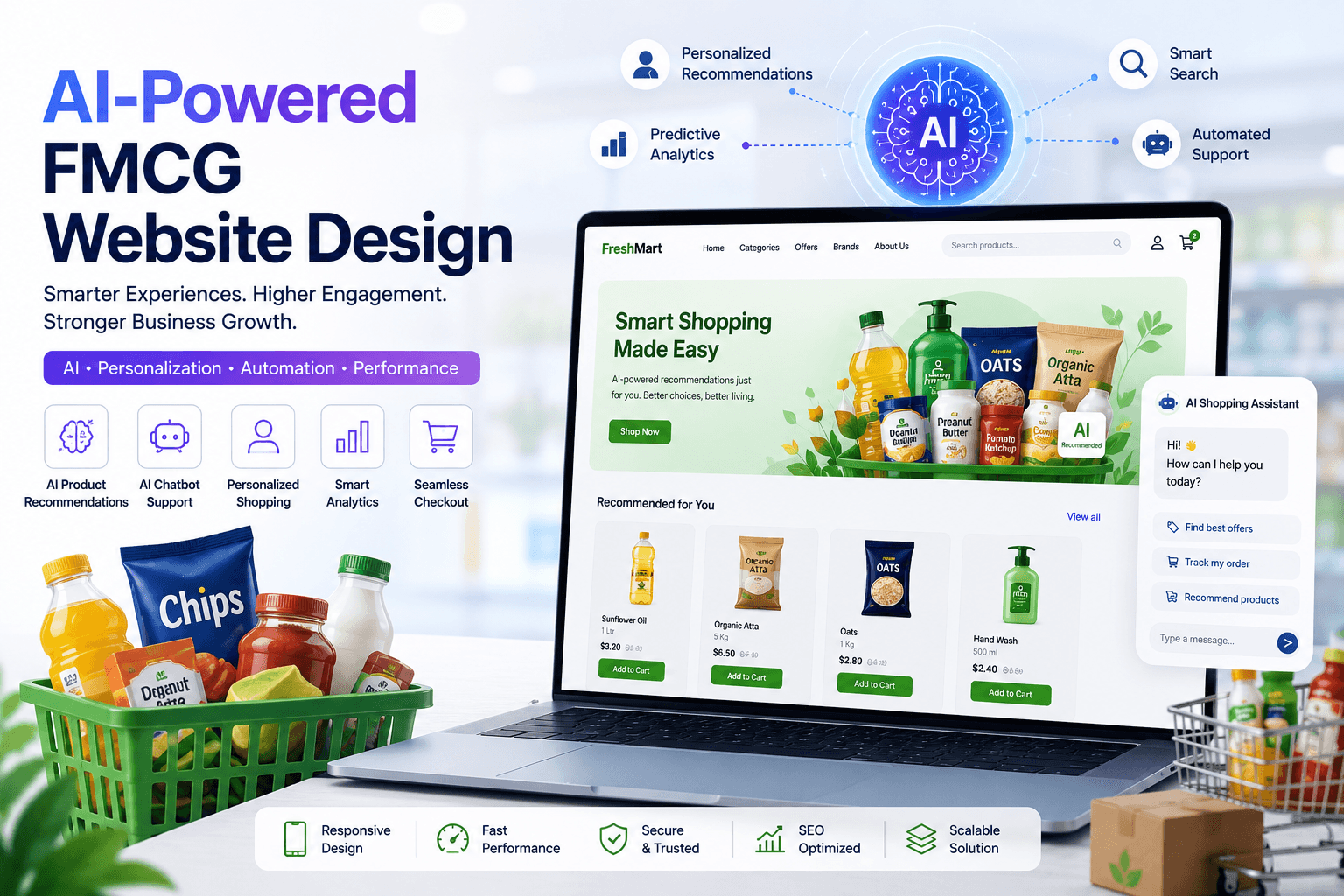
The FMCG industry has never moved faster. In 2026, consumers expect to open an app, get personalized recommendations for their weekly groceries, complete a checkout in under thirty seconds, and have their order tracked in real time. Behind that seamless experience sits a sophisticated, AI-powered website — and building one requires a very different conversation about cost than it did even three years ago.
Global online FMCG sales crossed $1.2 trillion in 2025 and are projected to grow at nearly 18% annually through 2029, according to market intelligence firms tracking the consumer goods sector. Brands like Unilever, Nestlé, Procter & Gamble, and Hindustan Lever are pouring hundreds of millions into digital infrastructure. Even mid-sized regional FMCG players are realizing that a static product catalogue website is no longer enough to compete.
What's changed isn't just design taste or technology preference — it's customer expectation. Today's online shopper has been trained by Amazon, Flipkart, and Blinkit to expect a website that knows what they want before they search for it. AI-powered personalization, conversational chatbots, predictive reordering, and intelligent search have shifted from "premium extras" to table-stakes features for any FMCG brand that wants to grow online.
This article breaks down everything you need to know about the true cost of building an AI-powered FMCG website in 2026 — from small brands launching their first online store to enterprise manufacturers managing thousands of SKUs across global markets. We'll cover pricing ranges, the specific AI features that drive costs up (and the ROI they deliver), technology stack decisions, and how to choose the right development partner.
If you've been wondering whether AI ecommerce is worth the investment, this guide was written for you.
What Is an AI-Powered FMCG Website?
Before discussing cost, it helps to be crystal clear about what we mean by "AI-powered FMCG website" — because this term gets used loosely, and the difference between a website with a basic chatbot and a fully AI-integrated ecommerce platform is enormous, both in capability and in price.
A traditional FMCG website is essentially a digital catalogue with a shopping cart. You browse, search manually, add to cart, and check out. The experience is the same whether you're a first-time visitor or a loyal customer who's ordered fifty times. These sites are built on familiar CMS platforms, require minimal infrastructure, and cost between $5,000 and $30,000 to build, depending on design quality and feature set.
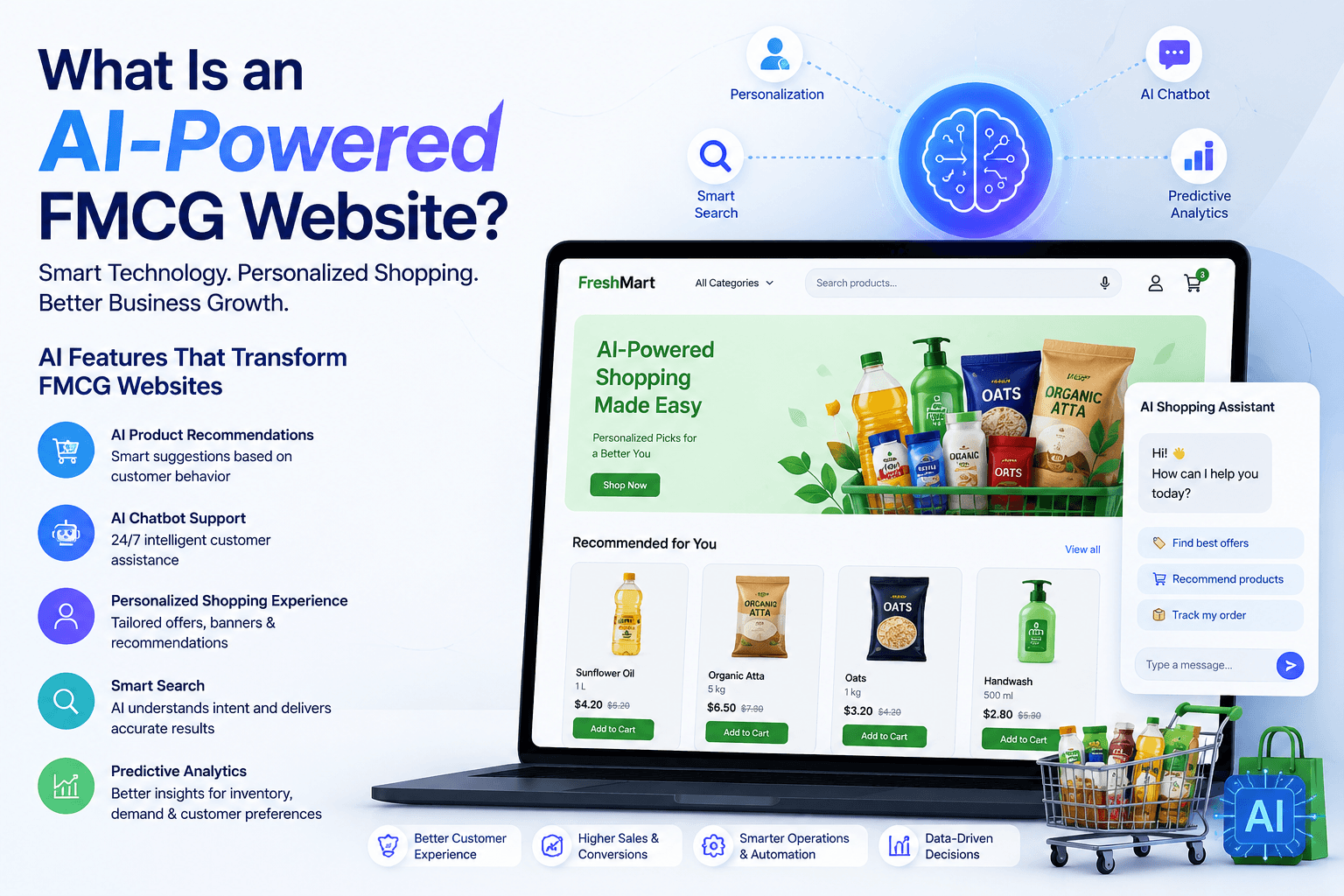
An AI-powered FMCG website is a fundamentally different animal. At its core, it uses machine learning and artificial intelligence to make the shopping experience dynamic, personalized, and predictive. Here's what that looks like in practice:
AI-Based Personalization means the website adapts its layout, product ordering, banners, and promotions based on each visitor's browsing history, purchase patterns, location, and real-time behavior. A customer who regularly buys organic breakfast cereals sees a very different homepage from someone who typically orders energy drinks and protein bars.
Smart Product Recommendations go beyond "customers also bought" widgets. Advanced recommendation engines analyze purchase sequences, seasonal patterns, household consumption cycles, and affinity clusters to suggest products the customer is likely to need next — often before the customer thinks of it themselves.
AI Chatbots and Conversational Assistants handle customer queries with natural language understanding, helping shoppers find products, troubleshoot orders, apply coupons, and complete purchases without human agent involvement. Modern conversational AI can handle over 80% of routine support interactions autonomously.
Predictive Analytics give the business deep insight into customer lifetime value, churn risk, demand forecasting, and campaign ROI. These systems help marketing and operations teams make smarter decisions faster.
Intelligent Search uses semantic understanding rather than exact keyword matching. When a customer types "healthy snacks for kids," an AI search engine understands intent, filters by nutritional profiles, and returns contextually relevant results even if the exact phrase doesn't match any product title.
The difference between traditional and AI-powered FMCG websites isn't cosmetic — it's architectural. AI features require data pipelines, model training infrastructure, API integrations, and ongoing optimization. That's why pricing diverges so dramatically once AI enters the conversation.
Why FMCG Brands Are Investing in AI-Powered Websites in 2026
The investment thesis for AI-powered FMCG websites has become impossible to ignore. Three converging forces are driving brands to upgrade their digital infrastructure in 2026.
Rising Online FMCG Demand — The pandemic permanently shifted consumer behavior toward online grocery and household goods purchasing. In India alone, the quick-commerce and online grocery segment grew at over 40% year-on-year between 2022 and 2025. Southeast Asia, Latin America, and Sub-Saharan Africa are experiencing similar growth curves. Brands that don't have a strong, intelligent online presence are ceding ground to pure-play digital competitors and platform marketplaces.
Mobile-First Shopping Behavior — Over 78% of online FMCG purchases in 2025 were initiated on mobile devices. Consumers expect apps and mobile websites that load in under two seconds, offer thumb-friendly navigation, and remember their preferences. AI-powered mobile optimization — including predictive prefetching and dynamic content loading — directly impacts conversion rates and customer satisfaction scores.
Personalization as a Competitive Moat — McKinsey research consistently shows that personalization-led ecommerce outperforms generic storefronts by 10–30% in revenue per visitor. For FMCG brands with high purchase frequency and large product catalogues, personalization isn't just a nice-to-have — it's the primary driver of repeat purchases and basket size growth.
AI-Driven Customer Retention — Acquiring a new customer in FMCG ecommerce costs five to seven times more than retaining an existing one. AI-powered churn prediction models allow marketing teams to identify at-risk customers and intervene with targeted offers before they lapse. Brands using these tools report retention improvements of 15–25% within the first year of deployment.
Omnichannel Retail Experiences — Modern FMCG consumers move fluidly between physical stores, websites, apps, and third-party marketplaces. AI-powered websites can unify these touchpoints through shared customer profiles, synchronized inventory, and consistent personalization across channels. Brands like Tata Consumer Products and Dabur have invested heavily in this kind of unified commerce infrastructure, and their digital revenue growth reflects it.
The bottom line is that AI-powered FMCG websites are no longer experimental technology — they're proven revenue infrastructure. The question for most brands in 2026 isn't whether to invest, but how much, and in which capabilities.
Average AI-Powered FMCG Website Design Cost in 2026
Website development pricing in 2026 reflects the complexity of the technology stack, the sophistication of AI features, and the scale of the business being served. Here's a detailed breakdown by business tier.
Small FMCG Business Website Cost
For small FMCG brands — regional food producers, artisan goods manufacturers, emerging D2C brands — an AI-powered website needs to be lean but capable. A well-built small business FMCG website in 2026 typically includes a clean, mobile-optimized storefront, a product catalogue of up to 200–300 SKUs, basic AI chatbot integration for customer support and order tracking, simple rule-based personalization (e.g., showing recently viewed products, basic "you might also like" widgets), a smooth checkout flow with multiple payment options, and integration with one or two logistics providers.
Estimated Cost Range: $8,000 – $25,000 USD (approximately ₹6.5 lakh – ₹20 lakh)
At this tier, development teams typically build on SaaS platforms like Shopify or WooCommerce with AI plugins and third-party recommendation tools like LimeSpot or Barilliance. The AI capabilities are mostly plug-and-play rather than custom-built, which keeps costs manageable while delivering meaningful personalization.
The investment is justified for brands doing upward of $200,000 in annual revenue who want to reduce marketplace dependency and build direct customer relationships.
Mid-Sized FMCG Ecommerce Website Cost
Mid-sized FMCG businesses — established regional brands, multi-category consumer goods companies, growing D2C players with national reach — need significantly more sophisticated websites. At this scale, the website is a core business system, not just a marketing asset.
A mid-sized AI-powered FMCG website typically includes custom UI/UX design aligned with brand identity, a catalogue of 500–5,000 SKUs with advanced filtering and smart search, a real AI recommendation engine (often built on collaborative filtering or neural network models), CRM integration for unified customer profiles, advanced analytics dashboards, subscription ordering capabilities, mobile-first design with performance optimization, multi-warehouse inventory management, and loyalty program integration.
Estimated Cost Range: $30,000 – $100,000 USD (approximately ₹25 lakh – ₹82 lakh)
At this level, development teams often use Shopify Plus, Magento Open Source, or headless commerce frameworks. Custom AI features — particularly recommendation engines and intelligent search systems — may be built using APIs from providers like Algolia (search), Nosto (recommendations), or directly through OpenAI integrations.
Mid-sized brands should budget separately for ongoing AI model training and optimization, which typically adds $1,000–$5,000 per month in operational costs.
Enterprise FMCG Website Development Cost
Enterprise FMCG brands — multinational manufacturers, large retail groups, companies managing tens of thousands of SKUs across multiple markets — require websites that are essentially large-scale technology platforms. At this tier, "website" is almost a misnomer; these are comprehensive digital commerce ecosystems.
Enterprise AI-powered FMCG platforms include headless commerce architecture for flexibility across channels, deep ERP integration (SAP, Oracle, Microsoft Dynamics), omnichannel commerce capabilities connecting online, offline, and third-party channels, advanced AI personalization with real-time model inference, predictive analytics for demand forecasting and customer lifetime value, AI-powered dynamic pricing systems, multilingual and multi-currency support, enterprise-grade security and compliance infrastructure, dedicated DevOps and cloud infrastructure (AWS, Google Cloud, Azure), and custom AI models trained on proprietary data.
Estimated Cost Range: $150,000 – $750,000+ USD (approximately ₹1.2 crore – ₹6+ crore)
At this scale, technology partners include Adobe Commerce (Magento), Salesforce Commerce Cloud, SAP Commerce Cloud, or fully custom-built headless platforms. AI capabilities are typically custom-developed or deeply integrated enterprise AI platforms.
Annual maintenance, optimization, and infrastructure costs for enterprise systems typically add 20–30% of initial development cost per year.
Key Factors Affecting AI-Powered FMCG Website Cost
Understanding the pricing ranges above requires understanding what actually drives costs. No two FMCG websites cost the same, even at the same business scale. Here are the primary variables.
Website Design Complexity
Custom design work — developing a distinctive visual identity, creating original UI components, and designing interactive experiences — costs significantly more than template-based development. A template-based Shopify store might require $500–$3,000 in design work. A fully custom-designed FMCG platform with branded motion design, custom component libraries, and accessibility compliance can require $15,000–$60,000 in design investment alone.
FMCG brands with strong visual identities and premium positioning (think premium food brands or personal care lines competing on brand image) typically need fully custom designs. Mass-market brands competing primarily on price and convenience can often use high-quality templates effectively.
AI Features and Automation
This is the single largest variable in 2026 FMCG website pricing. AI features range from inexpensive SaaS plugin integrations to complex custom-built systems. A basic AI chatbot integration using a platform like Intercom or Zendesk AI might cost $2,000–$5,000 to integrate. A custom-trained conversational AI built specifically for your product catalogue and customer service workflows might cost $20,000–$80,000 to develop and deploy.
Similarly, recommendation engines range from $5,000 SaaS integrations to $50,000+ custom systems. The more complex your product catalogue, the more sophisticated your personalization needs, and the more valuable custom AI development becomes.
Ecommerce Functionality
Beyond basic shopping cart and checkout, additional ecommerce capabilities add meaningful cost. Subscription ordering systems — increasingly important for FMCG brands selling consumables — add $5,000–$20,000 in development cost. Multi-vendor marketplace functionality (if you're building a platform for multiple brands) can add $30,000–$100,000. B2B ordering portals with account management, credit terms, and bulk ordering add another $20,000–$60,000.
Product Catalogue Size
Managing a catalogue of 50 products is architecturally trivial. Managing 50,000 SKUs with variant combinations, regional availability, nutritional information, allergen data, and dynamic pricing rules requires substantial database engineering and performance optimization. Every tenfold increase in catalogue size roughly doubles the infrastructure and development complexity.
Mobile Optimization
A genuinely excellent mobile shopping experience — fast load times under 3G conditions, intuitive touch interactions, seamless mobile checkout — requires dedicated mobile development investment. Progressive Web App (PWA) development, which gives mobile users an app-like experience without requiring an app store download, adds $10,000–$40,000 to a project depending on feature scope.
Headless Commerce Architecture
Headless commerce separates the frontend presentation layer from the backend commerce engine, allowing much greater flexibility in how products and content are presented across different channels (website, mobile app, kiosk, voice device). Building headless adds 30–50% to development cost but provides long-term flexibility that traditional "coupled" commerce architectures can't match. For enterprise FMCG brands with omnichannel ambitions, headless is increasingly the only sensible architecture.
Third-Party Integrations
Every integration — payment gateway, logistics API, ERP system, CRM platform, marketing automation tool, analytics platform — adds cost. Simple integrations with well-documented APIs might cost $1,000–$3,000 each. Complex ERP integrations involving data transformation, error handling, and real-time synchronization can cost $15,000–$50,000 per integration. A full enterprise integration suite can easily add $100,000 to a project budget.
Security and Compliance
FMCG websites handling consumer data must comply with GDPR, India's PDPB, CCPA (for US markets), and various sector-specific regulations. Implementing proper consent management, data encryption, secure payment processing (PCI DSS compliance), and privacy-by-design architecture adds cost but is non-negotiable. Security investment typically represents 10–15% of total development cost for well-built platforms.
AI Features That Increase FMCG Website Development Costs
It's worth examining the specific AI technologies that drive premium pricing — and the business value they deliver — in detail.
AI Product Recommendations are the most universally deployed AI feature in FMCG ecommerce. Collaborative filtering systems analyze patterns across your entire customer base to identify what products tend to be purchased together or in sequence. Neural network-based recommendation models go further, incorporating contextual signals like time of day, weather, seasonal trends, and browsing behavior. Development cost: $8,000–$60,000 depending on sophistication. Expected ROI: 15–35% increase in average order value.
Conversational AI Assistants handle customer queries, help shoppers navigate large catalogues, and guide purchase decisions through natural language interaction. In 2026, the best implementations use large language models fine-tuned on your product data and customer service history. Development and deployment cost: $15,000–$80,000. Operational benefit: 60–80% reduction in human customer service workload.
Voice Commerce capabilities allow customers to add items to their cart, reorder regular purchases, and check order status through voice commands. This is particularly relevant for mobile FMCG shopping. Integration cost: $10,000–$30,000. Adoption is still growing but early-mover advantage is significant in categories with high repurchase frequency.
Predictive Analytics systems analyze your customer data to forecast demand, identify high-value customers, predict churn, and optimize marketing spend. Building robust predictive analytics typically requires a dedicated data engineering investment of $20,000–$80,000 plus ongoing model maintenance.
AI-Powered Search with semantic understanding and natural language processing transforms product discovery. Systems like Algolia AI or custom-built semantic search can understand misspellings, synonyms, descriptive phrases, and intent. Integration cost: $5,000–$25,000. Impact on conversion rates from search: typically 20–40% improvement over keyword-based search.
Dynamic Pricing Systems adjust product prices in real time based on demand signals, competitor pricing, inventory levels, and customer segments. These systems are more common in B2B FMCG than consumer retail due to brand equity considerations. Development cost: $30,000–$100,000 for a sophisticated system.
AI Fraud Detection protects against payment fraud, account takeover, and promotional abuse — significant issues for high-volume FMCG ecommerce. Integration with platforms like Signifyd or custom ML-based fraud models costs $5,000–$20,000 to deploy.
Smart Inventory Prediction integrates with your supply chain to maintain optimal stock levels, prevent stockouts, and automatically trigger reorder workflows. This typically requires ERP integration and ML model development: $25,000–$75,000 for a well-built system.
The cumulative effect of these AI investments is a platform that runs smarter, retains customers more effectively, and generates substantially more revenue per visitor than a traditional website. The ROI case strengthens significantly at scale.
Must-Have Features for Modern FMCG Websites in 2026
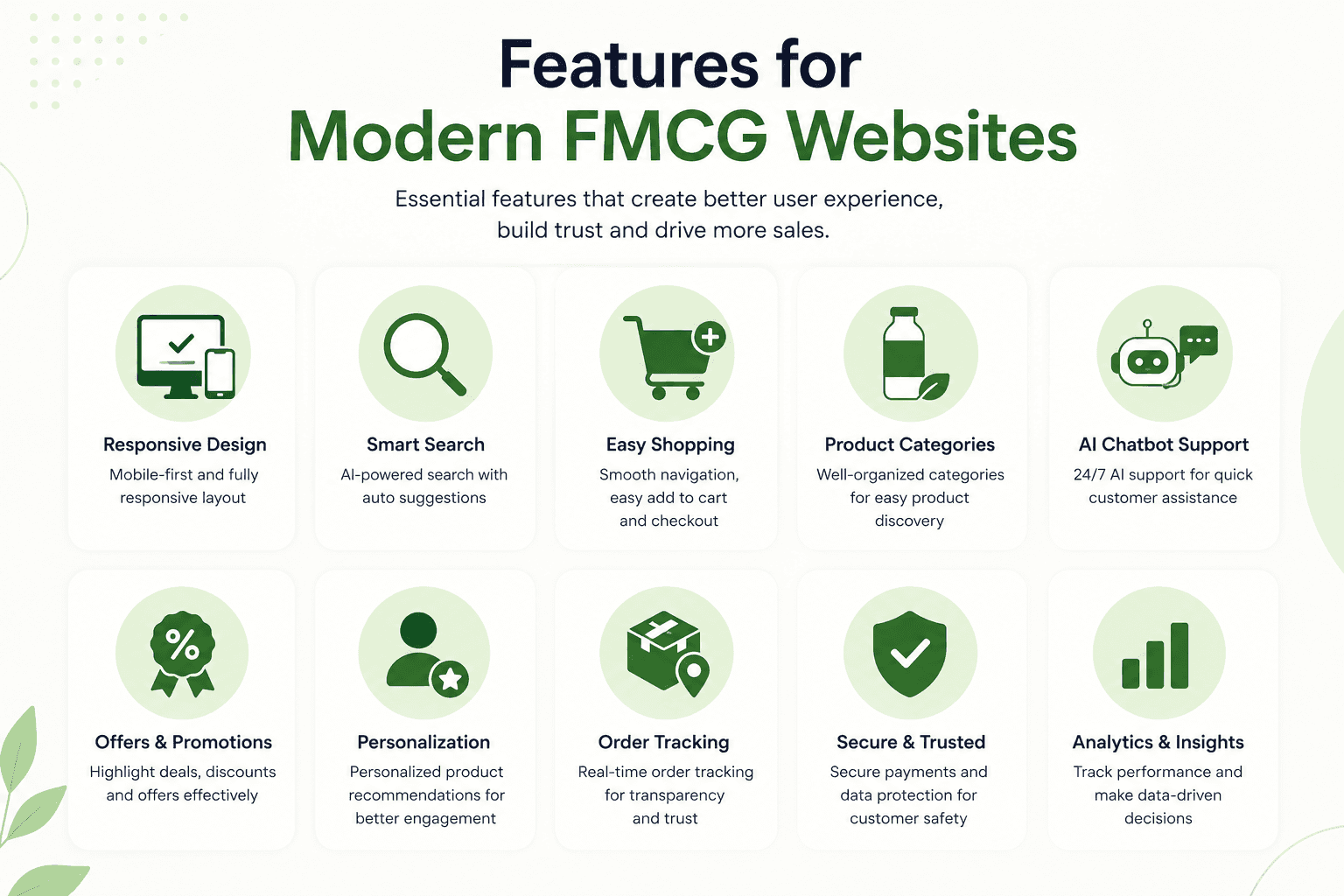
Beyond AI capabilities, certain features have become baseline requirements for any competitive FMCG website in 2026.
Fast-Loading Pages are non-negotiable. Google's Core Web Vitals standards penalize slow websites in search rankings, and consumer research consistently shows that 40% of users abandon a page that takes more than three seconds to load. Performance optimization — including image compression, lazy loading, CDN deployment, and code splitting — should be built into the development process, not added as an afterthought.
Mobile-First Design means designing the mobile experience first, then adapting for desktop — not the other way around. Given that over three-quarters of FMCG ecommerce traffic comes from mobile devices, this priority matters enormously for conversion rate performance.
One-Click Checkout dramatically reduces cart abandonment. Implementing saved payment methods, address auto-fill, and streamlined order confirmation should be a top development priority for any FMCG brand with repeat purchase potential.
Smart Search with Autocomplete needs to handle typos, partial queries, and descriptive phrases. For FMCG catalogues where customers often search by use case ("high protein snack for gym") rather than product name, semantic search capability is transformative.
Subscription Ordering is increasingly important across FMCG categories — from pet food to personal care to household cleaning products. A well-implemented subscription system builds predictable revenue and dramatically improves customer lifetime value.
Real-Time Inventory Display prevents the frustrating experience of completing checkout only to discover an item is out of stock. Live inventory information — including "only 3 left" urgency triggers — improves both customer experience and conversion rates.
Multi-Language and Multi-Currency Support is essential for any brand with regional or international ambitions. India's linguistic diversity alone — with major consumer markets across Hindi, Tamil, Telugu, Kannada, Bengali, and Marathi speaking regions — makes multi-language support a significant opportunity for FMCG brands.
Social Commerce Integration — connecting your website with Instagram, WhatsApp, and YouTube shopping features — extends your reach to where consumers already spend their digital time.
AI-Powered FMCG Website Design Trends in 2026
The frontier of FMCG website design in 2026 is defined by several converging trends that will shape platform investment decisions for the next three to five years.
Hyper-Personalized Shopping Journeys go beyond product recommendations to personalize every element of the shopping experience — navigation menus, homepage layout, content, promotional offers, and even price presentation — based on individual customer profiles. The most advanced FMCG platforms now generate essentially unique storefronts for every visitor.
AI Shopping Agents are perhaps the most transformative development in 2026. These autonomous AI systems can receive a brief from a customer ("get me everything I need for a week of healthy family meals under $150") and then browse, compare, add to cart, and check out on the customer's behalf. Leading FMCG platforms are integrating agent-ready APIs to capture this new commerce modality.
Conversational Commerce through embedded messaging interfaces — where the entire shopping journey happens within a chat conversation — is gaining traction especially in markets where WhatsApp and messaging apps dominate mobile time. Brands that can conduct complete transactions through conversational AI are seeing significant engagement from mobile-first customer segments.
Visual AI Search allows customers to photograph a product they've seen in a store, on social media, or in a friend's kitchen and instantly find it (or similar alternatives) on your website. This dramatically reduces search friction in categories where customers know what they want but not its name.
Augmented Reality Product Experiences let customers visualize products in their own environment before purchasing — particularly relevant for home care products, cooking ingredients displayed as prepared dishes, and personal care items with virtual try-on capabilities.
Predictive Ecommerce uses AI to anticipate purchases before customers initiate them, sending replenishment reminders at optimal timing, pre-populating carts with regular purchases, and making contextually timed promotional offers.
Sustainable Commerce Technology — carbon footprint calculators, sustainable packaging selection, ethical sourcing transparency features — is becoming a meaningful differentiator for FMCG brands targeting environmentally conscious consumer segments.
Cost Comparison – Traditional vs AI-Powered FMCG Websites
Factor | Traditional FMCG Website | AI-Powered FMCG Website |
|---|---|---|
Initial Design Cost | $5,000–$30,000 | $15,000–$750,000+ |
Development Complexity | Low to Medium | High to Very High |
Personalization | None or Rule-Based | Dynamic AI-Driven |
Search Capability | Keyword Matching | Semantic/Intent-Based |
Customer Support | Manual or Basic Bot | Conversational AI |
User Experience | Static and Uniform | Adaptive and Individual |
Customer Retention Tools | Email Campaigns | Predictive AI Intervention |
Analytics Depth | Basic Traffic Reports | Predictive Business Intelligence |
Automation Level | Minimal | High |
Operational Efficiency | Low | High |
Average Conversion Rate | 1.5–2.5% | 3.5–6%+ |
Long-Term ROI | Moderate | High to Very High |
Ongoing Maintenance Cost | Low | Medium to High |
Scalability | Limited | Highly Scalable |
The table makes the value proposition clear: AI-powered websites cost more to build, but they perform significantly better on every business metric that matters. The conversion rate difference alone — even at the conservative end — often justifies the additional investment within twelve to eighteen months.
Best Technologies for AI-Powered FMCG Website Development
Choosing the right technology foundation is as important as the budget conversation. Here's how the major options compare for FMCG use cases.
Shopify Plus is the leading choice for mid-market FMCG brands. Its ecosystem of AI-ready apps, headless commerce capabilities through the Hydrogen framework, strong international commerce features, and lower total cost of ownership make it excellent for brands doing $1M–$50M in annual online revenue. AI integrations are largely handled through best-in-class third-party apps.
Adobe Commerce (Magento) offers more flexibility and customization for complex catalogues and B2B requirements. Its enterprise feature set — tiered pricing, quote management, complex product configurations — makes it well-suited for FMCG brands with significant B2B sales. AI capabilities are increasingly native through Adobe's Sensei AI platform.
WooCommerce remains a viable option for smaller FMCG brands with WordPress-based marketing ecosystems. It's less suitable for high-volume AI-powered commerce due to performance limitations at scale.
Headless Commerce Frameworks — using platforms like Commerce.js, Medusa, or Vendure as the backend with React/Next.js on the frontend — offer maximum flexibility for brands with unique customer experience requirements. This approach is increasingly popular for FMCG brands that need their commerce platform to work seamlessly across website, app, kiosk, and emerging channels.
AI and ML Infrastructure typically involves a combination of OpenAI APIs for conversational features, Algolia or Elasticsearch for intelligent search, recommendation platforms like Nosto, Barilliance, or Dynamic Yield, and cloud-based ML infrastructure (AWS SageMaker, Google Vertex AI) for custom model development.
Cloud Infrastructure — AWS, Google Cloud, or Azure — provides the scalability, reliability, and AI service integration that modern FMCG platforms require. Infrastructure costs typically represent $1,000–$15,000 per month depending on traffic volume and AI compute requirements.
How to Reduce FMCG Website Development Costs
Not every FMCG brand needs a $500,000 website. Smart investment decisions can deliver meaningful AI capabilities at much lower cost. Here's how.
Start with an MVP Approach. Define the minimum viable product — the smallest set of features that delivers real business value — and launch that first. A well-built MVP lets you learn from real customer behavior before investing in advanced features. Many FMCG brands have launched successful platforms for $30,000–$50,000 by ruthlessly prioritizing core functionality.
Use SaaS Platforms Intelligently. Shopify Plus, BigCommerce, and similar platforms eliminate hundreds of thousands of dollars in core infrastructure development. Their ecosystems include high-quality AI apps that can be integrated for $100–$1,000 per month rather than built from scratch.
Adopt Modular AI Implementation. Rather than building all AI features at launch, implement them incrementally as revenue grows. Start with AI search and basic recommendations. Add conversational AI in phase two. Build custom predictive analytics in phase three. This approach spreads investment across time and aligns AI spend with demonstrated business value.
Choose Scalable Architecture from the Start. The most expensive mistake in FMCG website development is choosing a platform or architecture that can't scale, then rebuilding from scratch eighteen months later. Investing an additional $15,000–$30,000 in scalable architecture upfront saves $100,000+ in future rebuild costs.
Consider Offshore Development Partnerships. India has world-class ecommerce development talent at significantly lower rates than North American or Western European agencies. A well-vetted Indian development team can deliver the same technical quality at 40–60% lower cost. The key is rigorous vetting, clear specifications, and experienced project management.
Use Templates for Non-Differentiating Areas. Custom design investment should be focused on elements that create competitive differentiation — product pages, homepage, checkout flow. Administrative interfaces, account management pages, and order history sections can often use high-quality templates without compromising brand experience.
Choosing the Right FMCG Website Development Company
The development partner you choose has more impact on your website's success than almost any other decision. Here's what to evaluate.
Genuine FMCG Experience is non-negotiable. Building for fast-moving consumer goods involves domain-specific challenges — complex product variants, nutritional content management, regulatory compliance, high purchase frequency dynamics, and seasonal demand patterns — that generalist developers won't understand intuitively. Ask for specific FMCG case studies, not just ecommerce experience.
AI Implementation Capability should be demonstrated, not claimed. Ask potential partners to walk you through AI features they've built: recommendation engines, search systems, chatbot integrations. Request technical architecture documentation from previous AI projects. Generic statements about "leveraging cutting-edge AI" without specifics are a red flag.
Portfolio Quality and Business Results matter more than visual aesthetics. A well-designed website that didn't improve conversion rates is a failure regardless of how it looks. Ask for before-and-after performance metrics from previous clients. Good partners will be proud to share this data.
Post-Launch Support and Optimization capability is critical. AI-powered platforms require ongoing model training, performance monitoring, and optimization. Understand the partner's support structure, response time commitments, and approach to continuous improvement before signing any agreement.
SEO-Friendly Development Practices should be evident in technical implementation. Core Web Vitals optimization, semantic HTML structure, structured data markup, server-side rendering for critical pages — these aren't optional extras, they're baseline competencies for any development team building competitive FMCG platforms in 2026.
Transparency in Pricing and Process is a reliable proxy for overall partner quality. Partners who provide detailed project breakdowns, clear milestone definitions, and honest risk assessments are far more likely to deliver on time and budget than those who are vague about scope and cost.
ROI of AI-Powered FMCG Websites
The business case for AI-powered FMCG website investment is compelling when you look at the measurable outcomes.
Conversion Rate Improvement is typically the most immediate ROI driver. Industry data consistently shows AI-powered personalization, smart search, and streamlined checkout improving conversion rates by 30–80% compared to non-personalized alternatives. For a brand doing $1M in annual online revenue, even a 30% conversion rate improvement represents $300,000 in incremental annual revenue.
Average Order Value Increase from AI recommendations typically runs 15–35%. Customers exposed to intelligent "frequently bought together" and "you might also like" recommendations consistently purchase more per transaction than those browsing without recommendations.
Customer Retention Improvement from AI-powered churn prediction and intervention reduces customer acquisition cost significantly. Brands using predictive retention tools report 20–30% improvement in 12-month customer retention rates.
Customer Support Cost Reduction from conversational AI deployment is substantial. Handling 70–80% of routine queries automatically reduces support headcount requirements and improves response time for complex issues that genuinely require human attention.
Operational Efficiency from AI-powered inventory management, order routing, and supply chain optimization reduces working capital requirements and prevents both stockouts (which damage customer experience) and overstock situations (which erode margins).
Data-Driven Decision Making across marketing, merchandising, and product development improves with every month of AI operation. The insights generated by a well-instrumented AI commerce platform compound in value over time, creating a proprietary data advantage that competitors can't easily replicate.
A well-built AI-powered FMCG website typically achieves full ROI within 18–36 months at mid-market scale, with enterprise implementations often achieving payback within 12–18 months due to the greater baseline volume of transactions being optimized.
Future of AI-Powered FMCG Ecommerce
Looking ahead to 2027–2030, the trajectory of AI in FMCG ecommerce points toward even deeper automation and personalization.
Autonomous AI Shopping Agents will handle an increasing share of routine FMCG purchasing with minimal human involvement. Consumers will authorize AI agents to manage replenishment within defined parameters — budget limits, brand preferences, dietary requirements — and the agent will handle ordering, price comparison, and delivery scheduling autonomously.
Smart Retail Ecosystems will integrate physical store data, loyalty program data, online behavior data, and third-party data into unified customer intelligence platforms that power highly contextualized commerce experiences regardless of where the customer chooses to transact.
AI-Generated Storefront Personalization will extend beyond product and promotional personalization to include dynamically generated content — product descriptions tailored to individual customer values, AI-generated recipe content using products in the customer's cart, and personalized sustainability impact reports for eco-conscious consumers.
Predictive Commerce will evolve from reacting to customer intent to anticipating needs before they're expressed. AI systems will monitor household consumption patterns, dietary goals, upcoming occasions, and contextual signals to initiate commerce interactions at precisely the right moment with precisely the right product.
Hyperautomation will connect marketing, commerce, supply chain, and customer service workflows into self-optimizing systems that require minimal human intervention for routine operations — freeing marketing and operations teams to focus on strategy, creativity, and relationship-building.
For FMCG brands building platforms in 2026, the decisions made today about architecture, data strategy, and AI capability will determine competitive position for the entire decade. The brands that invest thoughtfully now will have structural advantages in data richness, model quality, and platform flexibility that will be extremely difficult for late movers to overcome.
Conclusion
The cost of building an AI-powered FMCG website in 2026 spans a wide range — from $8,000 for a lean small business platform to $750,000 or more for a full enterprise commerce ecosystem. But the real question isn't how much it costs; it's how much value it creates.
Every major force shaping FMCG commerce in 2026 — the shift to mobile, the demand for personalization, the rise of quick commerce, the expectation of seamless omnichannel experiences — points in the same direction: AI-powered digital infrastructure is not optional for brands that want to grow. It's the foundation.
For small FMCG brands, starting with a smart, scalable Shopify Plus or WooCommerce platform with best-in-class AI plugins delivers meaningful intelligence at accessible cost. For mid-sized brands, the investment in custom AI recommendation systems, intelligent search, and conversational commerce pays for itself through improved conversion rates and customer retention within 12–24 months. For enterprise players, the calculus is clear: the revenue impact of AI-optimized commerce at scale dwarfs the platform investment by an order of magnitude.
The FMCG brands that will lead digital commerce into 2030 are the ones making smart AI investments today — not because AI is fashionable, but because it delivers measurably better customer experiences and measurably stronger business results. The technology is proven. The ROI is documented. The competitive stakes are rising every quarter.
Build intelligently, invest strategically, and let AI do what it does best: turn every customer interaction into an opportunity to deliver genuine value.
Frequently Asked Questions
1. How much does an AI-powered FMCG website cost in 2026?
An AI-powered FMCG website costs between $8,000 and $750,000+ in 2026, depending on business size and the depth of AI features required. Small businesses should budget $8,000–$25,000, mid-sized brands $30,000–$100,000, and enterprise companies $150,000–$750,000 or more. Ongoing operational costs for AI model maintenance, cloud infrastructure, and platform subscriptions typically add 20–30% of initial development cost annually.
2. What AI features are most important for FMCG websites?
The highest-impact AI features for FMCG websites are: personalized product recommendations (typically drives 15–35% higher average order value), AI-powered search with semantic understanding (improves conversion from search by 20–40%), conversational AI chatbots for customer support (reduces support costs by 60–80%), and predictive analytics for customer retention (improves 12-month retention by 20–30%). Prioritize these four before investing in more advanced capabilities like dynamic pricing or voice commerce.
3. Is AI ecommerce worth the investment for FMCG brands?
Yes, for most FMCG brands doing over $200,000 in annual online revenue. AI-powered FMCG websites consistently deliver 30–80% higher conversion rates, 15–35% higher average order values, and significantly improved customer retention compared to non-AI platforms. Most mid-market implementations achieve full ROI within 18–36 months. The competitive risk of not investing — ceding ground to AI-enabled competitors — strengthens the investment case further.
4. What platform is best for FMCG ecommerce in 2026?
For most FMCG brands, Shopify Plus offers the best balance of capability, flexibility, and total cost of ownership. It supports headless commerce, has an extensive AI app ecosystem, and handles everything from small catalogues to enterprise volumes. Brands with complex B2B requirements should evaluate Adobe Commerce. Brands with highly unique experience requirements should consider headless commerce with Medusa or Commerce.js as the backend engine.
5. How does AI improve customer experience on FMCG websites?
AI improves FMCG customer experience by making the shopping journey relevant and efficient. Personalization means every visitor sees products, promotions, and content matched to their preferences and history. Smart search understands what customers mean, not just what they type. Conversational AI resolves queries instantly without waiting for human support agents. Predictive reordering reminds customers when they're likely running low on regular purchases. Together, these features reduce friction and increase the likelihood that customers find what they need and return regularly.
6. What is headless commerce, and does my FMCG brand need it?
Headless commerce separates the customer-facing frontend (what shoppers see and interact with) from the backend commerce engine (inventory, orders, pricing, customer data). This separation allows brands to deliver their commerce experience through any channel — website, mobile app, smart display, voice device, or third-party platform — from a single backend system. FMCG brands with omnichannel ambitions, custom experience requirements, or plans to expand into new commerce channels should strongly consider headless architecture. It adds 30–50% to initial development cost but provides flexibility that traditional coupled architectures can't deliver.
7. Can small FMCG businesses use AI-powered websites?
Absolutely. Small FMCG businesses can access meaningful AI capabilities through SaaS platforms and third-party plugins at very reasonable cost. A Shopify store with Nosto for recommendations, Tidio for AI chat, and Searchpie for intelligent search delivers genuinely sophisticated AI personalization for $200–$500 per month in software subscriptions plus a one-time setup investment of $8,000–$15,000. The ROI from even basic AI personalization is well-documented for small ecommerce operations.
8. How long does FMCG website development take?
Development timelines vary significantly by scope. A small FMCG website on Shopify with basic AI integrations takes 6–12 weeks. A mid-sized custom platform with AI recommendation systems and CRM integration typically requires 4–6 months. Enterprise platforms with deep ERP integration, custom AI development, and omnichannel capabilities usually require 8–18 months from requirements definition to full launch. Rushing development to hit an arbitrary launch date is one of the most common causes of FMCG website underperformance — adequate testing and optimization time is essential.
9. What technologies are used in AI-powered FMCG ecommerce?
The core technology stack for AI-powered FMCG websites in 2026 typically includes a commerce platform (Shopify Plus, Adobe Commerce, or headless), a frontend framework (React/Next.js for performance and flexibility), an AI recommendation engine (Nosto, Dynamic Yield, or custom-built), an intelligent search system (Algolia, Elasticsearch with AI extensions), a conversational AI platform (OpenAI API-based or Intercom/Zendesk AI), a cloud infrastructure provider (AWS, Google Cloud, Azure), and a customer data platform (CDP) for unifying customer intelligence across touchpoints.
10. What is the ROI of AI ecommerce websites for FMCG brands?
AI-powered FMCG websites deliver ROI through multiple simultaneous value streams. Conversion rate improvements of 30–80% increase revenue from existing traffic. Average order value increases of 15–35% from AI recommendations improve revenue per transaction. Customer retention improvements of 20–30% reduce acquisition cost dependency. Support automation reduces operational costs by 60–80% for handled queries. Most mid-market FMCG brands achieve full payback on their AI website investment within 18–36 months, with enterprise implementations often achieving payback in 12–18 months due to higher baseline transaction volumes.
11. What is the difference between B2B and B2C FMCG website development costs?
B2B FMCG websites are typically more expensive than B2C platforms due to greater functional complexity. B2B features — tiered pricing structures, account-specific catalogues, credit management, bulk ordering workflows, quote management, and approval chains — add $20,000–$80,000 to a project budget beyond standard ecommerce functionality. AI applications in B2B FMCG are also different: dynamic pricing, predictive reordering based on historical account patterns, and AI-powered sales assistance tools take precedence over consumer-facing personalization features.
12. How do I choose an FMCG website development company?
Evaluate potential development partners on five criteria: documented FMCG-specific experience (not just generic ecommerce), demonstrated AI implementation capability with specific examples, portfolio results measured in conversion rates and revenue impact (not just visual design), post-launch support and optimization processes, and transparent project pricing with detailed scope breakdowns. Request client references specifically for FMCG projects and ask those clients about post-launch performance improvements, not just the development process.